
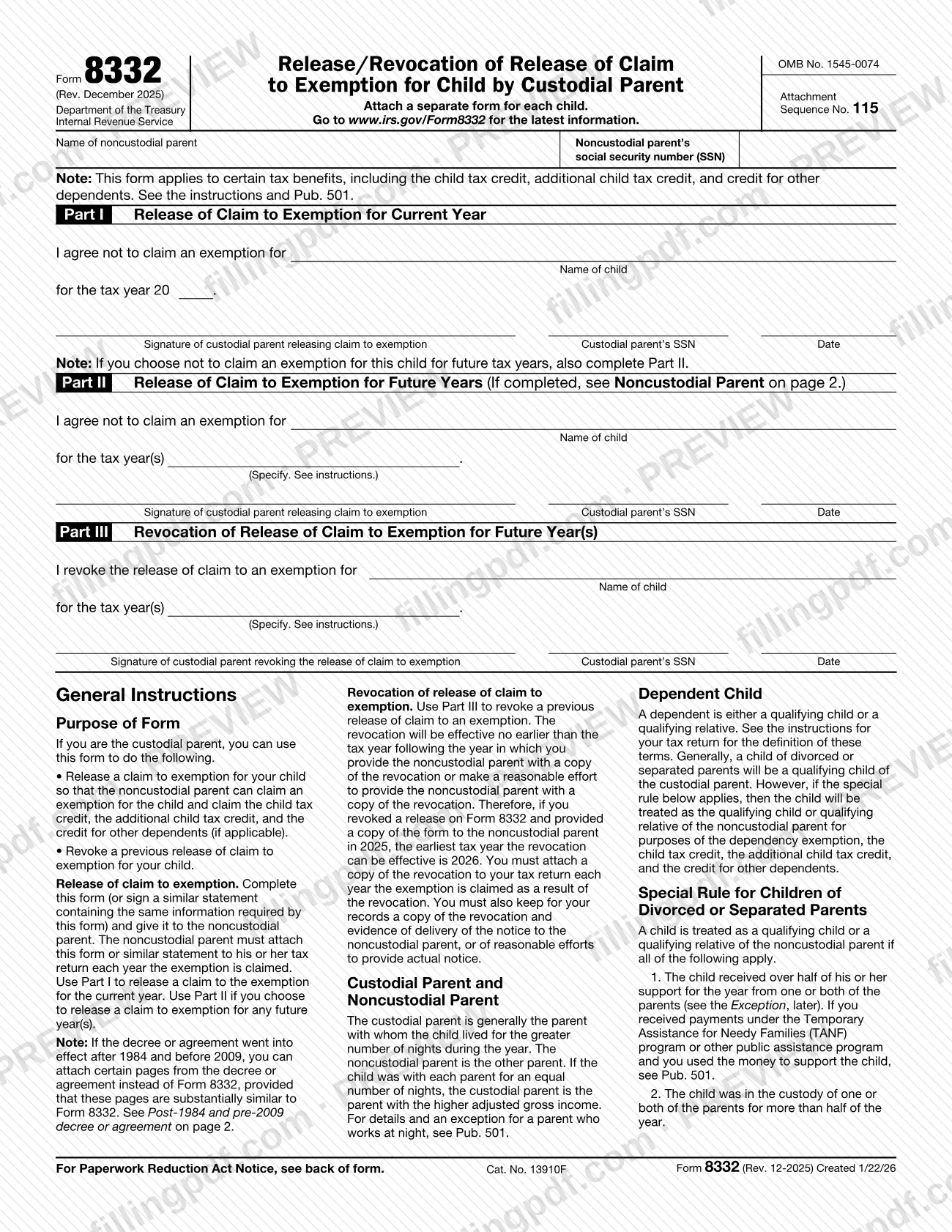
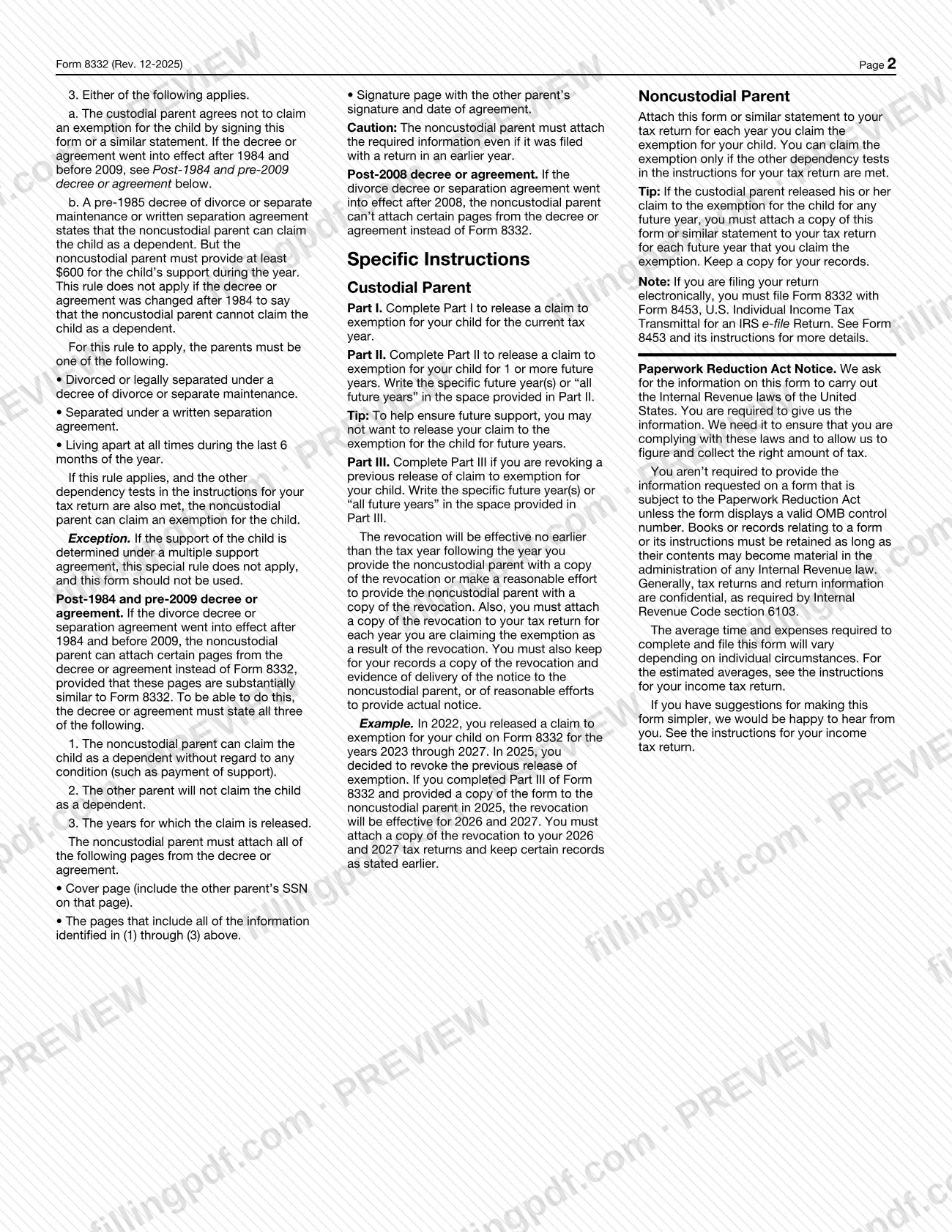
Form 8332, Release/Revocation of Release of Claim to Exemption for Child by Custodial Parent, is the Internal Revenue Service (IRS) form a custodial parent signs so that the noncustodial parent can claim an exemption for the child, or to take back an earlier release. It applies to certain tax benefits, including the child tax credit, the additional child tax credit and the credit for other dependents. On this page you can fill out Form 8332 online on FillingPDF and download or print the completed PDF; the official PDF and the latest information are published by the IRS at www.irs.gov/Form8332.
Last updated
What is Form 8332?
Form 8332, Release/Revocation of Release of Claim to Exemption for Child by Custodial Parent, is the IRS form on which a custodial parent agrees not to claim an exemption for a child, so the noncustodial parent can claim it, or revokes an earlier release of that claim.
The form has three parts:
- Part I, Release of Claim to Exemption for Current Year.
- Part II, Release of Claim to Exemption for Future Years.
- Part III, Revocation of Release of Claim to Exemption for Future Year(s).
The form applies to certain tax benefits, including the child tax credit, the additional child tax credit and the credit for other dependents; the IRS points to Pub. 501 and the instructions for your tax return for details. A separate form is attached for each child.
The IRS does not receive the form on its own. The custodial parent signs it and gives it to the noncustodial parent, who attaches it, or a similar statement containing the same information, to his or her tax return each year the exemption is claimed. The release does not by itself settle the claim: the noncustodial parent can claim the exemption only if the other dependency tests in the instructions for the tax return are met.
If a divorce decree or separation agreement went into effect after 1984 and before 2009, certain pages of it can replace Form 8332, provided they are substantially similar to the form.
Who needs to file Form 8332?
The custodial parent uses Form 8332 to release, or to revoke the release of, a claim to an exemption for a child. The custodial parent is generally the parent with whom the child lived for the greater number of nights during the year; the noncustodial parent is the other parent. If the child was with each parent for an equal number of nights, the custodial parent is the one with the higher adjusted gross income. Pub. 501 gives details and an exception for a parent who works at night.
The noncustodial parent receives the signed form and attaches it to his or her return each year the exemption is claimed.
The special rule for children of divorced or separated parents applies only if all of these are true:
- The child received over half of his or her support from one or both parents, and was in the custody of one or both parents for more than half of the year.
- The custodial parent agrees not to claim the exemption by signing this form or a similar statement (or, for a pre-1985 decree or agreement, the decree states the noncustodial parent can claim the child).
- The parents are divorced or legally separated under a decree, separated under a written separation agreement, or lived apart at all times during the last 6 months of the year.
Do not use this form if the child's support is determined under a multiple support agreement.
When to file Form 8332
Complete Form 8332 when the custodial parent decides to release a claim to the exemption, or to revoke an earlier release. Use Part I for the current tax year and Part II for one or more future years.
The form sets no due date of its own. The noncustodial parent must attach it, or a similar statement, to his or her return for each year the exemption is claimed, even if it was attached to a return in an earlier year.
A revocation in Part III is effective no earlier than the tax year following the year you give the noncustodial parent a copy of the revocation or make a reasonable effort to do so. The IRS example: if you provided the copy in 2025, the earliest tax year the revocation can be effective is 2026.
Documents you need
- Form 8332 itself, or a similar signed statement containing the same information, attached by the noncustodial parent to his or her tax return for each year the exemption is claimed.
- Form 8453, U.S. Individual Income Tax Transmittal for an IRS e-file Return, filed with Form 8332 only if the return is filed electronically.
- For a decree or agreement that went into effect after 1984 and before 2009: the cover page of the decree or agreement, including the other parent's SSN, in place of Form 8332.
- For that same decree or agreement: the pages that show the noncustodial parent can claim the child without conditions, the other parent will not claim the child, and the years of the release.
- For that same decree or agreement: the signature page with the other parent's signature and the date of the agreement.
- A copy of a Part III revocation, attached to the custodial parent's return for each year the exemption is claimed as a result of the revocation.
- For your records, not for filing: a copy of the revocation and evidence that the noncustodial parent was given the notice, or that reasonable efforts were made.
How to fill out Form 8332
Decide which part you need
Use Part I to release the claim for the current year, Part II for future years, or Part III to revoke an earlier release. Complete a separate form for each child.
Enter the noncustodial parent's details
At the top, write the Name of noncustodial parent and the noncustodial parent's social security number (SSN).
Complete Part I for the current year
After "I agree not to claim an exemption for," enter the child's name and the tax year (20__). The custodial parent then signs, enters the custodial parent's SSN and dates it.
Complete Part II for future years
If you also release future years, enter the child's name and write the specific year(s) or "all future years" in the space provided. Sign, enter the custodial parent's SSN and date.
Complete Part III to revoke a release
After "I revoke the release of claim to an exemption for," enter the child's name and the specific year(s) or "all future years." The custodial parent signs, enters the SSN and dates it.
Check the signatures and dates
Each part you complete has its own signature of the custodial parent, custodial parent's SSN and date. Leave unused parts blank.
Review, download and share the form
Check names, years and SSNs, then download or print the completed PDF from FillingPDF. Give it to the noncustodial parent, or for a revocation provide a copy and keep proof of delivery, as described under How to submit.
How to submit Form 8332
Form 8332 is not filed with the IRS by itself. It travels with a tax return, and the channel depends on who holds it.
- Release (Parts I and II): the custodial parent signs the form and gives it to the noncustodial parent. The noncustodial parent attaches it, or a similar statement, to his or her tax return for each year the exemption is claimed.
- Revocation (Part III): the custodial parent gives the noncustodial parent a copy of the revocation, or makes a reasonable effort to do so, and attaches a copy to his or her own tax return for each year the exemption is claimed as a result of the revocation. Keep a copy and evidence of delivery, or of the reasonable efforts to give notice.
- E-filing: if the return is filed electronically, Form 8332 must be filed with Form 8453, U.S. Individual Income Tax Transmittal for an IRS e-file Return. See Form 8453 and its instructions.
The form prints no mailing address; follow the filing instructions for the tax return it is attached to. FillingPDF lets you fill out and download the PDF; submission follows the channels above.
Common mistakes to avoid
- Using one form for several children; the form says to attach a separate Form 8332 for each child.
- Completing Part II or Part III without writing the specific year(s) or "all future years" in the space provided.
- Expecting a Part III revocation to apply right away; it is effective no earlier than the tax year after the year the noncustodial parent gets the copy.
- Not keeping a copy of the revocation and evidence of delivery, or of reasonable efforts to give actual notice, to the noncustodial parent.
- Assuming the noncustodial parent can skip the attachment because it was filed in an earlier year; it must be attached with the return each year the exemption is claimed.
- Attaching pages of a divorce decree or separation agreement that went into effect after 2008 instead of Form 8332; those pages are not accepted in place of the form.
- Using Form 8332 when support of the child is determined under a multiple support agreement; the special rule does not apply.
- Filing electronically without sending Form 8332 with Form 8453, U.S. Individual Income Tax Transmittal for an IRS e-file Return.
- Leaving out the custodial parent's signature, SSN or date in the part being completed.
Frequently asked questions
What is Form 8332 used for?
Form 8332 lets a custodial parent release a claim to an exemption for a child so the noncustodial parent can claim it, or revoke a previous release. It applies to certain tax benefits, including the child tax credit, additional child tax credit and credit for other dependents.
Who signs Form 8332?
The custodial parent signs, in each part completed, and enters his or her SSN and the date. The noncustodial parent does not sign; he or she receives the form and attaches it to his or her own tax return.
Do I send Form 8332 to the IRS?
Not separately. The custodial parent gives it to the noncustodial parent, who attaches it to his or her tax return each year the exemption is claimed. If the return is e-filed, Form 8332 must be filed with Form 8453.
How do I revoke a release on Form 8332?
Complete Part III, naming the child and the year(s) or "all future years," then give the noncustodial parent a copy or make a reasonable effort to. It takes effect no earlier than the following tax year, and you attach a copy to your return each year you claim the exemption.
Can I use Form 8332 to release a claim for future years?
Yes. Complete Part II and write the specific future year(s) or "all future years" in the space provided. The noncustodial parent must still attach the form to his or her return for each year the exemption is claimed.
Do I need a separate Form 8332 for each child?
Yes. The form says to attach a separate form for each child, with the child's name entered in the part you complete.
Can a divorce decree replace Form 8332?
Only if the decree or agreement went into effect after 1984 and before 2009 and the pages are substantially similar to the form. For a decree or agreement after 2008, the noncustodial parent cannot attach pages instead of Form 8332.
Can I fill out Form 8332 online on FillingPDF?
Yes, you can fill out the PDF online on FillingPDF and download or print it. FillingPDF is independent of the IRS and does not file the form or any tax return; you give it to the noncustodial parent as the form describes.
Ready to fill out Form 8332?
Fill out Form 8332 now