
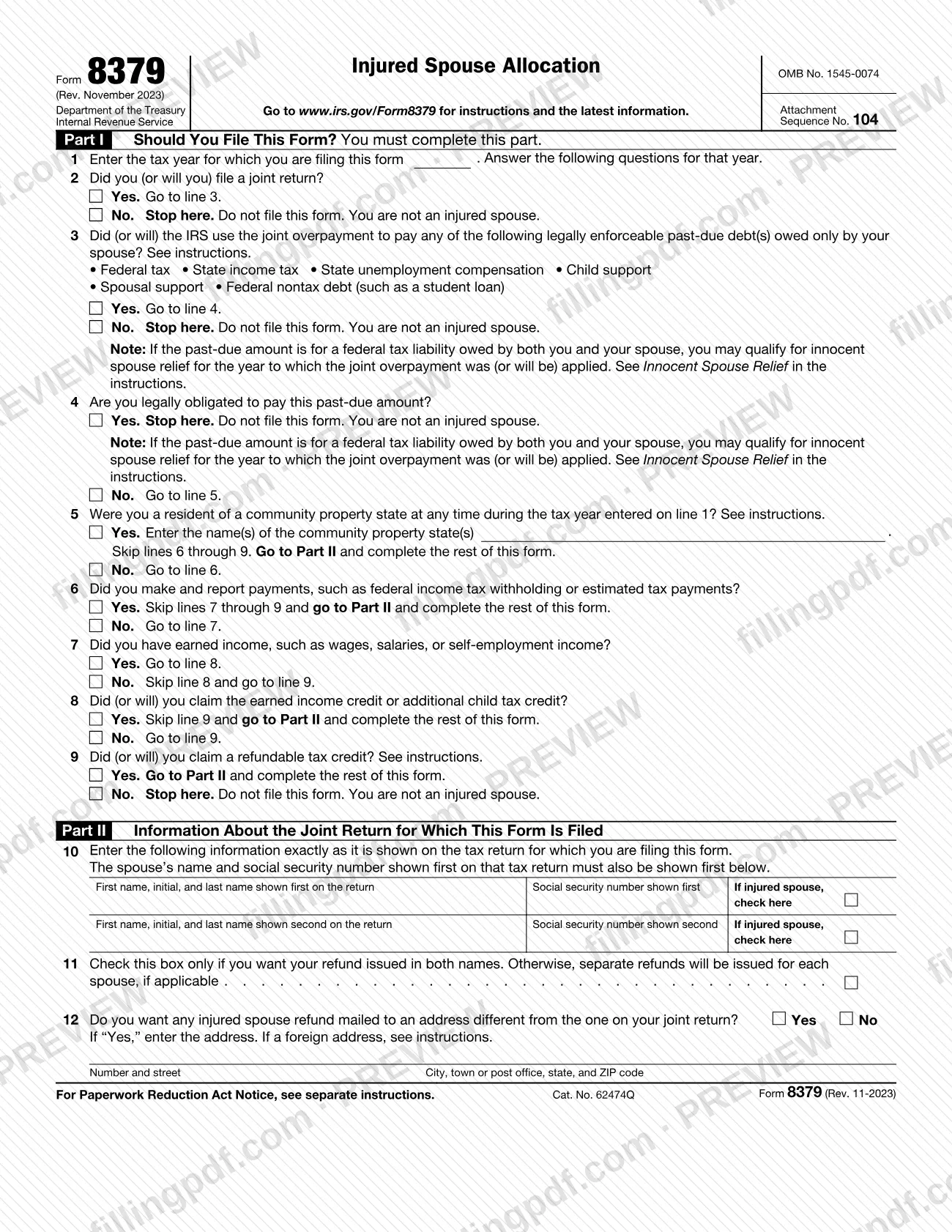
Form 8379, Injured Spouse Allocation, is the Internal Revenue Service (IRS) form that one spouse files on a joint return to get back their share of the joint refund when it is applied to a past-due debt owed only by the other spouse. Part I walks you through a short series of questions that tells you whether you are an injured spouse at all. On this page you can fill out Form 8379 online on FillingPDF and download or print the completed PDF; the form and its instructions are published by the IRS at www.irs.gov/Form8379.
Last updated
What is Form 8379?
Form 8379, Injured Spouse Allocation, is the IRS form an injured spouse files on a joint return to recover their share of the joint refund when the overpayment is applied (offset) to the other spouse's past-due obligation.
The form is filed by one spouse, the injured spouse, on a jointly filed return. The overpayment may be offset against legally enforceable past-due federal tax, state income tax, state unemployment compensation, child support, spousal support, or a federal nontax debt such as a student loan. By filing, the injured spouse may be able to get back their share of the joint refund.
The form has four parts:
- Part I (lines 1 to 9) is a set of questions that decides whether you should file at all.
- Part II (lines 10 to 12) identifies the joint return, the refund names and the refund address.
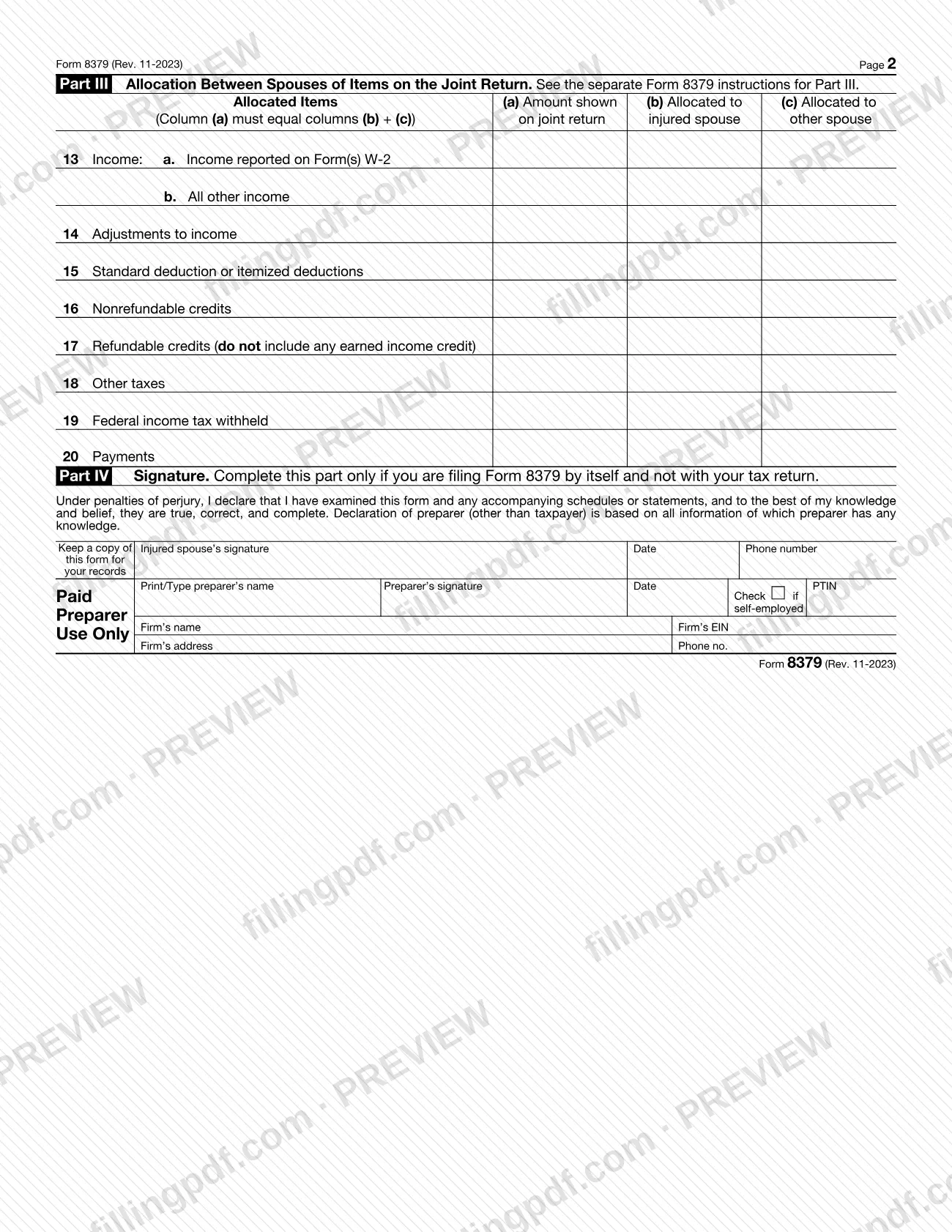
- Part III (lines 13 to 20) allocates income, deductions, credits, taxes and payments between the spouses, as if each had filed a separate return.
- Part IV is the signature block, completed only when the form is filed by itself.
Form 8379 is not a claim for innocent spouse relief. The IRS instructions say that if you are claiming innocent spouse relief you file Form 8857 instead; Pub. 971 gives more detail. A Notice of Offset for federal tax debts comes from the IRS, while notices for state income tax, state unemployment compensation, child support and federal nontax debts come from the U.S. Treasury Department's Bureau of the Fiscal Service.
Who needs to file Form 8379?
You may be an injured spouse if you file a joint return and all or part of your portion of the overpayment was, or is expected to be, applied to your spouse's legally enforceable past-due federal tax, state income tax, state unemployment compensation, child support, spousal support, or a federal nontax debt such as a student loan. Part I of the form tests each condition in turn.
Do not file Form 8379, because the form says you are not an injured spouse, if:
- you did not (and will not) file a joint return (line 2);
- the IRS will not use the joint overpayment to pay one of the listed past-due debts owed only by your spouse (line 3);
- you are legally obligated to pay the past-due amount (line 4); or
- you answer "No" through lines 5 to 9 without meeting any of the conditions that send you to Part II.
If the past-due amount is a federal tax liability owed by both of you, the form points to innocent spouse relief, which is requested on Form 8857, not Form 8379.
Filing Form 8379 when no past-due obligation exists will delay your refund. To check whether a debt other than federal tax is owed and whether an offset will occur, the instructions give the Bureau of the Fiscal Service number, 800-304-3107 (TTY/TDD 866-297-0517).
When to file Form 8379
File Form 8379 when you become aware that all or part of your share of an overpayment was, or is expected to be, applied against your spouse's legally enforceable past-due obligations. You must file it for each year you meet that condition and want your portion of the offset refunded.
The deadline is within 3 years from the due date of the original return (including extensions) or within 2 years from the date you paid the tax that was later offset, whichever is later. Certain circumstances described in section 6511 may extend this period.
You can file with your original joint return, with an amended joint return (Form 1040-X), or afterward by itself. File with Form 1040-X only if you are amending to claim a joint refund. If you file Form 1040-X for an additional refund and do not want your portion offset, complete and attach another Form 8379 for that additional refund.
Generally, processing takes about 14 weeks when the form is filed with a paper joint return (11 weeks if filed electronically), and about 8 weeks when it is filed by itself after the joint return has been processed. Processing errors can add time.
Documents you need
- Copies of all Forms W-2 and W-2G for both spouses: attach them only if you file Form 8379 by itself rather than with your joint return.
- Any Forms 1099 showing federal income tax withheld: attach them only if you file Form 8379 by itself.
- Form 8822, Change of Address: submit it with Form 8379 only if the refund address on line 12 is a permanent change; if your last return was joint, your spouse must also sign it unless you check the line 1 box for a separate residence.
How to fill out Form 8379
Check the tax year and joint return
On line 1, enter the tax year for which you are filing and answer all questions for that year. On line 2, check Yes if you did or will file a joint return; if No, stop, because you are not an injured spouse.
Answer the debt questions
Line 3 asks whether the IRS used or will use the joint overpayment for past-due debt owed only by your spouse. Line 4 asks whether you are legally obligated to pay it; answering Yes to line 4 means you stop and do not file.
Answer the community property question
On line 5, check Yes if you lived in a community property state at any time during the year and enter the state name(s). The instructions list Arizona, California, Idaho, Louisiana, Nevada, New Mexico, Texas, Washington and Wisconsin.
Complete lines 6 through 9
If you answered No to line 5, answer line 6 (payments you made and reported), line 7 (earned income), line 8 (earned income credit or additional child tax credit) and line 9 (refundable tax credit) as the form directs. Follow the Go to and Stop arrows exactly.
Enter both spouses' return information
On line 10, enter names and Social Security numbers exactly as shown on the joint return, with the spouse shown first on the return shown first. Check the box next to the injured spouse.
Choose refund names and address
On line 11, check the box only if you want the refund issued in both names; otherwise separate refunds are issued for each spouse, if applicable. On line 12, check Yes or No and, if Yes, enter the address; foreign addresses follow the instructions, with no abbreviation of the country name.
Allocate income on lines 13a and 13b
In column (a), enter the W-2 income (line 13a) and all other income (line 13b) shown on the joint return. In columns (b) and (c), enter each spouse's separate amounts so that column (a) equals (b) plus (c).
Allocate adjustments and deductions
Line 14 is adjustments to income and line 15 is the standard or itemized deduction. Allocate each to the spouse who would have claimed it on a separate return, following the instructions for line 15 if you used the standard deduction.
Allocate credits, taxes, withholding and payments
Complete lines 16 (nonrefundable credits), 17 (refundable credits, excluding earned income credit), 18 (other taxes), 19 (federal income tax withheld) and 20 (payments). Enter the joint-return amount in column (a) and each spouse's share in columns (b) and (c).
Sign if filing by itself
Complete Part IV only if you file Form 8379 by itself and not with your tax return: the injured spouse signs and dates it and adds a phone number. A paid preparer completes the preparer block.
Review, download and assemble
Check every line against the joint return and confirm that each allocation adds up. Download or print the completed PDF from FillingPDF, add any attachments, and mail it as described under How to submit.
How to submit Form 8379
You mail Form 8379 to an IRS Service Center, either with your joint return or by itself. The form itself names no other channel.
- With your joint return: attach it to the return in the order of the attachment sequence number in the upper right corner of the form (104), and enter "Injured Spouse" in the upper left corner of page 1 of the joint return. Mail to the Internal Revenue Service Center for the area where you live.
- By itself after a paper joint return: mail to the same Service Center where you filed your original return.
- By itself after an electronically filed joint return, or with Form 1040-X or another later return: mail to the Internal Revenue Service Center for the area where you live.
Service Center mailing addresses are in your tax return instructions and at IRS.gov/Filing/Where-to-File-Paper-Tax-Returns-With-or-Without-a-Payment. Taxpayer Assistance Centers are not Service Centers, and you cannot make an appointment at an Internal Revenue Service Center to file Form 8379.
If you file by itself, attach copies of all Forms W-2 and W-2G for both spouses and any Forms 1099 showing federal income tax withheld. Do not attach a copy of your joint return. Keep a copy of the form for your records. FillingPDF lets you fill out and download the PDF; submission follows the channels above.
Common mistakes to avoid
- Attaching a copy of your previously filed joint return when filing Form 8379 by itself; the instructions say this can delay processing.
- Filing by itself without copies of Forms W-2 and W-2G for both spouses and any Forms 1099 showing withholding, which may delay processing.
- Filing Form 8379 when no past-due obligation exists or the debt is not subject to offset; this delays your refund.
- Forgetting to write "Injured Spouse" in the upper left corner of page 1 of the joint return when Form 8379 is filed with it.
- Entering the spouses' names and Social Security numbers on line 10 in a different order than on the joint return; the spouse shown first on the return must be shown first.
- Allocating an item to the wrong spouse; each item goes to the spouse who would have entered it on a separate return.
- Allocating amounts so that column (a) does not equal columns (b) plus (c) on lines 13 through 20.
- Claiming innocent spouse relief on Form 8379; the instructions say to file Form 8857 instead.
- Skipping Part IV signature when filing the form by itself, or completing it unnecessarily when filing with your tax return.
Frequently asked questions
What is Form 8379 used for?
Form 8379, Injured Spouse Allocation, is filed by one spouse on a joint return to get back their share of the joint refund when it was, or is expected to be, applied (offset) to a past-due obligation of the other spouse, such as child support or a student loan.
Who is an injured spouse?
You may be one if you file a joint return and all or part of your portion of the overpayment is applied to your spouse's legally enforceable past-due debt. You are not an injured spouse if you did not file jointly or if you are legally obligated to pay the debt. Part I of the form tests this.
What is the difference between an injured spouse and innocent spouse relief?
Form 8379 recovers your share of a refund taken for a debt owed only by your spouse. Innocent spouse relief is for relief from joint tax liability and is requested on Form 8857, not Form 8379. The IRS instructions say not to file Form 8379 if you are claiming innocent spouse relief.
How long do I have to file Form 8379?
Within 3 years from the due date of the original return (including extensions) or within 2 years from the date you paid the tax that was later offset, whichever is later. Section 6511 circumstances may extend this. You file for each year you meet the condition.
Where do I mail Form 8379?
Mail it to the Internal Revenue Service Center for the area where you live when filed with your joint return. If filed by itself after a paper joint return, use the same Service Center where you filed that return. Addresses are in your tax return instructions.
Can I file Form 8379 by itself?
Yes. You can file it with your joint return or Form 1040-X, or afterward by itself. When filed by itself, attach copies of Forms W-2 and W-2G for both spouses and any Forms 1099 showing withholding, and do not attach a copy of your joint return. Complete Part IV.
How long does it take to process Form 8379?
Generally about 14 weeks when filed with a paper joint return (11 weeks if filed electronically), and about 8 weeks when filed by itself after the joint return was processed. Processing errors can add time. A daytime phone number may help speed processing.
Can I fill out Form 8379 online?
You can fill out the PDF online on FillingPDF and download or print it. FillingPDF is an independent service and does not file the form with the IRS; you mail it through the channels the IRS instructions describe.
Ready to fill out Form 8379?
Fill out Form 8379 now