
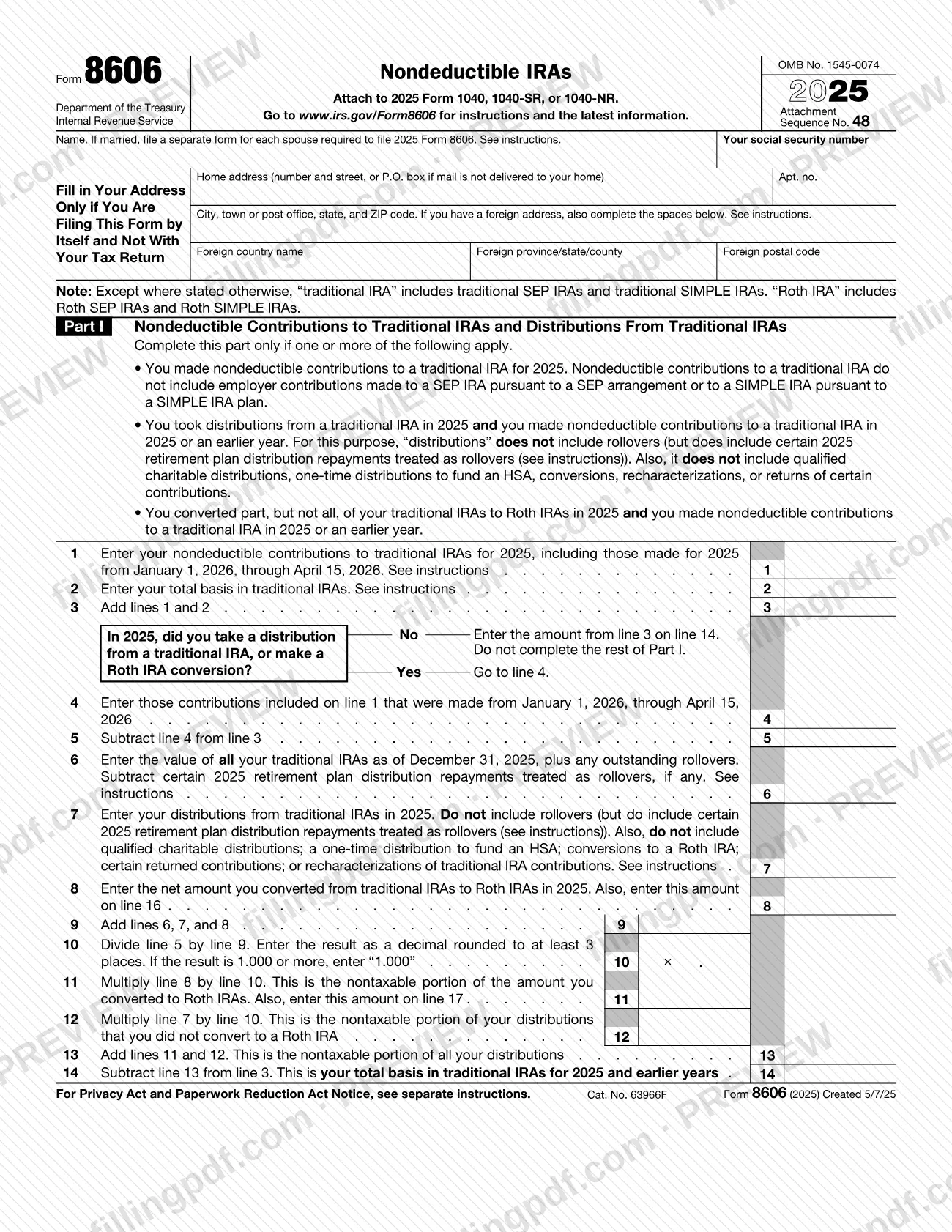
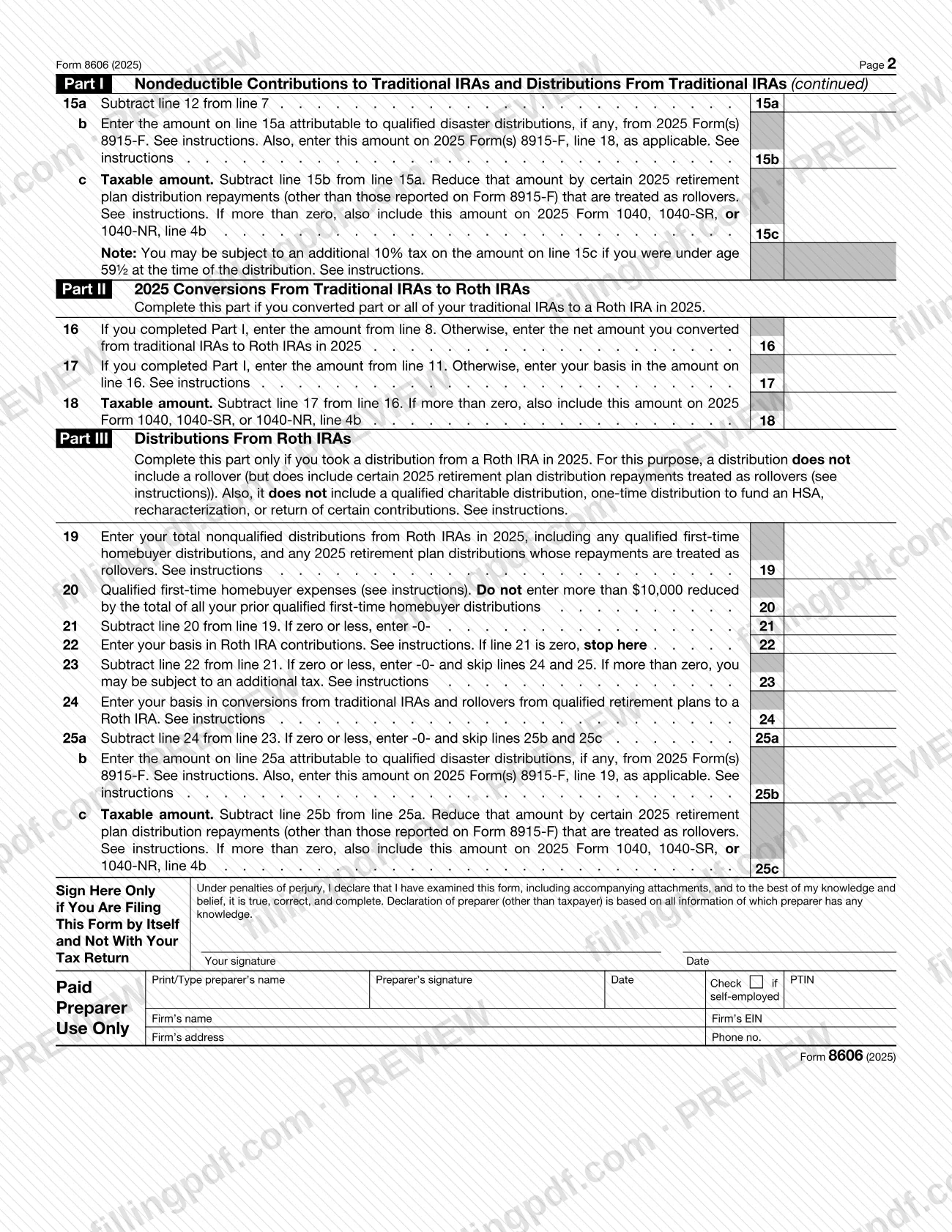
Form 8606, Nondeductible IRAs, is the Internal Revenue Service (IRS) form that tracks the after-tax money in your IRAs: nondeductible contributions to traditional IRAs, the nontaxable part of traditional IRA distributions, conversions to Roth IRAs and Roth IRA distributions. You attach it to your 2025 Form 1040, 1040-SR or 1040-NR, and a separate form is needed for each spouse who must file one. On this page you can fill out the form online on FillingPDF and download or print the completed PDF; the original form and its instructions are published by the IRS at www.irs.gov/Form8606.
Last updated
What is 8606?
Form 8606, Nondeductible IRAs, is the Internal Revenue Service (IRS) form used to report nondeductible contributions to traditional IRAs, distributions from traditional IRAs when you have basis, conversions from traditional IRAs to Roth IRAs, and distributions from Roth IRAs.
The form has three parts. Part I (lines 1 to 15c) covers nondeductible contributions and traditional IRA distributions: it builds your total basis, works out the nontaxable share of what you took out, and ends with the taxable amount. Part II (lines 16 to 18) covers 2025 conversions from traditional IRAs to Roth IRAs. Part III (lines 19 to 25c) covers Roth IRA distributions and figures the taxable part, if any.
Basis is the key idea. The IRS instructions define your basis in traditional IRAs as your nondeductible contributions plus nontaxable amounts rolled into those IRAs, minus your nontaxable distributions. You keep track of it year after year so you can figure the nontaxable part of future distributions; line 14 of one year's form feeds line 2 of the next.
On this form, "traditional IRA" includes traditional SEP IRAs and traditional SIMPLE IRAs, and "Roth IRA" includes Roth SEP IRAs and Roth SIMPLE IRAs. Nondeductible contributions do not include employer contributions to a SEP IRA or a SIMPLE IRA.
The form is issued under OMB No. 1545-0074 (Attachment Sequence No. 48). It is not a tax return: it is attached to Form 1040, 1040-SR or 1040-NR. The IRS points to Publication 590-A, Publication 590-B and Publication 560 for more detail on IRAs.
Who needs to file 8606?
You must file 2025 Form 8606 if any of these applies, according to the IRS instructions:
- You made nondeductible contributions to a traditional IRA for 2025.
- You received distributions from a traditional IRA in 2025 and your basis in those IRAs is more than zero.
- You converted an amount from a traditional IRA to a Roth IRA in 2025.
- You received distributions from a Roth IRA in 2025, other than a rollover, recharacterization or return of certain contributions.
- You or your spouse transferred a traditional IRA under a divorce or separation agreement and the transfer changed the basis of either spouse's IRA.
- You received a distribution from an inherited traditional IRA that has a basis, or from an inherited Roth IRA that was not a qualified distribution.
You do not need the form if your only 2025 distributions were qualified birth or adoption, emergency personal expense, domestic abuse or terminal illness distributions that you repaid in full in 2025. You also do not file it solely to report regular contributions to Roth IRAs. If you took traditional IRA distributions and never made nondeductible contributions, the distributions go on your Form 1040 or 1040-NR instead.
If both spouses must file, each completes a separate Form 8606. If you must file for IRAs inherited from more than one decedent, file a separate form for each decedent's IRA.
When to file 8606
File the 2025 Form 8606 with your 2025 Form 1040, 1040-SR or 1040-NR by the due date of that return, including extensions. If you are not required to file an income tax return but must file Form 8606, you sign it and send it to the IRS at the same time and place you would otherwise file your Form 1040, 1040-SR or 1040-NR.
The IRS instructions give Wednesday, April 15, 2026 as the due date for making 2025 IRA contributions for most people. Line 1 includes contributions made for 2025 from January 1, 2026, through April 15, 2026.
After you file, you can change a nondeductible contribution to a deductible one, or the reverse, within the time limit for filing Form 1040-X. In that case you complete a new Form 8606 and file it with Form 1040-X. If you are required to file Form 8606 for a nondeductible contribution and do not, a penalty applies unless you show reasonable cause.
Documents you need
- Form 1040, 1040-SR or 1040-NR for 2025: Form 8606 is attached to it, unless you are not required to file a return and send the signed form by itself.
- A statement explaining the recharacterization, if you recharacterized an IRA contribution (traditional to Roth or Roth to traditional) and still report part of it on the form.
- A statement explaining the distribution, if you had a 2025 contribution returned with related earnings by the due date of your return; the contribution and distribution are not reported on Form 8606.
- A statement explaining the basis adjustment, if a divorce or separation transfer changed the basis of an IRA: include the character of the amounts and the other spouse's name and SSN.
- A statement explaining the distribution, if you withdrew excess traditional IRA contributions from earlier years that qualify as nontaxable under the instructions.
- Form 1040-X with a newly completed Form 8606, if you are amending a previously filed Form 8606.
How to fill out 8606
Enter your name and SSN
At the top of page 1, enter your name and Social Security number. If you file a joint return, enter only the name and SSN of the spouse whose information is reported on this form.
Add your address if filing alone
Complete the address block only if you are filing this form by itself and not with your tax return. Use a P.O. box only if mail is not delivered to your home, and fill in the foreign address spaces if you have a foreign address.
Complete lines 1 through 3
Line 1: your nondeductible contributions to traditional IRAs for 2025, including those made from January 1, 2026, through April 15, 2026. Line 2: your total basis in traditional IRAs, generally -0- in your first year, otherwise from the Total Basis Chart. Line 3: add lines 1 and 2.
Answer the distribution or conversion question
If you took no traditional IRA distribution and made no Roth IRA conversion in 2025, check No, enter the line 3 amount on line 14 and skip the rest of Part I. If you did, check Yes and go to line 4.
Complete lines 4 and 5
Line 4: the contributions on line 1 that were made from January 1, 2026, through April 15, 2026. Line 5: subtract line 4 from line 3.
Enter values and distributions on lines 6 to 9
Line 6: the value of all traditional IRAs as of December 31, 2025, plus outstanding rollovers. Line 7: your 2025 traditional IRA distributions, excluding the items the line lists. Line 8: the net amount converted to Roth IRAs, also entered on line 16. Line 9: add lines 6, 7 and 8.
Figure the nontaxable share, lines 10 to 14
Line 10: divide line 5 by line 9 as a decimal rounded to at least 3 places, entering 1.000 if it is 1.000 or more. Multiply line 8 by line 10 for line 11 (also enter it on line 17) and line 7 by line 10 for line 12. Add lines 11 and 12 on line 13, then subtract line 13 from line 3 on line 14.
Find the taxable amount, lines 15a to 15c
Line 15a: subtract line 12 from line 7. Line 15b: the part attributable to qualified disaster distributions from Form(s) 8915-F, if any. Line 15c: the taxable amount; if more than zero, also include it on line 4b of Form 1040, 1040-SR or 1040-NR.
Complete Part II for Roth conversions
Line 16: the amount from line 8 if you completed Part I, otherwise the net amount converted in 2025. Line 17: the amount from line 11, otherwise your basis in line 16. Line 18: subtract line 17 from line 16; if more than zero, include it on line 4b of your return.
Complete Part III for Roth IRA distributions
Complete this part only if you took a distribution from a Roth IRA in 2025. Enter total nonqualified distributions on line 19 and qualified first-time homebuyer expenses on line 20, then subtract line 20 from line 19 on line 21 (enter -0- if zero or less).
Figure Roth basis and the taxable amount
Line 22: your basis in Roth IRA contributions; if line 21 is zero, stop. Line 23: subtract line 22 from line 21. Line 24: your basis in conversions and rollovers. Lines 25a to 25c: subtract line 24 from line 23, remove qualified disaster distributions on 25b, and enter the taxable amount on 25c.
Sign if filing by itself
Sign and date the form only if you are filing it by itself and not with your tax return. A paid preparer, if any, completes the preparer block.
Review and download the completed PDF
Check that each line you completed carries the right amounts forward, such as line 8 to line 16 and line 14 into next year's line 2. Download or print the completed PDF from FillingPDF and attach it to your return as described under How to submit.
How to submit 8606
Form 8606 has no filing channel of its own when it goes with your return: you attach it to your 2025 Form 1040, 1040-SR or 1040-NR and it travels with that return. Details:
- With your tax return: attach the completed form to the return and submit both by the channel and to the address that apply to your return.
- By itself: if you are not required to file a return, sign and send Form 8606 to the IRS at the same time and place you would file Form 1040, 1040-SR or 1040-NR. Put your address on page 1 and your signature and date on page 2.
- Amended filings: a new Form 8606 showing the revised information is filed with Form 1040-X, Amended U.S. Individual Income Tax Return.
The form and its instructions give no separate mailing address, portal or appointment rule. Instructions and the latest information are at www.irs.gov/Form8606. FillingPDF lets you fill out and download the PDF; submission follows the channels above.
Common mistakes to avoid
- Entering employer contributions to a SEP IRA or a SIMPLE IRA on line 1; the instructions say they are not nondeductible contributions.
- Reporting on Form 8606 a contribution you had returned to you, with related earnings, by the due date of your return; those are treated as never contributed.
- Including rollovers, conversions, recharacterizations, qualified charitable distributions or a one-time HSA funding distribution on line 7.
- Entering a result above 1.000 on line 10; the form says to enter "1.000" if the division comes to 1.000 or more.
- Using the wrong value on line 6: it is the value of all traditional IRAs as of December 31, 2025, plus any outstanding rollovers.
- Filing one form for both spouses; each spouse who must file needs a separate Form 8606, and on a joint return you enter only the name and SSN of the spouse whose information is reported.
- Not carrying a taxable amount from line 15c, 18 or 25c to line 4b of Form 1040, 1040-SR or 1040-NR when it is more than zero.
- Filing the form by itself without your address on page 1 or without your signature and date on page 2.
- Skipping the form when it is required: a penalty applies for not filing, and another for overstating nondeductible contributions, unless you show reasonable cause.
Frequently asked questions
What is Form 8606 used for?
Form 8606 reports nondeductible contributions to traditional IRAs, distributions from traditional IRAs if you have basis, conversions from traditional IRAs to Roth IRAs, and distributions from Roth IRAs. It tracks your after-tax basis so the nontaxable part of later distributions can be figured.
Do I have to file Form 8606 for 2025?
Yes, if you made nondeductible contributions to a traditional IRA for 2025, converted traditional IRA money to a Roth IRA, or took distributions from a traditional IRA with basis or from a Roth IRA. You do not file it solely to report regular Roth IRA contributions.
When is Form 8606 due?
With your 2025 Form 1040, 1040-SR or 1040-NR, by the due date of that return including extensions. If you do not have to file a return but must file Form 8606, you send it signed to the IRS at the same time and place you would file your return.
Can I file Form 8606 without a tax return?
Yes, if you are not required to file an income tax return but are required to file Form 8606. Sign and date it, put your address on page 1, and send it where you would otherwise file Form 1040, 1040-SR or 1040-NR.
What do I enter on line 2 of Form 8606?
Line 2 is your total basis in traditional IRAs. Generally enter -0- if this is the first year you must file the form; otherwise use the Total Basis Chart in the instructions, which usually points to line 14 of your last Form 8606. Divorce transfers and returned excess contributions can change it.
What is the penalty for not filing Form 8606?
If you must file Form 8606 to report a nondeductible traditional IRA contribution for 2025 and do not, a penalty applies unless you show reasonable cause. A separate penalty applies if you overstate your nondeductible contributions. See the IRS instructions for the current amounts.
Do married couples file one Form 8606 together?
No. If both spouses must file 2025 Form 8606, each files a separate form. On a joint return you enter only the name and SSN of the spouse whose IRA information is on that form.
Can I fill out Form 8606 online on FillingPDF?
Yes. You can fill out the fillable PDF online on FillingPDF and download or print it. FillingPDF is an independent service and does not file the form with the IRS; you attach it to your return or send it through the IRS channels.
Ready to fill out 8606?
Fill out 8606 now