
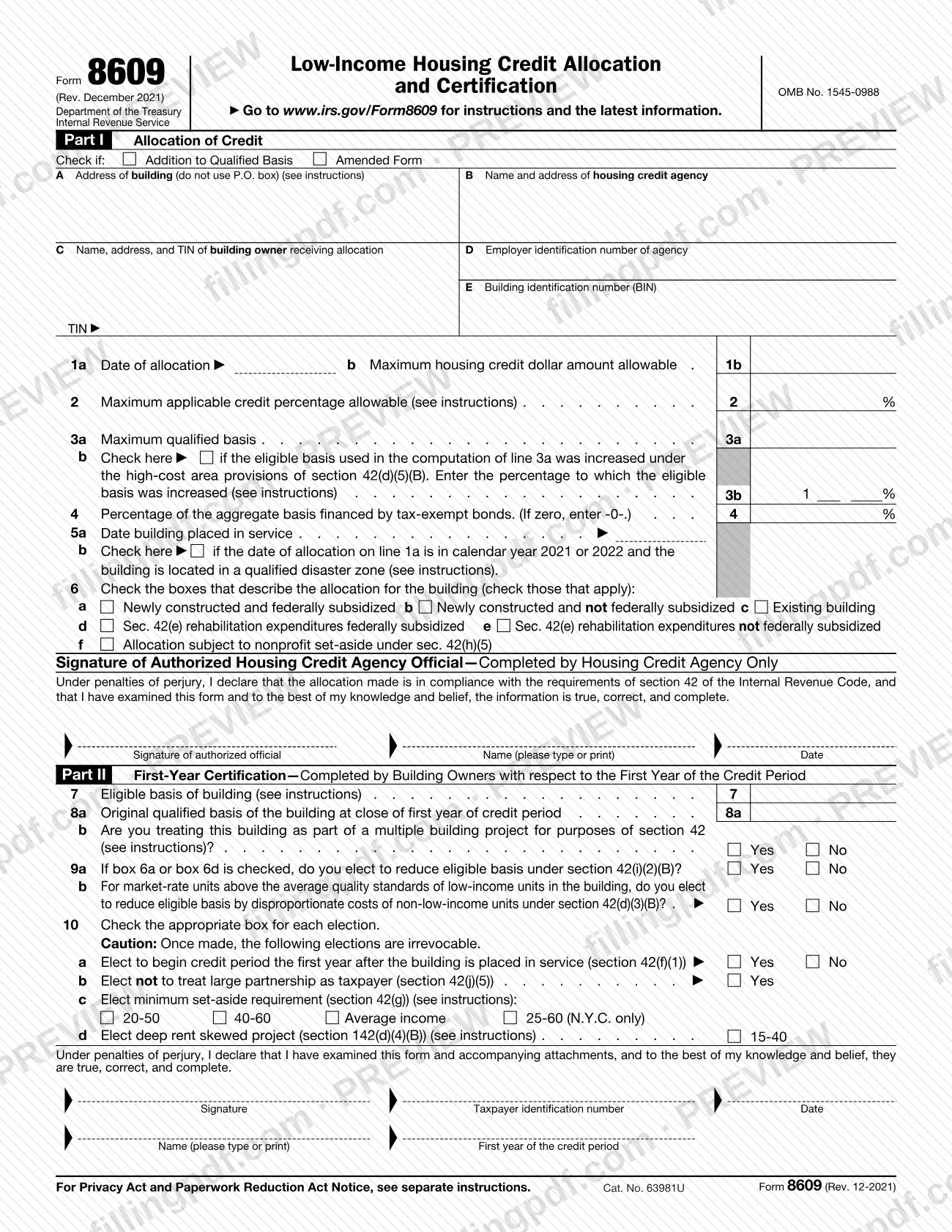
Form 8609, Low-Income Housing Credit Allocation and Certification, is the Internal Revenue Service (IRS) form that records a housing credit agency's allocation of the low-income housing credit to a building and the owner's first-year certification. The agency completes and signs Part I; the building owner completes Part II for the first year of the credit period. On this page you can fill out the form online on FillingPDF and download or print the completed PDF. The IRS publishes the form and its instructions at www.irs.gov/Form8609.
Last updated
What is Form 8609?
Form 8609, Low-Income Housing Credit Allocation and Certification, is the IRS form a housing credit agency uses to allocate the low-income housing credit to a qualified residential rental building, and on which the building owner certifies first-year information about that building.
Owners of residential low-income rental buildings are allowed the credit for each qualified building annually over a 10-year credit period. Part I, "Allocation of Credit," is completed by the housing credit agency, which is a state or local agency authorized to make allocations within its jurisdiction. Part II, "First-Year Certification," is completed by the owner for the first year of the credit period and covers eligible basis, qualified basis, multiple building projects and the owner's elections.
A separate Form 8609 is issued for each building in a multiple building project. Allocations made in separate calendar years need separate forms, and so do separate allocations for acquisition of an existing building and for rehabilitation expenditures. Each building carries a building identification number (BIN) assigned by the agency.
Form 8609 works with other IRS forms. The agency submits a copy with Form 8610, Annual Low-Income Housing Credit Agencies Report. The owner files Form 8609-A, Annual Statement for Low-Income Housing Credit, for each year of the 15-year compliance period, and claims the credit on Form 8586, Low-Income Housing Credit.
Who needs to file Form 8609?
Two groups complete this form, each in its own part.
- Housing credit agencies. A state or local agency authorized to make low-income housing credit allocations completes and signs Part I. It can allocate only to a building located within its geographical jurisdiction.
- Building owners. The owner of a qualified low-income building completes Part II for the first year of the credit period. By completing Part II, the owner certifies that the placed-in-service date on line 5a is correct.
Buildings financed with tax-exempt bonds are a special case. No allocation is required for the portion of eligible basis financed with qualifying tax-exempt bonds, and none is needed when 50% or more of the aggregate basis of the building and its land is so financed. The owner must still obtain a Form 8609 from the housing credit agency, with the applicable items completed and a BIN assigned.
Agencies should not issue Form 8609 for acquisition of an existing building unless substantial rehabilitation under section 42(e) is placed in service. The agency may also require the owner to send it a copy of Form 8609 with Part II completed.
When to file Form 8609
The housing credit agency must generally make the allocation by the close of the calendar year in which the building is placed in service. The instructions list exceptions: an advance binding commitment made by that date, an allocation for an increase in qualified basis, a carryover allocation for a building placed in service within the stated period, and an allocation for a multiple building project made during the project period. Temporary extensions apply to certain buildings in qualified disaster zones.
The owner makes a one-time submission of the original form to the IRS. File it no later than the due date, including extensions, of the first tax return with which you file Form 8609-A.
The minimum set-aside election on line 10c must be met by the close of the first year of the credit period to claim any credit for that year or later years. If the allocation amount changes before the close of the calendar year, the agency files an amended Form 8609 instead of a new original. Owners keep their records for 3 years after the due date, with extensions, of the return for the tax year that includes the end of the 15-year compliance period.
Documents you need
- Original, signed Form 8609 received from the housing credit agency: the owner files it with the IRS after making a copy, with Part II completed.
- Statement attached to Form 8609 when you answer Yes on line 8b: project and building names and addresses, each building's BIN, the aggregate credit dollar amount, and the credit allocated to each building.
- Copy of Form 8609 with Part II completed, only if the housing credit agency requires one for its own filing requirements.
How to fill out Form 8609
Mark addition or amended form
At the top of Part I, check Addition to Qualified Basis if the allocation relates to an increase in qualified basis; enter only the credit amount for the increase. Check Amended Form if this form amends a previously issued one, complete all entries and explain the reason.
Identify the building, agency and owner
Enter the building address in item A (no P.O. box; add a note such as BLDG. 6 of 8 when several buildings share an address), the agency's name and address in item B, the owner's name, address and TIN in item C, the agency's EIN in item D and the BIN in item E.
Enter the allocation date and amount
Line 1a is the date the agency completes, signs and dates the form; leave it blank if 50% or more of the building is financed by tax-exempt bonds. Line 1b is the annual credit dollar amount, equal to line 2 multiplied by line 3a.
Enter the credit percentage
On line 2, enter the maximum applicable credit percentage for the month the building was placed in service. Follow the instructions for the 4% and 9% minimums, which depend on the date placed in service and whether the building is federally subsidized.
Enter qualified basis and any increase
Line 3a is the maximum qualified basis. On line 3b, check the box if eligible basis was increased for a high-cost area and enter the percentage, for example 120.
Enter the tax-exempt bond percentage
On line 4, enter the percentage of the aggregate basis of the building and land financed by tax-exempt bonds. Enter -0- if zero; do not leave it blank.
Enter the placed-in-service date
Line 5a is the date the first unit is ready and available for occupancy under state or local law. Check line 5b only if the line 1a date is in 2021 or 2022 and the building is in a qualified disaster zone.
Check the allocation type boxes
On line 6, check every box that describes the allocation, 6a through 6f. Boxes 6a and 6d are required for federally subsidized buildings.
Have the agency official sign Part I
An authorized official of the housing credit agency signs, types or prints a name, and dates the declaration. Part I is completed by the agency only.
Enter eligible and qualified basis
The owner enters eligible basis on line 7, excluding land cost and applying any increased percentage from line 3b. On line 8a, multiply line 7 by the smaller of the unit fraction or the floor space fraction.
Answer the multiple building question
On line 8b, check Yes or No on treating the building as part of a multiple building project. If Yes, attach the required statement with project and building names, BINs and credit amounts.
Make the eligible basis elections
On line 9a, elect Yes or No to reduce eligible basis by tax-exempt obligation proceeds if box 6a or 6d is checked. On line 9b, elect Yes or No to reduce basis for market-rate units above average quality.
Make the line 10 elections
Check the box for each election: 10a credit period start, 10b large partnership, 10c minimum set-aside (20-50, 40-60, Average income or 25-60 for N.Y.C.) and 10d deep rent skewed 15-40. These are irrevocable.
Sign, review and download the PDF
The owner signs, enters the TIN, date, printed name and the first year of the credit period. Check every line, then download or print the completed PDF from FillingPDF and send it as described under How to submit.
How to submit Form 8609
Form 8609 moves by mail between three parties: the housing credit agency, the building owner and the IRS.
- Housing credit agency: complete and sign Part I and make copies. Submit a copy with Form 8610 and keep a copy for the agency's records. Send the original, signed Form 8609, including its instructions, to the building owner.
- Building owner, to the IRS: make a copy of the completed original, then file the original with the Low-Income Housing Credit (LIHC) Unit at: Department of the Treasury, Internal Revenue Service Center, Philadelphia, PA 19255-0549.
- Building owner, to the agency: the agency may require a copy of Form 8609 with Part II completed, so contact it for its filing requirements. The copy should match the Part II filed with the IRS.
Do not send the form to the Tax Forms and Publications address in the instructions; that address is only for comments on the form. The instructions give no online filing channel and no fee. FillingPDF lets you fill out and download the PDF; submission follows the channels above.
Common mistakes to avoid
- Entering a P.O. box as the address of the building in item A; the form says not to use one.
- Leaving line 4 blank when no tax-exempt bonds finance the building; the instructions say to enter -0-.
- Answering Yes on line 8b without attaching the required statement; each building is then treated as a separate project.
- Entering a credit percentage on line 2 below the 4% or 9% minimum that applies to the building, unless the agency determines a lesser amount is necessary for project feasibility.
- Failing to check box 6a or 6d for a federally subsidized building, even if the owner has not told the agency about a section 42(i)(2)(B) election.
- Including the cost of land in eligible basis on line 7.
- Assuming the line 10 elections can be changed later; the form states they are irrevocable.
- Completing Part II when the date on line 5a is wrong or missing, instead of getting a new or amended Form 8609 from the agency.
- Filling in line 1a when 50% or more of the building is financed by tax-exempt bonds; the instructions say to leave it blank.
Frequently asked questions
What is Form 8609 used for?
Form 8609 is the IRS form for allocating the low-income housing credit to a qualified building and certifying first-year information. The housing credit agency completes Part I, and the building owner completes Part II for the first year of the credit period.
Who fills out Form 8609, the agency or the owner?
Both do, in different parts. The housing credit agency completes and signs Part I, the allocation. The building owner completes Part II, the first-year certification, and signs it. The agency sends the original signed form to the owner.
Do I need a separate Form 8609 for each building?
Yes. A separate Form 8609 must be issued for each building in a multiple building project. Allocations made in separate calendar years, and separate allocations for acquisition and for rehabilitation of the same building, also need separate forms.
Where do I mail Form 8609 to the IRS?
The building owner sends the original, after making a copy, to the Department of the Treasury, Internal Revenue Service Center, Philadelphia, PA 19255-0549. It is a one-time submission to the Low-Income Housing Credit Unit.
When does the owner have to file Form 8609?
No later than the due date, including extensions, of the first tax return with which you file Form 8609-A. The agency generally must make the allocation by the close of the calendar year in which the building is placed in service, subject to listed exceptions.
Can I change the elections on line 10 later?
No. The form states that the elections on line 10 are irrevocable once made, and the instructions repeat this for lines 10a, 10b, 10c and 10d. Decide carefully before signing Part II.
What is the difference between Form 8609 and Form 8609-A?
Form 8609 is the one-time allocation and first-year certification for a building. Form 8609-A, Annual Statement for Low-Income Housing Credit, is filed for each year of the 15-year compliance period, and the credit is claimed on Form 8586.
Can I fill out Form 8609 online on FillingPDF?
Yes. You can fill out the fillable PDF online on FillingPDF and download or print it. FillingPDF is an independent service and does not file the form; you send it to the agency or the IRS through their channels.
Ready to fill out Form 8609?
Fill out Form 8609 now