
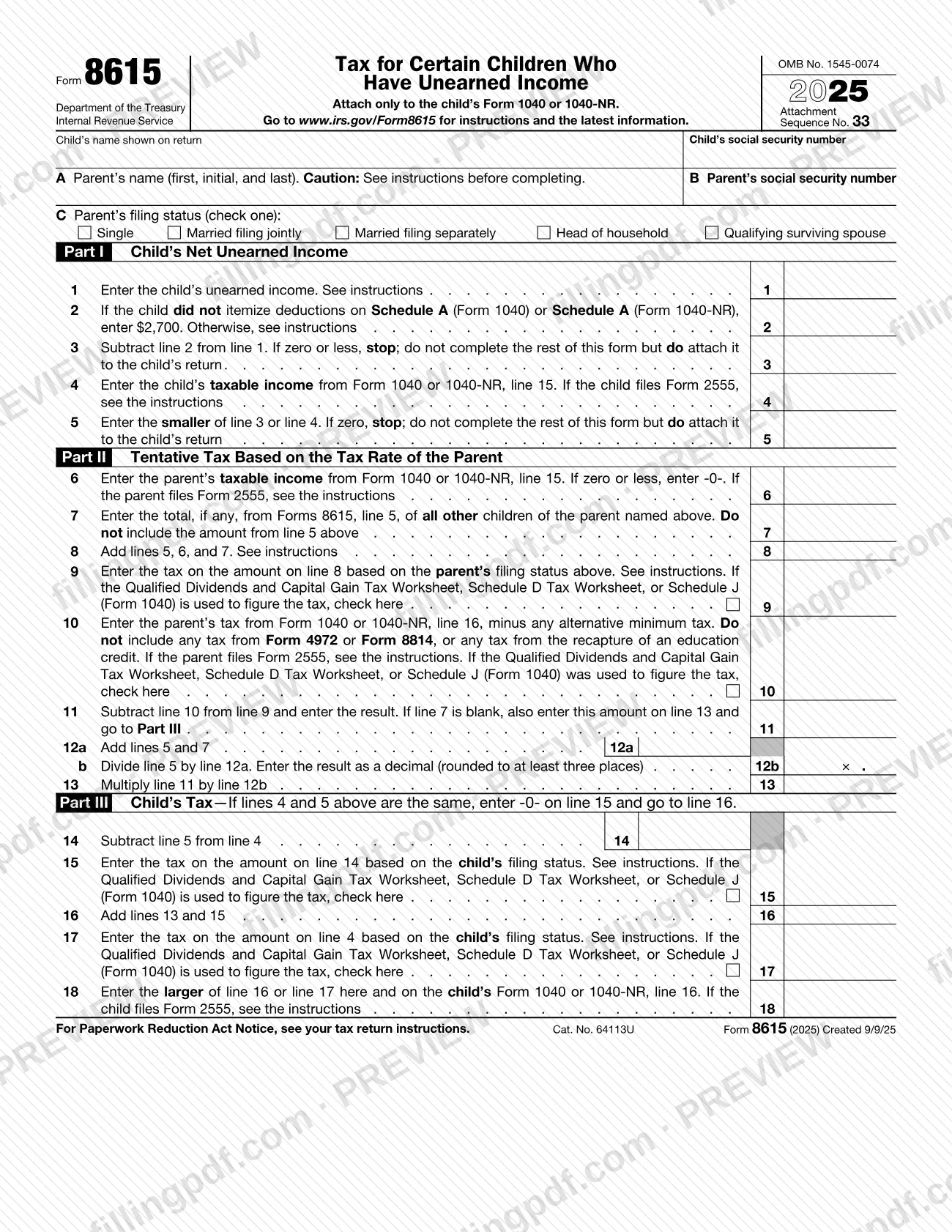
Form 8615, Tax for Certain Children Who Have Unearned Income, is the Internal Revenue Service (IRS) form that figures a child's tax when the child's unearned income is taxed at the parent's rate because that rate is higher than the child's. It is attached only to the child's Form 1040 or 1040-NR and uses figures from a parent's return. On FillingPDF you can fill out Form 8615 online and download or print the completed PDF; the form and its instructions are published by the IRS at www.irs.gov/Form8615.
Last updated
What is Form 8615?
Form 8615, Tax for Certain Children Who Have Unearned Income, is the IRS form used to figure the tax of a child whose unearned income is above the amount printed on line 2, by taxing that income at the parent's tax rate when the parent's rate is higher than the child's.
The form has three parts. Part I (lines 1 to 5) finds the child's net unearned income. Part II (lines 6 to 13) builds a tentative tax from the parent's taxable income and tax, and from the net unearned income of the parent's other children, if any; line 12b splits that tentative tax among the children by their share. Part III (lines 14 to 18) figures the child's tax on the rest of the child's income and compares it with the tax on all of the child's taxable income. The larger result goes on line 18 and on line 16 of the child's Form 1040 or 1040-NR.
Unearned income is generally all income other than pay for work actually performed. The instructions list taxable interest, dividends, capital gains, rents, royalties, pension and annuity income, unemployment compensation and the taxable part of social security, among others.
Form 8615 is not the only route: the instructions note that a parent may elect to report the child's interest, ordinary dividends and capital gain distributions on the parent's own return using Form 8814, Parents' Election To Report Child's Interest and Dividends. In that case the child does not file a return or Form 8615.
Who needs to file Form 8615?
A child must file Form 8615 when all five conditions in the IRS instructions are met:
- The child had more than the line 2 amount of unearned income.
- The child is required to file a tax return.
- The child was under age 18 at the end of 2025; or was age 18 and did not have earned income of more than half of the child's own support; or was a full-time student at least age 19 and under age 24 and did not have earned income of more than half of the child's support.
- At least one of the child's parents was alive at the end of 2025.
- The child does not file a joint return for 2025.
"Child" includes a legally adopted child and a stepchild, and the rules apply whether or not the child is a dependent. They do not apply if neither parent was living at the end of the year.
Do not use Form 8615 for a child born on January 1, 2002, who is treated as age 24 at the end of 2025. A child born January 1, 2008 is treated as age 18 and a child born January 1, 2007 as age 19, so the support and full-time student tests above decide those cases.
A child's legal representative may request the parent's tax information from the IRS for the child, as described under How to submit.
When to file Form 8615
Form 8615 has no due date of its own: it is attached to the child's Form 1040 or 1040-NR and is filed whenever that return is filed. If the parents' taxable income, filing status or the other children's net unearned income is not known by the original due date of the child's return, the instructions say the child should request an extension using Form 4868. An extension of time to file is not an extension of time to pay.
If the parent and the child do not have the same tax year, use the parent's return for the tax year that ends in the child's tax year. If the parents' income, or the other children's net unearned income, changes after the child's return is filed, the child's tax must be refigured, and if it changes the child files Form 1040-X.
Documents you need
- The child's Form 1040 or 1040-NR: Form 8615 is attached only to it and uses its line 11b, line 15 and line 16 figures.
- Parent's return information (taxable income from line 15, tax from line 16 and filing status) needed for lines A to C and lines 6 to 10; it is used to complete the form, not attached.
- For lines 7 and 8 when the parent has other children filing Form 8615: each other child's line 5 amount, used to complete the form; the other children's forms are not attached.
- Only if the parent's return information is unavailable: a signed written request to the IRS with proof of the child's age (for example a birth certificate) and evidence of the child's unearned income (for example a prior-year return or Forms 1099).
How to fill out Form 8615
Enter the child's name and SSN
At the top, write the child's name as shown on the return and the child's social security number.
Complete lines A to C for the parent
On line A enter the parent's name and on line B the parent's SSN; on line C check the parent's filing status. For parents who filed jointly, enter the parent listed first on the joint return; for separate returns, the parent with the higher taxable income; for unmarried or divorced parents, the custodial parent, with the exceptions in the instructions.
Figure unearned income on line 1
If the child had no earned income, enter adjusted gross income from Form 1040 or 1040-NR, line 11b. Otherwise use the Child's Unearned Income Worksheet, or the Alternate Worksheet for Form 8615, Line 1 if the child files Form 2555, has a net loss from self-employment or claims a net operating loss deduction.
Enter the line 2 amount
If the child did not itemize deductions on Schedule A, enter the amount printed on line 2. If the child itemized, enter the larger of the base amount plus deductions directly connected with the unearned income, or the printed amount, as the instructions explain.
Subtract on line 3, then enter taxable income
Line 3 is line 1 minus line 2; if zero or less, stop but still attach the form. On line 4 enter taxable income from Form 1040 or 1040-NR, line 15 (the Foreign Earned Income Tax Worksheet line 3 amount if the child files Form 2555).
Find net unearned income on line 5
Enter the smaller of line 3 or line 4. If it is zero, stop and attach the form to the child's return. If the child has net capital gain or qualified dividends, the Line 5 Worksheets in the instructions allocate them.
Enter the parent's taxable income
On line 6 enter the amount from the parent's Form 1040, 1040-SR or 1040-NR, line 15, or -0- if zero or less. If the parent files Form 2555, use line 3 of the Foreign Earned Income Tax Worksheet.
Add the other children's amounts
On line 7 enter the total of line 5 from the Forms 8615 of the parent's other children who use the same parent's information, not including this child's line 5. Leave it blank if there are none.
Add lines 5, 6 and 7
Enter the total on line 8. Before line 9, work out how much net capital gain and qualified dividends line 8 includes.
Figure the tax on line 9
Use the Tax Table, Tax Computation Worksheet, Qualified Dividends and Capital Gain Tax Worksheet, Schedule D Tax Worksheet or Schedule J, with the parent's filing status. Check the box if one of the last three worksheets was used.
Enter the parent's tax on line 10
Enter the parent's tax from Form 1040, 1040-SR or 1040-NR, line 16, minus any alternative minimum tax, and leave out tax from Form 4972, Form 8814 or an education credit recapture. Check the box if a capital gain worksheet or Schedule J was used.
Complete lines 11 to 13
Line 11 is line 9 minus line 10. If line 7 is blank, also enter it on line 13 and go to Part III. Otherwise enter lines 5 plus 7 on line 12a, divide line 5 by line 12a on line 12b (at least three decimal places), and multiply line 11 by line 12b on line 13.
Complete the child's tax in Part III
If lines 4 and 5 are the same, enter -0- on line 15 and go to line 16. Otherwise enter line 4 minus line 5 on line 14 and figure the tax on it using the child's filing status on line 15. Line 16 is lines 13 plus 15; line 17 is the tax on line 4.
Enter the larger tax on line 18
Enter the larger of line 16 or line 17 on line 18 and on line 16 of the child's Form 1040 or 1040-NR. If the child files Form 2555, use line 4 of the Foreign Earned Income Tax Worksheet instead.
Review and download the completed PDF
Check every line against the parent's and child's returns. The form has no signature block, because the child's return carries the signature. Download or print the completed PDF from FillingPDF and attach it to the child's return.
How to submit Form 8615
Form 8615 is not filed on its own. It goes with the child's return through whatever channel is used for that return, and the form prints no separate address.
- Attach to the child's return. The form says to attach it only to the child's Form 1040 or 1040-NR. Attach it even if line 3 is zero or less, or line 5 is zero; the instructions still require the attachment, and you then figure the child's tax in the normal manner.
- Do not attach worksheets. The Qualified Dividends and Capital Gain Tax Worksheet, Schedule D Tax Worksheet and any worksheet Schedule J used for lines 9, 15 or 17 are not attached, and neither are other children's Forms 8615.
- Parent's information unavailable. After the end of the tax year, the child or the child's legal representative can send a signed, written request to the Internal Revenue Service Center where the parent's return will be filed. The IRS cannot process a request received before the end of the tax year. The instructions list what it must contain, including proof of the child's age and evidence of the unearned income.
- Amended return. File Form 1040-X if the child's tax changes.
FillingPDF lets you fill out and download the PDF; submission follows the channels above.
Common mistakes to avoid
- Attaching Form 8615 to the parent's return; the form says to attach it only to the child's Form 1040 or 1040-NR.
- Leaving the form off the child's return because line 3 is zero or less, or line 5 is zero; the instructions say you must still attach it.
- Using the wrong parent's return when the parents file separately, are divorced or not living together; each case has its own rule in the instructions.
- Entering the noncustodial parent on lines A and B after the custodial parent remarried; the stepparent is treated as the other parent.
- Including the child's own line 5 amount on line 7; line 7 takes only the line 5 totals of the parent's other children.
- Including tax from Form 4972 or Form 8814, or tax from recapture of an education credit, in the parent's tax on line 10.
- Forgetting to check the box on line 9, 10, 15 or 17 when the Qualified Dividends and Capital Gain Tax Worksheet, Schedule D Tax Worksheet or Schedule J was used.
- Treating an extension on Form 4868 as extra time to pay; it extends only the time to file.
- Rounding the line 12b decimal to fewer than three places.
Frequently asked questions
What is Form 8615 used for?
Form 8615 figures the tax of a child whose unearned income is above the line 2 amount, taxing the excess at the parent's rate when that rate is higher than the child's. It is attached to the child's Form 1040 or 1040-NR and the result carries to line 16 of that return.
Who has to file Form 8615?
A child who had more than the line 2 amount of unearned income, must file a return, meets one of the age tests (under 18, or 18 or a full-time student 19 to 23 without earned income over half of support), has a living parent, and is not filing jointly. Other rules apply under the instructions.
Do I attach Form 8615 to my return or my parent's return?
To the child's return. The form says to attach it only to the child's Form 1040 or 1040-NR. It must be attached even when line 3 is zero or less or line 5 is zero, and you then figure the child's tax in the normal manner.
Which parent's return do I use for Form 8615?
If the parents file a joint return, use it. If they file separate returns, use the parent with the greater taxable income. For divorced parents, use the custodial parent's return unless that parent remarried, when the stepparent's return is used. The instructions cover other cases.
What if I don't have my parent's tax information by the due date?
Request an extension with Form 4868; it extends the time to file, not to pay. After the tax year ends you can also send the IRS Center where the parent's return will be filed a signed written request, which the IRS cannot process before year end.
Can I fill out Form 8615 online?
Yes. You can fill out the PDF online on FillingPDF and download or print it. FillingPDF does not file anything with the IRS: you attach the form to the child's return and submit that return through the channels you normally use.
What is the difference between Form 8615 and Form 8814?
Form 8615 is filed with the child's return to figure the child's tax at the parent's rate. On Form 8814 a parent elects to report the child's interest, dividends and capital gain distributions on the parent's return; then the child does not file a return or Form 8615.
What if the child's tax changes after filing?
If the parents' income changes, or the net unearned income of the parent's other children changes, the child's tax must be refigured using the adjusted amounts. If the child's tax changes, the child files Form 1040-X.
Ready to fill out Form 8615?
Fill out Form 8615 now