

Form 8815, Exclusion of Interest From Series EE and I U.S. Savings Bonds Issued After 1989, is the Internal Revenue Service (IRS) form that works out how much savings bond interest you may leave out of your income. It is for filers who cashed qualifying bonds during the year and paid qualified higher education expenses. On this page you can fill out Form 8815 online on FillingPDF and download or print the completed PDF. You attach the form to your Form 1040 or 1040-SR, and the IRS publishes the original at irs.gov.
Last updated
What is 8815?
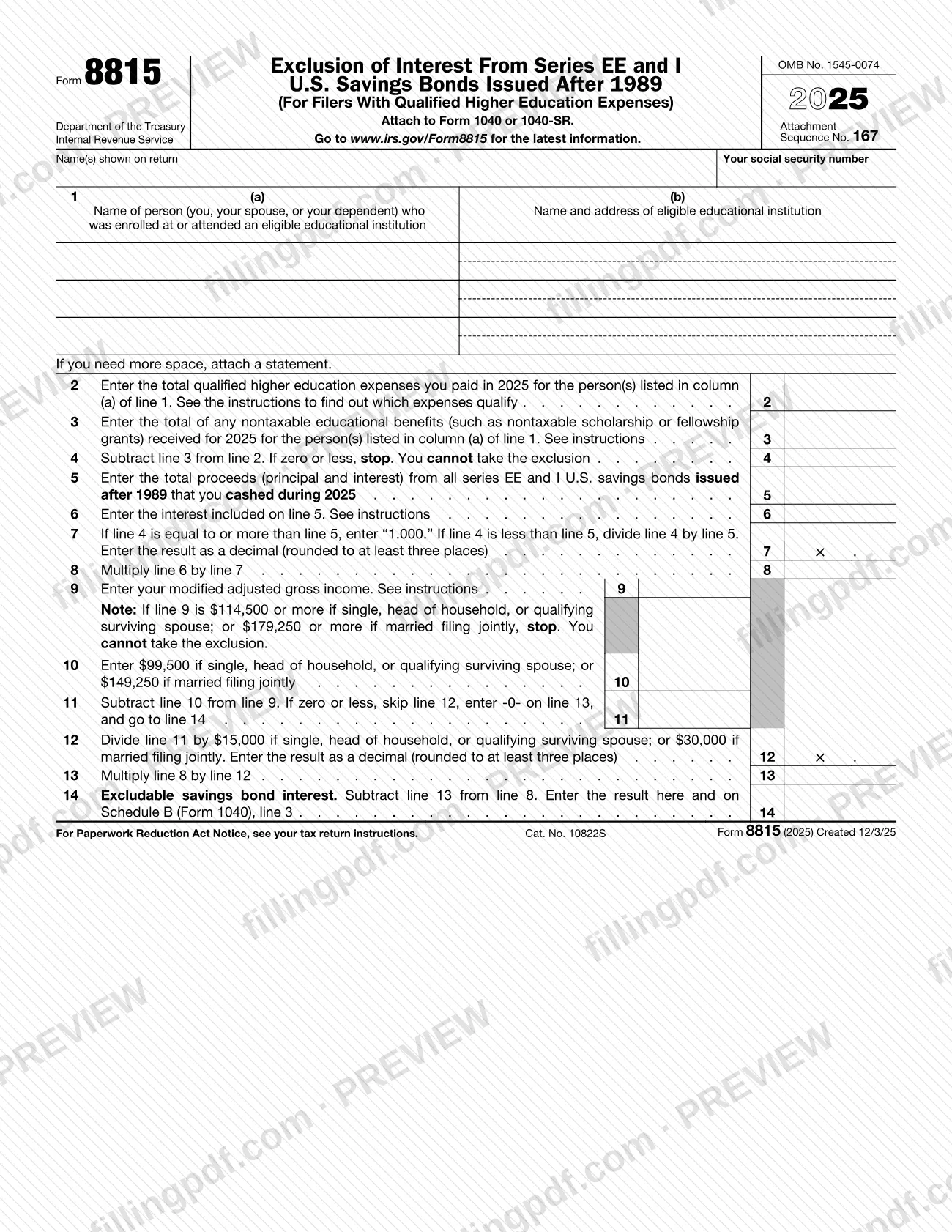
Form 8815, Exclusion of Interest From Series EE and I U.S. Savings Bonds Issued After 1989, is the IRS form used to figure how much interest on qualifying series EE and I bonds you cashed during the year can be left out of income. Its printed subtitle is "For Filers With Qualified Higher Education Expenses."
The form compares what you paid for education with what you received from the bonds. Lines 2 through 4 net your qualified higher education expenses against nontaxable educational benefits. Lines 5 through 8 measure how much of the bond proceeds and interest those net expenses cover. Lines 9 through 13 reduce the result when your modified adjusted gross income (AGI) is in the phase-out range. Line 14 gives the excludable savings bond interest, which you enter on Schedule B (Form 1040), line 3.
The form carries OMB No. 1545-0074 and Attachment Sequence No. 167, and the edition on this page is marked 2025. It is not filed alone: it is attached to Form 1040 or 1040-SR.
The instructions refer to several related items. Form 8818, Optional Form To Record Redemption of Series EE and I U.S. Savings Bonds Issued After 1989, can serve as your written record of the bonds you cashed. Form 8863 covers education credits, and expenses used for a credit cannot also be counted on Form 8815. Publication 970 gives more on the rules, and Publications 915, 590-A and 974 help with line 9.
Who needs to file 8815?
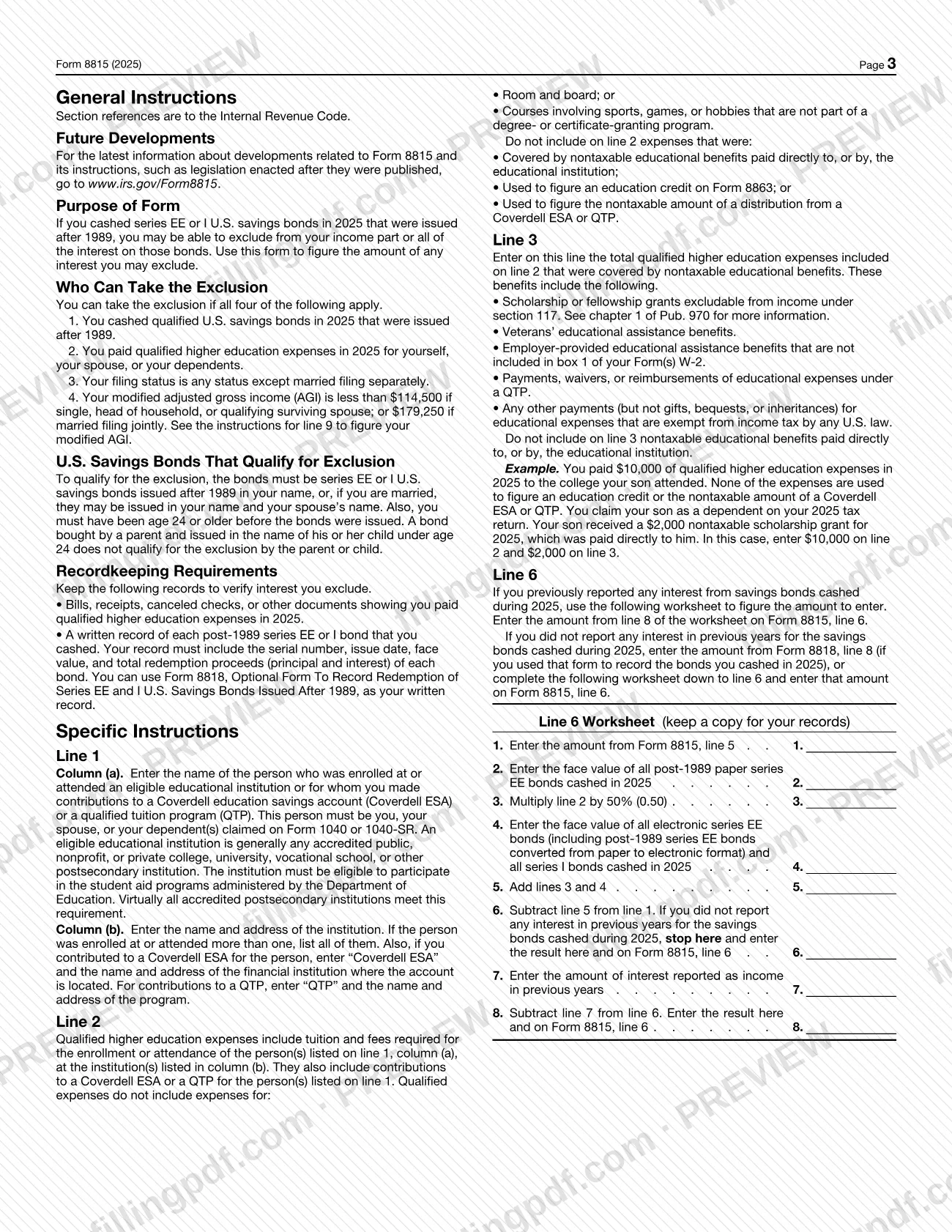
You can take the exclusion, and so complete Form 8815, if all four of these apply:
- You cashed series EE or I U.S. savings bonds in 2025 that were issued after 1989.
- You paid qualified higher education expenses in 2025 for yourself, your spouse or your dependents.
- Your filing status is any status except married filing separately.
- Your modified AGI is below the limit printed on the form for your filing status: one limit for single, head of household or qualifying surviving spouse, and a higher one for married filing jointly.
The bonds must be issued in your name or, if you are married, in your name and your spouse's name. You must have been age 24 or older before the bonds were issued. A bond bought by a parent and issued in the name of a child under age 24 does not qualify for the exclusion by the parent or the child.
The person listed on line 1, column (a), must be you, your spouse or a dependent you claim on Form 1040 or 1040-SR. If line 4 is zero or less, or your modified AGI reaches the limit in the note under line 9, the form says to stop: you cannot take the exclusion.
When to file 8815
Complete Form 8815 when you prepare the Form 1040 or 1040-SR for the year in which you cashed the qualifying series EE or I bonds. The edition on this page covers bonds cashed during 2025 and expenses paid in 2025. The form is an attachment to your return, so it has no separate due date: it travels with the return and follows the return's filing timing. The IRS instructions ask you to keep records that support the interest you exclude, including proof of the education expenses you paid and a written record of each post-1989 bond you cashed.
Documents you need
- Form 1040 or 1040-SR: Form 8815 is attached to it, and line 14 is entered on Schedule B (Form 1040), line 3.
- A statement attached to the form, only if you need more space on line 1 for persons or institutions.
- Records to keep, not attach: bills, receipts, canceled checks or other documents showing you paid qualified higher education expenses in 2025.
- Records to keep: a written record of each post-1989 series EE or I bond cashed, with serial number, issue date, face value and total redemption proceeds. Form 8818 can serve as this record.
- Line 6 Worksheet and Line 9 Worksheet from the instructions: complete as needed and keep a copy for your records.
How to fill out 8815
Enter your name and Social Security number
At the top, enter the name(s) shown on your return and your social security number.
List the student and institution on line 1
In column (a) enter the name of you, your spouse or your dependent who was enrolled or attended. In column (b) enter the institution's name and address; for a Coverdell ESA enter "Coverdell ESA" with the financial institution, and for a QTP enter "QTP" with the program's name and address.
Enter qualified expenses on line 2
Enter the total qualified higher education expenses you paid in 2025 for the persons in column (a), including tuition and fees and contributions to a Coverdell ESA or QTP. Leave out room and board and expenses already covered by benefits or used for a credit.
Enter nontaxable benefits on line 3
Enter the part of the line 2 expenses covered by nontaxable educational benefits, such as excludable scholarships or fellowships, veterans' educational assistance or employer-provided benefits not in Form W-2, box 1.
Subtract on line 4
Subtract line 3 from line 2. If the result is zero or less, stop: you cannot take the exclusion.
Enter bond proceeds on line 5
Enter the total proceeds, principal and interest, from all series EE and I U.S. savings bonds issued after 1989 that you cashed during 2025.
Figure the interest on line 6
Enter the interest included on line 5. If you reported savings bond interest in earlier years, use the Line 6 Worksheet; otherwise use Form 8818, line 8, or the worksheet down to its line 6.
Complete lines 7 and 8
On line 7 enter "1.000" if line 4 is equal to or more than line 5; otherwise divide line 4 by line 5 and round to at least three places. On line 8 multiply line 6 by line 7.
Enter modified AGI on line 9
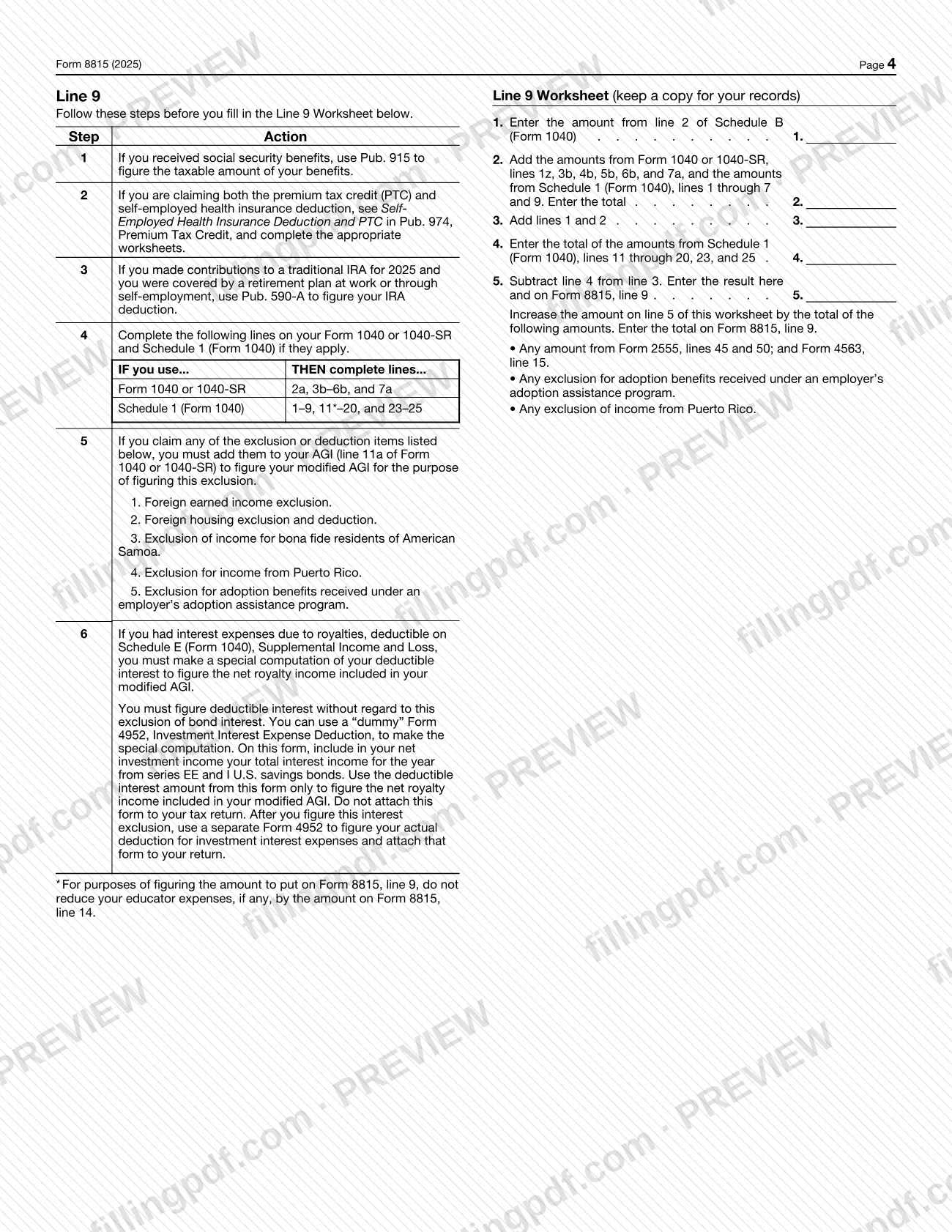
Use the Line 9 Worksheet in the instructions, and add back any exclusions listed there. If line 9 reaches the limit in the note for your filing status, stop; you cannot take the exclusion.
Complete lines 10 and 11
On line 10 enter the amount printed for your filing status. On line 11 subtract line 10 from line 9; if zero or less, skip line 12, enter -0- on line 13 and go to line 14.
Complete lines 12 and 13
On line 12 divide line 11 by the amount printed for your filing status and enter the decimal, rounded to at least three places. On line 13 multiply line 8 by line 12.
Find your excludable interest on line 14
Subtract line 13 from line 8. Enter the result on line 14 and on Schedule B (Form 1040), line 3.
Review and download the completed PDF
Check each line against your records and worksheets, then download or print the completed PDF from FillingPDF and attach it to Form 1040 or 1040-SR as described under How to submit.
How to submit 8815
Form 8815 has no filing channel of its own. You attach it to Form 1040 or 1040-SR and submit the return through whichever channel you use for the return. The form prints no mailing address, portal or appointment rule.
- With your return: attach the completed form to Form 1040 or 1040-SR. Enter the amount from line 14 on Schedule B (Form 1040), line 3.
- Extra space on line 1: if you need more room for names and institutions, attach a statement.
- Records you keep: the Line 6 Worksheet and the Line 9 Worksheet in the instructions are marked "keep a copy for your records." Keep your expense records and your written record of each bond cashed as well.
For the latest information, the form points to www.irs.gov/Form8815. FillingPDF lets you fill out and download the PDF; submission follows the channels that apply to your tax return.
Common mistakes to avoid
- Using the form when your filing status is married filing separately; the instructions allow every status except that one.
- Continuing past line 4 when the result is zero or less. The form says to stop because you cannot take the exclusion.
- Counting expenses on line 2 that were covered by nontaxable educational benefits paid directly to or by the institution, or used for an education credit on Form 8863.
- Including room and board, or courses involving sports, games or hobbies that are not part of a degree- or certificate-granting program, in qualified expenses on line 2.
- Excluding interest on a bond bought by a parent and issued in the name of a child under age 24, or on a bond issued when you were under age 24.
- Entering the full interest on line 6 when you reported savings bond interest in earlier years, instead of using the Line 6 Worksheet to subtract it.
- Leaving out the add-backs in the Line 9 Worksheet, such as the foreign earned income exclusion or the exclusion for adoption benefits, when figuring modified AGI.
- Carrying on with line 10 and beyond when line 9 reaches the limit in the note under it; the form says you cannot take the exclusion.
Frequently asked questions
What is Form 8815 used for?
Form 8815 is the IRS form for figuring how much interest from series EE or I U.S. savings bonds issued after 1989 you can exclude from income. It applies when you cashed those bonds during the year and paid qualified higher education expenses.
Who can take the savings bond interest exclusion?
You can if you cashed qualifying post-1989 bonds, paid qualified higher education expenses for yourself, your spouse or your dependents, use any filing status except married filing separately, and have modified AGI below the printed limit. You must also have been 24 or older when the bonds were issued.
Where does the line 14 amount of Form 8815 go?
Enter the excludable savings bond interest from line 14 on Schedule B (Form 1040), line 3. Form 8815 itself is attached to Form 1040 or 1040-SR, so it is submitted with your return and not alone.
Which expenses count as qualified higher education expenses?
Tuition and fees required for enrollment or attendance, and contributions to a Coverdell ESA or QTP for the person on line 1. Room and board and hobby or sports courses outside a degree or certificate program do not count, nor do expenses already covered by benefits or used for a Form 8863 credit.
Can I use Form 8815 if I am married filing separately?
No. The instructions allow every filing status except married filing separately. Married couples file jointly to take the exclusion, and the form prints a higher modified AGI limit for joint returns than for single, head of household or qualifying surviving spouse.
What records should I keep for Form 8815?
Keep bills, receipts or canceled checks showing the education expenses you paid, and a written record of each post-1989 bond cashed with its serial number, issue date, face value and total redemption proceeds. Form 8818 can serve as that written record.
Does a bond bought for my child qualify?
Not if it is issued in the name of a child under age 24. The instructions say a bond bought by a parent and issued in the child's name does not qualify for the exclusion by the parent or the child. You must also have been age 24 or older before the bonds were issued.
Can I fill out Form 8815 online on FillingPDF?
Yes. You can fill out the fillable PDF online on FillingPDF and download or print it. FillingPDF is an independent service and does not file the form with the IRS; you attach it to your Form 1040 or 1040-SR and submit the return through the usual channels.
Ready to fill out 8815?
Fill out 8815 now