
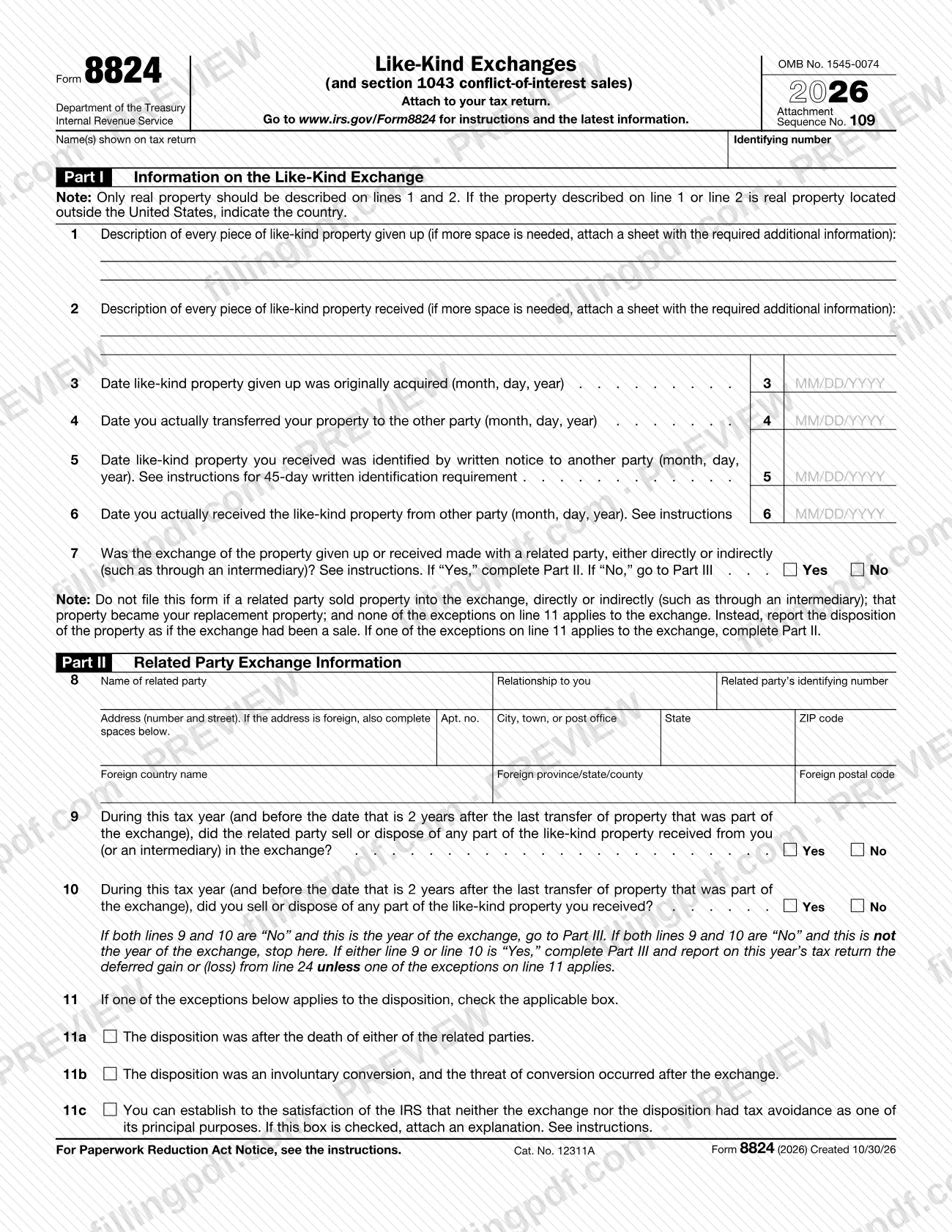
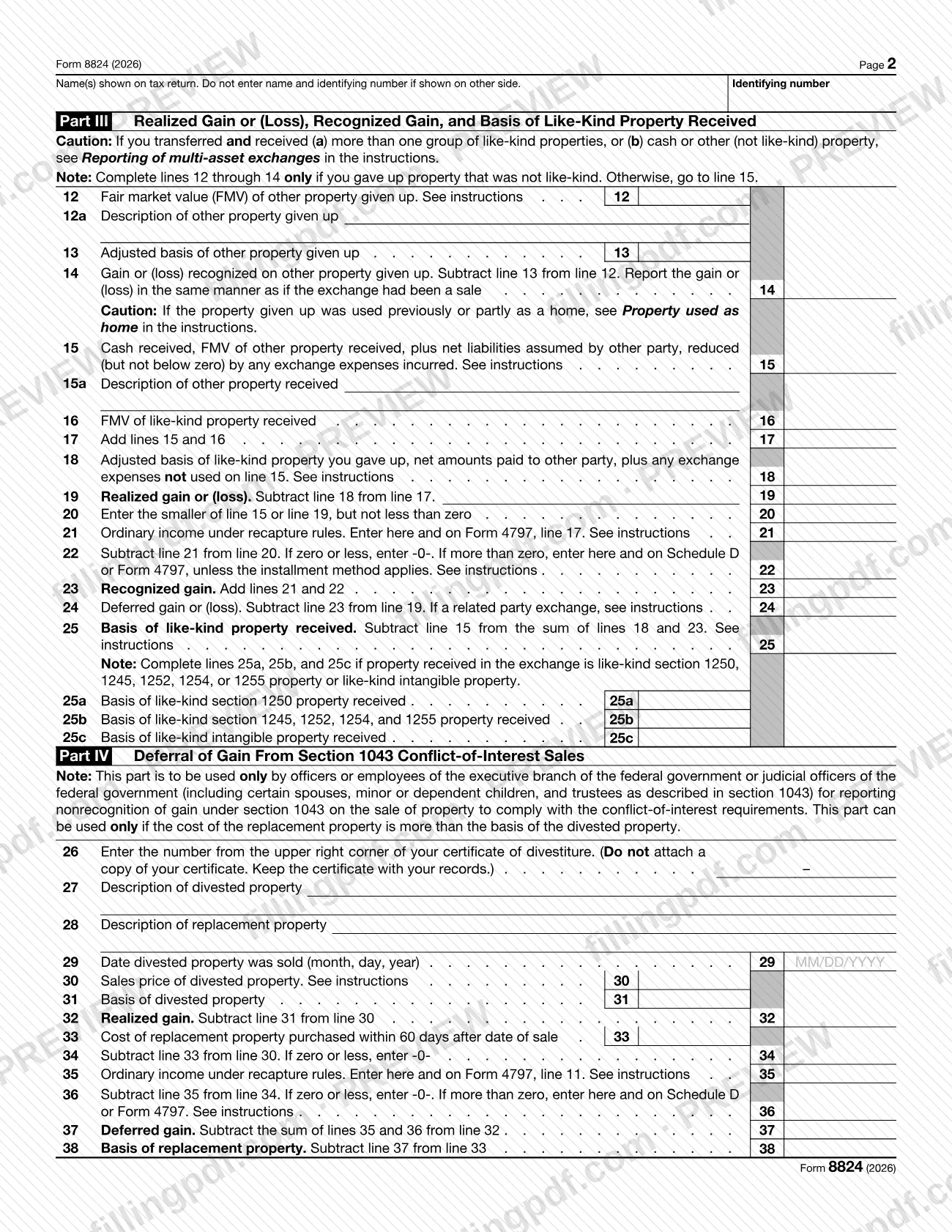
Form 8824 is the Internal Revenue Service (IRS) form on which you report a like-kind exchange of business or investment real property and figure the gain that is deferred. It is attached to your tax return for the year you transferred the property. Certain federal executive branch employees and judicial officers also use Part IV to defer gain on section 1043 conflict-of-interest sales. On this page you can fill out Form 8824 online on FillingPDF and download or print the completed PDF; the form and its instructions are published by the IRS.
Last updated
What is 8824?
Form 8824, Like-Kind Exchanges (and section 1043 conflict-of-interest sales), is the Internal Revenue Service (IRS) form used to report exchanges of business or investment real property for real property of a like kind, figure the gain deferred, and figure the basis of the property received.
The form has four parts. Part I describes the exchange and its dates. Part II applies only to exchanges with a related party. Part III figures realized gain or (loss), recognized gain and the basis of the like-kind property received; it is also where you figure the gain you must report this year if cash or other property that is not of a like kind was involved. Part IV is for reporting deferral of gain on section 1043 conflict-of-interest sales.
The IRS instructions explain that for 2018 and later years, section 1031 like-kind treatment applies only to real property held for use in a trade or business or for investment, other than real property held primarily for sale. Real property in the United States and real property outside the United States are not like-kind properties.
The form is an attachment (Attachment Sequence No. 109) to your tax return, issued under OMB No. 1545-0074. It does not stand alone: the gain it figures is reported on Schedule D, Form 4797 or Form 6252, as the instructions direct.
Who needs to file 8824?
You file Form 8824 if, during the tax year, you transferred property to another party in a like-kind exchange of business or investment real property. You also file it for each of the 2 years following the year of a related party exchange.
Related parties include your spouse, child, grandchild, parent, grandparent, brother, sister, or a related corporation, S corporation, partnership, trust, estate or tax-exempt organization. An exchange made indirectly, for example through a qualified intermediary, or by a disregarded entity you or a related party owned, can also be a related party exchange.
If you made more than one like-kind exchange, you can file a summary on one Form 8824 and attach your own statement for each exchange.
Part IV is only for officers or employees of the executive branch of the federal government and judicial officers of the federal government, including certain spouses, minor or dependent children and trustees described in section 1043. Special government employees as defined in 18 U.S.C. section 202 are not included. Use Part IV only if the cost of the replacement property is more than the basis of the divested property and you elect to defer the gain.
Do not file Form 8824 if a related party sold property into the exchange, that property became your replacement property, and none of the line 11 exceptions applies. In that case, report the disposition of the property you gave up as if it were a sale.
When to file 8824
If you transferred property to another party in a like-kind exchange during the current tax year, file Form 8824 with your tax return for that year. For a related party exchange, also file it for the 2 years following the year of the exchange.
Two deadlines inside a deferred exchange decide whether the exchange qualifies. You must identify the replacement property in writing within 45 days after you transfer the property you give up. You must receive the replacement property by the earlier of 180 days after that transfer or the due date (including extensions) of your tax return for the year of the transfer. If you receive the replacement property before the end of the 45-day period, you are automatically treated as having met the identification requirement, and you enter the date received on line 5.
Form 8824 has no separate due date of its own: it travels with the return.
Documents you need
- A written explanation, only if you check line 11c because you can establish to the satisfaction of the IRS that neither the exchange nor the disposition had tax avoidance as one of its principal purposes.
- Your own statement showing how you figured realized and recognized gain, if you transferred and received more than one group of like-kind properties, or cash or other (non-like-kind) property; enter the results on lines 19 through 25 instead of completing lines 12 through 18.
- Your own statement with all the information requested on Form 8824 for each exchange, with your name and identifying number at the top of each page, if you file a summary Form 8824 for more than one like-kind exchange.
- Do not attach your certificate of divestiture for Part IV; line 26 asks only for its number, and you keep the certificate with your records.
How to fill out 8824
Enter your name and identifying number
At the top of page 1, write the name(s) shown on your tax return and your identifying number. On page 2 do not repeat them if they are shown on the other side.
Describe the properties on lines 1 and 2
Line 1 is the like-kind property given up and line 2 the like-kind property received. Enter the address and type of property, a short description if there is no address, and the country if the real property is outside the United States.
Enter the exchange dates
Lines 3 to 6, in MM/DD/YYYY format: when you originally acquired the property given up, when you transferred it, when you identified the replacement property by written notice (line 5) and when you received it (line 6).
Answer the related party question
On line 7 check Yes or No for an exchange with a related party, direct or indirect. If Yes, complete Part II; if No, go to Part III.
Complete Part II for related parties
Line 8: the related party's name, relationship, identifying number and address. Lines 9 and 10: whether either of you sold or disposed of the property within 2 years after the last transfer. Line 11: check an exception box (11a, 11b or 11c) if one applies, and attach an explanation for 11c.
Report other property given up
Lines 12 to 14 only if you gave up property that was not like-kind: its fair market value (line 12, described on 12a), its adjusted basis (line 13) and the gain or (loss) recognized (line 14). Otherwise go to line 15.
Enter cash and other property received
Line 15: cash received, fair market value of other property received and net liabilities assumed by the other party, reduced but not below zero by your exchange expenses. Describe that other property on line 15a, then enter the fair market value of the like-kind property received on line 16.
Figure realized gain on lines 17 to 20
Line 17 adds lines 15 and 16. Line 18 is the adjusted basis of the like-kind property you gave up, net amounts paid to the other party, plus exchange expenses not used on line 15. Line 19 is line 17 minus line 18; line 20 is the smaller of line 15 or line 19, not less than zero.
Figure recapture and recognized gain
Line 21: ordinary income under recapture rules, also entered on Form 4797, line 16. Line 22 is line 20 minus line 21 (enter -0- if zero or less), and line 23 adds lines 21 and 22.
Calculate deferred gain and basis
Line 24: subtract line 23 from line 19. Line 25: subtract line 15 from the sum of lines 18 and 23, then allocate amounts on lines 25a, 25b and 25c if you received section 1250, 1245, 1252, 1254 or 1255 property or like-kind intangible property.
Complete Part IV if it applies
Federal officers and employees electing under section 1043 enter the certificate of divestiture number on line 26, describe the properties on lines 27 and 28, then complete lines 29 to 38 from the sale date through the basis of the replacement property.
Review and download the completed PDF
Check that dates use MM/DD/YYYY, amounts carry correctly between lines and any required statement is ready. Download or print the completed PDF from FillingPDF and attach it to your tax return as described under How to submit.
How to submit 8824
Form 8824 is not sent to the IRS on its own: the form says to attach it to your tax return, so it is filed through whichever channel you use for that return, on paper or electronically. The form prints no separate mailing address, portal or appointment rule.
- With your tax return: attach the completed form to the return for the year of the exchange. For a related party exchange, attach it again to the returns for the 2 following years, as the instructions require.
- E-filed returns: the IRS instructions say that, beginning with the 2024 Form 8824, e-filers no longer attach a separate sheet for lines 12a, 15a and 25a through 25c; those lines are completed on the form itself.
- Attachments: include any statement or explanation the instructions require (see Required documents).
Gain figured on the form is reported elsewhere on your return: Schedule D (Form 1040), Form 4797 or Form 6252, whichever applies. Line 21 carries to Form 4797, line 16, and line 35 to Form 4797, line 10.
FillingPDF lets you fill out and download the PDF; submission follows the channels above.
Common mistakes to avoid
- Filing Form 8824 when a related party sold property into the exchange, that property became your replacement property, and no line 11 exception applies; the instructions say to report the disposition as a sale instead.
- Describing personal property on lines 1 and 2; only real property should be described there, and real property outside the United States needs the country indicated.
- Treating U.S. real property and foreign real property as like-kind to each other; the instructions say they are not like-kind properties.
- Identifying replacement property later than 45 days after transferring the property given up, or not in writing, which can disqualify a deferred exchange.
- Receiving the replacement property after the earlier of 180 days or the due date of your return, including extensions, and still reporting a deferred exchange.
- Completing lines 12 through 18 for a multi-asset exchange instead of attaching your own statement and entering the amounts on lines 19 through 25.
- Reducing line 19 by the section 121 exclusion; the instructions say to write "Section 121 exclusion" and the amount in the line 19 entry space without reducing the line.
- Filing worksheet Forms 8824 for a property used partly as a main home; the combined amounts go on the one Form 8824 you file.
- Attaching a copy of the certificate of divestiture to Part IV instead of entering its number on line 26.
Frequently asked questions
What is Form 8824 used for?
Form 8824 reports each exchange of business or investment real property for real property of a like kind and figures the gain deferred. Part III also figures the gain you must report this year and the basis of the property received. Part IV is for section 1043 conflict-of-interest sales.
Who has to file Form 8824?
Anyone who transferred property to another party in a like-kind exchange during the tax year files it with that year's return. For a related party exchange, it is also filed for the 2 following years. Part IV is limited to certain federal executive branch employees and judicial officers.
When is Form 8824 due?
It is due with your tax return for the year you transferred the property in the exchange. It has no separate due date. For a related party exchange, file it again with the returns for the 2 following years.
What are the 45-day and 180-day rules on Form 8824?
In a deferred exchange, you must identify the replacement property in writing within 45 days after transferring the property you give up. You must receive it by the earlier of 180 days after the transfer or your return's due date, including extensions. Lines 5 and 6 record these dates.
Can I fill out Form 8824 online?
Yes. You can fill out the PDF online on FillingPDF and download or print it. FillingPDF is an independent service and does not file the form; you attach it to your tax return and submit that return through the IRS channels.
What do I do if I exchanged property with a related party?
Answer Yes on line 7 and complete Part II. If both lines 9 and 10 are No, you generally stop in later years; if either is Yes and no line 11 exception applies, report the deferred gain from line 24 on that year's return.
Can I use Form 8824 for more than one exchange?
Yes. File a summary on one Form 8824 and attach your own statement showing the information for each exchange. On the summary, enter your name and identifying number, "Summary" on line 1, total recognized gain on line 23 and total basis on line 25.
Should I attach my certificate of divestiture to Part IV?
No. Line 26 asks only for the number from the upper right corner of your certificate of divestiture. The form says not to attach a copy; keep the certificate with your records.
Ready to fill out 8824?
Fill out 8824 now