
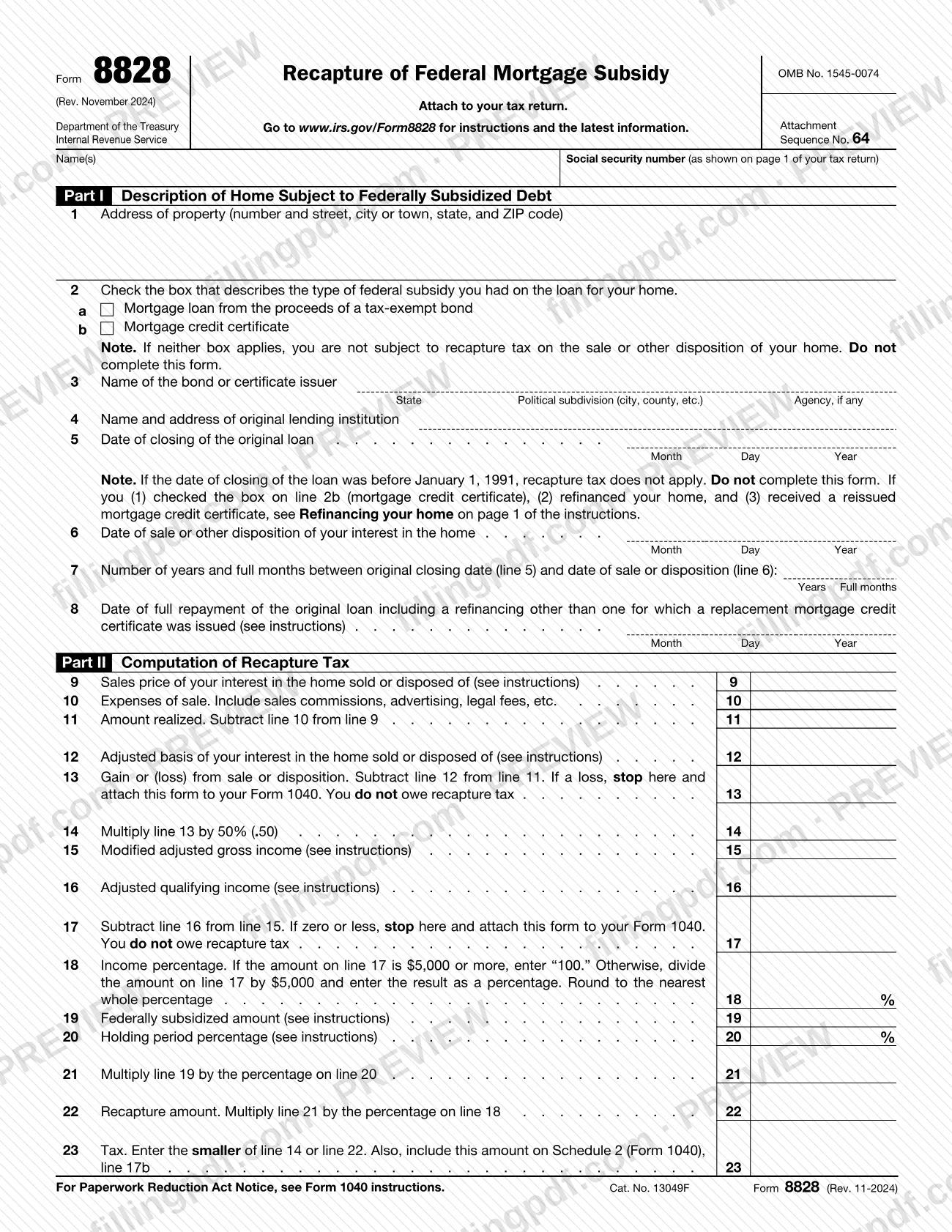
Form 8828, Recapture of Federal Mortgage Subsidy, is the Internal Revenue Service (IRS) form that figures and reports the recapture tax owed when you sell or otherwise dispose of a home financed with a federally subsidized mortgage. It applies to loans funded from a tax-exempt qualified mortgage bond or tied to a mortgage credit certificate. On FillingPDF you can fill out Form 8828 online and download or print the completed PDF; the IRS publishes the original PDF and its instructions at www.irs.gov/Form8828, and the form is attached to your tax return.
Last updated
What is 8828?
Form 8828, Recapture of Federal Mortgage Subsidy, is the IRS form used to figure and report the recapture tax on a mortgage subsidy when you sold or otherwise disposed of a home that was financed with federally subsidized debt.
A federal mortgage subsidy, as the IRS instructions define it, is either a mortgage loan with a lower interest rate because it was funded from a tax-exempt qualified mortgage bond (QMB), or a mortgage credit certificate (MCC) that you could use to reduce your federal income tax. If you sell or dispose of the home during the first 9 years after you received a QMB or MCC loan, you may have to pay back all or part of the subsidy by increasing your federal income tax for the year of the sale.
The form has two parts. Part I (lines 1 to 8) describes the home, the type of subsidy, the issuer, the original lender and the key dates. Part II (lines 9 to 23) computes the tax: the gain on the sale, your modified adjusted gross income, an income percentage, the federally subsidized amount and a holding period percentage. The tax on line 23 is the smaller of line 14 or line 22, and it is also included on Schedule 2 (Form 1040), line 17b.
Refinancing a subsidized loan without selling the home does not cause recapture, but a later sale may. The form does not apply if neither subsidy box on line 2 fits, or if the original loan closed before January 1, 1991. The form is printed with OMB No. 1545-0074 and Attachment Sequence No. 64.
Who needs to file 8828?
You must file Form 8828 if all three of the following apply, according to the IRS instructions: you sold or otherwise disposed of your home (whether or not you realized a gain); your original mortgage loan was provided after December 31, 1990; and you received a federal mortgage subsidy, meaning a QMB-funded loan or an MCC. You may also have a subsidy if you assumed the seller's QMB-funded loan, or if the seller's MCC was transferred to you with the issuer's approval and a replacement MCC was issued.
The instructions list special rules:
- Giving away your home (other than to a spouse or ex-spouse incident to divorce): figure the tax as if you sold it for fair market value at the time.
- Two or more owners jointly liable on the loan: each figures the recapture tax separately on his or her own interest.
- Divorce: a transfer between spouses or former spouses incident to divorce causes no recapture tax for either person if no gain or loss was included in or deducted from income; in that case do not file the form.
- Destruction by casualty: generally no recapture tax if you replace the home on its original site within the period the instructions give.
- Qualified home improvement loan (instead of a rehabilitation loan): no recapture of the subsidy.
Do not complete the form if neither line 2 box applies or if the loan closed before January 1, 1991.
When to file 8828
File Form 8828 for the tax year in which you sold or otherwise disposed of your home. The IRS instructions say to file it with your tax return when the return is due, including extensions.
The recapture period is the first 9 years after you received the federally subsidized loan, so a sale after that window generally falls outside the tax. Even so, if the holding period percentage on line 20 works out to zero, the worksheet in the instructions says you have no recapture but must still complete and file Form 8828.
If your home was destroyed by casualty and you do not replace it in time, the instructions say to file Form 8828 with Form 1040X for the year the home was destroyed. The replacement period is generally limited to 2 years after the end of the tax year of the destruction, and may be extended in some federally declared disaster areas.
Documents you need
- The written notification from the bond issuer or lender that you should have received when your mortgage was provided; it states the subsidy type and carries the federally subsidized amount and the adjusted qualifying income table used on lines 2, 3, 16 and 19.
- Your tax return (Form 1040, 1040-SR or 1040-NR) for the year of the sale, to which Form 8828 is attached.
- Form 1040X, Amended U.S. Individual Income Tax Return, only if your home was destroyed by casualty and you did not replace it in time; Form 8828 is filed with it.
- A worksheet explaining how you calculated your share of the gain, only if you paid a share of the gain to a qualifying subordinate mortgage loan (QSML) governmental lender and entered "QSML" on line 13.
- The Holding Period Percentage Worksheet from the instructions, only if you fully repaid or refinanced the original loan within 4 years of its closing date; it is marked "Keep for Your Records" and its result goes on line 20.
How to fill out 8828
Enter your name and SSN
At the top, enter your name(s) and social security number exactly as shown on page 1 of your tax return.
Enter the property address on line 1
List the address of the home that was subject to the federally subsidized debt, not your current address if it is different.
Check the subsidy type on line 2
Check box 2a for a mortgage loan from the proceeds of a tax-exempt bond or box 2b for a mortgage credit certificate, using your lender's notification. If neither applies, do not complete the form.
Complete the issuer and lender lines
Line 3: enter the state, political subdivision and agency of the bond or certificate issuer. Line 4: enter the name and address of the original lending institution.
Enter the loan and sale dates
Line 5: the month, day and year of the original loan closing, which must be after December 31, 1990. Line 6: the date of sale or other disposition of your interest in the home.
Figure the holding time and repayment date
Line 7: enter the full years and full months between lines 5 and 6. Line 8: enter the date the original loan was fully repaid, which may be the line 6 date.
Compute the gain on lines 9 to 13
Line 9: the sales price of your interest. Line 10: expenses of sale. Line 11: line 9 minus line 10. Line 12: adjusted basis. Line 13: line 11 minus line 12; if it is a loss, stop and attach the form to your Form 1040.
Apply the 50% limit on line 14
Multiply the line 13 gain by 50% (.50) and enter the result on line 14.
Enter income figures on lines 15 to 17
Line 15: modified adjusted gross income, figured as the instructions direct. Line 16: adjusted qualifying income from the table in your lender's notification. Line 17: line 15 minus line 16; if zero or less, stop.
Calculate the income percentage on line 18
Follow the line 18 rule printed on the form: enter 100 if line 17 reaches the threshold shown there, otherwise divide line 17 by the figure shown and round to the nearest whole percentage.
Enter subsidized amount and holding percentage
Line 19: the federally subsidized amount from your notification. Line 20: the holding period percentage from the table, or from the worksheet if you repaid the loan within 4 years of closing.
Compute the recapture tax
Line 21: line 19 times line 20. Line 22: line 21 times line 18. Line 23: the smaller of line 14 or line 22, also entered on Schedule 2 (Form 1040), line 17b.
Review and download the completed PDF
Check that names, dates and amounts match your return and notification, then download or print the completed PDF from FillingPDF and attach it to your tax return as described under How to submit.
How to submit 8828
Form 8828 has no filing channel of its own: you attach it to your tax return, and it travels with the return through whichever way you file that return.
- With your return: attach Form 8828 to Form 1040, 1040-SR or 1040-NR for the tax year of the sale or other disposition. Include the line 23 amount on Schedule 2 (Form 1040), line 17b.
- If you stop at line 13 or line 17: when line 13 is a loss, or line 17 is zero or less, the form tells you to stop and attach it to your Form 1040; you do not owe recapture tax.
- Home destroyed and not replaced in time: file Form 8828 with Form 1040X, Amended U.S. Individual Income Tax Return, for the year the home was destroyed.
- Qualifying subordinate mortgage loan: attach the worksheet explaining how you calculated your share of the gain, as the line 13 instructions direct.
The form prints no mailing address or portal. The IRS gives instructions and the latest information at www.irs.gov/Form8828. FillingPDF lets you fill out and download the PDF; submission follows the channels above.
Common mistakes to avoid
- Completing the form when neither line 2 box applies or the original loan closed before January 1, 1991; the form says not to complete it in either case.
- Entering your current address on line 1 instead of the address of the property that was subject to the federally subsidized debt, when the two differ.
- Reporting the full sales price when you owned only part of the home; lines 9 and 10 should cover only your interest, and co-owners figure tax separately.
- Continuing past line 13 or line 17 when the form says to stop: a loss on line 13 or zero or less on line 17 means no recapture tax.
- Entering the refinancing date on line 8 for a reissued mortgage credit certificate that met all the refinancing conditions; the instructions treat it as an extension of the original loan.
- Using the Holding Period Percentage Worksheet when lines 6 and 8 are the same date, or when the repayment date is more than 4 years after closing.
- Omitting "QSML" on the dotted line at line 13, or the explaining worksheet, after paying a share of the gain to a QSML governmental lender.
- Using names or a social security number that differ from page 1 of your tax return.
- Leaving out the line 23 amount on Schedule 2 (Form 1040), line 17b when you owe recapture tax.
Frequently asked questions
What is Form 8828 used for?
Form 8828 figures and reports the recapture tax on a federal mortgage subsidy when you sold or otherwise disposed of a home financed with a QMB-funded loan or a mortgage credit certificate. The result on line 23 is added to your federal income tax for the year of the sale.
Who has to file Form 8828?
You must file if you sold or disposed of your home (with or without a gain), your original mortgage loan was provided after December 31, 1990, and you received a federal mortgage subsidy. The instructions list exceptions, such as divorce transfers and replacement of a destroyed home.
Do I owe recapture tax if I sold my home at a loss?
No. If line 13 is a loss, the form tells you to stop and attach it to your Form 1040; you do not owe recapture tax. You do not owe it either when line 17 is zero or less.
How long is the recapture period for a federally subsidized mortgage?
The first 9 years after you received the subsidized QMB or MCC loan. If you sold or disposed of the home during that period, you may have to pay back all or part of the subsidy. Refinancing alone does not trigger recapture.
Where do I send Form 8828?
You do not send it separately. Attach it to your Form 1040, 1040-SR or 1040-NR for the year of the sale and file it when the return is due, including extensions. If your home was destroyed and not replaced in time, file it with Form 1040X.
Can I fill out Form 8828 online?
Yes. You can fill out the PDF online on FillingPDF and download or print it. FillingPDF is an independent service and does not file the form with the IRS; you submit it with your tax return through the IRS channels.
Where do I find my federally subsidized amount and qualifying income?
On the written notification from the bond issuer or lender you should have received when your mortgage was provided. It contains the federally subsidized amount for line 19 and a table of adjusted qualifying income by family size for line 16. If you cannot identify the issuer, ask your lender.
What if I gave my home away instead of selling it?
The tax is figured as if you had sold the home for its fair market value at the time of the disposition, and line 9 uses that value. The exception is a transfer to a spouse or ex-spouse incident to divorce, which does not cause recapture tax if no gain or loss was included in or deducted from income.
Ready to fill out 8828?
Fill out 8828 now