

Form 8833 is the Internal Revenue Service (IRS) form on which a taxpayer discloses a treaty-based return position, meaning a position that a U.S. treaty overrules or modifies a provision of the Internal Revenue Code and reduces tax. Dual-resident taxpayers also use it to make the disclosure required by Regulations section 301.7701(b)-7. On this page you can fill out the form online on FillingPDF and download or print the completed PDF; the official PDF and the latest information are published by the IRS at www.irs.gov/Form8833.
Last updated
What is Form 8833?
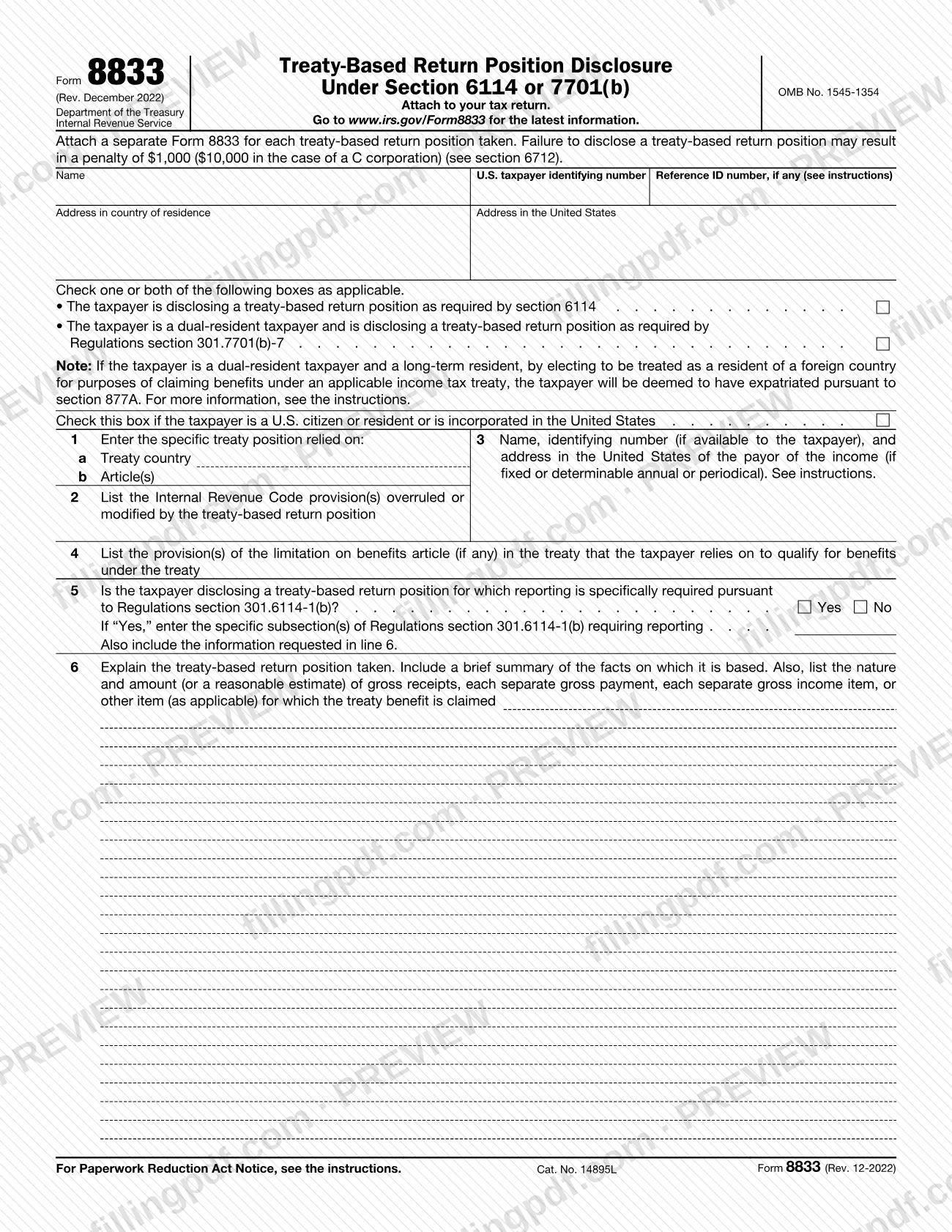
Form 8833, Treaty-Based Return Position Disclosure Under Section 6114 or 7701(b), is the IRS form taxpayers use to disclose that a treaty of the United States overrules or modifies a provision of the Internal Revenue Code and thereby causes, or may cause, a reduction of tax on their return.
The form carries out two disclosure rules. Section 6114 and Regulations section 301.6114-1 require taxpayers to disclose treaty-based return positions. Regulations section 301.7701(b)-7 requires dual-resident taxpayers to make a similar disclosure. The two boxes at the top of the form match these rules, and you check one or both.
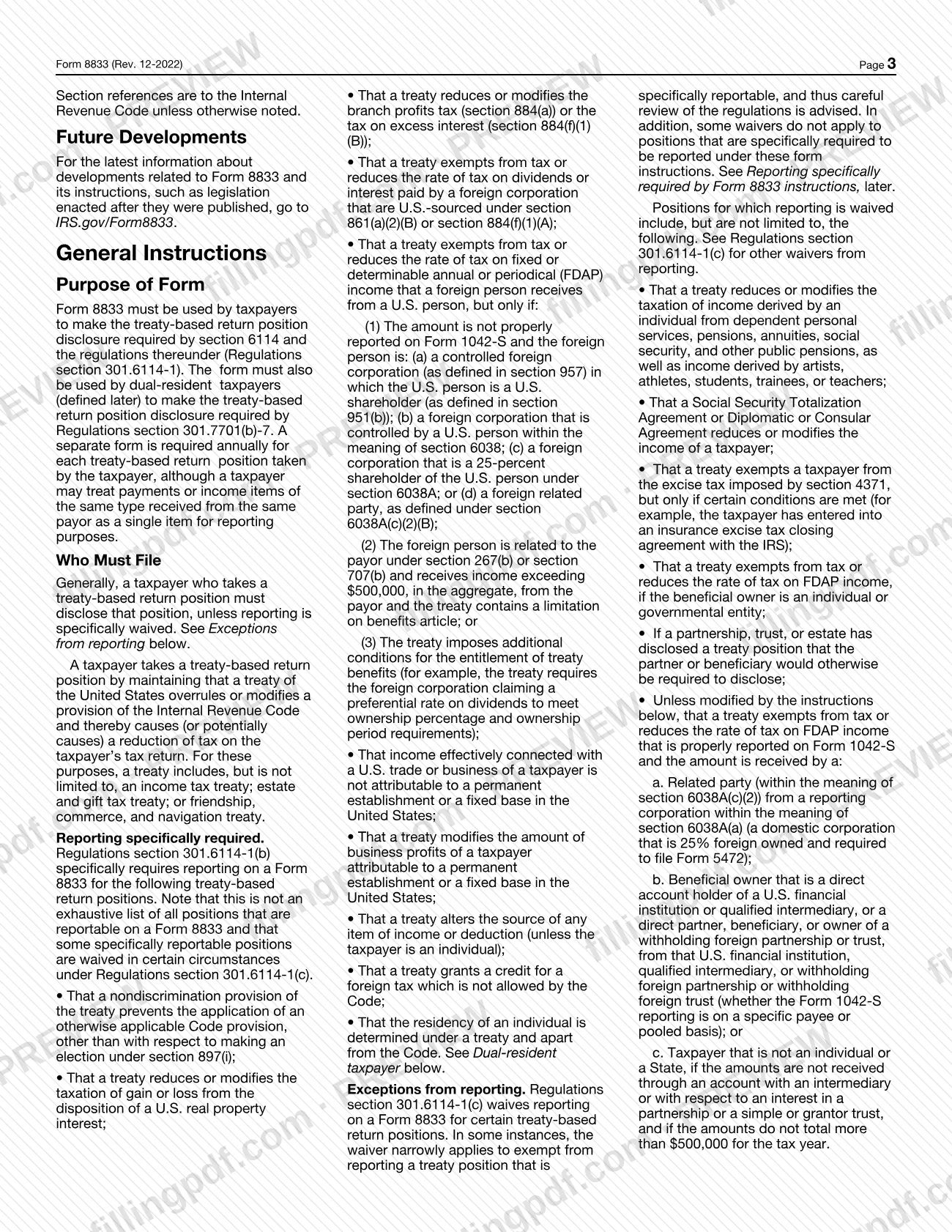
For this purpose, the IRS instructions say a treaty includes, but is not limited to, an income tax treaty; an estate and gift tax treaty; or a friendship, commerce, and navigation treaty.
A separate Form 8833 is required annually for each treaty-based return position taken. The taxpayer may treat payments or income items of the same type received from the same payor as a single item. The form is not a return: it is attached to your tax return, such as Form 1040-NR or Form 1120-F.
The form warns that failing to disclose a treaty-based return position may result in a penalty under section 6712. The instructions list positions for which reporting is specifically required, positions for which reporting is waived under Regulations section 301.6114-1(c), and positions that stay reportable even when a waiver would otherwise apply.
Who needs to file Form 8833?
Generally, a taxpayer who takes a treaty-based return position must disclose it on Form 8833, unless reporting is specifically waived. A taxpayer takes such a position by maintaining that a U.S. treaty overrules or modifies a provision of the Internal Revenue Code and thereby causes, or potentially causes, a reduction of tax.
- Taxpayers taking a treaty position. Check the section 6114 box. Examples the instructions list as specifically reportable include a treaty that reduces tax on gain from the disposition of a U.S. real property interest, or one that reduces the branch profits tax.
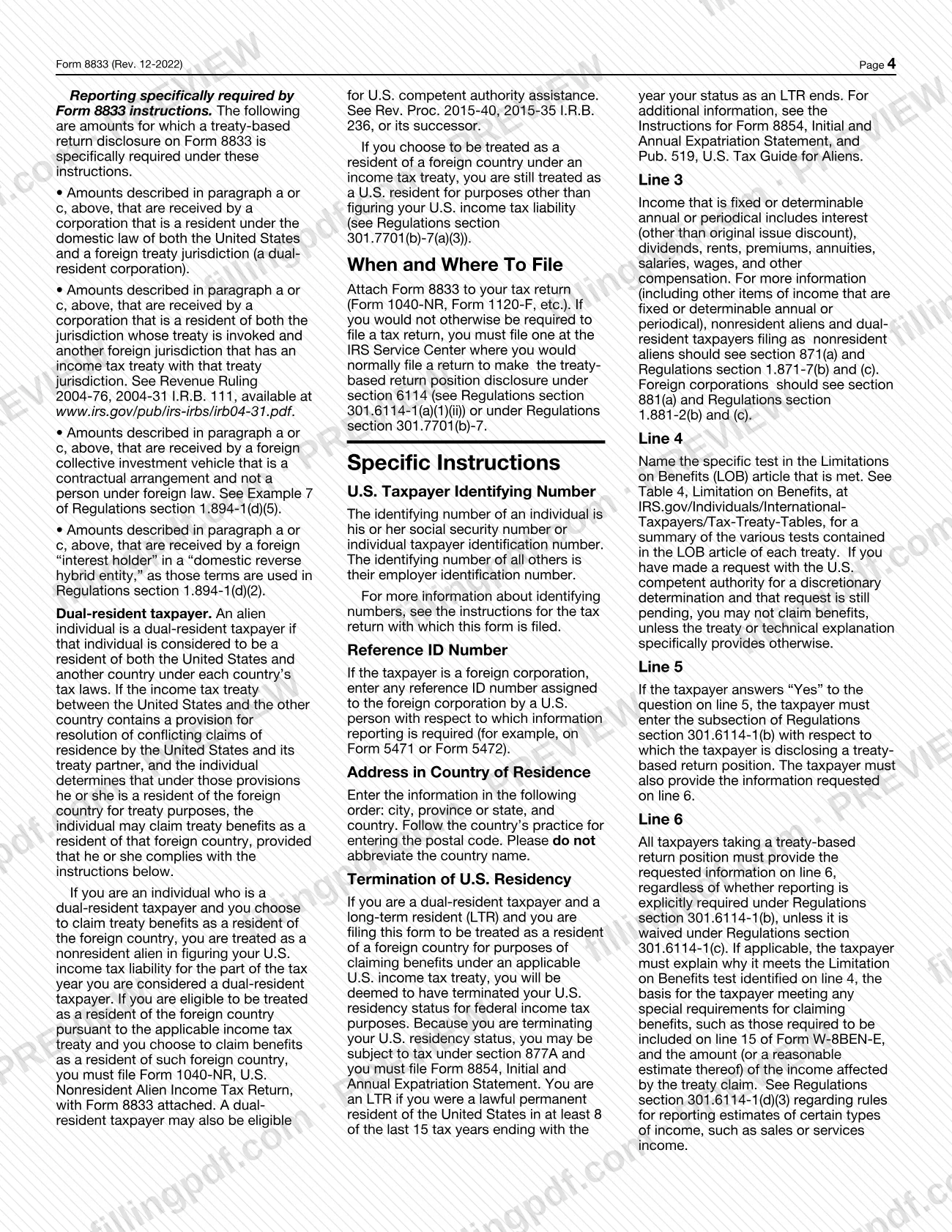
- Dual-resident taxpayers. An alien individual is a dual-resident taxpayer if considered a resident of both the United States and another country under each country's tax laws. One who claims treaty benefits as a resident of the foreign country checks the second box and files Form 1040-NR with Form 8833 attached.
- Long-term residents. A dual-resident taxpayer who is a long-term resident and claims treaty benefits as a resident of a foreign country is deemed to have terminated U.S. residency, and must also file Form 8854.
Reporting is waived for some positions, including certain treaty positions on dependent personal services, pensions, Social Security and student or teacher income. Some waivers are narrow or do not apply to positions specifically required to be reported, so check Regulations section 301.6114-1(c) and the instructions.
When to file Form 8833
File Form 8833 whenever you take a treaty-based return position on a tax return, because the form is attached to that return and has no separate due date printed on it. A separate form is required annually for each treaty-based return position taken.
If you would not otherwise be required to file a tax return, you must still file one at the IRS Service Center where you would normally file, to make the section 6114 disclosure or the disclosure under Regulations section 301.7701(b)-7.
For a dual-resident taxpayer who claims treaty benefits as a resident of the foreign country, the nonresident alien treatment applies for the part of the tax year in which the person is considered a dual-resident taxpayer. Deadlines for the return itself are in the instructions for that return.
Documents you need
- The tax return to which Form 8833 is attached, such as Form 1040-NR or Form 1120-F; the form says to attach it to your tax return.
- Form 1040-NR, U.S. Nonresident Alien Income Tax Return, with Form 8833 attached, if you are a dual-resident taxpayer who chooses to claim treaty benefits as a resident of the foreign country.
- Form 8854, Initial and Annual Expatriation Statement, if you are a dual-resident taxpayer and a long-term resident filing Form 8833 to be treated as a resident of a foreign country.
- A separate Form 8833 for each additional treaty-based return position taken, since one form covers one position.
How to fill out Form 8833
Enter taxpayer name and identifying number
Enter the taxpayer's name and U.S. taxpayer identifying number: the social security number or individual taxpayer identification number for an individual, or the employer identification number for all others.
Add a reference ID number if any
If the taxpayer is a foreign corporation, enter any reference ID number assigned by a U.S. person for which information reporting is required, for example on Form 5471 or Form 5472.
Enter both addresses
Give the address in country of residence in this order: city, province or state, and country, following the country's practice for the postal code and without abbreviating the country name. Then enter the address in the United States.
Check the disclosure boxes
Check one or both boxes: disclosure required by section 6114, and dual-resident taxpayer disclosure required by Regulations section 301.7701(b)-7. Check the separate box if the taxpayer is a U.S. citizen or resident or is incorporated in the United States.
Complete line 1 treaty position
On line 1a enter the treaty country and on line 1b the article(s) relied on.
List the Code provisions on line 2
Enter the Internal Revenue Code provision(s) overruled or modified by the treaty-based return position.
Identify the payor on line 3
Enter the name, identifying number (if available to the taxpayer) and U.S. address of the payor of the income, when the income is fixed or determinable annual or periodical (FDAP) income such as interest, dividends, rents or wages.
Name the limitation on benefits test
On line 4, list the provision(s) of the limitation on benefits article, if the treaty has one, that you rely on, naming the specific test that is met.
Answer the line 5 question
Check Yes or No for whether you are disclosing a position specifically required under Regulations section 301.6114-1(b). If Yes, enter the subsection(s) and also complete line 6.
Explain the position on line 6
Describe the treaty-based return position and summarize the facts. List the nature and amount, or a reasonable estimate, of the gross receipts, gross payments or income items for which the treaty benefit is claimed.
Review and download the completed PDF
Check that one form is completed for each treaty position, then download or print the completed PDF from FillingPDF and attach it to your tax return as described under How to submit.
How to submit Form 8833
You submit Form 8833 by attaching it to your tax return, such as Form 1040-NR or Form 1120-F, and filing that return through the channels that apply to it.
- With your return. Attach a separate Form 8833 for each treaty-based return position taken. The form says "Attach to your tax return."
- If you have no other filing requirement. You must still file a return at the IRS Service Center where you would normally file, to make the disclosure under section 6114 or Regulations section 301.7701(b)-7.
- Dual-resident taxpayers. If you choose to claim treaty benefits as a resident of the foreign country, file Form 1040-NR with Form 8833 attached.
The form prints no separate mailing address or portal; follow the instructions for the return you attach it to, and see www.irs.gov/Form8833 for the latest information. FillingPDF lets you fill out and download the PDF; submission follows the channels above.
Common mistakes to avoid
- Using one Form 8833 for several different treaty-based return positions; the form says to attach a separate Form 8833 for each position taken.
- Not disclosing a treaty-based return position at all; the form warns that failure to disclose may result in a penalty under section 6712.
- Abbreviating the country name in the address in country of residence; the instructions say not to, and to enter city, province or state, and country in that order.
- Answering "Yes" on line 5 without entering the subsection(s) of Regulations section 301.6114-1(b) that require reporting.
- Leaving line 6 incomplete; every taxpayer taking a treaty position must explain it, with a brief summary of facts and the amount, or a reasonable estimate, of the income affected.
- Naming only the treaty on line 4 instead of the specific test in the limitation on benefits article that is met.
- Claiming treaty benefits while a request to the U.S. competent authority for a discretionary determination is still pending, unless the treaty or technical explanation provides otherwise.
- Filing as a dual-resident long-term resident who claims foreign residency without also filing Form 8854, which the instructions require.
Frequently asked questions
What is Form 8833 used for?
Form 8833 is used to disclose a treaty-based return position. A taxpayer who maintains that a U.S. treaty overrules or modifies a provision of the Internal Revenue Code, reducing tax on the return, generally discloses it here. Dual-resident taxpayers also use it under Regulations section 301.7701(b)-7.
Who has to file Form 8833?
Generally, any taxpayer who takes a treaty-based return position must file it, unless reporting is specifically waived. Dual-resident taxpayers who claim treaty benefits as residents of a foreign country must also file it. Regulations section 301.6114-1(c) lists the waivers.
Do I need a separate Form 8833 for each treaty position?
Yes. The form says to attach a separate Form 8833 for each treaty-based return position taken, and a separate form is required annually. You may treat payments or income items of the same type from the same payor as a single item.
Where do I send Form 8833?
Attach it to your tax return, such as Form 1040-NR or Form 1120-F. If you would not otherwise have to file a return, file one at the IRS Service Center where you would normally file, to make the disclosure. The form prints no separate address.
What happens if I don't disclose a treaty-based return position?
The form states that failure to disclose a treaty-based return position may result in a penalty under section 6712. The instructions also say reporting is waived only for certain positions, so check Regulations section 301.6114-1(c) before deciding not to file.
What is a dual-resident taxpayer on Form 8833?
An alien individual who is considered a resident of both the United States and another country under each country's tax laws. If the treaty's tie-breaker provisions make the person a resident of the foreign country, the person may claim treaty benefits and files Form 1040-NR with Form 8833 attached.
What goes on line 6 of Form 8833?
Line 6 is an explanation of the treaty-based return position, with a brief summary of the facts. List the nature and amount, or a reasonable estimate, of the gross receipts, payments or income items for which the treaty benefit is claimed. All taxpayers taking a treaty position complete it unless reporting is waived.
Can I fill out Form 8833 online on FillingPDF?
Yes. You can fill out the fillable PDF online on FillingPDF and download or print it. FillingPDF is an independent service and does not file the form with the IRS; you attach it to your tax return and submit that return through the IRS channels.
Ready to fill out Form 8833?
Fill out Form 8833 now