
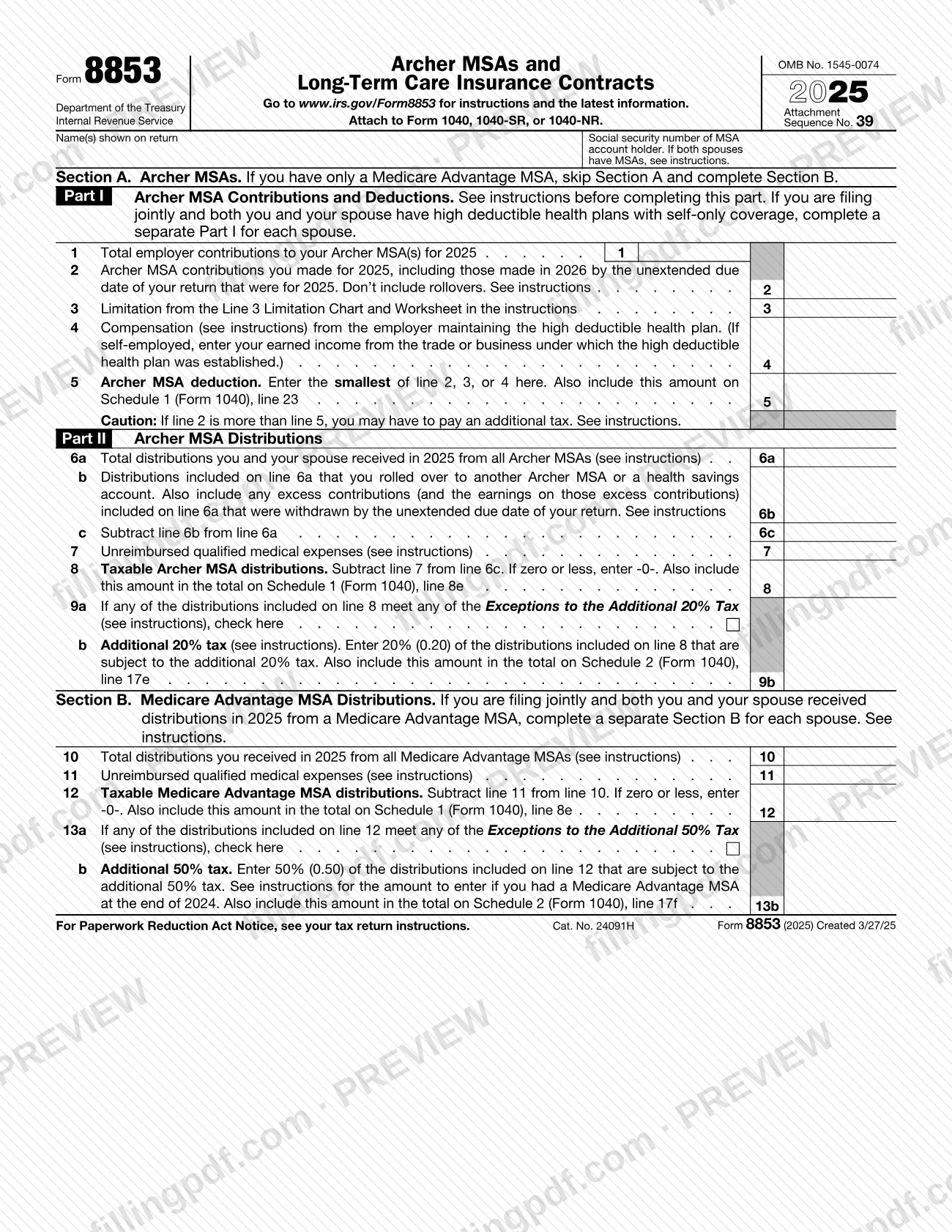
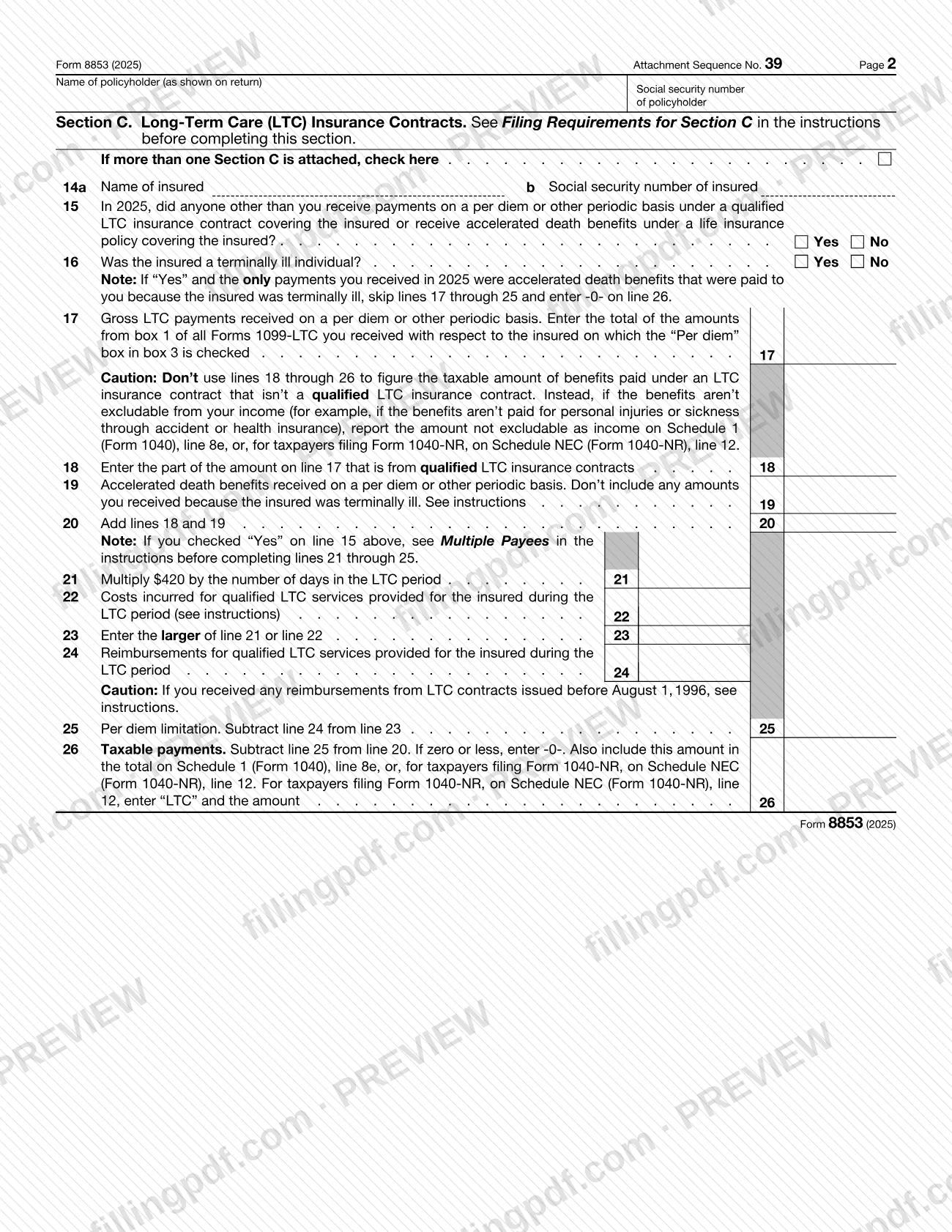
Form 8853, Archer MSAs and Long-Term Care Insurance Contracts, is the Internal Revenue Service (IRS) form that goes with your federal income tax return when you have an Archer medical savings account (MSA), a Medicare Advantage MSA, or taxable long-term care (LTC) insurance payments. It has three sections: Archer MSAs, Medicare Advantage MSA distributions, and LTC insurance contracts. On this page you can fill out the 2025 form online on FillingPDF and download or print the completed PDF. The IRS publishes the form and its instructions at www.irs.gov/Form8853.
Last updated
What is 8853?
Form 8853, Archer MSAs and Long-Term Care Insurance Contracts, is the Internal Revenue Service (IRS) form attached to Form 1040, 1040-SR or 1040-NR to report Archer MSA contributions and distributions, Medicare Advantage MSA distributions, and taxable long-term care insurance payments for the tax year.
The IRS instructions list what the form does:
- Reports Archer MSA contributions, including employer contributions.
- Figures your Archer MSA deduction.
- Reports distributions from Archer MSAs or Medicare Advantage MSAs.
- Reports taxable payments from long-term care (LTC) insurance contracts.
- Reports taxable accelerated death benefits from a life insurance policy.
The form is built in three sections. Section A covers Archer MSAs: Part I (lines 1 to 5) figures the contribution deduction, and Part II (lines 6a to 9b) reports distributions and any additional tax on them. Section B (lines 10 to 13b) covers Medicare Advantage MSA distributions. Section C (lines 14a to 26) covers LTC insurance contracts and accelerated death benefits, and figures the taxable part of per diem payments.
Amounts flow to the return: the deduction on line 5 goes to Schedule 1 (Form 1040), line 23; taxable amounts from lines 8, 12 and 26 go to Schedule 1 (Form 1040), line 8e; and additional taxes from lines 9b and 13b go to Schedule 2 (Form 1040), lines 17e and 17f. The IRS instructions point to Pub. 969 for more on MSAs and to Form 5329 for the additional tax on excess contributions.
Who needs to file 8853?
You must file Form 8853 if any of these applies, according to the IRS instructions:
- You (or your employer) made contributions for 2025 to your Archer MSA.
- You are filing a joint return and your spouse (or their employer) made contributions for 2025 to your spouse's Archer MSA.
- You (or your spouse, if filing jointly) acquired an interest in an Archer MSA or a Medicare Advantage MSA because of the death of the account holder.
- You (or your spouse, if filing jointly) were a policyholder who received payments under an LTC insurance contract, or accelerated death benefits from a life insurance policy on a per diem or other periodic basis, in 2025.
If you or your spouse received Archer MSA or Medicare Advantage MSA distributions in 2025, you must file Form 8853 with your return even if you have no taxable income or any other reason to file.
To take an Archer MSA deduction you must be an eligible individual: an employee of a small employer or self-employed, covered by a high deductible health plan (HDHP) with no other health coverage except permitted coverage, not enrolled in Medicare, and not another person's dependent. Employer contributions to your Archer MSA prevent you from deducting your own. If a Section C applies to more than one insured person, each insured needs a separate Section C.
When to file 8853
Form 8853 has no due date of its own: you file it with the Form 1040, 1040-SR or 1040-NR it is attached to, so it is due when that return is due. You must file it with a return whenever one of the triggering situations applies, such as 2025 Archer MSA contributions, MSA distributions or LTC payments.
Line 2 counts contributions made for 2025 through the unextended due date of your return; the instructions give the window January 1, 2026, through April 15, 2026. Excess contributions you make can be withdrawn without being treated as contributed if you withdraw them, with their earnings, by the due date of your 2025 return, including extensions. If you timely filed without withdrawing them, the instructions allow a withdrawal up to 6 months after the return's due date, excluding extensions, with an amended return marked "Filed pursuant to section 301.9100-2" at the top.
Documents you need
- Form 1040, 1040-SR or 1040-NR: Form 8853 is attached to your federal income tax return.
- Form(s) W-2, box 12 with code R: shows employer contributions to your Archer MSA for line 1, if an employer contributed.
- Form(s) 1099-SA, box 1: shows Archer MSA or Medicare Advantage MSA distributions for lines 6a and 10, if you received distributions.
- Form(s) 1099-LTC: boxes 1, 2 and 3 supply the gross LTC payments, accelerated death benefits and per diem or reimbursement indication for Section C, if you received LTC payments.
- Line 3 Limitation Chart and Worksheet from the instructions: complete it for each month of 2025 and keep it for your records; it is not attached.
- Additional 50% Tax Worksheet—Line 13b, only if some Medicare Advantage MSA distributions don't meet the exceptions; keep it for your records.
- Statement Forms 8853 and a controlling Form 8853, if both spouses have Part I or Section B amounts, or if you are beneficiary of more than one MSA.
- A statement duplicating lines 18 through 26, if you checked "Yes" on line 15 and other persons received per diem payments for the same insured.
- Form 5329, if you must figure the additional tax on excess contributions.
How to fill out 8853
Enter your name and SSN
At the top of page 1, enter the name(s) and Social Security number (SSN) as shown on your tax return. If both spouses have Archer MSAs or both have Medicare Advantage MSAs on a joint return, enter the SSN shown first on the return.
Decide which sections apply
Complete Section A for Archer MSAs; if you have only a Medicare Advantage MSA, skip Section A and complete Section B. Complete Section C only if you received LTC or accelerated death benefit payments, using the Filing Requirements chart in the instructions.
Enter contributions on lines 1 to 2
Line 1: total employer contributions to your Archer MSA(s) for 2025, shown in box 12 of Form W-2 with code R. Line 2: contributions you made for 2025, including those made in 2026 by the unextended due date, without rollovers.
Figure the limit and compensation
Line 3: complete the Line 3 Limitation Chart and Worksheet for each month of 2025 and enter the result. Line 4: enter your compensation from the employer maintaining the HDHP, or your earned income if self-employed.
Enter your Archer MSA deduction
Line 5: enter the smallest of lines 2, 3 and 4, and carry it to Schedule 1 (Form 1040), line 23. If employer contributions block the deduction, skip lines 3 and 4 and enter -0-.
Report Archer MSA distributions
Line 6a: total distributions from all Archer MSAs (Form 1099-SA, box 1). Line 6b: rollovers and withdrawn excess contributions. Line 6c: subtract 6b from 6a.
Figure taxable distributions
Line 7: unreimbursed qualified medical expenses. Line 8: subtract line 7 from line 6c, entering -0- if zero or less, and include it on Schedule 1 (Form 1040), line 8e.
Check exceptions and enter additional tax
Line 9a: check the box if any distributions on line 8 meet an exception to the additional 20% tax. Line 9b: enter 20% of the distributions on line 8 that are subject to it, and include it on Schedule 2 (Form 1040), line 17e.
Complete Section B
Line 10: total Medicare Advantage MSA distributions. Line 11: unreimbursed qualified medical expenses. Line 12: line 10 minus line 11, or -0-. Check line 13a if an exception applies, and use the Additional 50% Tax Worksheet to figure line 13b.
Identify the insured in Section C
On page 2, enter the policyholder's name and SSN, then the insured's name (14a) and SSN (14b). Answer lines 15 and 16 (Yes or No); if you checked "Yes" on line 16 and the only 2025 payments were terminal-illness accelerated death benefits, skip lines 17 through 25 and enter -0- on line 26.
Figure LTC payments and the limit
Enter gross per diem payments on line 17, the part from qualified contracts on line 18, and accelerated death benefits on line 19; add them on line 20. Then complete lines 21 through 25 to find the per diem limitation.
Enter taxable LTC payments
Line 26: subtract line 25 from line 20, entering -0- if zero or less, and include it on Schedule 1 (Form 1040), line 8e, or for Form 1040-NR on Schedule NEC (Form 1040-NR), line 12, writing "LTC" and the amount.
Review and download the PDF
Check each section against your Forms W-2, 1099-SA and 1099-LTC. Download or print the completed PDF from FillingPDF and attach it to your tax return as described under How to submit.
How to submit 8853
Form 8853 is not filed on its own. It is attached to Form 1040, 1040-SR or 1040-NR and travels through whichever channel you use to file that return.
- With your return: attach Form 8853 to your Form 1040, 1040-SR or 1040-NR. The form shows "Attach to Form 1040, 1040-SR, or 1040-NR."
- Statement forms on a paper return: when you must prepare several statement Forms 8853 (for example, one for each spouse, or for each Archer MSA you hold as a beneficiary), complete a controlling Form 8853 and attach the statement forms to your paper tax return after the controlling form. Write "statement" across the top of each statement form.
- Multiple payees (Section C): if you checked "Yes" on line 15, attach a statement duplicating lines 18 through 26 that shows the aggregate computation.
The form prints no mailing address or portal of its own; for addresses and filing options, use the instructions for your tax return. Form 8853 and its instructions are at www.irs.gov/Form8853. FillingPDF lets you fill out and download the PDF; submission follows the channels above.
Common mistakes to avoid
- Skipping Form 8853 when you received Archer MSA or Medicare Advantage MSA distributions because you have no taxable income; the instructions say you must file it anyway with your return.
- Completing lines 3 and 4 when employer contributions prevent a deduction; the instructions say to complete lines 1 and 2, skip lines 3 and 4, and enter -0- on line 5.
- Including rollovers or amounts from a direct trustee-to-trustee transfer on line 2 or line 6a instead of excluding them as the instructions direct.
- Entering a deduction on line 5 that is larger than the smallest of lines 2, 3 and 4.
- Counting insurance premiums as qualified medical expenses on line 7 or 11 when they aren't for LTC insurance, health care continuation coverage or coverage while receiving unemployment compensation.
- Claiming the same medical expenses on line 7 or 11 and as a deduction on Schedule A; the form instructions say you can't take a Schedule A deduction for them.
- Using lines 18 through 26 for benefits from a contract that isn't a qualified LTC insurance contract; the form says to report the non-excludable amount on Schedule 1 (Form 1040), line 8e.
- Combining several LTC periods in one Section C instead of completing lines 18 through 26 on a separate Section C for each period.
- Entering reimbursements on line 24 from LTC contracts issued before August 1, 1996, without checking the instructions' exception.
Frequently asked questions
What is Form 8853 used for?
Form 8853 reports Archer MSA contributions and distributions, Medicare Advantage MSA distributions, and taxable long-term care insurance payments. It also figures your Archer MSA deduction and any taxable accelerated death benefits from a life insurance policy. You attach it to your federal income tax return.
Who has to file Form 8853?
You must file it if you or your employer contributed to your Archer MSA for 2025, if your spouse's MSA received contributions on a joint return, if you inherited an MSA interest after the account holder's death, or if you received LTC or periodic accelerated death benefit payments as a policyholder.
Do I need Form 8853 if I have no taxable income?
Yes, if you or your spouse received Archer MSA or Medicare Advantage MSA distributions in 2025. The instructions say you must file Form 8853 with Form 1040, 1040-SR or 1040-NR even if you have no taxable income or other reason to file a return.
Where do I send Form 8853?
Attach it to your Form 1040, 1040-SR or 1040-NR and file it with the return; the form has no separate address. On a paper return, statement Forms 8853 go behind the controlling Form 8853. Check your tax return instructions for where to file.
Can I fill out Form 8853 online?
Yes. You can fill out the PDF online on FillingPDF and download or print it. FillingPDF is an independent service and does not file the form with the IRS; you submit it with your tax return through the IRS channels.
What goes on line 3 of Form 8853?
Line 3 is the limitation from the Line 3 Limitation Chart and Worksheet in the instructions. You go through the chart for each month of 2025, total the monthly amounts, divide by 12 and enter the result. It depends on coverage type and the HDHP's annual deductible.
What if both spouses have Archer MSAs?
If both have HDHPs with self-only coverage, each completes a statement Form 8853 with Part I, and you combine lines 1, 2 and 5 on a controlling Form 8853, leaving lines 3 and 4 blank. Attach the statements after it. Family coverage rules differ; check the instructions.
How do I report a deceased person's Archer MSA?
A surviving spouse who is the designated beneficiary completes the form as the account holder. Other beneficiaries write "Death of Archer MSA account holder" across the top, skip Part I and enter the fair market value at death on lines 6a and 6c.
What is the difference between Section A and Section B?
Section A covers Archer MSAs, including the contribution deduction and distributions. Section B covers only distributions from a Medicare Advantage MSA, which is an Archer MSA designated for Medicare enrollees. If you have only a Medicare Advantage MSA, skip Section A.
Ready to fill out 8853?
Fill out 8853 now