
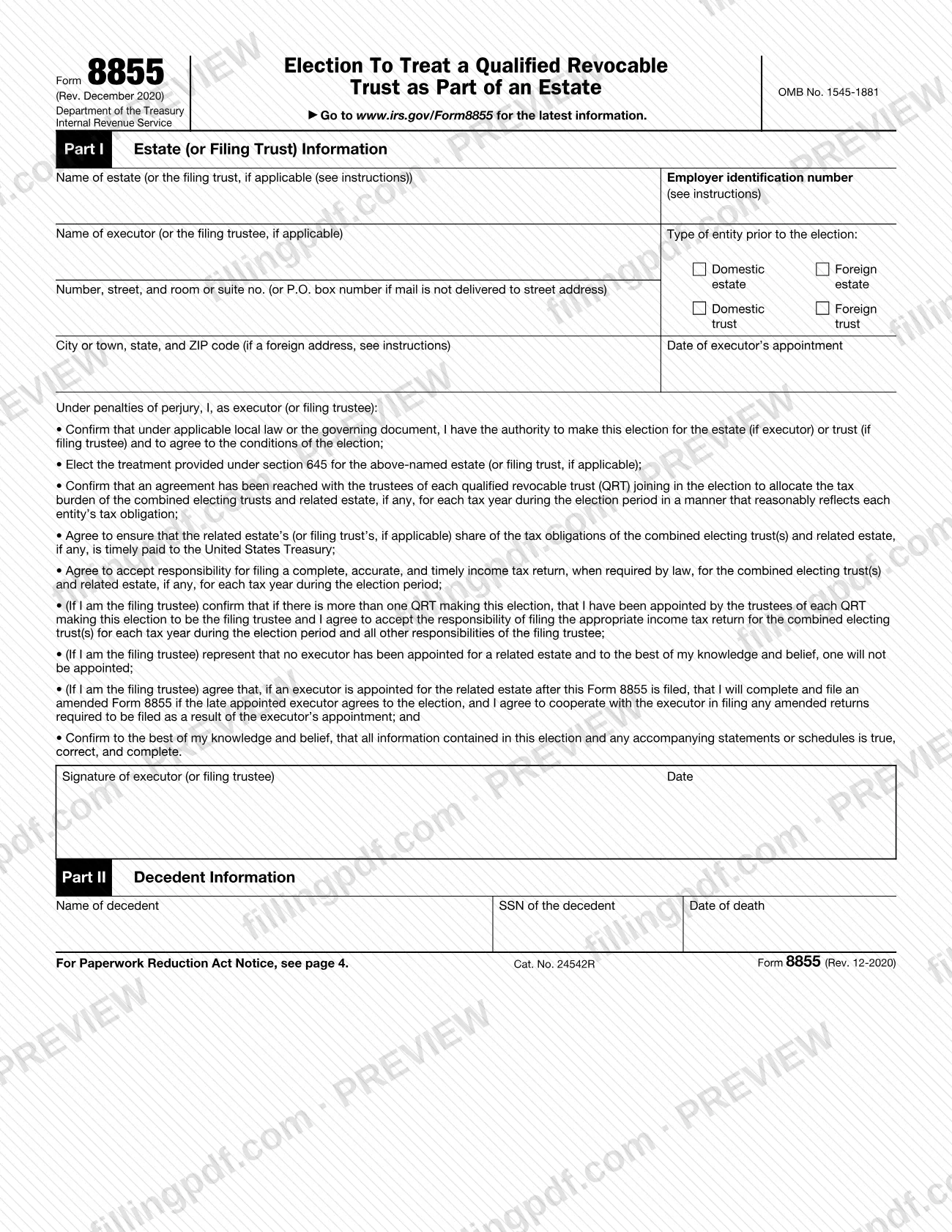
Form 8855, Election to Treat a Qualified Revocable Trust as Part of an Estate, is the Internal Revenue Service (IRS) form used to make a section 645 election. Executors of an estate and trustees of qualified revocable trusts (QRTs) use it so the trust is taxed as part of the estate during the election period, and the election cannot be revoked once it is made. On this page you can fill out form 8855 online on FillingPDF and download or print the completed PDF; the official PDF and the latest information are published by the IRS at www.irs.gov/Form8855.
Last updated
What is Form 8855?
Form 8855, Election to Treat a Qualified Revocable Trust as Part of an Estate, is the IRS form that executors and trustees use to make a section 645 election, treating a qualified revocable trust (QRT) as part of its related estate for income tax purposes.
Once the election is made, the electing trust or trusts and the related estate, if any, file one combined income tax return for each tax year of the election period and are treated as one estate. For example, the electing trusts are treated as part of the estate for adopting a tax year and for deciding whether estimated tax payments are required. Each electing trust and the estate are still treated as separate shares for the separate share rules under section 663(c).
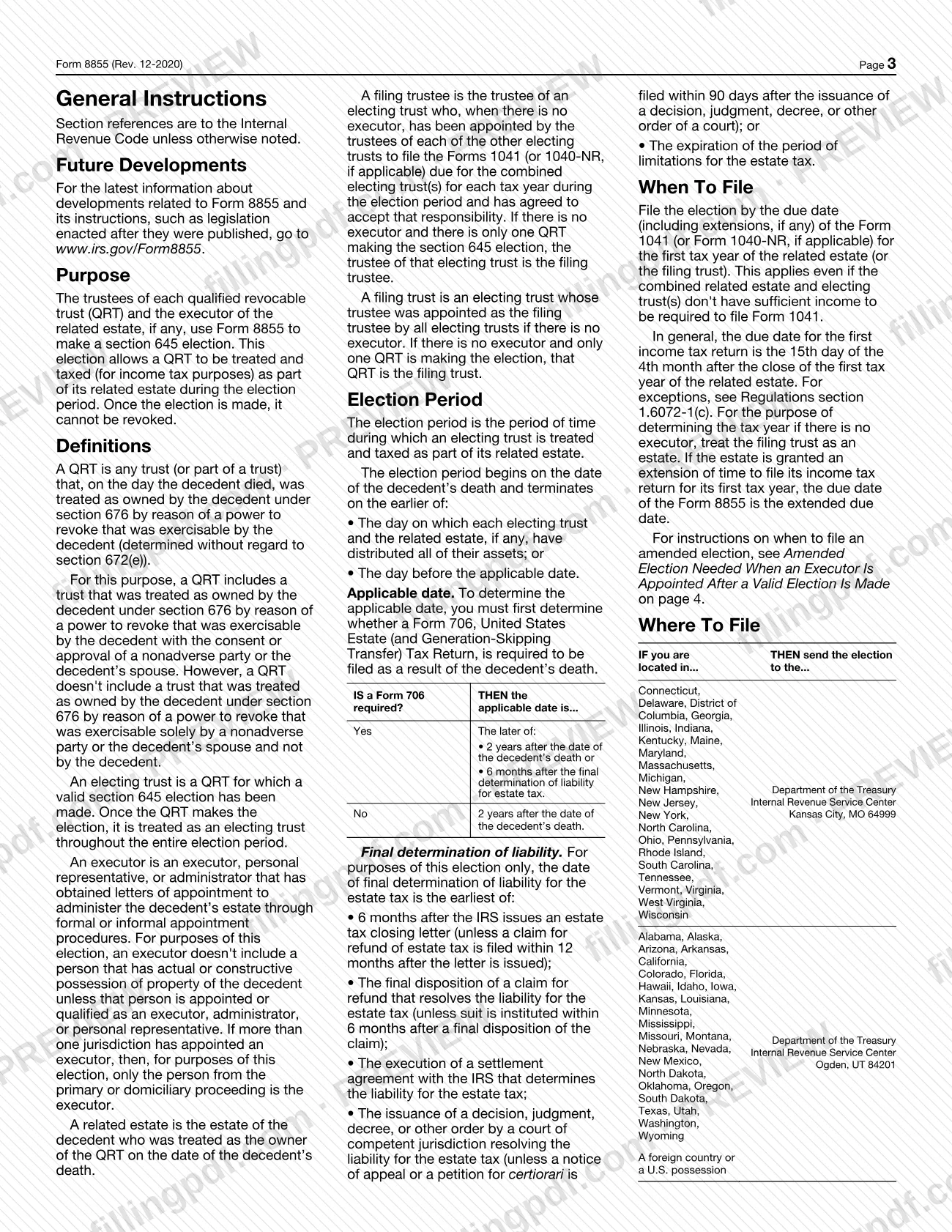
The election period begins on the date of the decedent's death. It ends on the earlier of the day all electing trusts and the related estate have distributed all their assets, or the day before the applicable date set out in the instructions. The election cannot be revoked.
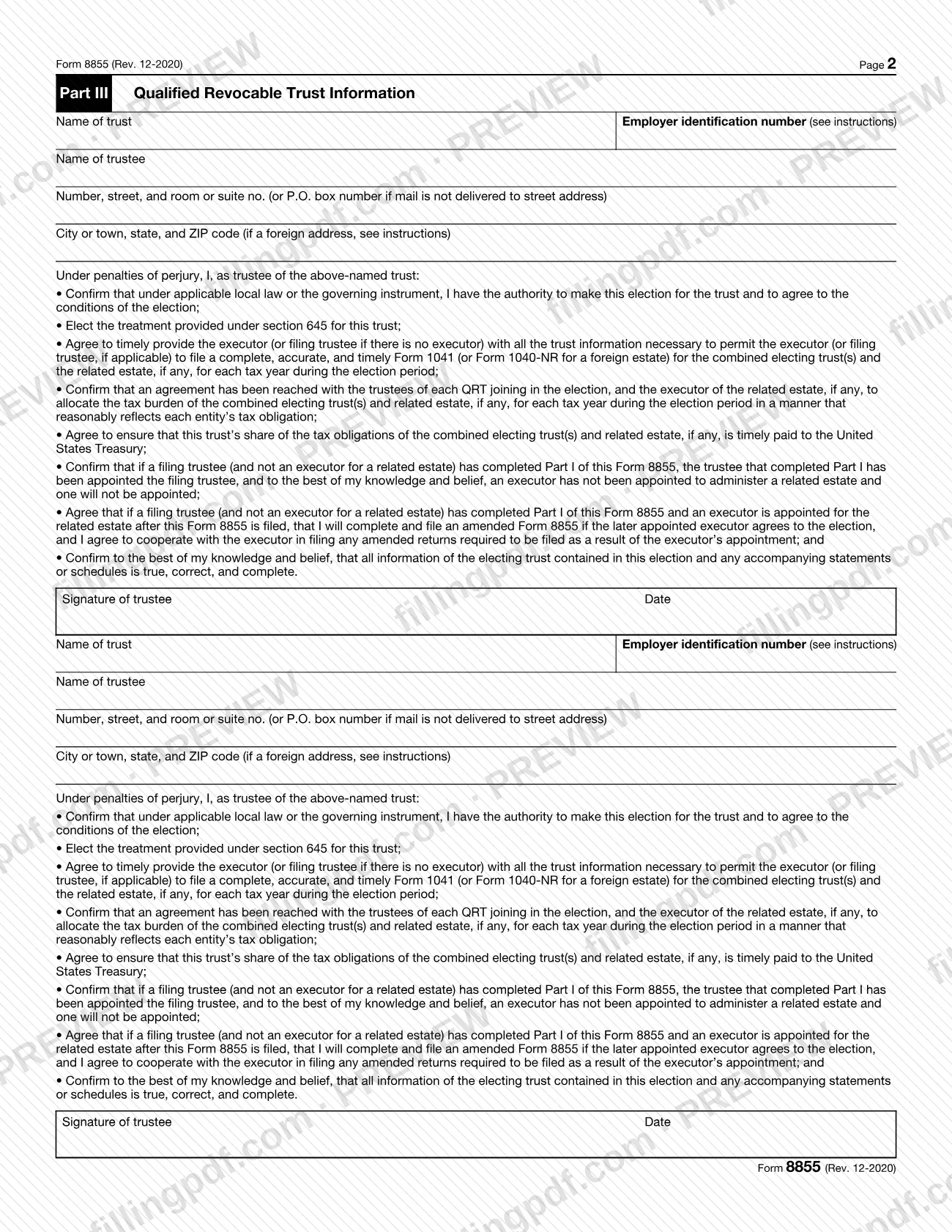
The form has three parts: Part I (estate or filing trust information), Part II (decedent information) and Part III (information and signature for each QRT joining in the election). The form is issued under OMB No. 1545-1881 and its instructions point to www.irs.gov/Form8855.
Who needs to file Form 8855?
The executor of the related estate and the trustee of each qualified revocable trust (QRT) that wants to be treated as part of that estate use Form 8855. A QRT is a trust, or part of one, that the decedent was treated as owning under section 676 on the day of death because of a power to revoke that the decedent could exercise.
- Executor: completes and signs Part I. An executor is a personal representative or administrator who has obtained letters of appointment; for this election it does not include someone who merely holds the decedent's property.
- Filing trustee: when there is no executor, a trustee appointed by the trustees of the other electing trusts to file the combined return completes and signs Part I. If only one QRT makes the election and there is no executor, that trust's trustee is the filing trustee.
- Trustee of each electing QRT: completes and signs Part III.
A trust treated as owned by the decedent only through a power to revoke held solely by a nonadverse party or the decedent's spouse, and not by the decedent, is not a QRT. If there are several executors or trustees for one entity, only one must sign unless local law or the governing document requires otherwise.
When to file Form 8855
File Form 8855 by the due date, including extensions, of the Form 1041 (or Form 1040-NR, if applicable) for the first tax year of the related estate or filing trust. This applies even if the combined estate and electing trusts do not have enough income to be required to file Form 1041.
In general, that return is due on the 15th day of the 4th month after the close of the estate's first tax year; see Regulations section 1.6072-1(c) for exceptions. If there is no executor, the filing trust is treated as an estate to determine the tax year. If the estate is granted an extension for its first return, the due date of Form 8855 is the extended due date.
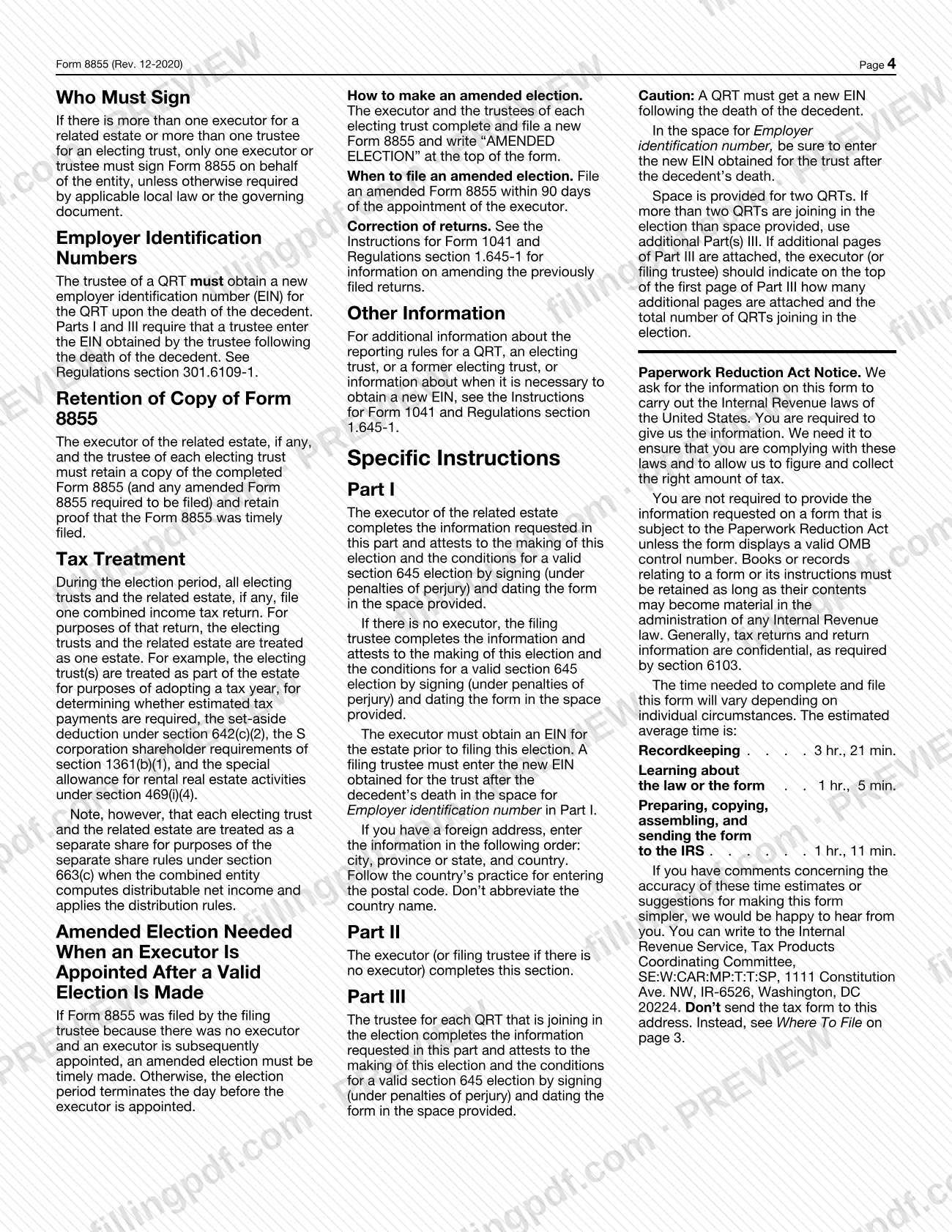
If a filing trustee made the election and an executor is later appointed, an amended Form 8855 must be filed within 90 days of the executor's appointment. Otherwise the election period ends the day before the executor is appointed.
How to fill out Form 8855
Identify the estate or filing trust
In Part I, enter the name of the estate (or the filing trust, if applicable) and its employer identification number. The executor must have obtained an EIN for the estate before filing; a filing trustee enters the new EIN obtained for the trust after the decedent's death.
Enter executor and address details
Enter the name of the executor (or filing trustee) and the street or P.O. box address, then city, state and ZIP code. For a foreign address, enter city, province or state, and country, following the country's postal code practice and without abbreviating the country.
Give appointment date and entity type
Enter the date of the executor's appointment. Check the type of entity prior to the election: domestic estate, foreign estate, domestic trust or foreign trust.
Sign and date Part I
The executor, or the filing trustee if there is no executor, signs and dates under penalties of perjury, which attests to the election and its conditions. If there are several executors or trustees, only one must sign unless local law or the governing document says otherwise.
Complete Part II decedent information
Enter the decedent's name, the decedent's SSN and the date of death. The executor (or filing trustee if there is no executor) completes this section.
Complete Part III for the first QRT
Enter the trust name, its EIN obtained after the decedent's death, the trustee's name and the trustee's address. The trustee signs and dates under penalties of perjury.
Complete the second QRT block
Page 2 has space for two QRTs. Repeat the same entries and signature for the second trust if it joins the election.
Add pages for more than two QRTs
If more than two QRTs join, use additional Part III pages. On the top of the first Part III page, write how many additional pages are attached and the total number of QRTs joining in the election.
Mark an amended election if needed
If an executor was appointed after a filing trustee made the election, the executor and each electing trustee complete and file a new Form 8855 and write "AMENDED ELECTION" at the top, within 90 days of the appointment.
Review, sign and download the PDF
Check that every EIN, name and date is correct and that every required signature is present. Download or print the completed PDF from FillingPDF, keep a copy, and mail it as described under How to submit.
How to submit Form 8855
Form 8855 is filed by mail with the IRS service center for the state where you are located. The instructions list no online or in-person channel.
- Kansas City: Department of the Treasury, Internal Revenue Service Center, Kansas City, MO 64999, for Connecticut, Delaware, District of Columbia, Georgia, Illinois, Indiana, Kentucky, Maine, Maryland, Massachusetts, Michigan, New Hampshire, New Jersey, New York, North Carolina, Ohio, Pennsylvania, Rhode Island, South Carolina, Tennessee, Vermont, Virginia, West Virginia and Wisconsin.
- Ogden: Department of the Treasury, Internal Revenue Service Center, Ogden, UT 84201, for Alabama, Alaska, Arizona, Arkansas, California, Colorado, Florida, Hawaii, Idaho, Iowa, Kansas, Louisiana, Minnesota, Mississippi, Missouri, Montana, Nebraska, Nevada, New Mexico, North Dakota, Oklahoma, Oregon, South Dakota, Texas, Utah, Washington and Wyoming.
The Form 8855 instructions place Tennessee with Kansas City, while an earlier IRS notice on its form page lists Tennessee with Ogden; confirm at www.irs.gov/Form8855. The instructions also have a separate row for filers in a foreign country or a U.S. possession. Do not send the form to the Tax Products Coordinating Committee address in the Paperwork Reduction Act notice. The executor and each electing trustee must keep a copy of the completed form and proof that it was timely filed. FillingPDF lets you fill out and download the PDF; submission follows the channels above.
Common mistakes to avoid
- Filing after the due date, including extensions, of the Form 1041 for the estate's first tax year; the deadline applies even if the combined entities have too little income to need to file Form 1041.
- Entering the trust's pre-death EIN in Part I or Part III; the trustee must obtain a new EIN after the decedent's death and enter that number.
- Filing as executor before the estate has an EIN; the executor must obtain one for the estate before filing the election.
- Leaving out the signature and date of the trustee of a QRT in Part III; the trustee of each QRT joining in the election completes and signs its own block.
- Using the wrong space for more than two QRTs; extra trusts go on additional Part III pages, with the number of added pages and total QRTs noted at the top of the first Part III page.
- Not filing an amended Form 8855 within 90 days after an executor is appointed following a filing trustee's election, or omitting "AMENDED ELECTION" at the top of the amended form.
- Abbreviating the country name on a foreign address; enter city, province or state, and country in that order, with the country spelled out.
- Mailing the form to the Tax Products Coordinating Committee address in the Paperwork Reduction Act notice instead of the service center listed under Where To File.
- Failing to keep a copy of the completed form and proof that it was timely filed.
Frequently asked questions
What is Form 8855 used for?
Form 8855 is the IRS form used to make a section 645 election. It lets a qualified revocable trust (QRT) be treated and taxed, for income tax purposes, as part of its related estate during the election period. The election cannot be revoked once made.
Who signs Form 8855?
The executor signs Part I, or the filing trustee if there is no executor, and the trustee of each QRT joining the election signs Part III. If an entity has several executors or trustees, only one needs to sign unless local law or the governing document requires more.
When is Form 8855 due?
By the due date, including extensions, of the Form 1041 (or Form 1040-NR) for the first tax year of the related estate or filing trust. That return is generally due on the 15th day of the 4th month after the tax year closes. If the estate gets an extension, Form 8855 is due on the extended date.
Where do I mail Form 8855?
Mail it to the Internal Revenue Service Center for your state: Kansas City, MO 64999 or Ogden, UT 84201. The instructions list which states go to which center and have a separate entry for foreign or U.S. possession filers, so check the Where To File table.
Can I revoke a section 645 election made on Form 8855?
No. The instructions state that once the election is made, it cannot be revoked. The election period continues until the electing trusts and the related estate have distributed all their assets, or until the day before the applicable date, whichever is earlier.
What if an executor is appointed after a filing trustee filed Form 8855?
An amended election must be timely made. The executor and each electing trustee complete a new Form 8855, write "AMENDED ELECTION" at the top and file it within 90 days of the executor's appointment. Otherwise the election period ends the day before the executor is appointed.
Does the trust need a new EIN for Form 8855?
Yes. The trustee of a QRT must obtain a new employer identification number upon the decedent's death, and Parts I and III require the EIN obtained after the death. The executor must also get an EIN for the estate before filing the election.
Can I fill out Form 8855 online?
You can fill out the Form 8855 PDF online on FillingPDF and download or print it. FillingPDF does not file the election for you: you mail the completed form to the IRS service center for your state, as described under How to submit.
Ready to fill out Form 8855?
Fill out Form 8855 now