
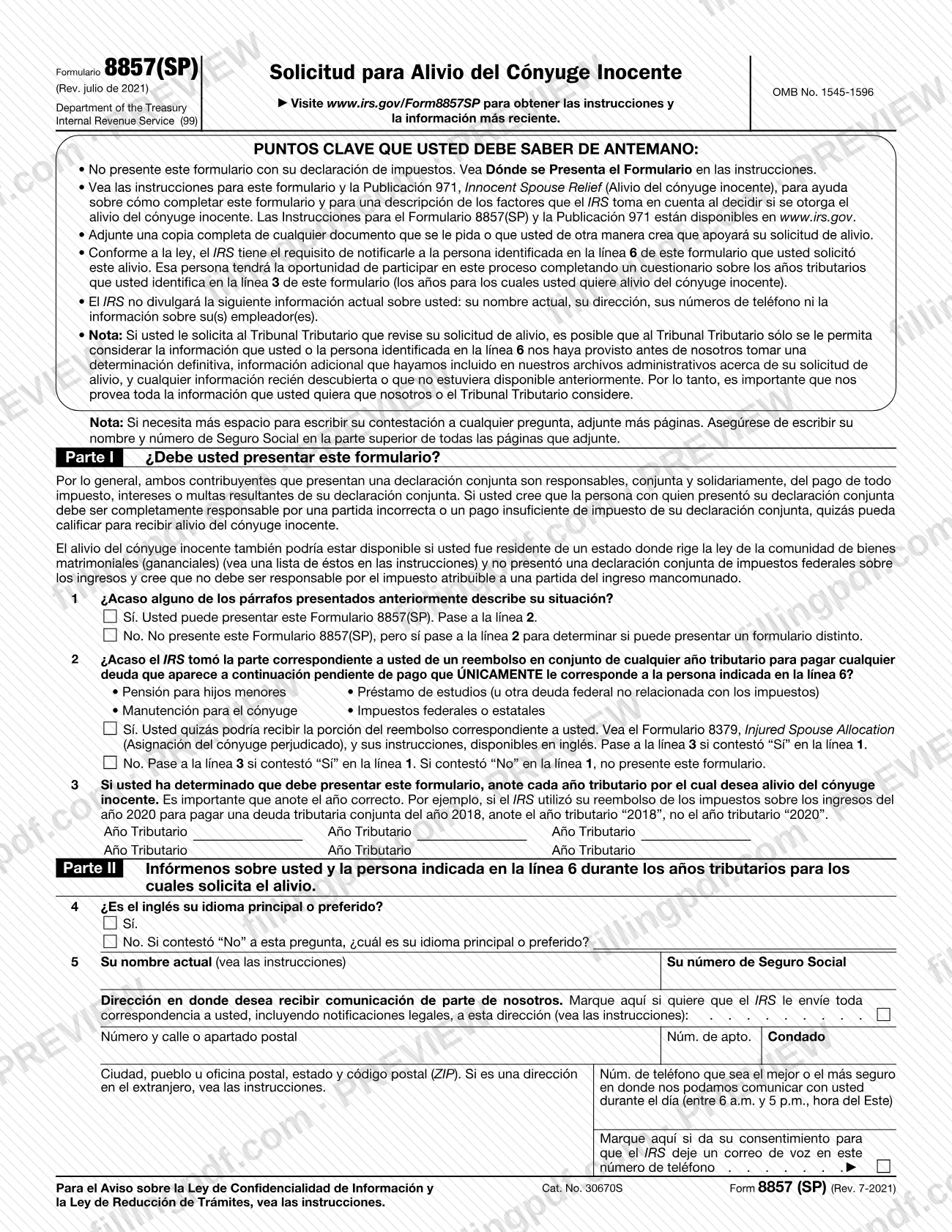
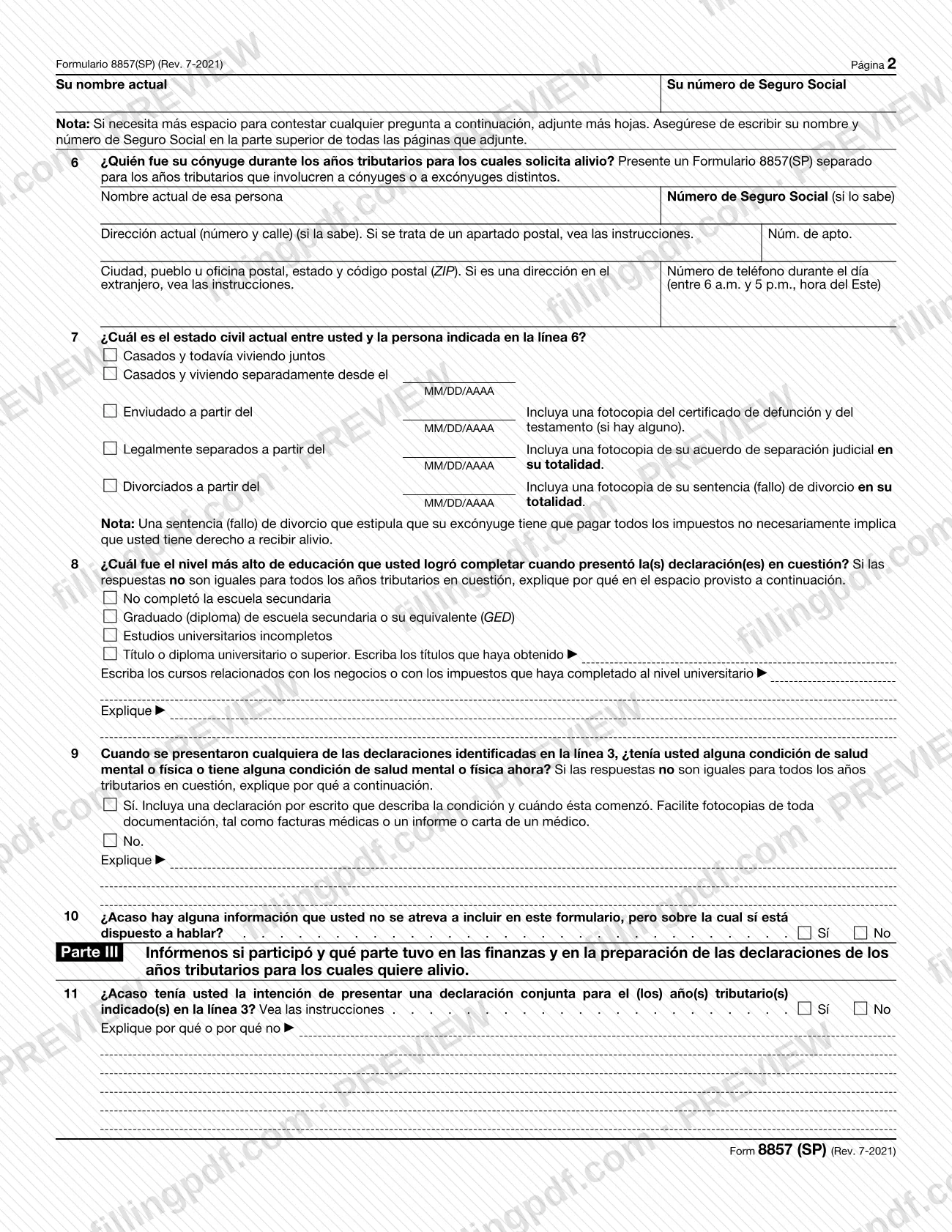
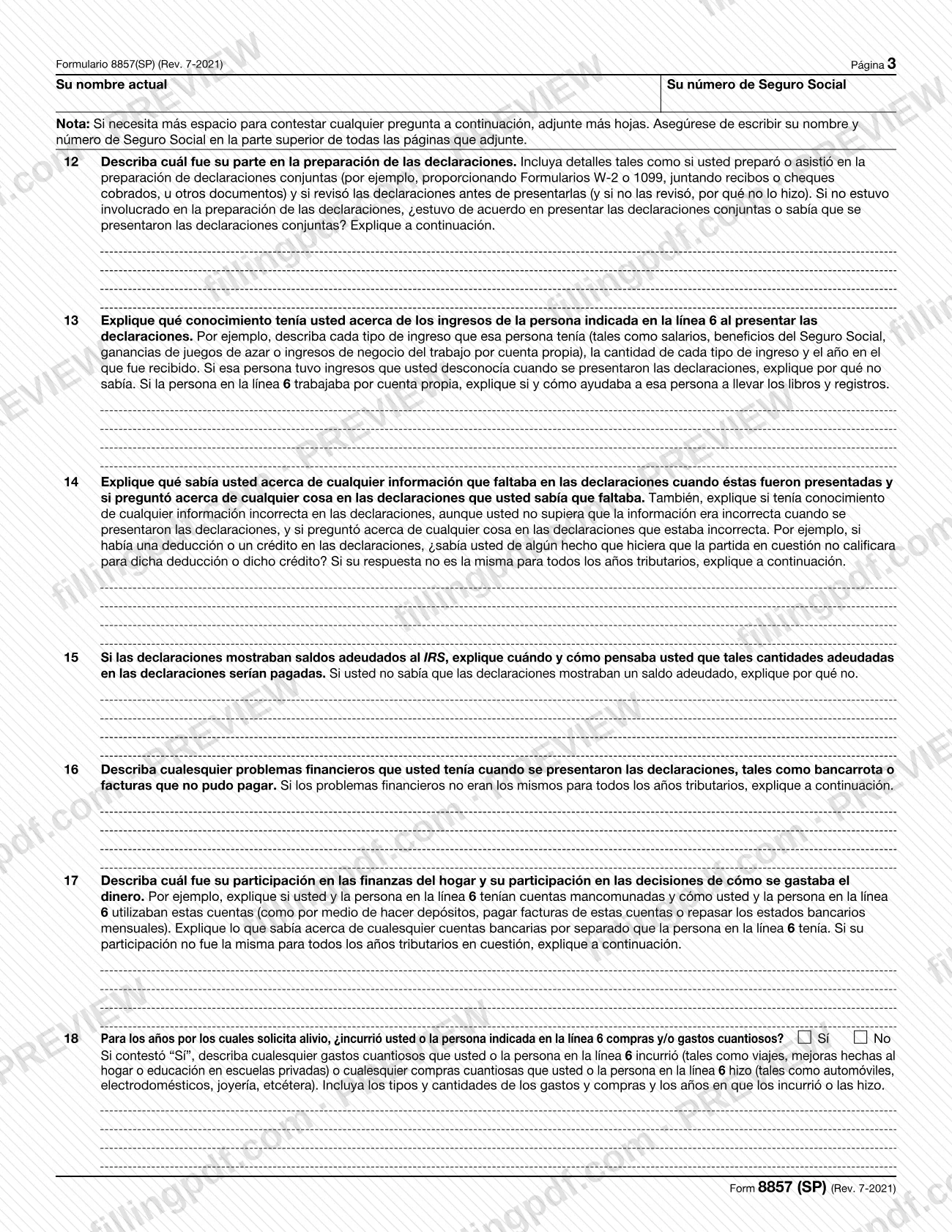
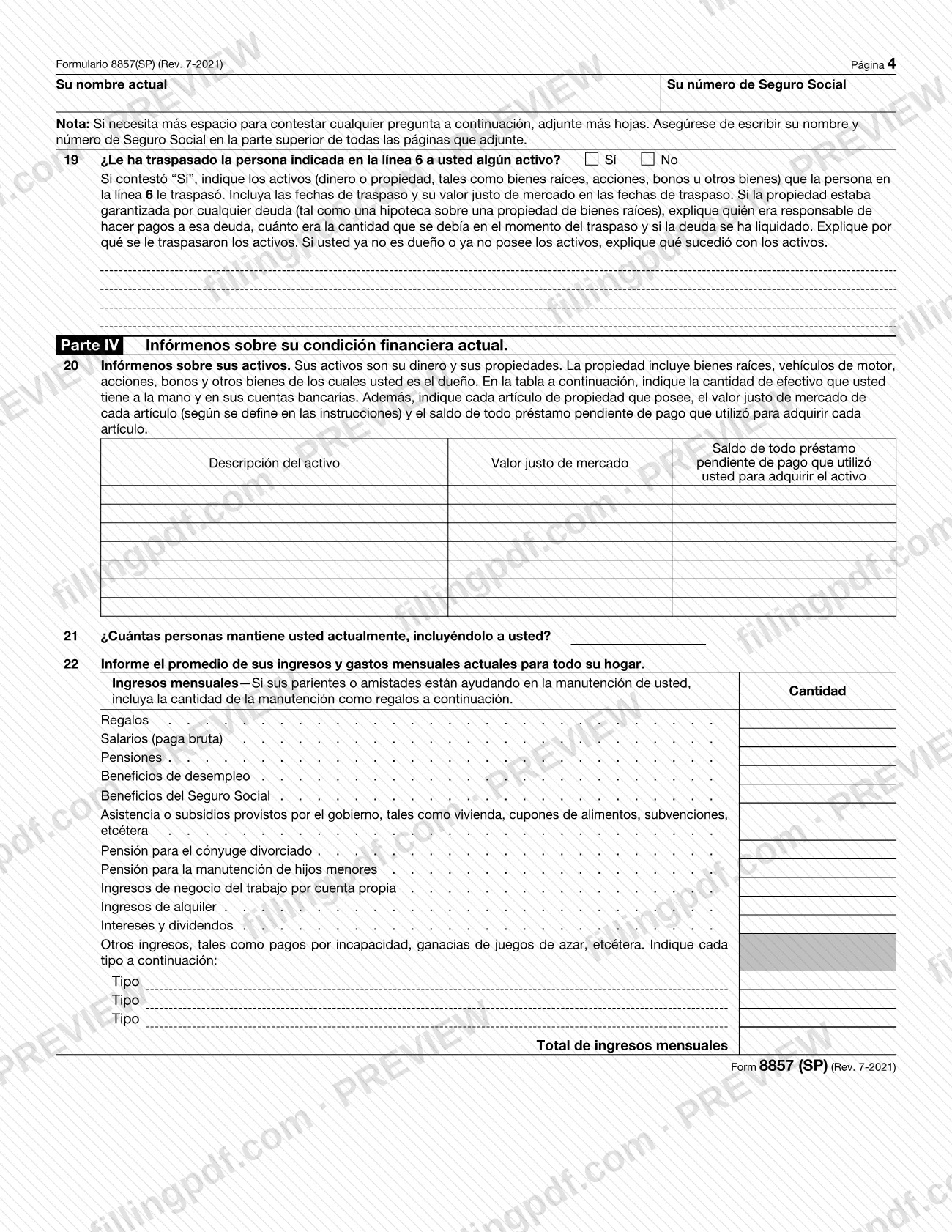
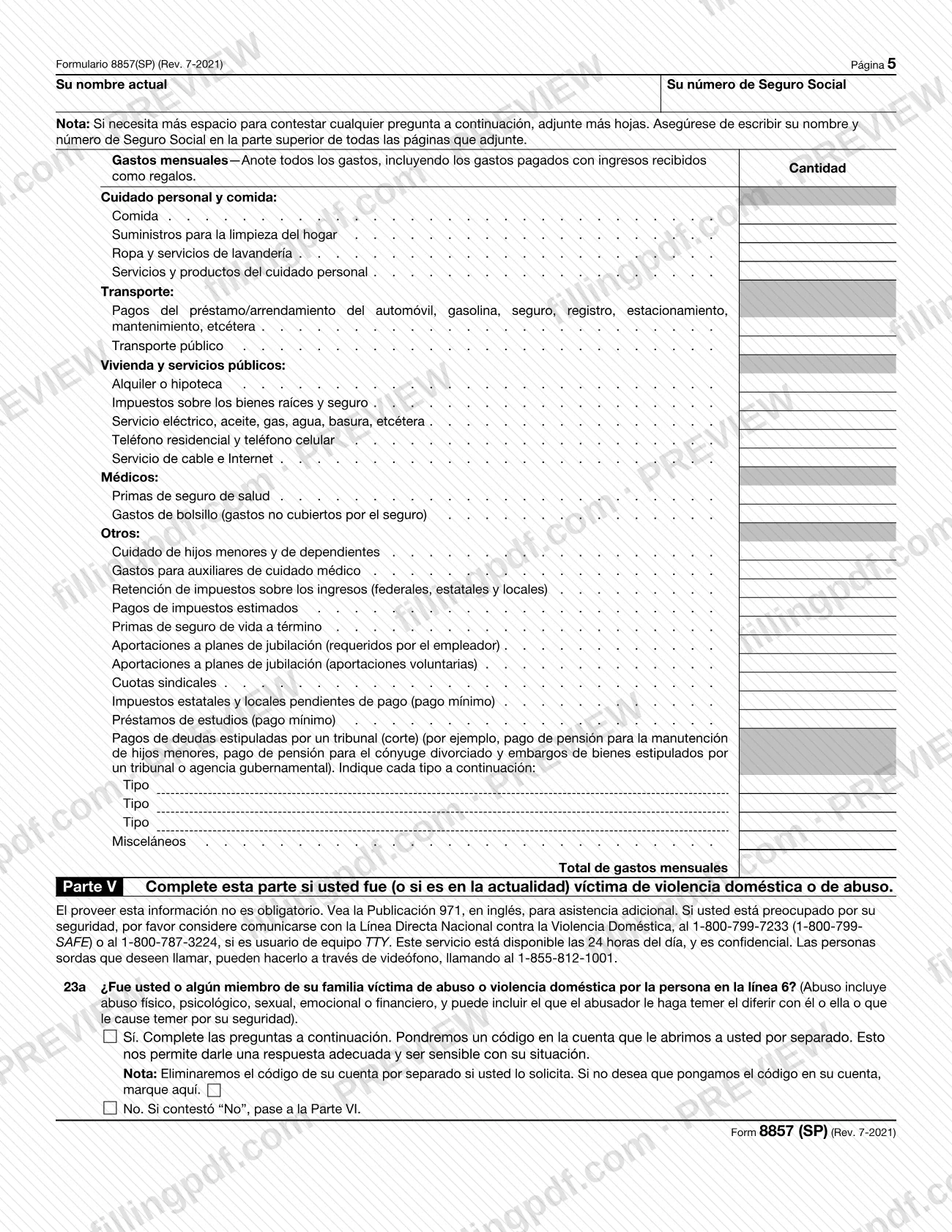
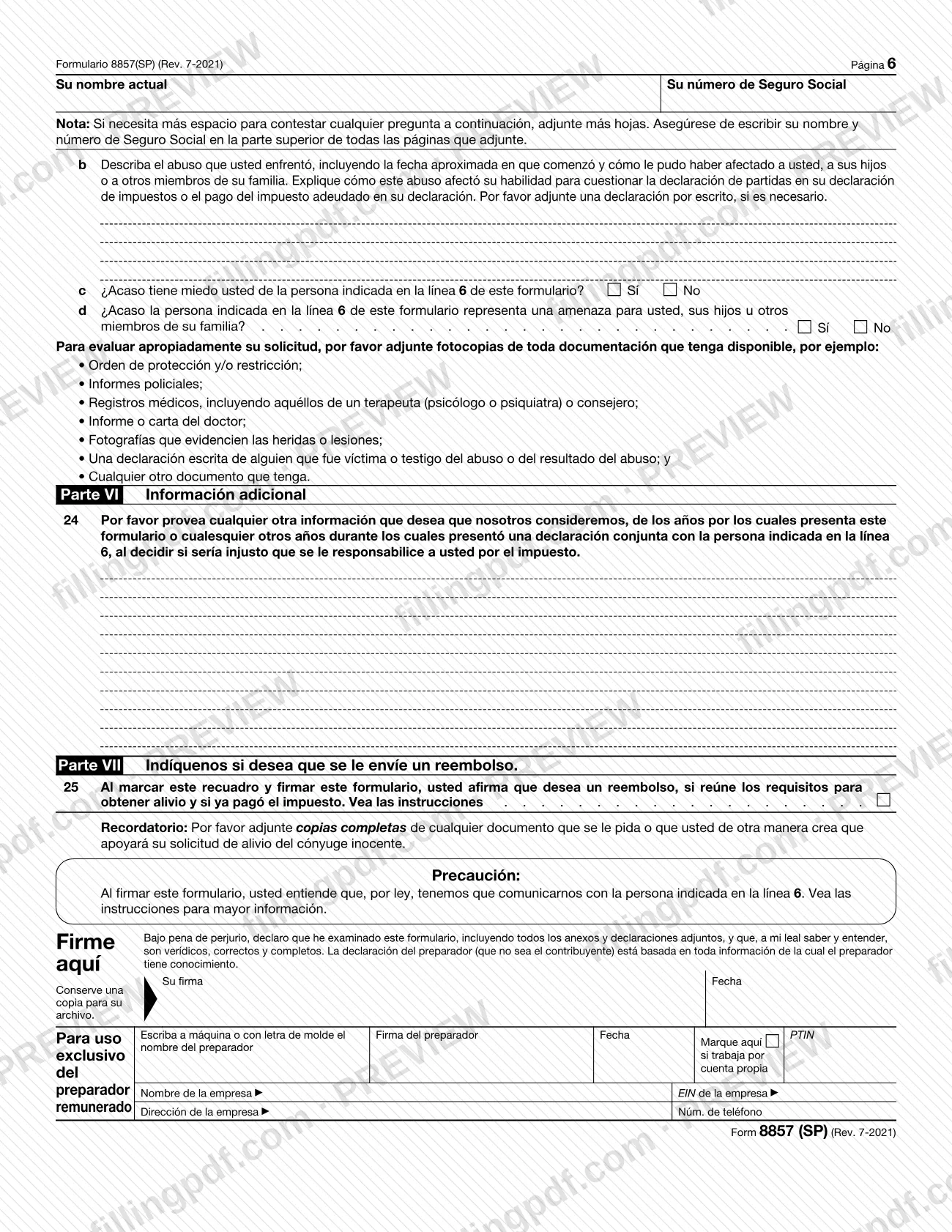
Form 8857 (SP), Solicitud para Alivio del Cónyuge Inocente, is the Spanish-language version of the Internal Revenue Service (IRS) request for innocent spouse relief. You use it when you filed a joint return, or lived in a community property state, and believe only your spouse or former spouse should be responsible for all or part of the tax, penalties and interest. On FillingPDF you can fill out Form 8857 (SP) online and download or print the completed PDF. The IRS publishes the form and its instructions at www.irs.gov/Form8857SP, and the form is not filed with your tax return.
Last updated
What is 8857 (SP)?
Form 8857 (SP), Solicitud para Alivio del Cónyuge Inocente, is the Spanish-language version of IRS Form 8857, the request for relief from tax, penalties and interest that you believe only your spouse or former spouse should be responsible for.
When two people file a joint return, the law makes each of them responsible for the whole tax, including any additional tax the IRS later finds. That joint and several liability continues even after a divorce, whatever the divorce decree says. Form 8857 (SP) is how you ask the IRS to relieve you of that liability. The IRS uses your answers and the documents you attach to decide whether you qualify.
The IRS instructions describe four types of relief:
- innocent spouse relief;
- relief by separation of liability;
- equitable relief, the only type available for unpaid tax;
- relief from liability for tax attributable to an item of community property.
The form is organized in seven parts: whether you should file (Part I), information about you and your spouse or former spouse (Part II), your involvement in finances and in preparing the returns (Part III), your current financial condition (Part IV), domestic violence or abuse (Part V), additional information (Part VI) and a refund request (Part VII).
It is not the same as Form 8379, Injured Spouse Allocation, which is a different claim for a share of a refund that was used for a debt owed only by your spouse. The IRS also publishes the English-language Form 8857, and the instructions accept either one.
Who needs to file 8857 (SP)?
You may file Form 8857 (SP) if you believe the person you filed a joint return with should be fully responsible for an incorrect item or an underpayment of tax on that return. You may also file if you lived in a community property state, did not file a joint federal income tax return, and believe you should not be responsible for the tax on an item of community property income. The instructions list Arizona, California, Idaho, Louisiana, Nevada, New Mexico, Texas, Washington and Wisconsin as community property states.
Line 1 of the form decides whether you file: check Sí if one of the situations on the form describes you. If you check No, do not file this form.
Do not file Form 8857 (SP) for a tax year if:
- a court issued a final ruling that considered and denied relief;
- a court did not consider relief but you took a meaningful part in the proceeding and could have asked for it;
- you accepted an offer in compromise with the IRS;
- you signed a closing agreement with the IRS covering the same liability (see Publication 971 for an exception tied to TEFRA partnership proceedings).
If the IRS used your share of a joint refund to pay a debt owed only by the person on line 6, you may instead need Form 8379. You may be represented by someone authorized to practice before the IRS, using Form 2848(SP). The IRS must contact your spouse or former spouse, with no exceptions, even for victims of abuse.
When to file 8857 (SP)
File Form 8857 (SP) as soon as you learn of a tax liability that you believe only your spouse or former spouse should owe, for example when the IRS examines your return and proposes an increase in tax, or sends you a notice or letter. Do not delay because you lack every document.
For most claims, file no later than 2 years after the IRS first tries to collect the tax from you. Different periods apply by type of relief:
- Balance due (equitable relief): generally within the period the IRS has to collect the tax, normally 10 years from assessment.
- Credit or refund: generally within 3 years of filing the original return or 2 years of paying the tax, whichever is later.
- Community property item relief: no later than 6 months before the statute of limitations for assessment on your spouse or former spouse expires, or within 30 days of the IRS's first letter if it starts an examination in that 6-month window.
If you receive a notice of deficiency, also file a petition with the Tax Court within the 90-day period stated in the notice. While your request is pending, the IRS cannot collect from you for that year, though interest and penalties keep accruing.
Documents you need
- If you are widowed (line 7): a photocopy of the death certificate and of the will, if there is one.
- If you are legally separated (line 7): a photocopy of the complete separate maintenance (separation) agreement.
- If you are divorced (line 7): a photocopy of the complete divorce decree.
- If you answer Yes on line 9 about a physical or mental health condition: a written statement describing the condition and when it began, plus photocopies of documentation such as medical bills or a doctor's report or letter.
- If you request a refund on line 25: proof that you paid the tax with your own funds, such as a bank statement or a canceled check. None is required if the IRS applied your personal refund to a joint tax debt for another year.
- If you answer Yes on line 23a (abuse): photocopies of available documentation, such as a protective or restraining order, police reports, medical or counselor records, a doctor's letter, photographs of injuries, or a written statement from a victim or witness.
- A complete copy of any other document the form asks for or that you believe supports your request.
- Additional pages if you need more space for an answer, each showing your name and Social Security number at the top.
How to fill out 8857 (SP)
Decide whether you should file
Part I, line 1: check Sí if a paragraph describes your situation, otherwise No. On line 2, say whether the IRS took your share of a joint refund for a debt owed only by the person on line 6; if so, Form 8379 may also apply.
List each tax year
Line 3: enter every tax year for which you want relief. Use the year of the joint tax liability, not the year of the refund the IRS used.
Enter your language and contact details
Part II, line 4 asks whether English is your primary language. On line 5 give your current name, Social Security number, mailing address with county, and a daytime phone number (6 a.m. to 5 p.m. Eastern); check the address box if you want all IRS mail sent there.
Identify your spouse and marital status
Line 6: enter the current name of the person you were married to in the years on line 3, with the SSN and address if known. On line 7 check your current status and the date (MM/DD/AAAA), and attach the document requested for widowed, separated or divorced status.
Answer education and health questions
Line 8: check your highest education level and list any degrees or tax or business courses. Line 9: answer about physical or mental health conditions and, if Yes, attach a written statement and documents. Line 10 asks whether there is information you cannot put on the form but would discuss.
Explain your role in the returns
Part III, lines 11 to 14: state whether you intended to file jointly, what you did to prepare the returns, what you knew about your spouse's income, and what you knew about missing or incorrect items. Attach more pages if needed.
Describe finances and large purchases
Lines 15 to 19: explain how you thought tax due would be paid, any financial problems, your part in household finances and accounts, large purchases or expenses (line 18) and assets transferred to you (line 19).
Report your current financial condition
Part IV: line 20 lists your assets, their fair market value and loans owed. Line 21 asks how many people you support. Line 22 asks for average monthly household income and expenses, with totals.
Complete the abuse questions if they apply
Part V is optional. If you answer Sí on line 23a, complete lines 23b to 23d and attach available documents. For help, the form lists the National Domestic Violence Hotline at 1-800-799-7233.
Add information and request a refund
Part VI, line 24: add anything else you want the IRS to consider about fairness. Part VII, line 25: check the box if you want a refund of tax you paid, if you qualify for relief.
Sign, date and attach documents
Sign and date under penalties of perjury. A paid preparer must also sign and enter a PTIN; someone who prepares it without charge should not sign. Attach complete copies of the supporting documents.
Review and download the completed PDF
Check every line, the tax years on line 3 and the attachments, with your name and SSN on each added page. Download or print the completed PDF from FillingPDF, keep a copy and send it as described under How to submit.
How to submit 8857 (SP)
You can send Form 8857 (SP) to the IRS by U.S. mail, by private delivery service or by fax. Do not file it with your tax return and do not send it to the Tax Court.
- U.S. Postal Service: Internal Revenue Service, P.O. Box 120053, Covington, KY 41012.
- Private delivery service (PDS): Internal Revenue Service, 7940 Kentucky Drive, Stop 840F, Florence, KY 41042. The IRS agency page notes a new private delivery mailing address for these instructions (May 2024), so confirm the current address at IRS.gov/Form8857SP before sending.
- Fax: 855-233-8558, with the form and the supporting documents.
Put your name and Social Security number on every page of attached documents, and keep a copy of the signed form. Use these addresses even if you are already dealing with an IRS employee about an audit, appeal or collection. The instructions describe the IRS as reviewing the form for completeness and contacting your spouse or former spouse; they give no processing time. To ask the IRS to remove the account code placed after a yes answer on line 23a, call 855-851-2009 or write to one of the addresses above. FillingPDF lets you fill out and download the PDF; submission follows the IRS channels above.
Common mistakes to avoid
- Filing Form 8857 (SP) with your tax return or with the Tax Court; the form says to send it to the addresses or fax number in the instructions.
- Entering the year the IRS took your refund on line 3 instead of the year of the joint tax debt; the form's example uses 2018, not 2020.
- Leaving the form unsigned or undated; the IRS cannot consider an unsigned request and returns it to you.
- Using one form for different spouses or former spouses; line 6 requires a separate form for tax years involving a different person.
- Omitting your name and Social Security number from the top of attached pages and documents.
- Checking No on line 1 and filing anyway; that answer means you should not file this form.
- Waiting to file until every document is gathered; the instructions warn that the filing deadline can pass.
- Skipping the Tax Court petition after receiving a notice of deficiency; the petition is due within the 90-day period stated in the notice.
- Expecting a refund of withholding, estimated tax or payments made with the joint return; the instructions say these are not refundable under this request.
Frequently asked questions
What is Form 8857 (SP) used for?
Form 8857 (SP) is the Spanish-language IRS request for innocent spouse relief. You file it to ask to be relieved of tax, penalties and interest from a joint return that you believe only your spouse or former spouse should be responsible for.
What is the difference between Form 8857 (SP) and Form 8857?
Form 8857 (SP) is the Spanish-language version of Form 8857, the English form. The IRS instructions treat them as the same request: you file one or the other, not both. The instructions refer to Form 8857(SP) (or Form 8857 in English).
Where do I send Form 8857 (SP)?
By U.S. mail to Internal Revenue Service, P.O. Box 120053, Covington, KY 41012, or by fax to 855-233-8558. A private delivery service goes to 7940 Kentucky Drive, Stop 840F, Florence, KY 41042; check IRS.gov/Form8857SP for the current address. Do not send it with your tax return.
What is the deadline to file Form 8857 (SP)?
Generally no later than 2 years after the IRS's first attempt to collect the tax from you. Separate periods apply for balances due, refunds and community property relief, so file as soon as you learn of the liability rather than waiting for every document.
Will the IRS tell my spouse or ex-spouse that I filed?
Yes. By law the IRS must notify the person on line 6 and let them take part in the process, with no exceptions, even for abuse victims. The IRS will not disclose your current name, address, phone numbers or employer information.
Can I file Form 8857 (SP) if my divorce decree says my ex-spouse pays the tax?
Yes, you can ask, but the decree does not remove your liability to the IRS. The form notes that a decree requiring an ex-spouse to pay all taxes does not necessarily mean you qualify for relief. Your situation is judged on the facts and circumstances.
Do I need to send documents with Form 8857 (SP)?
Attach complete copies of any document the form requests or that you believe supports your request. Examples include a divorce decree, separation agreement or death certificate for line 7, and proof of payment if you want a refund on line 25.
Can I fill out Form 8857 (SP) online?
You can fill out the PDF online on FillingPDF and download or print it. FillingPDF is an independent service and does not send the form to the IRS; you mail or fax it using the IRS channels.
Ready to fill out 8857 (SP)?
Fill out 8857 (SP) now