
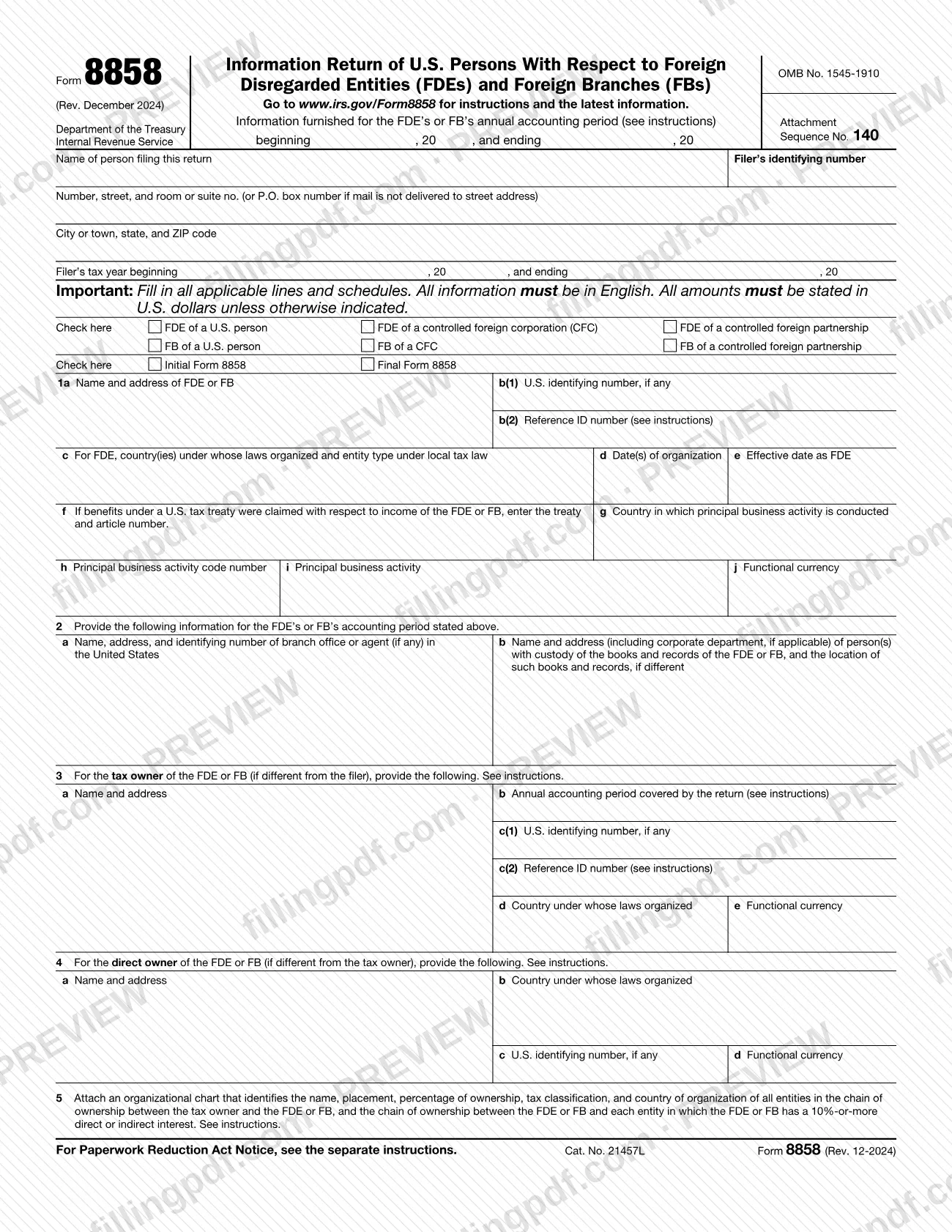
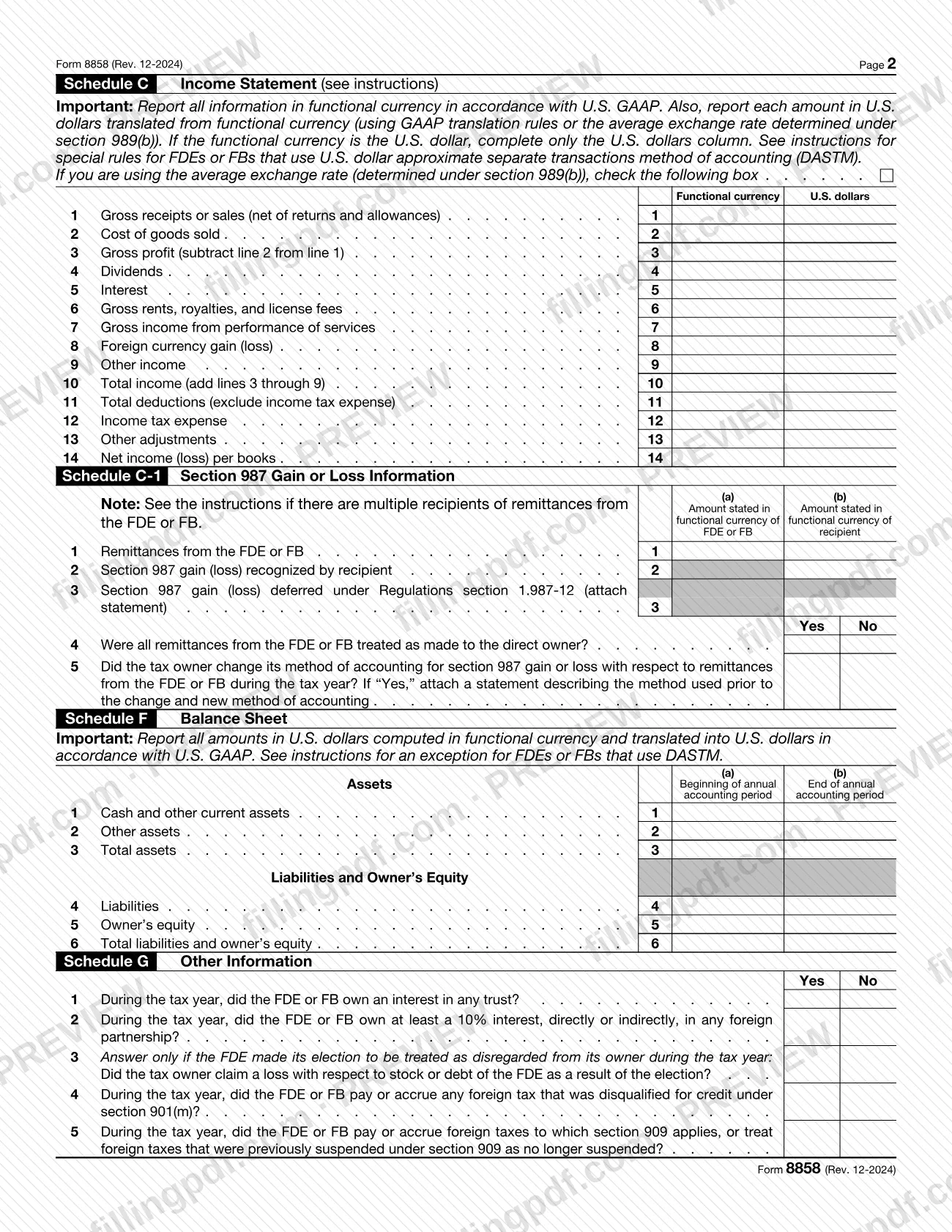
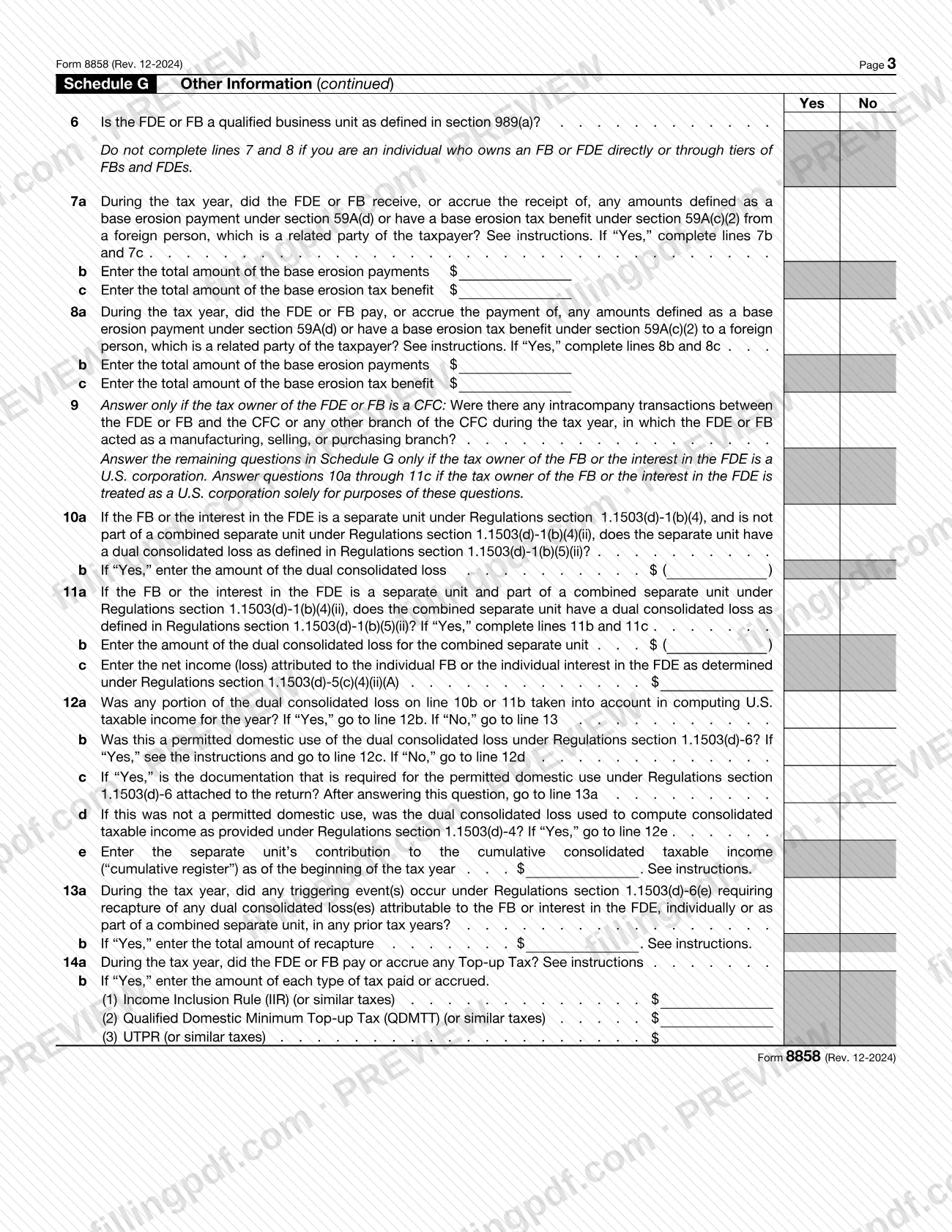
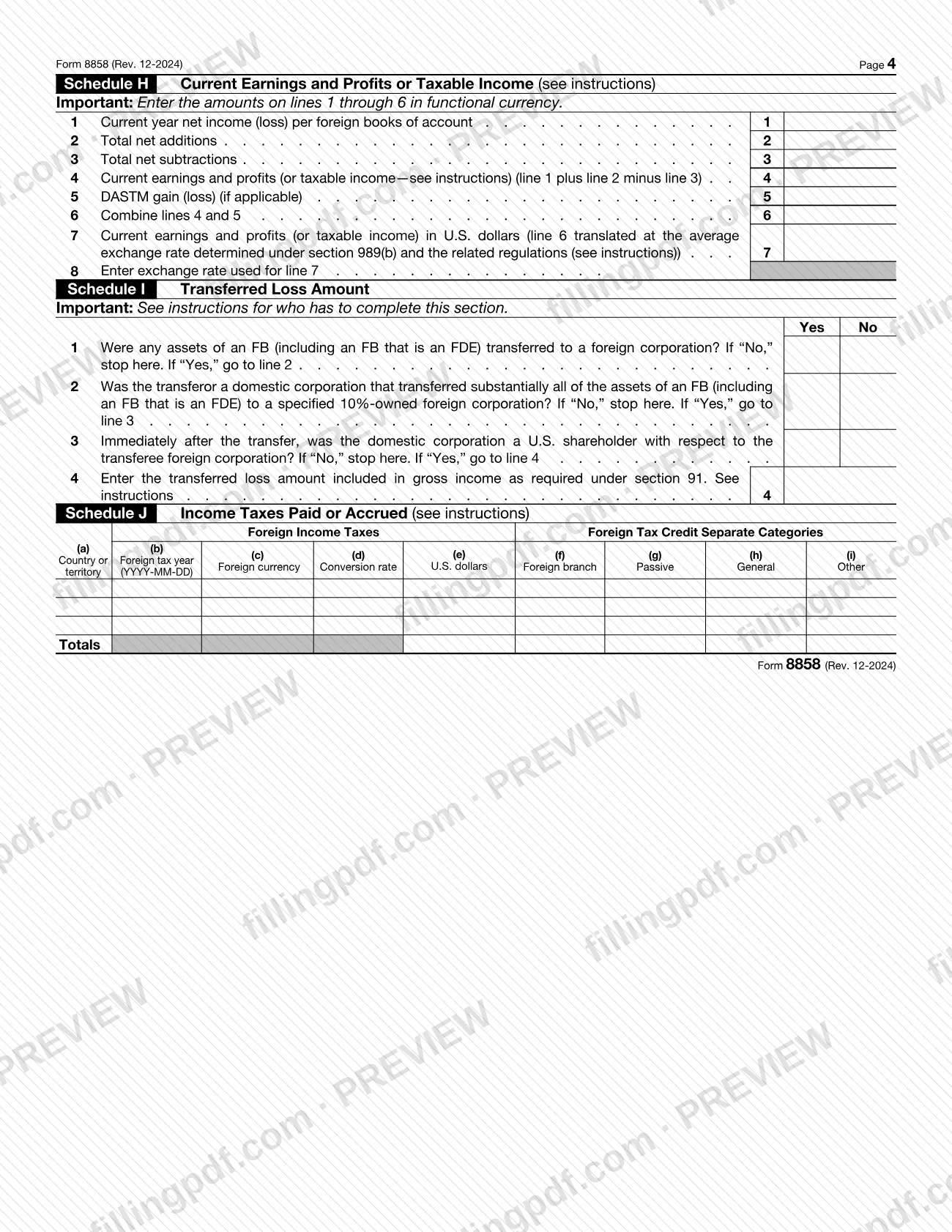
Form 8858, Information Return of U.S. Persons With Respect to Foreign Disregarded Entities (FDEs) and Foreign Branches (FBs), is the Internal Revenue Service (IRS) return that certain U.S. persons file to report a foreign disregarded entity (FDE) they own or a foreign branch (FB) they operate. It is attached to the filer's own income tax or information return or, for a controlled foreign corporation (CFC) or controlled foreign partnership (CFP), to Form 5471 or Form 8865. On FillingPDF you can fill out the form online and download or print the completed PDF; the original PDF and its instructions are published by the IRS at www.irs.gov/Form8858.
Last updated
What is 8858?
Form 8858, Information Return of U.S. Persons With Respect to Foreign Disregarded Entities (FDEs) and Foreign Branches (FBs) is the IRS form used by certain U.S. persons that operate a foreign branch or own a foreign disregarded entity to report its identity, ownership, financial statements, earnings and profits and foreign taxes.
The IRS says the form and its schedules satisfy the reporting requirements of sections 6011, 6012, 6031 and 6038 of the Internal Revenue Code and the related regulations. The form is issued under OMB No. 1545-1910.
Besides the identifying lines on page 1 (including the organizational chart required by line 5), the form contains these schedules:
- Schedule C, Income Statement, and Schedule C-1, Section 987 Gain or Loss Information.
- Schedule F, Balance Sheet.
- Schedule G, Other Information, which includes the dual consolidated loss and Top-up Tax questions.
- Schedule H, Current Earnings and Profits or Taxable Income.
- Schedule I, Transferred Loss Amount, and Schedule J, Income Taxes Paid or Accrued.
Transactions between the FDE or FB and the filer or related entities are reported on the separate Schedule M (Form 8858), which the IRS publishes as its own PDF. A separate Form 8858 is completed for each FDE or FB, including each tier.
Form 8858 does not make an entity disregarded. Eligible entities elect their classification on Form 8832; Form 8858 reports the resulting FDE.
Who needs to file 8858?
The main group is U.S. persons that are the tax owner of an FDE or operate an FB. The IRS instructions divide filers into categories:
- Category 1: a U.S. person that is directly a tax owner of an FDE or operates an FB at any time during its tax year or annual accounting period. It completes the entire form and Schedule M (Form 8858).
- Category 2: a U.S. person that is a tax owner of an FDE, or operates an FB, indirectly through one or more tiers of FDEs. It also completes the entire form and Schedule M.
- Categories 3 and 4: certain U.S. persons required to file Form 5471 for a CFC, or Form 8865 for a CFP, that is the tax owner of an FDE or operates an FB. Some complete everything; others complete only the identifying information on page 1 and Schedules G, H and J.
- Category 5: a U.S. partner in a partnership that applies section 987 at the partner level; it completes page 1 and Schedule C-1.
- Category 6: a U.S. corporation (other than a RIC, REIT or S corporation) that is a partner in a partnership that checked box 11 (Dual Consolidated Loss) on Schedules K-2 and K-3 (Form 1065).
A U.S. person is a citizen or resident alien, a domestic partnership or corporation, an estate other than a foreign estate, or a domestic trust.
Exceptions: one person may file for others with the same filing requirements, and a category 2 filer of Form 8865 need not file if a category 1 filer of Form 8865 completes the entire form. Individuals who own an FB or FDE directly or through tiers do not complete Schedule G lines 7 and 8.
When to file 8858
Form 8858 is due when your income tax return or information return is due, including extensions. It has no separate due date.
If you are the tax owner of the FDE or operate the FB, attach Form 8858, and Schedule M (Form 8858) if required, to your income tax return or information return. If you are not the tax owner of the FDE or indirect FB, attach it to the Form 5471 or Form 8865 you file for the CFC or CFP.
Check Initial Form 8858 in the year the tax owner formed or acquired the FDE or FB, and Final Form 8858 in the year it terminated or disposed of it. Only one box may be checked on each form. If the FDE or FB is formed or acquired and terminated or disposed of in the same tax year, file a separate Form 8858 for each event.
The information covers the annual accounting period of the FDE or FB, which follows the tax year of a U.S. tax owner, or the annual accounting period of a CFC or CFP tax owner.
Documents you need
- Organizational chart required by line 5: name, placement, percentage of ownership, tax classification and country of organization of every entity between the tax owner and the FDE or FB, and each entity in which it has a 10%-or-more interest.
- Schedule M (Form 8858), Transactions Between Foreign Disregarded Entity (FDE) or Foreign Branch (FB) and the Filer or Other Related Entities: required with each Form 8858 where the FDE or FB entered into any such transaction, for filers who complete it.
- Statement with the line 4 information for each additional direct owner, when the FDE has more than one direct owner.
- Statements for Schedule C-1: the methodology and deferral details for section 987 gain or loss reported on lines 2 and 3, and a description of the old and new method if the accounting method for section 987 changed (line 5).
- Disclosure statement under Regulations section 1.6011-4 if the tax owner of the FDE claims a section 165 loss for worthless stock or certain obligations, as described for Schedule G, line 3.
- Documents for a permitted domestic use of a dual consolidated loss (Schedule G, line 12c): an elective agreement document, a "No Possibility of Foreign Use of Dual Consolidated Loss Statement" or a "Domestic Use Election and Agreement".
- Statement describing the triggering event, its regulation citation and the prior-year DCLs recaptured, when you answer Yes on Schedule G, line 13a.
- Separate schedule of Schedule H adjustment items, showing each amount, whether it is a net addition or subtraction, and the totals entered on lines 2 and 3.
- "Schedule I—Transferred Loss Amount Additional Information" statement, when a transferred loss amount greater than zero is entered on Schedule I, line 4.
- IRS approval letter, when the Form 8858 and its schedules are computer-generated.
How to fill out 8858
Enter the filer and accounting period
Enter the FDE's or FB's annual accounting period below the title, then the filer's name, identifying number, address and tax year. A U.S. corporation in a consolidated group lists the common parent as the filer.
Check the filer type and Initial or Final
Check the box that describes the FDE or FB (for example FDE of a U.S. person, FB of a CFC). Check Initial Form 8858 or Final Form 8858 only if the FDE or FB was formed, acquired, terminated or disposed of this year, never both.
Identify the FDE or FB on line 1
Line 1a: name and address. Line 1b(1): EIN, or line 1b(2): a reference ID number if you have no EIN (never an SSN). Complete lines 1c to 1f, then 1g with the two-letter country code, 1h with the 6-digit activity code, 1i and 1j with the three-letter functional currency code.
Complete lines 2, 3 and 4
Line 2: the U.S. branch office or agent and the person with custody of the books and records. Line 3: the tax owner if different from the filer. Line 4: the direct owner if different from the tax owner, attaching a statement for each extra direct owner.
Attach the organizational chart
For line 5, attach a chart of the ownership chain between the tax owner and the FDE or FB, and between the FDE or FB and each entity in which it has a 10%-or-more direct or indirect interest. One chart may cover several FDEs and FBs.
Complete Schedule C income statement
Report lines 1 to 14 in functional currency under U.S. GAAP and in U.S. dollars. Check the box above line 1 if you use the section 989(b) average exchange rate. If the functional currency is the U.S. dollar, complete only the U.S. dollars column.
Complete Schedule C-1 if section 987 applies
Enter remittances on line 1, section 987 gain or loss recognized on line 2 and deferred gain or loss on line 3 in columns (a) and (b), then answer lines 4 and 5. Use a separate Schedule C-1 for each QBU owner.
Complete Schedule F balance sheet
Enter cash and other current assets, other assets, liabilities and owner's equity for the beginning and end of the annual accounting period, in U.S. dollars per U.S. GAAP. Lines 3 and 6 are the totals.
Answer Schedule G questions 1 to 9
Check Yes or No for lines 1 to 6, complete lines 7 and 8 on base erosion payments unless you are an individual, and answer line 9 only if the tax owner is a CFC. Answer line 3 only if the FDE elected disregarded status this year.
Answer Schedule G lines 10 to 14
Complete lines 10 to 13 on dual consolidated losses only if the tax owner is a U.S. corporation (not a RIC, REIT or S corporation). Line 14 asks about Top-up Tax; enter each type on lines 14b(1) to 14b(3) if you answer Yes.
Complete Schedule H earnings and profits
Start with net income per books on line 1, add net additions on line 2, subtract net subtractions on line 3 and enter DASTM gain or loss on line 5 if applicable. Translate line 6 into U.S. dollars on line 7 and enter the exchange rate on line 8.
Complete Schedule I if assets transferred
Answer lines 1 to 3, stopping at the first No. If you reach line 4, enter the transferred loss amount included in gross income under section 91 and attach the additional information statement.
Complete Schedule J foreign income taxes
For each country, enter the two-letter code, the foreign tax year (YYYY-MM-DD), the tax in foreign currency, the conversion rate and the U.S. dollar amount. Then assign the dollars to the separate category in columns (f) to (i) and total them.
Prepare Schedule M and attachments
Complete the separate Schedule M (Form 8858) if required and gather the statements and chart the form calls for. Match the column set to the tax owner: U.S. person, CFC or CFP.
Review and download the completed PDF
Check that every applicable line is complete, amounts are in U.S. dollars unless noted, and exchange rates use the divide-by convention. Download or print the completed PDF from FillingPDF and attach it to the return described under How to submit.
How to submit 8858
Form 8858 is not mailed on its own. It is filed as an attachment to another return, and the instructions name no separate address, portal or appointment.
- Paper filing: attach Form 8858 and Schedule M (Form 8858), if required, to your income tax return or information return. If you are not the tax owner of the FDE or indirect FB, attach it to the Form 5471 or Form 8865 you file for the CFC or CFP. Send the whole package as the instructions for that return direct.
- Electronic filing, Form 1120 or 1065: attach Form 8858 electronically to the e-filed Form 1120, Form 1065, Form 5471 or Form 8865.
- Electronic filing, Form 1040, Form 1040-SR or Form 1041: attach Form 8858 to the applicable Form 8453. When e-filing, enter a valid country code from IRS.gov/CountryCodes instead of a country name in addresses.
- Computer-generated forms: these generally need prior IRS approval through the Substitute Forms Program, and the approval letter must be attached to Form 8858.
Extra information that does not fit in a section goes on additional sheets that follow the IRS version of that section. FillingPDF lets you fill out and download the PDF; submission follows the channels above.
Common mistakes to avoid
- Writing "see attached" in a section instead of completing every entry space and attaching only the remaining information on additional sheets that follow the IRS version of that section.
- Entering a Social Security number on line 1b(1) or 1b(2) for the FDE or FB; the instructions say not to, and an EIN belongs on line 1b(1).
- Reporting the exchange rate as U.S. dollars per unit of foreign currency. It must use the divide-by convention: units of foreign currency equal to 1 U.S. dollar, rounded to at least four places.
- Checking both the Initial and Final boxes, or filing one form when an FDE is formed and terminated in the same year; each event needs its own Form 8858.
- Adding lower-tier FDE or FB amounts to the form for the upper-tier FDE; each tier gets its own Form 8858, although all amounts are included for the tax owner.
- Completing Schedule G lines 7 and 8 as an individual who owns an FB or FDE directly or through tiers; the form says not to.
- Abbreviating the country name in a foreign address, or entering a country name instead of a valid country code on an e-filed form.
- Omitting Schedule M (Form 8858) when the FDE or FB had transactions with the filer or related entities.
- Reducing Schedule H earnings and profits or taxable income by blocked income that could not have been distributed because of foreign currency or other restrictions.
- Listing non-creditable taxes, such as those disallowed under section 901(j), (k), (l) or (m), on Schedule J.
Frequently asked questions
What is Form 8858 used for?
Form 8858 is the IRS information return on which certain U.S. persons report a foreign disregarded entity they own or a foreign branch they operate. It covers the entity's identity, ownership, income statement, balance sheet, earnings and profits and foreign taxes, satisfying sections 6011, 6012, 6031 and 6038.
Who has to file Form 8858?
U.S. persons that are the direct or indirect tax owner of an FDE, or that operate an FB, must file it. Certain Form 5471 and Form 8865 filers and certain partners must also file. The IRS instructions define six filer categories, and each category completes different parts of the form.
When is Form 8858 due?
It is due when your income tax return or information return is due, including extensions. The form has no separate due date, because you attach it to that return, or to Form 5471 or Form 8865 if you are not the tax owner of the FDE or indirect FB.
Where do I send Form 8858?
You do not send it separately. Attach it, with Schedule M (Form 8858) if required, to your income tax or information return, or to Form 5471 or Form 8865. When e-filing Form 1120 or 1065, attach it electronically; with Form 1040, 1040-SR or 1041, attach it to Form 8453.
Do I need a separate Form 8858 for each FDE or FB?
Yes. Complete a separate Form 8858 and all applicable schedules for each FDE or FB, including each tier. Do not add lower-tier amounts to the upper-tier form, although all amounts are included when figuring amounts for the tax owner.
Is Schedule M part of Form 8858?
Schedule M (Form 8858), Transactions Between Foreign Disregarded Entity (FDE) or Foreign Branch (FB) and the Filer or Other Related Entities, is a separate IRS PDF filed with Form 8858. It is required when the FDE or FB entered into transactions with the filer or related entities, for filers who must complete it.
How do I report the exchange rate on Form 8858?
Use the divide-by convention: report the units of foreign currency that equal 1 U.S. dollar, rounded to at least four places, and divide the functional currency amount by it. Do not report U.S. dollars per unit of foreign currency.
What are the penalties for not filing Form 8858?
Failure to furnish the information on time can bring a monetary penalty for each annual accounting period, a reduction of foreign taxes available for credit, and, if the failure continues after IRS notice, additional amounts. Criminal penalties may also apply. See the instructions for the current limits.
When do I check Initial or Final on Form 8858?
Check Initial Form 8858 in the year the tax owner formed or acquired the FDE or FB, and Final Form 8858 in the year it terminated or disposed of it. Only one box can be checked, and an entity formed and ended in the same year needs two separate forms.
Can I fill out Form 8858 online on FillingPDF?
Yes. You can fill out the fillable PDF online on FillingPDF and download or print it. FillingPDF is an independent service and does not file the form with the IRS; you attach it to your return and submit it through the IRS channels.
Ready to fill out 8858?
Fill out 8858 now