
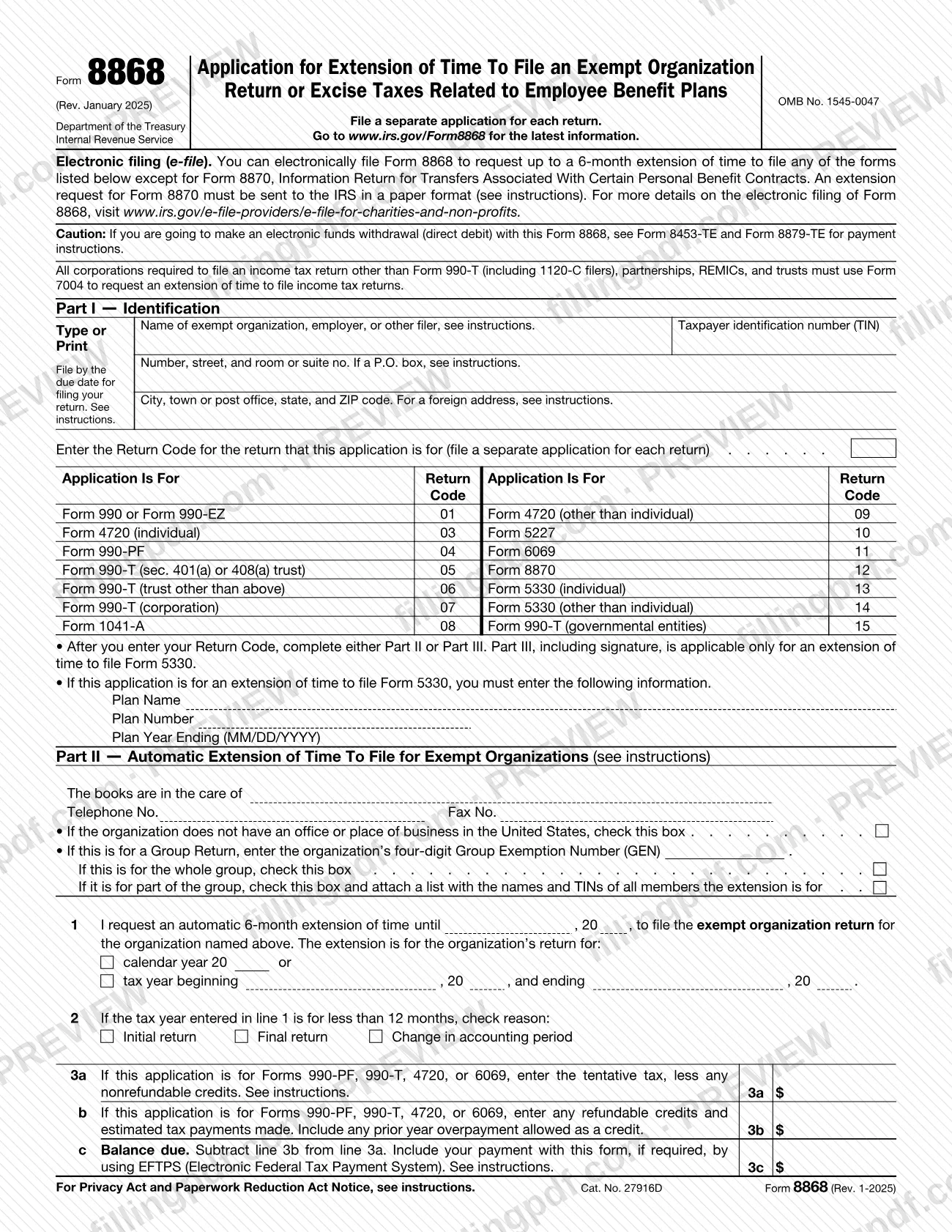
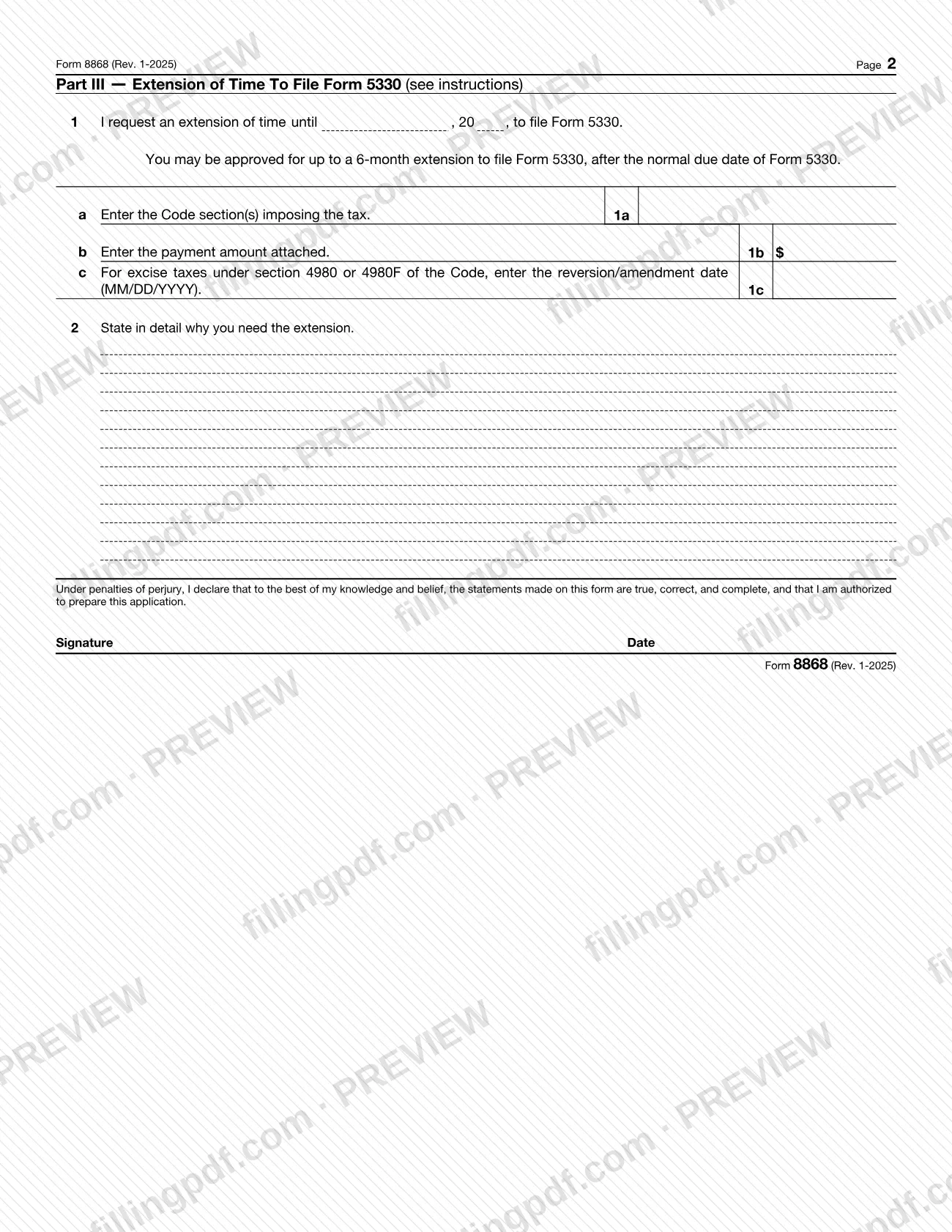
Form 8868 is the Internal Revenue Service (IRS) application that an exempt organization, a governmental entity filing Form 990-T, or a trustee of certain trusts uses to request an automatic 6-month extension of time to file its return. Form 5330 filers also use it to ask for an extension of up to 6 months. On FillingPDF you can fill out the form online and download or print the completed PDF; the IRS publishes the original form and the instructions for Form 8868 at irs.gov, and filing follows the IRS channels described below.
Last updated
What is Form 8868?
Form 8868, Application for Extension of Time To File an Exempt Organization Return or Excise Taxes Related to Employee Benefit Plans, is the IRS form used to request more time to file certain exempt organization returns and Form 5330, the return of excise taxes related to employee benefit plans.
For exempt organizations, governmental entities filing Form 990-T to make an elective payment election, and trustees of trusts required to file Form 1041-A or Form 5227, a properly completed and timely form gives an automatic 6-month extension. For Form 5330, the IRS may grant an extension of up to 6 months after the normal due date, and that request must give the reason in detail and be signed under penalties of perjury.
The form has three parts. Part I identifies the filer and takes the Return Code of the return being extended. Part II is the automatic extension for exempt organizations and governmental entities. Part III is used only for Form 5330. You complete Part II or Part III, never both.
Return Codes run from 01 (Form 990 or Form 990-EZ) to 15 (Form 990-T for governmental entities). A separate Form 8868 is required for each return. The extension covers only the return checked and does not extend the time to pay any tax due.
The form is not used for Form 990-N. Corporations other than Form 990-T filers, partnerships, REMICs and trusts that need more time for income tax returns use Form 7004 instead.
Who needs to file Form 8868?
Use Form 8868 if you must file one of the returns listed with a Return Code in Part I and need more time:
- An exempt organization that needs an automatic 6-month extension for a return such as Form 990, 990-EZ, 990-PF or 990-T.
- A governmental entity (including state, local and tribal entities) filing Form 990-T to make an elective payment election, using Return Code 15.
- The trustee of a trust required to file Form 1041-A or Form 5227.
- A Form 5330 filer, whether an individual or other than an individual, who needs an extension of up to 6 months. The filer may be an employer, plan sponsor, plan administrator or disqualified person.
- A central organization requesting an extension for a group return, using the Group Exemption Number (GEN).
Do not use Form 8868 for Form 990-N: the instructions say it cannot extend that due date. Corporations other than Form 990-T filers (including Form 1120-C filers), partnerships, REMICs and trusts must use Form 7004 to extend income tax returns. Form 8870 can be extended on this form only by a paper request.
For Form 5330, an attorney or certified public accountant qualified to practice before the IRS, a person enrolled to practice before the IRS, or a person holding a power of attorney may sign. No signature is required for Part II filers.
When to file Form 8868
File Form 8868 by the due date of the return you want to extend. An application attached to a return filed after the original due date does not extend that date, and the instructions say not to request an extension by attaching Form 8868 to the original return.
For Form 5330, file in enough time for the IRS to consider and act on the request before the return's normal due date. The extension for Form 5330 can run up to 6 months after the normal due date.
The date on Part II, line 1 cannot be later than 6 months from the original due date of the return. A single 6-month extension is allowed for each type of return for a tax year.
Extending the time to file does not extend the time to pay. Any balance due on Part II, line 3c, or the Part III, line 1b payment for Form 5330, is due by the original due date. The IRS sends a computer-generated notice stating whether the extension is approved or denied.
Documents you need
- A list of the names and TINs of the group members covered, attached when the request is for only part of a group return (Part II, group return line). The instructions also call for each member's address.
- Payment of the balance due on Part II, line 3c, if required, made through EFTPS or another payment option in the instructions, since the extension does not extend the time to pay.
- For Form 5330 requests, the payment of the estimated tax shown on Part III, line 1b, included with the form.
- A written explanation on Part III, line 2, stating in detail why you need the extension, when the request is for Form 5330.
How to fill out Form 8868
Enter the filer's name and TIN
In Part I, enter the name of the exempt organization, employer or other filer and the taxpayer identification number (TIN). For a Form 5330 filer, enter either the EIN or the SSN, not both.
Enter the address
Enter the street address with any suite or room number. If the post office does not deliver to the street address, show the P.O. box; for a third party, use "C/O" and the party's name. For a foreign address, enter city, province or state, and country, without abbreviating the country.
Enter one Return Code
Enter the two-digit Return Code for the return this application is for, such as 01 for Form 990 or Form 990-EZ or 15 for Form 990-T (governmental entities). Enter only one code and file a separate application for each return.
Add Form 5330 plan details
If the application is for Form 5330, enter the Plan Name, Plan Number and Plan Year Ending (MM/DD/YYYY) before completing Part III.
Complete the Part II identification lines
Enter who has the books ("The books are in the care of"), with telephone and fax numbers. Check the box if the organization has no office or place of business in the United States. For a group return, enter the four-digit GEN and check whole group or part of the group.
Request the extension on line 1
Enter the requested date, no later than 6 months from the original due date. Then check calendar year or give the tax year beginning and ending dates.
Explain a short tax year on line 2
If the tax year on line 1 is under 12 months, check Initial return, Final return or Change in accounting period. A change in accounting period generally requires prior approval of the tax year change.
Complete lines 3a, 3b and 3c
For Forms 990-PF, 990-T, 4720 or 6069, enter the tentative tax less nonrefundable credits on line 3a and refundable credits and estimated payments on line 3b. Line 3c is line 3a minus line 3b. Enter -0- where the amount is zero.
Complete Part III for Form 5330
Use Part III only for Form 5330. Enter the requested date on line 1, the Code section(s) on line 1a, the payment on line 1b and, for sections 4980 or 4980F, the reversion/amendment date on line 1c. Explain in detail on line 2 why you need the extension.
Sign if filing for Form 5330
A Form 5330 request must be signed and dated under penalties of perjury by an authorized person. Part II filers do not need a signature.
Review and download the PDF
Check the Return Code, dates and payment lines, then download or print the completed PDF from FillingPDF and file it as described under How to submit.
How to submit Form 8868
You can file Form 8868 electronically or on paper.
- Electronic filing (e-file): You can e-file the request for any return listed in Part I except Form 8870. Details are at www.irs.gov/e-file-providers/e-file-for-charities-and-non-profits. If you plan a direct debit with an e-filed form, see Form 8453-TE and Form 8879-TE for payment instructions.
- Paper: Mail the form to Internal Revenue Service, Mail Stop 6054, 1973 N Rulon White Blvd., Ogden, UT 84201-0045. An extension request for Form 8870 must be sent on paper to this address.
If a balance is due, the instructions list these ways to pay:
- EFTPS, or Electronic Funds Withdrawal if you e-file.
- Same-day wire from your financial institution.
- Check payable to "United States Treasury", with the EIN or SSN, plan number, Form 5330 section number and tax year written on it.
- Cash at participating retail stores.
See IRS.gov/Payments for details. A new address on Form 8868 does not update your IRS record; use Form 8822 or Form 8822-B. FillingPDF lets you fill out and download the PDF; submission follows the channels above.
Common mistakes to avoid
- Attaching Form 8868 to the original return when it is filed; the instructions say not to request an extension this way, and a form attached to a late return does not extend the due date.
- Filing one Form 8868 for several returns. A separate application is required for each return, and it applies only to the Return Code entered.
- Completing both Part II and Part III. Complete only one; Part III is only for Form 5330.
- Leaving lines 3a, 3b and 3c blank because the organization is exempt or expects no tax. All Part II filers must complete them, entering -0- where the amount is zero.
- Entering a line 1 date more than 6 months after the original due date of the return.
- Assuming the extension covers payment. Form 8868 does not extend the time to pay, and interest runs on unpaid tax from the regular due date.
- Using Form 8868 for Form 990-N, or for an income tax return that requires Form 7004.
- Entering both an EIN and an SSN as the TIN on a Form 5330 request; the TIN is one or the other.
- Leaving Part III unsigned or without a detailed explanation on line 2 for a Form 5330 request.
- Sending a Form 8868 for Form 8870 electronically, when that request must be sent on paper.
Frequently asked questions
What is Form 8868 used for?
Form 8868 is the IRS application to extend the time to file certain exempt organization returns and Form 5330. Exempt organizations, governmental entities filing Form 990-T, and trustees of trusts filing Form 1041-A or Form 5227 can get an automatic 6-month extension. Form 5330 filers can request up to 6 months.
How long is the extension with Form 8868?
Up to 6 months. A properly completed, timely form gives an automatic 6-month extension for all forms except Form 5330, for which the IRS may grant up to 6 months after the normal due date. Only one 6-month extension is allowed for each type of return for a tax year.
When is Form 8868 due?
By the due date of the return you want to extend. For Form 5330, file early enough for the IRS to act on the request before the normal due date. A Form 8868 attached to a return filed after the original due date does not extend the due date.
Does Form 8868 extend the time to pay tax?
No. It extends only the time to file. Pay any balance due on line 3c, or the Part III, line 1b amount for Form 5330, by the original due date. Interest is charged on tax not paid by the regular due date even when an extension is granted.
Can I e-file Form 8868, and where do I mail it?
You can e-file Form 8868 for every listed return except Form 8870. On paper, mail it to Internal Revenue Service, Mail Stop 6054, 1973 N Rulon White Blvd., Ogden, UT 84201-0045. A Form 8870 extension request must go on paper to that address.
What is the Return Code on Form 8868?
It is the two-digit code in Part I that identifies the return the application is for, such as 01 for Form 990 or 990-EZ, 04 for Form 990-PF, or 15 for Form 990-T (governmental entities). Enter only one code and file a separate Form 8868 for each return.
Do I need to sign Form 8868?
Only for Form 5330. A Form 5330 request must be signed under penalties of perjury, by an employer, plan sponsor, plan administrator, disqualified person, qualified attorney or CPA, enrolled practitioner, or someone with a power of attorney. Part II filers need no signature.
Can I use Form 8868 for Form 990-N or a corporation's income tax return?
No for Form 990-N: the instructions say Form 8868 cannot extend its due date. Corporations other than Form 990-T filers, partnerships, REMICs and trusts use Form 7004 instead to extend income tax returns.
Can I fill out Form 8868 online on FillingPDF?
Yes. You can fill out the fillable PDF online on FillingPDF and download or print it. FillingPDF is an independent service and does not file the form with the IRS; you submit it by e-file or paper through the IRS channels.
Ready to fill out Form 8868?
Fill out Form 8868 now