
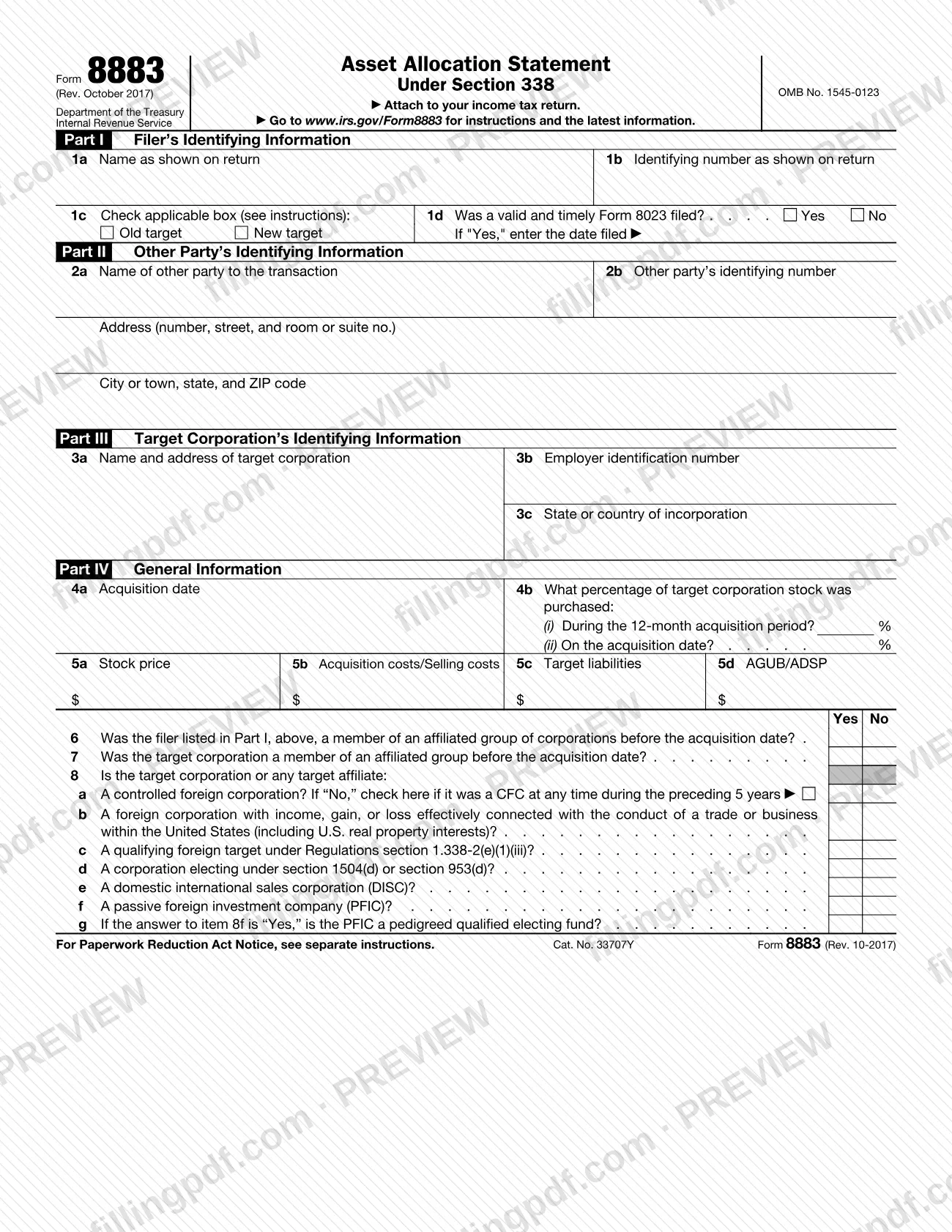
Form 8883, Asset Allocation Statement Under Section 338, is the Internal Revenue Service (IRS) form that reports information about transactions involving the deemed sale of corporate assets under section 338. Both the old target and the new target file it, attached to their income tax returns, whenever a section 338(g) or section 338(h)(10) election applies. On this page you can fill out the form online on FillingPDF and download or print the completed PDF; the form and its instructions are published by the IRS at www.irs.gov/Form8883.
Last updated
What is 8883?
Form 8883, Asset Allocation Statement Under Section 338, is the Internal Revenue Service (IRS) form used to report information about transactions involving the deemed sale of corporate assets under section 338, including information previously reported on Form 8023.
When an election is made under section 338 for a qualified purchase of stock of a target corporation, the target (the old target) is deemed to sell its assets to a new corporation (the new target) at the close of the acquisition date. Form 8883 supplies the facts about that deemed sale: who the parties are, the stock price, costs, target liabilities, and how the price is allocated among asset classes.
The instructions describe two types of section 338 election. A section 338(g) election is made only by the purchasing corporation. A section 338(h)(10) election is made jointly by the old target shareholders and the purchasing corporation. Form 8883 is used for both.
Form 8883 does not replace Form 8023, Elections Under Section 338 for Corporations Making Qualified Stock Purchases. You make the election on Form 8023 and also file Form 8883 to supply the information relevant to it.
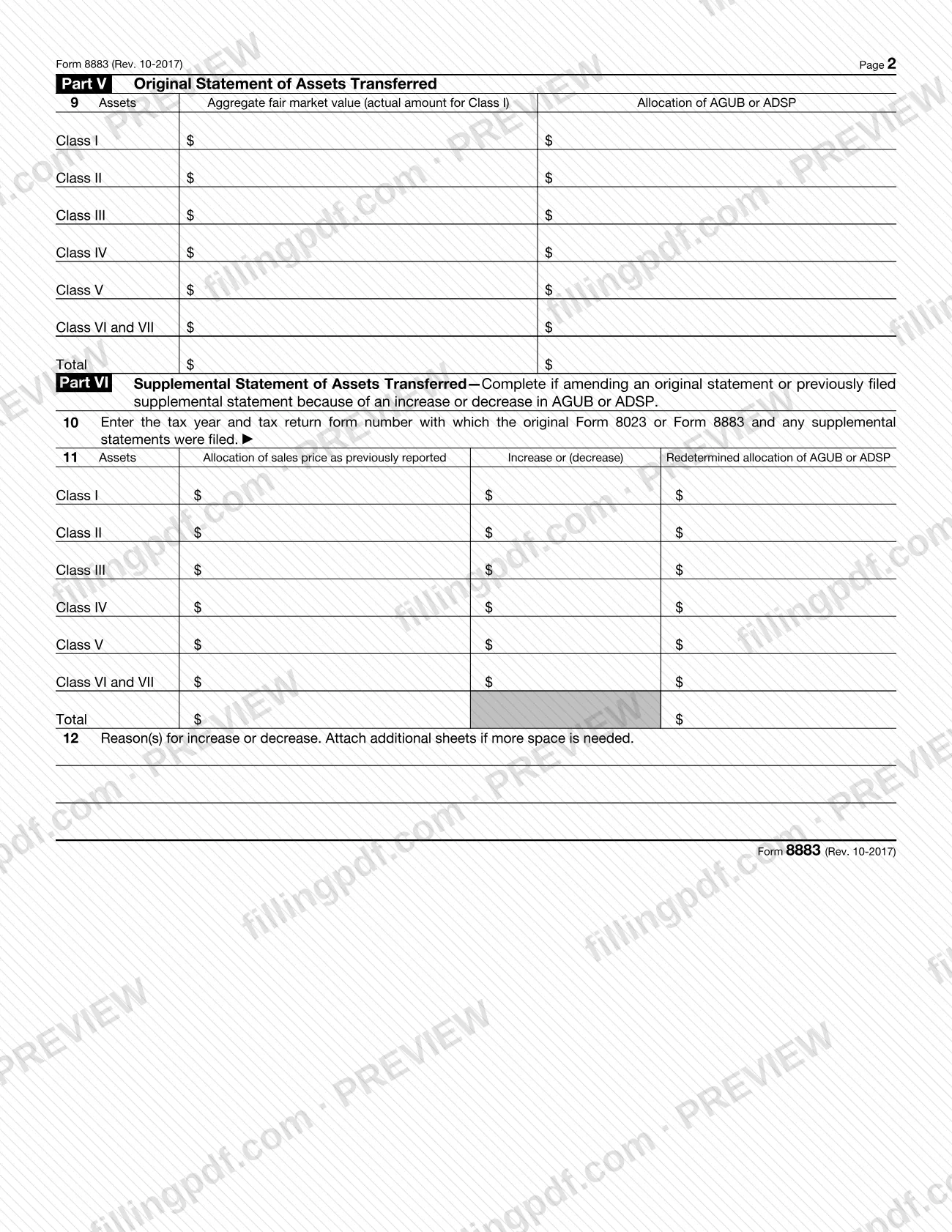
The form has six parts: the filer's, other party's and target corporation's identifying information (Parts I to III), general information (Part IV), the original statement of assets transferred (Part V), and a supplemental statement used when the allocation is later increased or decreased (Part VI). It is not filed alone: it is attached to an income tax return.
Who needs to file 8883?
For elections under sections 338(g) and 338(h)(10), both the old target and the new target must file Form 8883.
- Old target and new target: each completes Parts I through IV, with both completing lines 4a through 8g, and Part V.
- Affected parties after a change in price: if the amount allocated to any asset is increased or decreased after the year in which the sale occurs, any affected party completes Parts I through IV and VI and attaches the form to the return for the year in which the change is taken into account.
- Multiple targets: one Form 8023 may cover several targets that share the same acquisition date and the same affiliated group immediately before and after that date, but a separate Form 8883 is filed for each target corporation.
- Foreign targets: when the filer is a seller, purchaser or U.S. shareholder filing for a foreign target, Part III identifies the target, and an individual U.S. shareholder enters a Social Security number on line 1b. If a section 338(g) election is made for a foreign target for which Form 5471 must be filed, the seller or U.S. shareholder attaches a copy of Form 8883 to the last Form 5471 for the old foreign target, and the purchaser or its U.S. shareholder attaches a copy to the first Form 5471 for the new foreign target.
When to file 8883
Form 8883 is due with the income tax return on which the effects of the section 338 deemed sale and purchase of the target's assets are required to be reported. It has no separate due date of its own.
- Old target, S corporation (section 338(h)(10)): attach it to Form 1120S, U.S. Income Tax Return for an S Corporation.
- Old target, consolidated return: attach it to the final consolidated return ending on the acquisition date. A member of a selling group making a section 338(h)(10) election attaches it to the selling group's consolidated return for the year including the acquisition date. If a section 338(g) election is made, attach it to the old target's deemed sale return instead.
- New target: attach it to the new target's first return, or to the consolidated return that includes the day after the acquisition date if the new target is then a member of a consolidated group.
- Supplemental statements: file a new Form 8883 for each year in which an increase or decrease in AGUB or ADSP occurs.
File Form 8023 on time even if you do not yet have all the information needed for Form 8883. If you do not file a correct Form 8883 by the due date of your return and cannot show reasonable cause, you may be subject to penalties under sections 6721 through 6724.
Documents you need
- The income tax return of the old target or new target, to which Form 8883 is attached (for example Form 1120S for an S corporation target with a section 338(h)(10) election).
- A copy of Form 8883 attached to Form 5471 for the old foreign target (seller or U.S. shareholder) and for the new foreign target (purchaser or its U.S. shareholder), when a section 338(g) election is made for a foreign target for which Form 5471 must be filed.
- Additional sheets explaining the reasons for an increase or decrease on line 12, only if the space on the form is not enough.
How to fill out 8883
Identify the filer in Part I
On line 1a enter the name as shown on your return and on line 1b the identifying number (EIN, or SSN for an individual U.S. shareholder filing for a foreign target). On line 1c check Old target or New target.
Answer the Form 8023 question
On line 1d check Yes or No for whether a valid and timely Form 8023 was filed. If Yes, enter the date it was filed.
Enter the other party in Part II
Give the name (line 2a), identifying number (line 2b, EIN or SSN) and address of the taxpayer that files the return reflecting the section 338 results for the other party. If that party reports on a consolidated return, enter the common parent's information.
Identify the target in Part III
Complete Part III only if the target's information is not already in Part I, for example when a common parent, seller, purchaser or U.S. shareholder files. Enter name and address, EIN on line 3b (not required if none exists or is required) and state or country of incorporation on line 3c, including any political subdivision.
Enter dates and percentages in Part IV
Line 4a is the acquisition date. On line 4b enter the percentage of target stock purchased during the 12-month acquisition period (i) and on the acquisition date (ii).
Complete lines 5a through 5d
Line 5a: consideration actually paid to the sellers for the recently purchased stock, before selling or acquisition costs. Line 5b: acquisition costs (new target) or selling costs (old target). Line 5c: target liabilities at the beginning of the day after the acquisition date. Line 5d: AGUB (new target) or ADSP (old target).
Answer lines 6 through 8
Check Yes or No for the affiliated group questions on lines 6 and 7 and for items 8a through 8g about controlled foreign corporations, foreign corporations with effectively connected income, DISCs, PFICs and similar. Both old and new targets complete lines 4a through 8g.
Allocate the price in Part V
On line 9, for each class (Class I through Class VI and VII combined) enter the aggregate fair market value, and the allocation of AGUB or ADSP. Use the residual method: reduce by Class I, allocate to Classes II through VI in order in proportion to fair market value, then the rest to Class VII.
Complete Part VI for later changes
Only if an original or supplemental statement is being amended, enter on line 10 the tax year and return form number (for example, 2017 Form 1120). On line 11 show the allocation as previously reported, the increase or (decrease) and the redetermined allocation by class.
Explain the change on line 12
Give the reason(s) for each increase or decrease in AGUB or ADSP, attaching additional sheets if more space is needed. Skip lines 10 through 12 on an original statement.
Review and download the completed PDF
Check that names and identifying numbers match the return, that the class totals on line 9 agree with line 5d, and that no Part V or VI line is left incomplete. Download or print the PDF from FillingPDF and attach it to the income tax return.
How to submit 8883
Form 8883 is not filed on its own: you attach it to the income tax return that reports the section 338 results, and it travels through whatever channel you use to file that return. The form prints no separate address or portal of its own.
- Attach to the return: put the completed form with the old target's or new target's return as described under When to file (for example Form 1120S for an S corporation target, or the relevant consolidated return).
- Foreign target with Form 5471: attach a copy of Form 8883 to Form 5471 as the instructions require for the seller (or U.S. shareholder) and for the purchaser (or its U.S. shareholder).
- Supplemental statement: attach the new Form 8883 to the income tax return for the year in which the increase or decrease is taken into account.
Do not mail Form 8883 to the Tax Forms and Publications Division address in Washington, DC, that appears in the instructions; that address is only for comments about the form. FillingPDF lets you fill out and download the PDF; submission follows the channels above.
Common mistakes to avoid
- Mailing Form 8883 to the Tax Forms and Publications Division address in Washington, DC; the instructions say that address is for comments only and that the form goes with the return.
- Filing only one side of the transaction: for section 338(g) and 338(h)(10) elections both the old target and the new target must file Form 8883.
- Waiting to file Form 8023 until all Form 8883 information is ready; the instructions say to file Form 8023 on time even without it.
- Using one Form 8883 for several targets; one Form 8023 may cover them, but a separate Form 8883 is filed for each target corporation.
- Reporting fair market value net of mortgages, liens or other debt on line 9; the instructions use gross fair market value.
- Allocating more than an asset's fair market value on the acquisition date to any asset other than a Class VII asset.
- Placing an asset that fits more than one class in the higher-numbered class; the instructions say to choose the lower-numbered one.
- Changing the original statement for a later price adjustment instead of completing Parts I through IV and VI on a new Form 8883 for the year the change occurs.
- Attaching a section 338(g) old target's form to the selling group's consolidated return instead of the old target's deemed sale return.
Frequently asked questions
What is Form 8883 used for?
Form 8883 reports information about transactions involving the deemed sale of corporate assets under section 338. It includes information previously reported on Form 8023 and shows how the price paid for a target corporation is allocated among its asset classes.
Who has to file Form 8883?
For section 338(g) and section 338(h)(10) elections, both the old target and the new target must file it. If an allocation is later increased or decreased, any affected party completes Parts I through IV and VI on a new Form 8883.
Where do I send Form 8883?
You do not send it separately. Attach it to the income tax return that reports the section 338 results, such as Form 1120S for an S corporation old target. The Washington, DC address in the instructions is for comments only.
What is the difference between Form 8023 and Form 8883?
Form 8023 is the form used to make the section 338 election. Form 8883 supplies the information relevant to the election and must be filed too. Form 8023 should still be filed on time even if you lack the Form 8883 information.
What are AGUB and ADSP on Form 8883?
AGUB, adjusted grossed-up basis, is entered on line 5d by the new target: the amount for which it is deemed to have bought its assets. ADSP, aggregate deemed sales price, is entered by the old target: the amount for which it is deemed to have sold all its assets.
When do I file a supplemental Form 8883?
File a new Form 8883 for each year in which an increase or decrease in AGUB or ADSP occurs. Complete Parts I through IV and VI and attach it to the income tax return for the year in which the change is taken into account.
What happens if I do not file a correct Form 8883?
If you do not file a correct Form 8883 by the due date of your return and cannot show reasonable cause, you may be subject to penalties. The instructions refer to sections 6721 through 6724 of the Internal Revenue Code.
Can I fill out Form 8883 online?
Yes. You can fill out the PDF online on FillingPDF and download or print it. FillingPDF is an independent service and does not file the form with the IRS; you attach it to your return and file it through the IRS channels.
Ready to fill out 8883?
Fill out 8883 now