
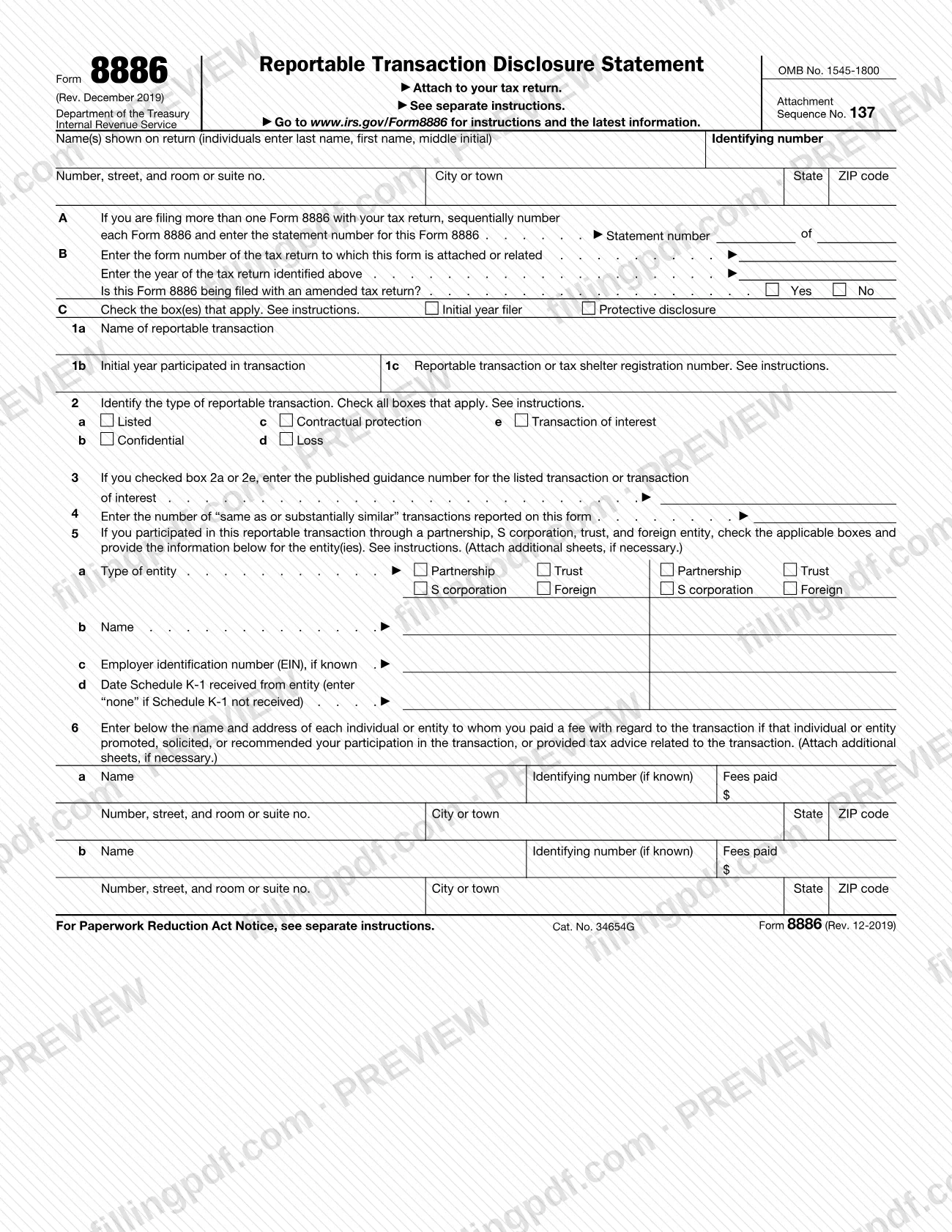
Form 8886 is the Internal Revenue Service (IRS) statement that taxpayers attach to a return to disclose each reportable transaction in which they participated. Individuals, trusts, estates, partnerships, S corporations and other corporations use it when they take part in a listed, confidential, contractual protection, loss or transaction of interest category transaction. On this page you can fill out the form online on FillingPDF and download or print the completed PDF; the original form and the instructions are published by the IRS at www.irs.gov/Form8886.
Last updated
What is 8886?
Form 8886, Reportable Transaction Disclosure Statement, is the Internal Revenue Service (IRS) form used to disclose information about each reportable transaction in which a taxpayer participated. It is attached to the taxpayer's federal tax return (OMB No. 1545-1800).
The IRS instructions define a reportable transaction by category. The form's line 2 asks you to check every category that applies:
- Listed: the same as or substantially similar to a transaction the IRS has identified as a tax avoidance transaction.
- Confidential: offered under conditions of confidentiality for a minimum fee paid to an advisor.
- Contractual protection: you have a right to a full or partial refund of fees if the intended tax consequences are not sustained, or fees are contingent on the tax benefits.
- Loss: a section 165 loss that equals or exceeds the applicable threshold amount.
- Transaction of interest: the same as or substantially similar to a transaction the IRS has identified as one of interest.
The form asks for the transaction's name, its reportable transaction registration number, any partnership, S corporation or trust through which you participated, the advisors you paid fees, the tax benefits expected, a narrative of the facts, and any tax-exempt, foreign or related parties. The instructions say that a transaction being reportable does not mean its tax benefits will be disallowed.
Form 8886 is different from Form 8886-T, Disclosure by Tax-Exempt Entity Regarding Prohibited Tax Shelter Transaction, which a tax-exempt entity party to a prohibited tax shelter transaction may have to file in addition to Form 8886.
Who needs to file 8886?
Any taxpayer that participates in a reportable transaction and must file a federal tax return or information return must file Form 8886. The instructions name individuals, trusts, estates, partnerships, S corporations and other corporations.
- You generally file a separate Form 8886 for each reportable transaction. You may report more than one transaction on one form only if they are the same or substantially similar.
- A regulated investment company (RIC), or an investment vehicle at least 95% owned by one or more RICs at all times, does not have to file for any transaction other than a listed transaction or a transaction of interest.
- If your only link to a transaction described in Notice 2002-35 (tax avoidance using notional principal contracts) is a direct or indirect interest in a pass-through entity, you are not required to disclose it on Form 8886.
- Partners, shareholders and beneficiaries of a pass-through entity can participate in a loss transaction through a loss allocated to them.
- A reporting shareholder of a foreign corporation (a U.S. shareholder in a controlled foreign corporation, or a 10% shareholder of a qualified electing fund) can be a participant under special rules.
A tax-exempt entity party to a prohibited tax shelter transaction may also have to file Form 8886-T.
When to file 8886
Attach Form 8886 to your income tax return or information return for each tax year in which you participated in a reportable transaction. This includes amended returns. If a reportable transaction produces a loss or credit carried back to an earlier year, attach the form to the application for tentative refund (Form 1045 or 1139) or to the amended return for the carryback years.
Special timing rules in the instructions:
- Initial year filers also send an exact copy of the form to the Office of Tax Shelter Analysis (OTSA).
- A transaction that becomes a listed transaction or transaction of interest after you file: for a transaction entered into after August 2, 2007 (listed) or after November 1, 2006 (transaction of interest), file with OTSA within 90 days after it became one. Earlier listed transactions are attached to the first return filed after that date.
- A partner, S corporation shareholder or trust beneficiary who gets a timely Schedule K-1 less than 10 calendar days before the return due date (including extensions) is not late if the form reaches OTSA within 60 days after the due date, including extensions.
- A transaction that becomes a loss transaction: file for the first year the threshold is reached and every later return that reflects any section 165 loss from it.
Documents you need
- The federal tax return or information return to which Form 8886 is attached, including an amended return; the form is not filed alone.
- For a carryback of a loss or credit from a reportable transaction: Form 1045 or Form 1139, or the amended return for the carryback year, with Form 8886 attached.
- Additional sheets, if the information exceeds the space on the form, in the same order as the lines they correspond to, with your name and identifying number at the top of each.
- For initial year filers: an exact copy of Form 8886, with any accompanying materials, sent to the Office of Tax Shelter Analysis (OTSA), plus a fax cover sheet if you fax it.
- For a previously undisclosed listed transaction under section 6501(c)(10): a separate Form 8886 and a separate cover letter for each tax year, sent to the Internal Revenue Service Center where the original return was filed, with a copy to OTSA.
How to fill out 8886
Enter your name, number and address
At the top, enter the name(s) shown on your return (individuals: last name, first name, middle initial), your identifying number, and your address.
Number the statement in item A
If you file more than one Form 8886 with your return, number each one in sequence and enter the statement number, for example 1 of 3.
Identify the related tax return in item B
Enter the form number of the return this form is attached to (for example, Form 1040) and its year, using MM/DD/YYYY for a fiscal-year return. Check Yes or No to say whether it is filed with an amended return.
Check the boxes in item C
Check Initial year filer if this is the first year you disclose the transaction, which also requires the copy to OTSA. Check Protective disclosure if you file on a protective basis.
Name and date the transaction
Line 1a: the name by which the transaction is known, or a short identifying description. Line 1b: the first year you participated (YYYY). Line 1c: every reportable transaction or tax shelter registration number you received.
Identify the transaction type
Line 2: check all boxes that apply: Listed, Confidential, Contractual protection, Loss or Transaction of interest. For 2a or 2e, enter the published guidance number on line 3.
Count similar transactions
Line 4: enter the number of "same as or substantially similar" transactions reported on this form.
Report entities you invested through
Line 5: if you participated through a partnership, S corporation or trust, including foreign ones, check the type and enter the name (5b), EIN if known (5c) and the date you received Schedule K-1, or "none" (5d).
List advisors and fees paid
Line 6: enter the name, address and identifying number of each person or entity paid a fee for promoting, soliciting, recommending or advising on the transaction, with the fees paid. Attach additional sheets if needed.
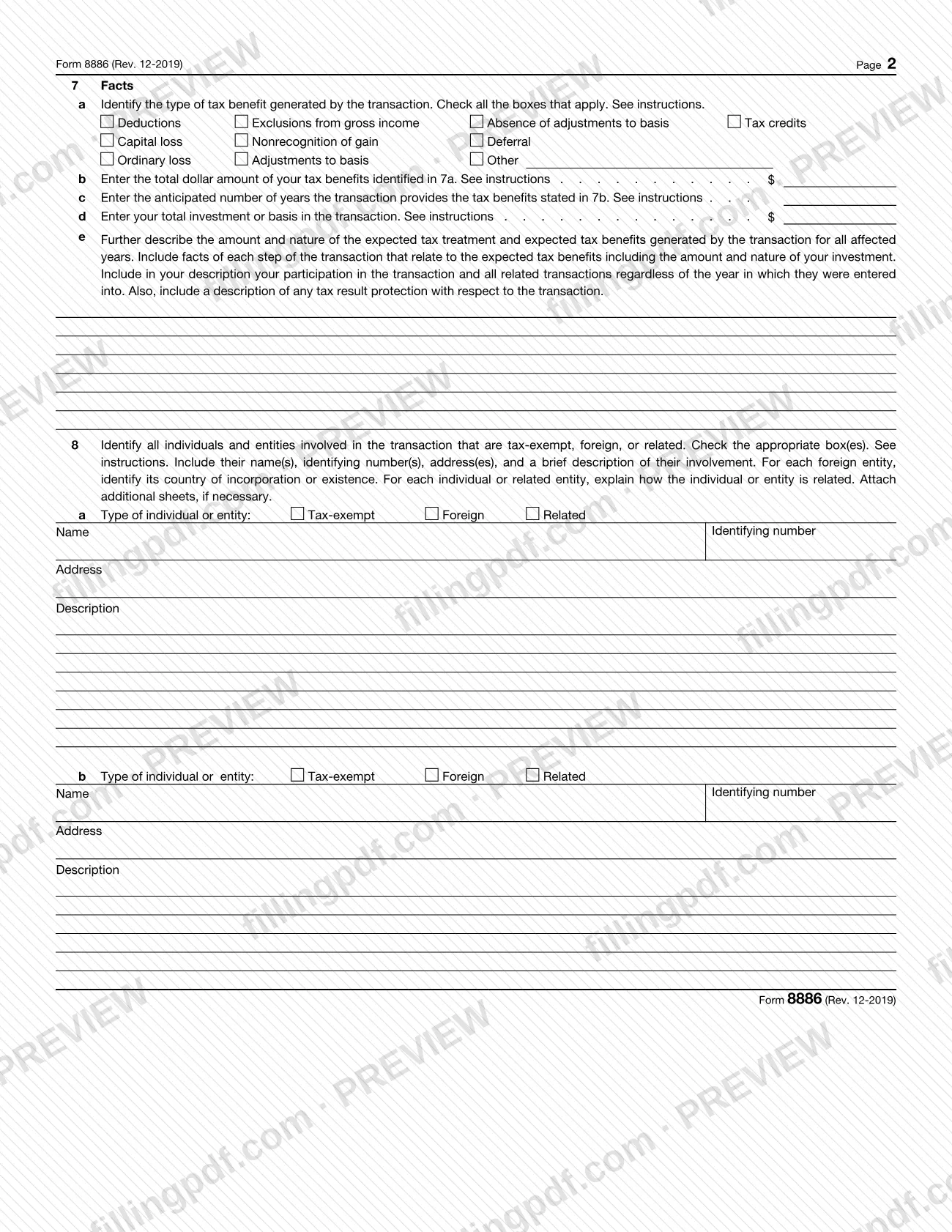
Describe the tax benefits and facts
Line 7a: check the tax benefit types. Lines 7b to 7d: enter the total tax benefits, the anticipated number of years and your total investment or basis. Line 7e: describe each step of the transaction, the expected tax treatment and any tax result protection.
Identify tax-exempt, foreign or related parties
Line 8: for each such individual or entity, check Tax-exempt, Foreign or Related, and give the name, identifying number, address and a description of its involvement; for foreign entities give the country, and for related ones explain the relationship.
Review, download and assemble the package
Check that every line is complete, with no "upon request" statements, then download or print the completed PDF from FillingPDF. Attach it to your return and, if you are an initial year filer, prepare the exact copy for OTSA as described under How to submit.
How to submit 8886
Form 8886 goes in two places: attached to your tax return, and, for initial year filers, as an exact copy to OTSA by mail or fax.
- With your return: attach the original Form 8886 to your income tax or information return (or to Form 1045, Form 1139 or the amended return for a carryback year). You must file the original with the return even when you send the OTSA copy.
- OTSA by mail: Internal Revenue Service, OTSA Mail Stop 4915, 1973 Rulon White Blvd., Ogden, UT 84201. The IRS notes an update to the mailing address in the instructions, so confirm it at IRS.gov/Form8886 before mailing.
- OTSA by fax: 844-253-2553. Use it only for the exact copy of Form 8886 and its materials, send one exact copy per fax, and keep within 100 pages. The fax cover sheet should show the subject "Form 8886", the sender's name, title, phone number and address, the taxpayer's name, the date and the number of pages including the cover sheet. Do not put an EIN or Social Security number on it. The IRS sends no receipt, so keep your fax transmission log.
- Electronic return filers: the copy sent to OTSA must match, word for word, what you filed electronically.
FillingPDF lets you fill out and download the PDF; submission follows the channels above.
Common mistakes to avoid
- Writing "Information provided upon request" or a similar statement in a space; the instructions say this makes the form incomplete and subjects you to penalties under sections 6707A and 6662A.
- Reporting more than one transaction on a single Form 8886 when they are not the same or substantially similar.
- Skipping the exact copy to OTSA when you check the Initial year filer box.
- Checking only box 2c, 2d or 2b and missing the Listed or Transaction of interest box (2a or 2e) when the transaction is a listed transaction or transaction of interest.
- Leaving out the reportable transaction or tax shelter registration number on line 1c when you received one or more numbers.
- Continuing additional sheets out of order, or omitting your name and identifying number at the top of each additional sheet.
- Using the OTSA fax number for anything other than the exact copy of Form 8886, or sending more than one exact copy in one fax; other submissions will not be processed.
- Not numbering several Forms 8886 filed with one return in item A (for example, statement number 1 of 3).
- Filing the OTSA copy of an electronically filed return that differs from the electronic return's information.
Frequently asked questions
What is Form 8886 used for?
Form 8886, Reportable Transaction Disclosure Statement, is the IRS form you attach to your tax return to disclose each reportable transaction in which you participated. Reportable categories are listed, confidential, contractual protection, loss and transaction of interest transactions.
Who has to file Form 8886?
Any taxpayer that participates in a reportable transaction and must file a federal tax return or information return, including individuals, trusts, estates, partnerships, S corporations and other corporations. RICs, and vehicles at least 95% owned by RICs, file only for listed transactions or transactions of interest.
Do I file a separate Form 8886 for each transaction?
Generally yes. You file one Form 8886 for each reportable transaction, but you may report more than one transaction on one form if they are the same or substantially similar. The instructions say "substantially similar" is construed broadly in favor of disclosure.
Where do I send the copy of Form 8886 to OTSA?
Initial year filers mail an exact copy to Internal Revenue Service, OTSA Mail Stop 4915, 1973 Rulon White Blvd., Ogden, UT 84201, or fax it to 844-253-2553. The IRS notes an address update, so check IRS.gov/Form8886 first. You must still file the original with your return.
Can I fill out Form 8886 online?
Yes. You can fill out the fillable PDF online on FillingPDF and download or print it. FillingPDF is an independent service and does not file the form with the IRS or OTSA; you attach it to your return and send the OTSA copy yourself.
What does the Protective disclosure box mean?
Checking it in item C shows you are filing on a protective basis under Regulations section 1.6011-4(f). The IRS generally treats such a form like any other Form 8886, so it only works if you complete the form properly and provide all required information.
What happens if I don't file Form 8886 or leave it incomplete?
The instructions describe a monetary penalty under section 6707A for failing to attach the form, failing to file with OTSA when required, or filing incomplete or incorrect information. An accuracy-related penalty under section 6662A may also apply. Ask the IRS for current penalty amounts.
How do I get the transaction number for line 1c?
Material advisors receive reportable transaction numbers (formerly tax shelter registration numbers) when they disclose the transaction under section 6111 and must give the number to investors. The number is 9 or 11 digits and may begin with "MA". Enter every number you received.
Ready to fill out 8886?
Fill out 8886 now