
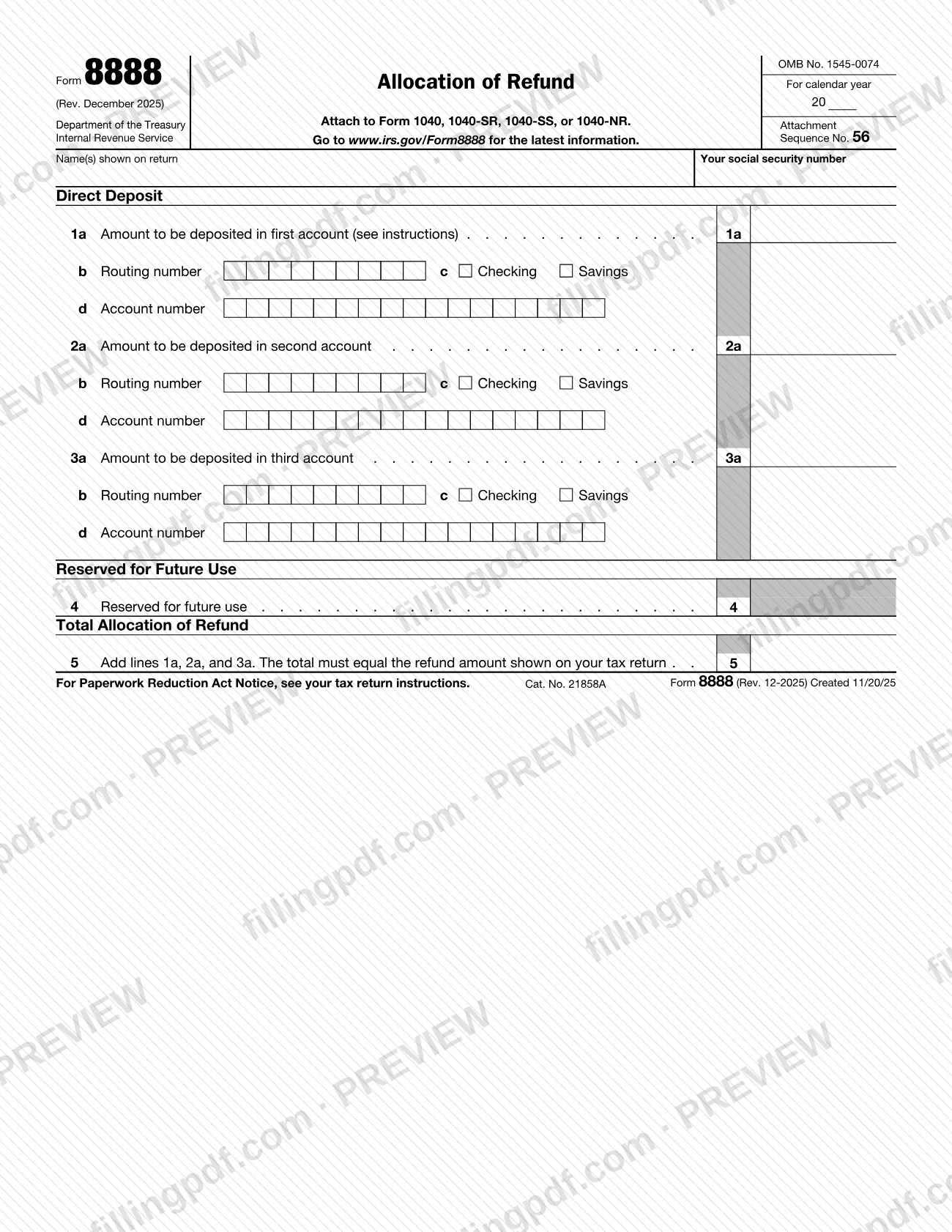
Form 8888, Allocation of Refund, is the Internal Revenue Service (IRS) form for directing parts of one federal tax refund into two or three accounts at U.S. banks or other financial institutions. You attach it to Form 1040, 1040-SR, 1040-SS, or 1040-NR, and the amounts on lines 1a, 2a, and 3a must add up to the refund on that return. On this page you can fill out the form online on FillingPDF and download or print the completed PDF; the form and its instructions are published by the IRS at www.irs.gov/Form8888.
Last updated
What is 8888?
Form 8888, Allocation of Refund, is the IRS form you attach to your federal income tax return when you want your refund, or part of it, deposited directly into two or three accounts at a bank or other financial institution in the United States.
The form has three direct deposit blocks. Each block asks for the amount to deposit (lines 1a, 2a, 3a), the nine-digit routing number (1b, 2b, 3b), whether the account is checking or savings (1c, 2c, 3c) and the account number (1d, 2d, 3d). Line 4 is printed as reserved for future use. Line 5 is the total of lines 1a, 2a, and 3a, and it must equal the refund shown on your tax return.
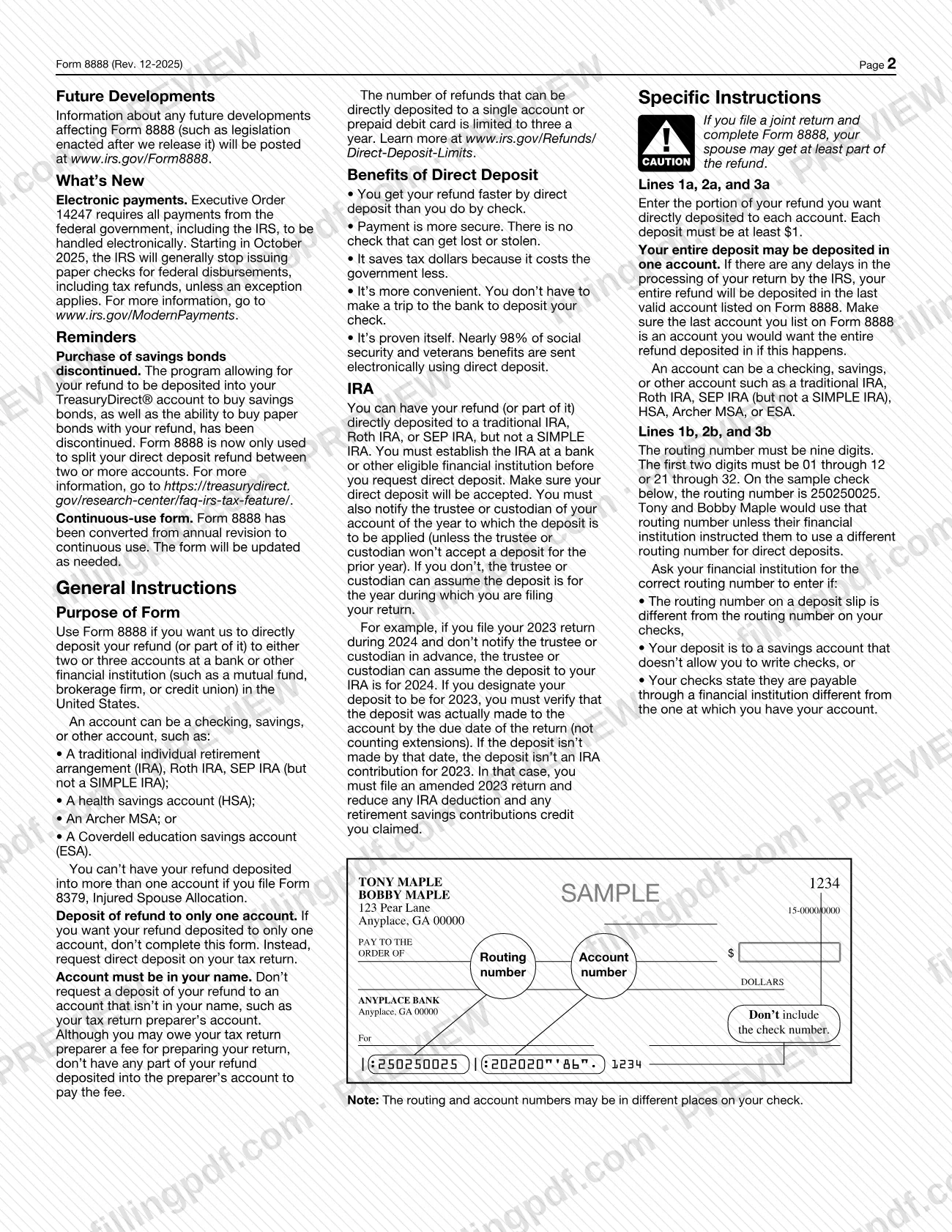
An account can be a checking or savings account or another kind of account, such as a traditional IRA, Roth IRA, SEP IRA (but not a SIMPLE IRA), health savings account, Archer MSA or Coverdell education savings account. Funds can go to a mutual fund, brokerage firm or credit union.
The IRS instructions state that Form 8888 is now used only to split a direct deposit refund between two or more accounts. The earlier option of depositing a refund into a TreasuryDirect account to buy savings bonds has been discontinued. The form is now a continuous-use form, updated as needed, and its current revision is dated December 2025.
Who needs to file 8888?
Use Form 8888 if you file Form 1040, 1040-SR, 1040-SS, or 1040-NR and want the IRS to deposit your refund, or part of it, into two or three accounts at U.S. financial institutions.
Conditions and exclusions from the IRS instructions:
- One account only: do not complete this form. Request direct deposit on your tax return instead.
- Injured spouse: you cannot have your refund deposited into more than one account if you file Form 8379, Injured Spouse Allocation.
- Account ownership: the account must be in your name. Do not request a deposit to an account that is not yours, such as your tax return preparer's account, even to pay the preparer's fee.
- Joint returns: if you file a joint return and complete Form 8888, your spouse may get at least part of the refund.
- Deposit limit: no more than three refunds a year can be directly deposited to a single account or prepaid debit card.
- IRAs: a SIMPLE IRA cannot receive the deposit, and you must have established the IRA before you request direct deposit.
When to file 8888
Form 8888 has no due date of its own: you complete it when you prepare the federal tax return it is attached to, and it is submitted with that return. The form is marked "For calendar year 20__" so it matches the tax year of the return.
If you deposit part of the refund into an IRA, tell the trustee or custodian which year the deposit is for. Unless you do, the trustee or custodian can assume it is for the year in which you file your return. If you designate it for the prior year, you must verify that the deposit was actually made by the return's due date (not counting extensions); otherwise the deposit is not an IRA contribution for that year.
Documents you need
- Form 1040, 1040-SR, 1040-SS, or 1040-NR: Form 8888 is attached to your federal return, and the refund shown there must equal the total on line 5.
How to fill out 8888
Enter your name, SSN and tax year
At the top, write the name(s) shown on your return and your social security number. Enter the calendar year of the return after "For calendar year 20".
Confirm you need to split the refund
Form 8888 is for two or three accounts. If your whole refund goes to one account, do not use this form and request direct deposit on your tax return instead.
Enter the first deposit amount
Line 1a: enter the part of your refund to deposit into the first account. If processing is delayed, the entire refund goes to the last valid account listed.
Enter the routing number
Line 1b: write the nine-digit routing number. The first two digits must be 01 through 12 or 21 through 32. If your deposit slip, savings account or check shows something different, ask your financial institution.
Mark the account type
Line 1c: check Checking or Savings, not both. For an IRA, HSA, brokerage or similar account, ask your financial institution which box to check.
Enter the account number
Line 1d: enter up to 17 characters from left to right, including hyphens but omitting spaces and special symbols. Leave unused boxes blank and leave out the check number.
Complete the second and third accounts
Repeat lines 1a to 1d on lines 2a to 2d, and on lines 3a to 3d if you use a third account. Put the account you would want to receive the entire refund last.
Leave line 4 as reserved
Line 4 is printed as "Reserved for future use," so it carries no entry from you.
Add the deposits on line 5
Line 5: add lines 1a, 2a, and 3a. The total must equal the refund amount on your tax return.
Review, download and attach
Check that nothing is crossed out or whited out and that the accounts are in your name. Download or print the completed PDF from FillingPDF and attach it to your tax return.
How to submit 8888
Form 8888 is not filed on its own. You attach it to your Form 1040, 1040-SR, 1040-SS, or 1040-NR, and it reaches the IRS through whichever channel you use for that return.
- With your return: the form is headed "Attach to Form 1040, 1040-SR, 1040-SS, or 1040-NR." Include the completed Form 8888 with the return.
- Addresses: the Form 8888 instructions print no separate mailing address or portal. Use the filing instructions for your tax return.
- Only one account: do not file this form; request direct deposit on the return instead.
- More information: the IRS publishes the latest information at www.irs.gov/Form8888, and details on deposit limits at www.irs.gov/Refunds/Direct-Deposit-Limits.
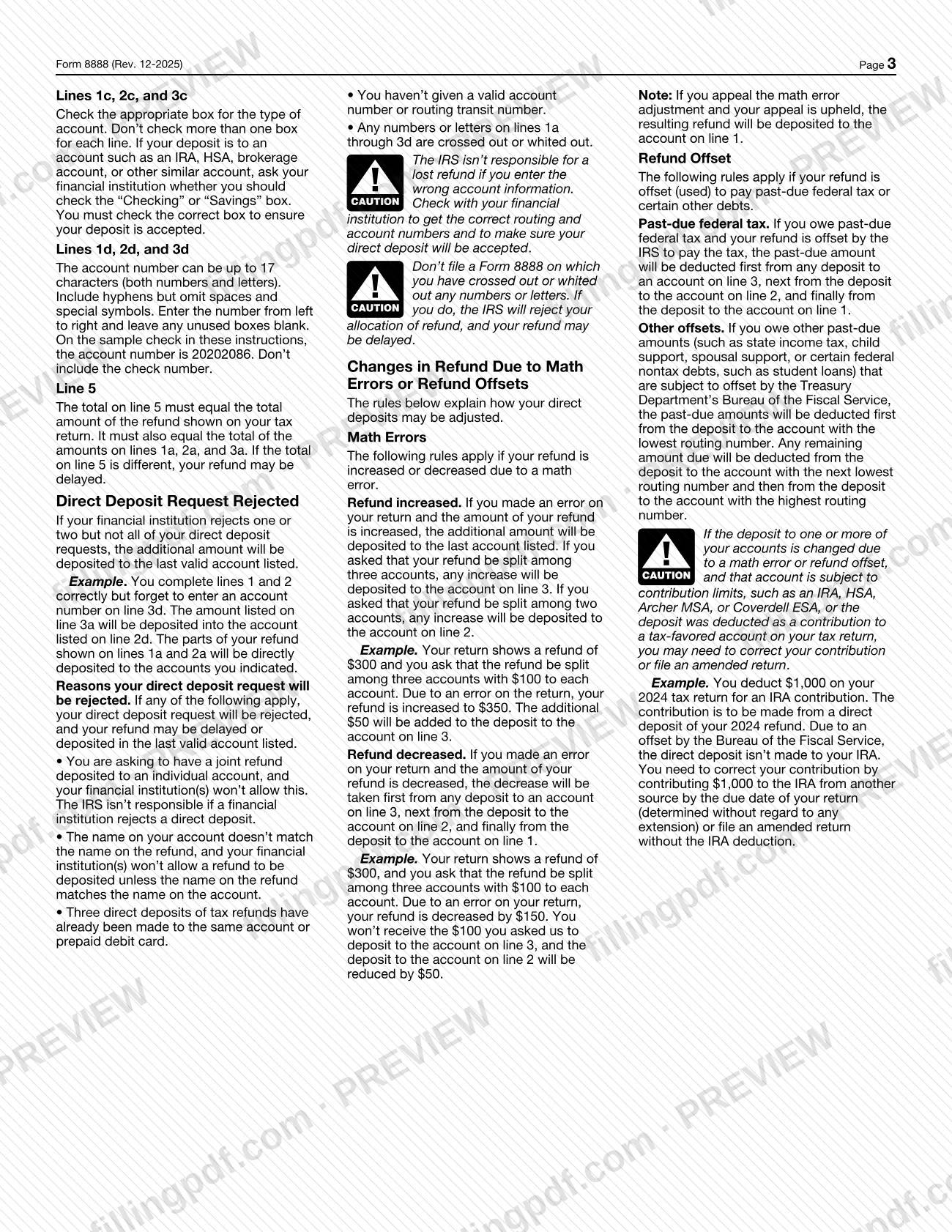
If your financial institution rejects some of the deposits, the IRS instructions say the extra amount goes to the last valid account listed, and the IRS is not responsible if an institution rejects a deposit. FillingPDF lets you fill out and download the PDF; submission follows the channels above.
Common mistakes to avoid
- Entering totals on lines 1a, 2a, and 3a that do not add up to the refund on your tax return; the IRS says your refund may be delayed if line 5 is different.
- Using Form 8888 when you want the whole refund in one account; the instructions say not to complete the form and to request direct deposit on your tax return.
- Crossing out or whiting out any number or letter on lines 1a through 3d; the IRS will reject the allocation, and your refund may be delayed.
- Listing an account that is not in your name, such as your tax return preparer's account, to pay a preparer's fee.
- Leaving the wrong account last: delays or a rejected deposit send the entire or remaining refund to the last valid account listed.
- Entering a routing number that is not nine digits, or whose first two digits fall outside 01 through 12 or 21 through 32.
- Checking both Checking and Savings, or the wrong box, on lines 1c, 2c, or 3c; check only one box per line, and ask your institution for IRAs, HSAs or brokerage accounts.
- Writing spaces or special symbols in the account number, or including the check number; include hyphens only, up to 17 characters.
- Requesting a deposit into a SIMPLE IRA, or into an IRA you have not yet established, or filing it after Form 8379 was attached.
Frequently asked questions
What is Form 8888 used for?
Form 8888, Allocation of Refund, is used to split your federal tax refund between two or three accounts at U.S. banks or other financial institutions. You attach it to Form 1040, 1040-SR, 1040-SS, or 1040-NR. It is used only to split a direct deposit refund among accounts.
Do I need Form 8888 to deposit my refund into one account?
No. If you want your refund deposited into only one account, the IRS says not to complete Form 8888. Request direct deposit on your tax return instead. Use the form only when the refund is divided between two or three accounts.
Can I fill out Form 8888 online?
You can complete the Form 8888 PDF online on FillingPDF and download or print it. FillingPDF is an independent service and does not file the form for you; you attach it to your tax return and submit that return through the IRS channels.
Where do I send Form 8888?
Attach it to your Form 1040, 1040-SR, 1040-SS, or 1040-NR and submit it with that return. The Form 8888 instructions list no separate address, so follow the filing instructions for your tax return.
What happens if the amounts do not add up to my refund?
Your refund may be delayed. The total on line 5 must equal the refund on your tax return and the sum of lines 1a, 2a, and 3a. If your financial institution rejects one or two deposits, the extra goes to the last valid account listed.
Can I send part of my refund to my tax preparer's account?
No. The account must be in your name, and the IRS says not to request a deposit to an account that is not yours, such as your preparer's, even to pay a preparer's fee.
How many refunds can go into the same account?
No more than three refunds a year can be directly deposited to a single account or prepaid debit card. If three have already been made, a further direct deposit request will be rejected and your refund may be delayed.
Can I split my refund if I file Form 8379?
No. The instructions say you cannot have your refund deposited into more than one account if you file Form 8379, Injured Spouse Allocation. In that situation you cannot use Form 8888 to divide the refund.
What happens if my refund is offset for a debt?
Past-due federal tax is taken first from the deposit on line 3, then line 2, then line 1. Other past-due debts, such as child support or student loans, come from the account with the lowest routing number first, then the next lowest, then the highest.
Ready to fill out 8888?
Fill out 8888 now