
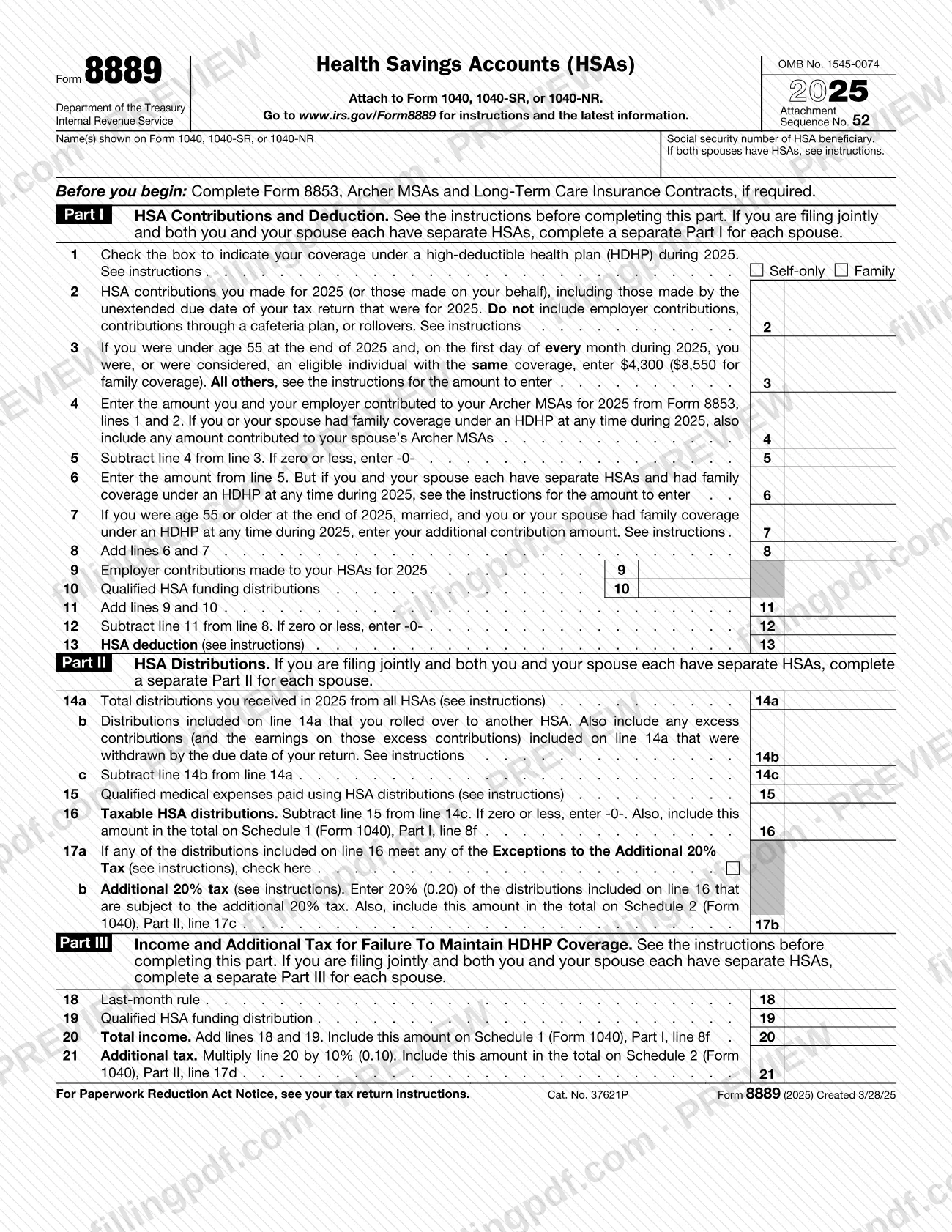
Form 8889, Health Savings Accounts (HSAs), is the Internal Revenue Service (IRS) form that you attach to your federal income tax return to report HSA contributions, figure your HSA deduction and report distributions from your HSAs. You file it if you, your employer or someone else contributed to your HSA, or if your HSA paid out money during the year. On FillingPDF you can fill out Form 8889 online and download or print the completed PDF; the IRS publishes the original PDF and the instructions at www.irs.gov/Form8889.
Last updated
What is 8889?
Form 8889, Health Savings Accounts (HSAs) is the Internal Revenue Service (IRS) attachment to Form 1040, 1040-SR or 1040-NR on which you report HSA contributions, figure your HSA deduction, report HSA distributions, and calculate income and additional tax owed if you fail to remain an eligible individual.
The form has three parts. Part I (lines 1 to 13) covers contributions and the deduction, starting with your high-deductible health plan (HDHP) coverage type and ending with the HSA deduction on line 13. Part II (lines 14a to 17b) covers distributions: total distributions, rollovers, qualified medical expenses, the taxable amount and any additional tax on it. Part III (lines 18 to 21) covers income and additional tax for failing to maintain HDHP coverage during a testing period, which arises from the last-month rule or from a qualified HSA funding distribution.
Results carry to other forms. The deduction goes to Schedule 1 (Form 1040), taxable distributions and Part III income go to Schedule 1, Part I, line 8f, and the additional taxes go to Schedule 2 (Form 1040), Part II, lines 17c and 17d. The printed form is the 2025 edition, OMB No. 1545-0074, Attachment Sequence No. 52. It says to complete Form 8853, Archer MSAs and Long-Term Care Insurance Contracts, first if required. The IRS points to Pub. 969 for more detail on HSAs.
Who needs to file 8889?
You must file Form 8889 if any of the following applies, according to the IRS instructions:
- You, your employer or someone else made contributions to your HSA.
- Your HSA made a distribution.
- You failed to be an eligible individual during a testing period and must recognize income.
- You acquired an interest in an HSA because of the death of the account beneficiary.
If you, or your spouse if filing jointly, received HSA distributions in 2025, you must file Form 8889 with your Form 1040, 1040-SR or 1040-NR even if you have no taxable income or other reason to file a return.
Married couples who file jointly and both have separate HSAs complete a separate Form 8889 for each spouse and attach both to the paper return. A surviving spouse who is the designated beneficiary completes the form as if the HSA were their own. A beneficiary who is not the surviving spouse enters "Death of HSA account beneficiary" across the top and skips Part I. A beneficiary of two or more HSAs, or of an HSA while holding their own, completes a separate form for each HSA plus a controlling Form 8889.
When to file 8889
File Form 8889 with your federal income tax return for the year; it has no separate due date. For 2025, the instructions say contributions for 2025 count if made by the unextended filing deadline of April 15, 2026, or a later date for people who served in a designated combat zone or contingency operation (see Pub. 3).
Timing also matters for corrections. You can withdraw excess contributions and their earnings by the due date of your 2025 return, including extensions, and they are treated as not contributed. If you timely filed without withdrawing them, you can still withdraw no later than 6 months after the return's due date, excluding extensions, and file an amended return with "Filed pursuant to section 301.9100-2" written at the top.
For the last-month rule and for a qualified HSA funding distribution, the testing period runs through the last day of the 12th month after the month in which it begins; you report the income in the year you fail to remain eligible.
Documents you need
- Form 1040, 1040-SR or 1040-NR: Form 8889 is attached to your federal income tax return.
- Form 8853, Archer MSAs and Long-Term Care Insurance Contracts: complete it first if required; line 4 uses its lines 1 and 2.
- Form 1099-SA, box 1: the source for total HSA distributions you enter on line 14a.
- Form W-2, box 12, code W: shows employer contributions for line 9; use the Employer Contribution Worksheet if 2024 amounts are included or 2025 contributions were made in 2026.
- Form 5329: used to figure additional tax on excess contributions when line 2 is more than line 13.
- A second Form 8889 for each spouse: when you file jointly and both have separate HSAs.
- Statement Forms 8889 plus a controlling Form 8889: only if you are the beneficiary of two or more HSAs, or of an HSA while also holding your own.
How to fill out 8889
Enter names and Social Security number
At the top, enter the name(s) shown on your tax return and the Social Security number of the HSA account beneficiary. If both spouses have HSAs, complete a separate Form 8889 for each.
Complete Form 8853 first if required
The form says to complete Form 8853, Archer MSAs and Long-Term Care Insurance Contracts, before you begin. Line 4 draws from that form.
Check your HDHP coverage on line 1
Check Self-only or Family for your HDHP coverage during 2025. If coverage changed, check the type in effect longer; if you had family coverage on the first day of the last month, check Family.
Enter contributions on lines 2 to 5
Line 2: your contributions for 2025, excluding employer contributions, cafeteria plan payroll contributions and rollovers. Line 3: the limit per the instructions. Line 4: Archer MSA contributions from Form 8853. Line 5: subtract line 4 from line 3, or enter -0-.
Figure the limit on lines 6 to 8
Line 6: the amount from line 5, unless spouses with separate HSAs had family coverage and must follow the instructions. Line 7: the additional contribution amount if you were 55 or older, married and had family coverage. Line 8: add lines 6 and 7.
Subtract other contributions on lines 9 to 12
Line 9: employer contributions for 2025 (see Form W-2, box 12, code W). Line 10: qualified HSA funding distributions. Line 11: add lines 9 and 10. Line 12: subtract line 11 from line 8, or enter -0-.
Enter your HSA deduction on line 13
Generally enter the smaller of line 2 or line 12. If line 2 exceeds line 13, you have excess contributions; use Form 5329 for the additional tax.
Report distributions on lines 14a to 14c
Line 14a: total 2025 distributions from all HSAs, shown on Form 1099-SA, box 1. Line 14b: rollovers to another HSA and excess contributions withdrawn by the due date of your return. Line 14c: subtract line 14b from line 14a.
Enter qualified medical expenses and taxable amount
Line 15: qualified medical expenses paid with HSA distributions. Line 16: subtract line 15 from line 14c, or enter -0-, and include it on Schedule 1 (Form 1040), Part I, line 8f.
Check exceptions and figure additional tax
Line 17a: check the box if any line 16 distributions meet an exception (made after the account beneficiary dies, becomes disabled or turns age 65). Line 17b: enter the additional tax on the part that does not, and include it on Schedule 2 (Form 1040), Part II, line 17c.
Complete Part III if the testing period applies
Line 18: last-month rule amount. Line 19: qualified HSA funding distribution. Line 20: add lines 18 and 19 and include on Schedule 1, Part I, line 8f. Line 21: additional tax on line 20, included on Schedule 2, Part II, line 17d.
Review and download the completed PDF
Check that each applicable line carries to the right schedule, then download or print the completed PDF from FillingPDF and attach it to your return as described under How to submit.
How to submit 8889
Form 8889 is not filed on its own: you attach it to your Form 1040, 1040-SR or 1040-NR and submit it through the channels you use for that return.
- With a paper return: attach the completed Form 8889 to the return. If you and your spouse each have an HSA, attach both forms. Statement Forms 8889 for multiple HSAs go after the controlling Form 8889.
- With an electronically filed return: the form is part of the return you transmit. The Form 8889 instructions give no separate address or portal for it.
Enter the results on the other forms the instructions name: Schedule 1 (Form 1040), Part II, line 13 for the deduction (combined from both spouses' forms when both have HSAs), Schedule 1, Part I, line 8f, and Schedule 2 (Form 1040), Part II, lines 17c and 17d. The IRS directs you to www.irs.gov/Form8889 for instructions and the latest information. FillingPDF lets you fill out and download the PDF; submission follows the channels above.
Common mistakes to avoid
- Skipping Form 8889 because you have no other reason to file; if you received HSA distributions, you must file it with your return.
- Filing one Form 8889 for a couple when both spouses have separate HSAs; each spouse completes their own form.
- Including employer contributions, cafeteria plan payroll contributions or rollovers on line 2; those do not belong there.
- Entering a self-only coverage amount on line 3 when you or your spouse had family coverage under an HDHP.
- Counting distributions of excess contributions withdrawn after the return's due date, including extensions, as qualified medical expenses on line 15.
- Counting expenses incurred before the HSA was established as qualified medical expenses on line 15.
- Deducting contributions for months you were enrolled in Medicare, or when you are someone else's dependent.
- Leaving out Part III income when you failed to remain an eligible individual during the testing period.
Frequently asked questions
What is Form 8889 used for?
Form 8889 is the IRS form for reporting HSA contributions, figuring your HSA deduction, reporting distributions from HSAs, and figuring income and additional tax if you fail to remain an eligible individual. You attach it to Form 1040, 1040-SR or 1040-NR.
Do I have to file Form 8889 if I only took money out of my HSA?
Yes. If you or your spouse, if filing jointly, received HSA distributions in 2025, you must file Form 8889 with your return, even if you have no taxable income or other reason to file. You also file if anyone contributed to your HSA.
Can I fill out Form 8889 online?
You can fill out the Form 8889 PDF online on FillingPDF and download or print it. FillingPDF is an independent service and does not file the form; you attach it to your Form 1040, 1040-SR or 1040-NR and submit that return through the IRS channels.
Do both spouses need their own Form 8889?
Yes, if you file jointly and each spouse has a separate HSA. Each completes a separate Form 8889, combines the line 13 amounts on Schedule 1 (Form 1040), line 13, and attaches both forms to the paper return.
What goes on line 14a of Form 8889?
Line 14a is the total distributions your HSAs made in 2025. The instructions say these amounts should be shown on Form 1099-SA, box 1. Rollovers and withdrawn excess contributions are removed on line 14b.
What is the last-month rule on Form 8889?
If you are an eligible individual on the first day of the last month of your tax year, you may treat yourself as eligible all year, but you then face a testing period through the end of the 12th month after that month. If you fail to stay eligible, you report income and additional tax in Part III.
Where do the Form 8889 results go on my tax return?
The line 13 deduction goes to Schedule 1 (Form 1040), Part II, line 13. Taxable distributions on line 16 and Part III income on line 20 go to Schedule 1, Part I, line 8f. Additional taxes go to Schedule 2, Part II, line 17c and line 17d.
What do I do with Form 8889 if the HSA owner died?
If the surviving spouse is the designated beneficiary, they complete the form as if the HSA were theirs. Otherwise the beneficiary enters "Death of HSA account beneficiary" across the top, skips Part I, and enters the fair market value at death on line 14a.
Ready to fill out 8889?
Fill out 8889 now