
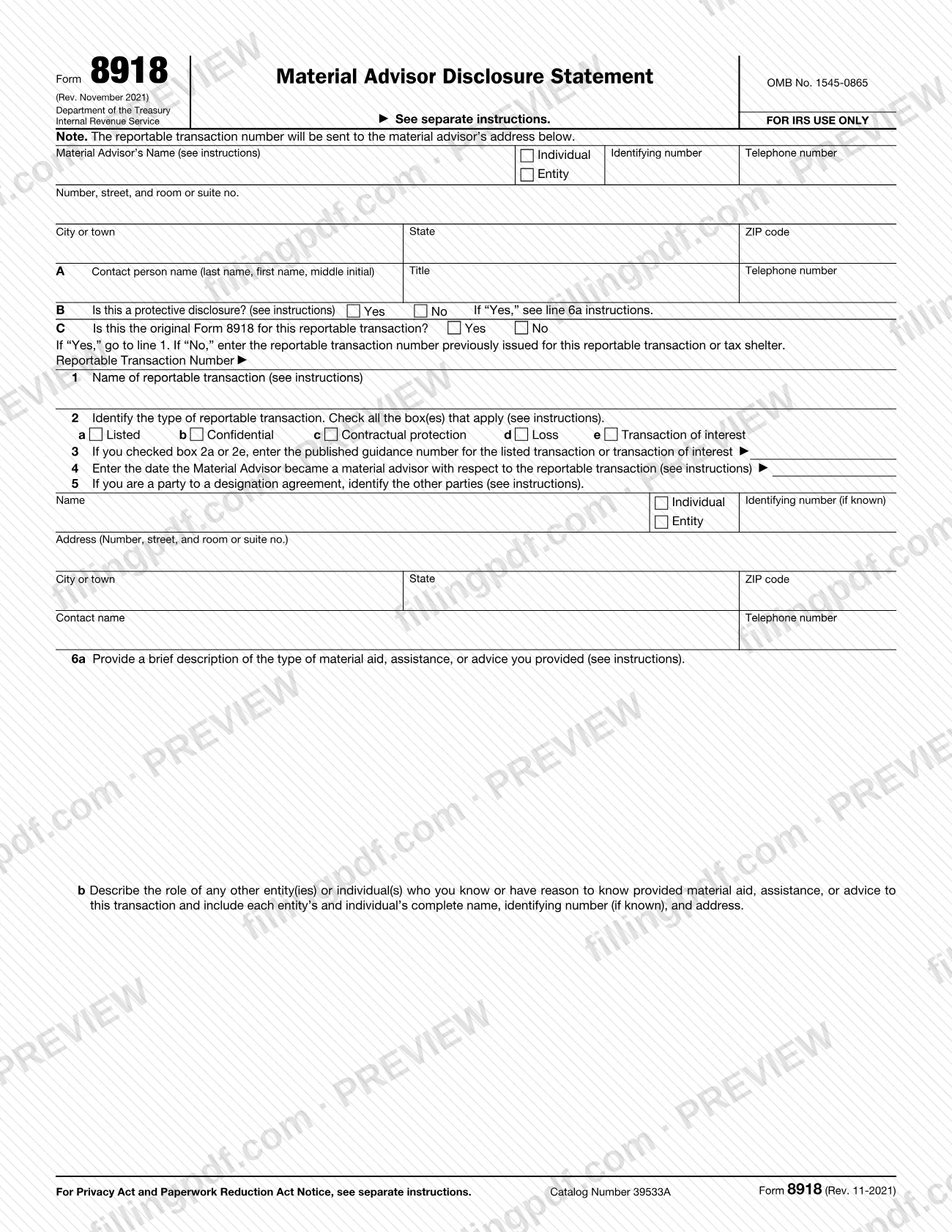
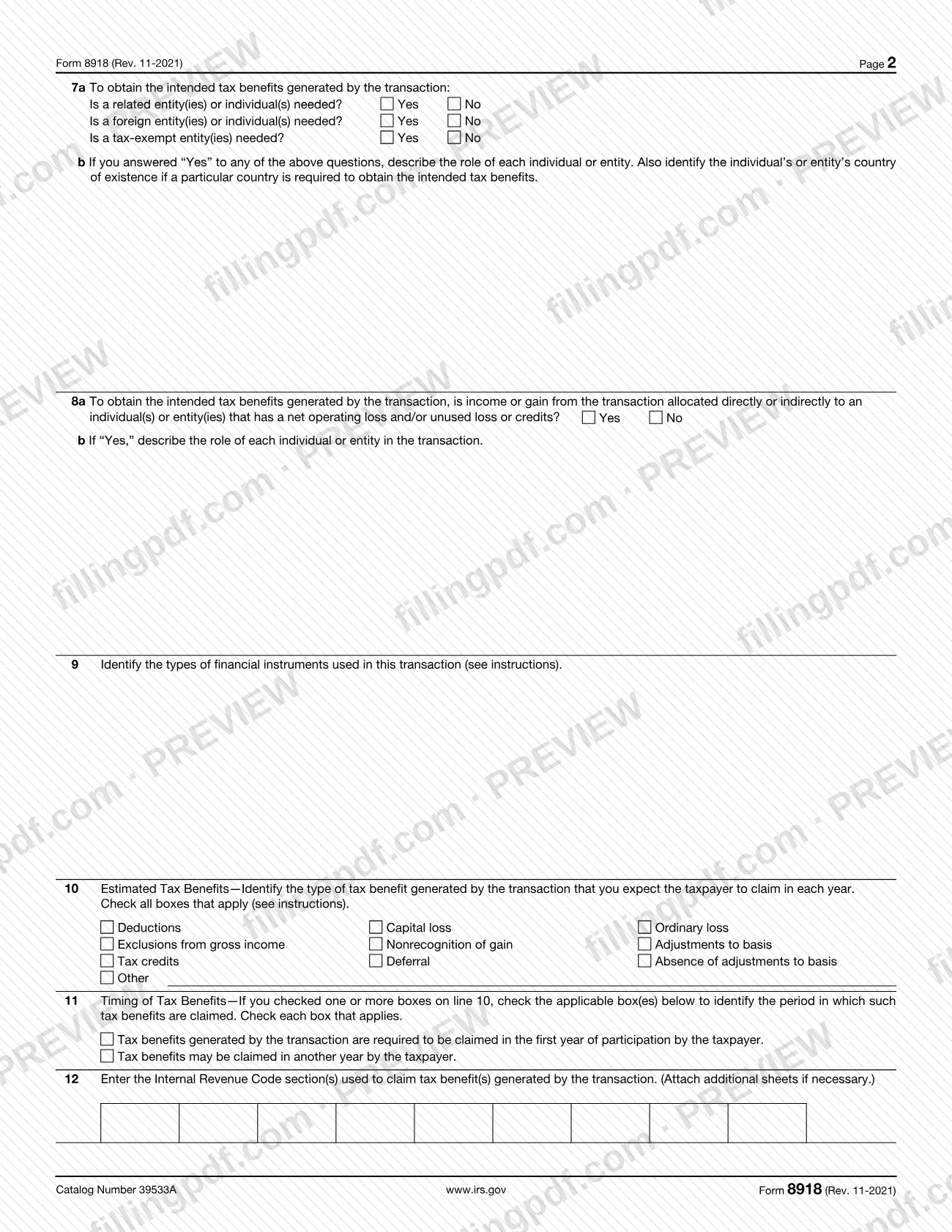
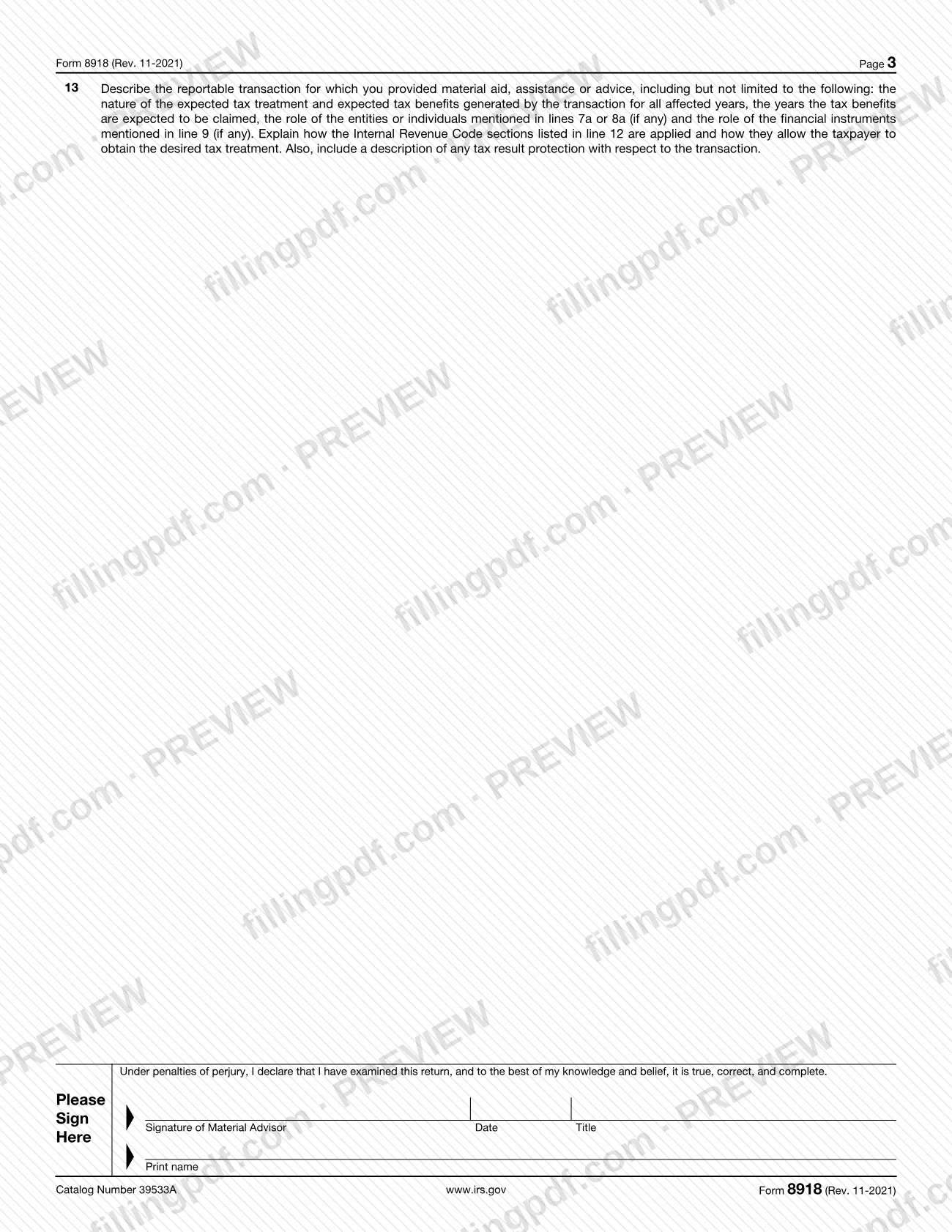

Form 8918 is the Material Advisor Disclosure Statement that the Internal Revenue Service (IRS) requires from material advisors to a reportable transaction. It tells the IRS who the advisor is, what the transaction is, which tax benefits are expected and how the transaction is structured, and it earns the advisor a reportable transaction number in return. On this page you can fill out the form online on FillingPDF and download or print the completed PDF; the form and its instructions are published by the IRS at IRS.gov/Form8918.
Last updated
What is Form 8918?
Form 8918, Material Advisor Disclosure Statement, is the IRS form that a material advisor to a reportable transaction files to disclose the transaction, the tax benefits expected from it and the role of the advisor and the other parties involved.
The Internal Revenue Service (IRS) uses the form to identify and describe the transaction. In return, the IRS sends a reportable transaction number to the material advisor's address shown on the form. Receiving that number does not mean the IRS has reviewed, examined or approved the transaction. The material advisor must pass the number on to every taxpayer and material advisor for whom the advisor acts as a material advisor.
Form 8918 covers the reportable transaction categories described in the instructions: listed transactions, confidential transactions, transactions with contractual protection, loss transactions and transactions of interest. The form replaces Form 8264, Application for Registration of a Tax Shelter.
Form 8918 is not the taxpayer's disclosure. A taxpayer who participated in a reportable transaction must also disclose it, on Form 8886, Reportable Transaction Disclosure Statement. The advisor files Form 8918; the taxpayer files Form 8886.
The same form is used for an original disclosure and for an amended statement, which is filed when earlier information is no longer accurate, new information becomes available or the transaction changes materially.
Who needs to file Form 8918?
Generally, every material advisor to a reportable transaction must file Form 8918. A material advisor can be an individual, trust, estate, partnership or corporation.
You are a material advisor if you provide material aid, assistance or advice with respect to organizing, managing, promoting, selling, implementing, insuring or carrying out a reportable transaction, and you directly or indirectly receive, or expect to receive, gross income above the threshold amount for that aid, assistance or advice. The instructions set the threshold separately for each reportable transaction and explain how fees are counted.
You are not required to file unless you made or provided a tax statement to or for the benefit of a taxpayer, as the instructions describe. If you provide a tax statement to another material advisor, you need not file unless the transaction is entered into by a taxpayer to whom, or for whose benefit, you provided the tax statement.
Exceptions in the instructions:
- Employees and agents. You are generally not a material advisor if you make a tax statement solely as an employee, shareholder, partner or agent of another person, unless you form or use an entity to avoid the rules of section 6111 or 6112 or the penalties under section 6707 or 6708.
- Post-filing advice. You are not a material advisor if you make no tax statement until after the first return reflecting the transaction's tax benefits is filed, unless the taxpayer is expected to file a supplemental or amended return reflecting additional benefits.
If you are unsure whether a transaction must be disclosed, the instructions let you file on a protective basis.
When to file Form 8918
File Form 8918 by the last day of the month that follows the end of the calendar quarter in which you became a material advisor to the reportable transaction. The same deadline applies to an amended statement: it is due by the last day of the month after the quarter in which circumstances arise that require one.
You became a material advisor on the latest of four dates: when you made a tax statement, when you received or expected to receive gross income above the threshold amount, when the taxpayer entered into the transaction, and when the transaction became a listed transaction or transaction of interest. Enter that date on line 4.
When several material advisors designate one advisor by written agreement to disclose the transaction, the disclosure is due by the last day of the month following the quarter that includes the earliest date on which a material advisor who is party to the agreement became a material advisor.
A pending ruling request does not suspend the obligation: the instructions say to file the form anyway to avoid potential penalties.
Documents you need
- Additional sheets, only if the information for a line exceeds the space on the form: fill the form space first, keep the sheets in line order and put your name and identifying number at the top of each sheet.
- Attached sheets for line 12, only if you need to list more Internal Revenue Code sections than the form allows.
How to fill out Form 8918
Enter material advisor information
Enter the material advisor's name, identifying number (SSN for an individual, EIN for an entity), telephone number and complete address. An individual enters first name, middle initial and last name; an entity enters its full name as shown on its income tax return.
Complete Items A, B and C
Item A: for an entity, give a contact person's name, title and phone number. Item B: check Yes for a protective disclosure. Item C: check Yes for an original form, or No and enter the previously issued Reportable Transaction Number.
Name the reportable transaction
Line 1: enter the name by which you or published guidance know the transaction. If it has none, give a short description that distinguishes it from your other reportable transactions.
Identify the transaction type
Line 2: check every box that applies: Listed, Confidential, Contractual protection, Loss or Transaction of interest. Check Listed for a listed transaction, plus any other boxes that apply.
Enter guidance number and advisor date
Line 3: if you checked 2a or 2e, enter the published guidance number. Line 4: enter the date you became a material advisor, which is the latest of the dates listed in the instructions.
Identify designation agreement parties
Line 5: if you are party to a designation agreement, enter the name, identifying number if known, address and contact for each other party.
Describe your role and other advisors
Line 6a: briefly state the material aid, assistance or advice you provided, and for a protective disclosure explain why you believe you are not a material advisor. Line 6b: describe the role of other parties who provided aid, with names, identifying numbers if known and addresses.
Answer lines 7a and 7b
Line 7a: answer Yes or No for related, foreign and tax-exempt parties. Line 7b: if any answer is Yes, describe each role and the country of existence when a particular country is required.
Answer lines 8a and 8b
Line 8a: check Yes or No on whether income or gain is allocated to a party with a net operating loss or unused losses or credits. Line 8b: if Yes, describe each party's role.
List financial instruments
Line 9: identify the types of financial instruments used, such as loans, stocks, bonds, notes, swaps, futures or options. Use attached sheets only if the form space is not enough.
Check tax benefits and timing
Line 10: check each expected tax benefit, and use Other with a description if none fits. Line 11: check whether benefits must be claimed in the first year of participation, may be claimed in another year, or both.
Enter Code sections on line 12
List the Internal Revenue Code sections used to claim the tax benefits. Attach additional sheets only if needed.
Describe the transaction on line 13
Describe the expected tax treatment and benefits for all affected years, the roles of parties from lines 7a and 8a, the financial instruments from line 9, how the Code sections on line 12 apply, and any tax result protection.
Sign, review and download the PDF
The material advisor signs and dates under penalties of perjury, and enters title and printed name. Check that every line is complete, then download or print the completed PDF from FillingPDF and send it through the channels under How to submit.
How to submit Form 8918
You can file Form 8918 by electronic fax or by mail to the IRS Office of Tax Shelter Analysis (OTSA).
- Electronic fax: send Form 8918 and related attachments to 1-844-253-5607 (toll-free). Other items sent to this number will not be processed. The fax cover sheet should show the subject "Form 8918", the sender's name, title, phone number and street address, the material advisor's name, the date and the number of pages including the cover sheet. Do not put sensitive information, such as an Employer Identification Number or Social Security Number, on the cover sheet. A fax may not exceed 100 pages.
- Mail: if you have no access to electronic fax, mail the completed form to Internal Revenue Service, OTSA Mail Stop 4915, 1973 Rulon White Blvd., Ogden, Utah 84201. The IRS says a receipt will be provided confirming submission.
The IRS rejects incorrectly filed forms. After June 1, 2022 only the 2021 revision is accepted, and the form must not be handwritten. The IRS sends the reportable transaction number to the material advisor's address on the form. Do not send the form to the Tax Forms and Publications address printed for comments. FillingPDF lets you fill out and download the PDF; submission follows the channels above.
Common mistakes to avoid
- Filling in Form 8918 by hand; the instructions say the form must not be handwritten and that incorrectly filed forms are rejected.
- Using an older revision; after June 1, 2022 only the 2021 revision is accepted.
- Writing "See Attached" without first entering as much information as the text box allows.
- Stating that information will be provided upon request or that details are available upon request; that is not a description and may cause the statement to be treated as incomplete.
- Not checking the listed transaction box on line 2 in addition to any other boxes when the transaction is a listed transaction.
- Filing a protective disclosure without explaining on line 6a why you are filing on a protective basis.
- Entering a new original disclosure as an amendment, or an amendment without the earlier reportable transaction number in item C.
- Reporting more than one transaction on one form when the transactions are not the same or substantially similar.
- Faxing items other than Form 8918 and its attachments to the Form 8918 fax number, or exceeding 100 pages.
Frequently asked questions
What is Form 8918 used for?
Form 8918 is the IRS Material Advisor Disclosure Statement. Material advisors to a reportable transaction file it to disclose the transaction and its expected tax benefits, and the IRS responds with a reportable transaction number. It replaced Form 8264, Application for Registration of a Tax Shelter.
Who has to file Form 8918?
Generally, every material advisor to a reportable transaction. You are one if you provide material aid, assistance or advice on a reportable transaction and expect gross income above the threshold amount for it. Employees acting only in that capacity and post-filing advisors are generally excepted, as the instructions explain.
What is the difference between Form 8918 and Form 8886?
Material advisors file Form 8918. Taxpayers who participated in a reportable transaction must separately disclose it on Form 8886, Reportable Transaction Disclosure Statement. Filing one does not replace the other.
When is Form 8918 due?
By the last day of the month that follows the end of the calendar quarter in which you became a material advisor to the reportable transaction. An amended statement follows the same rule, counted from the quarter in which circumstances requiring the amendment occur.
Where do I send Form 8918?
Fax it, with related attachments, to 1-844-253-5607, or mail it to Internal Revenue Service, OTSA Mail Stop 4915, 1973 Rulon White Blvd., Ogden, Utah 84201. Mail is for filers without access to electronic fax. The fax limit is 100 pages.
Can I fill out Form 8918 online?
You can fill out the Form 8918 PDF online on FillingPDF and download or print it. FillingPDF does not file it with the IRS and is not affiliated with the agency; you submit the form by electronic fax or mail.
What is a protective disclosure on Form 8918?
It is a disclosure filed when you are uncertain whether a transaction must be disclosed. Check Yes at Item B and explain on line 6a why you are filing on a protective basis. The form must still be fully completed for the protection to be effective.
Can I send a handwritten or older version of Form 8918?
No. The instructions say the IRS rejects incorrectly filed forms, the form must not be handwritten, and only the 2021 version is accepted after June 1, 2022. Always use the latest revision available on IRS.gov.
What happens if I do not file Form 8918 or file it incomplete?
A penalty may be imposed if you are required to file and do not file on time, or if you file false or incomplete information. The instructions refer to section 6707 for the penalty. Stating that details will be provided on request does not count as a description.
Ready to fill out Form 8918?
Fill out Form 8918 now