
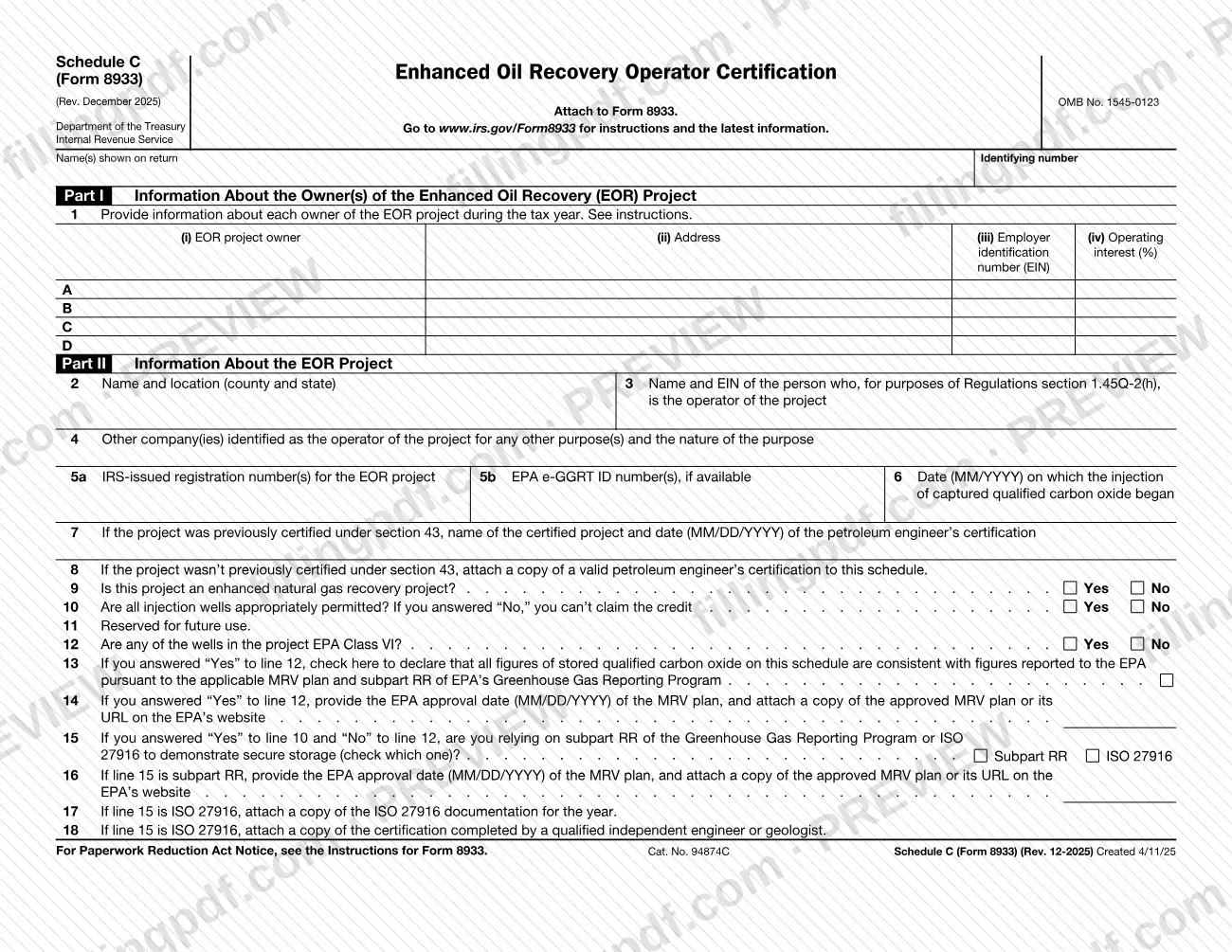
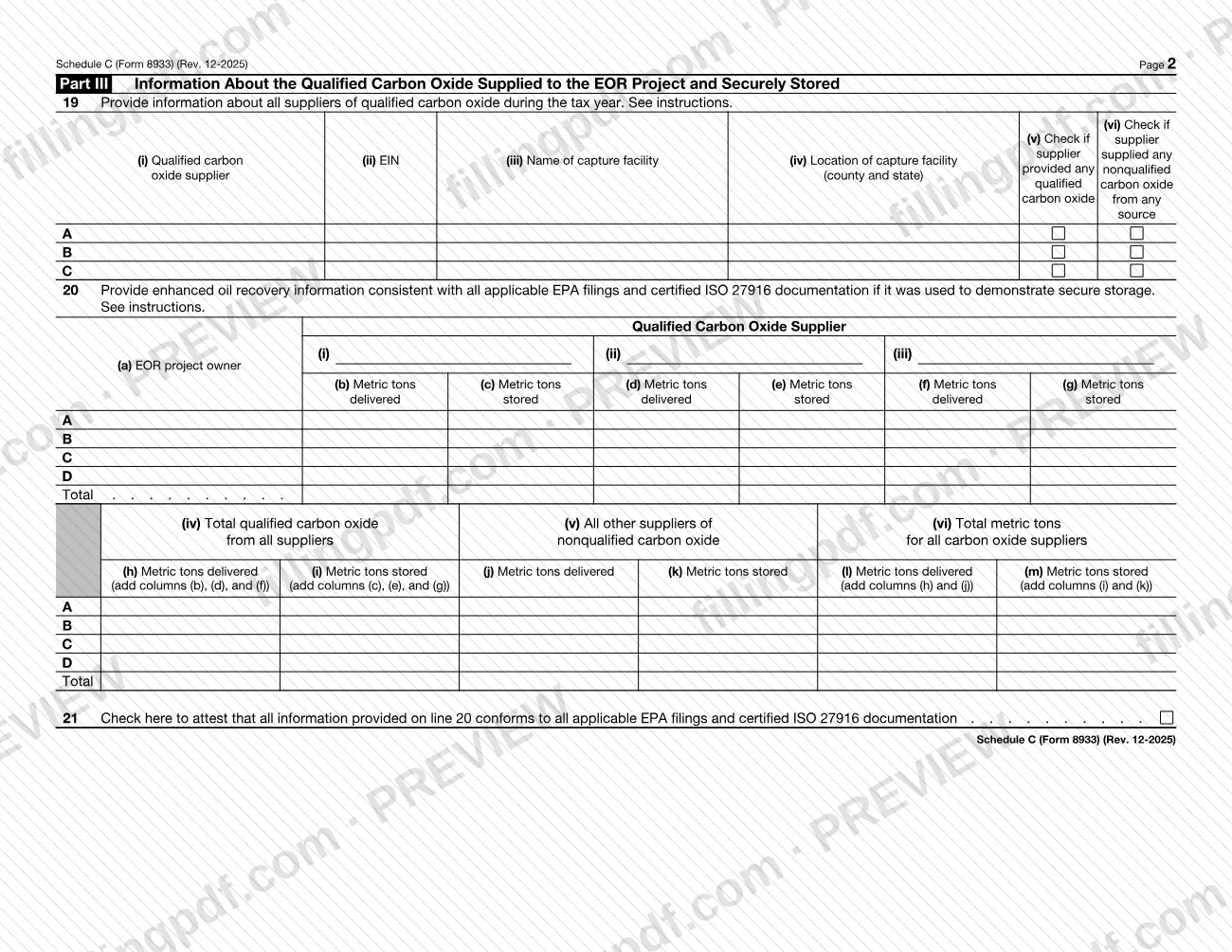
Schedule C (Form 8933), Enhanced Oil Recovery Operator Certification, is an Internal Revenue Service (IRS) schedule that you attach to Form 8933. It identifies the owners of an enhanced oil recovery (EOR) project, describes the project and its permits and storage reporting, and lists the suppliers of qualified carbon oxide with the metric tons delivered and stored. On this page you can fill out the form online on FillingPDF and download or print the completed PDF; the IRS publishes the form and its instructions at www.irs.gov/Form8933.
Last updated
What is Schedule C (Form 8933)?
Schedule C (Form 8933), Enhanced Oil Recovery Operator Certification, is the IRS schedule attached to Form 8933 that identifies an enhanced oil recovery (EOR) project, its owners and operator, its permits and storage reporting, and the qualified carbon oxide supplied to it and securely stored.
The schedule has three parts:
- Part I (line 1) lists each owner of the EOR project during the tax year, with address, employer identification number (EIN) and operating interest percentage.
- Part II (lines 2 to 18) describes the project: its name and location, the operator for purposes of Regulations section 1.45Q-2(h), registration numbers, the date injection began, any earlier certification under section 43, well permits, EPA Class VI wells and the monitoring, reporting and verification (MRV) plan or ISO 27916 documentation used to show secure storage.
- Part III (lines 19 to 21) lists every supplier of qualified carbon oxide and reports metric tons delivered and stored, by supplier and by project owner.
The form carries OMB No. 1545-0123 and the revision printed on it is Rev. December 2025. It is a schedule of Form 8933 and is not filed on its own. Line 10 warns that if not all injection wells are appropriately permitted, you can't claim the credit. The IRS instructions for Form 8933 are at www.irs.gov/Form8933.
Who needs to file Schedule C (Form 8933)?
Taxpayers completing Form 8933 for an enhanced oil recovery project attach this schedule to that form. It asks for the name(s) shown on the return and an identifying number, so it is completed by the filer of Form 8933.
What the schedule collects, and from whom:
- Each owner of the EOR project during the tax year, with its EIN and operating interest (line 1).
- The person who, for purposes of Regulations section 1.45Q-2(h), is the operator of the project, with name and EIN (line 3).
- Every supplier of qualified carbon oxide during the tax year, including any supplier that provided nonqualified carbon oxide from any source (line 19).
Lines 13 to 18 apply only in the situations the form describes: Class VI wells (lines 12 to 14), reliance on subpart RR of the Greenhouse Gas Reporting Program or ISO 27916 (lines 15 to 18). The form does not say who may sign for another person; check the Form 8933 instructions at www.irs.gov/Form8933 for eligibility questions.
When to file Schedule C (Form 8933)
You complete Schedule C when you complete Form 8933, because the form says to attach it to Form 8933. No separate due date is printed on it, so it travels with Form 8933 whenever that form is submitted.
The information it asks for is tied to the tax year: line 1 covers each owner of the project during the tax year, and line 19 covers all suppliers of qualified carbon oxide during the tax year. Line 6 asks for the month and year (MM/YYYY) injection of captured qualified carbon oxide began. For any deadline that applies to Form 8933, see the IRS instructions at www.irs.gov/Form8933.
Documents you need
- If the project was not previously certified under section 43: a copy of a valid petroleum engineer's certification, attached to the schedule (line 8).
- If you answered "Yes" to line 12 (EPA Class VI wells): a copy of the approved MRV plan or its URL on the EPA's website, with the EPA approval date (line 14).
- If line 15 is subpart RR: a copy of the approved MRV plan or its URL on the EPA's website, with the EPA approval date (line 16).
- If line 15 is ISO 27916: a copy of the ISO 27916 documentation for the year (line 17).
- If line 15 is ISO 27916: a copy of the certification completed by a qualified independent engineer or geologist (line 18).
How to fill out Schedule C (Form 8933)
Enter name and identifying number
At the top, enter the name(s) shown on your return and your identifying number, matching Form 8933.
List the EOR project owners
Line 1, Part I: for each owner of the EOR project during the tax year (rows A to D), enter the owner, address, employer identification number (EIN) and operating interest (%). See the instructions.
Identify the project and operator
Line 2: name and location (county and state). Line 3: name and EIN of the operator for purposes of Regulations section 1.45Q-2(h). Line 4: any other company identified as operator for another purpose, and that purpose.
Enter registration and injection details
Line 5a: IRS-issued registration number(s). Line 5b: EPA e-GGRT ID number(s), if available. Line 6: date injection of captured qualified carbon oxide began, as MM/YYYY.
Report prior certification
Line 7: if previously certified under section 43, enter the certified project name and the petroleum engineer's certification date (MM/DD/YYYY). Line 8: if not, attach a copy of a valid petroleum engineer's certification.
Answer the project and permit questions
Line 9: check Yes or No for an enhanced natural gas recovery project. Line 10: check Yes or No for whether all injection wells are appropriately permitted; "No" means you can't claim the credit. Leave line 11, reserved for future use, blank.
Complete the Class VI wells lines
Line 12: check Yes or No. If Yes, check the line 13 box declaring your figures are consistent with EPA reporting, and give the line 14 MRV plan approval date (MM/DD/YYYY) with a copy or URL.
Show how secure storage is demonstrated
Line 15, only if you answered Yes on line 10 and No on line 12: check Subpart RR or ISO 27916. For subpart RR, complete line 16; for ISO 27916, attach the documents named on lines 17 and 18.
List the carbon oxide suppliers
Line 19, Part III: for each supplier (rows A to C), enter the EIN, capture facility name, its location (county and state), and check the boxes in columns (v) and (vi) that apply.
Enter metric tons on line 20
For each project owner, report metric tons delivered and stored by supplier in columns (b) to (g). Complete columns (h) to (m) as the headings direct and fill the Total row, consistent with EPA filings and ISO 27916 documentation.
Review, attest, and download the PDF
Check the line 21 box to attest line 20 conforms to EPA filings and certified ISO 27916 documentation. Review every line, then download or print the completed PDF from FillingPDF and attach it to Form 8933.
How to submit Schedule C (Form 8933)
Schedule C (Form 8933) is submitted as an attachment to Form 8933; it has no filing channel or address of its own printed on it.
- Attach it to Form 8933. Send the completed schedule with Form 8933, the way you submit that form.
- Add the attachments the lines require. Depending on your answers, these are a petroleum engineer's certification (line 8), a copy of the approved MRV plan or its URL (lines 14 and 16), ISO 27916 documentation for the year (line 17) and the certification by a qualified independent engineer or geologist (line 18).
- Find instructions. The form directs you to www.irs.gov/Form8933 for instructions and the latest information.
FillingPDF lets you fill out and download the PDF; submission follows the IRS channels that apply to Form 8933.
Common mistakes to avoid
- Submitting the schedule without attaching it to Form 8933; the form states it is to be attached to Form 8933.
- Claiming the credit after answering "No" on line 10; the form says you can't claim the credit if not all injection wells are appropriately permitted.
- Omitting the petroleum engineer's certification on line 8 when the project was not previously certified under section 43.
- Answering "Yes" on line 12 but skipping the line 13 declaration or the line 14 EPA approval date and MRV plan copy or URL.
- Answering line 15 when it does not apply; it is for projects that answered "Yes" on line 10 and "No" on line 12.
- Choosing ISO 27916 on line 15 without attaching the ISO 27916 documentation (line 17) and the independent engineer or geologist certification (line 18).
- Using the wrong date format: line 6 takes MM/YYYY, while lines 7, 14 and 16 take MM/DD/YYYY.
- Entering figures on line 20 that differ from EPA filings or certified ISO 27916 documentation, then checking the line 21 attestation.
- Not adding the columns as directed in line 20, such as (b), (d) and (f) for column (h) and (h) and (j) for column (l).
Frequently asked questions
What is Schedule C (Form 8933)?
Schedule C (Form 8933), Enhanced Oil Recovery Operator Certification, is an IRS schedule attached to Form 8933. It identifies the owners and operator of an EOR project, describes its permits and storage reporting, and lists qualified carbon oxide suppliers with metric tons delivered and stored.
Is Schedule C (Form 8933) filed on its own?
No. The form says to attach it to Form 8933, so it is submitted with that form. It has no separate address, portal or due date printed on it; the instructions are at www.irs.gov/Form8933.
What happens if I answer No on line 10?
Line 10 asks whether all injection wells are appropriately permitted. The form states that if you answer "No," you can't claim the credit.
What do I attach if the project was not certified under section 43?
Attach a copy of a valid petroleum engineer's certification to the schedule (line 8). If the project was previously certified under section 43, enter the certified project name and the certification date (MM/DD/YYYY) on line 7 instead.
When do I complete lines 15 through 18?
Only if you answered "Yes" on line 10 and "No" on line 12. Check Subpart RR or ISO 27916 on line 15. Subpart RR requires the MRV plan approval date and a copy or URL (line 16); ISO 27916 requires the year's documentation and an engineer or geologist certification (lines 17 and 18).
What does line 20 report?
Line 20 reports metric tons of qualified carbon oxide delivered and stored for each EOR project owner, by supplier, plus totals and nonqualified carbon oxide. The figures must be consistent with EPA filings and certified ISO 27916 documentation, and you check line 21 to attest to that.
Can I fill out Schedule C (Form 8933) online?
Yes. You can fill out the PDF online on FillingPDF and download or print it. FillingPDF is an independent service and does not file the form with the IRS; you submit it with Form 8933 through the IRS channels.
Ready to fill out Schedule C (Form 8933)?
Fill out Schedule C (Form 8933) now