
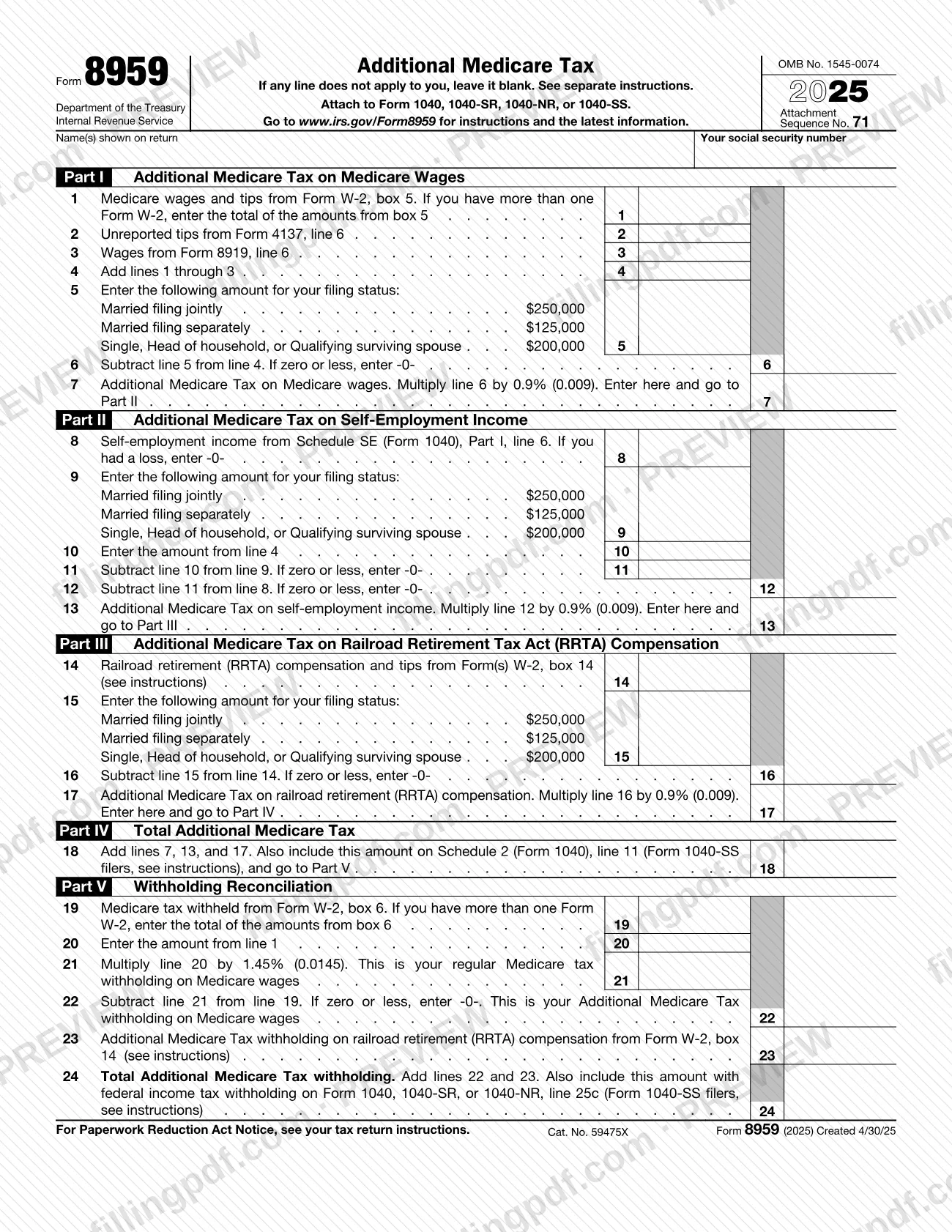
Form 8959, Additional Medicare Tax, is the Internal Revenue Service (IRS) form that figures the Additional Medicare Tax you owe on Medicare wages, railroad retirement (RRTA) compensation and self-employment income, and the amount your employer withheld. You attach it to Form 1040, 1040-SR, 1040-NR or 1040-SS. On FillingPDF you can fill out Form 8959 online and download or print the completed PDF. The form and its instructions are published by the IRS at www.irs.gov/Form8959.
Last updated
What is 8959?
Form 8959, Additional Medicare Tax, is the IRS form that calculates the Additional Medicare Tax you owe on wages, RRTA compensation and self-employment income above a threshold for your filing status, and reconciles the amount your employer withheld.
The form has five parts:
- Part I (lines 1 to 7): Additional Medicare Tax on Medicare wages, using Form W-2 box 5, unreported tips from Form 4137 and wages from Form 8919.
- Part II (lines 8 to 13): Additional Medicare Tax on self-employment income from Schedule SE (Form 1040).
- Part III (lines 14 to 17): Additional Medicare Tax on Railroad Retirement Tax Act (RRTA) compensation.
- Part IV (line 18): the total, which carries to your return.
- Part V (lines 19 to 24): the withholding reconciliation, which carries to your payments.
Medicare wages and self-employment income are combined to see whether you pass the threshold, but a self-employment loss is not counted. RRTA compensation is compared to the threshold separately. The form is not a return by itself: the IRS instructions say that if you file Form 8959 you must also file Form 1040, 1040-SR, 1040-NR or 1040-SS. The form is printed with OMB No. 1545-0074 and Attachment Sequence No. 71.
Who needs to file 8959?
You must file Form 8959 if any one of the following applies, according to the IRS instructions:
- Your Medicare wages and tips on any single Form W-2 (box 5) are greater than the threshold for a single W-2 given in the instructions.
- Your RRTA compensation on any single Form W-2 (box 14) is greater than that same threshold.
- Your total Medicare wages and tips plus self-employment income, together with your spouse's if you are married filing jointly, are greater than the threshold amount for your filing status.
- Your total RRTA compensation and tips, together with your spouse's if you are married filing jointly, are greater than the threshold amount for your filing status.
The thresholds differ for married filing jointly, married filing separately, and single, head of household or qualifying surviving spouse; they are listed in the instructions chart. The instructions give examples of people who do not need the form, such as a single filer whose self-employment income is below the threshold and who has no wages.
You also file the form to claim a credit for Additional Medicare Tax your employer withheld when you do not owe the tax. The instructions say there are no special rules for nonresident aliens and U.S. citizens living abroad.
When to file 8959
Form 8959 has no due date of its own: you file it with the Form 1040, 1040-SR, 1040-NR or 1040-SS that it is attached to, so it is due when that return is due. Your employer must furnish Form W-2 no later than February 2, 2026; if you do not have it by early February, see Tax Topic 154. Even without a Form W-2 you must still figure the tax.
If your Medicare wages, RRTA compensation or self-employment income is adjusted later, you may need to correct your liability by attaching a corrected Form 8959 to your original or amended return. When correcting wages or RRTA compensation, also attach Form W-2 or Form W-2c.
If you expect to owe Additional Medicare Tax for 2026, the instructions say you may ask your employer for more income tax withholding on a new Form W-4 or make estimated tax payments.
Documents you need
- Form W-2, Wage and Tax Statement: box 5 (Medicare wages and tips), box 6 (Medicare tax withheld) and box 14 (RRTA compensation and Additional Medicare Tax withheld) feed lines 1, 19, 14 and 23.
- Form W-2 box 12 codes B and N: needed for line 19 if you have uncollected Medicare tax on tips or on group-term life insurance; do not include amounts coded for uncollected RRTA Medicare tax.
- Form 4137, Social Security and Medicare Tax on Unreported Tip Income: needed for line 2 (line 6 of that form) if you have unreported tips.
- Form 8919, Uncollected Social Security and Medicare Tax on Wages: needed for line 3 (line 6 of that form) if you have such wages.
- Schedule SE (Form 1040), Part I, line 6: needed for line 8 if you have self-employment income; combine amounts if you have multiple Schedules SE.
- Form CT-2: needed by an employee representative subject to RRTA taxes, for lines 14 and 23 (line 2 and line 3 of all Forms CT-2 filed for 2025).
- Form W-2c, Corrected Wage and Tax Statement: attach with a corrected Form 8959 only if you are correcting Medicare wages or RRTA compensation.
How to fill out 8959
Enter your name and Social Security number
At the top, print your name(s) exactly as on your return and your Social Security number. If you are married filing jointly, enter the first Social Security number that appears on your return.
Report Medicare wages on lines 1 to 3
Line 1: total Medicare wages and tips from Form W-2, box 5, for all your Forms W-2. Line 2: unreported tips from Form 4137, line 6. Line 3: wages from Form 8919, line 6. On a joint return include your spouse's amounts; skip Part I if neither of you had Medicare wages.
Figure the tax on wages
Line 4: add lines 1 through 3. Line 5: enter the amount printed for your filing status. Line 6: subtract line 5 from line 4, entering -0- if zero or less. Line 7: multiply line 6 by the percentage printed on the line and go to Part II.
Enter self-employment income
Line 8: your self-employment income from Schedule SE (Form 1040), Part I, line 6, combining multiple Schedules SE; enter -0- for a loss. Skip Part II if neither spouse had self-employment income.
Apply the reduced threshold
Line 9: enter the amount for your filing status. Line 10: copy line 4. Line 11: subtract line 10 from line 9, -0- if zero or less. Line 12: subtract line 11 from line 8, -0- if zero or less.
Figure the tax on self-employment income
Line 13: multiply line 12 by the percentage printed on the line and go to Part III.
Complete Part III for RRTA compensation
Line 14: RRTA compensation and tips from Form W-2, box 14, adding your spouse's on a joint return. Line 15: the amount for your filing status. Line 16: subtract line 15 from line 14, -0- if zero or less. Line 17: multiply line 16 by the percentage printed. Skip Part III if you had no RRTA compensation.
Total the tax on line 18
Line 18: add lines 7, 13 and 17. Include this amount on Schedule 2 (Form 1040), line 11, or on line 5 of Part I of Form 1040-SS.
Reconcile Medicare tax withheld
Line 19: Medicare tax withheld from Form W-2, box 6, plus any box 12 code B and N amounts as the instructions describe. Line 20: copy line 1. Line 21: multiply line 20 by the regular Medicare percentage printed. Line 22: subtract line 21 from line 19, -0- if zero or less. Leave Part V blank if you had no Medicare wages or RRTA compensation.
Enter RRTA withholding and the total
Line 23: Additional Medicare Tax withheld on RRTA compensation from Form W-2, box 14. Line 24: add lines 22 and 23, and include it with federal income tax withholding on line 25c of Form 1040, 1040-SR or 1040-NR, or on line 11a of Part I of Form 1040-SS.
Review and download the completed PDF
Leave blank any line that does not apply, check that lines 18 and 24 match what you enter on your return, then download or print the completed PDF from FillingPDF and attach it to your return.
How to submit 8959
Form 8959 is not sent on its own: you attach it to your federal income tax return, and it travels through the same channel as that return.
- With Form 1040, 1040-SR or 1040-NR: attach the completed Form 8959. Include the line 18 amount on Schedule 2 (Form 1040), line 11, and the line 24 amount with your federal income tax withholding on line 25c.
- With Form 1040-SS: attach the completed Form 8959. Line 18 goes on line 5 of Part I of Form 1040-SS, and line 24 goes on line 11a of Part I; Form 1040-SS filers should also see the instructions for the lines.
- Corrections: attach a corrected Form 8959 to your original return or amended return, plus Form W-2 or Form W-2c if you are correcting Medicare wages or RRTA compensation.
Form 8959 has no separate mailing address or portal; follow the filing instructions for the return it is attached to. FillingPDF lets you fill out and download the PDF; submission follows the channels above.
Common mistakes to avoid
- Filing Form 8959 without filing Form 1040, 1040-SR, 1040-NR or 1040-SS; the instructions say one of those returns must be filed with it.
- Counting a self-employment loss: on line 8 enter -0- if you had a loss, since negative amounts are not considered for this tax.
- Skipping line 10 and the wage reduction: your Medicare wages from line 4 reduce the threshold for self-employment income, but not below zero.
- Combining a spouse's wages and RRTA compensation to test one threshold; the instructions treat RRTA compensation separately, and it does not reduce the self-employment threshold.
- Leaving out your spouse's amounts on a joint return for lines 1, 2, 3, 14, 19 and 23.
- Asking your employer to stop Additional Medicare Tax withholding; the instructions say you cannot, and any excess is claimed as a credit on your return.
- Entering the line 24 total only on its own line instead of adding it to federal income tax withholding on line 25c of Form 1040, 1040-SR or 1040-NR.
- Filing Form 1040-SS and entering the line 24 amount on line 25c; Form 1040-SS filers enter it on line 11a of Part I.
- Omitting box 12 codes B and N amounts from line 19 when your Form W-2 shows them, other than codes for uncollected RRTA Medicare tax.
Frequently asked questions
What is Form 8959 used for?
Form 8959 figures the Additional Medicare Tax you owe and the amount your employer withheld, if any. You carry the results to Form 1040, 1040-SR, 1040-NR or 1040-SS, so the tax is added to your total and the withholding counts as a payment.
Who has to file Form 8959?
You must file if Medicare wages or RRTA compensation on a single Form W-2 exceed the threshold in the instructions, or if your combined wages, self-employment income or RRTA compensation (with your spouse's if filing jointly) exceed the threshold for your filing status.
Do I attach Form 8959 to my tax return?
Yes. Attach Form 8959 to Form 1040, 1040-SR, 1040-NR or 1040-SS. The instructions say that if you file Form 8959 you must file one of those returns, and the form has no separate address or due date.
Can I fill out Form 8959 online?
You can fill out Form 8959 online on FillingPDF and download or print the PDF. FillingPDF is an independent service and does not file anything with the IRS; you submit the form with your return through the IRS channels.
Where does the line 18 amount go?
Include line 18 on Schedule 2 (Form 1040), line 11. Form 1040-SS filers enter it on line 5 of Part I of Form 1040-SS. It is the total Additional Medicare Tax from Parts I, II and III.
Where do I enter the line 24 withholding?
If you file Form 1040, 1040-SR or 1040-NR, include line 24 with your federal income tax withholding on line 25c. Form 1040-SS filers enter it on line 11a of Part I. It is the total of lines 22 and 23.
Can my employer stop withholding Additional Medicare Tax?
No. If your employer is required to withhold it, you cannot ask it to stop. If you do not owe the tax, you claim the withheld amount as a credit against your total tax by filing Form 8959.
Does my spouse's income count on Form 8959?
On a joint return, yes: include your spouse's Medicare wages, tips, unreported tips, self-employment income and RRTA compensation. RRTA compensation is compared with the threshold separately from wages, and it does not reduce the self-employment threshold.
Ready to fill out 8959?
Fill out 8959 now