
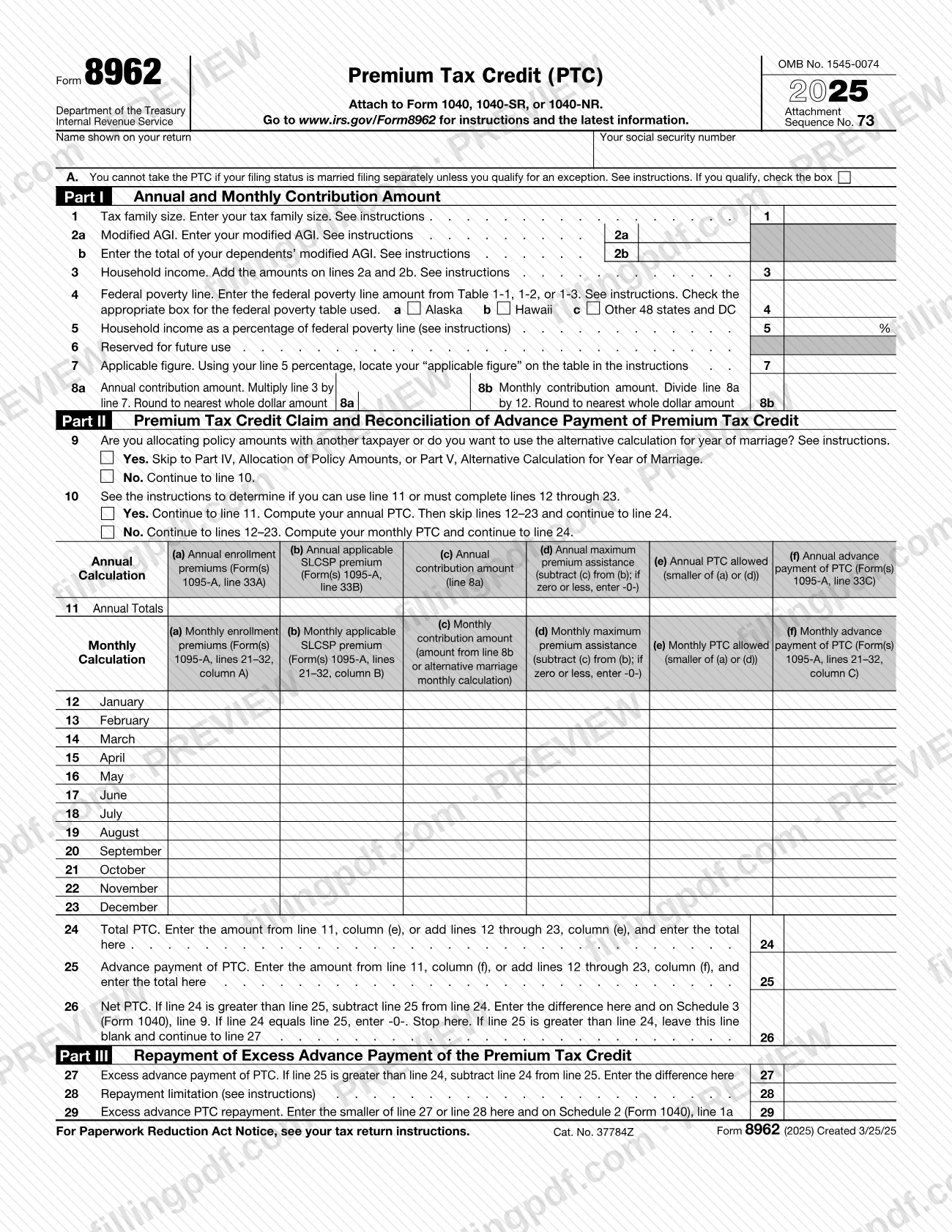
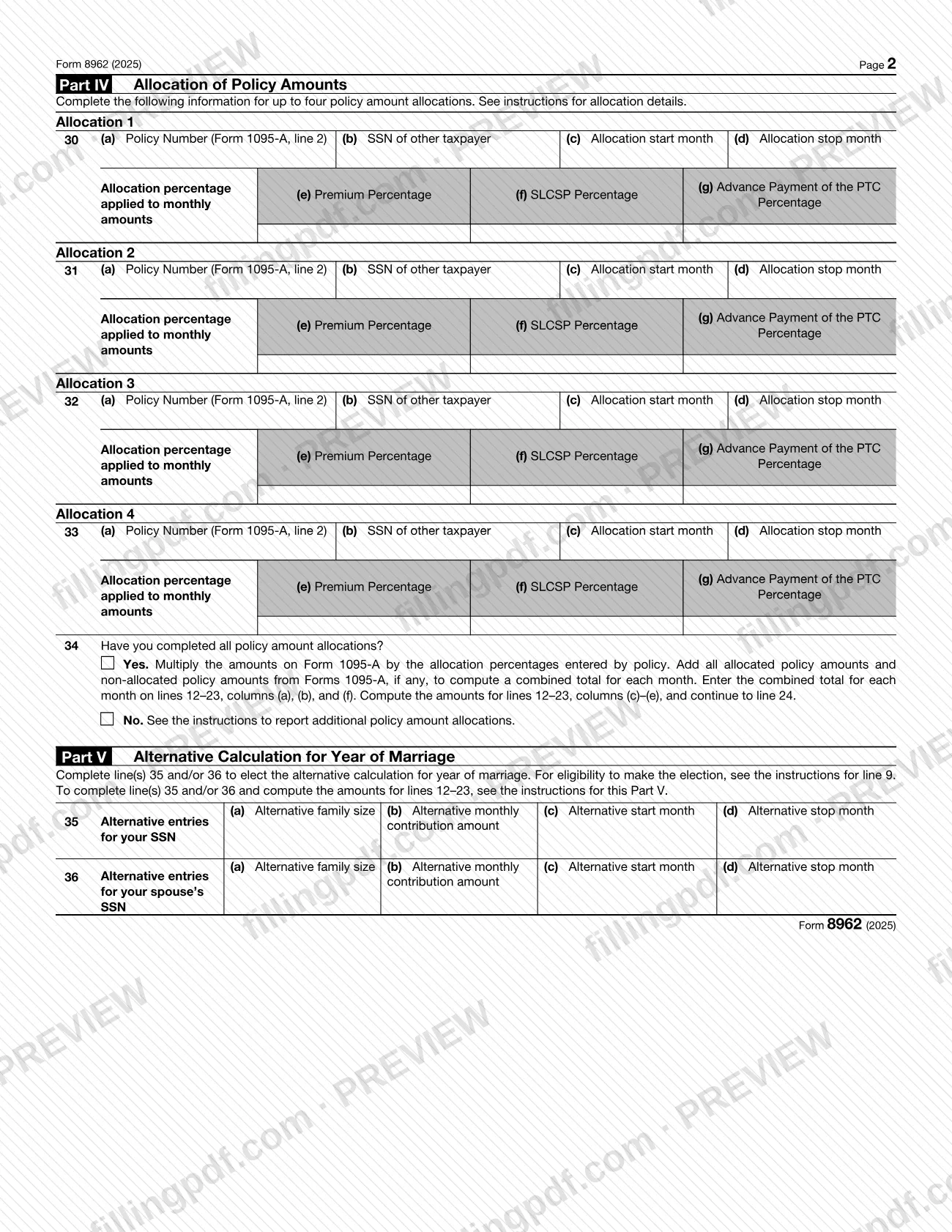
Form 8962, Premium Tax Credit (PTC), is the Internal Revenue Service (IRS) form used to figure the amount of your premium tax credit (PTC) and to reconcile it with any advance payment of the premium tax credit (APTC) paid for Marketplace health coverage. You attach it to Form 1040, 1040-SR, or 1040-NR. On this page you can fill out the form online on FillingPDF and download or print the completed PDF. The form and its instructions are published by the IRS at www.irs.gov/Form8962.
Last updated
What is 8962?
Form 8962, Premium Tax Credit (PTC) is the IRS form on which you compute the premium tax credit you can take for health insurance bought through a Health Insurance Marketplace and compare it with the advance payments (APTC) made to your insurer during the year.
The PTC helps pay the premiums for a qualified health plan offered through a Marketplace. If the APTC paid is more than your PTC, you have excess APTC and must repay it, subject to certain limitations. If the APTC is less than your PTC, you get a credit for the difference, which reduces your tax payment or increases your refund. The Marketplace reports the coverage and APTC on Form 1095-A, Health Insurance Marketplace Statement, which you need to complete Form 8962.
The form has five parts:
- Part I, Annual and Monthly Contribution Amount (lines 1–8b).
- Part II, Premium Tax Credit Claim and Reconciliation of Advance Payment of Premium Tax Credit (lines 9–26).
- Part III, Repayment of Excess Advance Payment of the Premium Tax Credit (lines 27–29).
- Part IV, Allocation of Policy Amounts, for a policy shared with another taxpayer (lines 30–34).
- Part V, Alternative Calculation for Year of Marriage (lines 35–36).
Complete Form 8962 only for coverage in a qualified health plan purchased through a Marketplace, on HealthCare.gov or a State Marketplace. Catastrophic plans, stand-alone dental plans and all Small Business Health Options Program (SHOP) plans are not qualified health plans for the PTC. The IRS publishes the PTC in Pub. 974 as well.
Who needs to file 8962?
You must file Form 8962 with your income tax return (Form 1040, 1040-SR, or 1040-NR) if any of the following applies:
- You are taking the PTC.
- APTC was paid for you or another individual in your tax family.
- APTC was paid for an individual you told the Marketplace would be in your tax family, and neither you nor anyone else included that individual in a tax family.
If one of these applies, you must file a return and attach Form 8962 even if you are not otherwise required to file. If someone else enrolled an individual in your tax family and APTC was paid for that coverage, you still file Form 8962 to reconcile it and need a copy of Form 1095-A from the person who enrolled the individual.
You do not need to file Form 8962 if you are claimed as a dependent on another person's return; the person who claims you files it. You cannot file Form 1040-SS with Form 8962. Married taxpayers generally must file jointly to take the PTC, unless an exception in the instructions applies (certain married persons living apart, or a victim of domestic abuse or spousal abandonment). Individuals who are not lawfully present cannot take the PTC for their own coverage but may still have to complete parts of the form.
When to file 8962
File Form 8962 with your federal income tax return for the year, because it is attached to Form 1040, 1040-SR, or 1040-NR and has no separate due date of its own. The 2025 instructions apply to coverage in 2025.
Timing matters in two places. The Marketplace must provide or send Form 1095-A by January 31, 2026; if you expect one and have not received it by early February, the instructions tell you to contact the Marketplace. And the enrollment premium you are responsible for generally must be paid by the due date of your tax return, not including extensions, for the month to count toward a monthly credit amount.
Report changes in circumstances, such as income, address, employment or family changes, to the Marketplace promptly during the year so that your APTC can be adjusted.
Documents you need
- Form 1095-A, Health Insurance Marketplace Statement, for each Marketplace policy: you need it to complete Form 8962. If someone else enrolled a member of your tax family, get a copy from that person.
- A corrected Form 1095-A, if you received one with the "CORRECTED" box checked: use it instead of the original for the same policy. Do not use a Form 1095-A with the "VOID" box checked.
- Form 1040, 1040-SR, or 1040-NR: Form 8962 is attached to your return, and the entries for AGI, tax-exempt interest and Social Security benefits come from it.
- Form 1095-C, if your employer sent one: it shows the coverage offered to you and your family and can help determine whether employer coverage was affordable.
- Form 8814 or Form 2555 amounts, only if you filed them: certain figures from those forms go into the modified AGI worksheets for lines 2a and 2b.
How to fill out 8962
Enter your name and SSN
At the top of page 1, enter your name exactly as on your tax return and your social security number. On a joint return, enter the name and SSN that appear first; if you entered an ITIN on your return, enter it here.
Check line A if you qualify
Check the box on line A only if you file as married filing separately and qualify for the exception for victims of domestic abuse or spousal abandonment. Otherwise leave it blank.
Enter tax family size on line 1
Enter the number of individuals in your tax family, including yourself, based on your tax return. If someone can claim you (or your spouse on a joint return) as a dependent, that person is not counted.
Enter modified AGI on lines 2a and 2b
Use Worksheet 1-1 for your modified AGI on line 2a. Use Worksheet 1-2 for the combined modified AGI of dependents required to file a return on line 2b.
Add household income on line 3
Add lines 2a and 2b, combining them even if one is negative. If the total is less than zero, enter -0-.
Find the poverty line and percentage
On line 4, check Alaska, Hawaii or Other 48 states and DC, and enter the amount from Table 1-1, 1-2 or 1-3 for your family size. On line 5, use Worksheet 2 to enter household income as a percentage of that line, without rounding up.
Complete lines 7, 8a and 8b
On line 7, enter the applicable figure from Table 2 for your line 5 percentage. Multiply line 3 by line 7 for line 8a, then divide line 8a by 12 for line 8b, rounding each to the nearest whole dollar.
Answer lines 9 and 10
On line 9, check Yes only if you allocate policy amounts with another taxpayer or want the alternative calculation for year of marriage. On line 10, check Yes for full-year, unchanged coverage with the same premiums every month; otherwise check No.
Fill in line 11 or lines 12–23
If line 10 is Yes, complete line 11 columns (a)–(f) from Form 1095-A line 33 and skip lines 12–23. If No, complete columns (a)–(f) for each month January–December from Form 1095-A lines 21–32.
Total the credit on lines 24–26
Enter the total PTC on line 24 and the total advance payment on line 25. If line 24 is more than line 25, enter the difference on line 26 and on Schedule 3 (Form 1040), line 9, and stop.
Figure repayment on lines 27–29
If line 25 is more than line 24, enter the excess on line 27 and the repayment limitation from Table 5 on line 28 (leave it blank if line 5 is 400 or more). Enter the smaller on line 29 and on Schedule 2 (Form 1040), line 1a.
Complete Parts IV and V if needed
For a shared policy, use lines 30–33 (policy number, other taxpayer's SSN, start and stop months, percentages) and answer line 34. For the alternative calculation for year of marriage, complete line 35 and/or 36.
Review and download the PDF
Check every line against your Form 1095-A and tax return, then download or print the completed PDF from FillingPDF and attach it to your return as described under How to submit.
How to submit 8962
Form 8962 has no filing channel or address of its own: you attach it to your Form 1040, 1040-SR, or 1040-NR and submit the whole return the way you file that return.
- With your tax return: attach the completed Form 8962 to the return, and use whichever filing method and address the instructions for your return give.
- Carry the results to your return: the net PTC from line 26 goes on Schedule 3 (Form 1040), line 9. The excess advance PTC repayment from line 29 goes on Schedule 2 (Form 1040), line 1a.
- Do not attach documentation of domestic abuse or spousal abandonment if you check the box on line A; keep it with your tax records instead.
- Questions: the IRS instructions list the IRS Healthcare Hotline for ACA questions at 800-919-0452, and the form and its latest information are at www.irs.gov/Form8962.
FillingPDF lets you fill out and download the PDF; submission follows the channels above.
Common mistakes to avoid
- Filing Form 1040-SS with Form 8962; the instructions say you cannot, and you must use Form 1040, 1040-SR, or 1040-NR.
- Using a Form 1095-A with the "VOID" box checked, or the original instead of a "CORRECTED" Form 1095-A, to fill in the monthly amounts.
- Checking "Yes" on line 10 and using line 11 when you had coverage for fewer than 12 months, or when your premium or SLCSP premium changed during the year.
- Copying a blank, -0- or wrong SLCSP premium from Form 1095-A instead of working out the correct applicable SLCSP premium when no APTC was paid or circumstances changed.
- Rounding the line 5 percentage; Worksheet 2 says to drop the decimals, and to enter 401 if household income is more than 400% of the federal poverty line.
- Checking the box on line A as married filing separately without qualifying as a victim of domestic abuse or spousal abandonment, or after using that exception for 3 consecutive years.
- Attaching proof of abuse or abandonment to the return instead of keeping it with your tax records.
- Completing Part IV but not checking "No" on line 10, or entering a full policy number when it has more than 15 characters; enter only the last 15.
- Forgetting to write "QSEHRA" in the top margin of page 1 when a QSEHRA was unaffordable and you reduced the monthly PTC.
Frequently asked questions
What is Form 8962 used for?
Form 8962 is the IRS form used to figure your premium tax credit (PTC) and reconcile it with advance payments of the credit (APTC) made for Marketplace coverage. You attach it to Form 1040, 1040-SR, or 1040-NR. It decides whether you get an added credit or must repay excess APTC.
Do I have to file Form 8962?
Yes, if you are taking the PTC or if APTC was paid for you or another individual in your tax family, even if you are not otherwise required to file a return. If you are claimed as a dependent on someone else's return, that person files it and you do not.
What do I need from my Form 1095-A to fill out Form 8962?
You need the enrollment premiums (column A), the applicable SLCSP premium (column B) and the advance payments (column C), either as annual totals on line 33 or monthly on lines 21–32. Use the policy number from line 2 if you complete Part IV.
Do I use line 11 or lines 12 through 23?
Use line 11 only if you were enrolled all 12 months and both your enrollment premium and SLCSP premium were the same every month; check Yes on line 10. In every other case, check No and complete the monthly lines 12 through 23.
Do I attach Form 8962 to my tax return?
Yes. Form 8962 is attached to Form 1040, 1040-SR, or 1040-NR, and you cannot use it with Form 1040-SS. It has no separate address; the net PTC goes to Schedule 3 (Form 1040), line 9, and any repayment to Schedule 2 (Form 1040), line 1a.
What happens if I received more advance payments than my credit?
Then you have excess APTC and must repay it, subject to certain limitations. You figure the excess on line 27, apply the repayment limitation on line 28 (Table 5 in the instructions), and enter the smaller amount on line 29.
Can I fill out Form 8962 online?
You can fill out the Form 8962 PDF online on FillingPDF and download or print it. FillingPDF is an independent service and does not file anything with the IRS; you submit the form attached to your tax return through the IRS channels for that return.
What if I am married and filing separately?
You generally cannot take the PTC if you file as married filing separately. Exceptions apply for certain married persons living apart and for victims of domestic abuse or spousal abandonment, who check the box on line A. You may still have to repay APTC.
Ready to fill out 8962?
Fill out 8962 now