
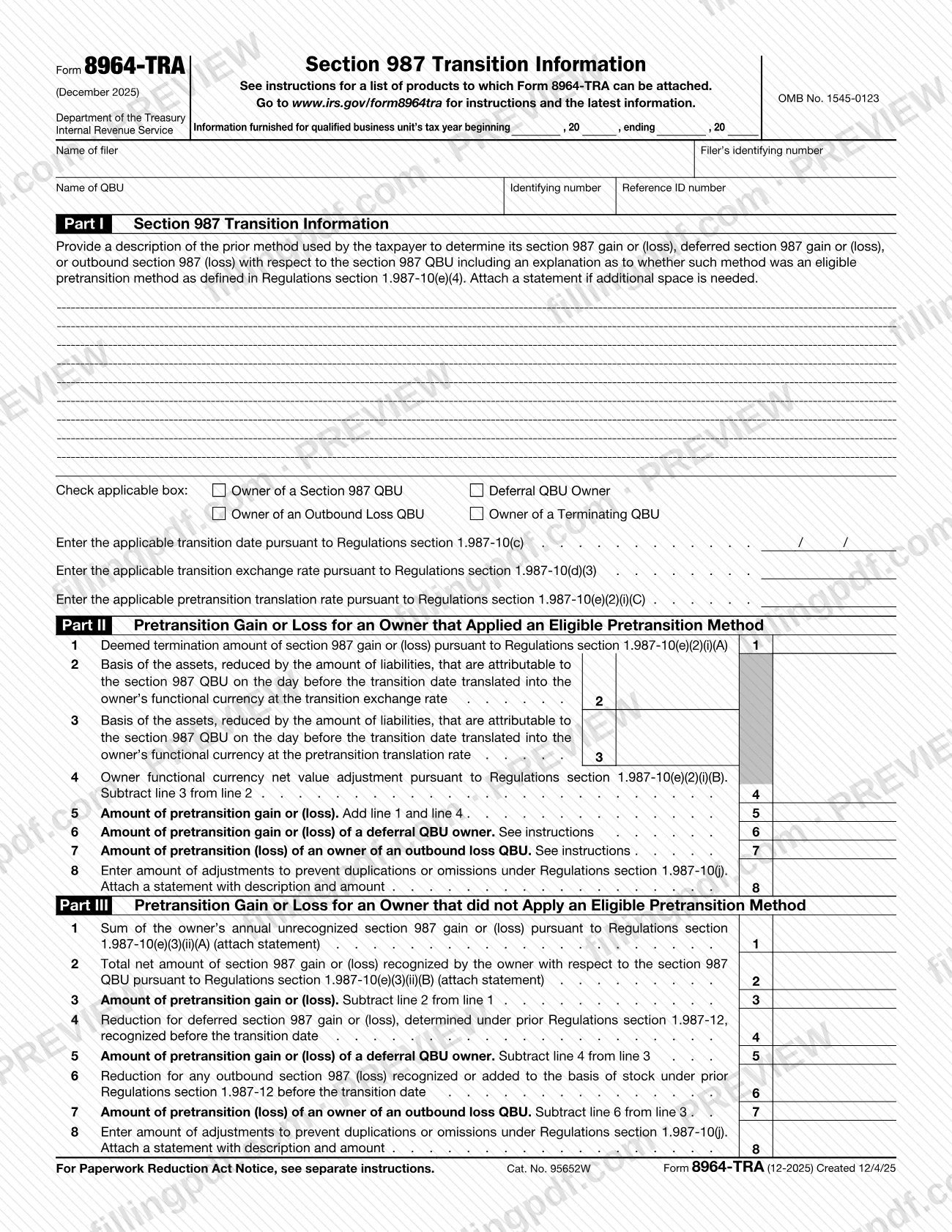
Form 8964-TRA, Section 987 Transition Information, is the Internal Revenue Service (IRS) form that reports the section 987 transition information required under Regulations section 1.987-10(k). Owners of section 987 qualified business units (QBUs), deferral QBUs, outbound loss QBUs and terminating QBUs use it to show their pretransition gain or loss. On FillingPDF you can fill out Form 8964-TRA online and download or print the completed PDF; the IRS publishes the original form and its instructions at www.irs.gov/form8964tra.
Last updated
What is 8964-TRA?
Form 8964-TRA, Section 987 Transition Information, is the IRS form used to report the section 987 transition information required under Regulations section 1.987-10(k) by owners of qualified business units (QBUs) whose functional currency differs from their own.
The transition rules in Regulations section 1.987-10 explain how a taxpayer moves from its previous method of accounting for section 987 gain or loss to the method the section 987 regulations prescribe. As part of that move, an owner must compute pretransition gain or loss for each section 987 QBU, deferral QBU and outbound loss QBU under Regulations section 1.987-10(e). Form 8964-TRA is where that computation is reported.
The form has three parts:
- Part I describes the prior method the taxpayer used and whether it was an eligible pretransition method, and gives the transition date, transition exchange rate and pretransition translation rate.
- Part II computes pretransition gain or loss for an owner that applied an eligible pretransition method.
- Part III computes it for an owner that did not apply an eligible pretransition method.
The IRS instructions say that filing the form in accordance with them satisfies the owner's obligation to file a section 987 transition information statement under Regulations section 1.987-10(k). It is not the form for making or revoking section 987 elections: those are made on Form 8964-ELE, Section 987 Elections.
Who needs to file 8964-TRA?
The main group is the owner of a section 987 QBU on the transition date. The IRS instructions list who must complete Form 8964-TRA and check the matching box in Part I:
- An owner of a section 987 QBU, if it owned the QBU on the transition date.
- A deferral QBU owner or the owner of an outbound loss QBU, if the deferral event or outbound loss event occurred before the transition date.
- The owner of a terminating QBU, meaning a section 987 QBU that terminated on or after November 9, 2023, and before the first day of the first tax year beginning after December 31, 2024 (unless the section 987 regulations were adopted before the termination).
A partnership or S corporation is not required to file Form 8964-TRA. Complete a separate form for each applicable QBU. The owner is generally the person treated as owning the QBU's assets and liabilities for federal income tax purposes, and it can be a U.S. person, a controlled foreign corporation (CFC), a U.S. partnership or a foreign partnership. If a domestic corporation in a consolidated group is the filer, the common parent is listed as the filer.
When to file 8964-TRA
The triggering event is the transition date, and the filing year depends on the type of owner. An owner of a section 987 QBU, a deferral QBU owner and an owner of an outbound loss QBU file for the tax year beginning on the transition date. The owner of a terminating QBU files in the first tax year beginning after December 31, 2024.
The transition date is generally the first day of the first tax year in which the section 987 regulations apply, which is generally the first tax year beginning after December 31, 2024. For a terminating QBU it is the day after the termination date.
The form is due with the return it is attached to: file both by the due date, including extensions, for that return. When a schedule is required but every reportable amount is zero, still file it with one or more zero amounts. If you later find a filed Form 8964-TRA incomplete or incorrect, file a corrected form with an amended return.
Documents you need
- A statement with Part I information, if the prior-method description or other entries need more space than the form gives; complete all entry spaces first, then attach the remainder on sheets that conform to the IRS version of that section.
- Part II, line 8: a statement describing each adjustment to prevent duplications or omissions under Regulations section 1.987-10(j) and its amount, when you report an adjustment.
- Part III, line 1: a statement listing the annual unrecognized section 987 gain or (loss) for each tax year.
- Part III, line 2: a statement listing the amount of section 987 gain or (loss) recognized in each tax year.
- Part III, line 8: a statement describing each adjustment under Regulations section 1.987-10(j) and explaining its amount, when you report an adjustment.
- The IRS approval letter for a computer-generated Form 8964-TRA, unless the computer-generated form is identical to the IRS-prescribed form.
- A statement identifying the changes, with "Corrected" written at the top of the form, when you file a corrected Form 8964-TRA with an amended return.
How to fill out 8964-TRA
Enter the tax year and identifiers
Enter the tax year of the QBU beginning and ending dates below the title; it is the owner's tax year. Then enter the name of filer and filer's identifying number, and the name of QBU, its identifying number and Reference ID number.
Show the filer and prior names
The filer is generally the owner of the section 987 QBU; for a consolidated group, enter the common parent. If the filer's or QBU's name changed within the past 3 years, show the prior name in parentheses.
Describe the prior method in Part I
Describe the prior method used to determine section 987 gain or (loss), deferred section 987 gain or (loss) or outbound section 987 (loss), and explain whether it was an eligible pretransition method under Regulations section 1.987-10(e)(4).
Check the owner type box
Check one box: Owner of a Section 987 QBU, Deferral QBU Owner, Owner of an Outbound Loss QBU or Owner of a Terminating QBU. This choice decides which lines you complete in Parts II and III.
Enter the transition date and rates
Enter the transition date in MM/DD/YYYY form, the transition exchange rate and the pretransition translation rate. Report each rate as units of foreign currency per one U.S. dollar, rounded to at least four places.
Handle special elections in Part I
For a QBU under the small business election with no pretransition gain or loss, explain why it qualifies and skip Parts II and III. For a fresh start transition QBU, explain that in Part I and complete only Part II, line 8, if applicable.
Complete Part II if method was eligible
An owner of a section 987 QBU completes lines 1 through 5 and 8; line 4 is line 2 minus line 3, and line 5 is line 1 plus line 4. A deferral QBU owner completes only lines 6 and 8, and an owner of an outbound loss QBU only lines 7 and 8.
Complete Part III if method was not eligible
An owner of a section 987 QBU completes lines 1 through 3 and 8. A deferral QBU owner completes lines 1 through 5 and 8, and an owner of an outbound loss QBU completes lines 1 through 3 and 6 through 8. Attach the statements for lines 1 and 2.
Report adjustments on line 8
On line 8 of Part II or III, enter adjustments to prevent duplications or omissions under Regulations section 1.987-10(j), and attach a statement describing each adjustment and its amount.
Review and download the completed PDF
Check that you used one form per QBU, entered zero amounts where a required schedule has no reportable amounts, and attached all statements. Download or print the completed PDF from FillingPDF and attach it to your return as described under How to submit.
How to submit 8964-TRA
Form 8964-TRA is not sent on its own: you attach it to your income tax return (or, if applicable, exempt organization return) and file both by the return's due date, including extensions. The instructions say it can be attached to Forms 1040, 1120 and 5471.
- With your return: submit the return and Form 8964-TRA through whatever channel and address the return's own instructions give. The form prints no separate mailing address or portal.
- Amended return: to correct a filed form, attach a corrected Form 8964-TRA to an amended return, following the amended return instructions for the original return. Write "Corrected" at the top and attach a statement identifying the changes.
- Computer-generated versions: these generally need prior IRS approval, requested at [email protected] or by mail to Internal Revenue Service, Attention: Substitute Forms Program, C:DC:TS:CAR:MP:P:TP, 1111 Constitution Ave. NW, Room 6554, Washington, DC 20224. A version identical to the IRS form needs no approval or attachment; otherwise attach the approval letter.
Do not send the form to the Tax Forms and Publications comment address in the instructions. FillingPDF lets you fill out and download the PDF; submission follows the channels above.
Common mistakes to avoid
- Listing several QBUs on one form; the instructions require a separate Form 8964-TRA for each applicable QBU.
- Writing "See attached" in a section and putting everything on extra sheets; complete every entry space first and attach only the remaining information.
- Reporting an exchange rate as U.S. dollars per unit of foreign currency; report units of foreign currency per one U.S. dollar, rounded to at least four places.
- Leaving out a required schedule because all amounts are zero; the form should still be filed with one or more zero amounts.
- Completing both Part II and Part III; use Part II only if an eligible pretransition method was applied and Part III only if it was not.
- Filling lines that do not match the owner type, such as lines 6 and 7 of Part II for an owner of a section 987 QBU, who completes only lines 1 through 5 and 8.
- Omitting the statements required for Part III lines 1 and 2, or the statement describing each line 8 adjustment and its amount.
- Filing a corrected form without writing "Corrected" at the top and attaching a statement of the changes, or without an amended return.
- Leaving out prior names when the filer's or QBU's name changed within the past 3 years; show them in parentheses after the current name.
- Filing a computer-generated form that deviates from the official form without attaching the IRS approval letter.
Frequently asked questions
What is Form 8964-TRA used for?
Form 8964-TRA reports the section 987 transition information required under Regulations section 1.987-10(k). Owners of section 987 QBUs, deferral QBUs, outbound loss QBUs and terminating QBUs use it to report pretransition gain or loss when moving to the section 987 regulations' method.
Who has to file Form 8964-TRA?
An owner of a section 987 QBU on the transition date must file, as must a deferral QBU owner or outbound loss QBU owner whose event occurred before the transition date, and the owner of a terminating QBU. A partnership or S corporation is not required to file it.
When is Form 8964-TRA due?
It is due with the return it is attached to, by that return's due date including extensions. It is filed for the tax year beginning on the transition date, or, for a terminating QBU, in the first tax year beginning after December 31, 2024.
Where do I send Form 8964-TRA?
Attach it to your income tax return, or exempt organization return if applicable, and file both together. The instructions say it can be attached to Forms 1040, 1120 and 5471. The form prints no separate address, so follow the return's instructions.
Do I need a separate Form 8964-TRA for each QBU?
Yes. The instructions say to complete a separate Form 8964-TRA for each applicable QBU. Even if a schedule is required and all reportable amounts are zero, you should still file it with one or more zero amounts.
Should I complete Part II or Part III of Form 8964-TRA?
Complete Part II if the owner applied an eligible pretransition method, and Part III if it did not. The lines you fill in depend on whether you are an owner of a section 987 QBU, a deferral QBU owner or an owner of an outbound loss QBU.
How do I report exchange rates on Form 8964-TRA?
Use a divide convention: report units of foreign currency that equal one U.S. dollar, rounded to at least four places. Do not report the number of U.S. dollars per unit of foreign currency. Round further if four places would materially distort the rate or amount.
What is the difference between Form 8964-TRA and Form 8964-ELE?
Form 8964-TRA reports transition information and pretransition gain or loss. Form 8964-ELE, Section 987 Elections, is the form on which all elections under the section 987 regulations must be made, according to the IRS instructions.
Can I fill out Form 8964-TRA online?
Yes. You can fill out the PDF online on FillingPDF and download or print it. FillingPDF does not file anything with the IRS, so you still attach the form to your return and file it through the return's channels.
Ready to fill out 8964-TRA?
Fill out 8964-TRA now