
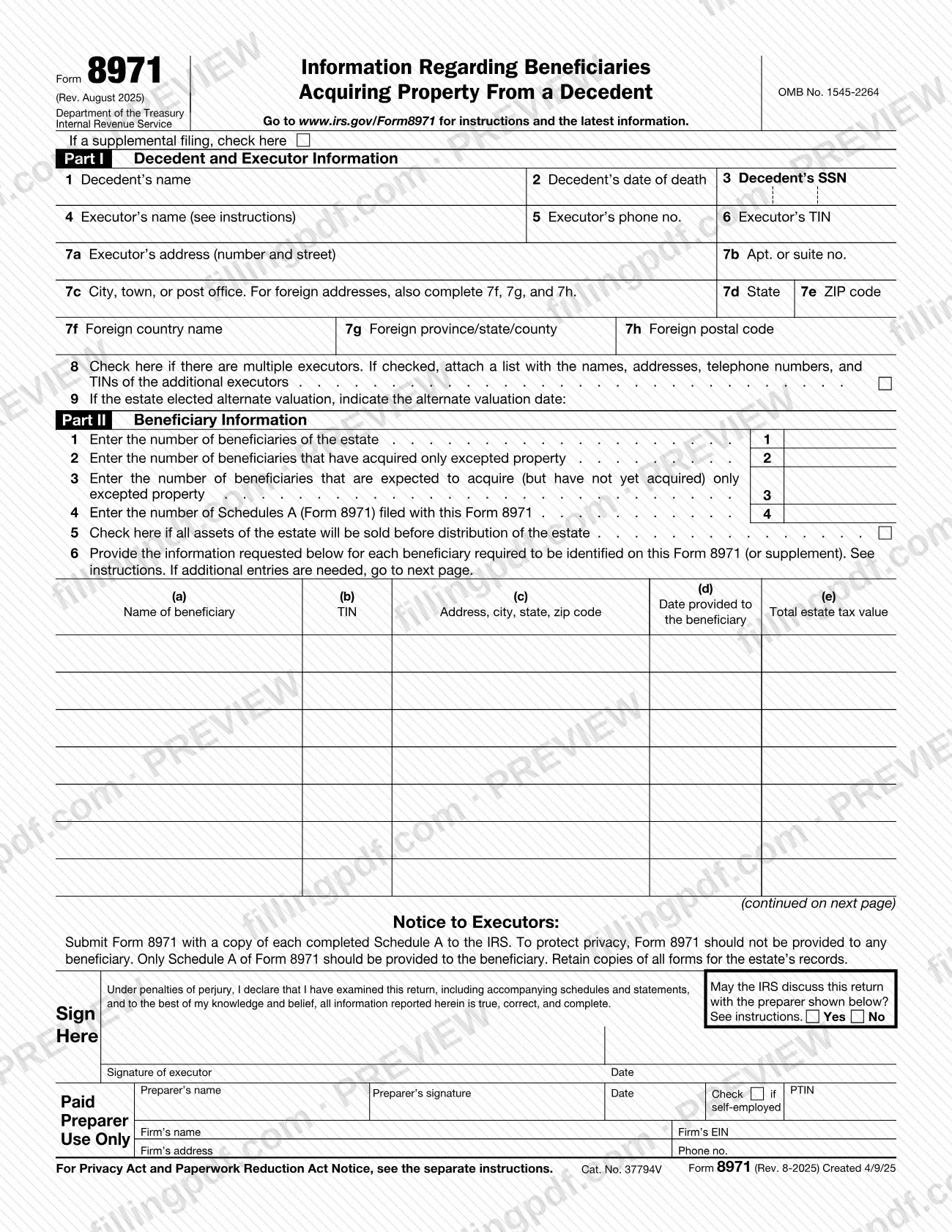
Form 8971 is the Internal Revenue Service (IRS) form that an executor files to tell the IRS which beneficiaries acquired, or are expected to acquire, property from a decedent's estate. It travels with a copy of each Schedule A, the statement that gives each beneficiary the estate tax value of the property for basis purposes. You can fill out Form 8971 online on FillingPDF and download or print the completed PDF; the IRS publishes the original form and the Instructions for Form 8971 and Schedule A at IRS.gov/Form8971.
Last updated
What is Form 8971?
Form 8971, Information Regarding Beneficiaries Acquiring Property From a Decedent, is the IRS information return on which an executor identifies the beneficiaries of an estate that filed an estate tax return and lists the estate tax value of the property each one acquires.
The form and the copies of Schedule A attached to it give the IRS information about beneficiaries who acquired property from a decedent. Schedule A itself gives each beneficiary basis information for the property. Beneficiaries need it to follow the consistent basis requirement of section 1014(f): a beneficiary who acquires property subject to that requirement cannot use a value higher than the one reported on Schedule A as the initial basis.
A complete Form 8971 includes a copy of each Schedule A furnished or required to be furnished to a beneficiary. It is filed separately from any other tax return of the estate, and it is filed even when no Schedules A are required when it is due.
The same form is used for supplemental filings. A box above Part I is checked when the form supplements a previously filed Form 8971. Form 8971 is not given to beneficiaries: only their own Schedule A goes to them.
Who needs to file Form 8971?
An executor of an estate, or another person required to file Form 706 or Form 706-NA (the estate tax return) under IRC section 6018(a) or 6018(b), must file Form 8971 and furnish Schedules A to certain beneficiaries. Only an executor of an estate for which Form 706 or Form 706-NA is filed after July 2015 must file, whether or not that return is filed on time.
For this form, "executor" means the executor, personal representative or administrator. If none is appointed, qualified and acting in the United States, every person in actual or constructive possession of property of the decedent is treated as an executor. More than one person may therefore have to file for the same estate; each reports the property that person reported or must report.
Form 8971 is not required when:
- The gross estate plus adjusted taxable gifts and specific exemption is less than the basic exclusion amount for the year of death.
- Only other estate tax forms, such as Forms 706-QDT, 706-CE or 706-GS(D), are filed.
- The estate tax return is filed solely for a generation-skipping transfer tax allocation or election, solely to elect portability of the deceased spousal exclusion amount (DSUE), or solely as a protective filing to avoid a penalty or satisfy a state law requirement.
A paid preparer who prepares the form must sign as preparer.
When to file Form 8971
File Form 8971, with a copy of each required Schedule A, no later than the earlier of 30 days after the date Form 706 or Form 706-NA is required to be filed (including extensions), or 30 days after the date that return is actually filed. If the due date falls on a Saturday, Sunday or legal holiday, the executor may file on the next business day. Schedules A must be furnished to beneficiaries by the same date.
The form is due even if no Schedules A are furnished or required at that time. Supplements have their own timing:
- When a beneficiary later acquires property that was not reported on a Schedule A, the supplement and Schedule A are due on or before January 31 of the year after the acquisition.
- When information already reported becomes incorrect or incomplete, the supplement is due 30 days after the information becomes available to the executor.
The duty to supplement lasts until final value is determined for all property subject to reporting or, if later, until a beneficiary has acquired all of it. Penalties may apply to late or incorrect filings even if no estate tax is due.
Documents you need
- A copy of each completed Schedule A (Form 8971) furnished or required to be furnished to a beneficiary, attached to the form; optional Schedules A furnished before filing are attached too.
- A list with the names, addresses, telephone numbers and TINs of the additional executors, only if you check the box on line 8 because there are multiple executors.
- A copy of your written request for the TIN, only if you enter "requested" in column (b) because a beneficiary has not supplied a TIN by the due date.
- A statement of the executor's efforts to obtain the trustee's name and TIN, only if you enter "trust not yet established" for a beneficiary trust.
- A statement of the authority under which a foreign beneficiary is not required to provide a TIN, only if you enter "Not Required" in column (b).
- A separate page explaining missing information and the efforts made to locate a beneficiary, only if you enter "not furnished" in column (d) because the beneficiary cannot be located.
- A copy of Form 2848, Power of Attorney and Declaration of Representative, with "copy" written at the top, only if it authorizes the return preparer to represent the estate on Form 8971.
How to fill out Form 8971
Mark a supplemental filing
Check the box at the top, "If a supplemental filing, check here," only if this form supplements a previously filed Form 8971. Report only the information that has changed.
Enter the decedent's details
Part I, lines 1 through 3: the decedent's name, date of death and SSN. If the decedent had no SSN, the instructions say the executor should get one by filing Form SS-5.
Enter the executor's details
Lines 4 through 6: the executor's name, phone number and TIN. With more than one executor, enter one name and TIN here and handle the others on line 8.
Enter the executor's address
Lines 7a through 7e: street, apartment or suite, city, state and ZIP code. For a foreign address, also complete 7f, 7g and 7h.
Check for multiple executors
Line 8: check the box if there is more than one executor and attach a list with each additional executor's name, address, telephone number and TIN.
Enter the alternate valuation date
Line 9: enter the alternate valuation date only if the estate elected alternate valuation on the estate tax return.
Count the beneficiaries
Part II, lines 1 through 4: enter the number of beneficiaries, those who acquired only excepted property, those expected to acquire only excepted property, and the number of Schedules A filed with this form.
Check the sale-of-assets box
Part II, line 5: check the box if all assets of the estate will be sold before distribution.
List each beneficiary
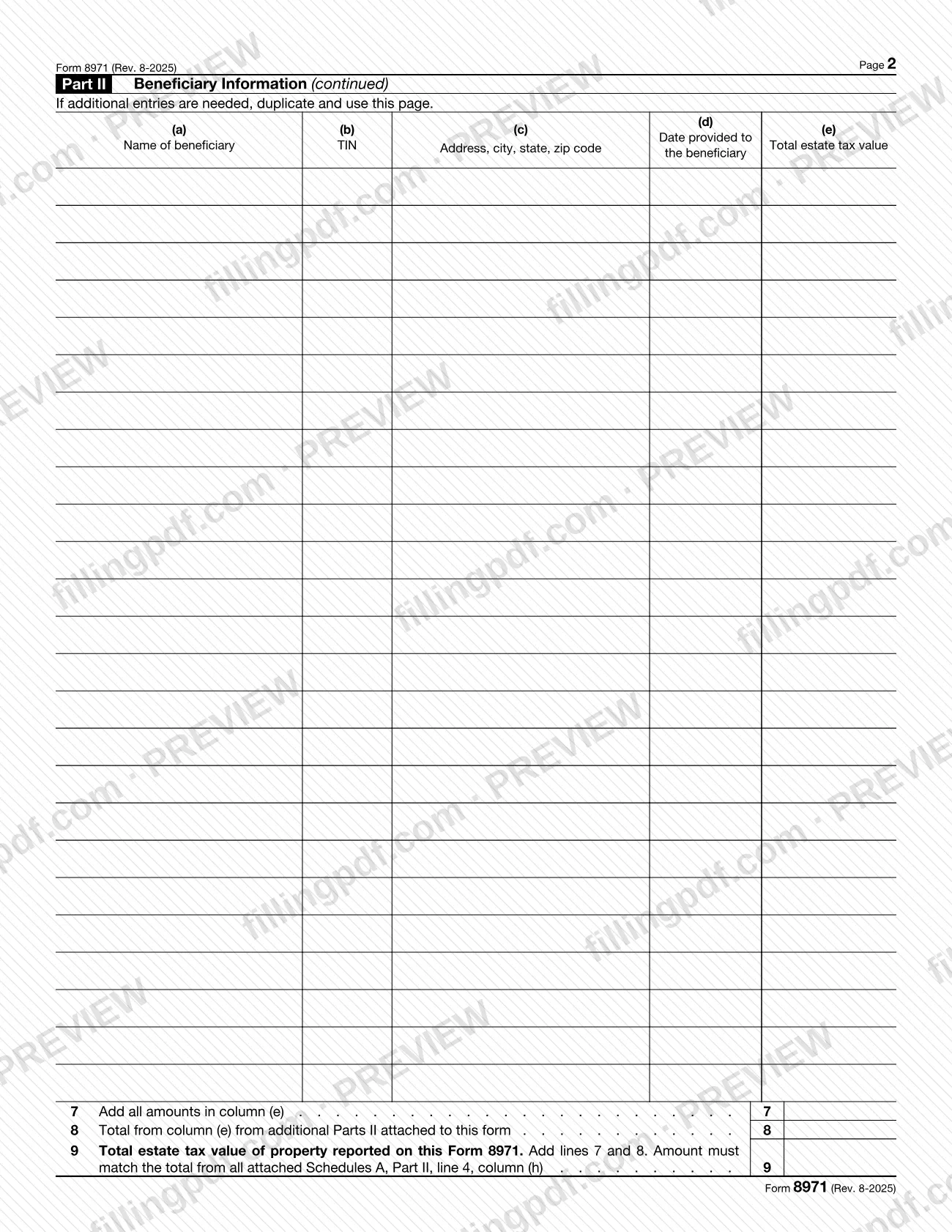
Line 6: for each required beneficiary, enter (a) name, (b) TIN, (c) address, (d) the date the Schedule A was provided and (e) the total estate tax value. Duplicate page 2 if you need more rows.
Total the estate tax values
Page 2, line 7: add column (e). Line 8: add column (e) totals from any additional Parts II. Line 9: add lines 7 and 8; it must match the total of column (h) on the attached Schedules A.
Sign and add preparer details
The executor signs and dates under penalties of perjury and answers whether the IRS may discuss the return with the preparer. A paid preparer completes the preparer block.
Review, download and assemble
Check names, TINs and totals, then download or print the completed PDF from FillingPDF. Attach a copy of each Schedule A and submit the package as described under How to submit.
How to submit Form 8971
File Form 8971 with the IRS by mail, and furnish each Schedule A to its beneficiary in person, by email, by U.S. mail or by private delivery service.
- To the IRS: send Form 8971 with all Schedules A to Internal Revenue Service, Mail Stop 824G, 7940 Kentucky Drive, Florence, KY 41042.
- Private delivery services: the same address may be used. Only the services the IRS designates, listed in the instructions and at IRS.gov/PDS, count for the timely-mailing rule; the carrier can explain how to get written proof of the mailing date.
- To beneficiaries: give each individual beneficiary, trustee of a beneficiary trust, or executor of a beneficiary estate their own Schedule A, in person, by email, by U.S. mail to the last known address, or by private delivery service to that address. Do not give them Form 8971.
Certify the date each Schedule A was provided in Part II, column (d), and keep proof of mailing, delivery or acknowledgment of receipt. Keep copies of all forms for the estate's records. FillingPDF lets you fill out and download the PDF; submission follows the channels above.
Common mistakes to avoid
- Giving a beneficiary a copy of Form 8971. The instructions say to furnish only that beneficiary's own Schedule A, to protect privacy.
- Skipping Form 8971 because no Schedules A are required yet. The executor must still file it on time, even if no Schedules A are furnished.
- Mailing the filing to the address in the Form 706 instructions instead of Mail Stop 824G, 7940 Kentucky Drive, Florence, KY 41042.
- Leaving the TIN blank for a beneficiary. Enter the TIN, "requested" with the written solicitation attached, "Not Required" with a statement for certain foreign beneficiaries, or "trust not yet established" with a statement.
- Not checking the "Supplemental Filing" box on both the supplemental Form 8971 and each supplemental Schedule A, or repeating information that has not changed.
- Completing lines 7 and 8 of Part II on a duplicate page 2. Those totals belong only on the original page 2.
- Entering a total on line 9 that does not match the attached Schedules A totals in column (h).
- Missing the supplement deadline after a beneficiary acquires new property or a value changes.
Frequently asked questions
What is Form 8971 used for?
Form 8971 is the IRS form an executor uses to identify the beneficiaries who acquired, or will acquire, property from a decedent and to report its estate tax value. Each beneficiary receives a Schedule A with basis information, and copies go to the IRS with the form.
Who has to file Form 8971?
The executor or other person required to file Form 706 or Form 706-NA under IRC section 6018(a) or (b), when that return is filed after July 2015. It is not required if the return is filed only to elect portability of the DSUE, for a generation-skipping transfer tax election, or as a protective filing.
When is Form 8971 due?
No later than the earlier of 30 days after the due date of Form 706 or 706-NA, including extensions, or 30 days after that return is actually filed. If the date falls on a weekend or legal holiday, the executor may file on the next business day.
Where do I mail Form 8971?
Send it, with copies of all Schedules A, to Internal Revenue Service, Mail Stop 824G, 7940 Kentucky Drive, Florence, KY 41042. The same address may be used with an IRS-designated private delivery service.
Should I give the beneficiaries a copy of Form 8971?
No. To protect privacy, give each beneficiary only the Schedule A that reports property acquired by that beneficiary. You may do so in person, by email, by U.S. mail or by private delivery service, and you certify the date in column (d) of Part II.
Do I have to file Form 8971 if all the property is excepted property?
Yes. The executor must still file Form 8971 on time even if all property subject to reporting is excepted property, such as U.S. dollars or life insurance proceeds paid in a lump sum, but no information on that property is required on a Schedule A.
What happens if I file Form 8971 late or with errors?
The executor may face penalties under sections 6721 and 6722 unless reasonable cause is shown, even if no estate tax was due. The amounts are on the IRS information return penalties page at IRS.gov/Payments/Information-Return-Penalties.
How do I correct or add to a Form 8971 I already filed?
File a supplement with the "Supplemental Filing" box checked on the form and on each supplemental Schedule A, reporting only changed information. Changes are generally due 30 days after the information is available; newly acquired property is due by January 31 of the following year.
Can I fill out Form 8971 online?
Yes. You can fill out the PDF online on FillingPDF and download or print it. FillingPDF is an independent service and does not file the form with the IRS; you mail it to the IRS address in the instructions.
Ready to fill out Form 8971?
Fill out Form 8971 now