
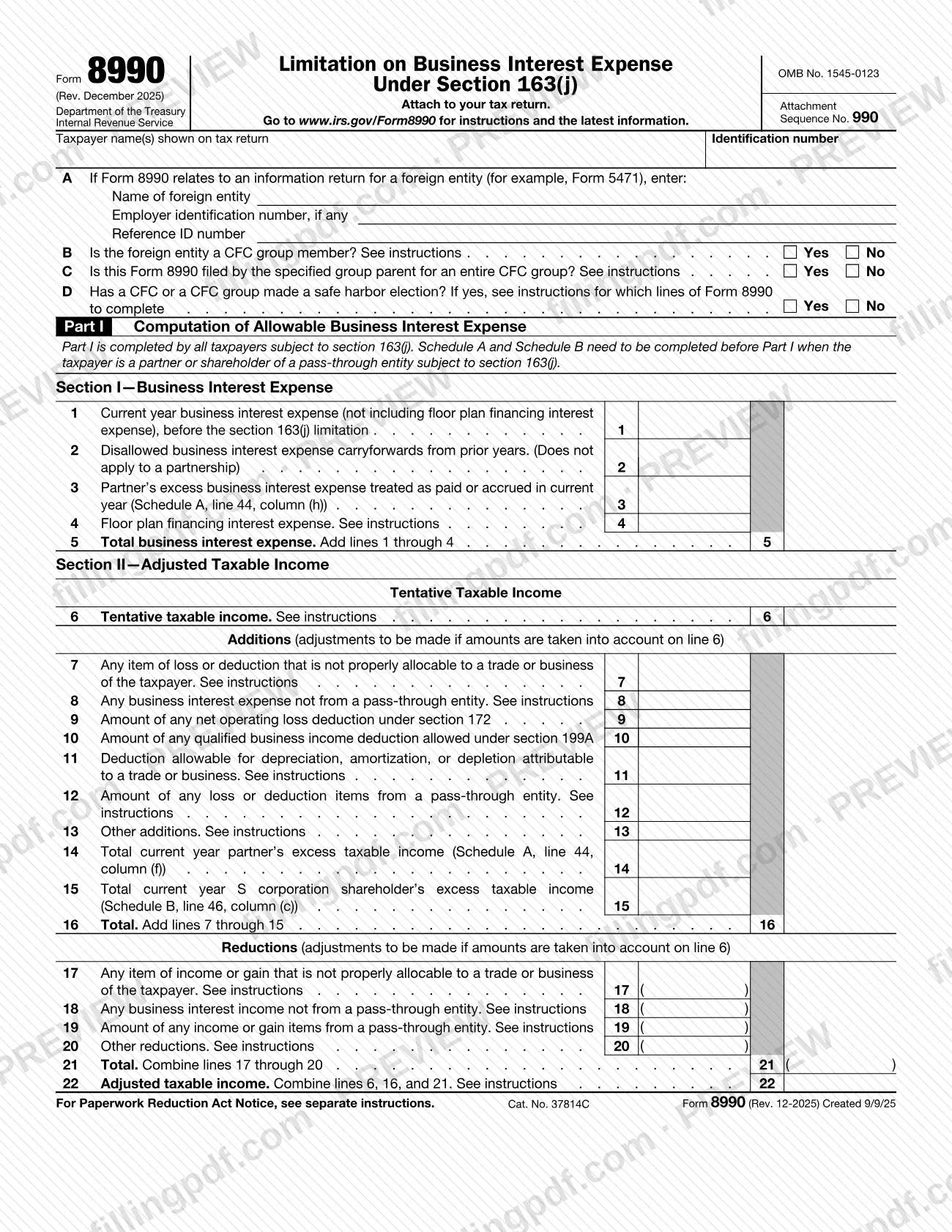
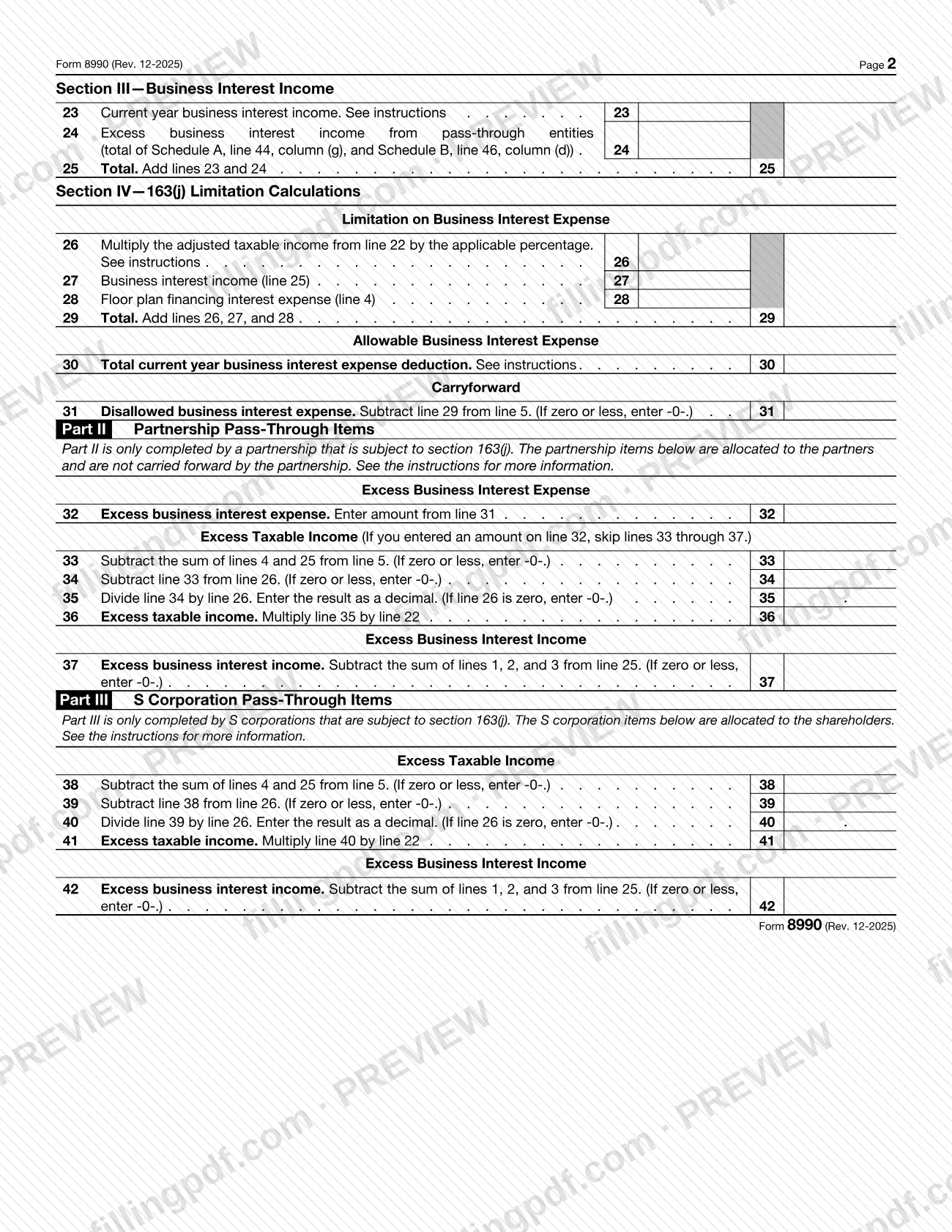
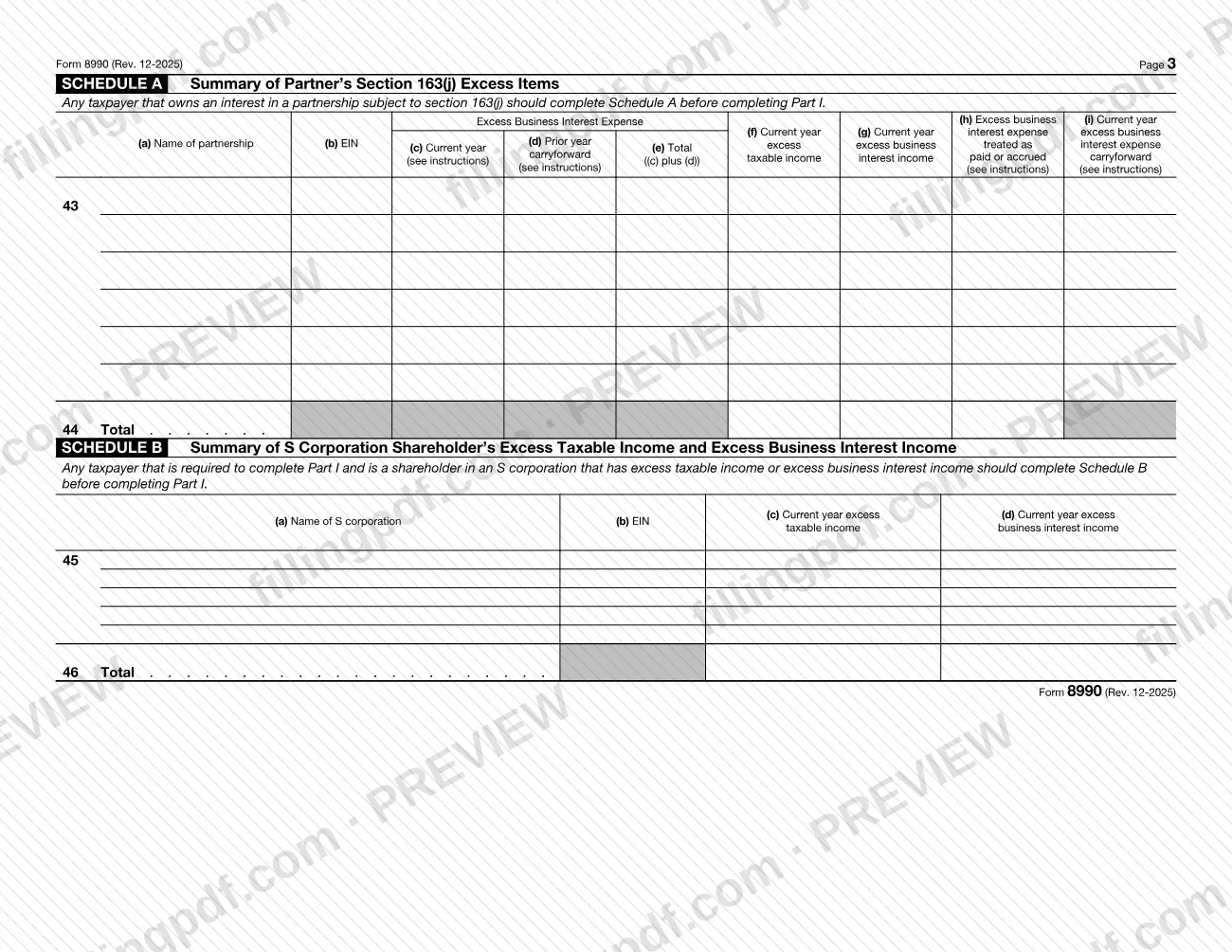
Form 8990, Limitation on Business Interest Expense Under Section 163(j), is the Internal Revenue Service (IRS) form that figures how much business interest expense you can deduct for the year and how much carries forward to the next year. Taxpayers with business interest expense, a disallowed business interest expense carryforward, or excess business interest expense generally file it, unless an exclusion applies. On FillingPDF you can fill out Form 8990 online and download or print the completed PDF; the form and its instructions are published by the IRS at www.irs.gov/Form8990.
Last updated
What is 8990?
Form 8990, Limitation on Business Interest Expense Under Section 163(j), is the IRS form used to figure the business interest expense deduction allowed for the tax year under section 163(j) and the disallowed amount that carries forward to the following year. It is attached to your tax return (OMB No. 1545-0123).
Under the IRS instructions, the deduction allowed when section 163(j) applies is limited to the sum of business interest income, the applicable percentage of adjusted taxable income (ATI), and floor plan financing interest expense. Anything not allowed is carried forward as disallowed business interest expense, with special rules for partnerships.
The form has these parts:
- Part I, Computation of Allowable Business Interest Expense, completed by all taxpayers subject to section 163(j): business interest expense (lines 1–5), ATI (lines 6–22), business interest income (lines 23–25) and the limitation calculations (lines 26–31).
- Part II, Partnership Pass-Through Items, completed only by a partnership subject to section 163(j).
- Part III, S Corporation Pass-Through Items, completed only by an S corporation subject to section 163(j).
- Schedule A, Summary of Partner's Section 163(j) Excess Items, and Schedule B, Summary of S Corporation Shareholder's Excess Taxable Income and Excess Business Interest Income, completed before Part I by partners and S corporation shareholders.
Lines A through D at the top cover foreign entities, controlled foreign corporation (CFC) groups and the CFC safe-harbor election. The instructions add Worksheets A and B for partnerships and Worksheet C for the safe-harbor election.
Who needs to file 8990?
A taxpayer (for example an individual, corporation, partnership or S corporation) with business interest expense, a disallowed business interest expense carryforward, or current or prior year excess business interest expense must generally file Form 8990, unless an exclusion applies.
Others the IRS instructions require to file:
- A pass-through entity allocating excess taxable income or excess business interest income to its owners, whether or not it has interest expense.
- A regulated investment company that pays section 163(j) interest dividends.
- A U.S. shareholder of an applicable CFC that has business interest expense, a disallowed carryforward or is part of a CFC group, who generally attaches a Form 8990 with each Form 5471. For a CFC group, an additional Form 8990 is filed for the group; if a safe-harbor election is made, a form is filed for the group but not for each member.
You are not required to file if you are a small business taxpayer with no excess business interest expense from a partnership. You also do not file if your only interest expense comes from excepted trades or businesses: services as an employee, an electing real property trade or business, an electing farming business or certain regulated utility businesses. A small business taxpayer is not a tax shelter and meets the gross receipts test described in the instructions. A pass-through entity that is exempt must still give a partner or shareholder who files certain information on request.
When to file 8990
Form 8990 has no due date of its own: you attach it to the tax return it supports, so it is due when that return is due, including extensions. The form says "Attach to your tax return."
Timing rules in the instructions that tie to the form:
- An election for a real property, farming or non-automatically excepted regulated utility trade or business is made by attaching an election statement to a timely filed original return, including extensions. The election is irrevocable.
- A CFC group election is made by attaching the required statement to the CFC group's Form 8990 in the year the election is made.
- A taxpayer that meets the small business exemption in the current year is no longer required to limit business interest expense, even with a disallowed carryforward from a prior year.
The Rev. December 2025 edition reflects changes for tax years beginning after 2024 and after 2025, described in the instructions' What's New section.
Documents you need
- Your tax return, to which Form 8990 is attached; the form states "Attach to your tax return."
- Election statement titled "Section 1.163(j)-9 Election" (real property or farming business) or "Section 1.163(j)-1(b)(15)(iii) Election" (electing utility), attached to a timely filed original return, only if you make that election.
- Worksheet C, Stand-Alone Applicable CFC/CFC Group Safe Harbor Election, attached to your return, only if a safe-harbor election is made.
- CFC group election statement under Regulations section 1.163(j)-7(e)(5)(iv), from each designated U.S. person, only in the year a CFC group election is made.
- Statement identifying the specified group parent, specified period, and the name and specified tax year of each CFC group member, attached by each designated U.S. person to the CFC group's Form 8990.
- Statement of the line 2 amount in functional currency and translation rates, only if line 2 differs from the prior year's line 31 because of translation rates for an applicable CFC.
- Schedule showing the amount and return line item where business interest expense is deducted, only if line 29 is less than line 5 and the expense is reported in more than one place.
- Statement on the asset basis and allocation under Regulations section 1.163(j)-10(c)(6)(iii), only if you have both excepted and non-excepted trades or businesses.
- Statements identifying the partnership name and amounts for Schedule A adjustments, such as negative section 163(j) expense or the column (h) additions, when those adjustments apply.
How to fill out 8990
Enter taxpayer name and identification number
At the top, enter the taxpayer name(s) shown on the tax return and the identification number. If Form 8990 relates to an information return for a foreign entity, such as Form 5471, complete line A with the foreign entity's name, EIN if any, and Reference ID number.
Answer lines B, C and D
Check Yes or No on line B (foreign entity is a CFC group member), line C (filed by the specified group parent for an entire CFC group) and line D (CFC or CFC group made a safe-harbor election). If a safe-harbor election applies, complete Worksheet C from the instructions first.
Complete Schedule A or Schedule B first
If you are a partner in a partnership subject to section 163(j), complete Schedule A (lines 43 and 44) before Part I. If you are a shareholder in such an S corporation, complete Schedule B (lines 45 and 46) first.
Enter business interest expense, Section I
Line 1: current year business interest expense, excluding floor plan financing. Line 2: prior year disallowed carryforward from line 31 (not for partnerships). Line 3: Schedule A, line 44, column (h). Line 4: floor plan financing interest expense. Add lines 1 through 4 on line 5.
Enter tentative taxable income
Line 6: tentative taxable income, computed as though all business interest expense is otherwise allowable. Enter all numbers as positive unless the form shows parentheses.
Complete the additions on lines 7–16
Enter the items on lines 7 through 13 only to the extent they were taken into account on line 6, then lines 14 and 15 from Schedule A, line 44, column (f), and Schedule B, line 46, column (c). Add lines 7 through 15 on line 16.
Complete the reductions and ATI
Enter lines 17 through 20 in parentheses and combine them on line 21. Combine lines 6, 16 and 21 on line 22 for adjusted taxable income; if it is zero or less, enter zero (CFC group members follow the instructions).
Enter business interest income, Section III
Line 23: current year business interest income. Line 24: excess business interest income from pass-through entities, from Schedule A, line 44, column (g), plus Schedule B, line 46, column (d). Add lines 23 and 24 on line 25.
Calculate the section 163(j) limitation
Line 26: multiply line 22 by the applicable percentage given in the instructions. Lines 27 and 28 repeat line 25 and line 4, and line 29 adds lines 26, 27 and 28.
Figure the deduction and carryforward
Line 30: enter the smaller of line 29 or line 5 as the current year business interest expense deduction. Line 31: subtract line 29 from line 5, entering -0- if zero or less; this is the disallowed amount carried forward.
Complete Part II or Part III if required
A partnership subject to section 163(j) completes Part II (lines 32 through 37). An S corporation subject to section 163(j) completes Part III (lines 38 through 42). Other taxpayers leave these parts blank.
Review, download and attach the PDF
Check each line against the instructions, confirm the required statements are ready, then download or print the completed PDF from FillingPDF. Attach it to your tax return as described under How to submit.
How to submit 8990
Form 8990 is not filed alone and has no mailing address, portal or appointment process of its own: you attach it to your tax return, which you submit through the channels that return uses.
- With your return: attach the completed form to the return that reports the deduction. The instructions for that return give where and how to file it.
- With Form 5471: a U.S. shareholder of an applicable CFC attaches a Form 8990 with each Form 5471. For a CFC group, a U.S. shareholder who files Form 5471 for a CFC group member but not for the specified group parent attaches the CFC group's Form 8990 to that shareholder's own tax return.
- With attachments: attach any election statements, Worksheet C (safe-harbor election) and the other statements listed under required documents.
Keep Worksheets A and B for your records; they are marked "Keep for Your Records." FillingPDF lets you fill out and download the PDF; submission follows the channels above.
Common mistakes to avoid
- Completing Part I before Schedule A or Schedule B when you are a partner or S corporation shareholder; the form says to complete the schedules first.
- Entering an amount on line 2 as a partnership; the instructions say line 2 does not apply to a partnership, which carries line 31 to Part II, line 32.
- Including interest expense from an excepted trade or business on line 1, or interest income from one on line 23.
- Entering pass-through entity amounts on lines 7, 11, 17 or 18 instead of lines 12 and 19, which are the lines for items from pass-through entities.
- Entering a negative adjusted taxable income on line 22 when you are not a CFC group member; if the amount is zero or less, enter zero.
- Completing lines 26 through 29 on an individual CFC group member's Form 8990; the instructions say to skip them and report lines 30 and 31.
- Completing Schedules A and B when a safe-harbor election is made; the instructions say they should not be completed.
- Using a Form 8990 for a partnership or S corporation but skipping Part II or Part III, which those entities complete when subject to section 163(j).
- Preparing the form in a currency other than U.S. dollars; the instructions say to prepare it in U.S. dollars.
Frequently asked questions
What is Form 8990 used for?
Form 8990 figures the business interest expense you can deduct for the year under section 163(j) and the amount you carry forward to the next year. It is attached to your tax return, and the deduction is limited by business interest income, the applicable percentage of ATI and floor plan financing interest.
Who has to file Form 8990?
A taxpayer with business interest expense, a disallowed business interest expense carryforward, or excess business interest expense must generally file it. Pass-through entities allocating excess items to owners file too. You are excluded if you are a small business taxpayer without partnership excess business interest expense.
Do I file Form 8990 by itself or with my return?
You attach it to your tax return; it has no separate address or due date. The form says "Attach to your tax return," and the return's own instructions govern where and when it is filed. For a CFC, it is attached with Form 5471.
What do I enter on line 30 and line 31 of Form 8990?
On line 30, enter the smaller of line 29 or line 5; that is the current year business interest expense deduction allowed. On line 31, subtract line 29 from line 5 (enter -0- if zero or less); that amount carries to next year's line 2, except for partnerships.
Does a partnership carry forward disallowed interest on Form 8990?
No. A partnership's disallowed amount is not carried by the partnership but allocated to partners as excess business interest expense. The partnership enters line 31 on Part II, line 32, and partners report their shares on Schedule A.
How do I make the real property or farming election?
Attach an election statement to a timely filed original return, including extensions. Title it "Section 1.163(j)-9 Election" for real property or farming businesses, with the taxpayer's name, address, SSN or EIN, a description of the business and the election statement. The election is irrevocable.
What is the difference between Form 8990 for a CFC group member and for the CFC group?
Each CFC group member's Form 8990 reports that member's amounts on lines 1 through 25, skipping lines 26 through 29. A separate Form 8990 for the whole group reports the combined limitation, with "Specified Group Parent" entered on line A.
Can I fill out Form 8990 online?
You can fill out the PDF online on FillingPDF and download or print it. FillingPDF is an independent service and does not file the form with the IRS; you attach it to your tax return and submit it through the return's channels.
Ready to fill out 8990?
Fill out 8990 now