
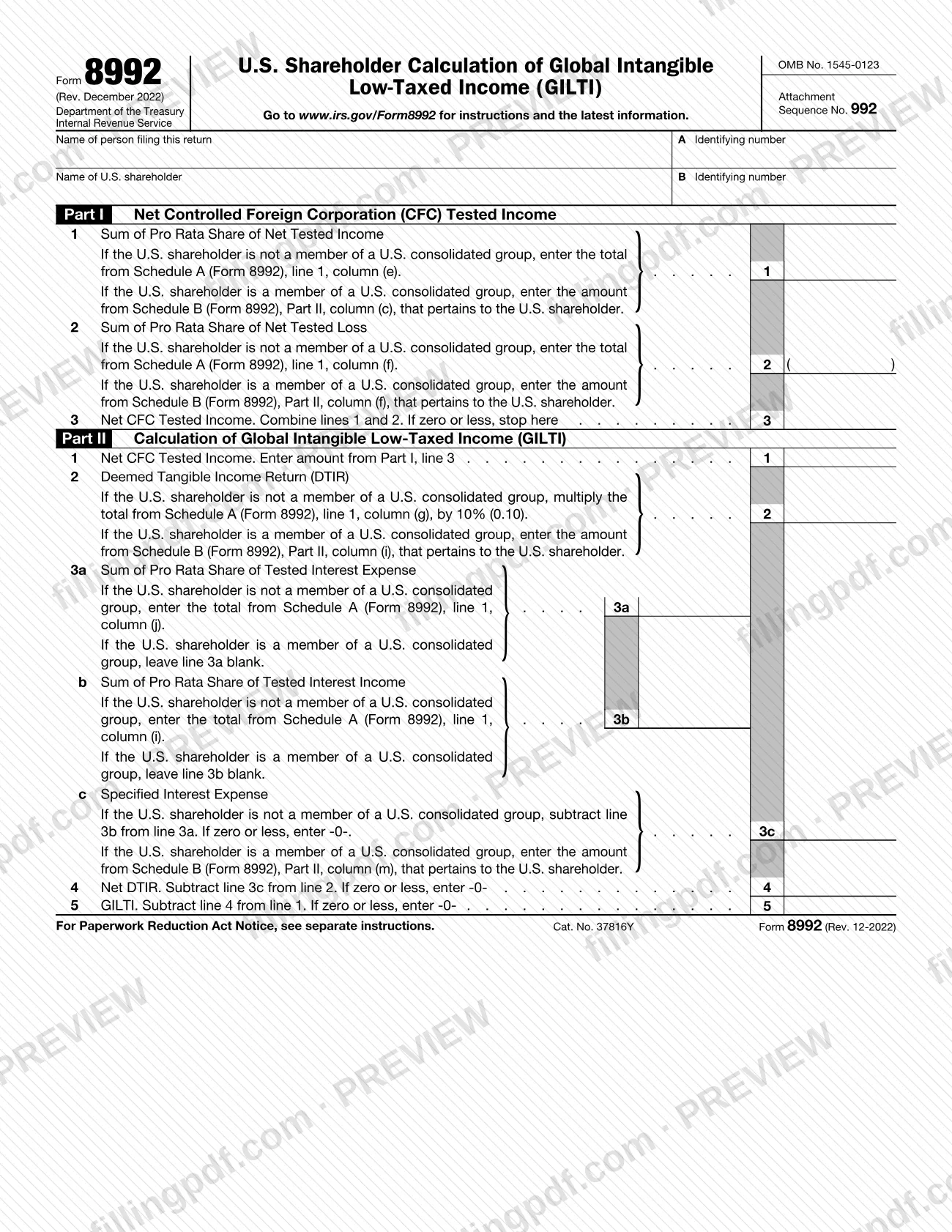
Form 8992 is the Internal Revenue Service (IRS) form on which a U.S. shareholder of a controlled foreign corporation (CFC) calculates its global intangible low-taxed income (GILTI) inclusion under section 951A. It is used by corporations, individuals and S corporations that own CFC stock, and it is normally filed with Schedule A (Form 8992). On this page you can fill out Form 8992 online on FillingPDF and download or print the completed PDF; the form and its instructions are published by the IRS at www.irs.gov/Form8992.
Last updated
What is Form 8992?
Form 8992, U.S. Shareholder Calculation of Global Intangible Low-Taxed Income (GILTI), is the IRS form a U.S. shareholder of a controlled foreign corporation uses to compute its GILTI inclusion amount and to report related information under section 951A.
Under section 951A, U.S. shareholders who own, within the meaning of section 958(a), stock in a CFC must include GILTI in gross income. The form works in two parts. Part I totals the shareholder's pro rata share of net tested income and net tested loss from its CFCs to reach Net CFC Tested Income (line 3). Part II subtracts the net deemed tangible income return (DTIR) from that amount to arrive at GILTI on line 5. If line 3 is zero or less, the form tells you to stop there.
Two schedules support the form. Schedule A (Form 8992) reports the shareholder's pro rata share of amounts for each CFC, taken from each CFC's Schedule I-1 (Form 5471), Information for Global Intangible Low-Taxed Income. Schedule B (Form 8992) is used instead of Schedule A when the shareholder is a member of a U.S. consolidated group.
The deduction under section 250 for a GILTI inclusion is not figured on this form: the IRS points to Form 8993, Section 250 Deduction for Foreign-Derived Intangible Income (FDII) and Global Intangible Low-Taxed Income (GILTI).
Who needs to file Form 8992?
A person who was a U.S. shareholder of at least one foreign corporation at any time during that corporation's tax year ending with or within the shareholder's tax year, and who owned stock in it within the meaning of section 958(a) on the last day of the year in which it was a CFC, must file Form 8992. A partner of a domestic partnership can be such a shareholder.
- U.S. shareholder: a U.S. person who owns, directly, indirectly or constructively, 10% or more of the total combined voting power of all classes of voting stock, or 10% or more of the total value of all classes of stock, of the foreign corporation.
- Members of a U.S. consolidated group: each member that is a U.S. shareholder completes a separate Form 8992, but those forms are not filed with the consolidated return. A single consolidated Form 8992 and Schedule B (Form 8992) are filed instead.
- S corporations that elected entity treatment: an S corporation that elected to be treated as owning CFC stock under Proposed Regulations section 1.958-1(e) and is a U.S. shareholder of a CFC must file Form 8992.
Domestic partnerships are no longer required to complete Form 8992 or Schedule A (Form 8992). They complete Schedule K-2 (Form 1065), Part VI, and Schedule K-3 (Form 1065), Part VI, instead.
When to file Form 8992
Form 8992 is due with the income tax return it accompanies. The IRS instructions say to attach Form 8992 and Schedule A (Form 8992) to your income tax return (or exempt organization return, as applicable) and file both by the due date, including extensions, for that return. The form has no separate due date of its own.
A U.S. consolidated group attaches Schedule B (Form 8992) and one consolidated Form 8992 to the group's income tax return, with the same due date including extensions. An S corporation that elected entity treatment attaches Form 8992 and Schedule A to its Form 1120-S by that return's due date, including extensions.
If you later find that a filed Form 8992 is incomplete or incorrect, file a corrected Form 8992 with an amended return. Penalties under sections 6038(b) and (c) may apply for failure to report the information the form requires.
Documents you need
- Schedule A (Form 8992): generally completed and attached to Form 8992 to report your pro rata share of amounts for each CFC, unless you are a member of a U.S. consolidated group.
- Schedule B (Form 8992): attached instead of Schedule A when the U.S. shareholder is a member of a U.S. consolidated group; only one is completed for the group.
- Schedule A—Continuation Sheet(s): attach them when you have more CFCs than fit on one Schedule A (Form 8992); do not write "See attached" on the schedule.
- Amounts from each CFC's Schedule I-1 (Form 5471), Information for Global Intangible Low-Taxed Income: used to complete Schedule A or Schedule B, even if you did not file a Schedule I-1 for that CFC.
- IRS approval letter: attach it if you file a computer-generated Form 8992 that is not identical to the IRS-prescribed form.
- Form 8833, Treaty-Based Return Position Disclosure Under Section 6114 or 7701(b): generally required if a treaty position overrides or modifies the Internal Revenue Code and reduces tax.
- Statement identifying the changes: attach it to a corrected Form 8992 marked "Corrected", filed with an amended return.
How to fill out Form 8992
Enter filer and shareholder names
Enter the name of the person filing the return and its identifying number in item A: an SSN for an individual, an EIN for all others. If the U.S. shareholder's name differs from the filer, enter its name and identifying number in item B. For a consolidated group, list the common parent in item A and leave the shareholder name and item B blank.
Complete Schedule A or Schedule B first
A shareholder that is not in a consolidated group completes Schedule A (Form 8992), columns (a) through (f), to get the amounts for Part I. A consolidated group member uses Schedule B (Form 8992) and follows its step-by-step instructions.
Enter the sum of net tested income
Part I, line 1: enter the total from Schedule A, line 1, column (e). Consolidated group members enter the amount from Schedule B, Part II, column (c), that pertains to the shareholder.
Enter the sum of net tested loss
Part I, line 2: enter the total from Schedule A, line 1, column (f), in the parentheses. Consolidated group members use Schedule B, Part II, column (f).
Combine lines 1 and 2
Part I, line 3: combine lines 1 and 2 to get Net CFC Tested Income. If it is zero or less, stop; do not complete Part II or Schedule A, columns (g) through (l).
Carry Net CFC Tested Income to Part II
Part II, line 1: enter the amount from Part I, line 3.
Figure the deemed tangible income return
Part II, line 2: if you are not in a consolidated group, multiply the Schedule A, line 1, column (g) total by 10% (0.10). Consolidated group members enter the Schedule B, Part II, column (i), amount.
Calculate specified interest expense
Lines 3a and 3b: enter the Schedule A, line 1 totals for column (j) (interest expense) and column (i) (interest income); consolidated members leave both blank. Line 3c: subtract 3b from 3a, entering -0- if zero or less, or the Schedule B, Part II, column (m), amount for consolidated members.
Compute net DTIR and GILTI
Line 4: subtract line 3c from line 2, entering -0- if zero or less. Line 5: subtract line 4 from line 1, entering -0- if zero or less; this is your GILTI.
Finish Schedule A columns (k) and (l)
Once Parts I and II are done, divide each CFC's column (e) amount by the line 1, column (e) total for column (k), to four decimal places. Multiply the column (k) ratio by Part II, line 5, for column (l), in whole dollars.
Carry the GILTI amount to your return
A corporate shareholder enters Part II, line 5, on line 17 of Form 1120, Schedule C. An individual enters it on line 8o of Schedule 1 (Form 1040). An S corporation that elected entity treatment enters it on Form 1120-S, Schedule K, line 10 (code E).
Review and download the completed PDF
Check names, identifying numbers and every line against Schedule A or B, and enter -0- where the form requires it. Download or print the completed PDF from FillingPDF and attach it to your return as described under How to submit.
How to submit Form 8992
Form 8992 is not sent to the IRS on its own: you attach it, with Schedule A (Form 8992), to the income tax return it supports and file the return through that return's usual channels.
- Most U.S. shareholders: attach Form 8992 and Schedule A (Form 8992) to your income tax return or exempt organization return.
- U.S. consolidated groups: attach Schedule B (Form 8992) and one consolidated Form 8992 to the group's income tax return. Do not file the separate Forms 8992 completed for each member; keep them for your records in case of an examination.
- S corporations that elected entity treatment: attach Form 8992 and Schedule A to Form 1120-S.
- Corrections: file a corrected Form 8992 with an amended return, using the amended return instructions for the return it was first filed with. Write "Corrected" at the top and attach a statement identifying the changes.
- Computer-generated forms: these generally need prior IRS approval, requested at [email protected] or by mail to Internal Revenue Service, Attention: Substitute Forms Program, C:DC:TS:CAR:MP:P:TP:TP, ATSC, 4800 Buford Highway, Mail Stop 061-N, Chamblee, GA 30341. Attach the approval letter. A form identical to the IRS form needs no approval and no attachment.
FillingPDF lets you fill out and download the PDF; submission follows the channels above.
Common mistakes to avoid
- Filing the separate Forms 8992 of each consolidated group member with the consolidated return; only one consolidated Form 8992 and Schedule B (Form 8992) are filed.
- Completing Part II or Schedule A, columns (g) through (l), when Part I, line 3 is zero or negative; the instructions say not to complete them.
- Entering "APPLIED FOR" in column (b) of Schedule A instead of an EIN, or "FOREIGNUS" instead of a reference ID number for a CFC without an EIN.
- Using a reference ID number for a CFC on Schedule A or B that differs from the one on that CFC's Form 5471.
- Writing "See attached" on Schedule A and attaching extra sheets instead of using Schedule A—Continuation Sheet(s).
- Leaving item B blank for a U.S. shareholder whose name differs from the person filing, or filling it in for a U.S. consolidated group, where the name and item B stay blank.
- Entering a negative result on Part II, line 4 or line 5; the form says to enter -0- if the result is zero or less.
- Filing a corrected Form 8992 without writing "Corrected" at the top and attaching a statement of the changes.
- Counting a CFC's items more than once in Schedule B totals for columns (e), (f), (k) and (m) when the CFC is listed on several lines.
Frequently asked questions
What is Form 8992 used for?
Form 8992 is used by a U.S. shareholder of a controlled foreign corporation to calculate its GILTI inclusion amount under section 951A and to report related information. Part II, line 5 gives the GILTI amount that is carried to the shareholder's income tax return.
Who has to file Form 8992?
A U.S. shareholder, including a partner of a domestic partnership, that owned stock in a CFC within the meaning of section 958(a) on the last day of the CFC's year must file. An S corporation that elected entity treatment also files. Domestic partnerships themselves use Schedules K-2 and K-3 (Form 1065) instead.
When is Form 8992 due?
It is due with the return it is attached to. Attach Form 8992 and Schedule A (Form 8992) to your income tax return and file both by that return's due date, including extensions. The form has no separate due date.
What is the difference between Schedule A and Schedule B of Form 8992?
Schedule A (Form 8992) reports a shareholder's pro rata share of each CFC's amounts and is attached to Form 8992 in general. A U.S. consolidated group member uses Schedule B (Form 8992) instead, which reports the amounts used to determine each member's GILTI inclusion.
How does a U.S. consolidated group file Form 8992?
Each member that is a U.S. shareholder completes its own Form 8992, but those are kept for your records, not filed. The group files one Schedule B (Form 8992) and one consolidated Form 8992 with the group's income tax return, listing the common parent in item A.
Where does the GILTI amount from Form 8992 go on my tax return?
A corporate shareholder enters Part II, line 5 on line 17 of Form 1120, Schedule C. An individual enters it on line 8o of Schedule 1 (Form 1040). An S corporation that elected entity treatment uses Form 1120-S, Schedule K, line 10, with code E.
How do I correct a Form 8992 I already filed?
File a corrected Form 8992 with an amended tax return, following the amended return instructions for the return you originally filed it with. Write "Corrected" at the top of the form and attach a statement identifying the changes.
Can I fill out Form 8992 online on FillingPDF?
Yes. You can fill out the fillable PDF online on FillingPDF and download or print it. FillingPDF is an independent service and does not file the form with the IRS; you attach it to your return and file through the return's channels.
Ready to fill out Form 8992?
Fill out Form 8992 now