
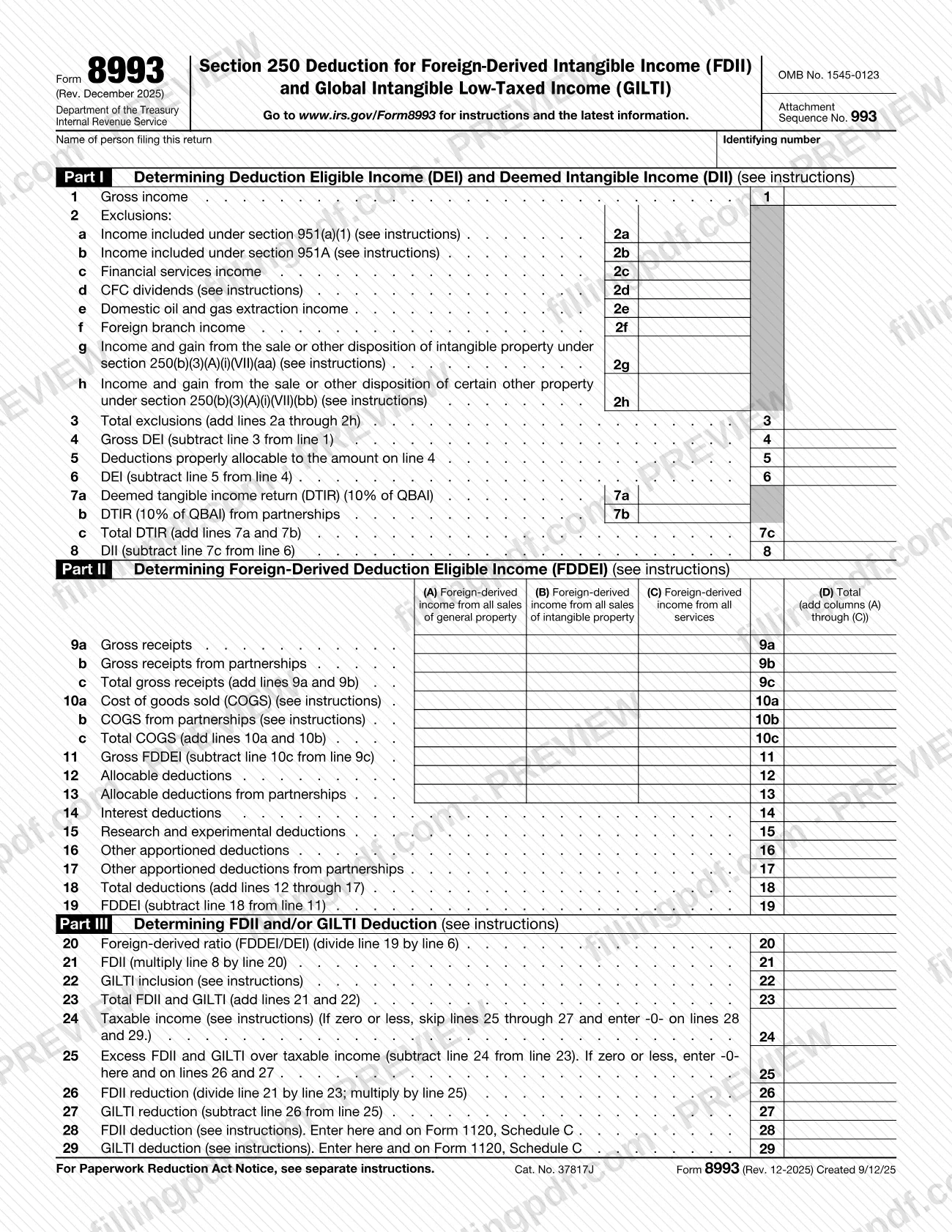
Form 8993 is the Internal Revenue Service (IRS) form that domestic corporations use to figure the deduction allowed under section 250 for Foreign-Derived Intangible Income (FDII) and Global Intangible Low-Taxed Income (GILTI). U.S. individual shareholders of controlled foreign corporations (CFCs) who make a section 962 election use it too. On FillingPDF you can fill out Form 8993 online and download or print the completed PDF; the IRS publishes the original form and the instructions at www.irs.gov/Form8993, and the form is filed with your income tax return.
Last updated
What is 8993?
Form 8993, Section 250 Deduction for Foreign-Derived Intangible Income (FDII) and Global Intangible Low-Taxed Income (GILTI), is the IRS form used to compute the eligible deduction under section 250 of the Internal Revenue Code for FDII and GILTI.
The form has three parts:
- Part I (lines 1 through 8) determines Deduction Eligible Income (DEI) and Deemed Intangible Income (DII). It starts from gross income, removes the exclusions listed on line 2, subtracts allocable deductions and then subtracts the Deemed Tangible Income Return (DTIR) based on Qualified Business Asset Investment (QBAI).
- Part II (lines 9 through 19) determines Foreign-Derived Deduction Eligible Income (FDDEI) in three columns for sales of general property, sales of intangible property and services, plus a total column.
- Part III (lines 20 through 29) works out the foreign-derived ratio, FDII, the GILTI inclusion, the limit based on taxable income, and the final FDII deduction (line 28) and GILTI deduction (line 29).
The results on lines 28 and 29 are entered on Form 1120, Schedule C. The GILTI inclusion on line 22 comes from Form 8992, U.S. Shareholder Calculation of Global Intangible Low-Taxed Income (GILTI), Part II, line 5. The December 2025 revision reflects Public Law 119-21, which added exclusions on lines 2g and 2h for income and gain from certain sales or dispositions occurring after June 16, 2025.
Who needs to file 8993?
All domestic corporations, and U.S. individual shareholders of CFCs who make a section 962 election (962 electing individuals), must use Form 8993 to determine the allowable deduction under section 250.
The deduction itself is allowed only to domestic corporations and section 962 electing individuals. The instructions exclude real estate investment trusts (REITs), regulated investment companies (RICs) and S corporations from the deduction.
Other groups the instructions address:
- Corporate partners. A domestic corporation that is a partner in a partnership takes into account its distributive share of the partnership's gross DEI, gross FDDEI, deductions and QBAI. The partnership should report these items on Schedule K-3 (Form 1065). The instructions refer to Regulations sections 1.250(b)-1(e) and 1.250(b)-3(e) for the treatment of partners.
- Filers with a GILTI inclusion. Line 22 takes the GILTI amount from Form 8992, which is attached to the income tax return.
- Filers correcting an earlier Form 8993. A corrected form is filed with an amended return.
When to file 8993
Attach Form 8993 to your income tax return and file both by the due date of that return, including extensions. The form has no separate due date of its own.
The instructions say to use this revision for tax year 2025 and later years until the IRS issues a superseding revision. If you find that a Form 8993 you filed is incomplete or incorrect, file a corrected Form 8993 with an amended tax return, using the amended return instructions for the return with which you originally filed it, and enter "Corrected" at the top of the form.
Documents you need
- Your income tax return, to which Form 8993 is attached; line 1 takes gross income from Form 1120, line 11, and lines 28 and 29 are entered on Form 1120, Schedule C.
- Form 8992, U.S. Shareholder Calculation of Global Intangible Low-Taxed Income (GILTI), attached to the return; line 22 takes the amount from Form 8992, Part II, line 5.
- For partners in a partnership: a statement attached to Form 8993 listing each partnership's name, employer identification number (EIN), the partner's share of QBAI reported on line 7b, and other FDDEI items reported on lines 9b, 10b, 13 and 17.
- Partnership figures from Schedule K-3 (Form 1065), which the partnership should have reported to its partners; you use them for partner shares on lines 7b, 9b, 10b, 13, 14, 15 and 17.
- If line 29 applies: the amount treated as a dividend under section 78 attributable to GILTI, taken from Form 1118, Schedule A, column 3(b).
How to fill out 8993
Enter name and identifying number
At the top, enter the name of the person filing the return and the identifying number.
Enter gross income on line 1
Line 1: enter gross income, which the instructions say to take from Form 1120, line 11.
Complete the line 2 exclusions
Lines 2a through 2h: enter, to the extent included on line 1, income under sections 951(a)(1) and 951A (with the section 78 gross-up), financial services income, CFC dividends, domestic oil and gas extraction income, foreign branch income, and the intangible and other property sale amounts on lines 2g and 2h. Leases and licenses are not sales for lines 2g and 2h.
Figure gross DEI and DEI
Line 3: add lines 2a through 2h. Line 4: subtract line 3 from line 1. Line 5: enter deductions properly allocable to line 4, including the partner's share from a partnership. Line 6: subtract line 5 from line 4; if zero or less, enter zero.
Compute DTIR and DII
Line 7a: enter your DTIR based on your QBAI. Line 7b: enter the partner's share of partnership QBAI times the same percentage. Line 7c: add lines 7a and 7b. Line 8: subtract line 7c from line 6; if zero or less, enter zero.
Enter gross receipts and COGS
Lines 9a through 9c: enter foreign-derived gross receipts in column (A) general property, (B) intangible property and (C) services, with column (D) as the total, and add partnership amounts on line 9b. Lines 10a through 10c: enter cost of goods sold attributable to those receipts, then subtract line 10c from line 9c on line 11.
Enter FDDEI deductions
Line 12: allocable deductions. Line 13: allocable deductions from partnerships. Line 14: interest deductions. Line 15: research and experimental deductions. Line 16: other apportioned deductions. Line 17: other apportioned deductions from partnerships. Add lines 12 through 17 on line 18.
Figure FDDEI on line 19
Line 19: subtract line 18 from line 11 in each column and in column (D).
Calculate the ratio and FDII
Line 20: divide line 19 by line 6; the ratio must not exceed 1. Line 21: multiply line 8 by line 20.
Enter GILTI and taxable income
Line 22: GILTI inclusion from Form 8992, Part II, line 5. Line 23: add lines 21 and 22. Line 24: taxable income determined without regard to section 250; if zero or less, skip lines 25 through 27 and enter -0- on lines 28 and 29.
Apply the taxable income limit
Line 25: subtract line 24 from line 23; if zero or less, enter -0- on lines 25, 26 and 27. Line 26: use the Line 26 Worksheet (line 25 times line 21 divided by line 23). Line 27: use the Line 27 Worksheet (line 25 minus line 26).
Compute the FDII and GILTI deductions
Line 28: subtract line 26 from line 21 and apply the percentage given in the instructions. Line 29: subtract line 27 from line 22, add any section 78 dividend attributable to GILTI from Form 1118, Schedule A, column 3(b), and apply the percentage given in the instructions. Enter both results on Form 1120, Schedule C.
Review and download the completed PDF
Check that line totals and the ratio on line 20 are consistent, and that any partner statement and Form 8992 are ready. Download or print the completed PDF from FillingPDF and attach it to your income tax return.
How to submit 8993
Form 8993 is not filed on its own: you submit it as an attachment to your income tax return, through the same channel you use for that return. The form prints no separate mailing address or portal.
- With the return: attach Form 8993 and file both by the return's due date, including extensions. Enter the results of lines 28 and 29 on Form 1120, Schedule C.
- Attachments: attach Form 8992 to the return (line 22 draws on it). Partners attach the statement described under the required documents.
- Corrections: file a corrected Form 8993 with an amended return and write "Corrected" at the top.
- Computer-generated forms: these generally need prior IRS approval. Requests may be sent to [email protected] or mailed to Internal Revenue Service, Attention: Substitute Forms Program, C:DC:TS:CAR:MP:P:TP:TP, ATSC, 4800 Buford Highway, Mail Stop: 061-N, Chamblee, GA 30341.
FillingPDF lets you fill out and download the PDF; submission follows the channels above.
Common mistakes to avoid
- Leaving out the section 78 gross-up on lines 2a and 2b; the instructions say to include it with the section 951(a)(1) and section 951A inclusions.
- Not entering zero on lines 21 and 28 when DEI on line 6 or DII on line 8 is zero or negative; the instructions say your FDII deduction is then zero.
- Reporting on lines 9a through 9c amounts that belong to the line 2 exclusions for items 7 and 8 (sales of intangible or other depreciable property after June 16, 2025); the instructions say not to include them.
- Entering a foreign-derived ratio on line 20 greater than 1; the resulting ratio must not exceed 1.
- Entering on line 24 taxable income that already reflects the section 250 deduction; it must be determined without regard to section 250.
- Skipping lines 25 through 27 logic: if line 24 is zero or less, enter -0- on lines 28 and 29; if line 25 is zero or less, enter -0- on lines 26 and 27.
- Filing a corrected Form 8993 by itself or without writing "Corrected" at the top; it must go with an amended return.
- Using a computer-generated Form 8993 without prior IRS approval.
- Figuring deductions on lines 12 through 17 after applying sections 163(j), 170(b)(2), 172, 246(b) or 250; they are determined without regard to those sections.
Frequently asked questions
What is Form 8993 used for?
Form 8993 is the IRS form for figuring the deduction under section 250 for foreign-derived intangible income (FDII) and global intangible low-taxed income (GILTI). Domestic corporations and section 962 electing individuals use it, and the results go on Form 1120, Schedule C.
Who has to file Form 8993?
All domestic corporations, and U.S. individual shareholders of CFCs making a section 962 election, must use it to determine the allowable deduction. The deduction itself is allowed only to domestic corporations other than REITs, RICs and S corporations, and to 962 electing individuals.
When is Form 8993 due?
Form 8993 is attached to your income tax return and filed by the return's due date, including extensions. The instructions set no separate deadline for the form. This December 2025 revision is for tax year 2025 and later until a new revision is issued.
Where do I send Form 8993?
You do not send it separately. Attach it to your income tax return and file both together through the channel you use for that return. The form and its instructions print no separate address or portal for Form 8993 itself.
Where do the amounts on lines 28 and 29 go?
The FDII deduction on line 28 and the GILTI deduction on line 29 are each entered on Form 1120, Schedule C, as printed on the form. Line 22 draws the GILTI inclusion from Form 8992, Part II, line 5, so Form 8992 must be attached to the return as well.
What if the sum of FDII and GILTI exceeds my taxable income?
Then the section 250 deduction is limited to taxable income. Line 25 shows the excess, line 26 reduces FDII using the Line 26 Worksheet and line 27 reduces GILTI. If line 24 taxable income is zero or less, enter -0- on lines 28 and 29.
How do I correct a Form 8993 I already filed?
File a corrected Form 8993 with an amended tax return, following the amended return instructions for the return you originally filed it with. Write "Corrected" at the top of the corrected form.
Can I fill out Form 8993 online on FillingPDF?
Yes. You can fill out the fillable PDF online on FillingPDF and download or print it. FillingPDF is an independent service and does not file the form with the IRS; you submit it with your income tax return through the IRS channels for that return.
Ready to fill out 8993?
Fill out 8993 now