
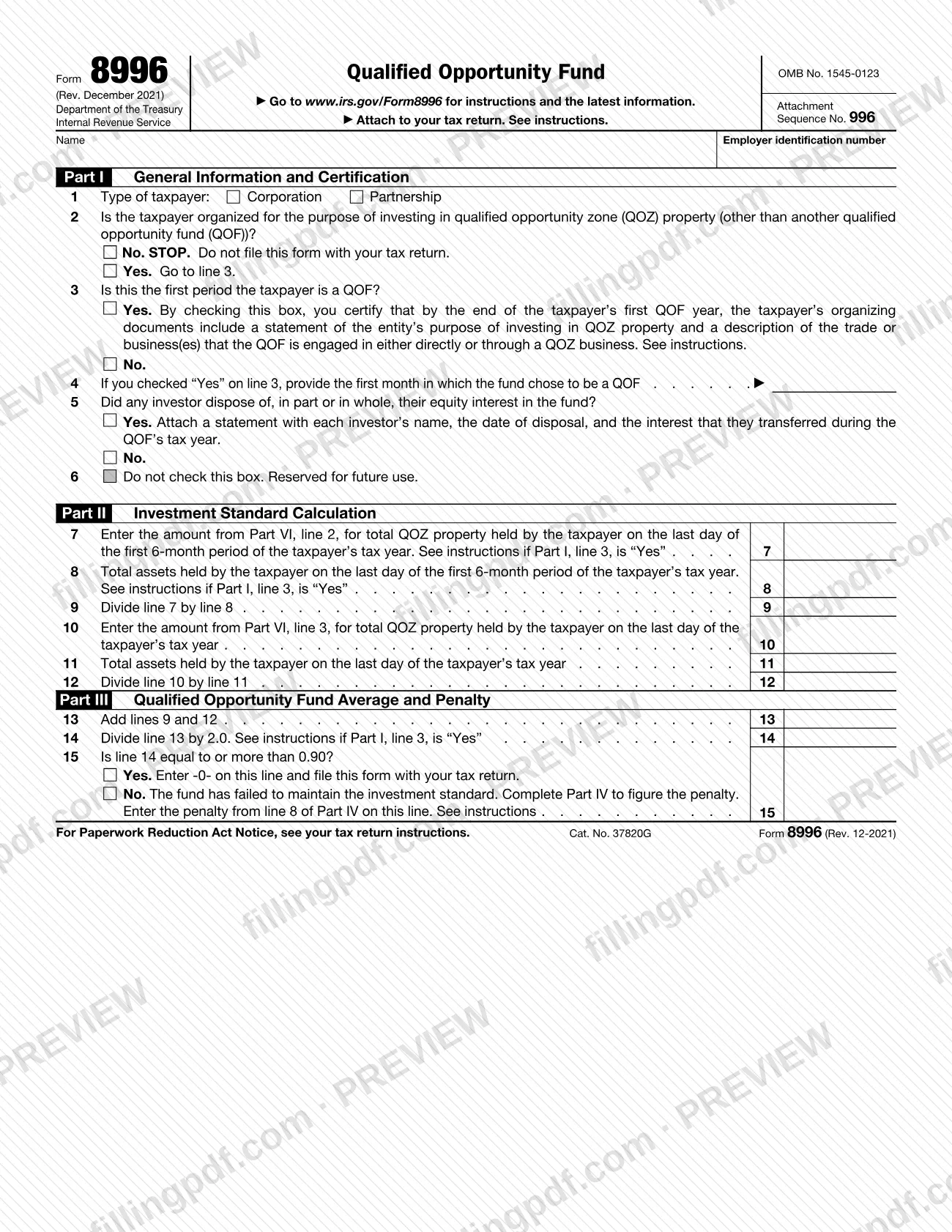
Form 8996 is the Internal Revenue Service (IRS) form that a corporation or partnership attaches to its tax return to certify that it is a qualified opportunity fund (QOF) and to report each year whether it met the 90% investment standard. It is filed by the fund itself, not by the qualified opportunity zone (QOZ) businesses the fund invests in. On this page you can fill out Form 8996 online on FillingPDF and download or print the completed PDF; the form and its instructions are published by the IRS at IRS.gov/Form8996.
Last updated
What is 8996?
Form 8996, Qualified Opportunity Fund, is the IRS form a corporation or partnership attaches to its annual tax return to self-certify as a qualified opportunity fund (QOF) and to report whether it met the 90% investment standard or to figure the penalty.
The form belongs to the opportunity zone rules added by the Tax Cuts and Jobs Act. A QOF is an investment vehicle organized as a corporation or partnership to invest in QOZ property (other than another QOF), and it must hold at least 90% of its total assets in QOZ property. Taxpayers who invest in QOZ property through a QOF can defer the recognition of certain gains.
By completing the form, the entity is self-certifying that it is a QOF and attesting that the property used to meet the 90% standard is QOZ property. The standard is measured as the average of the QOZ-property percentage on the last day of the first 6-month period of the tax year and on the last day of the tax year.
The form has seven parts:
- Part I: general information and certification.
- Part II: investment standard calculation.
- Part III: QOF average and the line 15 penalty entry.
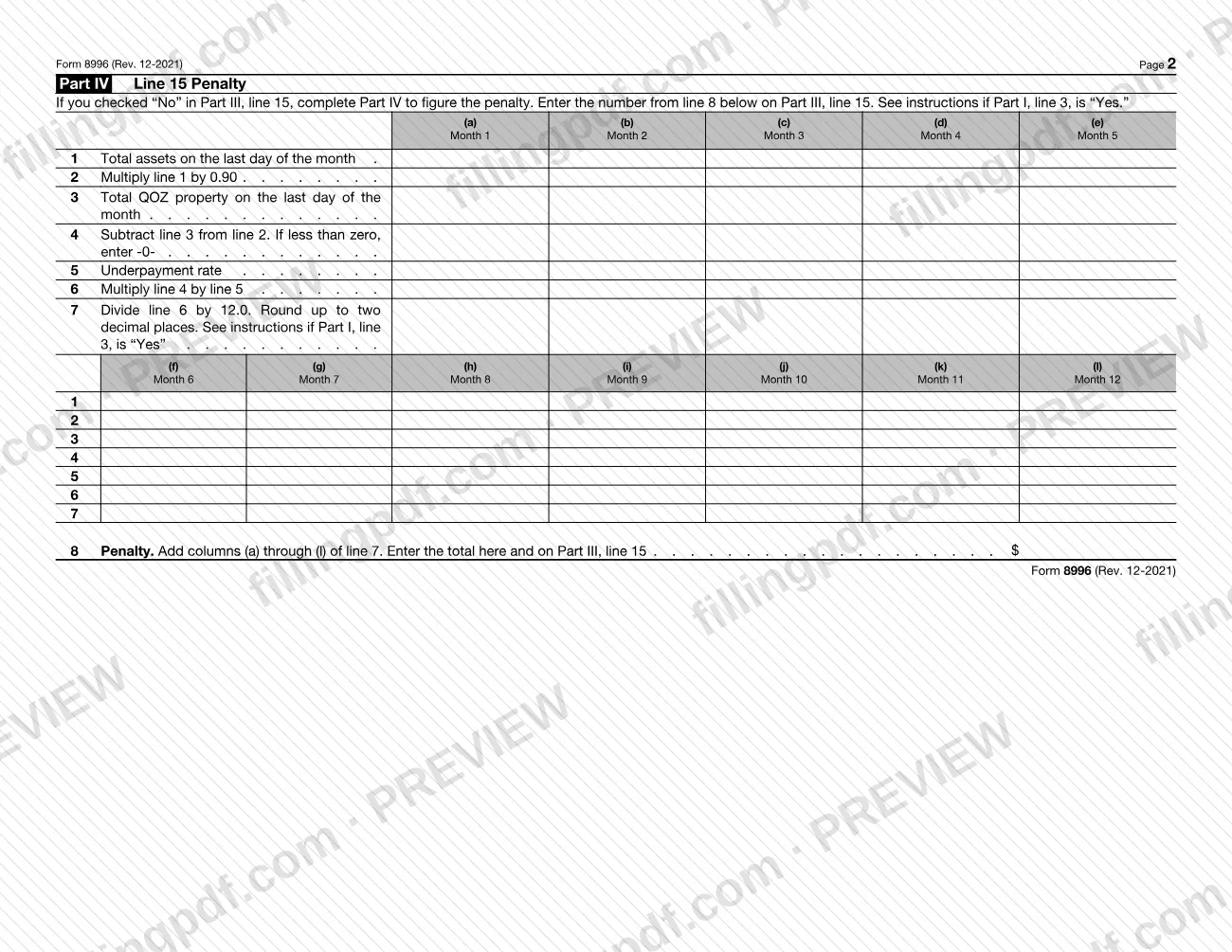
- Part IV: monthly penalty computation.
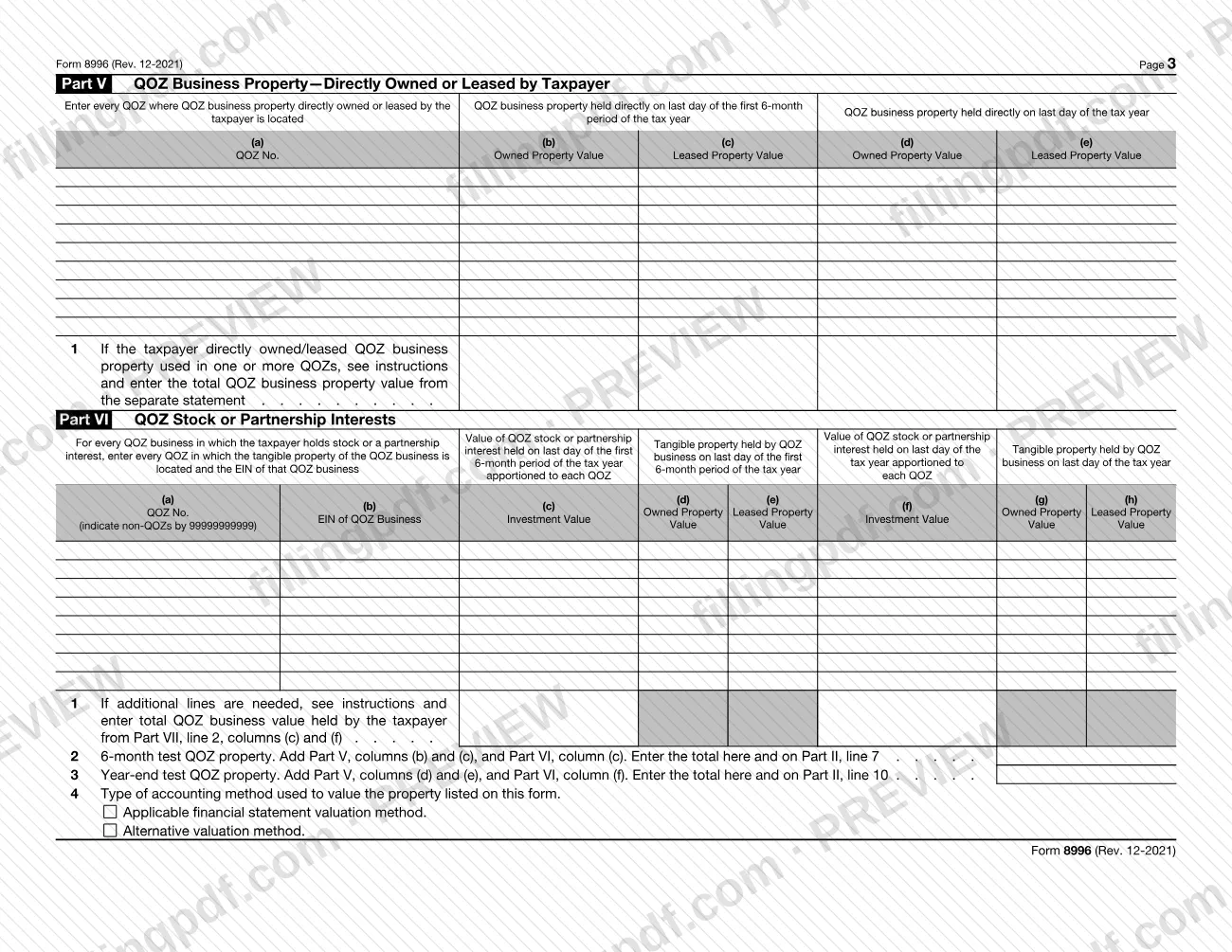
- Part V: QOZ business property the fund directly owns or leases.
- Part VI: QOZ stock or partnership interests.
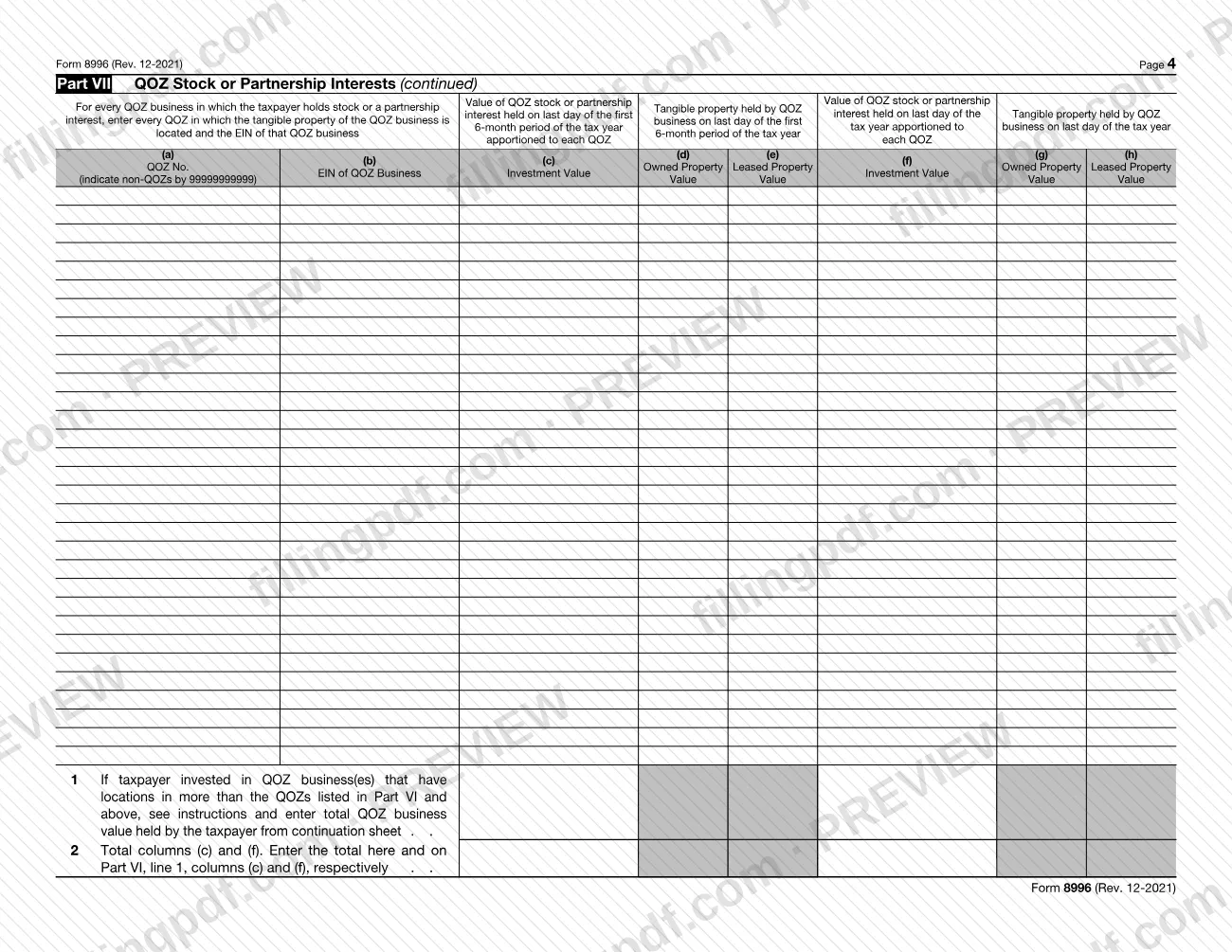
- Part VII: continuation lines for Part VI.
Form 8996 is not filed by QOZ businesses. If the fund meets the standard, line 15 is -0-; if not, Part IV produces the penalty, and the IRS sends a notice about it.
Who needs to file 8996?
A corporation or partnership that is organized and operated as a QOF must file Form 8996 every year with its tax return. The instructions list the returns it travels with: Form 1120, Form 1120-F, Form 1120-REIT, Form 1120-RIC, Form 1120-S or Form 1065, as applicable.
- A QOF organized in a U.S. territory may attach Form 8996 to its Form 1120-F. A corporation or partnership organized in a U.S. territory may be a QOF only if it is organized to invest in QOZ property tied to a trade or business operated in that territory.
- Members of a consolidated group that must certify QOF status each need their own Form 8996, and the group includes them all with its return.
- A new fund that is certifying for the first time answers Yes on line 3 and completes line 4.
Do not file this form if the taxpayer is not organized to invest in QOZ property (other than another QOF): on line 2, No means you stop and do not file it with your return. QOZ businesses do not file Form 8996 either. Form 8996 is used only by entities that self-certify as a QOF or certify that they met the 90% investment standard.
When to file 8996
File Form 8996 every year, by the due date of the tax return it is attached to, including extensions. The form carries no separate due date of its own.
A fund certifying for the first time checks Yes on line 3 and gives the first month it chose to be a QOF on line 4. That month cannot be earlier than the month the entity was formed. For a fund that was not a QOF for the full tax year, the first 6-month period starts with the month on line 4, and lines 7 through 9 may be blank. If you check Yes on line 3 but leave line 4 empty, the 6-month period starts on the first day of the tax year.
The instructions note that a QOF may receive an investment tied to an investor's deferral election in the first month it is certified, but not in any earlier month.
If the fund fails the standard, the IRS sends a notice about the line 15 penalty with instructions on the penalty, the reasonable cause relief process and payment.
Documents you need
- The tax return the form is attached to: Form 1120, 1120-F, 1120-REIT, 1120-RIC, 1120-S or 1065, as applicable.
- A statement listing each investor's name(s), Taxpayer Identification Number(s), the date of disposition and the interest disposed of, only if you answered Yes on Part I, line 5.
- A separate statement in the same format as Part V, only if the fund directly owned or leased QOZ business property used in more than the QOZs listed on Part V; submit it with Form 8996 and the return.
- Additional Part VII pages or a continuation sheet, only if the fund invested in QOZ businesses with locations in more than the QOZs listed in Part VI.
How to fill out 8996
Enter name and EIN
Enter the name and employer identification number exactly as they appear on the QOF's applicable tax return.
Complete lines 1 and 2
On line 1 check Corporation or Partnership. On line 2 check Yes if the taxpayer is organized to invest in QOZ property (other than another QOF), then go to line 3; if you check No, stop and do not file the form.
Certify first-period status
On line 3 check Yes if this is the first period the taxpayer is a QOF, which includes the organizing-documents certification, and give the first month on line 4. Check No if you certified in a prior year.
Report investor dispositions
On line 5 check Yes if any investor disposed of part or all of an equity interest, and attach the investor statement. Do not check the box on line 6.
Complete the Part II calculation
Enter the Part VI, line 2 amount on line 7 and total assets on line 8, then divide for line 9. Repeat for the year-end test on lines 10 through 12, entering ratios as 0.00-format decimals.
Figure the average on Part III
Add lines 9 and 12 on line 13 and divide by 2.0 on line 14; if lines 7 through 9 are blank, enter the line 13 result. On line 15 check Yes and enter -0- if line 14 is 0.90 or more.
Compute any penalty in Part IV
If line 15 is No, fill in lines 1 through 7 for each month the fund failed the standard, then total line 7 on line 8 and carry it to Part III, line 15. A first-year QOF starts Month 1 with the month on Part I, line 4.
Report directly held property
In Part V, list each QOZ number in column (a) and enter owned and leased QOZ business property values in columns (b) through (e). Use the separate statement on line 1 if more QOZs are needed.
Report QOZ stock and interests
In Part VI, list each QOZ number and QOZ business EIN, using 99999999999 for non-QOZs. Enter investment values and tangible property values in columns (c) through (h), then complete lines 2 through 4, including the valuation method on line 4.
Add Part VII if needed
If QOZ businesses have locations in more QOZs than Part VI holds, use Part VII and carry the line 2 totals to Part VI, line 1.
Review and download the PDF
Check that ratios, Part V and VI totals and the line 15 entry agree, then download or print the completed PDF from FillingPDF and attach it, with any statements, to the tax return.
How to submit 8996
Form 8996 is not filed on its own: you attach it to the applicable tax return, and it goes to the IRS by whatever channel that return uses.
- With the tax return: attach the form to Form 1120, 1120-F, 1120-REIT, 1120-RIC, 1120-S or 1065, as applicable. Follow the filing instructions and addresses for that return; Form 8996 prints no address of its own.
- Consolidated groups: include a separate Form 8996 for each group member that must certify QOF status with the group's return.
- Statements: if you answer Yes on Part I, line 5, attach the investor statement to your return. If you use a separate statement for Part V, line 1, submit it with Form 8996 and your tax return.
Parts V, VI and VII must be completed whether line 15 is Yes or No. The form says the IRS sends a penalty notice with payment instructions when a penalty is reported on line 15. FillingPDF lets you fill out and download the PDF; submission follows the channels above.
Common mistakes to avoid
- Filing the form after answering No on line 2; the form says to stop and not file it with your return if the taxpayer is not organized to invest in QOZ property.
- Filing Form 8996 for a QOZ business; the instructions say QOZ businesses do not file it.
- Choosing a first QOF month on line 4 that is earlier than the month the entity was formed.
- Checking Yes on line 3 and leaving line 4 blank, which makes the 6-month period start on the first day of the tax year.
- Checking the box on line 6; it is reserved for future use and the instructions say to skip it.
- Entering ratios in the wrong format on lines 9, 12 and 14; use one digit, a decimal point and two digits, such as 0.92 for 92%.
- Skipping Parts V, VI and VII because line 15 is Yes; they must be completed whether line 15 is Yes or No.
- Leaving non-QOZ property off Part VI: use 99999999999 for non-QOZs instead of an 11-digit QOZ number.
- Mixing valuation methods in the same year instead of using the applicable financial statement method or the alternative valuation method consistently.
Frequently asked questions
What is Form 8996 used for?
Form 8996 is the IRS form a corporation or partnership uses to certify that it is organized to invest in QOZ property as a qualified opportunity fund. It is also filed annually to report that the QOF met the 90% investment standard, or to figure the penalty if it did not.
Who has to file Form 8996?
A corporation or partnership organized and operated as a QOF files it each year with its tax return (Form 1120, 1120-F, 1120-REIT, 1120-RIC, 1120-S or 1065, as applicable). QOZ businesses do not file it, and an entity not organized to invest in QOZ property does not file it.
When is Form 8996 due?
By the due date of the tax return it is attached to, including extensions. The form is filed annually, and it has no due date of its own. Check the instructions for the return you are filing.
Where do I send Form 8996?
You do not send it separately. Attach it to the tax return it supports and file that return through its usual channel. The form prints no mailing address; consolidated groups attach a separate form for each member that must certify.
What is the 90% investment standard on Form 8996?
A QOF must hold at least 90% of its total assets in QOZ property. The standard is the average of the QOZ-property percentage on the last day of the first 6-month period and the last day of the tax year. Line 15 asks whether line 14 is 0.90 or more.
What happens if my fund does not meet the 90% standard?
Check No on Part III, line 15 and complete Part IV to figure the penalty for each month the fund fell short. The IRS then sends a notice about the penalty, with instructions on the penalty, reasonable cause relief and payment.
Can I fill out Form 8996 online?
Yes. You can fill out the Form 8996 PDF online on FillingPDF and download or print it. FillingPDF is an independent service and does not file the form; you attach it to your tax return and submit it through the IRS channels for that return.
Where are the Form 8996 instructions?
The IRS publishes the Instructions for Form 8996 (Rev. December 2024) and the latest developments at IRS.gov/Form8996. They cover the definitions, the valuation methods and line-by-line directions for each part.
Ready to fill out 8996?
Fill out 8996 now