
Form 907, Agreement to Extend the Time to Bring Suit, is the Internal Revenue Service (IRS) agreement that extends the two-year period for filing a refund suit after the IRS has disallowed a claim for refund or credit. Taxpayers, their spouses, representatives, fiduciaries and corporate officers sign it, and it takes effect only when an authorized IRS employee signs for the Commissioner of Internal Revenue. On this page you can fill out Form 907 online on FillingPDF and download or print the completed PDF; the IRS publishes the original form and its instructions at irs.gov.
Last updated
What is Form 907?
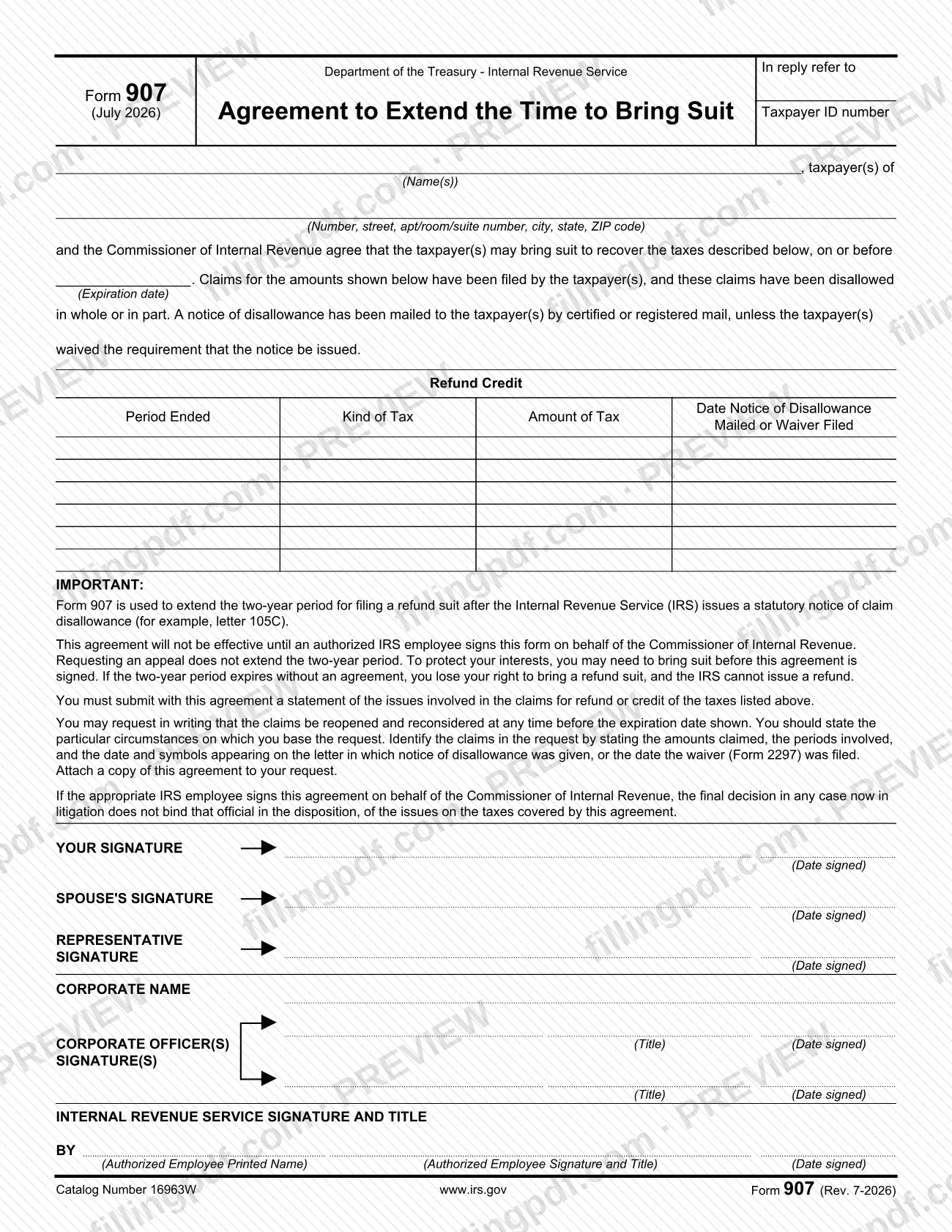
Form 907, Agreement to Extend the Time to Bring Suit, is the Internal Revenue Service (IRS) form on which the taxpayer(s) and the Commissioner of Internal Revenue agree that the taxpayer(s) may bring suit to recover taxes on or before an agreed expiration date.
The IRS states that the form extends the two-year period for filing a refund suit after the IRS issues a statutory notice of claim disallowance, for example letter 105C. The agreement covers claims for refund or credit that were filed and then disallowed in whole or in part. A notice of disallowance must have been mailed by certified or registered mail, unless the taxpayer waived that requirement (the waiver is filed on Form 2297).
The form has three parts: the identification of the taxpayer(s) and the agreed expiration date; a table listing each claim by period ended, kind of tax, amount of tax and the date the notice of disallowance was mailed or the waiver was filed; and the signature blocks for the taxpayer, spouse, representative, corporate officers and the IRS.
It is not an appeal. The IRS says that requesting an appeal does not extend the two-year period. The agreement is also not effective until an authorized IRS employee signs it on behalf of the Commissioner.
Who needs to file Form 907?
Taxpayers whose claim for refund or credit the IRS has disallowed, in whole or in part, and who want more time to bring a refund suit use Form 907. The agreement lists the claims by tax period and kind of tax, so it is completed for the claims covered by the disallowance notice.
Who signs:
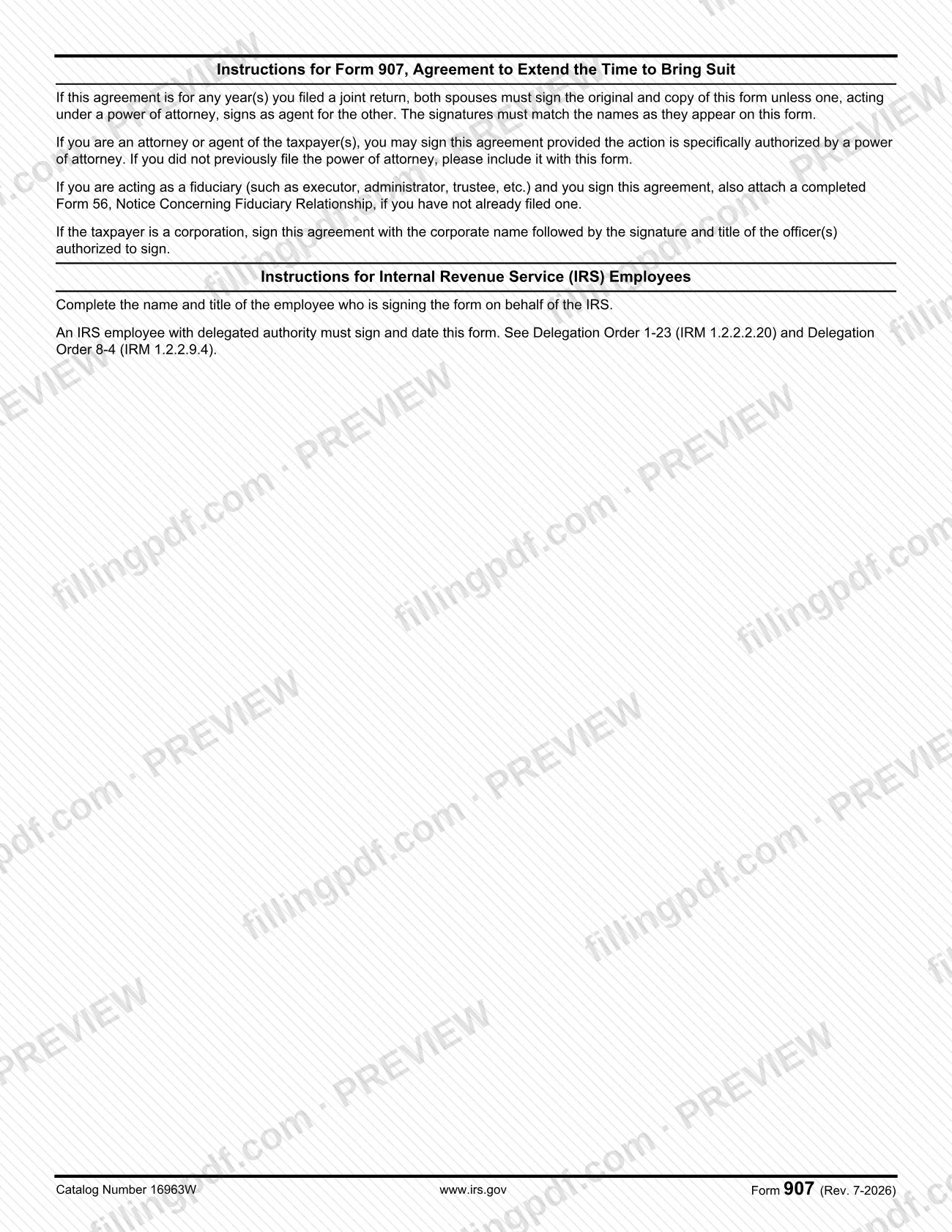
- Joint filers: if the agreement is for any year in which you filed a joint return, both spouses must sign the original and the copy, unless one signs as agent for the other under a power of attorney. Signatures must match the names printed on the form.
- Attorneys and agents: may sign only if a power of attorney specifically authorizes this action. Include the power of attorney if you did not previously file it.
- Fiduciaries: an executor, administrator, trustee or similar fiduciary who signs also attaches a completed Form 56, Notice Concerning Fiduciary Relationship, if one has not already been filed.
- Corporations: sign with the corporate name followed by the signature and title of the officer(s) authorized to sign.
The IRS signature block is completed by an IRS employee with delegated authority, not by the taxpayer.
When to file Form 907
Use Form 907 after the IRS has issued a statutory notice of claim disallowance and before the two-year period for filing a refund suit runs out. If that period expires without an agreement, the IRS says you lose your right to bring a refund suit and the IRS cannot issue a refund.
Because the agreement is not effective until an authorized IRS employee signs it, the IRS warns that you may need to bring suit before it is signed to protect your interests. Requesting an appeal does not extend the two-year period.
The expiration date written on the form is the last day on which the taxpayer(s) may bring suit under the agreement. You may ask in writing that the claims be reopened and reconsidered at any time before that date.
Documents you need
- Statement of the issues involved in the claims for refund or credit listed on the form; required with the agreement.
- A copy of the signed agreement, attached to any written request to reopen and reconsider the claims, if you make one before the expiration date.
- Power of attorney, if an attorney or agent signs for the taxpayer(s) and it was not previously filed; it must specifically authorize the action.
- Form 56, Notice Concerning Fiduciary Relationship, if you sign as a fiduciary such as an executor, administrator or trustee and have not already filed one.
- A second signed copy of the form: for joint returns, both spouses sign the original and the copy unless one signs under a power of attorney.
How to fill out Form 907
Enter taxpayer identification details
Enter the taxpayer ID number, the name(s) of the taxpayer(s) and the full address (number, street, apt/room/suite number, city, state, ZIP code). Use the names exactly as the signatures will appear.
Enter the expiration date
In the sentence about bringing suit, write the expiration date: the last day on or before which the taxpayer(s) may bring suit to recover the taxes described.
List the disallowed claims
In the table, enter for each claim the Period Ended, Kind of Tax, Amount of Tax under Refund or Credit, and the Date Notice of Disallowance Mailed or Waiver Filed. Use the dates on the disallowance letter or the Form 2297 waiver.
Prepare the statement of issues
Write a statement of the issues involved in the claims listed, which must be submitted with the agreement. If you also request reopening, state the circumstances and identify the claims by amount, period, and date and symbols of the letter.
Sign and date as taxpayer
Sign at YOUR SIGNATURE and enter the date signed. On a joint return, the spouse signs at SPOUSE'S SIGNATURE with the date; both sign the original and the copy.
Add a representative or fiduciary signature
If an attorney or agent signs, use the REPRESENTATIVE SIGNATURE line and include the power of attorney. A fiduciary who signs also attaches Form 56 if none is on file.
Complete the corporate block
For a corporation, enter the CORPORATE NAME, then the signature, title and date for each authorized corporate officer.
Leave the IRS block blank
Do not complete the Internal Revenue Service signature and title section. An authorized IRS employee enters name, title, signature and date.
Review, sign and download the PDF
Check that names, dates, amounts and periods match your disallowance notice and that every signer has signed. Download or print the completed PDF from FillingPDF, make the copy and assemble the package described under How to submit.
How to submit Form 907
Form 907 prints no mailing address, portal or fax number, so submission follows the instructions the IRS gave you for your disallowed claim. What the form does require:
- Signed original and copy: for joint returns, both spouses sign the original and the copy, unless one signs under a power of attorney.
- Statement of issues: you must submit with the agreement a statement of the issues involved in the claims for refund or credit listed on the form.
- IRS signature: the agreement is not effective until an authorized IRS employee signs it on behalf of the Commissioner of Internal Revenue.
- Request to reopen (optional): a written request to reopen and reconsider the claims may be made at any time before the expiration date. Identify the claims by the amounts claimed, the periods involved, and the date and symbols on the disallowance letter or the date the waiver (Form 2297) was filed, and attach a copy of the agreement.
FillingPDF lets you fill out and download the PDF; submission follows the IRS channels that apply to your claim.
Common mistakes to avoid
- Assuming that requesting an appeal extends the two-year period; the IRS says it does not.
- Waiting for the IRS to sign before suing when the two-year period may expire first; the agreement is not effective until an authorized IRS employee signs it.
- Submitting the form without the statement of the issues involved in the claims for refund or credit.
- Having only one spouse sign a joint-return year, with no power of attorney authorizing the other to sign as agent.
- Signing with a name that differs from the name printed on the form; the signatures must match.
- Signing as an attorney or agent without a power of attorney that specifically authorizes this action, or without including it when not previously filed.
- Signing as executor, administrator or trustee without attaching Form 56 when none has been filed.
- Signing for a corporation without the corporate name followed by the officer's signature and title.
- Filling in the Internal Revenue Service signature block; an IRS employee with delegated authority completes it.
Frequently asked questions
What is Form 907 used for?
Form 907 is the IRS agreement used to extend the two-year period for filing a refund suit after the IRS issues a statutory notice of claim disallowance, such as letter 105C. It states the date on or before which the taxpayer(s) may bring suit to recover the listed taxes.
Does requesting an appeal extend the time to file a refund suit?
No. The IRS states on Form 907 that requesting an appeal does not extend the two-year period. If the period expires without an agreement, you lose your right to bring a refund suit and the IRS cannot issue a refund.
When does Form 907 take effect?
Only when an authorized IRS employee signs it on behalf of the Commissioner of Internal Revenue. Because of that, the IRS says you may need to bring suit before the agreement is signed to protect your interests.
What do I have to submit with Form 907?
A statement of the issues involved in the claims for refund or credit listed on the form. Add the power of attorney if a representative signs and it was not filed before, and Form 56 if a fiduciary signs and none is on file.
Who has to sign Form 907 on a joint return?
Both spouses must sign the original and the copy, unless one signs as agent for the other under a power of attorney. The signatures must match the names printed on the form.
Can I ask the IRS to reopen my disallowed claim with Form 907?
You may request in writing, at any time before the expiration date, that the claims be reopened and reconsidered. State your circumstances, identify the claims by amount, period and letter date and symbols, and attach a copy of the agreement.
Can I fill out Form 907 online?
Yes. You can fill out the Form 907 PDF online on FillingPDF and download or print it. FillingPDF is an independent service and does not file the form with the IRS or obtain the IRS signature.
Ready to fill out Form 907?
Fill out Form 907 now