
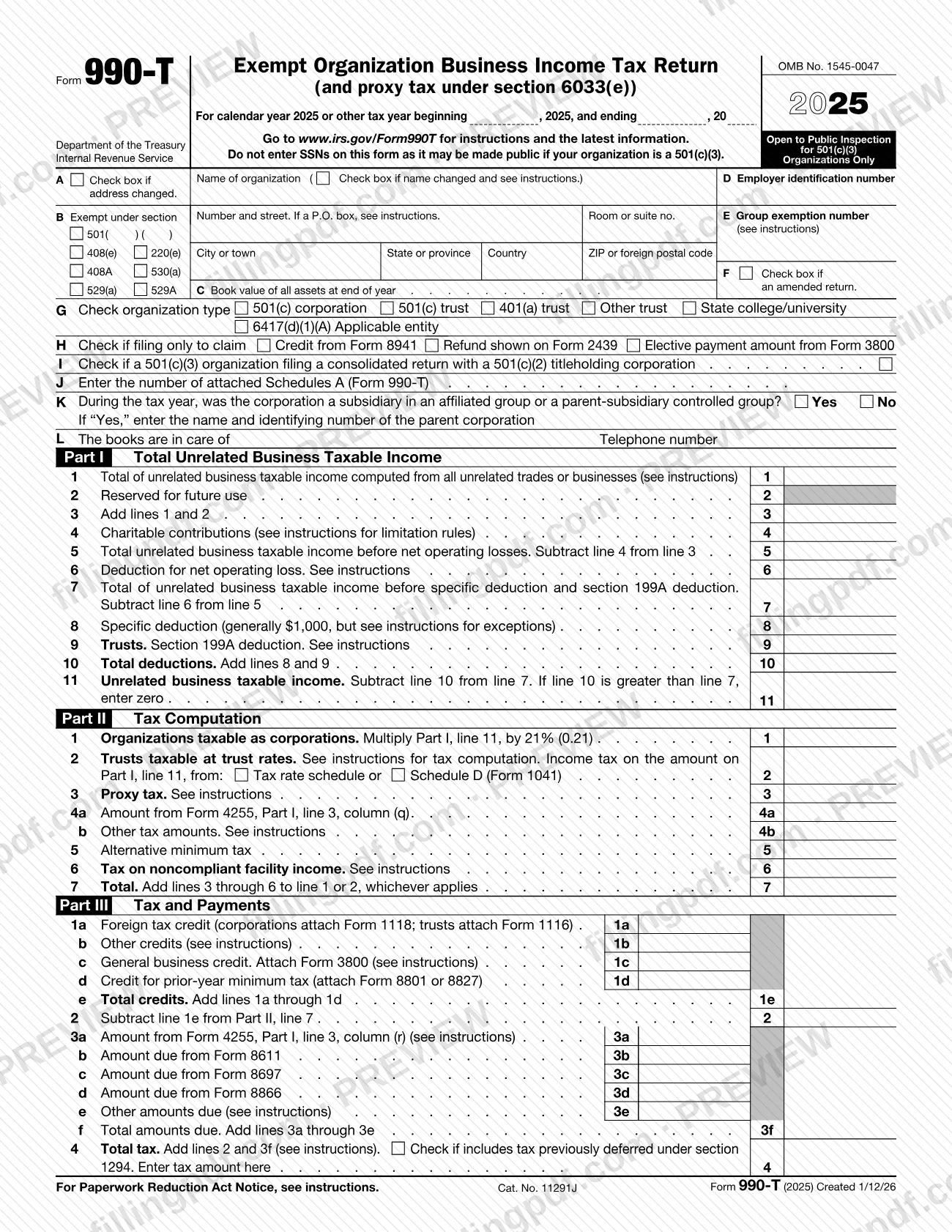
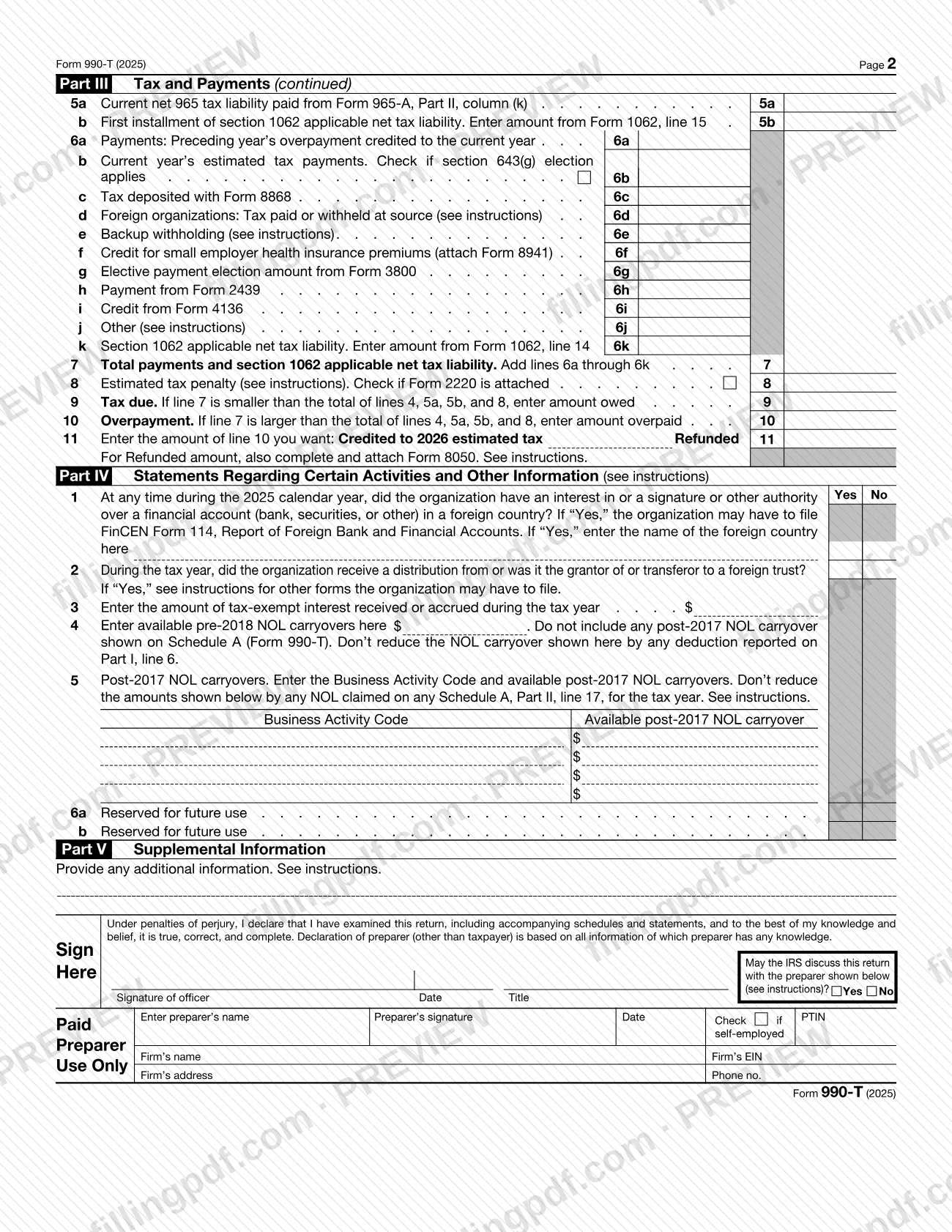
Form 990-T, Exempt Organization Business Income Tax Return (and proxy tax under section 6033(e)), is the Internal Revenue Service (IRS) return on which tax-exempt organizations report unrelated business taxable income (UBTI) and figure the tax on it. Organizations also use it to report proxy tax, claim certain refunds and credits, and make an elective payment election. On FillingPDF you can fill out the form online and download or print the completed PDF; the form and its instructions are published by the IRS at www.irs.gov/Form990T, and filing follows the IRS channels.
Last updated
What is 990-T?
Form 990-T, Exempt Organization Business Income Tax Return (and proxy tax under section 6033(e)), is the IRS return that tax-exempt organizations use to report unrelated business income, figure the unrelated business income tax they owe, and report proxy tax liability.
According to the IRS instructions, the form is also used to:
- claim a refund of income tax paid by a regulated investment company (RIC) or real estate investment trust (REIT) on undistributed long-term capital gain;
- request a credit for certain federal excise taxes paid for small employer health insurance premiums;
- make an elective payment election under section 48D or section 6417.
The return has five parts: Part I, Total Unrelated Business Taxable Income; Part II, Tax Computation; Part III, Tax and Payments; Part IV, Statements Regarding Certain Activities and Other Information; and Part V, Supplemental Information. An organization with UBTI also completes a separate Schedule A (Form 990-T) for each unrelated trade or business, and completes those schedules first. An organization with no UBTI files Form 990-T only, without Schedule A.
Form 990-T is not an annual information return. Organizations that file Form 990, Form 990-EZ, Form 990-PF or Form 5500 report the unrelated business gross income and expenses from Form 990-T on that information return as well. A section 501(c)(3) organization must make its entire Form 990-T, including amended returns, available for public inspection.
Who needs to file 990-T?
Organizations exempt under section 501(a), section 529(a) or section 529A(a), including domestic or foreign organizations and disregarded entities, must file Form 990-T if they have gross income of $1,000 or more from a regularly conducted unrelated trade or business. The same threshold applies to:
- colleges and universities of states and other governmental units, and their wholly owned subsidiary corporations;
- qualified tuition programs under section 529 and qualified ABLE programs under section 529A;
- trustees of IRAs, SEP IRAs, SIMPLE IRAs, Roth IRAs, Coverdell ESAs, Archer MSAs and HSAs. Each account is treated as a separate trust and needs its own EIN.
You may also have to file with no UBTI when you:
- owe the proxy tax on lobbying and political expenditures (it does not apply to section 501(c)(3) organizations);
- are an applicable entity making an elective payment election;
- are claiming only a refund or credit, such as an IRA or other tax-exempt shareholder in a RIC or REIT seeking a refund of tax on undistributed long-term capital gains;
- owe certain other taxes or amounts listed in the instructions for Part III.
A section 501(c)(1) corporation that is an instrumentality of the United States and is both organized and exempt from tax by an Act of Congress does not have to file. Individual retirement annuities, unlike IRAs, are not subject to unrelated business income tax.
When to file 990-T
The due date depends on the type of filer. An employees' trust under section 401(a), an IRA (including SEPs and SIMPLEs), a Roth IRA, a Coverdell ESA or an Archer MSA files by the 15th day of the 4th month after the end of its tax year. All other organizations file by the 15th day of the 5th month after the end of their tax year. If that date falls on a Saturday, Sunday or legal holiday, file by the next business day.
The 2025 form covers calendar year 2025 or a fiscal year beginning in 2025 and ending in 2026. To request more time, file Form 8868, Application for Extension of Time To File an Exempt Organization Return or Excise Taxes Related to Employee Benefits Plans. An extension does not stop interest on tax unpaid after the original due date. Pay any tax due in full by the due date of the return, without extension.
To correct a filed return, check the Amended return box in item F. Generally, file the amended return within 3 years after the original due date or 3 years after the filing date, whichever is later. A late return or late payment can bring interest and penalties; the IRS can figure them and bill you.
Documents you need
- Schedule A (Form 990-T), one for each separate unrelated trade or business, when the organization has UBTI; complete these first. An organization with no UBTI does not attach Schedule A.
- Form 3800, General Business Credit, plus the form for each individual credit, when an applicable entity makes an elective payment election or claims a general business credit on line 1c.
- Form 1118 for a corporation, or Form 1116 for a trust, to claim the foreign tax credit on Part III, line 1a.
- Form 8801 (trusts) or Form 8827 (corporations) to claim the credit for prior-year minimum tax on line 1d.
- Form 4626 for corporations, or Schedule I (Form 1041) for trusts, if alternative minimum tax applies on Part II, line 5.
- Schedule D (Form 1041), when a trust checks the Schedule D box on Part II, line 2 to use capital gain rates.
- A statement showing the proxy tax computation, when you enter proxy tax on Part II, line 3.
- Attached statements for lines 4b, 3e, 1b and Part III line 4 items, showing the type of tax or credit, form or Code section, and amount.
- Form 8941 to claim the credit for small employer health insurance premiums on line 6f.
- Copy B of Form 2439 from each RIC or REIT, when claiming tax paid on undistributed long-term capital gains (line 6h).
- Form 1042-S, or another form verifying the withholding, for tax paid or withheld at source by a foreign organization (line 6d).
- A copy of the Form 1099 showing the withholding, when the only reason for filing is a refund of backup withholding.
- Form 2220, only if the annualized income or adjusted seasonal installment method is used, or a large organization computes its first installment on prior-year tax.
- Form 8050, when there is an overpayment on line 11 that you want refunded by direct deposit.
- Form 8997 with the applicable Schedule D and Form 8949, for organizations that deferred a capital gain into a qualified opportunity fund.
How to fill out 990-T
Complete Schedules A first
If the organization has UBTI, complete a separate Schedule A (Form 990-T) for each unrelated trade or business before Parts I through V. Enter the number of attached schedules in item J.
Enter the tax year
At the top, check the calendar year 2025 or enter the dates a fiscal year began in 2025 and ended in 2026. Use the established annual accounting period, or the calendar year if none exists.
Enter name, address and EIN
Enter the organization's name and address as on other Forms 990; check item A or the name-change box if either changed. In item D enter the organization's own EIN, and in item E any group exemption number. Item C asks for the book value of all assets at year end, and item L for the person holding the books and a phone number.
Select exemption and organization type
In item B check the section under which the organization is exempt (for example 501(c)(3), written in the parentheses). In item G check the organization type. Check item F for an amended return, item H if filing only to claim a listed credit or refund, and item I for a consolidated return with a 501(c)(2) titleholding corporation.
Answer the affiliated group question
Item K: check Yes or No for whether the corporation was a subsidiary in an affiliated group or parent-subsidiary controlled group. If Yes, enter the parent corporation's name and identifying number.
Compute unrelated business taxable income
Part I, line 1: enter the sum of positive amounts from all Schedules A, Part II, line 18. Then complete line 4 (charitable contributions), line 6 (pre-2018 NOL deduction), line 8 (specific deduction) and, for trusts, line 9. Line 11 is the result, or zero if line 10 exceeds line 7.
Figure the tax in Part II
Corporations use line 1; trusts use line 2 and check Tax rate schedule or Schedule D. Add proxy tax on line 3 with an attached statement, then lines 4a, 4b, 5 (alternative minimum tax) and 6 (noncompliant facility income). Line 7 is the total.
Enter credits and total tax
In Part III, lines 1a through 1d, enter the foreign tax credit, other credits, general business credit and prior-year minimum tax credit, and total them on line 1e. Subtract line 1e from Part II, line 7 on line 2, list amounts due on lines 3a through 3f, and enter total tax on line 4.
Enter payments and balance
Report lines 5a and 5b (sections 965 and 1062), payments on lines 6a through 6k, and the total on line 7. Check Form 2220 on line 8 if attached. Line 9 is tax due; line 10 is overpayment; on line 11 choose the amount credited to 2026 estimated tax or refunded.
Answer the Part IV statements
Answer the foreign financial account question (line 1) and foreign trust question (line 2), enter tax-exempt interest on line 3, pre-2018 NOL carryovers on line 4, and each Business Activity Code with its post-2017 NOL carryover on line 5.
Add supplemental information
In Part V, give narrative information the form calls for. For an amended return, state the line numbers changed on the original return and the reason for each change.
Sign and complete the preparer block
An authorized officer signs and dates for a corporation; the fiduciary or authorized officer signs for a trust. Check Yes or No for IRS discussion with the preparer. A paid preparer signs and enters a PTIN, firm name, EIN, address and phone.
Review and download the completed PDF
Check that every applicable line is complete and Schedules A and attachments match the lines you used. Download or print the completed PDF from FillingPDF and file it through the channels described under How to submit.
How to submit 990-T
Form 990-T is filed electronically or, for some filers only, on paper; any tax is paid separately through the IRS payment channels.
- Electronic filing: an organization or trust defined in section 511 is required to file Form 990-T electronically. See IRS.gov/EOefile for details.
- Paper filing: an applicable entity that is not an organization or trust defined in section 511 and files only to make an elective payment election may file electronically (encouraged, not required) or by paper. Mail the paper return to Department of the Treasury, Internal Revenue Service Center, Ogden, UT 84201-0027.
- Paying tax: pay by EFTPS (IRS.gov/EFTPS or 800-555-4477), or by credit or debit card through IRS.gov/E-pay. Submit EFTPS deposits by 8 p.m. Eastern time the day before the due date.
- Refunds: if there is an overpayment on Part III, line 11, and you want it refunded, attach Form 8050 for direct deposit.
- Help: call 877-829-5500 for questions about completing the form.
Attach Schedule(s) A (Form 990-T) and every form or statement the lines you complete require. FillingPDF lets you fill out and download the PDF; submission follows the channels above.
Common mistakes to avoid
- Filing a paper return when the organization or trust is defined in section 511; those filers are required to file Form 990-T electronically.
- Entering a Social Security number. The form warns not to enter SSNs because a 501(c)(3) return is made public, and an IRA trust must use its own EIN, never an SSN or the trustee's EIN.
- Completing Part I before the Schedules A. The instructions say to complete all needed Schedules A (Form 990-T) first.
- Computing tax on the wrong line: a 501(c) corporation uses Part II, line 1 and leaves line 2 blank; a 501(c) trust, 401(a) trust or other trust uses line 2 and leaves line 1 blank.
- Checking "6417(d)(1)(A) Applicable entity" in item G when another box applies, such as a rural electric cooperative under section 501(c)(12), which checks 501(c) corporation or trust.
- Entering an amount on Part I, line 2, or Part IV, lines 6a and 6b. These lines are reserved for future use and must stay blank.
- Reducing the pre-2018 NOL carryover on Part IV, line 4 by the deduction claimed on Part I, line 6, or including post-2017 NOL carryovers there.
- Leaving lines in Part IV unanswered. The instructions say to complete all lines in Part IV.
- Entering the paid preparer's SSN instead of the PTIN; because a 501(c)(3) Form 990-T is publicly disclosable, that block is public.
Frequently asked questions
What is Form 990-T used for?
Form 990-T is the IRS return that tax-exempt organizations use to report unrelated business income and figure the tax on it. It also reports proxy tax liability, claims certain refunds and credits, and is used to make an elective payment election under section 48D or 6417.
Who has to file Form 990-T?
Organizations exempt under section 501(a), 529(a) or 529A(a) with gross income of $1,000 or more from a regularly conducted unrelated trade or business must file. IRA and similar trustees, state colleges and universities, and 529 and ABLE programs are covered at the same threshold.
When is Form 990-T due?
By the 15th day of the 5th month after the tax year ends for most organizations. Section 401(a) employees' trusts, IRAs, Roth IRAs, Coverdell ESAs and Archer MSAs file by the 15th day of the 4th month. A weekend or holiday due date moves to the next business day.
Do I have to e-file Form 990-T?
Yes, if you are an organization or trust defined in section 511; electronic filing is required, with details at IRS.gov/EOefile. An applicable entity filing only to make an elective payment election may e-file or mail a paper return to the IRS in Ogden, UT.
How do I get an extension for Form 990-T?
File Form 8868 by the return's due date. All entities filing Form 990-T must use Form 8868 to request an extension of time to file. The extension does not extend the time to pay, and interest runs on unpaid tax from the original due date.
Do I attach Schedule A (Form 990-T)?
Only if the organization has UBTI. Complete a separate Schedule A for each unrelated trade or business, before the rest of the form, and enter the number attached in item J. An organization with no UBTI files Form 990-T alone.
Can I fill out Form 990-T online on FillingPDF?
Yes. You can fill out the fillable PDF online on FillingPDF and download or print it. FillingPDF is an independent service and does not file the return with the IRS; you file through the IRS channels, and electronic filing is required for many filers.
How do I correct a Form 990-T I already filed?
Check the Amended return box in item F and, in Part V, list the line numbers changed on the original return and the reason for each. Generally, file within 3 years after the original due date or the filing date, whichever is later.
Is Form 990-T open to public inspection?
For a section 501(c)(3) organization, yes. Under section 6104(d), the entire return, including amended returns, must be available for public inspection. That is why the form warns against entering SSNs and why a preparer's PTIN, not SSN, is entered.
Ready to fill out 990-T?
Fill out 990-T now