
The appearance bond on Form AO 98 is the United States District Court document in which a defendant agrees to follow the court's orders and accepts the terms of a bond, which may be a personal recognizance, unsecured or secured bond. The form is published by the Administrative Office of the U.S. Courts (AO) and is signed by the defendant and, where one is used, each surety or property owner, then by the clerk and the judge. On this page you can fill out the form online on FillingPDF and download or print the completed PDF; the official PDF is published at uscourts.gov.
Last updated
What is AO 98?
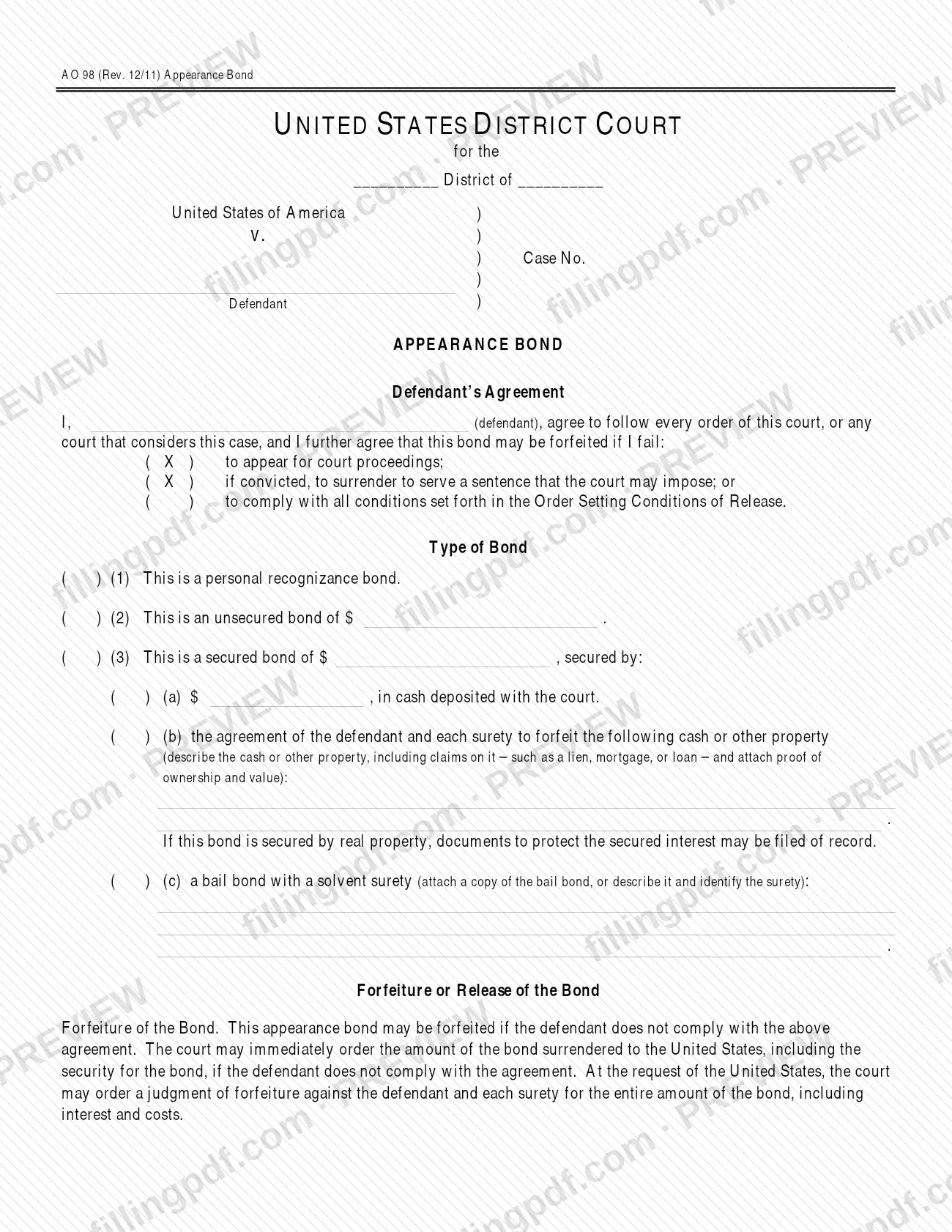
Form AO 98, Appearance Bond, is the form used in a United States District Court criminal case, captioned "United States of America v. Defendant," in which the defendant agrees to follow court orders and accepts the terms of the bond the court sets.
In the Defendant's Agreement section, the defendant agrees to follow every order of the court, or any court that considers the case, and agrees that the bond may be forfeited for failing to appear for court proceedings, failing to surrender to serve a sentence if convicted, or, when that box is marked, failing to comply with the conditions in the Order Setting Conditions of Release.
The form then offers three types of bond:
- (1) a personal recognizance bond;
- (2) an unsecured bond of a stated dollar amount;
- (3) a secured bond of a stated dollar amount, secured by cash deposited with the court, by the agreement of the defendant and each surety to forfeit cash or other property, or by a bail bond with a solvent surety.
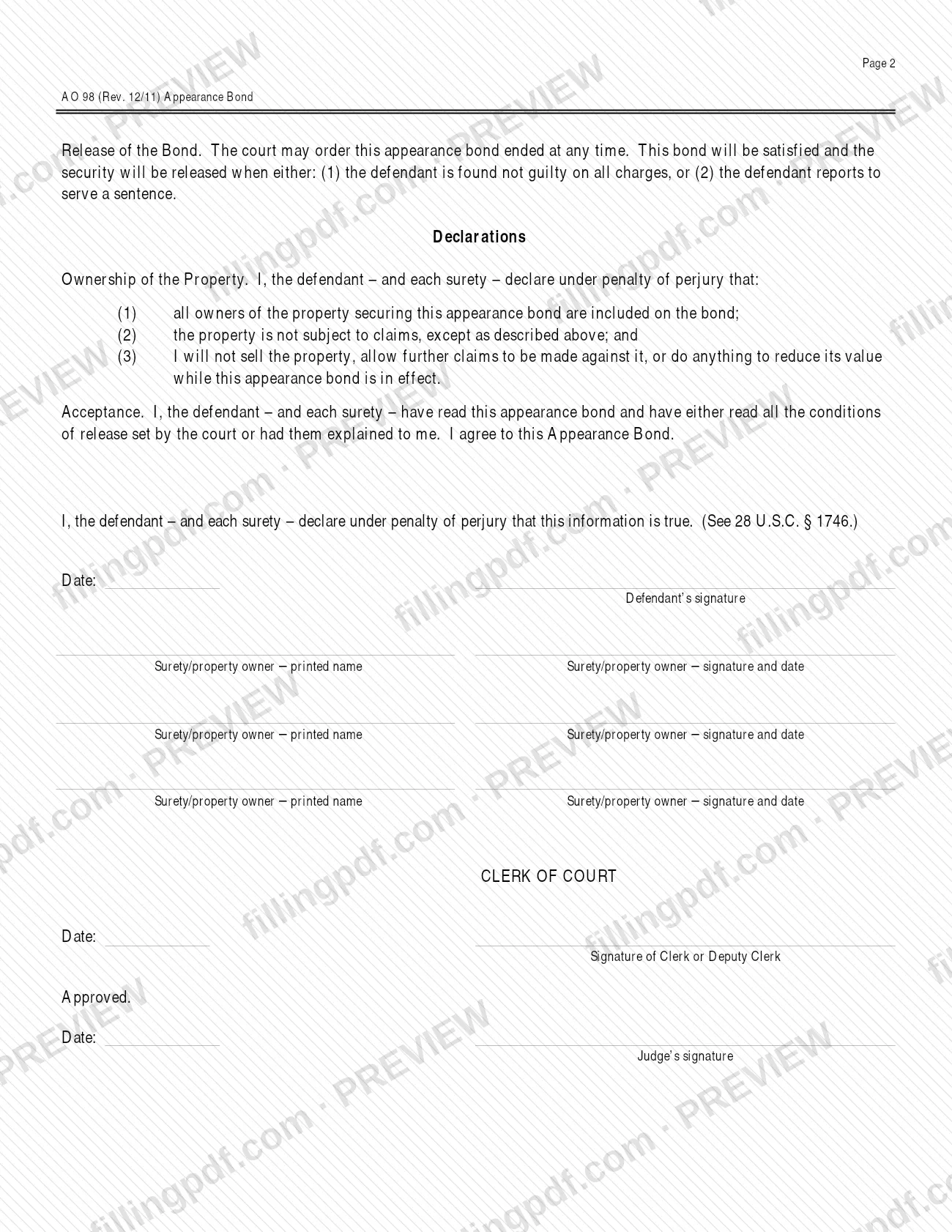
It also explains forfeiture and release of the bond, contains declarations about ownership of the property, and ends with signature blocks for the defendant, each surety or property owner, the Clerk of Court and the judge. The form's own revision mark is Rev. 12/11.
Who needs to file AO 98?
The main user is a defendant in a case before a United States District Court who is released on an appearance bond. The defendant enters their name in the agreement, picks the type of bond and signs and dates the form under penalty of perjury.
Other people sign as well when the bond calls for them:
- Sureties and property owners. Each surety or property owner prints their name and signs and dates the form. Under the Declarations, the defendant and each surety state that all owners of the property securing the bond are included on it.
- Clerk of Court. The Clerk or a Deputy Clerk signs and dates the clerk block; the person posting the bond does not complete it.
- Judge. The judge signs and dates under "Approved."
The form does not tell anyone to use it on their own; it belongs to a specific case and district, named in the caption, and it refers to the Order Setting Conditions of Release set by the court. Nothing printed on it addresses signing for someone else.
When to file AO 98
The form sets no filing deadline of its own. It is completed for the case named in its caption, and it refers to the Order Setting Conditions of Release and to the bond the court sets.
Its timing is described by when the bond ends rather than when it starts. The court may order the appearance bond ended at any time. The bond is satisfied and the security released when either the defendant is found not guilty on all charges or the defendant reports to serve a sentence.
Until then the bond stays in effect, and the form's ownership declarations apply throughout: the defendant and each surety promise not to sell the property, allow further claims against it, or do anything that reduces its value while the bond is in effect. If the defendant does not comply with the agreement, the court may immediately order the amount of the bond surrendered to the United States.
Documents you need
- Proof of ownership and value of the cash or other property pledged, attached when the bond is secured under item (3)(b); the form also asks you to describe any claims on it, such as a lien, mortgage or loan.
- A copy of the bail bond, attached when the bond is secured under item (3)(c) by a bail bond with a solvent surety; if you do not attach a copy, describe the bail bond and identify the surety on the form.
How to fill out AO 98
Complete the case caption
At the top, enter the district court's district and state in the "__ District of __" line, then the Case No. The caption reads United States of America v. Defendant.
Enter the defendant's name
In the Defendant's Agreement, write the defendant's name after "I,". The first two boxes, to appear for court proceedings and to surrender to serve a sentence if convicted, are printed already marked.
Mark the release conditions box
The third box, to comply with all conditions set forth in the Order Setting Conditions of Release, is unmarked on the printed form. Mark it if it applies to this bond.
Choose the type of bond
Mark one: (1) personal recognizance bond, (2) unsecured bond, or (3) secured bond. For (2) or (3), enter the dollar amount of the bond.
Describe the security for a secured bond
Under (3), mark (a) and enter the cash deposited with the court, (b) and describe the cash or other property with any lien, mortgage or loan claims, or (c) a bail bond with a solvent surety. Attach proof of ownership and value for (b), and a copy of the bail bond for (c), or describe it and identify the surety.
Review forfeiture, release and declarations
Read Forfeiture or Release of the Bond and the Declarations about ownership of the property and Acceptance. They are printed text and need no entries.
Enter the date and defendant's signature
Enter the Date and have the defendant sign. The defendant signs under penalty of perjury (28 U.S.C. § 1746).
Add each surety or property owner
On each line, print the surety or property owner's name and have them sign and date. The form has three lines.
Leave the clerk and judge blocks
The CLERK OF COURT block and the judge's "Approved." block are signed by the Clerk or Deputy Clerk and by the judge, not by you.
Review and download the completed PDF
Check the case number, bond type, amounts and signatures, then download or print the completed PDF from FillingPDF and deliver it as the court directs.
How to submit AO 98
Form AO 98 is handled inside the court case it belongs to: the form prints no mailing address, online portal or appointment rule, and it names no fee. Its signature page moves the form through the people who must sign it.
- Defendant and sureties. The defendant signs and dates the form; each surety or property owner prints a name and signs and dates.
- Clerk of Court. The Clerk or Deputy Clerk signs and dates the CLERK OF COURT block.
- Judge. The judge signs and dates beneath "Approved."
For how and where to deliver the signed bond in your case, ask the clerk's office of the United States District Court named in the caption. If the bond is secured by property or a bail bond, attach what the form asks for: proof of ownership and value for property, or a copy of the bail bond (or a description that identifies the surety). For real property, the form says documents to protect the secured interest may be filed of record.
FillingPDF lets you fill out and download the PDF; submission follows the court's own channels.
Common mistakes to avoid
- Securing the bond with property without attaching proof of ownership and value, which item (3)(b) asks for.
- Omitting a claim on the pledged property, such as a lien, mortgage or loan; the declarations state the property is not subject to claims except as described.
- Leaving a property owner off the bond; the declarations state that all owners of the property securing the bond are included.
- Choosing item (3)(c), a bail bond, without attaching a copy or describing the bond and identifying the surety.
- Signing before reading the bond and the conditions of release, or having them explained; the Acceptance paragraph says each signer has done so.
- Leaving a surety or property owner's printed name, signature or date blank on their line.
- Selling the pledged property or allowing further claims against it while the bond is in effect, which the declarations prohibit.
- Filling in the Clerk of Court or judge blocks yourself; those are signed by the Clerk or Deputy Clerk and the judge.
Frequently asked questions
What is an appearance bond on Form AO 98?
Form AO 98 is the appearance bond used in United States District Court cases. The defendant agrees to follow court orders, and the bond may be forfeited if the defendant fails to appear, fails to surrender to serve a sentence, or breaks the release conditions when that box is marked.
What types of bond does the appearance bond form offer?
Three: (1) a personal recognizance bond, (2) an unsecured bond of a stated amount, and (3) a secured bond of a stated amount. A secured bond is backed by cash deposited with the court, by cash or property the defendant and each surety agree to forfeit, or by a bail bond with a solvent surety.
Who has to sign an appearance bond?
The defendant signs and dates the form, and each surety or property owner prints a name and signs and dates. The Clerk or Deputy Clerk signs the clerk block, and the judge signs under "Approved." Each signer declares under penalty of perjury that the information is true.
What happens if the defendant does not follow the bond agreement?
The bond may be forfeited. The court may immediately order the bond amount, including the security, surrendered to the United States. At the United States' request it may order a judgment of forfeiture against the defendant and each surety for the entire amount, including interest and costs.
When does an appearance bond end?
The court may order it ended at any time. It is also satisfied, and the security released, when the defendant is found not guilty on all charges or the defendant reports to serve a sentence.
What do I attach if the bond is secured by property?
Attach proof of ownership and value of the cash or other property, and describe any claims on it, such as a lien, mortgage or loan. For real property, the form says documents to protect the secured interest may be filed of record.
Can I fill out an appearance bond online?
Yes. You can fill out the AO 98 PDF online on FillingPDF and download or print it. FillingPDF is an independent service and does not file the bond with the court; the signed form goes through the court's own channels.
Ready to fill out AO 98?
Fill out AO 98 now