
A reaffirmation agreement is the written agreement in which a debtor in a bankruptcy case agrees to stay personally liable for a debt instead of having it discharged. Form B2400A/B ALT, Reaffirmation Agreement, is the Director's Bankruptcy Form issued by the Administrative Office of the U.S. Courts that packages the disclosure statement, the agreement, the attorney certification, the debtor's statement and the motion for court approval in Parts A through E. On FillingPDF you can fill out the form online and download or print the completed PDF. The official PDF is published by the U.S. Courts, and the completed form is filed with the bankruptcy court, not through this site.
Last updated
What is B2400A/B ALT?
Form B2400A/B ALT, Reaffirmation Agreement, is the Director's Bankruptcy Form on which a debtor and a creditor document an agreement to reaffirm a debt in a bankruptcy case, together with the disclosures, certifications and statements the Bankruptcy Code requires around that agreement.
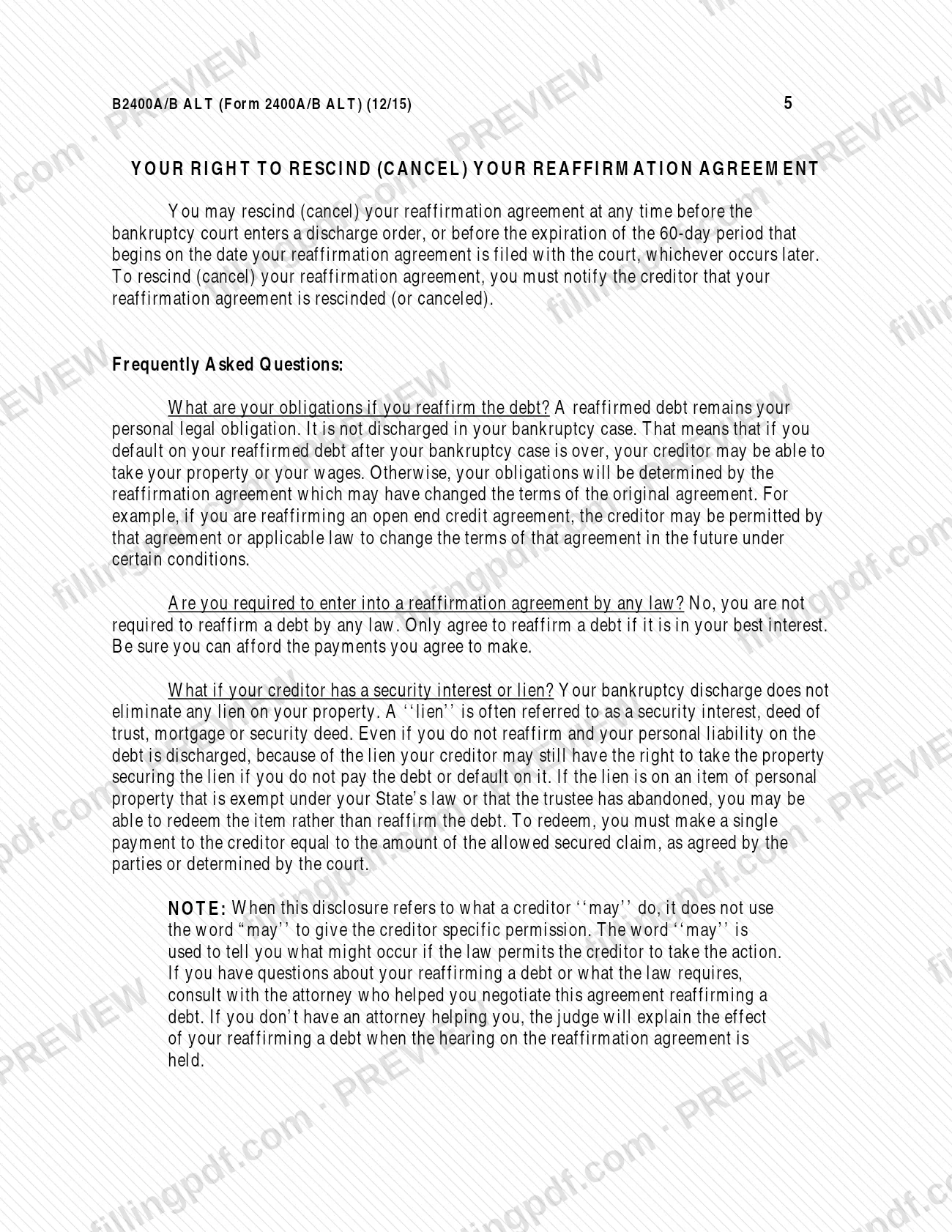
A reaffirmed debt remains the debtor's personal legal obligation and is not discharged in the bankruptcy case. If the debtor defaults after the case is over, the creditor may be able to take the debtor's property or wages. The form states that no law requires a debtor to reaffirm a debt.
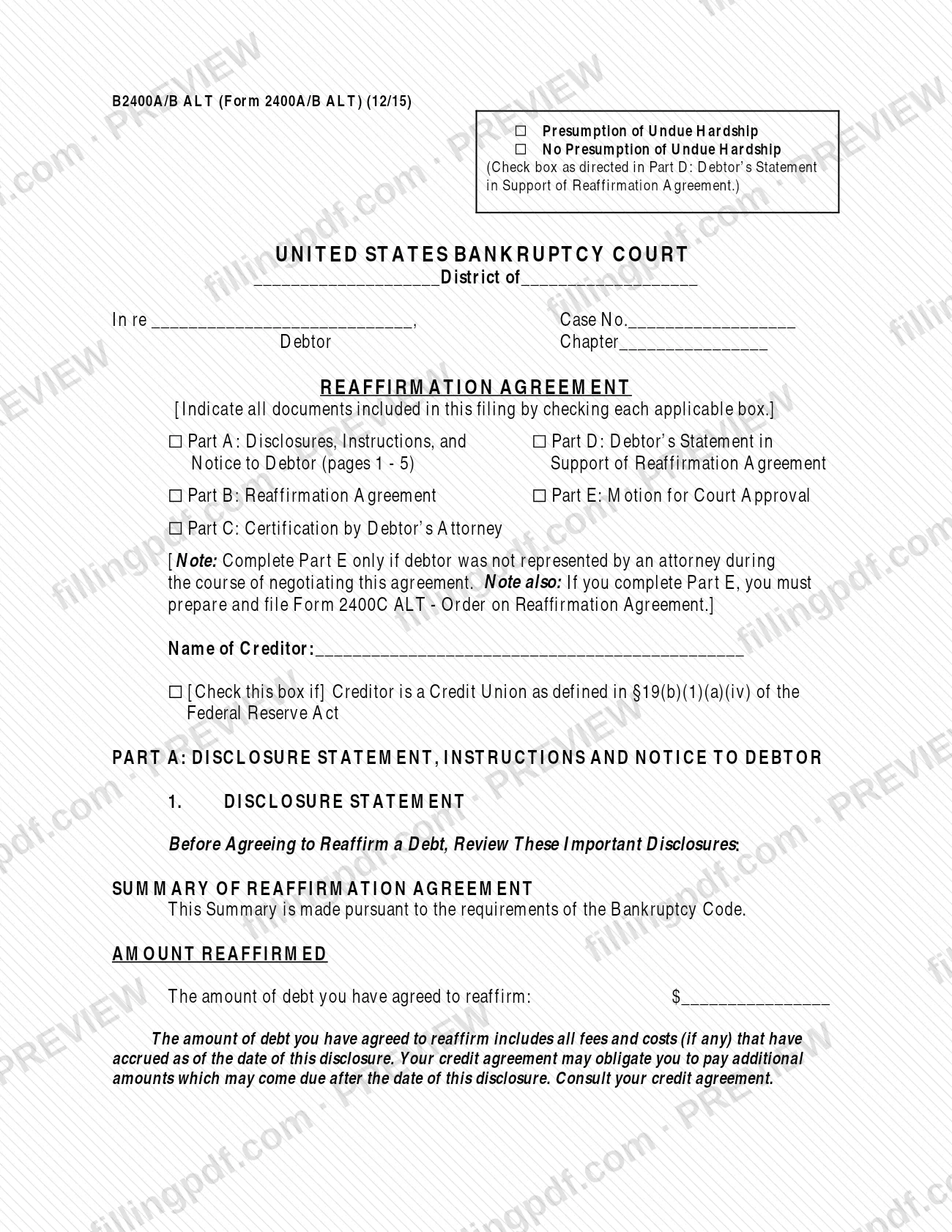
The form has five parts, and a checklist on page 1 lets you indicate which ones are included in the filing:
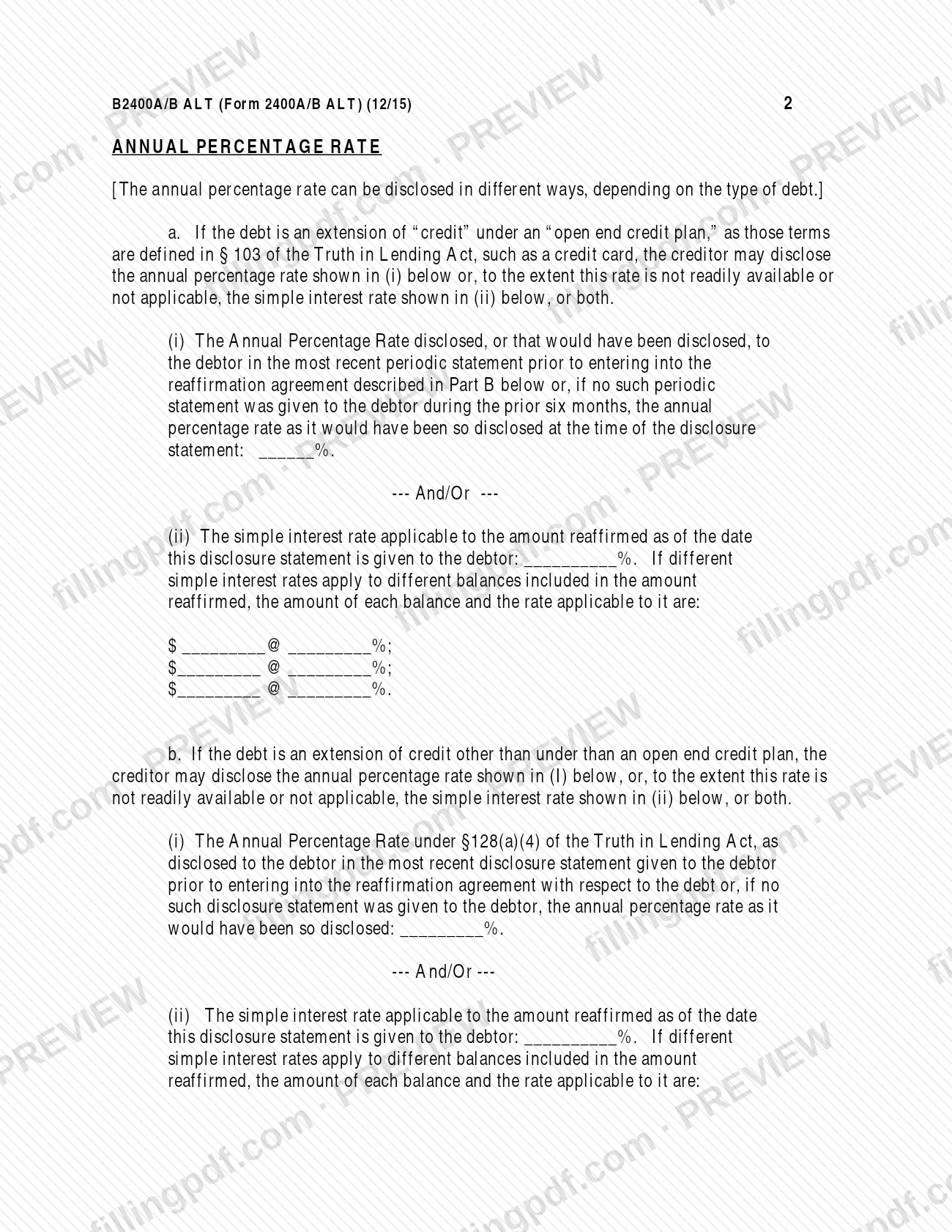
- Part A: Disclosures, Instructions, and Notice to Debtor (pages 1-5), including the amount reaffirmed, the annual percentage rate, any property that stays subject to a lien, the right to rescind and frequently asked questions.
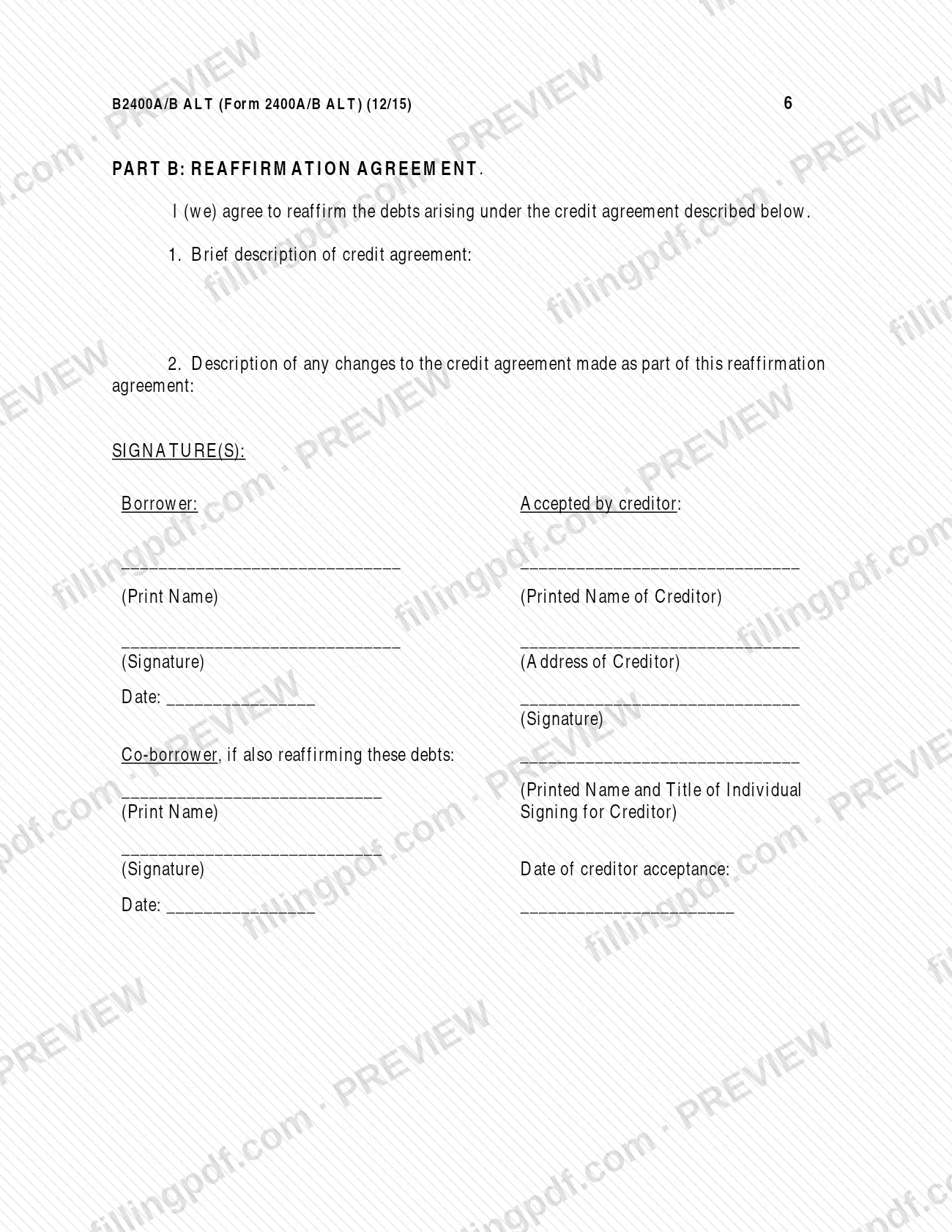
- Part B: the Reaffirmation Agreement itself, with signatures of the borrower, any co-borrower and the creditor.
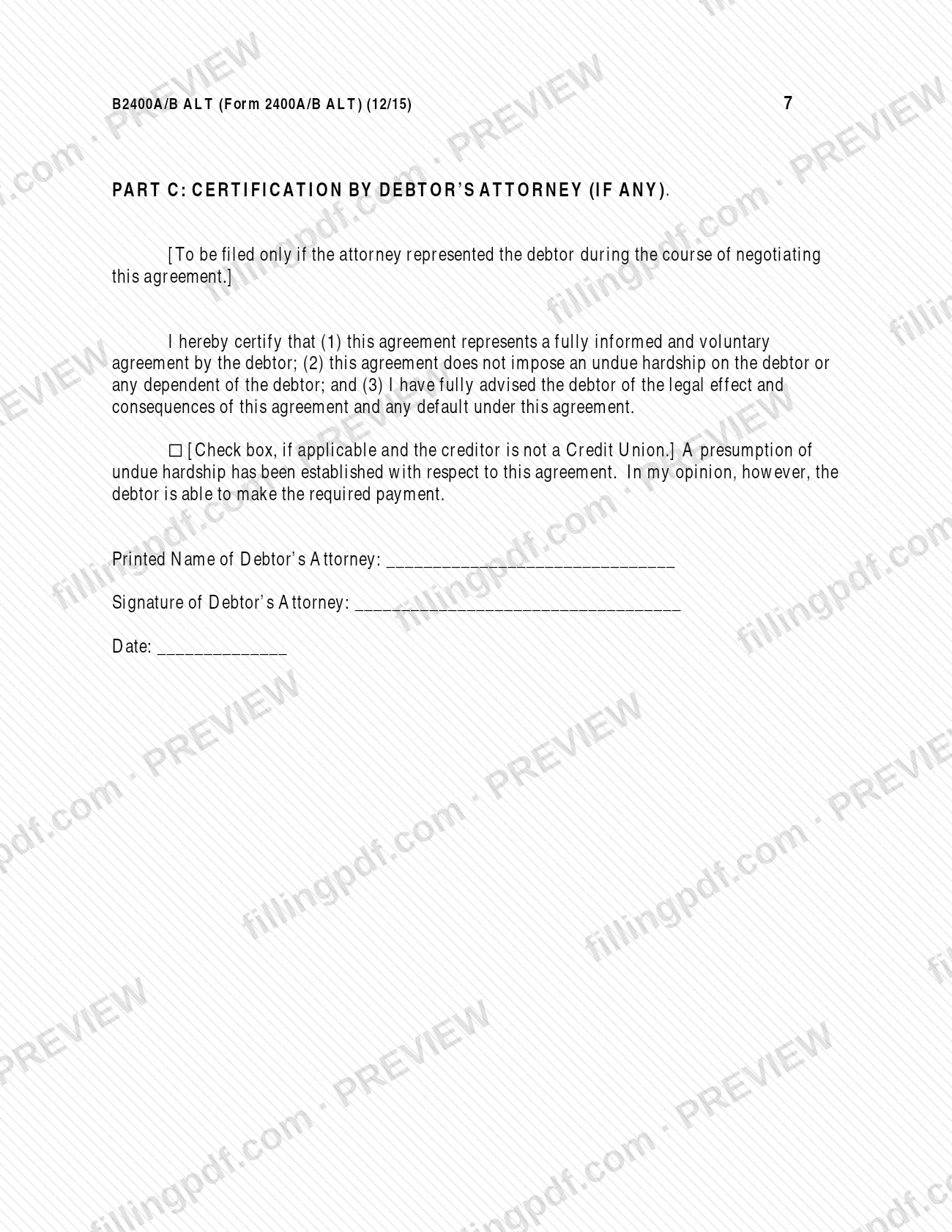
- Part C: Certification by Debtor's Attorney.
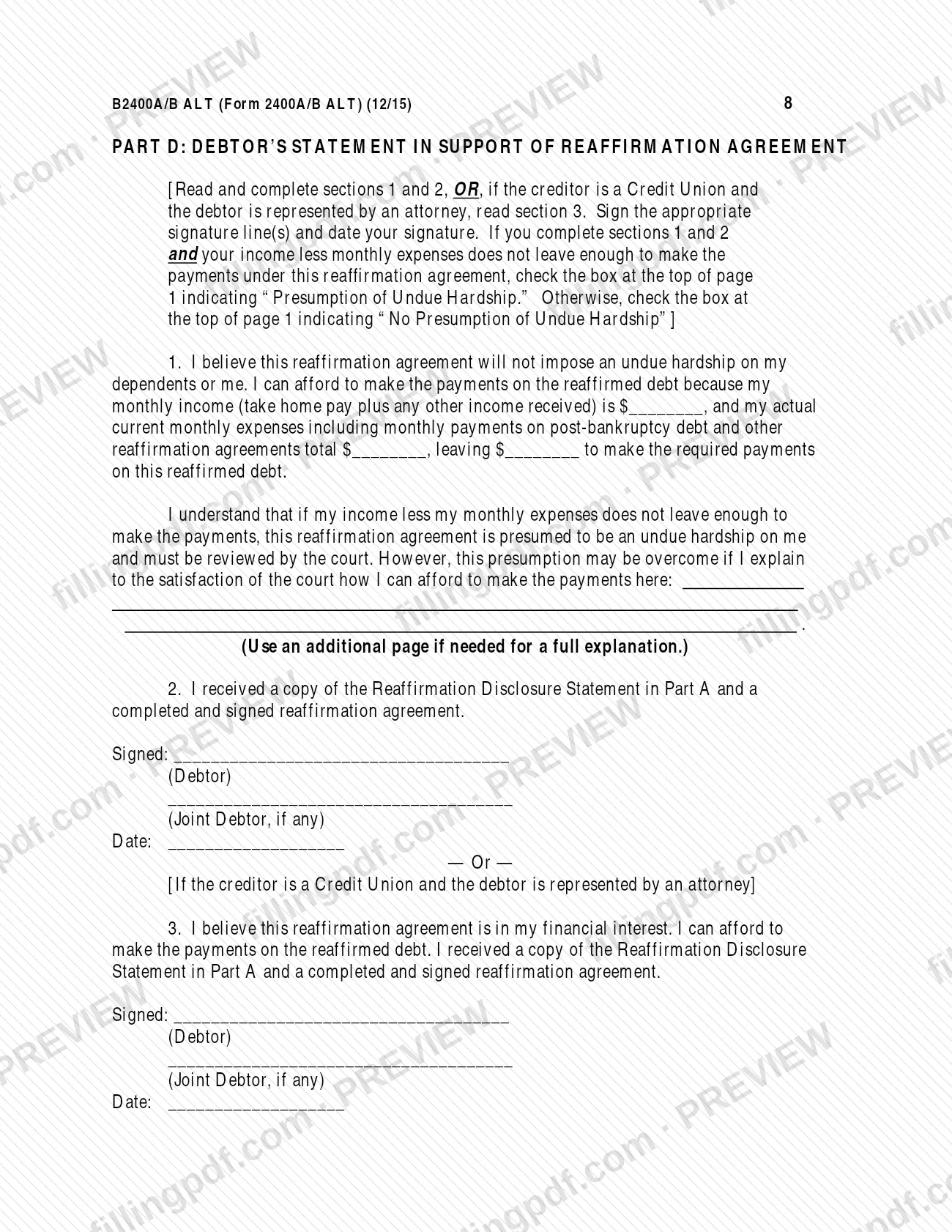
- Part D: Debtor's Statement in Support of Reaffirmation Agreement, with the income and expense figures that decide the undue hardship box at the top of page 1.
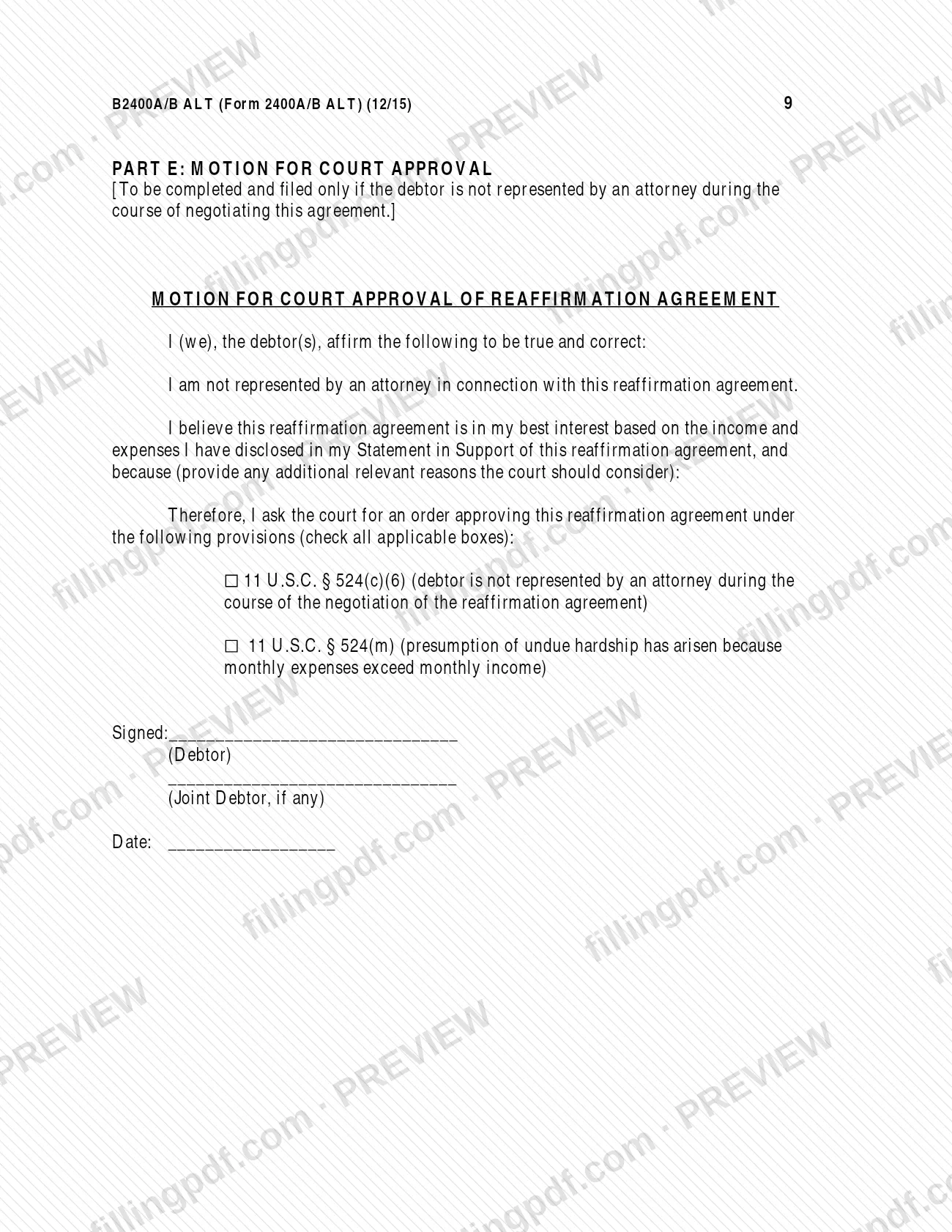
- Part E: Motion for Court Approval, used only when the debtor had no attorney during the negotiation.
The agency page explains that Director's Bankruptcy Forms are issued under Bankruptcy Rule 9009; local court rules or general orders may require their use. If you complete Part E, you must also prepare and file Form 2400C ALT, Order on Reaffirmation Agreement.
Who needs to file B2400A/B ALT?
The debtor in a bankruptcy case who chooses to reaffirm a debt uses this form, together with the creditor who holds the debt. A joint debtor or co-borrower who is also reaffirming signs as well.
Which parts apply depends on the debtor's situation:
- Debtor represented by an attorney during the negotiation: the attorney must sign the certification in Part C, which is filed only in that case.
- Debtor not represented by an attorney during the negotiation: the debtor must complete and sign Part E, the Motion for Court Approval, and the agreement is not effective unless the court approves it.
- Creditor that is a Credit Union as defined in §19(b)(1)(a)(iv) of the Federal Reserve Act: the box on page 1 is checked. If the debtor also has an attorney, the debtor reads section 3 of Part D instead of sections 1 and 2.
Nobody is required by law to enter into a reaffirmation agreement; the form tells the debtor to agree only if it is in the debtor's best interest and the payments are affordable. A debtor can ask the attorney who helped negotiate the agreement about its effect; a debtor without an attorney will hear the judge explain it at the hearing.
When to file B2400A/B ALT
The form is prepared once the debtor and creditor have agreed to reaffirm a debt; the original of the disclosure must then be filed with the court by the debtor or the creditor. The form prints no calendar deadline for filing.
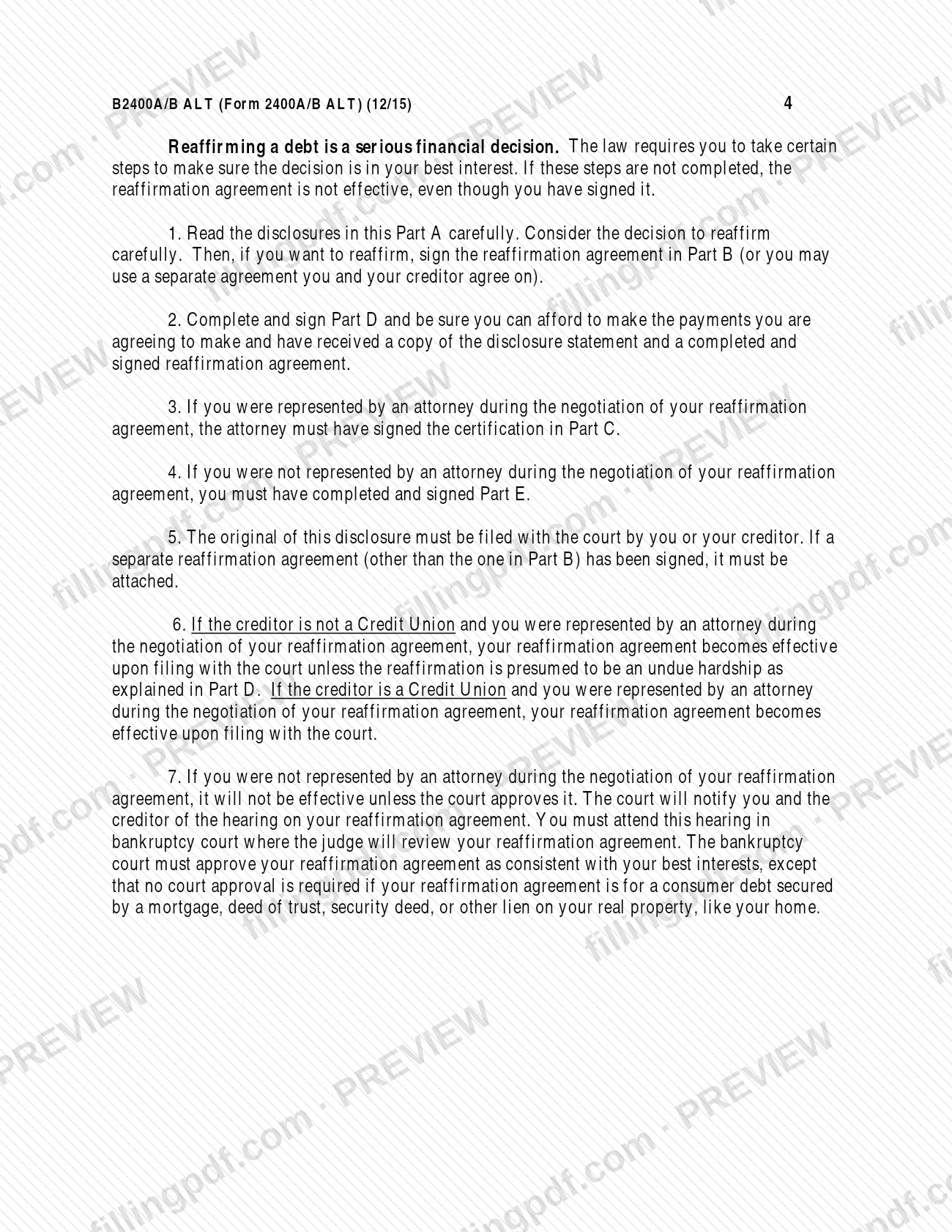
When the agreement takes effect depends on the case. If the debtor had an attorney and the creditor is not a Credit Union, the agreement becomes effective upon filing unless it is presumed to be an undue hardship, as explained in Part D. If the creditor is a Credit Union and the debtor had an attorney, it becomes effective upon filing. If the debtor had no attorney, it is not effective unless the court approves it after a hearing the court schedules; no court approval is required for a consumer debt secured by a mortgage, deed of trust, security deed or other lien on the debtor's real property.
The debtor may rescind (cancel) the agreement at any time before the bankruptcy court enters a discharge order, or before the 60-day period that begins on the date the agreement is filed ends, whichever occurs later, by notifying the creditor.
Documents you need
- A separate reaffirmation agreement, only if you and the creditor signed one other than Part B; it must be attached to the disclosure filed with the court.
- Part C, Certification by Debtor's Attorney, only if an attorney represented you during the negotiation of the agreement; the attorney signs it.
- Part E, Motion for Court Approval, only if you were not represented by an attorney during the negotiation; you complete and sign it.
- Form 2400C ALT, Order on Reaffirmation Agreement, which you must prepare and file if you complete Part E.
- An additional page with your explanation, only if you need more room in Part D to explain to the court how you can afford the payments despite a presumption of undue hardship.
How to fill out B2400A/B ALT
Enter the court and case details
At the top of page 1, write the district, the debtor's name after In re, the Case No. and the Chapter under United States Bankruptcy Court.
Check the documents included
Tick each of Parts A through E that is part of this filing. Enter the Name of Creditor, and check the Credit Union box if the creditor is a Credit Union as defined in §19(b)(1)(a)(iv) of the Federal Reserve Act.
Record the amount reaffirmed
In the Part A summary, enter the amount of debt reaffirmed. It includes all fees and costs that have accrued as of the date of the disclosure.
Complete the annual percentage rate
Use section a for open end credit, such as a credit card, or section b for other credit. Enter the annual percentage rate, the simple interest rate, or both, and list balances and rates if different rates apply.
List secured property and payments
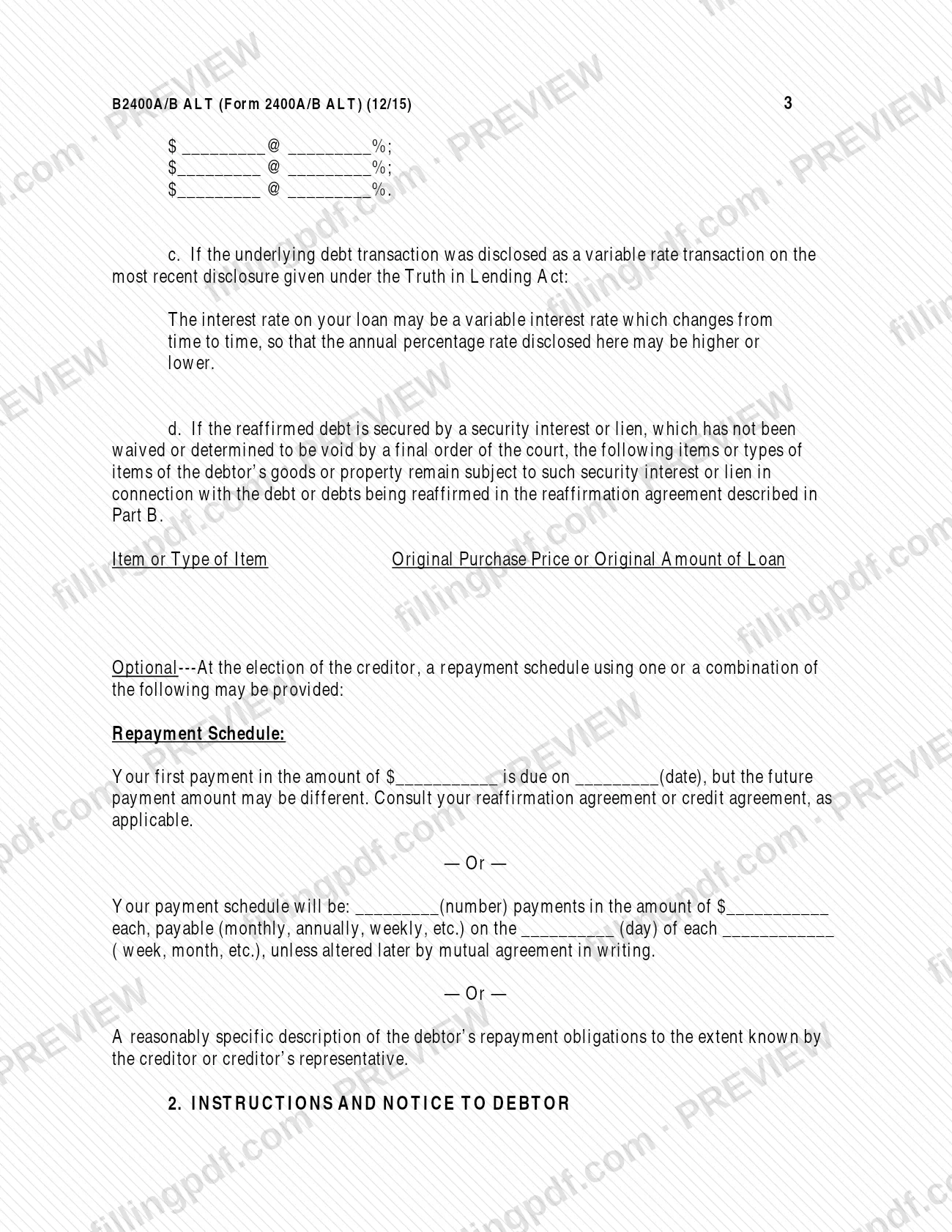
If the debt is secured by a lien not waived or voided by a final court order, list each item or type of item with its original purchase price or original loan amount. The repayment schedule is optional at the creditor's election.
Complete the Part B agreement
Give a brief description of the credit agreement and of any changes made by this reaffirmation. The borrower, any co-borrower and the creditor each print their name, sign and date; the creditor adds its address and the title of the person signing.
Have an attorney complete Part C
If an attorney represented you, the attorney prints a name, signs and dates the certification. The attorney checks the presumption box only if it applies, the creditor is not a Credit Union and the attorney believes you can make the payment.
Complete the Part D statement
In section 1, enter your monthly income, your actual current monthly expenses and the amount left over, then sign and date. Use section 3 instead if the creditor is a Credit Union and you have an attorney. Then check the matching box at the top of page 1.
Complete Part E only if unrepresented
If you had no attorney, explain why the agreement is in your best interest and check the applicable provisions, 11 U.S.C. § 524(c)(6) and, if it applies, § 524(m). Sign and date, and prepare Form 2400C ALT.
Review and download the PDF
Check that every box, amount, signature line and date matches the parts you are filing. Download or print the completed PDF from FillingPDF and file it as described under How to submit.
How to submit B2400A/B ALT
The original of the disclosure is filed with the bankruptcy court by the debtor or by the creditor; the form prints no mailing address, portal or fee, so follow the filing rules of the court named at the top of the form.
- Filing with the court: file the original of the form with the United States Bankruptcy Court for the district where the case is pending. The agency page notes that local court rules or general orders may require use of this Director's Form.
- Separate agreement: if you and your creditor signed a separate reaffirmation agreement instead of Part B, attach it to the disclosure.
- Part E: if you complete the Motion for Court Approval, also prepare and file Form 2400C ALT, Order on Reaffirmation Agreement. The court will notify you and the creditor of the hearing, which you must attend.
- Copies: Part D confirms that you received a copy of the disclosure statement and a completed, signed reaffirmation agreement.
FillingPDF lets you fill out and download the PDF; submission follows the channels above.
Common mistakes to avoid
- Leaving the box at the top of page 1 unchecked. Part D tells you which one to check: Presumption of Undue Hardship if income less expenses does not cover the payments, otherwise No Presumption of Undue Hardship.
- Completing Part E when an attorney represented you during the negotiation; the form says Part E is only for debtors who had no attorney.
- Completing Part E but not preparing and filing Form 2400C ALT, Order on Reaffirmation Agreement, which the form requires with it.
- Filing without the attorney's signed certification in Part C when an attorney represented you; the instructions say the attorney must have signed it.
- Signing Part D before receiving a copy of the disclosure statement and a completed, signed reaffirmation agreement; Part D states that you received them.
- Leaving out an explanation when a presumption of undue hardship applies; the presumption can be overcome only by explaining to the court's satisfaction how you can afford the payments.
- Not attaching a separate reaffirmation agreement when you signed one instead of Part B.
- Assuming you can cancel only until discharge; the right to rescind runs until the discharge order or the end of the 60-day period after filing, whichever is later, and you must notify the creditor.
- Skipping the date lines in the signature blocks of Parts B, C, D and E.
Frequently asked questions
What is a reaffirmation agreement?
A reaffirmation agreement is an agreement by a bankruptcy debtor to remain personally liable for a debt. Form B2400A/B ALT documents it. A reaffirmed debt is not discharged, so if you default after the case ends, the creditor may be able to take your property or wages.
Am I required to sign a reaffirmation agreement?
No. The form states that no law requires you to reaffirm a debt. It tells you to agree only if reaffirming is in your best interest and you can afford the payments you are agreeing to make.
When does a reaffirmation agreement take effect?
With an attorney and a creditor that is not a Credit Union, it takes effect when filed with the court unless it is presumed to be an undue hardship. With a Credit Union and an attorney, it takes effect on filing. Without an attorney, the court must approve it.
Can I cancel a reaffirmation agreement after signing?
Yes. You may rescind it at any time before the bankruptcy court enters a discharge order, or before the 60-day period that starts when the agreement is filed ends, whichever is later. To cancel, you must notify the creditor that the agreement is rescinded.
What is Part E of the reaffirmation agreement form?
Part E is the Motion for Court Approval. You complete it only if no attorney represented you while the agreement was negotiated. If you complete it, you must also prepare and file Form 2400C ALT, Order on Reaffirmation Agreement.
Does the court have to approve every reaffirmation agreement?
No. Without an attorney, the court must approve the agreement at a hearing as consistent with your best interests. No court approval is required for a consumer debt secured by a mortgage, deed of trust, security deed or other lien on your real property.
Where do I file the reaffirmation agreement?
File the original with the United States Bankruptcy Court named at the top of the form, where your case is pending. Either you or the creditor can file it. The form prints no separate address, so check the court's local rules.
Can I fill out the reaffirmation agreement form online?
You can fill out the PDF online on FillingPDF and download or print it. FillingPDF is an independent service and does not file the form with the bankruptcy court; you or the creditor file it through the court's own channels.
Ready to fill out B2400A/B ALT?
Fill out B2400A/B ALT now