
DS-2029 is the U.S. Department of State application for a Consular Report of Birth Abroad of a U.S. Citizen (CRBA), the record issued to a child born outside the United States who acquired U.S. citizenship at birth. A parent, legal guardian, person acting in loco parentis or the child can apply, and the application is filed before the child's 18th birthday. On FillingPDF you can fill out the form online and download or print the completed PDF; the form is then taken, unsigned, to a U.S. embassy, consulate, consular agency or military acceptance agent.
Last updated
What is DS-2029?
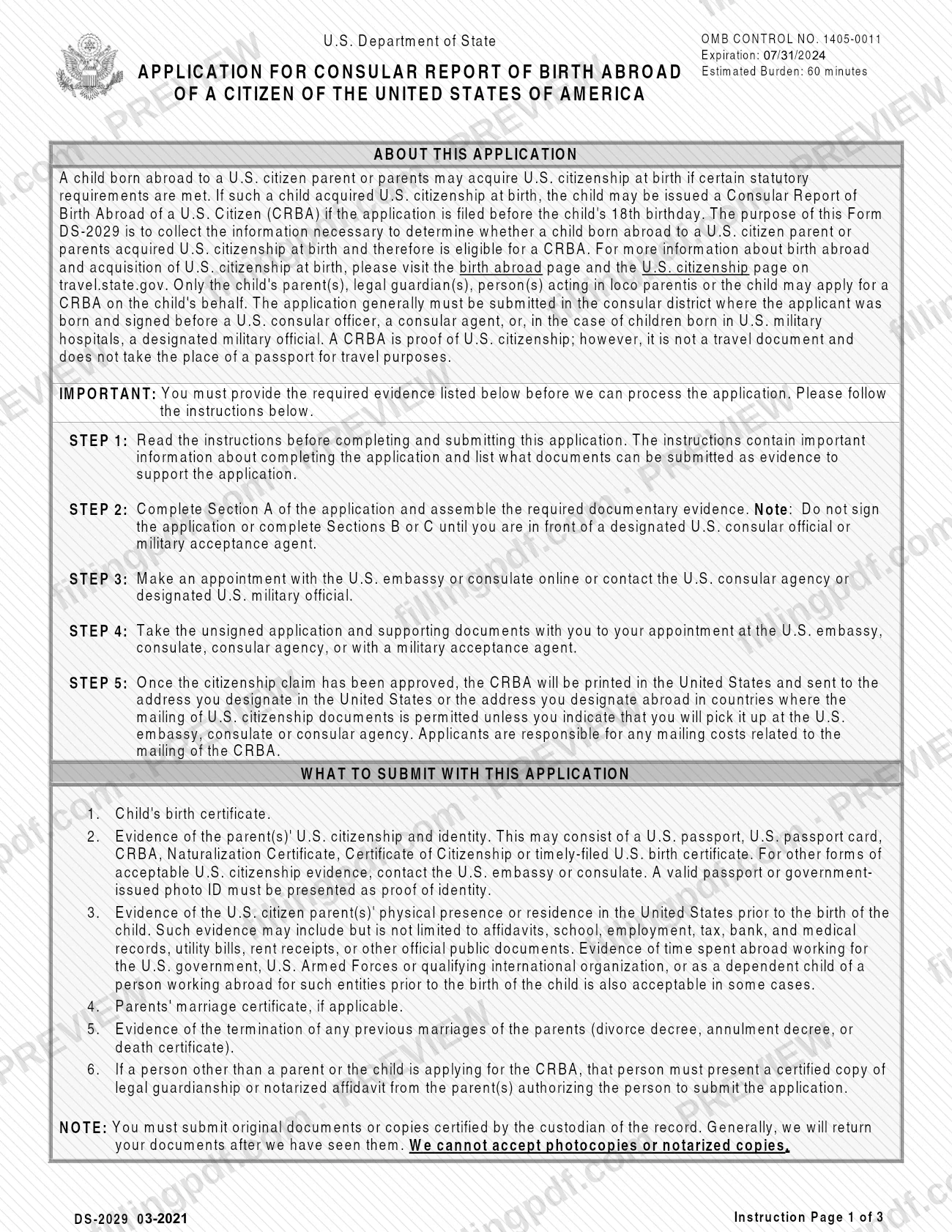
Form DS-2029 is the U.S. Department of State application for a Consular Report of Birth Abroad of a U.S. Citizen (CRBA). It collects the information used to decide whether a child born abroad to a U.S. citizen parent(s) acquired U.S. citizenship at birth.
Its full title is Application for Consular Report of Birth Abroad of a Citizen of the United States of America, printed under OMB Control No. 1405-0011 with an estimated burden of 60 minutes. The instructions explain that a child born abroad to a U.S. citizen parent or parents may acquire citizenship at birth if statutory requirements are met, and that a CRBA can be issued if the application is filed before the child's 18th birthday.
A CRBA is proof of U.S. citizenship. It is not a travel document and does not take the place of a passport for travel.
The form has these parts:
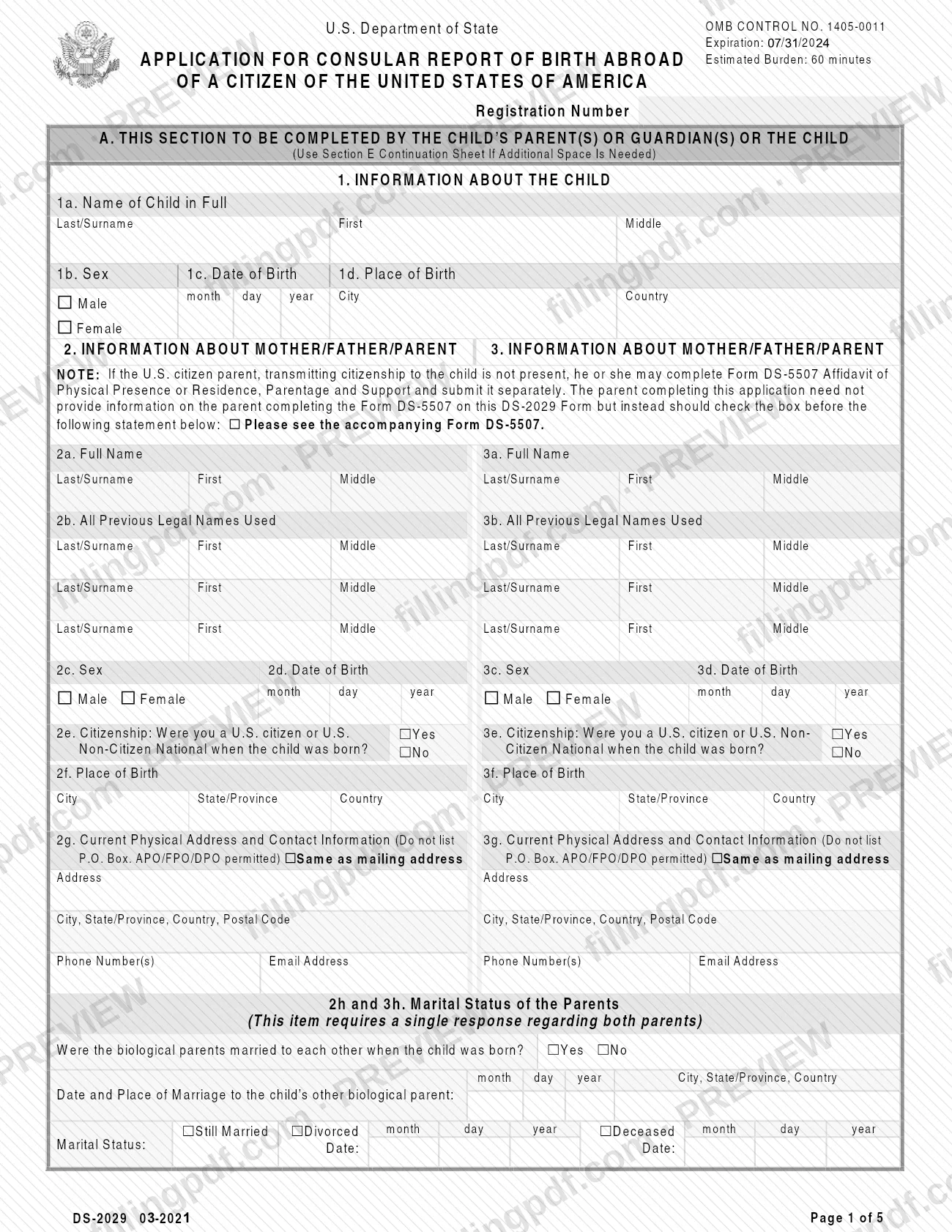
- Section A: information about the child and each parent, completed by the parents, guardians or the child.
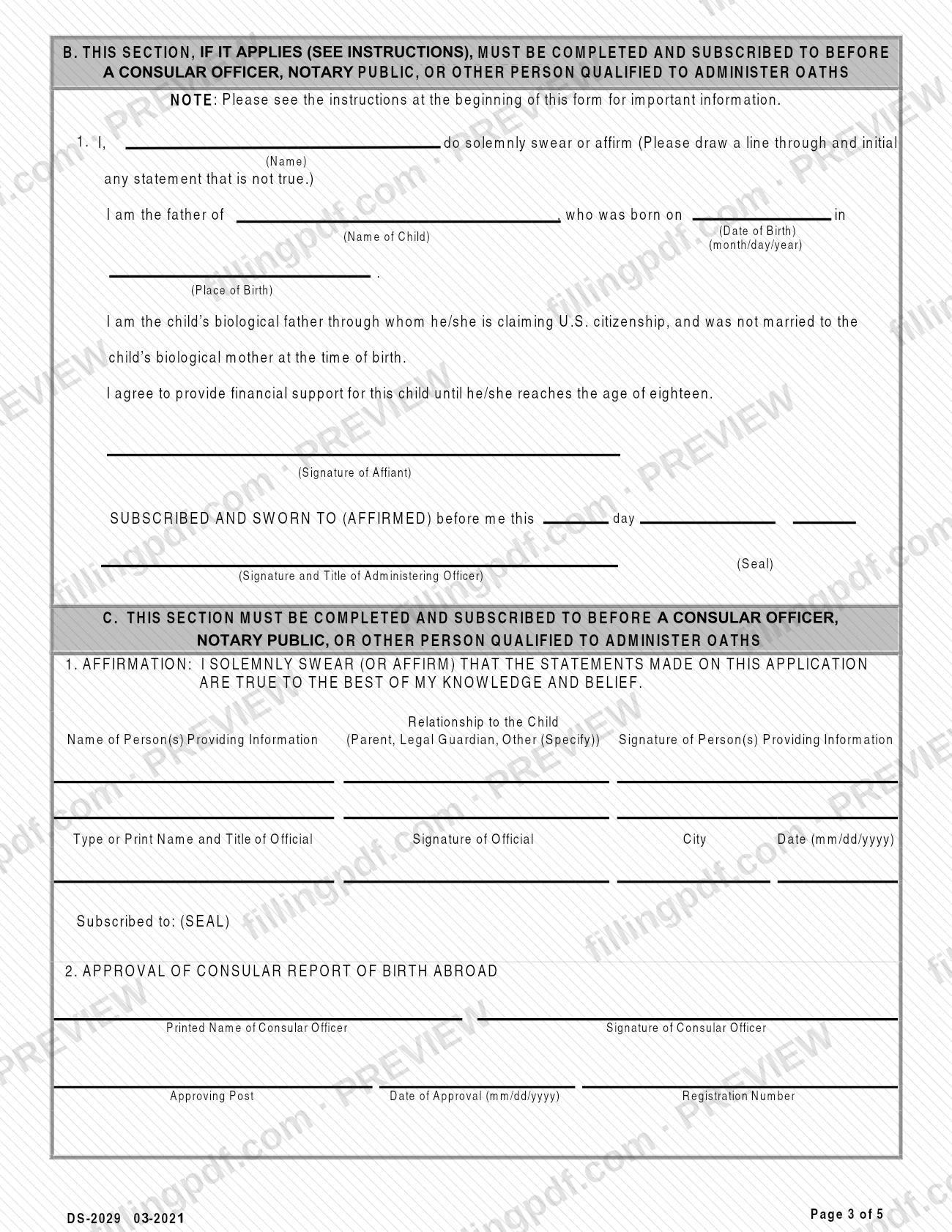
- Section B: a sworn statement that applies only to a U.S. citizen father of a child born out of wedlock.
- Section C: the affirmation that the statements are true, and the consular approval block.
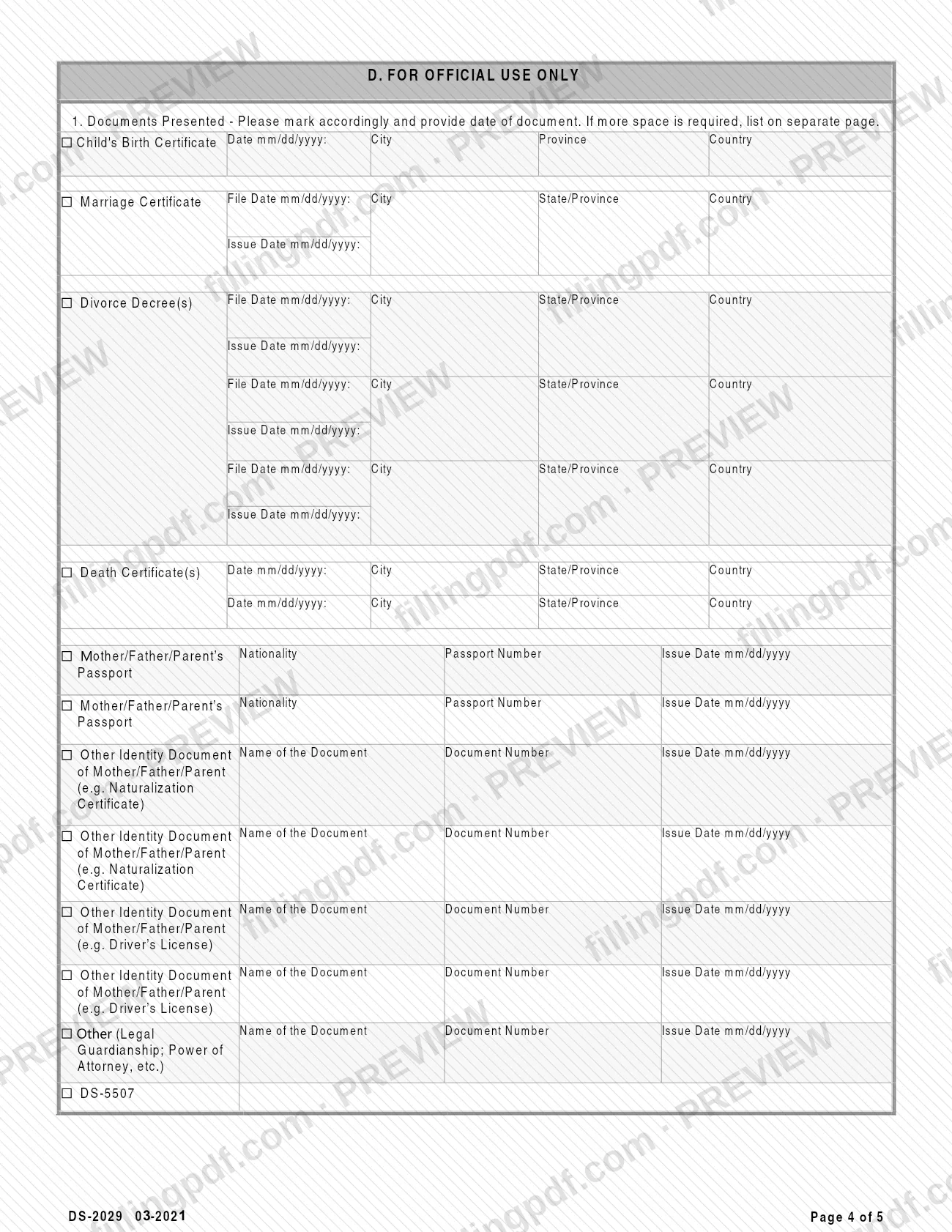
- Section D: a list of documents presented, for official use only.
- Section E: a continuation sheet for additional information.
A U.S. citizen parent who cannot be present may complete Form DS-5507 and submit it separately.
Who needs to file DS-2029?
Only the child's parent(s), legal guardian(s), person(s) acting in loco parentis, or the child may apply for a CRBA on the child's behalf. The form is for a child born abroad to a U.S. citizen parent or parents who may have acquired U.S. citizenship at birth.
- Parents and guardians: complete Section A for the child and for each parent.
- A person other than a parent or the child: must present a certified copy of legal guardianship, or a notarized affidavit from the parent(s) authorizing that person to submit the application.
- A U.S. citizen father of a child born abroad out of wedlock: completes Section B, before a consular officer, notary public or other person qualified to administer oaths, when he is claiming citizenship for the child through himself.
- A transmitting U.S. citizen parent who cannot attend: may complete Form DS-5507 and submit it separately instead of appearing.
A CRBA does not replace a passport, so applicants who need a document for travel need more than this application.
When to file DS-2029
File the application before the child's 18th birthday; the form's instructions say a CRBA can be issued only if the application is filed by then. The triggering event is the birth abroad of a child to a U.S. citizen parent or parents.
Complete Section A and assemble your evidence first, then make an appointment with the U.S. embassy or consulate online, or contact the U.S. consular agency or designated U.S. military official. Do not sign the form or complete Sections B or C until you are in front of the consular official or military acceptance agent. The form sets no other deadline and gives no processing time.
Documents you need
- The child's birth certificate.
- Evidence of each U.S. citizen parent's citizenship: U.S. passport, U.S. passport card, CRBA, Naturalization Certificate, Certificate of Citizenship or timely-filed U.S. birth certificate. Other evidence may be accepted; ask the embassy or consulate.
- A valid passport or government-issued photo ID of the parent(s), presented as proof of identity.
- Evidence of the U.S. citizen parent(s)' physical presence or residence in the United States before the birth, such as affidavits or school, employment, tax, bank or medical records, utility bills or rent receipts.
- Official documentation of periods abroad in U.S. Armed Forces, other U.S. Government employment, a qualifying international organization, or as a dependent child of such an employee, when listed in item 2k or 3k.
- The parents' marriage certificate, if applicable.
- Evidence that any previous marriages of the parents ended: divorce decree, annulment decree or death certificate.
- If someone other than a parent or the child applies: a certified copy of legal guardianship or a notarized affidavit from the parent(s) authorizing that person.
- An affidavit from the parent or legal guardian, signed, witnessed and notarized, if the child's name on the form differs from the name on the birth certificate.
- Documentary evidence of a legal name change, such as by adoption, if the new name is recorded on the application.
- Form DS-5507, if a transmitting U.S. citizen parent is not present and completes it separately.
How to fill out DS-2029
Read the instructions first
Read the instruction pages before you start; they list the documents that can support the application. Complete only Section A now and gather your evidence.
Enter the child's information
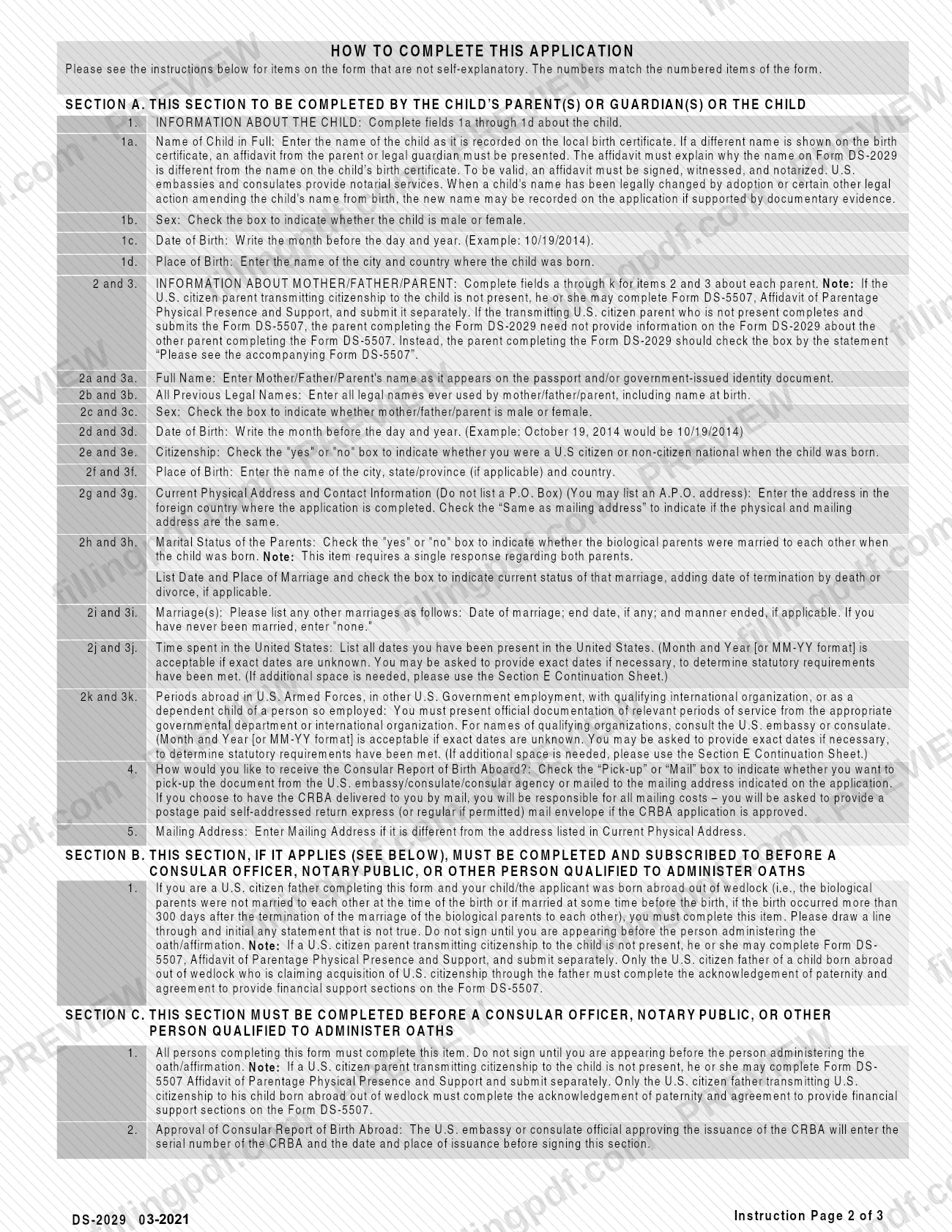
In items 1a to 1d, enter the child's full name as recorded on the local birth certificate, check the sex box, and give the date of birth as month, day, year (for example 10/19/2014) and the city and country of birth.
Enter each parent's identity details
In items 2a to 2f and 3a to 3f, give each parent's full name as on the passport or government ID, all previous legal names including the birth name, sex, date of birth, U.S. citizenship status when the child was born, and place of birth.
Add address and contact information
In items 2g and 3g, enter the current physical address in the foreign country where the application is completed, with phone and email; do not use a P.O. Box. Check Same as mailing address if it applies.
Report the parents' marital history
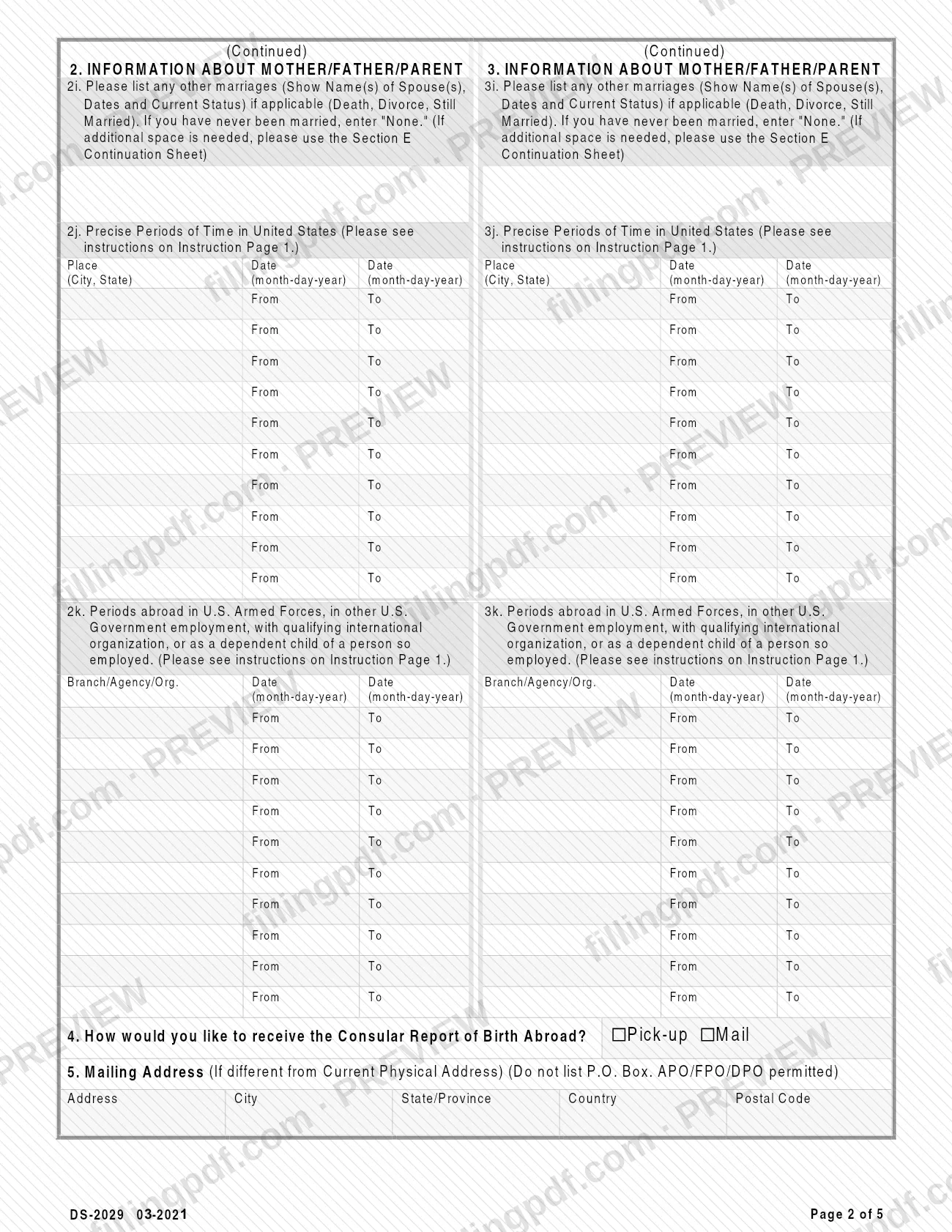
Item 2h and 3h takes one answer for both parents: whether the biological parents were married when the child was born, with date and place of marriage and current status. In 2i and 3i list any other marriages, or enter "None".
List time spent in the United States
In items 2j and 3j, list each period of presence with place and from and to dates; month and year is acceptable if exact dates are unknown. Use the Section E continuation sheet for more space.
List qualifying periods abroad
In items 2k and 3k, enter periods abroad in the U.S. Armed Forces, other U.S. Government employment, a qualifying international organization, or as a dependent child of such an employee, with dates.
Choose delivery and mailing address
In item 4, check Pick-up or Mail for the CRBA. In item 5, enter a mailing address only if it differs from the physical address; P.O. Boxes are not allowed.
Account for an absent parent
If the transmitting U.S. citizen parent cannot attend and submits Form DS-5507 separately, check the Please see the accompanying Form DS-5507 box instead of giving that parent's details.
Leave Sections B, C and D blank
Do not sign Section C, or complete Section B if it applies to a U.S. citizen father of a child born out of wedlock, until you are before the official. Section D is for official use only.
Review and download the unsigned PDF
Check every entry against your documents, then download or print the completed PDF from FillingPDF unsigned and take it with your evidence to your appointment.
How to submit DS-2029
DS-2029 is submitted in person at a U.S. embassy, consulate or consular agency, or to a designated military acceptance agent; the form describes no mailing address or online filing.
- Appointment: make an appointment with the U.S. embassy or consulate online, or contact the U.S. consular agency or designated U.S. military official.
- Where: the application generally must be submitted in the consular district where the child was born and signed before a U.S. consular officer, a consular agent or, for children born in U.S. military hospitals, a designated military official.
- What to bring: the unsigned application and your original supporting documents, or copies certified by the custodian of the record. Photocopies and notarized copies are not accepted.
- After approval: the CRBA is printed in the United States and sent to the address you designate in the United States, or abroad where mailing of U.S. citizenship documents is permitted, unless you choose pick-up at the post. You pay the mailing costs and will be asked for a postage-paid, self-addressed return envelope.
FillingPDF lets you fill out and download the PDF; submission follows the channels above.
Common mistakes to avoid
- Signing the application or completing Sections B or C before you are in front of the consular official or military acceptance agent; the form says to leave them until then.
- Bringing photocopies or notarized copies of evidence; only originals or copies certified by the custodian of the record are accepted.
- Entering a child's name that differs from the local birth certificate without a signed, witnessed and notarized affidavit explaining the difference.
- Listing a P.O. Box as the current physical address in item 2g or 3g; APO/FPO/DPO addresses are permitted.
- Writing dates day-first; the form wants month before day and year, for example 10/19/2014.
- Skipping the "Please see the accompanying Form DS-5507" box when a transmitting parent submits DS-5507 separately.
- Leaving statements that are not true intact in Section B instead of drawing a line through and initialing them.
- Filing for a child who has already turned 18; the CRBA application must be filed before the 18th birthday.
- Sending a non-parent applicant without a certified guardianship copy or a notarized parental affidavit.
Frequently asked questions
What is Form DS-2029 used for?
Form DS-2029 is the application for a Consular Report of Birth Abroad (CRBA). The State Department uses it to decide whether a child born abroad to a U.S. citizen parent or parents acquired U.S. citizenship at birth and can be issued a CRBA as proof of citizenship.
Who can apply for a CRBA with the DS-2029?
The child's parent(s), legal guardian(s), person(s) acting in loco parentis, or the child. A person other than a parent or the child must present a certified copy of legal guardianship or a notarized affidavit from the parent(s) authorizing them to apply.
What is the deadline to file the DS-2029?
The application must be filed before the child's 18th birthday for a CRBA to be issued. The form gives no other deadline, so contact the U.S. embassy or consulate to book your appointment well before that date.
Can I sign the DS-2029 before my appointment?
No. Complete Section A and gather your evidence, but do not sign or complete Sections B or C until you are in front of a U.S. consular official, consular agent or military acceptance agent, who administers the oath.
Can I fill out the DS-2029 online and submit it?
You can fill out the PDF online on FillingPDF and download or print it. FillingPDF does not submit it: you take it unsigned to your appointment at a U.S. embassy, consulate or consular agency, or to a military acceptance agent.
What documents do I need to bring with the DS-2029?
Bring the child's birth certificate, evidence of the parents' U.S. citizenship and identity, evidence of their physical presence in the United States before the birth, and marriage and divorce records if applicable. Bring originals or certified copies.
What is Form DS-5507 and when is it used?
Form DS-5507 is an affidavit a transmitting U.S. citizen parent can complete and submit separately when that parent cannot be present. The parent completing the DS-2029 then checks the box saying to see the accompanying Form DS-5507.
Is a CRBA the same as a U.S. passport?
No. A CRBA is proof of U.S. citizenship, but it is not a travel document and does not take the place of a passport for travel purposes.
How will I receive the CRBA after approval?
Once the citizenship claim is approved, the CRBA is printed in the United States. You either pick it up at the post or have it mailed to the address you gave; mailing costs are yours, and you provide a postage-paid, self-addressed return envelope.
Ready to fill out DS-2029?
Fill out DS-2029 now