
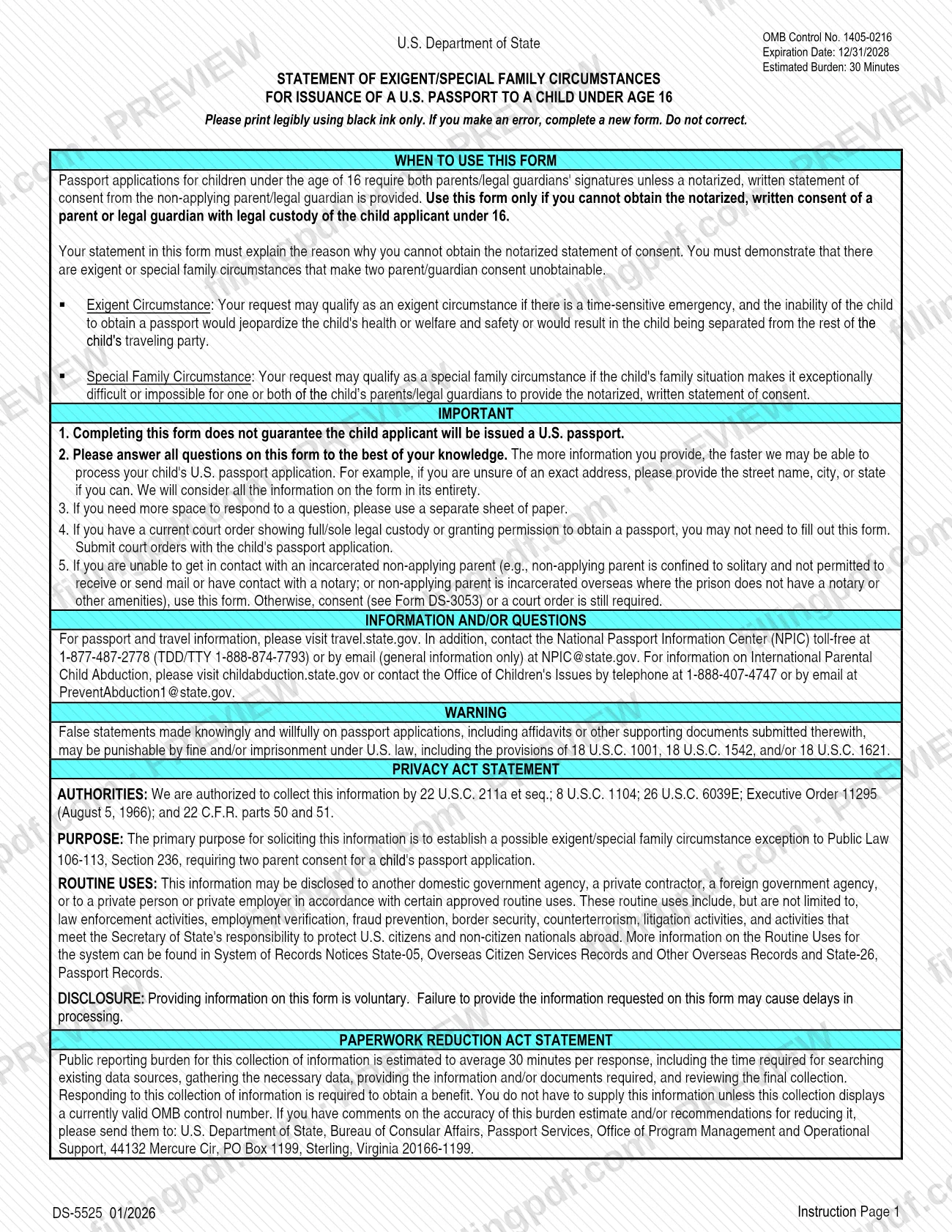
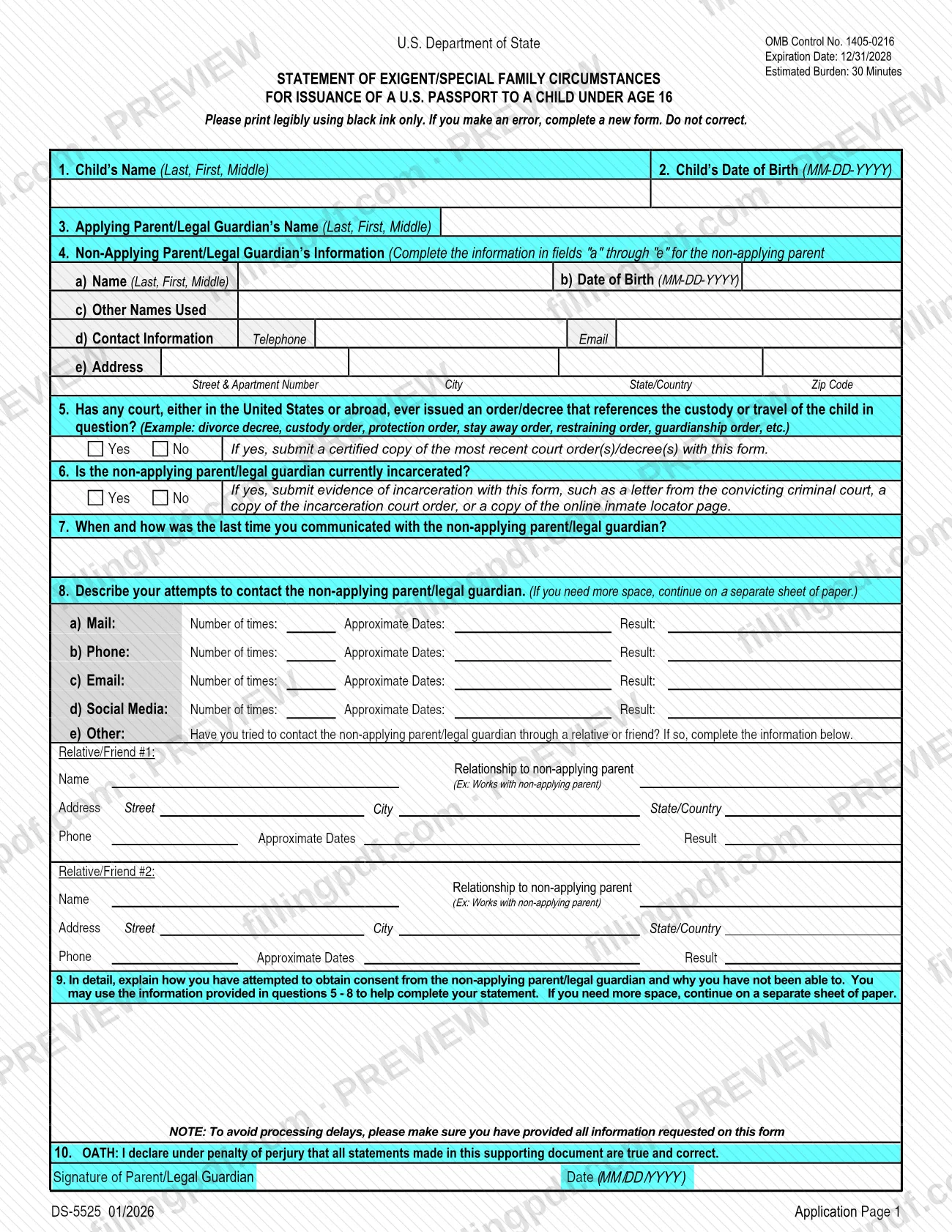
Form DS-5525 is the U.S. Department of State statement that explains why a child's other parent or legal guardian cannot give notarized, written consent for a U.S. passport for a child under 16. It is meant for the parent or legal guardian who is applying for the passport and cannot obtain that consent because of exigent or special family circumstances. On this page you can fill out the form online on FillingPDF and download or print the completed PDF. The original form is published by the Department of State at eforms.state.gov.
Last updated
What is DS-5525?
Form DS-5525, Statement of Exigent/Special Family Circumstances for Issuance of a U.S. Passport to a Minor Under Age 16, is the U.S. Department of State form on which a parent or legal guardian explains why the child's other parent or legal guardian cannot provide notarized, written consent for a child's passport.
Passport applications for children under 16 require the signatures of both parents or legal guardians, unless a notarized, written statement of consent from the non-applying parent or legal guardian is provided. The Privacy Act statement on the form says its primary purpose is to establish a possible exigent or special family circumstance exception to the two-parent consent requirement of Public Law 106-113, Section 236.
The form defines two grounds:
- Exigent circumstance: a time-sensitive emergency in which the child's inability to get a passport would jeopardize the child's health, welfare or safety, or would separate the child from the rest of the traveling party.
- Special family circumstance: a family situation that makes it exceptionally difficult or impossible for one or both parents or legal guardians to provide the notarized consent.
The form asks about court orders, incarceration, your last communication with the other parent and each attempt to reach them, then closes with a narrative explanation and an oath. Completing it does not guarantee that the passport will be issued. The consent it replaces is documented on Form DS-3053.
Who needs to file DS-5525?
The parent or legal guardian who is applying for a U.S. passport for a child under age 16 uses Form DS-5525 when they cannot obtain the notarized, written consent of the other parent or legal guardian who has legal custody of the child. You must be able to show exigent or special family circumstances that make two-parent consent unobtainable.
Situations the form mentions:
- Incarcerated non-applying parent: use this form if you cannot get in contact with that parent, for example because they are in solitary confinement and cannot send or receive mail or reach a notary, or are held overseas in a prison with no notary or similar services. Otherwise, consent (Form DS-3053) or a court order is still required.
- Court order in hand: if you have a current court order showing full or sole legal custody, or granting permission to obtain a passport, you may not need this form. You submit the order with the child's passport application.
Do not use the form simply because the other parent is inconvenient to reach: it is only for cases where the notarized consent cannot be obtained. The form is for children under 16, not for older applicants.
When to file DS-5525
Complete Form DS-5525 when you are preparing a passport application for a child under 16 and have found that you cannot obtain the other parent's or legal guardian's notarized, written consent. The form prints no separate deadline; it belongs with the child's passport application, so timing follows that application. The form notes that the more information you provide, the faster the Department of State may be able to process the child's passport application, and that you should answer every question to avoid processing delays. If you have a current court order showing full or sole legal custody or permission to obtain a passport, you may not need to file the form at all. For time-sensitive travel, the form's exigent-circumstance definition covers an emergency where the child's inability to get a passport would jeopardize health, welfare or safety, or separate the child from the traveling party.
Documents you need
- A certified copy of the most recent court order(s) or decree(s) that reference the child's custody or travel, only if you answer Yes to question 5 (examples: divorce decree, custody order, protection order, restraining order, guardianship order).
- Evidence of incarceration, only if you answer Yes to question 6: a letter from the convicting criminal court, a copy of the incarceration court order, or a copy of the online inmate locator page.
- A separate sheet of paper, only if you need more space to answer question 8 or question 9.
- A current court order showing full or sole legal custody or granting permission to obtain a passport, if you have one; the form says you may then not need this form, and the order is submitted with the child's passport application.
How to fill out DS-5525
Read the when-to-use section
Confirm you cannot obtain the notarized, written consent of a parent or legal guardian with legal custody of the child, and that you can describe an exigent or special family circumstance. The form says to print legibly in black ink and to complete a new form rather than correct an error.
Enter the child's details
Question 1: the child's name (Last, First, Middle). Question 2: the child's date of birth in MM-DD-YYYY format.
Enter the applying parent's name
Question 3: your name as the applying parent or legal guardian, in Last, First, Middle order.
Complete the non-applying parent's information
Question 4, fields a through e: their name, date of birth (MM-DD-YYYY), other names used, telephone and email, and address (street and apartment number, city, state or country, ZIP code). If you are unsure of an exact address, give what you can, such as street name, city or state.
Report any court orders
Question 5: check Yes or No on whether any U.S. or foreign court has issued an order or decree referencing the child's custody or travel. If Yes, submit a certified copy of the most recent order(s) with the form.
Answer the incarceration question
Question 6: check Yes or No on whether the non-applying parent or legal guardian is currently incarcerated. If Yes, include evidence such as a letter from the convicting court, the incarceration order or the online inmate locator page.
Describe your last communication
Question 7: state when and how you last communicated with the non-applying parent or legal guardian.
List your contact attempts
Question 8, lines a through d: for mail, phone, email and social media, enter the number of times, approximate dates and result. Use line e for other attempts, including contacts through a relative or friend (name, relationship, address, phone, dates and result).
Explain why consent is unobtainable
Question 9: explain in detail how you tried to obtain consent and why you could not. You may draw on your answers to questions 5 through 8, and you may continue on a separate sheet of paper.
Sign and date the oath
Question 10: the parent or legal guardian signs and dates (MM/DD/YYYY) the declaration, made under penalty of perjury, that all statements are true and correct.
Review and download the completed PDF
Check that every question is answered and the attachments are ready, then download or print the completed PDF from FillingPDF and assemble it with the child's passport application as described under How to submit.
How to submit DS-5525
The form prints no mailing address, portal or appointment rule of its own. It is a supporting statement for a child's U.S. passport application, used instead of the other parent's notarized consent, so it goes with that application. Court orders are submitted with the child's passport application, and the certified court orders or proof of incarceration requested in questions 5 and 6 are submitted with this form.
- Passport and travel information: travel.state.gov.
- National Passport Information Center (NPIC): toll-free 1-877-487-2778 (TDD/TTY 1-888-874-7793) or [email protected], for general information only.
- International Parental Child Abduction: childabduction.state.gov, or the Office of Children's Issues at 1-888-407-4747 or [email protected].
The Sterling, Virginia address printed in the Paperwork Reduction Act statement is for comments on the form's burden estimate, not for sending the completed form. FillingPDF lets you fill out and download the PDF; submission follows the Department of State's passport application channels.
Common mistakes to avoid
- Using the form when you can still get the other parent's notarized, written consent; the form is only for cases where that consent cannot be obtained.
- Correcting an error on a printed copy instead of completing a new form; the form says not to correct.
- Answering Yes to question 5 or 6 without including the certified court order(s) or the evidence of incarceration the question asks for.
- Using the form for an incarcerated parent you can actually reach; otherwise consent (Form DS-3053) or a court order is still required.
- Leaving questions blank or writing only a vague account in question 9, when the form asks for every answer and a detailed explanation of your attempts to obtain consent.
- Reporting contact attempts in question 8 without the number of times, approximate dates and result for each method.
- Leaving the oath unsigned or undated in question 10.
- Mailing the completed form to the Sterling, Virginia address in the Paperwork Reduction Act statement, which is for comments on the burden estimate.
Frequently asked questions
What is Form DS-5525 used for?
Form DS-5525 is the Department of State statement you complete when you cannot get the other parent's or legal guardian's notarized, written consent for a passport for a child under 16. It explains the exigent or special family circumstances that make two-parent consent unobtainable.
Does Form DS-5525 guarantee my child will get a passport?
No. The form states that completing it does not guarantee the child will be issued a U.S. passport. The Department of State considers all the information on the form in its entirety, so complete every question as fully as you can.
What is the difference between Form DS-5525 and Form DS-3053?
Form DS-3053 is the consent the form refers to for a non-applying parent, notarized and written. Form DS-5525 is used only when you cannot obtain that notarized consent. For an incarcerated parent you can reach, consent or a court order is still required.
What counts as an exigent or special family circumstance?
An exigent circumstance is a time-sensitive emergency where lacking a passport would jeopardize the child's health, welfare or safety or separate the child from the traveling party. A special family circumstance makes it exceptionally difficult or impossible for a parent or guardian to give notarized consent.
Do I need Form DS-5525 if I have a custody order?
Not necessarily. If you have a current court order showing full or sole legal custody or granting permission to obtain a passport, you may not need this form. Submit the court order with the child's passport application.
Can I fill out Form DS-5525 online?
Yes. You can fill out the PDF online on FillingPDF and download or print it. FillingPDF does not file the form or the passport application; you submit them through the Department of State's passport application channels. The form says to use black ink and not to correct errors.
What happens if I make false statements on the form?
False statements made knowingly and willfully on passport applications, including affidavits and other supporting documents, may be punishable by fine, imprisonment or both under U.S. law, including 18 U.S.C. 1001, 1542 and 1621. Question 10 is an oath under penalty of perjury.
Who can I contact with questions about Form DS-5525?
Call the National Passport Information Center toll-free at 1-877-487-2778 (TDD/TTY 1-888-874-7793) or email [email protected] for general information. For international parental child abduction questions, call the Office of Children's Issues at 1-888-407-4747.
Ready to fill out DS-5525?
Fill out DS-5525 now