
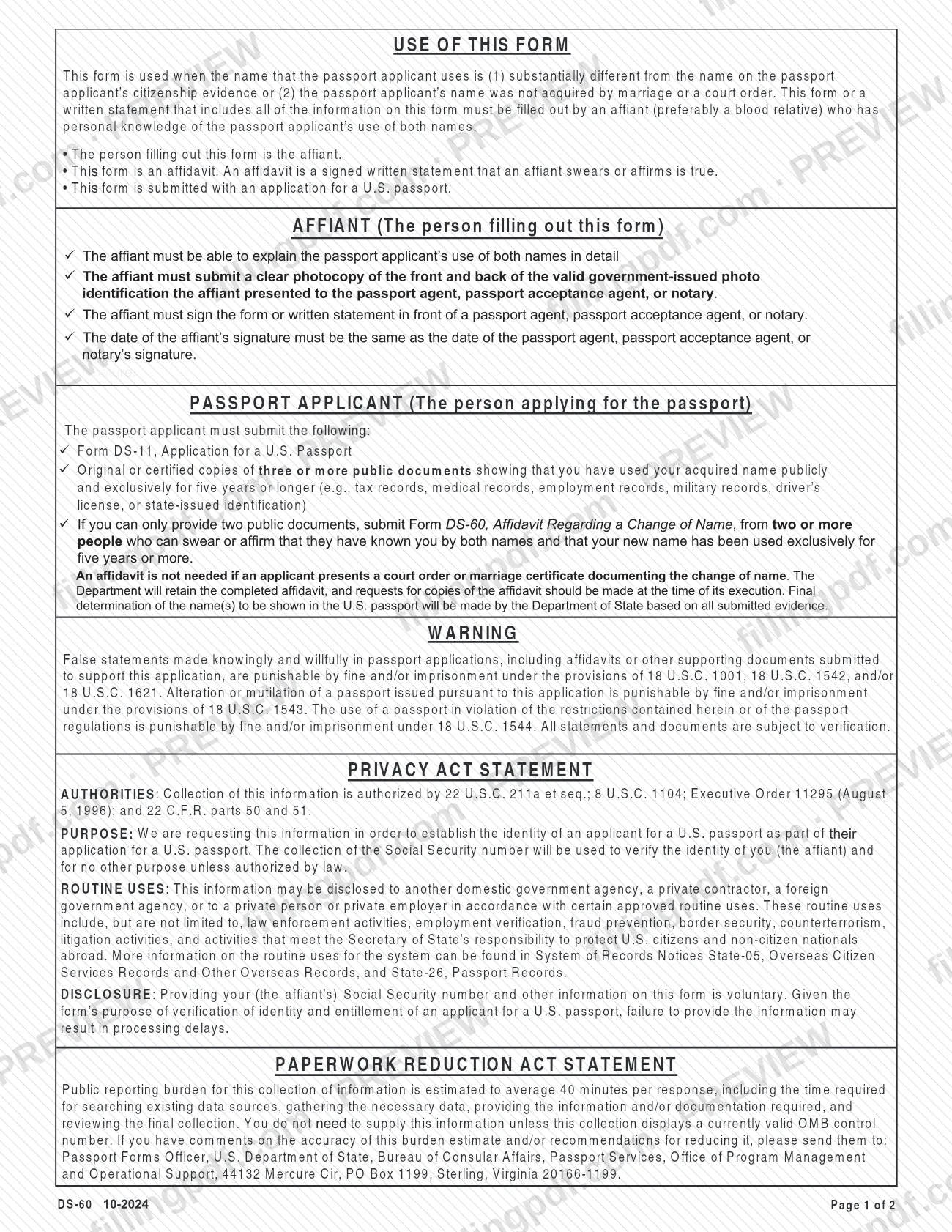
The ds60 is Form DS-60, Affidavit Regarding A Change of Name, a U.S. Department of State form in which someone who knows a passport applicant swears to how the applicant has used a current name and a former name. It is submitted with an application for a U.S. passport when the applicant's name is substantially different from the name on their citizenship evidence, or was not acquired by marriage or a court order. On this page you can fill out the form online on FillingPDF and download or print the completed PDF; the affiant must still sign it in front of a passport agent, passport acceptance agent, or notary. The official PDF is published by the Department of State.
Last updated
What is DS-60?
Form DS-60, Affidavit Regarding A Change of Name, is the U.S. Department of State affidavit in which a person who knows a passport applicant swears that the applicant has used a current name and a former name, supporting a U.S. passport application.
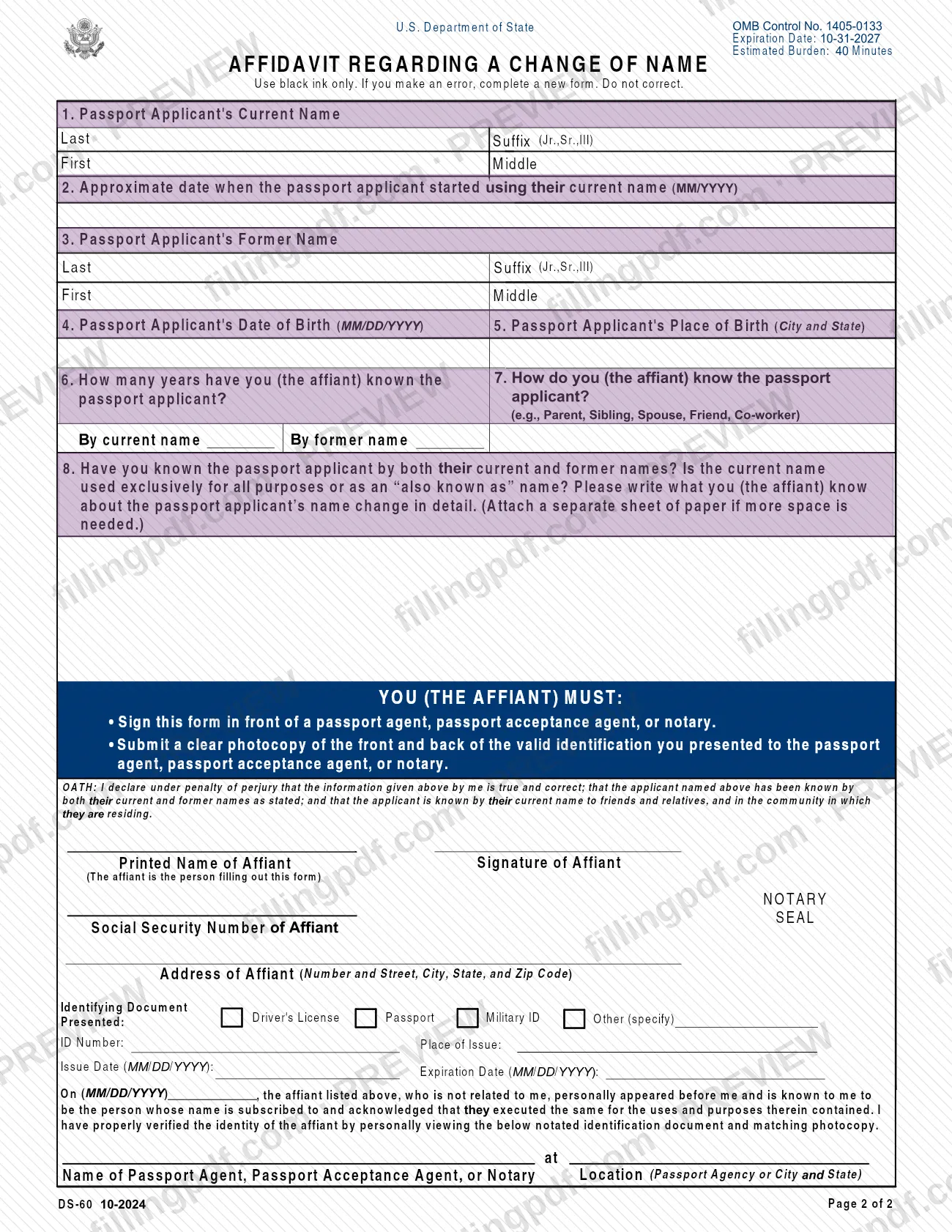
An affidavit is a signed written statement that the person making it swears or affirms is true. On Form DS-60 that person is the affiant, not the passport applicant. The affiant gives the applicant's current and former names, the approximate date the current name was first used (MM/YYYY), the applicant's date and place of birth, how many years and in what way the affiant has known the applicant, and a detailed explanation of the name change on line 8. The affiant then signs an oath under penalty of perjury before a passport agent, passport acceptance agent, or notary.
The form is used when the applicant's name is substantially different from the name on their citizenship evidence, or when the name was not acquired by marriage or a court order. It is not a stand-alone document and it does not change anyone's name: it is evidence submitted with Form DS-11, Application for a U.S. Passport. The Department of State makes the final determination of the name or names shown in the passport, based on all the evidence submitted.
The form carries OMB Control No. 1405-0133 and is marked DS-60 10-2024. The Department's eForms listing also files it as DS-0060.
Who needs to file DS-60?
The affiant is the person who fills out Form DS-60. The Department of State prefers a blood relative with personal knowledge of the passport applicant's use of both names. The affiant must be able to explain that use in detail.
You need this form when you are applying for a U.S. passport and:
- the name you use is substantially different from the name on your citizenship evidence; or
- your name was not acquired by marriage or a court order.
If you can provide only two public documents showing that you have used your acquired name publicly and exclusively for five years or longer, the instructions on the form call for affidavits on Form DS-60 from two or more people who can swear or affirm that they have known you by both names and that the new name has been used exclusively for five years or more.
You do not need an affidavit if you present a court order or a marriage certificate documenting the change of name. The notary section states that the affiant is not related to the passport agent, passport acceptance agent, or notary who witnesses the signature.
When to file DS-60
Form DS-60 is completed when you apply for a U.S. passport and your name does not match your citizenship evidence, because the form is submitted with that passport application. The form prints no separate due date.
The affiant must sign in front of a passport agent, passport acceptance agent, or notary, and the date of the affiant's signature must be the same as the date of the official's signature. Because the form is signed at a specific appointment, plan the signing before you submit the application.
The Department of State retains the completed affidavit. If you or the affiant want copies, the form says to request them at the time the affidavit is executed. The five-year period in the instructions refers to how long the acquired name has been used publicly and exclusively, as shown by your public documents.
Documents you need
- Clear photocopy of the front and back of the valid government-issued photo identification the affiant presented to the passport agent, passport acceptance agent, or notary; it goes with Form DS-60.
- Form DS-11, Application for a U.S. Passport, which the passport applicant submits; Form DS-60 is submitted with it.
- Original or certified copies of three or more public documents showing the applicant has used the acquired name publicly and exclusively for five years or longer, such as tax, medical, employment or military records, a driver's license or state-issued identification.
- Form DS-60 from two or more people who can swear or affirm they have known the applicant by both names, if the applicant can provide only two public documents.
- A separate sheet of paper, if the affiant needs more space for the detailed explanation on line 8.
How to fill out DS-60
Prepare to use black ink
Use black ink only if you complete the printed form by hand. If you make an error, complete a new form instead of correcting it.
Enter the applicant's current name
On line 1, enter the passport applicant's current last name, suffix (Jr., Sr., III), first name and middle name.
Give the date the current name began
On line 2, enter the approximate date the passport applicant started using their current name, in MM/YYYY format.
Enter the applicant's former name
On line 3, enter the former last name, suffix, first name and middle name of the passport applicant.
Enter birth date and birthplace
On line 4, enter the applicant's date of birth as MM/DD/YYYY. On line 5, enter the place of birth as city and state.
Say how long and how you know them
On line 6, enter the number of years you, the affiant, have known the applicant by the current name and by the former name. On line 7, state how you know the applicant, such as parent, sibling, spouse, friend or co-worker.
Explain the name change in detail
On line 8, say whether you have known the applicant by both names and whether the current name is used exclusively for all purposes or as an "also known as" name. Write what you know about the name change in detail, and attach a separate sheet if you need more space.
Enter the affiant's details
Print the affiant's name, and enter the affiant's Social Security number and address (number and street, city, state and ZIP code). Providing the Social Security number is voluntary, but leaving it out may cause processing delays.
Sign before an authorized witness
Do not sign until you are in front of a passport agent, passport acceptance agent, or notary. The signature date must match that person's date, and the identifying document section is completed with the document you present.
Review, download and photocopy ID
Check every line, then download or print the completed PDF from FillingPDF. Make a clear photocopy of the front and back of the identification you presented and assemble both with the passport application package.
How to submit DS-60
Form DS-60 has no filing channel of its own: it is submitted together with an application for a U.S. passport, Form DS-11, Application for a U.S. Passport.
- With the passport application: include the completed and signed DS-60 with the DS-11 package, along with the other evidence of your name use listed under required documents.
- At signing: the affiant signs in front of a passport agent, passport acceptance agent, or notary and gives that person the valid government-issued photo identification. A clear photocopy of the front and back of that identification goes with the form.
- Copies: the Department of State keeps the completed affidavit, so ask for any copies when the affidavit is signed.
The only address printed on the form, the Passport Forms Officer in Sterling, Virginia, is for comments on the time-burden estimate, not for sending the affidavit. FillingPDF lets you fill out and download the PDF; submission follows the passport application channels described above.
Common mistakes to avoid
- Signing the form before meeting the passport agent, passport acceptance agent, or notary; the affiant must sign in front of that person.
- Dating the affiant's signature differently from the official's signature; the two dates must be the same.
- Leaving out the clear photocopy of the front and back of the identification the affiant presented.
- Correcting an error on the form instead of completing a new one; the form says to use black ink only and not to correct.
- Submitting only one affidavit when the applicant has just two public documents; the form calls for affidavits from two or more people.
- Filling out the affidavit when a court order or marriage certificate already documents the name change; the form says an affidavit is not needed then.
- Answering line 8 with a yes or no instead of explaining in detail how the affiant knows both names and how the current name is used.
- Mailing the affidavit to the Passport Forms Officer address printed on the form, which is only for comments on the burden estimate.
- Giving false information; the form warns that knowingly and willfully false statements are punishable under 18 U.S.C. 1001, 1542 and 1621.
Frequently asked questions
What is Form DS-60 used for?
Form DS-60 is a Department of State affidavit that supports a U.S. passport application. It is used when the applicant's name is substantially different from the name on their citizenship evidence, or when the name was not acquired by marriage or a court order.
Do I need a DS-60 if I changed my name by marriage?
Not if you present a marriage certificate or court order documenting the name change; the form states that an affidavit is not needed in that case. It is for names that differ from your citizenship evidence without that kind of documentation.
Who can be the affiant on a ds60?
The affiant is the person who fills out the form, preferably a blood relative with personal knowledge of the applicant's use of both names. The affiant must be able to explain that use in detail and must sign in front of a passport agent, passport acceptance agent, or notary.
Does Form DS-60 have to be notarized?
The affiant must sign in front of a passport agent, passport acceptance agent, or notary. The date of the affiant's signature must be the same as that person's signature date, and the affiant also provides a photocopy of the front and back of the photo ID presented.
How many DS-60 affidavits do I need?
If you have three or more public documents showing five years or longer of exclusive public use of your new name, the form does not call for an affidavit. If you can provide only two, submit DS-60 affidavits from two or more people.
Do I have to give my Social Security number on the DS-60?
Providing the affiant's Social Security number is voluntary. The Privacy Act statement says it is used to verify the affiant's identity and that failing to provide information on the form may result in processing delays.
Where do I send Form DS-60?
You do not send it separately. It is submitted with your application for a U.S. passport, Form DS-11. The only address printed on the form is for comments about the burden estimate, not for submitting the affidavit.
Can I fill out the ds60 form online?
You can fill out the DS-60 PDF online on FillingPDF and download or print it. FillingPDF is an independent service: it does not file the form or witness signatures, so the affiant still signs in front of an authorized official.
Can I get a copy of the affidavit after it is submitted?
The Department of State retains the completed affidavit. The form says requests for copies should be made at the time the affidavit is executed, so ask for your copies when the affiant signs.
Ready to fill out DS-60?
Fill out DS-60 now