
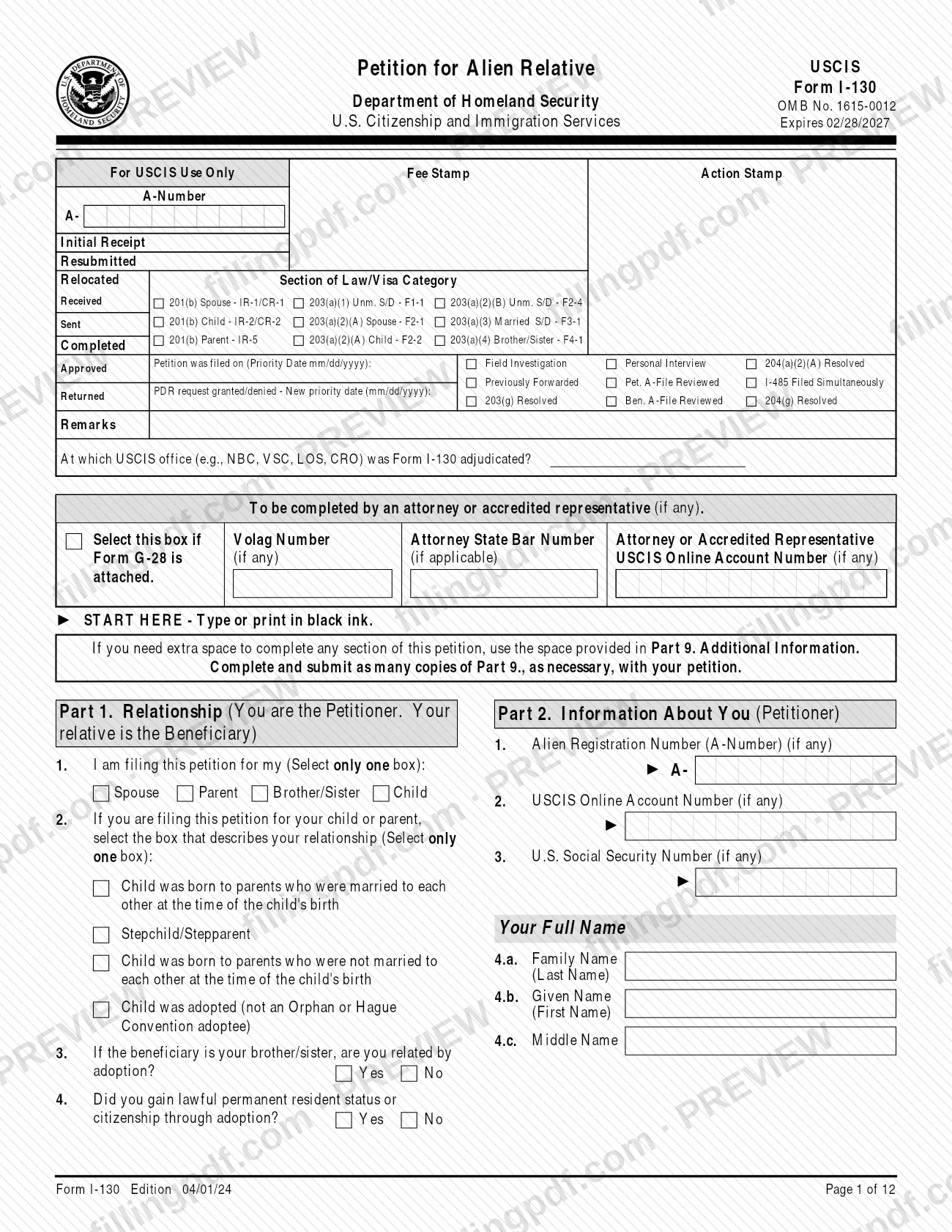
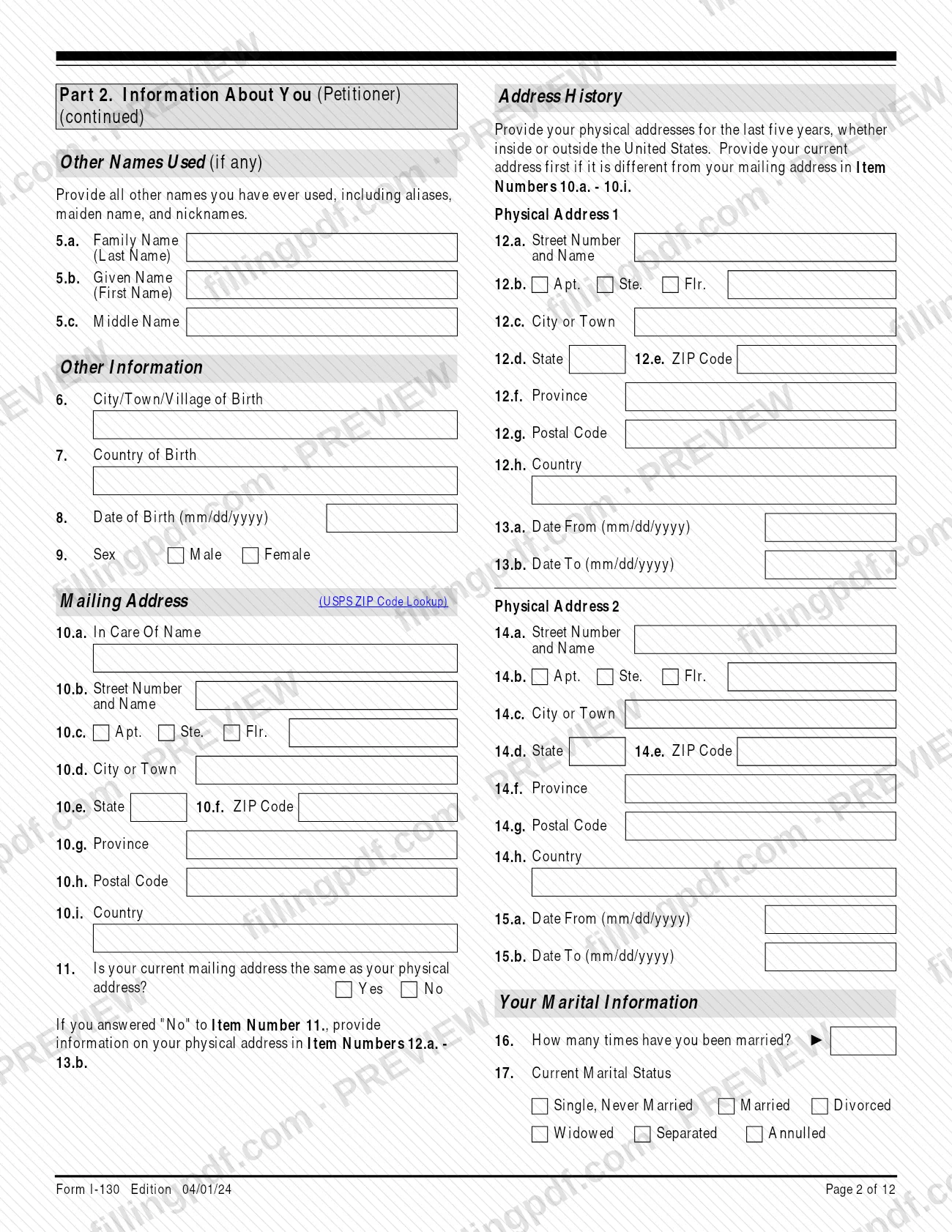
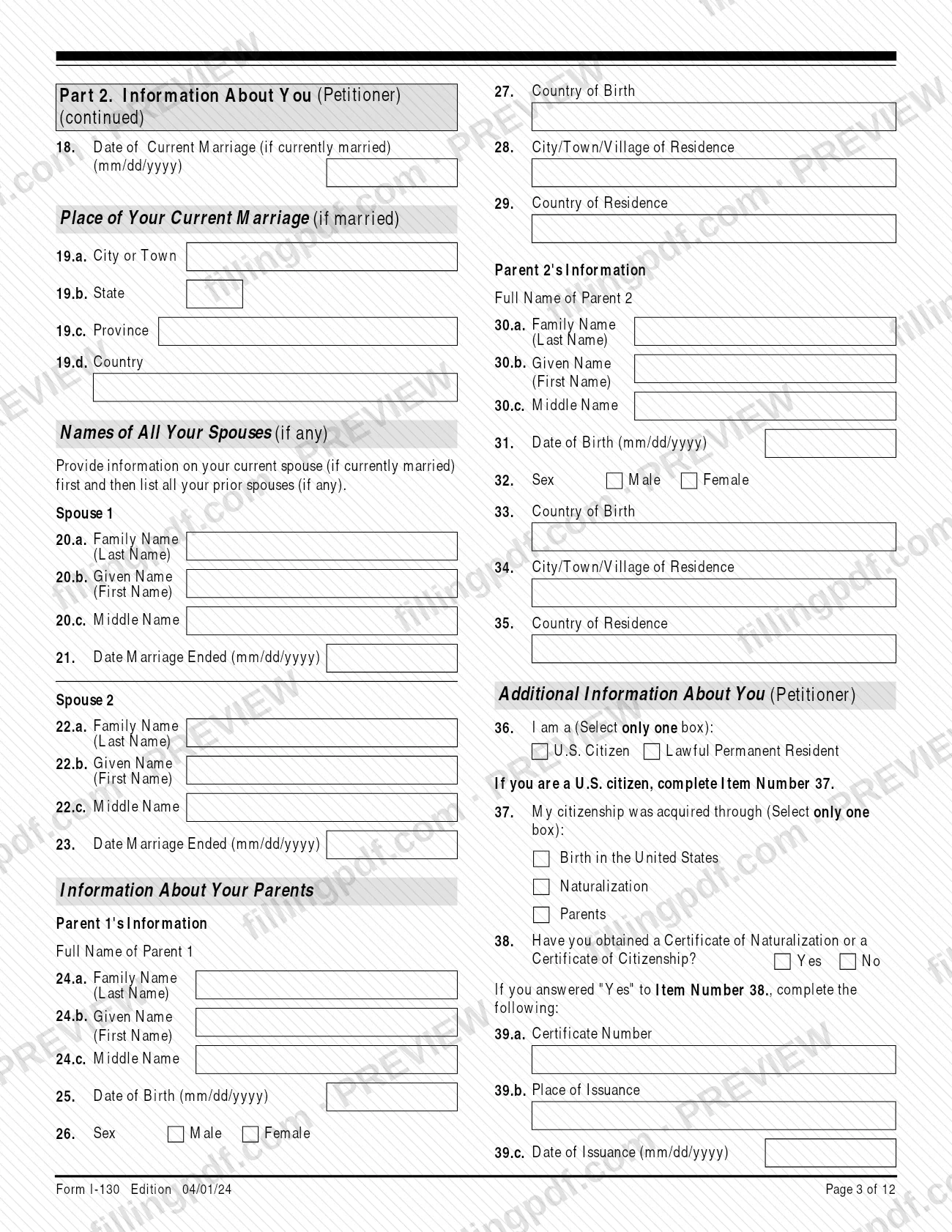
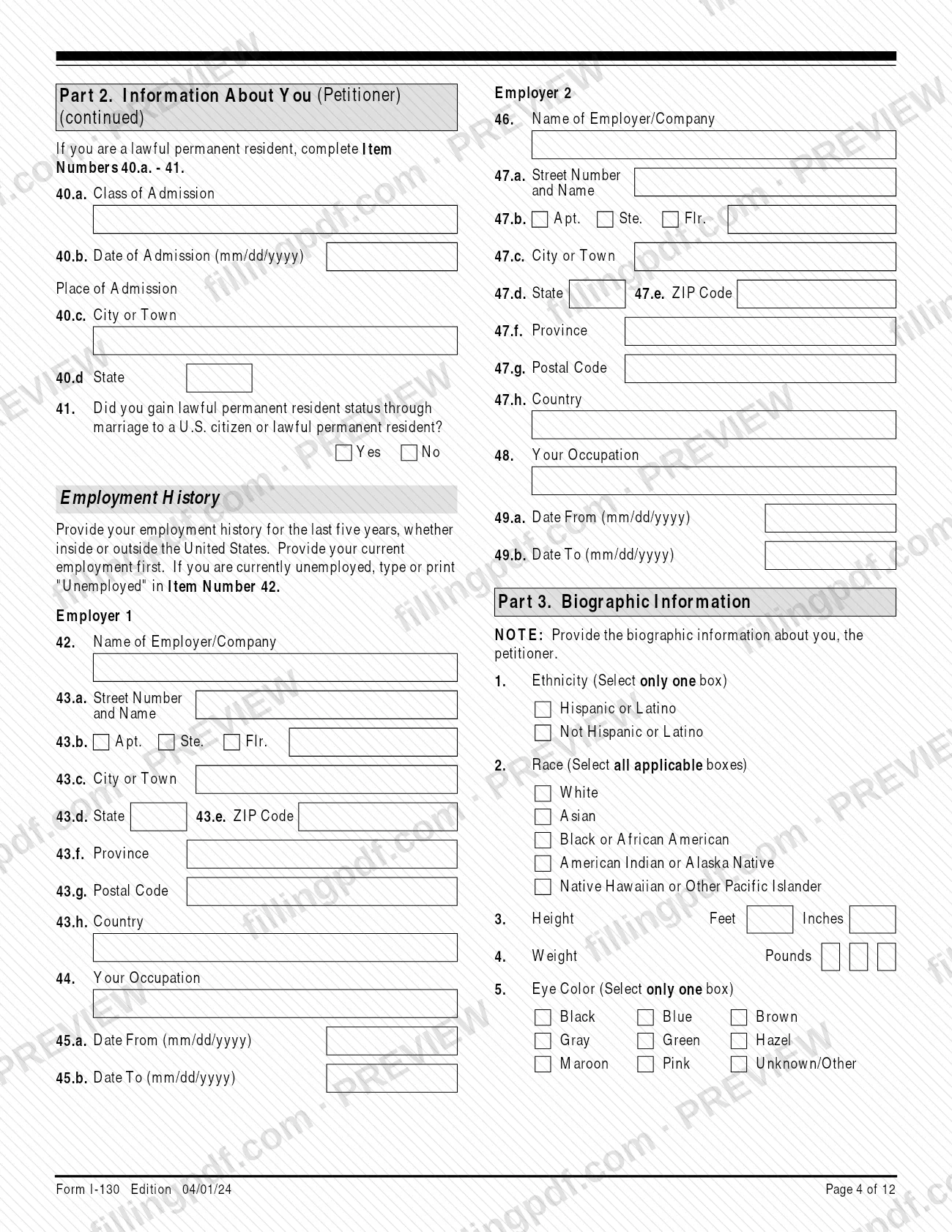
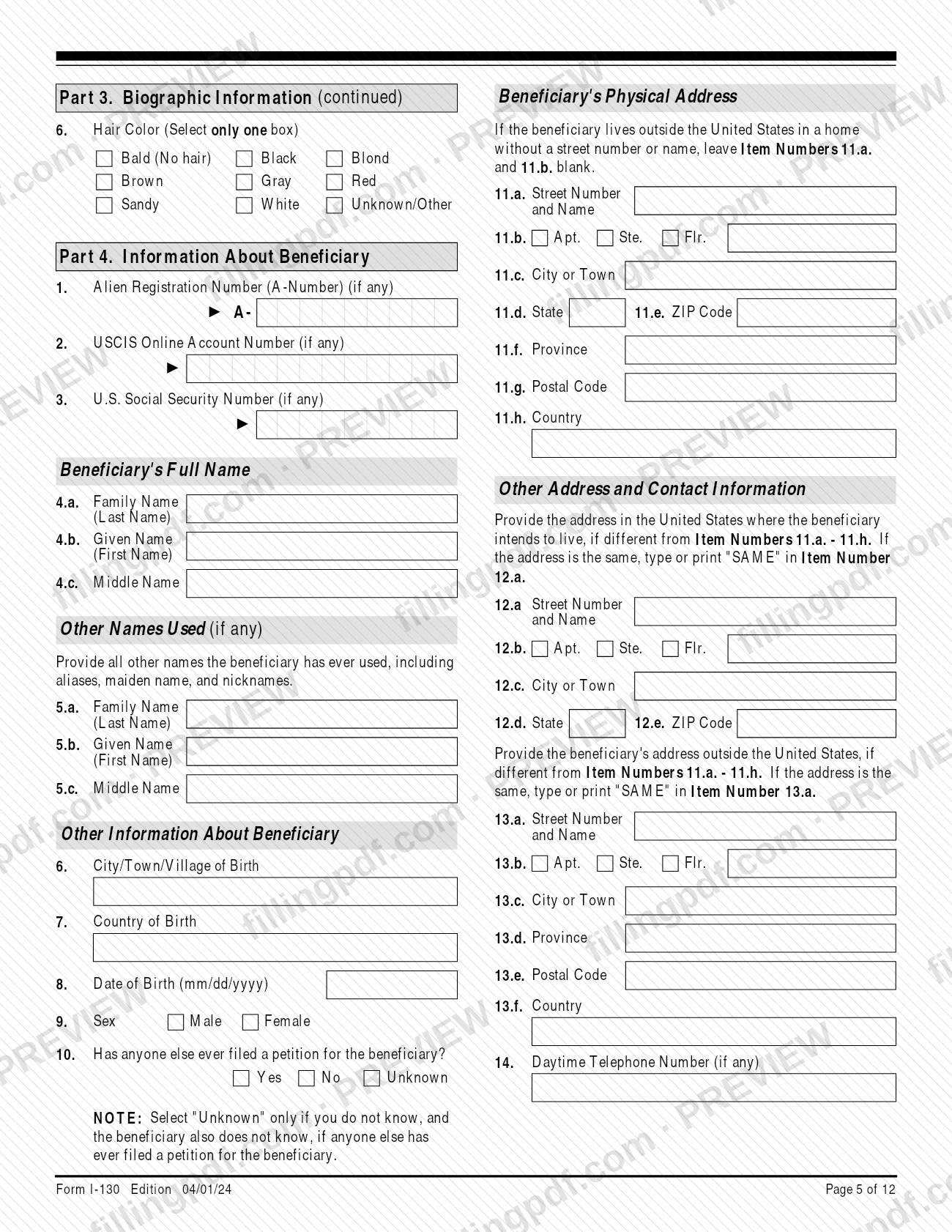
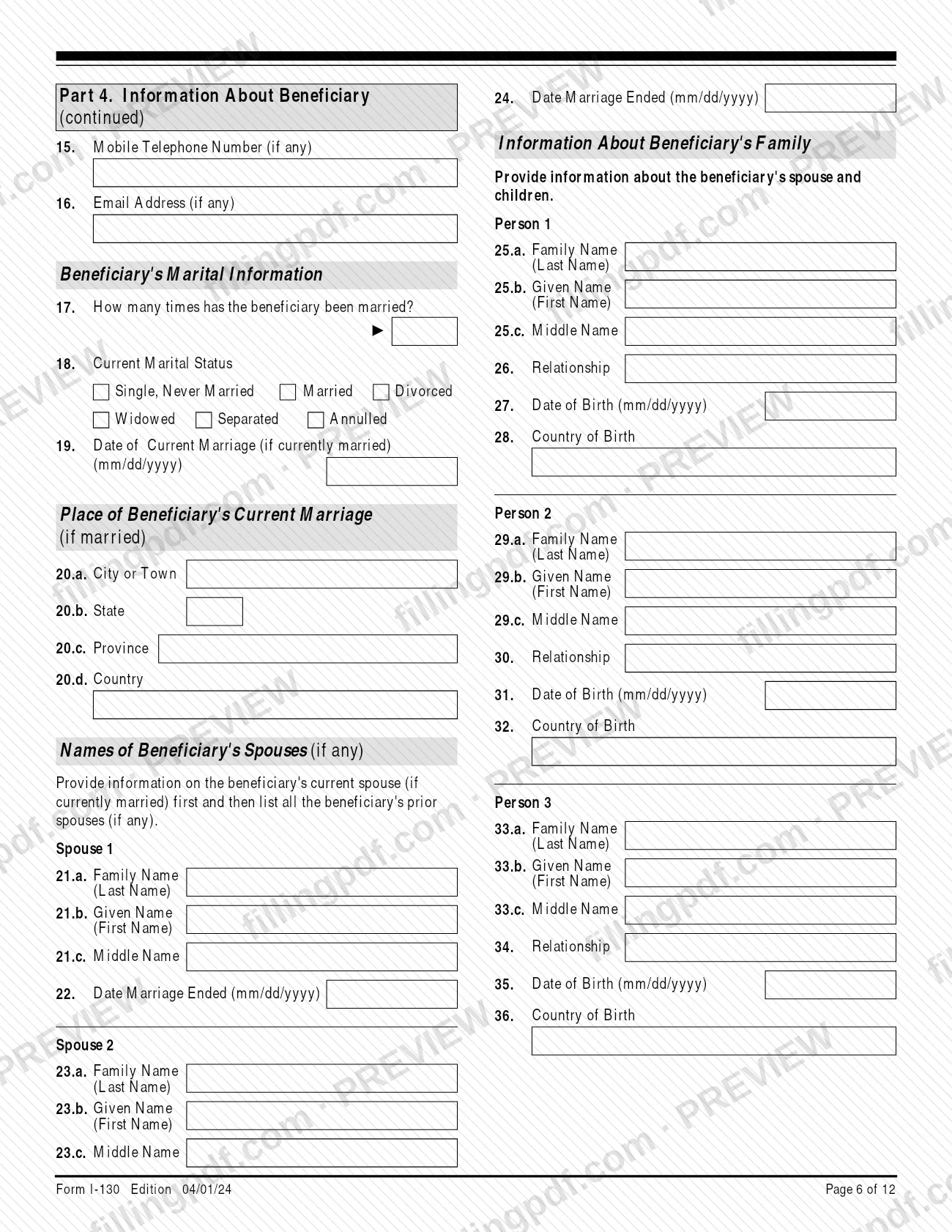
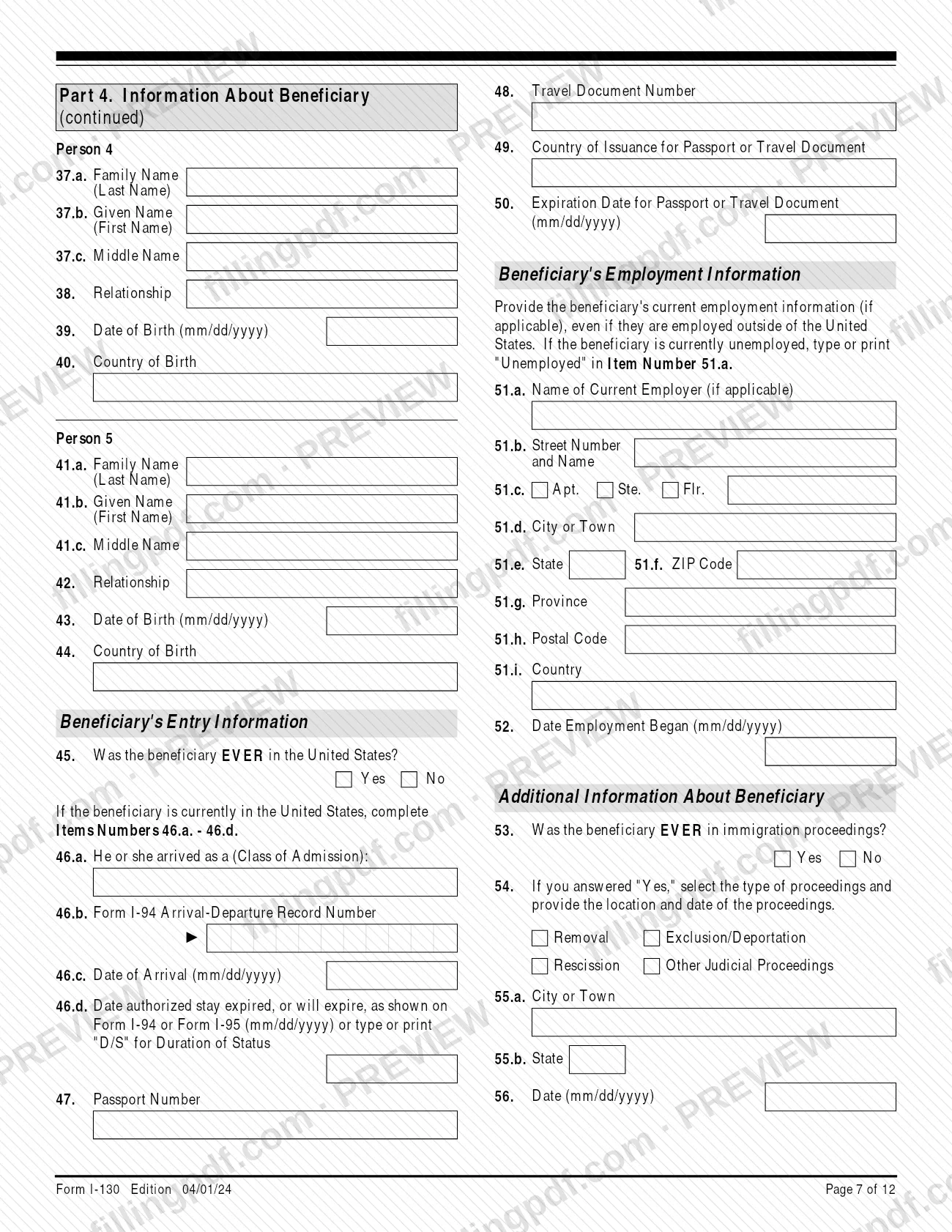
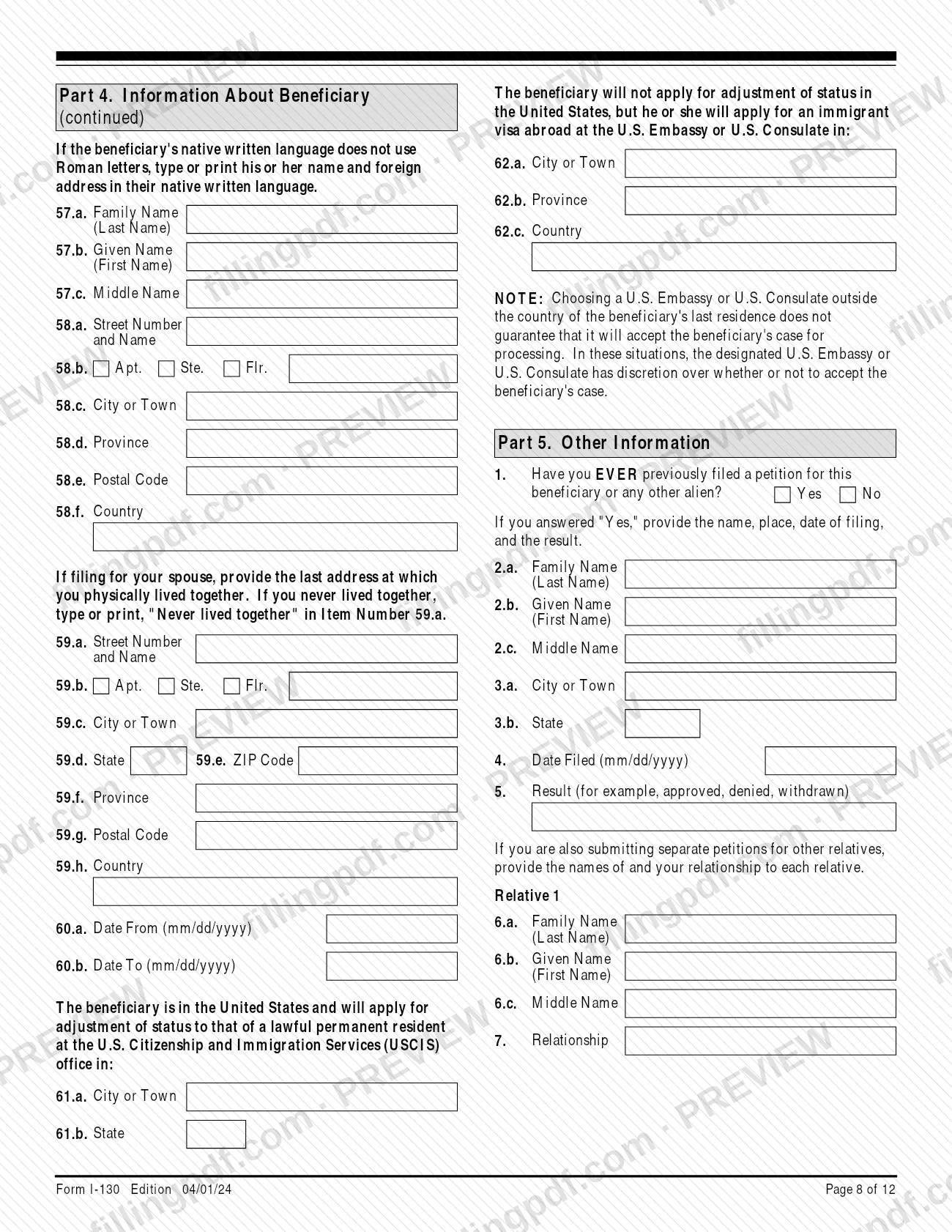
Form I-130, Petition for Alien Relative, is the petition a U.S. citizen or lawful permanent resident files with U.S. Citizenship and Immigration Services (USCIS) to establish a qualifying relationship with a relative who wishes to immigrate to the United States. It is the first step toward the relative's Green Card, and filing or approval of the petition does not give the relative any immigration status. On FillingPDF you can fill out the form online and download or print the completed PDF; the official PDF and instructions are published by USCIS, and the petition reaches USCIS only through the channels described below.
Last updated
What is Form I-130?
Form I-130, Petition for Alien Relative, is the form a U.S. citizen or lawful permanent resident files with U.S. Citizenship and Immigration Services (USCIS) to establish a qualifying family relationship with an alien relative who wishes to immigrate to the United States.
The person who files is the petitioner and the relative is the beneficiary. USCIS generally approves the petition when the petitioner establishes a qualifying relationship that allows the relative to immigrate. Approval does not make the relative a lawful permanent resident and does not allow immediate immigration: it is the first step. Afterward, a relative in the United States may be able to apply for a Green Card with Form I-485, Application to Register Permanent Residence or Adjust Status, once an immigrant visa is available. A relative abroad goes through consular processing with the U.S. Department of State.
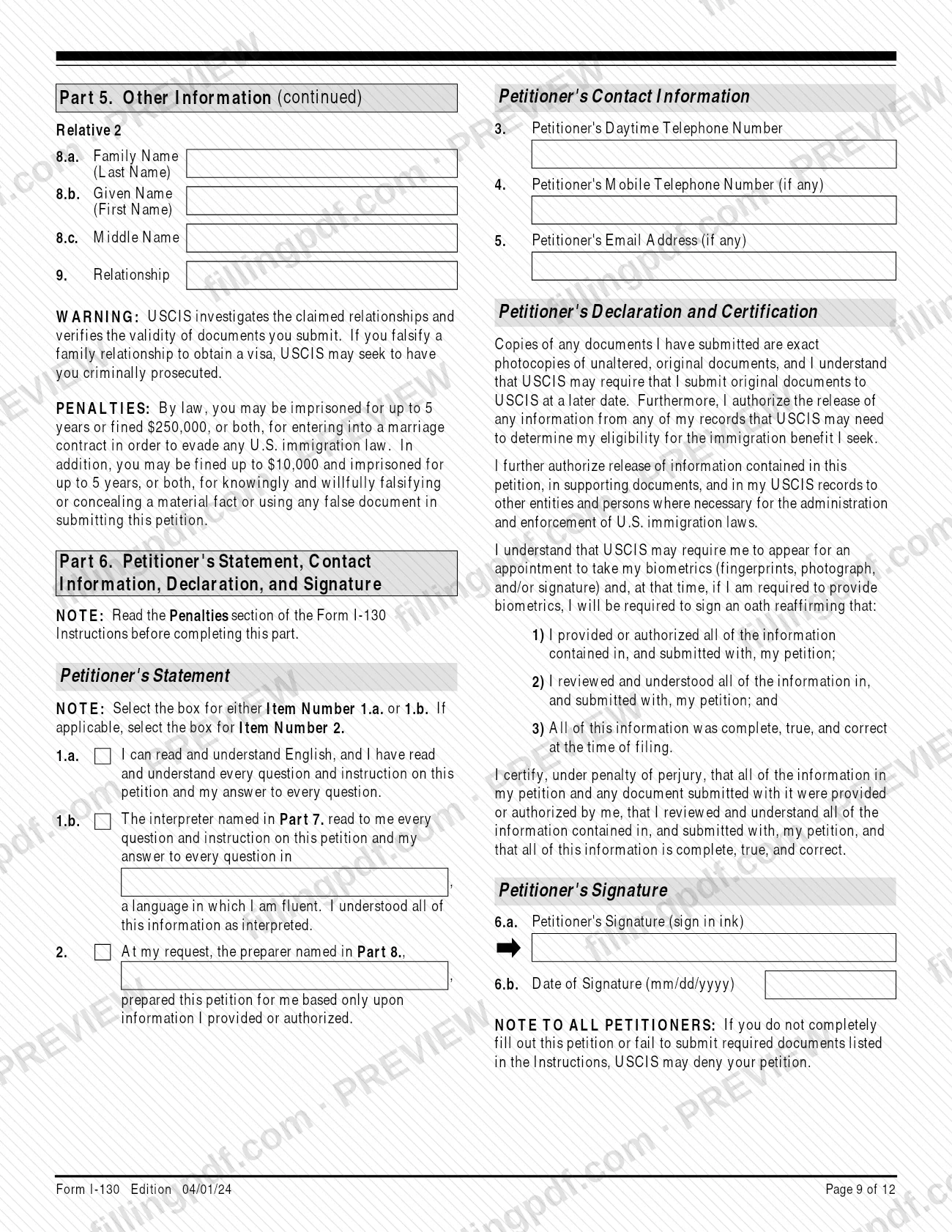
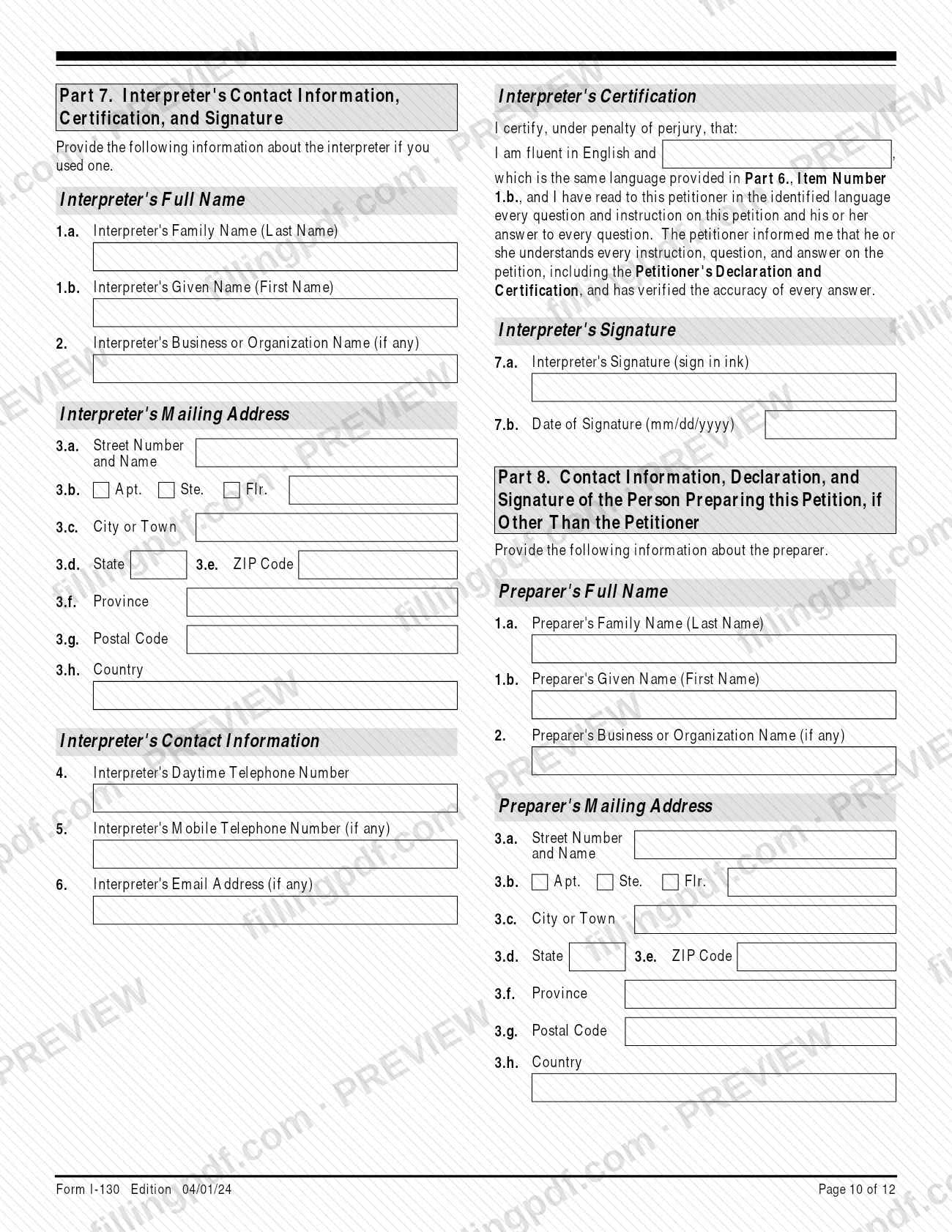
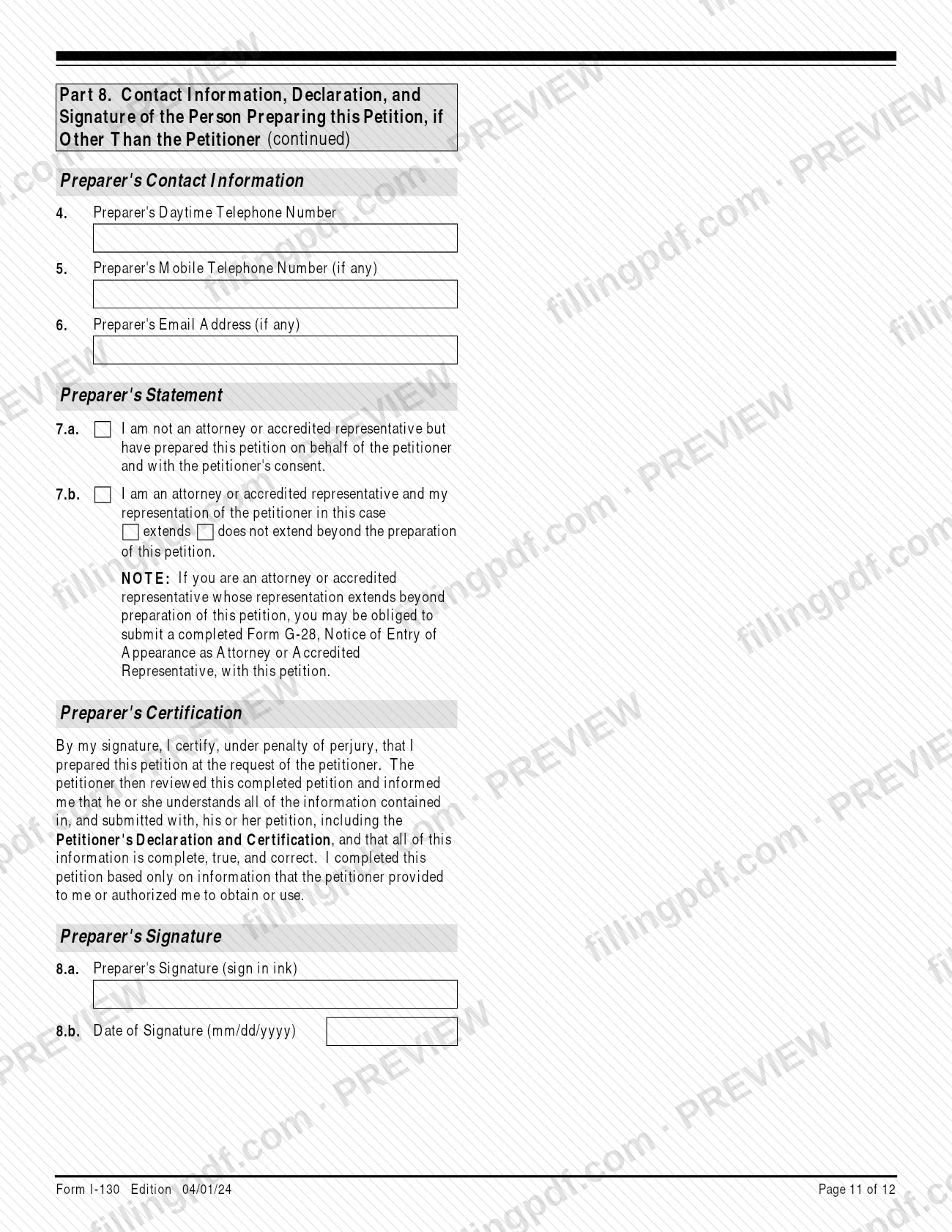
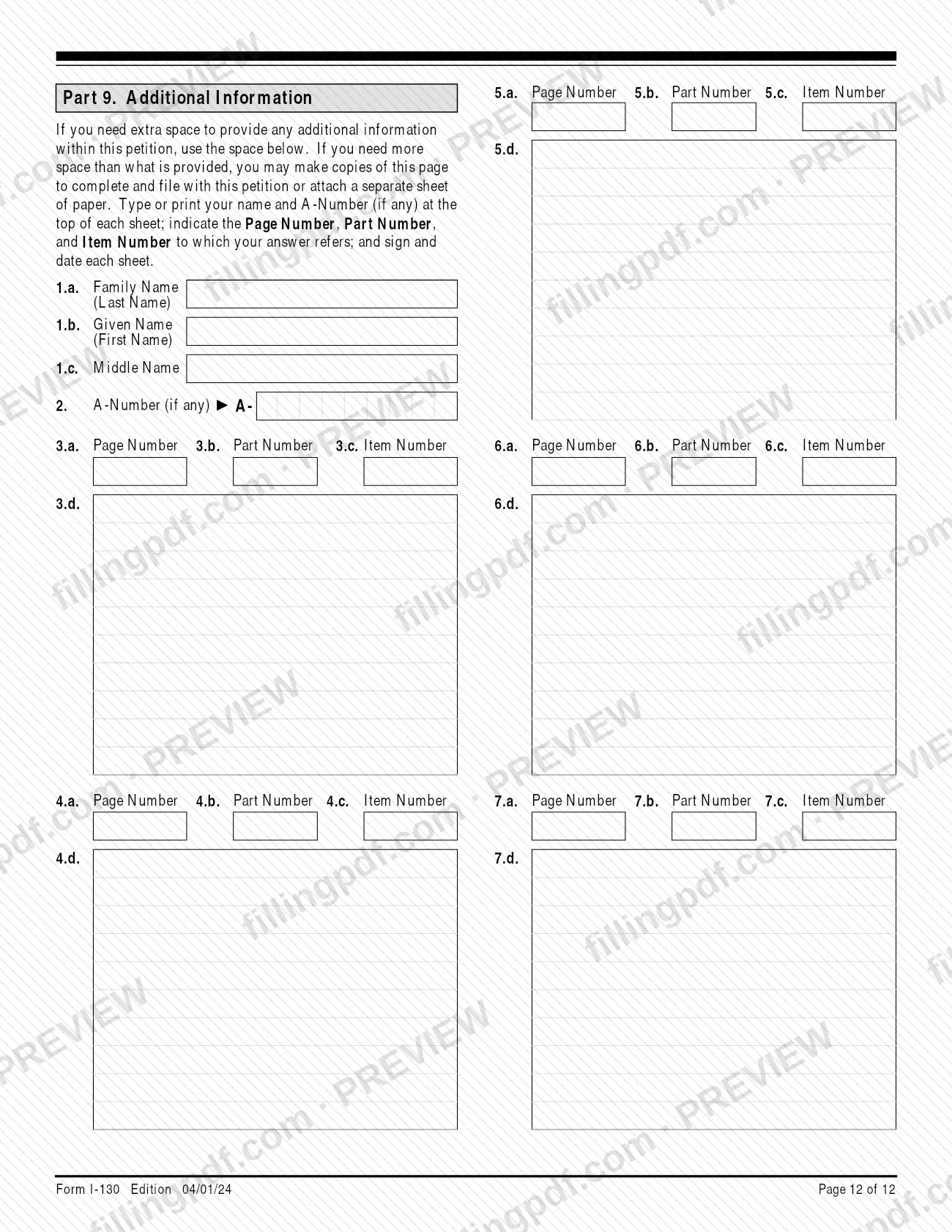
The form has nine parts: Part 1 (relationship), Part 2 (petitioner), Part 3 (biographic information), Part 4 (beneficiary), Part 5 (other information), Parts 6 to 8 (statement, interpreter and preparer sections) and Part 9 (additional information). In Part 4, Item Number 61 or 62 tells USCIS whether the beneficiary will seek adjustment of status in the United States or an immigrant visa abroad.
Form I-130 is different from Form I-130A, Supplemental Information for Spouse Beneficiary, which a petitioner filing for a spouse must submit with it. Form I-130 is also not the self-petition that abused spouses, children and parents may file for themselves; USCIS directs them to its Form I-360 VAWA self-petitioner page.
Who needs to file Form I-130?
The main group is U.S. citizens and lawful permanent residents who want to petition for an eligible relative. You must file a separate Form I-130 for each eligible relative.
U.S. citizens may file for a spouse; unmarried children under 21; unmarried sons or daughters 21 or older; married sons or daughters of any age; brothers or sisters (the petitioner must be 21 or older); and a mother or father (the petitioner must be 21 or older).
Lawful permanent residents may file for a spouse, an unmarried child under 21 and an unmarried son or daughter 21 or older. There is no visa category for married children of lawful permanent residents: if the son or daughter marries before immigrating, USCIS will deny or automatically revoke the petition.
Non-citizen U.S. nationals have the same petitioning rights as lawful permanent residents and mark that status in Part 2, Item Number 36.
Derivative beneficiaries, such as a beneficiary's spouse and unmarried children under 21 in the cases the instructions describe, are listed in Part 4 and need no separate petition.
You may not file for a grandparent, grandchild, nephew, niece, uncle, aunt, cousin or parent-in-law. The instructions also bar certain adoptive, step and spousal relationships, for example a spouse when you were not both physically present at the marriage ceremony, unless it was consummated.
If a parent or legal guardian signs for a petitioner under 14, or a legal guardian for a mentally incompetent person, that is allowed.
When to file Form I-130
File Form I-130 when you are ready to establish the relationship with an eligible relative; no due date is printed on the form. If you are petitioning for a spouse, Form I-130A must go in with it.
Timing matters for visas. A petition for the spouse, unmarried child under 21 or parent of a U.S. citizen makes the beneficiary an immediate relative, for whom visas are immediately available. For other relatives, such as a citizen's sibling or married or adult son or daughter, or a permanent resident's spouse, child or unmarried son or daughter, the petition is assigned to a preference category with limited yearly visas, processed in the order petitions are properly filed and accepted. A petition counts as properly filed only when it is fully completed, signed and accompanied by the filing fee.
If the beneficiary will later file Form I-485, the filing location depends on whether the two forms are filed together (concurrent filing).
If you are not a U.S. citizen, notify USCIS of a new address within 10 days of moving. If you become a U.S. citizen while the petition is pending or after approval, notify USCIS or the National Visa Center as the USCIS page describes.
Documents you need
- Proof of U.S. citizenship, if you are a citizen: U.S. birth certificate, naturalization or citizenship certificate, Form FS-240, unexpired U.S. passport, or an original consular statement.
- Proof of permanent residence, if you are a lawful permanent resident: a copy of the front and back of your Permanent Resident Card (Form I-551), or passport pages and other USCIS evidence if you have no card yet.
- For a spouse: your marriage certificate and, if either of you was married before, documents showing each prior marriage was legally terminated.
- For a spouse: a completed and signed Form I-130A, Supplemental Information for Spouse Beneficiary (your spouse need not sign it if overseas).
- For a spouse: two identical 2 by 2 inch color passport-style photos of you and of your spouse (if in the United States), taken within 30 days of filing.
- For a spouse: evidence of a bona fide marriage, such as joint property ownership, a joint lease, combined finances, children's birth certificates or third-party affidavits.
- For a child: your child's birth certificate; fathers also need the marriage certificate and proof of terminated prior marriages, or legitimation or bona fide parent-child evidence for a child born out of wedlock.
- For a parent: your birth certificate showing the parent's name; for a father, also your parents' marriage certificate and proof that any prior marriages ended.
- For a brother or sister: your birth certificate and your sibling's showing at least one common parent, plus marriage certificates if you share only a father.
- For stepparent, stepchild or adoption cases: the stepparent's marriage certificate showing the child was under 18, or the adoption decree and evidence of two years of legal custody and residence.
- Legal documents reflecting a name change, such as a marriage certificate, adoption decree or court order, if you or the beneficiary use a name different from the one on the relevant documents.
- If an official document is unavailable: a statement from the civil authority certifying it, plus secondary evidence such as religious, school or census records or two written statements.
- A full English translation with the translator's signed certification for every document in a foreign language.
- Form G-28, Notice of Entry of Appearance as Attorney or Accredited Representative, if an attorney or accredited representative represents you beyond preparing the petition.
- A photocopy of your Form I-130 receipt notice for your spouse, if you are a U.S. citizen filing separate petitions for children in the same family.
How to fill out Form I-130
Select the relationship in Part 1
Select only one box for Item Number 1 (Spouse, Parent, Brother/Sister or Child). Answer Items 2 to 4 on child, adoption and stepparent relationships where they apply.
Enter your identity in Part 2
Give your A-Number, USCIS Online Account Number and Social Security Number if you have them (Items 1 to 3), your full name (Item 4), other names used (Item 5), and birth details and sex (Items 6 to 9). Dates use mm/dd/yyyy.
Add mailing address and address history
Enter your mailing address in Items 10.a. to 10.i. and answer Item 11. List your physical addresses for the last five years in Items 12 to 15, current first, and mark PRESENT for the current one.
Complete marital and parent information
Enter the number of marriages and your marital status (Items 16 and 17), current marriage details (18 and 19), prior spouses (20 to 23) and both parents (24 to 35). Type "N/A" where a question does not apply.
State your citizenship or residence
Item 36: select U.S. Citizen or Lawful Permanent Resident. Citizens complete Items 37 to 39; permanent residents complete Items 40.a. to 41. Non-citizen U.S. nationals mark Lawful Permanent Resident.
List your employment history
Provide five years of employment, current first, in Items 42 to 49. If you are unemployed, type "Unemployed" in Item 42.
Fill in Part 3 biographic information
Select ethnicity and race, then height, weight, eye color and hair color. Enter weight in pounds, or "000" if you do not know it or it is under 30 or over 699 pounds.
Enter the beneficiary's identity in Part 4
Items 1 to 16: A-Number, online account and Social Security Number if any, full name, other names, birth details, whether anyone else filed a petition, physical address and contact details. Type "SAME" in 12.a. or 13.a. where addresses repeat.
Provide the beneficiary's marital and family details
Complete Items 17 to 24 on marital status and prior spouses, then list the beneficiary's spouse and children in Items 25 to 44, including derivative family members.
Answer the entry and proceedings questions
Item 45: was the beneficiary ever in the United States? If in the country now, complete Items 46.a. to 50 with Form I-94, passport and travel document details. Complete Items 51 to 56 on employment and immigration proceedings.
Add native script and spouse address
Items 57 to 58 are for a name and foreign address in the native writing if it does not use Roman letters. If filing for a spouse, enter the last shared address in Items 59 to 60, or "Never lived together" in 59.a.
Choose adjustment or consular processing
Complete Item 61 (beneficiary in the United States will apply for adjustment of status) or Item 62 (immigrant visa abroad), not both and not neither.
Complete Part 5 other information
Answer Item 1 on prior petitions and, if yes, give the name, place, date and result in Items 2 to 5. List other relatives you are petitioning for in Items 6 to 9.
Complete Parts 6 to 9
In Part 6 select Item 1.a. or 1.b., enter contact details and sign in ink. Interpreters complete and sign Part 7; anyone who prepared the petition completes and signs Part 8. Use Part 9 for extra space, with page, part and item numbers.
Review, sign and download the PDF
Check every item, make sure no required item is blank, and confirm the signature requirement. Download or print the completed PDF from FillingPDF and assemble the evidence described under How to submit.
How to submit Form I-130
You can file Form I-130 online with a USCIS online account or by mail on paper.
- Online: create or log in to your USCIS online account. USCIS's Forms Available to File Online page shows when you or your representative can file this form online. You can file online even if your relative will later file Form I-485 by mail. USCIS sends a receipt notice, which your relative includes in the Form I-485 packet.
- By mail from inside the United States: file at the Chicago or Phoenix lockbox, depending on where you live and whether Form I-485 is filed at the same time. The addresses are on the USCIS Direct Filing Addresses for Form I-130 page, reached from www.uscis.gov/i-130.
- From outside the United States: file at the Chicago lockbox, file online, or, in limited circumstances, request to file at a U.S. embassy or consulate if you are a U.S. citizen petitioning for an immediate relative.
A filing fee applies; see the USCIS Fee Schedule page and Form G-1055 at www.uscis.gov/forms for the current amount. Do not mail the petition to the Paperwork Reduction Act address printed in the instructions. Do not send original documents unless the instructions request them. For a printed form, keep the edition date and page numbers visible on every page, since missing or mixed-edition pages may lead USCIS to reject it. For an email or text message when a lockbox accepts the petition, clip Form G-1145 to the first page. FillingPDF lets you fill out and download the PDF; submission follows the USCIS channels above.
Common mistakes to avoid
- Submitting the petition unsigned or with a stamped or typewritten name; USCIS rejects a petition without a valid signature.
- Answering both Part 4, Item Number 61 and Item Number 62, or leaving both blank; select one only.
- Leaving blank a part USCIS names as required, such as Part 1, your name, date of birth, mailing address and marital information, or the beneficiary's equivalents.
- Filing one Form I-130 for several relatives who are not derivative beneficiaries; each eligible relative needs a separate petition.
- Filing for a spouse without Form I-130A, or without the two passport-style photographs of you and your spouse.
- Mailing a printed form with missing pages or pages from different editions, or with the edition date and page numbers cut off.
- Sending original documents when none were requested; USCIS may destroy them.
- Submitting foreign-language documents without a full English translation and the translator's certification.
- Leaving a question blank instead of typing "N/A" or "None" where the instructions say to use them.
- Sending a change-of-address request to the USCIS Lockbox; the instructions say not to.
Frequently asked questions
What is Form I-130 used for?
Form I-130 is the USCIS petition a U.S. citizen or lawful permanent resident files to establish a qualifying relationship with an alien relative who wants to immigrate. It is the first step: approval does not make the relative a permanent resident or allow immediate immigration.
Who can file Form I-130 for a relative?
U.S. citizens can file for a spouse, children, sons and daughters, siblings (if 21 or older) and parents (if 21 or older). Lawful permanent residents can file only for a spouse, an unmarried child under 21 and an unmarried son or daughter 21 or older. A separate petition is needed for each relative.
Do I have to file Form I-130A with Form I-130?
Only if you are filing for your spouse. Your spouse completes Form I-130A, Supplemental Information for Spouse Beneficiary, and signs it unless he or she is overseas. It must be submitted with Form I-130.
Where do I file Form I-130?
You can file online with a USCIS online account or by mail. From inside the United States, mail it to the Chicago or Phoenix lockbox, depending on where you live and whether Form I-485 is filed at the same time. Current addresses are on the USCIS Form I-130 page.
Can I fill out Form I-130 online?
You can fill out the PDF online on FillingPDF and download or print it. FillingPDF does not file it for you. You submit it to USCIS by mail, or you can file online through your USCIS online account.
Does an approved I-130 give my relative a Green Card?
No. An approved petition does not give automatic lawful permanent resident status or permission to immigrate immediately. Afterward, the relative may apply for a Green Card, through Form I-485 in the United States or consular processing abroad, once an immigrant visa is available.
Is there a fee to file Form I-130?
Yes, a filing fee applies and the petition is not properly filed without it. USCIS publishes the amount on its Fee Schedule page and in Form G-1055, so check there for the current figure before you file.
Should I complete Item 61 or Item 62 in Part 4?
Select one only. Item 61 is for a beneficiary in the United States who will apply for adjustment of status; Item 62 is for one who will apply for an immigrant visa abroad. If you complete it wrongly or leave it blank, USCIS decides based on the relative's address.
Can I file Form I-130 for my married son or daughter as a permanent resident?
No. Permanent residents may file only for an unmarried son or daughter, because there is no visa category for married children of permanent residents. If a son or daughter marries before immigrating, USCIS will deny or revoke the petition.
Who signs Form I-130 if the petitioner is a minor?
The petitioner signs in ink. If the petitioner is under 14, a parent or legal guardian may sign, and a legal guardian may sign for a mentally incompetent person. A photocopy, fax or scan of the original handwritten signature is valid for filing.
Ready to fill out Form I-130?
Fill out Form I-130 now