
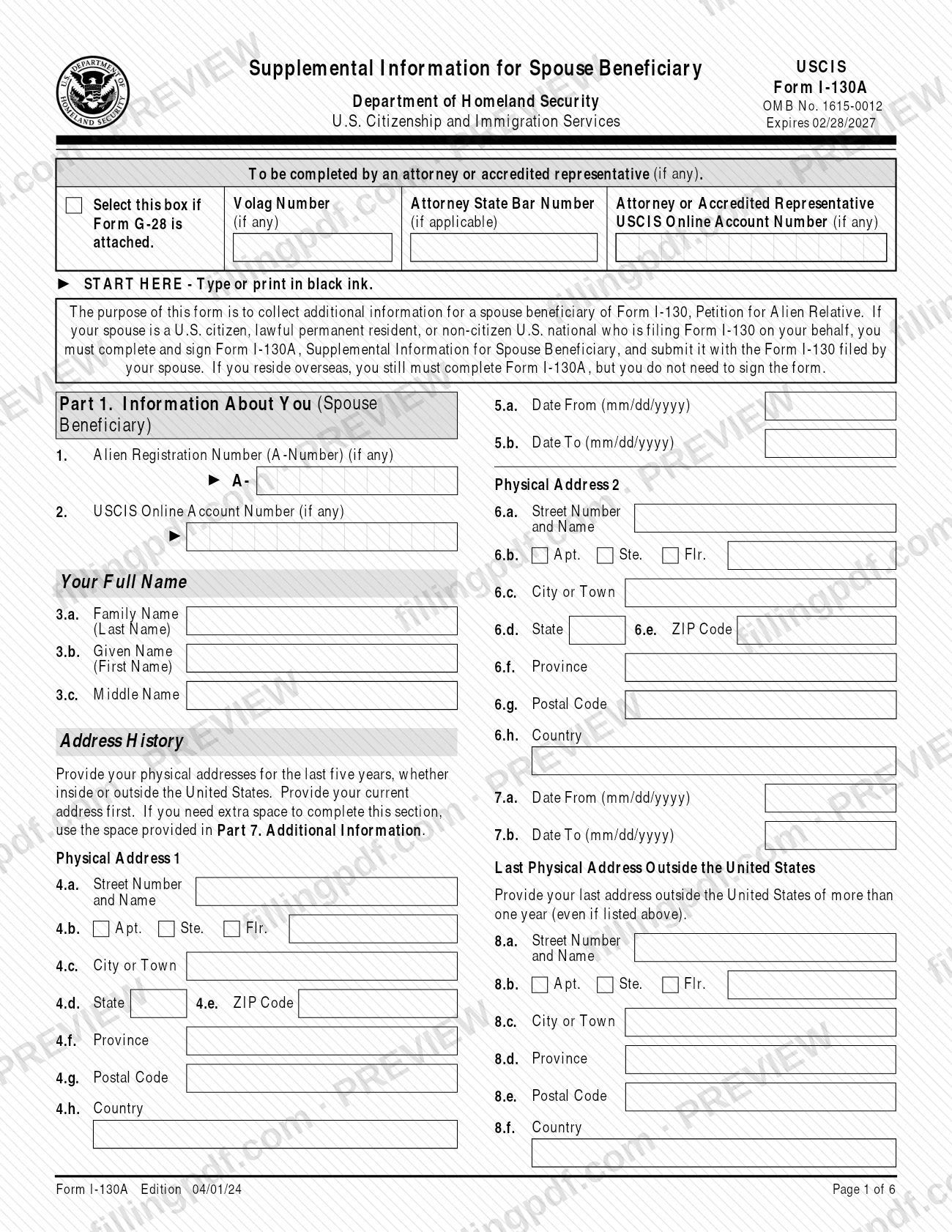
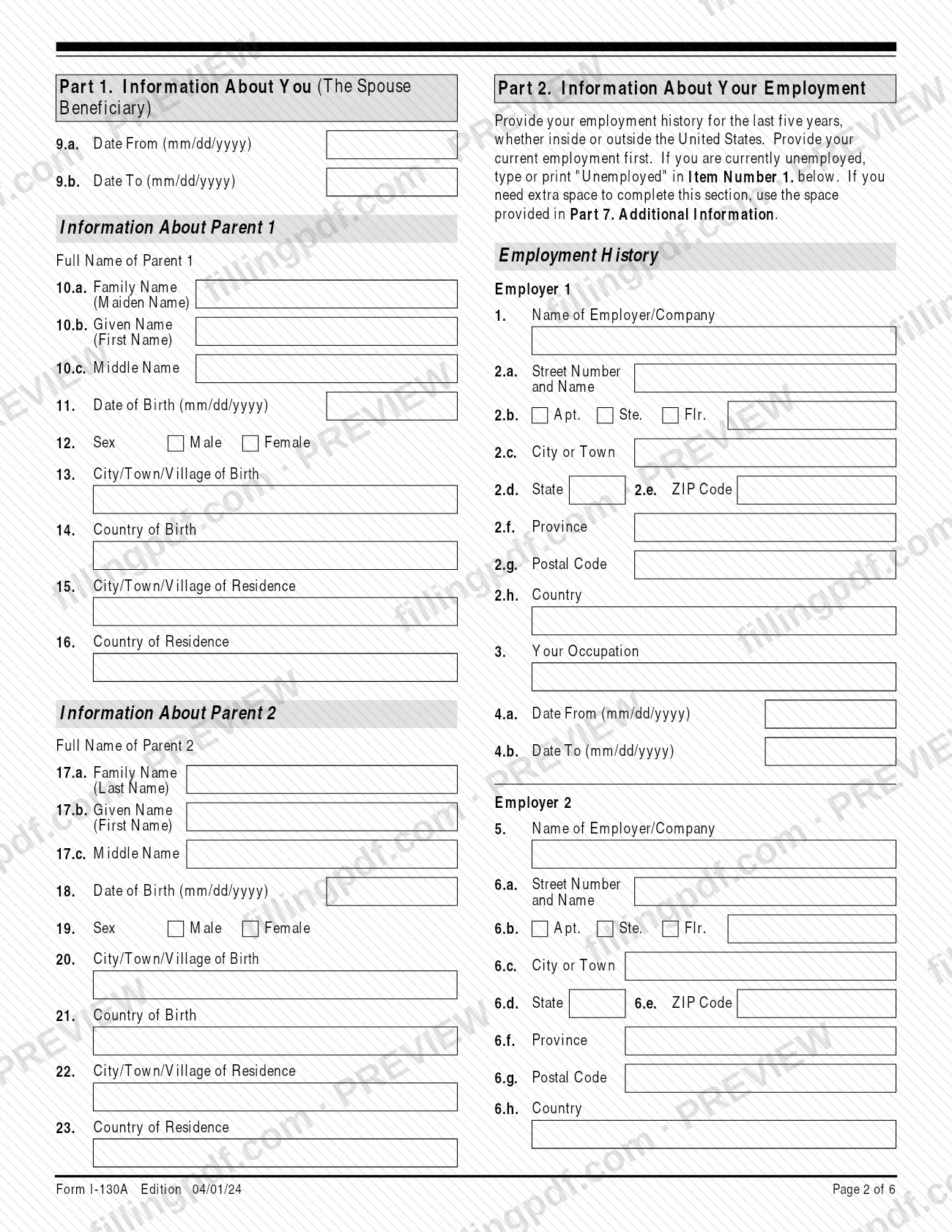
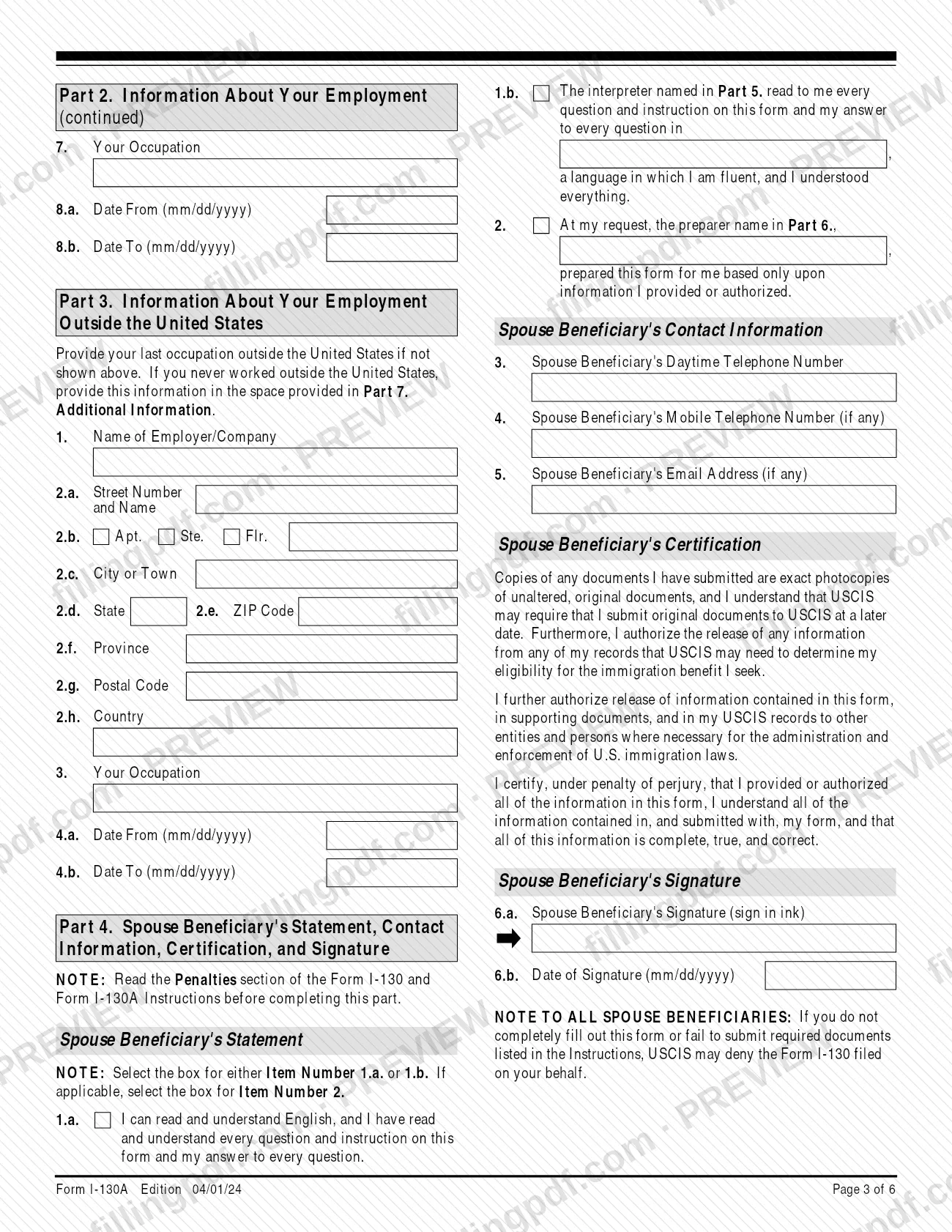
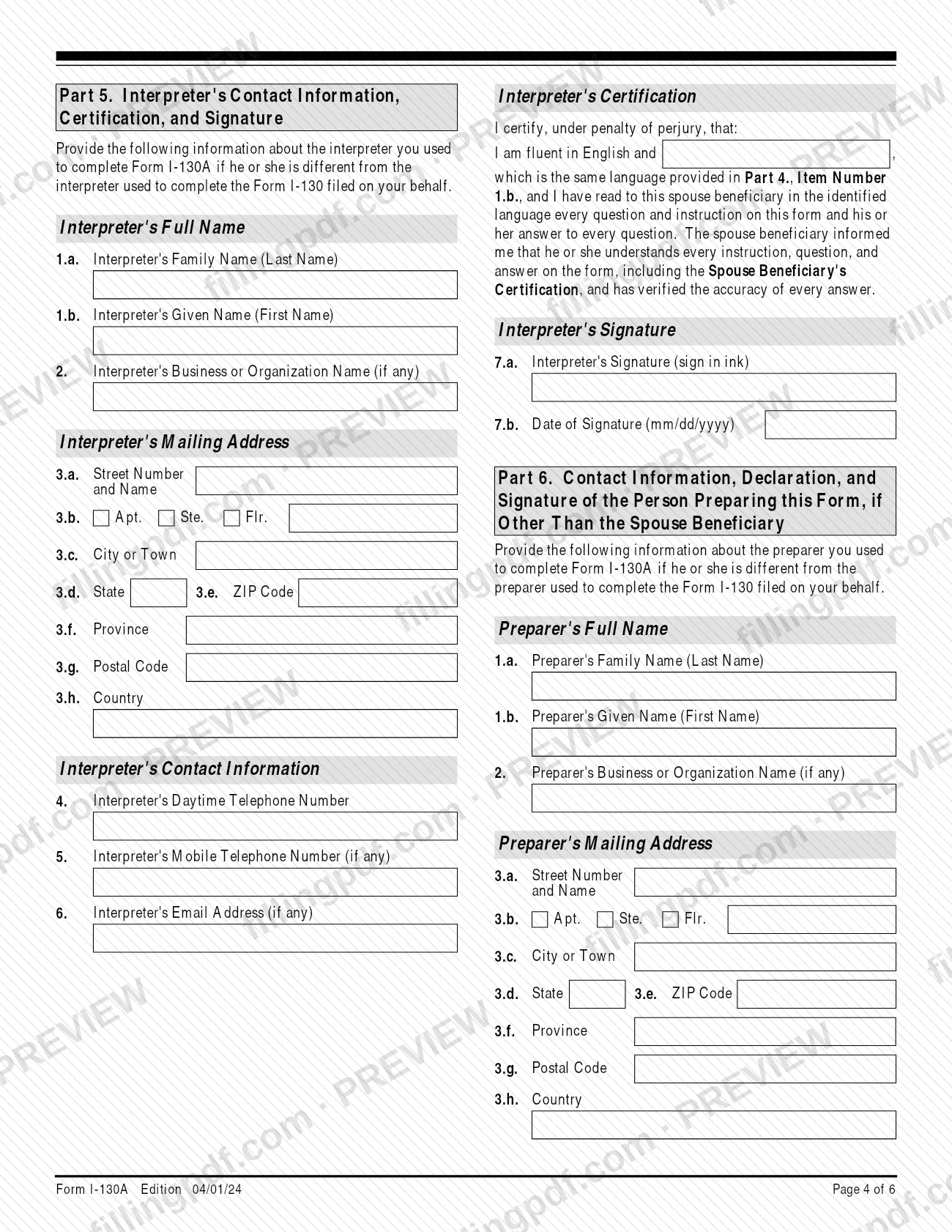
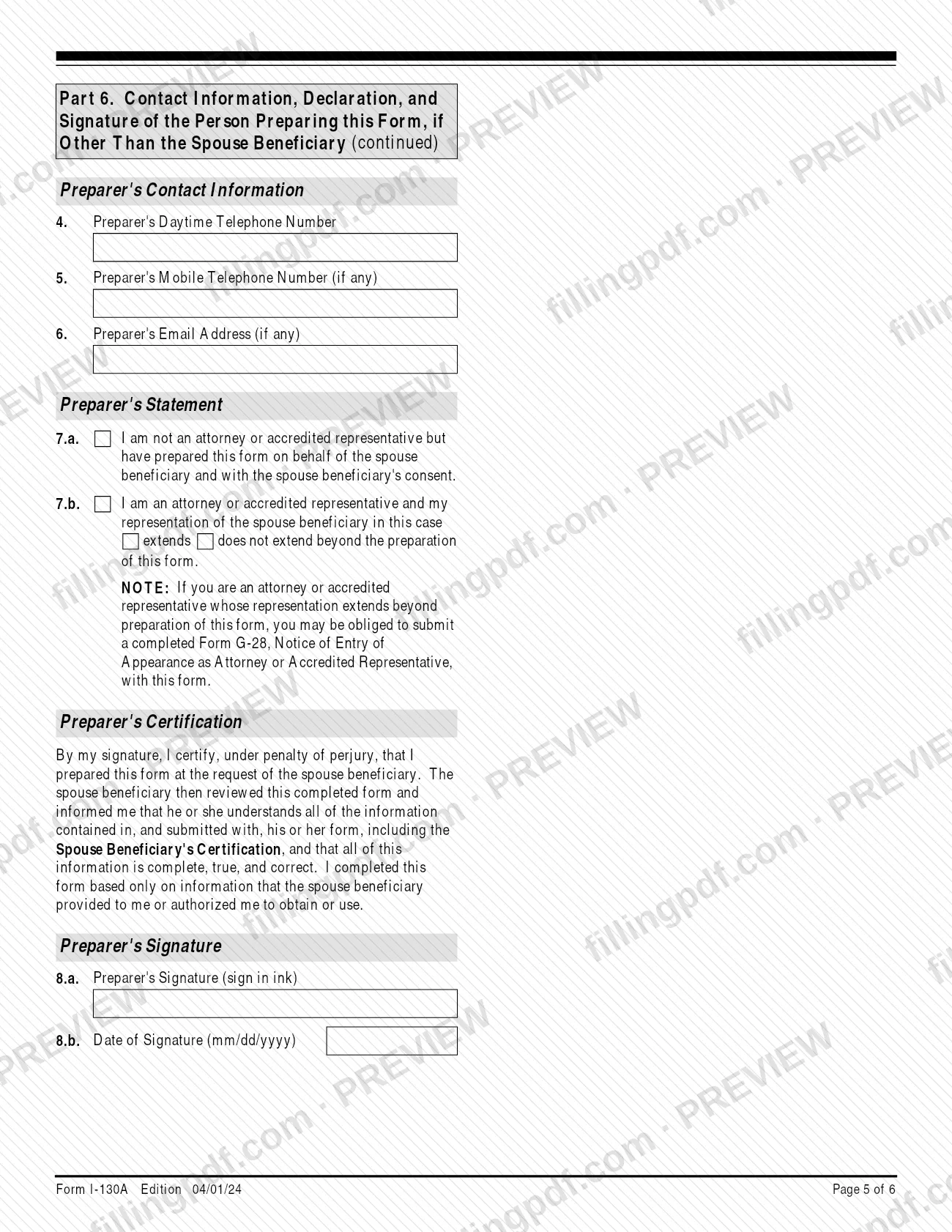
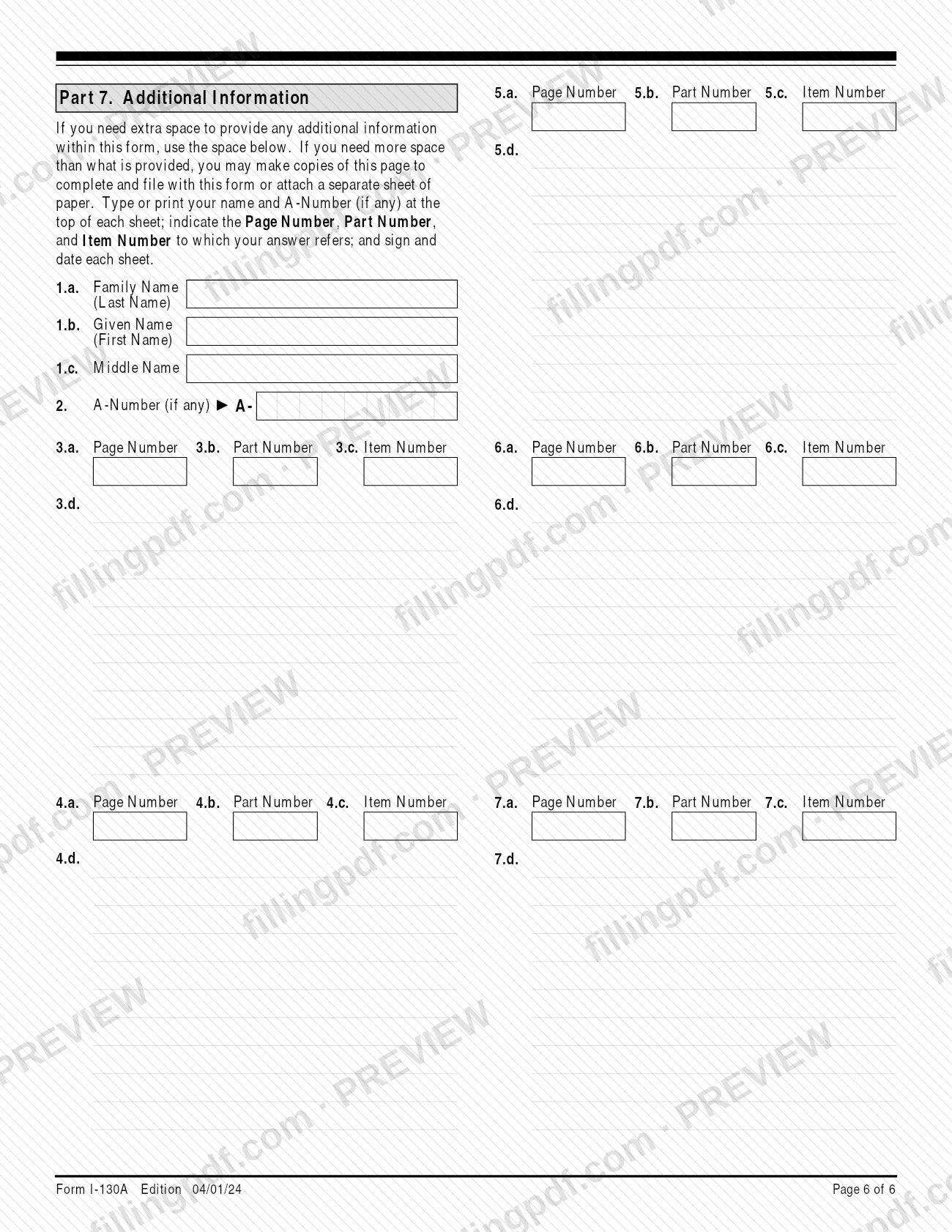
Form I-130A, Supplemental Information for Spouse Beneficiary, is the U.S. Citizenship and Immigration Services (USCIS) form that collects extra information about the spouse named in a Form I-130, Petition for Alien Relative. The beneficiary completes it, and it is submitted with the Form I-130 that the U.S. citizen, lawful permanent resident or non-citizen U.S. national spouse files. On FillingPDF you can fill out Form I-130A online and download or print the completed PDF; the official form and its instructions are published by USCIS, and the form travels with the petition through USCIS filing channels.
Last updated
What is I-130A?
Form I-130A, Supplemental Information for Spouse Beneficiary, is the U.S. Citizenship and Immigration Services (USCIS) form that collects additional information about a spouse beneficiary of Form I-130, Petition for Alien Relative, and is completed by the beneficiary and submitted with the petition.
The two forms have different authors. The spouse who is the petitioner completes Form I-130 to establish the qualifying relationship. The spouse who is the beneficiary completes Form I-130A to supply personal background. USCIS states that filing or approving Form I-130 does not by itself give the relative any immigration status or benefit.
The six-page form (Edition 04/01/24, OMB No. 1615-0012, expiration date printed as 02/28/2027) follows this order:
- Part 1: A-Number, USCIS Online Account Number, full name, five years of physical addresses, last address outside the United States, and information about Parent 1 and Parent 2.
- Part 2: five years of employment history.
- Part 3: last occupation outside the United States.
- Part 4: the beneficiary's statement, contact information, certification and signature.
- Part 5: interpreter's information and certification.
- Part 6: preparer's information, statement and certification.
- Part 7: additional information, for answers that need more space.
An attorney or accredited representative may select the box at the top of page 1 to show that Form G-28 is attached. The instructions for Form I-130/I-130A cover both forms.
Who needs to file I-130A?
The spouse beneficiary completes Form I-130A when the spouse who files Form I-130 on his or her behalf is a U.S. citizen, a lawful permanent resident or a non-citizen U.S. national. The form says the beneficiary must complete and sign it and submit it with the Form I-130 filed by the spouse.
- Beneficiaries living overseas: you still must complete Form I-130A, but you do not need to sign it.
- Petitioners filing for a spouse: the USCIS checklist asks whether you included a completed and signed Form I-130A with your petition, so you should make sure your spouse gets the form.
- Interpreters and preparers: complete Part 5 or Part 6 only if the person who helped with Form I-130A is different from the one who helped with the Form I-130 filed for you. Anyone who helped prepare the form must sign and date it.
- Attorneys and accredited representatives: an attorney or accredited representative whose representation extends beyond preparing the form may be obliged to submit Form G-28 with it.
The instructions tie Form I-130A to petitions for a spouse. Petitions for other relatives follow the Form I-130 instructions, which list who may and may not be petitioned for.
When to file I-130A
Submit Form I-130A at the same time as the Form I-130 filed for your spouse: the instructions say it must be submitted with the petition. The form has no separate due date of its own, so the timing follows when the petition is filed.
Prepare it before the petition is assembled, because USCIS may deny the Form I-130 filed on your behalf if the form is not completely filled out or if required documents listed in the instructions are missing. Gather five years of address and employment history first.
Form I-130A has no processing time of its own. The decision is made on the Form I-130, and USCIS notifies the petitioner of its decision in writing. USCIS may also ask for more information or evidence, request originals of copies, or call for an interview or biometrics appointment based on the petition.
Documents you need
- Form G-28, Notice of Entry of Appearance as Attorney or Accredited Representative, if an attorney or accredited representative's representation extends beyond preparing Form I-130A; also select the G-28 box on page 1.
- Two identical color passport-style photographs of your spouse beneficiary if he or she is in the United States, taken within 30 days of filing the petition, as the Form I-130 instructions require for spouse petitions.
- Additional sheet or copy of Part 7, only if you need more space; type or print your name and A-Number (if any) on each sheet, give the page, part and item number, and sign and date it.
- English translation with the translator's signed certification, only for any supporting document submitted in a foreign language.
How to fill out I-130A
Mark the Form G-28 box
At the top of page 1, an attorney or accredited representative selects the box if Form G-28 is attached and enters the Volag Number, Attorney State Bar Number and USCIS Online Account Number, where they apply. Skip this block if you have no representative.
Enter your numbers and full name
Part 1, Item 1: A-Number, if any. Item 2: USCIS Online Account Number, if any. Items 3.a to 3.c: family name, given name and middle name.
List your physical addresses
Give physical addresses for the last five years, inside or outside the United States, current address first, in Items 4.a to 4.h (with dates in 5.a and 5.b, using PRESENT for 5.b if you still live there) and Items 6.a to 6.h (dates in 7.a and 7.b). Use Part 7 if you need more room.
Give your last address abroad
Items 8.a to 8.f ask for your last address outside the United States of more than one year, even if it is listed above. Enter the dates in 9.a and 9.b in mm/dd/yyyy format.
Enter information about your parents
Items 10.a to 16 cover Parent 1 (family name, given name, middle name, date of birth, sex, city and country of birth, city and country of residence). Items 17.a to 23 ask the same for Parent 2.
Complete your employment history
Part 2: list five years of employment, inside or outside the United States, current employer first (Items 1 to 4.b for Employer 1, then Items 5 to 8.b for Employer 2). If you are unemployed, type or print "Unemployed" in Item 1.
Add your last job outside the U.S.
Part 3: if not shown in Part 2, enter the employer, address, occupation and dates of your last occupation outside the United States. If you never worked outside the United States, say so in Part 7.
Complete your statement and contact details
Part 4: select 1.a if you read English, or 1.b if an interpreter read the form to you in a language you are fluent in. Select Item 2 if a preparer helped, then enter your daytime phone, mobile phone and email in Items 3 to 5.
Sign and date Part 4
Sign in ink at Item 6.a and enter the date at 6.b in mm/dd/yyyy format. If you live overseas you must still complete the form, but you do not need to sign it.
Complete interpreter and preparer parts
Part 5: if your interpreter differs from the one used for the Form I-130, enter name, business, mailing address and contact details (Items 1 to 6) and have them sign at 7.a. Part 6: do the same for a preparer in Items 1 to 6, check 7.a or 7.b, and have the preparer sign at 8.a.
Use Part 7 for extra answers
In Part 7, enter your name (Items 1.a to 1.c) and A-Number (Item 2), then the page, part and item number each extra answer refers to. Sign and date any added sheet.
Review and download the completed PDF
Check that all parts are complete, dates use mm/dd/yyyy, and any required signatures will be added in ink. Download or print the completed PDF from FillingPDF and include it with the Form I-130 package as described under How to submit.
How to submit I-130A
Form I-130A is not filed on its own. It goes with the Form I-130 that your spouse files, either online or by mail.
- Online: USCIS says Form I-130 can be filed online through a USCIS online account; its Forms Available to File Online page explains when the petitioner or a representative can do so. After an online submission USCIS sends a receipt notice.
- By mail from inside the United States: the petition goes to the Chicago or Phoenix lockbox, depending on where the petitioner lives and whether the relative is concurrently filing Form I-485. Current addresses are on the USCIS Direct Filing Addresses for Form I-130 page, reached from www.uscis.gov/i-130.
- From outside the United States: file at the USCIS Chicago lockbox, file online, or, in certain limited circumstances, request to file at a U.S. embassy or consulate. The USCIS page describes that last option for a U.S. citizen filing for an immediate relative.
Do not mail the petition or Form I-130A to the Camp Springs, MD address printed in the Paperwork Reduction Act notice; it is only for comments on the burden estimate. Do not send original documents unless the instructions or regulations request them. A filing fee applies to Form I-130: see the USCIS Fee Schedule page and Form G-1055 for the amount. To get email or text notice of acceptance at a lockbox, clip Form G-1145 to the first page. Questions go to the USCIS Contact Center at 800-375-5283 (TTY 800-767-1833). FillingPDF lets you fill out and download the PDF; submission follows the channels above.
Common mistakes to avoid
- Leaving Form I-130A out of a spouse petition; the instructions say it must be submitted with Form I-130, and the USCIS checklist asks whether it is included.
- Not completely filling out the form or omitting required documents listed in the instructions; USCIS may deny the Form I-130 filed on your behalf.
- Thinking an overseas beneficiary can skip the form; you must still complete Form I-130A and may leave it unsigned only because you live overseas.
- Leaving Part 4 unsigned when you are required to sign, or typing a name instead of signing in ink at item 6.a.
- Listing less than five years of physical addresses or employment, or not putting your current address and current employer first.
- Not typing or printing "Unemployed" in Part 2, Item Number 1 when you are currently unemployed.
- Skipping Part 5 or Part 6 when a different interpreter or preparer helped with Form I-130A than with Form I-130, or leaving their signatures off.
- Writing extra answers on a sheet without your name, A-Number (if any), page, part and item numbers, signature and date.
- Mailing the form to the Camp Springs, MD address in the Paperwork Reduction Act notice instead of the filing address for Form I-130.
Frequently asked questions
What is Form I-130A used for?
Form I-130A, Supplemental Information for Spouse Beneficiary, collects additional information from the spouse named in a Form I-130, Petition for Alien Relative. It covers the beneficiary's address history, parents, employment history and signature, and it is submitted together with the I-130.
Who has to complete Form I-130A?
The spouse beneficiary does, when the spouse filing Form I-130 on his or her behalf is a U.S. citizen, lawful permanent resident or non-citizen U.S. national. The instructions tie the form to petitions for a spouse, and the petitioner must include it with the petition.
Do I sign Form I-130A if I live overseas?
No. If you reside overseas, you still must complete Form I-130A, but you do not need to sign it. Otherwise, sign in ink at Part 4, Item 6.a and enter the date at Item 6.b in mm/dd/yyyy format.
Can I file Form I-130A by itself?
No. The instructions say Form I-130A must be submitted with Form I-130, and USCIS says a petitioner filing for a spouse must also submit it. The package goes in online or by mail, depending on how the petitioner files the I-130.
Where do I mail Form I-130A?
Mail it with the Form I-130 petition. From inside the United States, that is the Chicago or Phoenix lockbox, depending on where the petitioner lives and whether Form I-485 is filed at the same time. Current addresses are on the USCIS Direct Filing Addresses for Form I-130 page.
What happens if Form I-130A is incomplete?
USCIS may deny the Form I-130 filed on your behalf if you do not completely fill out Form I-130A or fail to submit required documents listed in the instructions. Knowingly falsifying or concealing a material fact can lead to denial and other penalties.
How many years of addresses and jobs must I list on Form I-130A?
Five years of each, inside or outside the United States, with the current address and current employer first. The form also asks for your last address outside the United States of more than one year and your last occupation abroad if not shown. Use Part 7 if you need more space.
Do I need Form G-28 with Form I-130A?
Only if you have an attorney or accredited representative. Select the box at the top of page 1 when Form G-28 is attached. A representative whose representation extends beyond preparing the form may be obliged to submit a completed G-28 with it.
Can I fill out Form I-130A online on FillingPDF?
Yes, you can fill out the PDF online on FillingPDF and download or print it. FillingPDF is an independent service and does not file the form with USCIS; submission follows the USCIS channels for Form I-130.
Ready to fill out I-130A?
Fill out I-130A now