
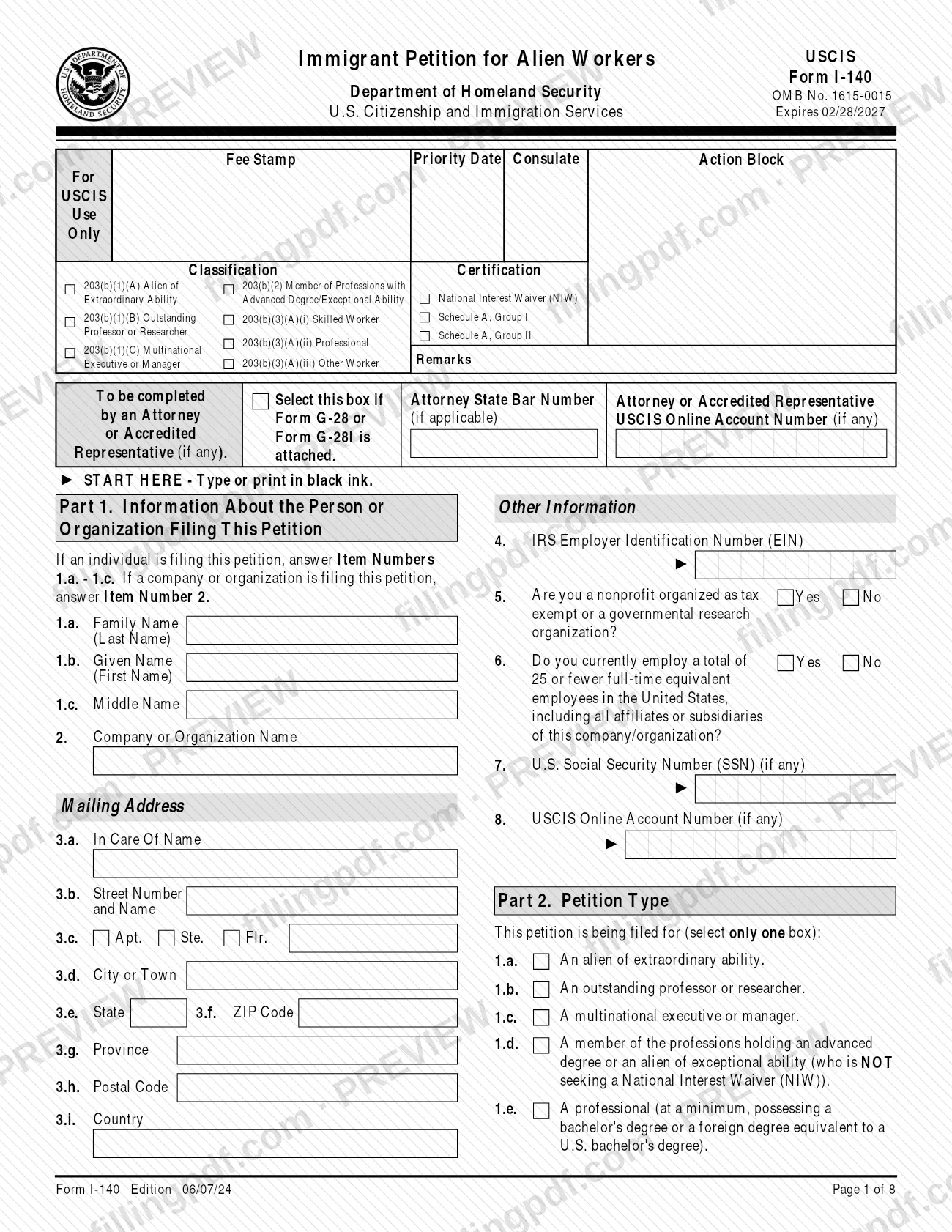
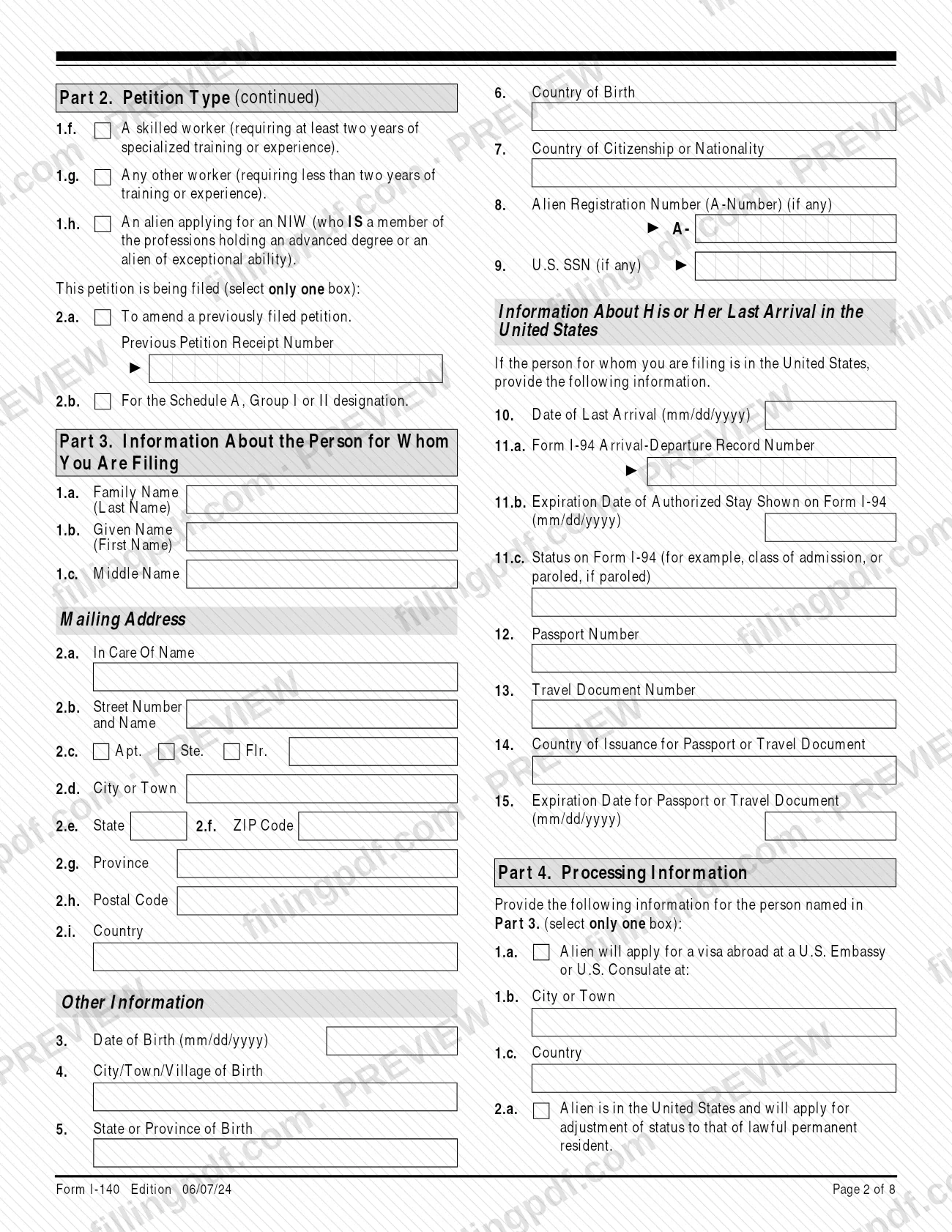
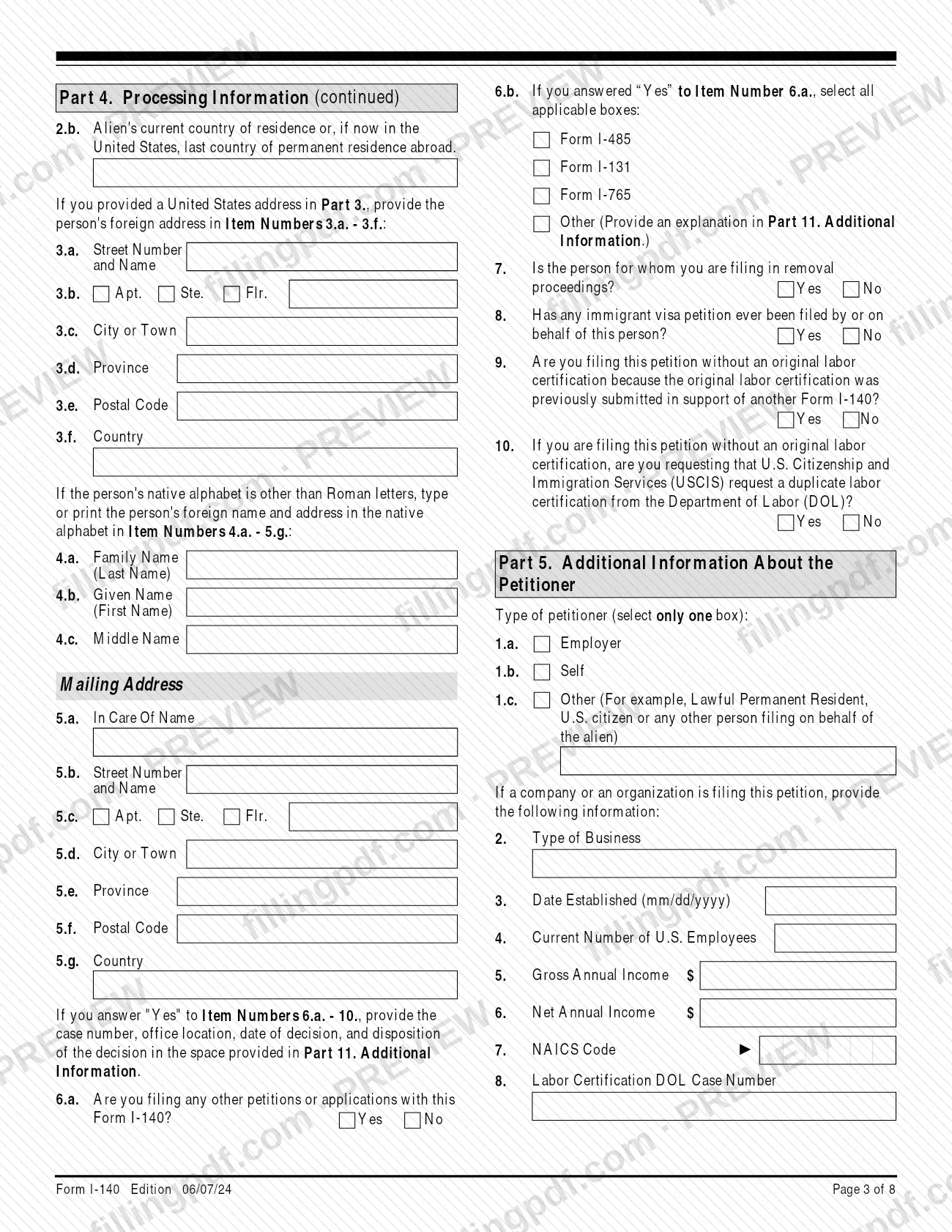
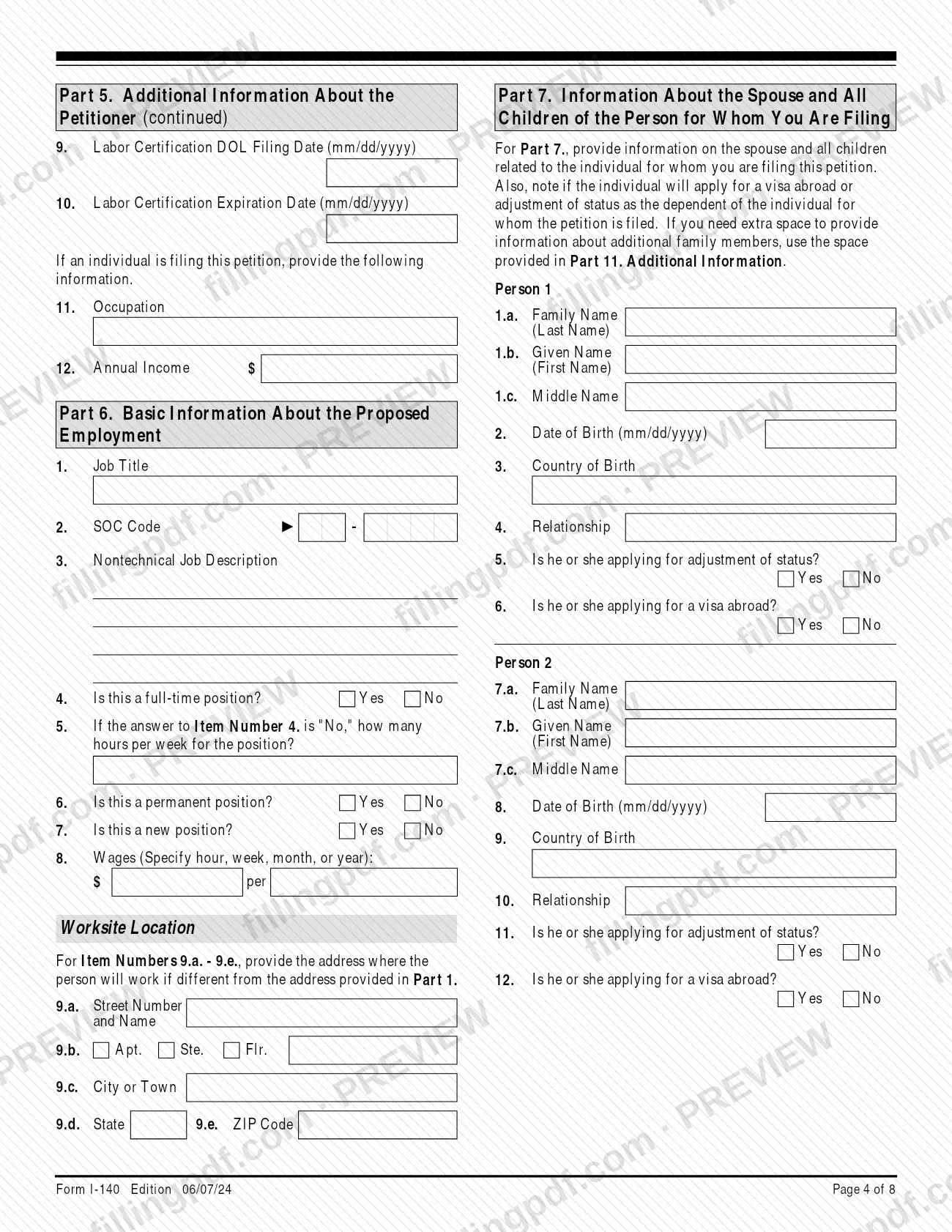
Form I-140, Immigrant Petition for Alien Workers, is the petition that U.S. Citizenship and Immigration Services (USCIS) uses for an employment-based immigrant visa. A U.S. employer files it for most categories, and a self-petitioner or other person may file it for an alien of extraordinary ability or a National Interest Waiver (NIW). On this page you can fill out the form online on FillingPDF and download or print the completed PDF; the original form and its instructions are published by USCIS.
Last updated
What is Form I-140?
Form I-140, Immigrant Petition for Alien Workers, is the form a petitioner files with U.S. Citizenship and Immigration Services (USCIS) to request an employment-based immigrant visa classification for a worker.
The petitioner chooses one classification in Part 2: an alien of extraordinary ability (1.a), an outstanding professor or researcher (1.b), a multinational executive or manager (1.c), a member of the professions with an advanced degree or an alien of exceptional ability (1.d), a professional (1.e), a skilled worker (1.f), any other worker (1.g), or an alien applying for a National Interest Waiver (1.h). Part 2 also lets you amend a previously filed petition (2.a) or ask for a Schedule A, Group I or II designation (2.b).
Most categories require a permanent job offer from a U.S. employer and, for several of them, an individual labor certification from the Department of Labor (DOL). The form also collects details about the worker, the proposed job, the processing route (visa abroad or adjustment of status) and the worker's spouse and children.
Approval means USCIS found the worker eligible for the requested classification. The instructions say approval is the first step toward permanent residence but does not by itself grant permanent residence or employment authorization. Companion forms named by USCIS include Form I-485 (filed with it in some cases), Form I-907 for premium processing and Form G-28 for a representative.
Who needs to file Form I-140?
A U.S. employer files Form I-140 for an outstanding professor or researcher, a multinational executive or manager, a member of the professions with an advanced degree or an alien of exceptional ability, a professional with a bachelor's degree, a skilled worker (at least two years of training or experience) or another worker (less than two years).
Any employer, individual or third party may file it, including the worker himself or herself, for:
- an alien of extraordinary ability in the sciences, arts, education, business or athletics; or
- a member of the professions with an advanced degree, or an alien claiming exceptional ability, who requests a National Interest Waiver (NIW) of the job offer requirement.
Except for those two categories, every category requires a permanent job offer from a U.S. employer, and that employer must file.
If the petitioner is a corporation or other legal entity, only an officer or employee who knows the facts in the petition and has authority to sign for the entity may sign it. A parent or legal guardian may sign for a petitioner under 14 years of age, and a legal guardian may sign for a mentally incompetent person. USCIS does not accept a signature by an attorney, representative or family member signing for the requestor.
When to file Form I-140
Form I-140 may be filed at any time, but a petition based on an approved labor certification must reach USCIS before the labor certification expires. Labor certifications expire 180 days from the date of certification. If the last day falls on a Saturday, Sunday or legal holiday, USCIS accepts the petition on the next business day and rejects petitions with expired labor certifications filed after that.
Where no labor certification is required, the employer must show the ability to pay the offered wage from the date of filing Form I-140 (the priority date) until the worker becomes a lawful permanent resident. Where one is required, that period starts on the date the labor certification was filed.
Certain classifications can use Premium Processing, which requires Form I-907 with the filing fee. The instructions do not give a standard processing time.
Documents you need
- Original, individual labor certification from the Department of Labor (DOL), or documentation of a Schedule A, Group I or II shortage occupation, for categories that require one; not needed if it was already submitted with a different Form I-140.
- Alternatively, select Yes in Part 4, Item Number 10 to ask USCIS to request a duplicate labor certification from DOL.
- Evidence of the employer's ability to pay the offered wage for petitions requiring a job offer: annual reports, federal tax returns or audited financial statements; a financial officer's statement may be used by employers with 100 or more workers.
- For extraordinary ability: evidence of a one-time major achievement or at least three of the listed types of evidence, plus evidence the worker will continue work in the area of expertise.
- For an outstanding professor or researcher: evidence meeting at least two listed standards, three years of teaching or research experience, and a job offer letter (and, for private employers, evidence of three full-time researchers).
- For a multinational executive or manager: a statement showing the required one year of managerial or executive employment abroad, the qualifying relationship between employers and the U.S. duties.
- For an advanced degree or exceptional ability worker: academic records and experience letters, or at least three listed exceptional-ability items; an NIW also needs documentation that the worker's presence is in the national interest.
- For a professional: evidence of a U.S. baccalaureate or equivalent foreign degree and that the degree is required for the occupation.
- For skilled or other workers: evidence that the worker meets the education, training or experience requirements of the labor certification.
- A full English translation of any foreign-language document, with the translator's signed certification of accuracy and competence.
- Form G-28, if an attorney or accredited representative represents the petitioner (select the box at the top of the form).
- Form I-907, only if you request Premium Processing for an eligible classification.
- Evidence supporting a reduced asylum program fee, such as IRS Form 941 or 943, or an IRS Determination Letter, if you qualify as a small employer or nonprofit.
How to fill out Form I-140
Complete the top attorney block if used
If an attorney or accredited representative is acting for you, that person completes the top block: select the box for Form G-28 or G-28I, and enter the State Bar Number and USCIS Online Account Number if any. Leave the USCIS-use boxes blank.
Identify the petitioner in Part 1
Individuals answer Items 1.a. to 1.c.; companies and organizations answer Item 2. Enter the mailing address (Item 3), EIN (4), Yes or No for items 5 and 6, SSN if any (7) and USCIS Online Account Number if any (8).
Select the petition type in Part 2
In Item 1 select only one box, 1.a. to 1.h., for the classification. In Item 2 select 2.a. to amend a previous petition and give its receipt number, or 2.b. for a Schedule A, Group I or II designation.
Enter the person's details in Part 3
Give the name and mailing address (Items 1 to 2), date of birth in mm/dd/yyyy (3), place of birth (4 to 6), country of citizenship (7), A-Number (8) and SSN (9). Use “stateless” with an explanation in Part 11 if there is no citizenship.
Add last arrival information if in the U.S.
For a person in the United States, complete Items 10 to 15: date of last arrival, Form I-94 number, authorized stay expiration date and status, passport and travel document numbers, country of issuance and expiration date.
Choose the processing route in Part 4
Select only one box: 1.a. for a visa abroad (give the Embassy or Consulate city and country) or 2.a. for adjustment of status. Then provide the foreign address (3.a. to 3.f.), the native-alphabet name and address if needed (4 to 5), and answer Items 6.a. to 10.
Describe the petitioner in Part 5
Select the type of petitioner (1.a. Employer, 1.b. Self or 1.c. Other). Companies enter type of business, date established, U.S. employees, incomes, NAICS code and labor certification data (Items 2 to 10); individuals enter occupation and annual income (11 to 12).
Describe the job in Part 6
Enter the job title, SOC code, nontechnical job description, full-time, permanent and new position answers, hours per week if not full time, and wages with the period. Add the worksite address in Items 9.a. to 9.e. if different from Part 1.
List the spouse and children in Part 7
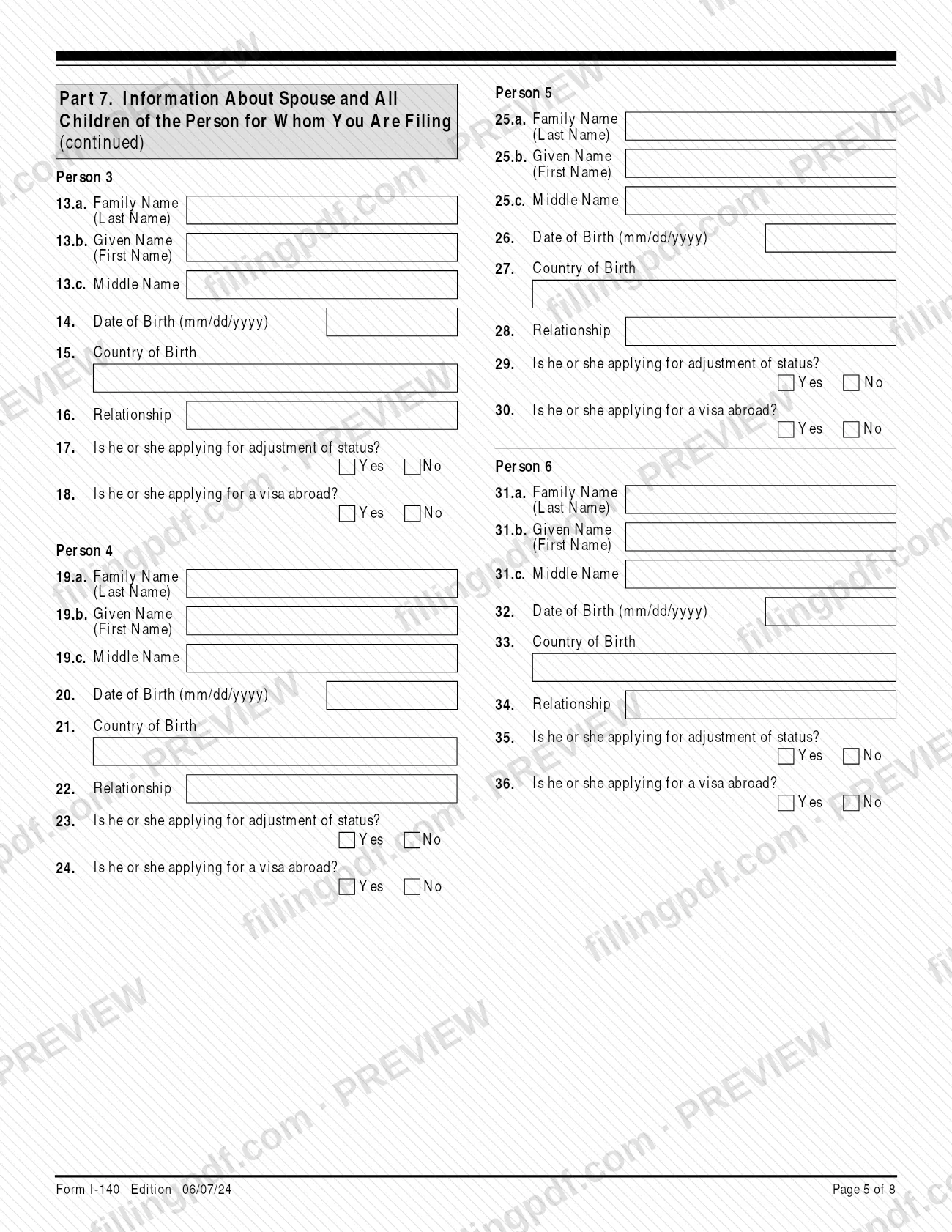
For each person, up to six, give name, date of birth, country of birth and relationship, and answer whether he or she will apply for adjustment of status or a visa abroad. Use Part 11 for additional family members.
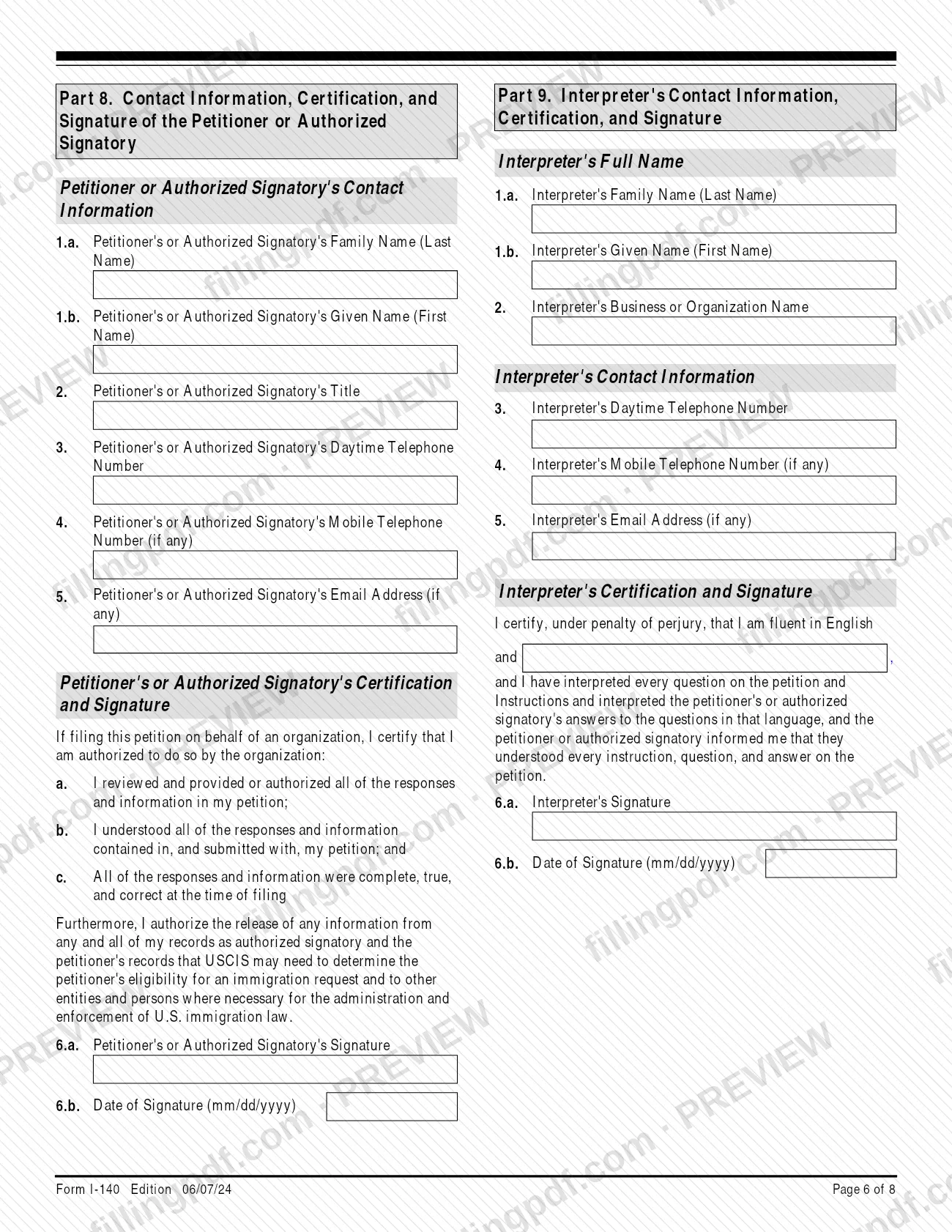
Sign the petition in Part 8
The petitioner or authorized signatory enters contact information, then signs and dates by hand in ink. Do not use a typed or stamped name. An officer or employee with authority signs for an organization.
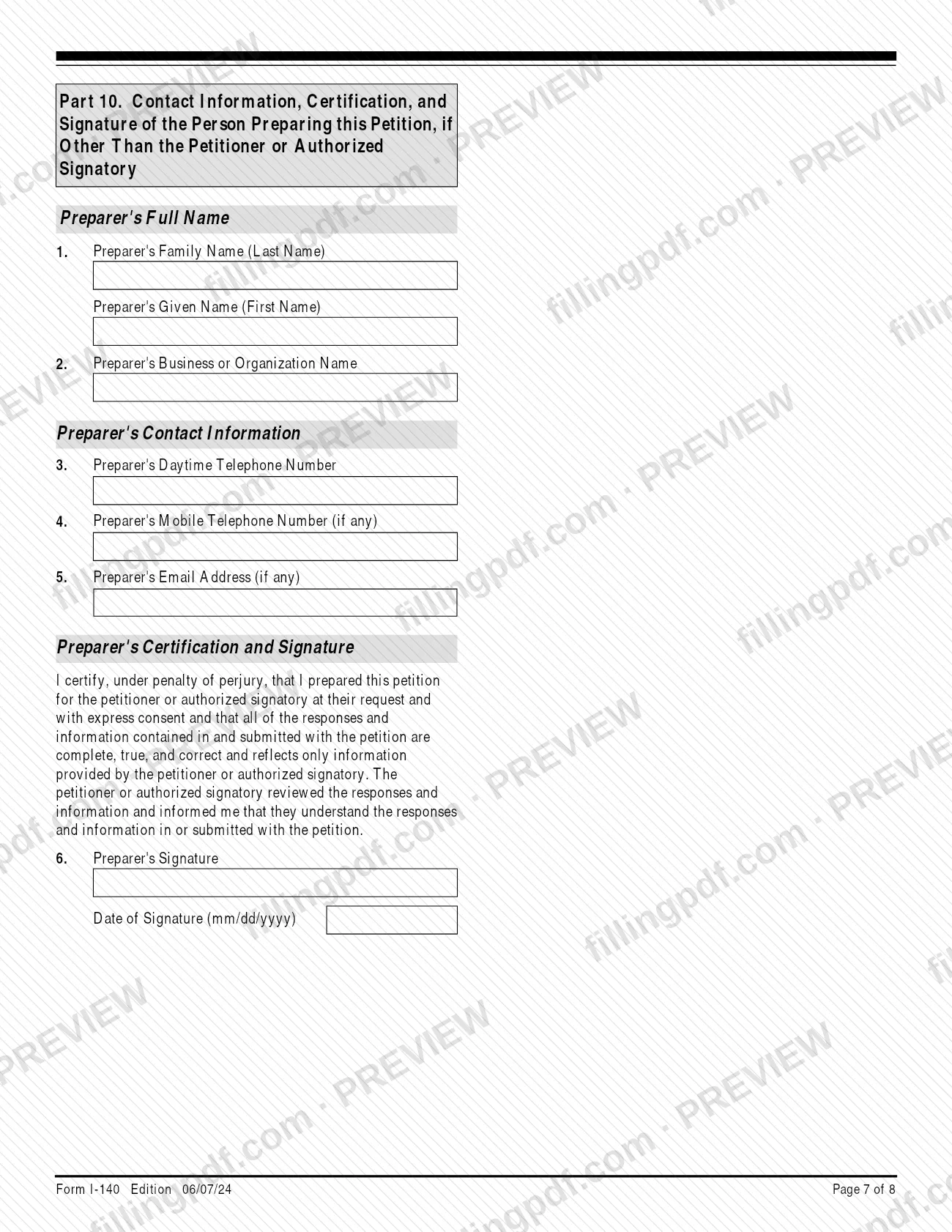
Complete Parts 9 and 10 if applicable
If an interpreter read the instructions and questions to you, the interpreter completes Part 9, signs and dates. If someone other than the petitioner prepared the petition, that person completes, signs and dates Part 10.
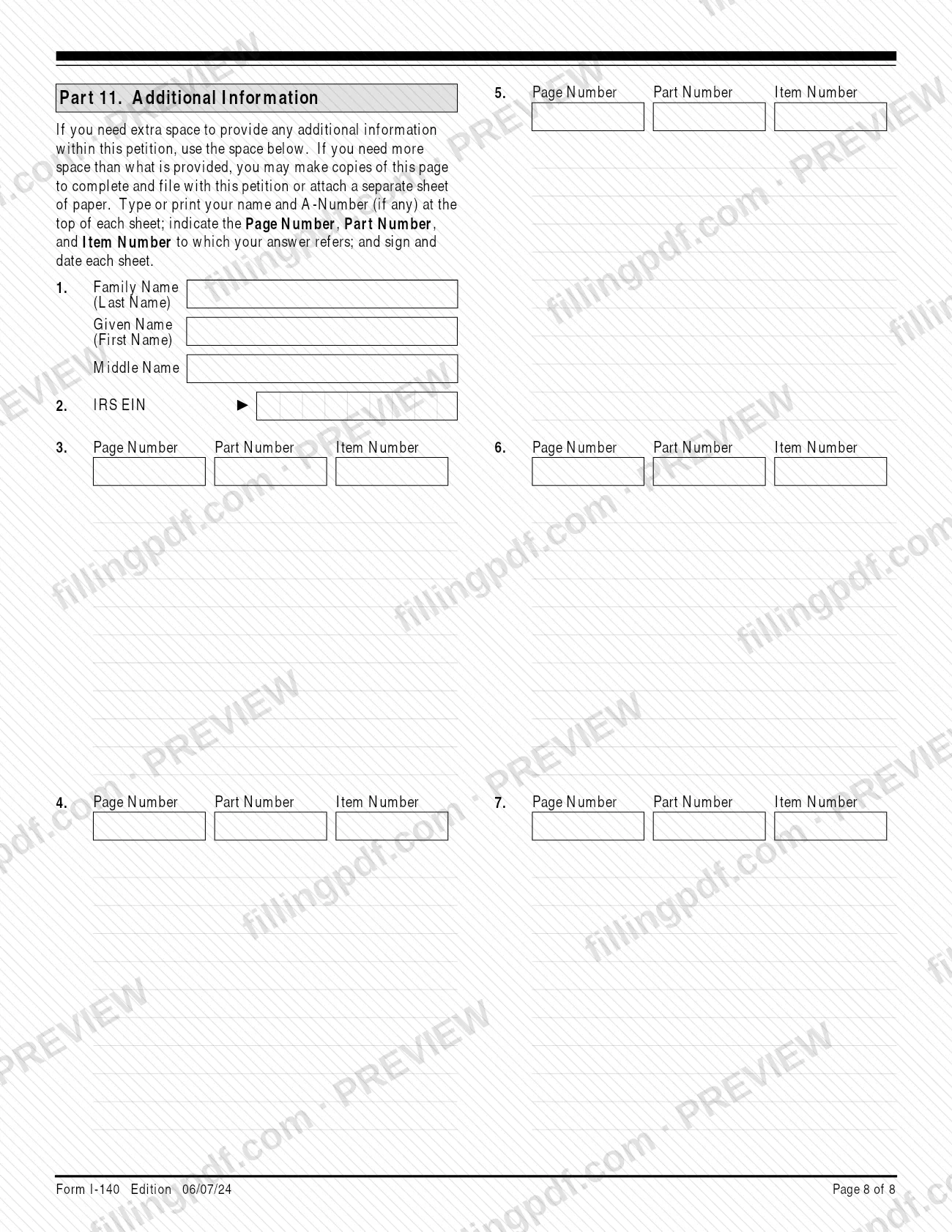
Use Part 11 for extra information
Add your name, EIN and the page, part and item number for each answer that needs more space. On any extra sheet, print your name and A-Number if any, and sign and date it. Enter “N/A” or “None” where the instructions direct.
Review, print and download the PDF
Check every part, the signature and the edition date on each page. Download or print the completed PDF from FillingPDF, sign it by hand and assemble the package described under How to submit.
How to submit Form I-140
USCIS accepts Form I-140 by mail or online.
- By mail: the filing address depends on whether you file Form I-140 alone or with another form. Check the Direct Filing Addresses for Form I-140 on the USCIS page at https://www.uscis.gov/i-140. If you print the form, the edition date and page numbers must be visible on every page, and all pages must come from the same edition, or USCIS may reject it.
- Online: create or log in to a USCIS online account and check the Forms Available to File Online page to see when you or your representative can file Form I-140 online.
- With Form I-907: if you submit Form I-140 together with Form I-907 for Premium Processing, you must file by mail. Do not send Premium Processing requests to a USCIS Lockbox facility.
When filing with Form I-485, do not combine supporting documents; assemble a separate package for each form. A fee applies: see Form G-1055 and the USCIS Fee Schedule page for the amount and payment forms such as G-1450, G-1650 or G-1651. Sign the petition in ink; photocopies, faxes and scans of an original handwritten signature are valid. Do not mail the form to the Paperwork Reduction Act address in the instructions. FillingPDF lets you fill out and download the PDF; submission follows the channels above.
Common mistakes to avoid
- Leaving the petition unsigned or signing with a typed or stamped name; USCIS rejects it, and a signature by an attorney or family member for the requestor is not accepted.
- Omitting the IRS Employer Identification Number or Social Security number in Part 1 when the category requires a permanent job offer; USCIS rejects the petition as deficient.
- Leaving Part 1, Item Number 5 or 6 without a Yes or No answer; self-petitioners should answer No to 5 and Yes to 6.
- Filing a petition based on a labor certification after its 180-day validity has elapsed.
- Leaving the person's date of birth in Part 3 blank, which is one of the fields that triggers rejection.
- Printing the form with pages from different editions or without the edition date and page numbers visible at the bottom.
- Submitting original documents when copies are enough; USCIS may destroy originals sent when not required or requested.
- Sending foreign-language documents without a full English translation and the translator's signed certification.
- Combining the Form I-140 and Form I-485 supporting documents into one package when filing the two together.
- Sending a Premium Processing request to a USCIS Lockbox facility or filing the petition without the correct fee.
Frequently asked questions
What is Form I-140 used for?
Form I-140 is the USCIS petition for an employment-based immigrant visa. A petitioner files it to request a classification for a worker, such as extraordinary ability, skilled worker or National Interest Waiver. Approval does not itself grant permanent residence or employment authorization.
Who can file the i-140 form?
A U.S. employer files for most categories, which require a permanent job offer. Any employer, individual or third party, including the worker, may file for an alien of extraordinary ability or for a National Interest Waiver. A parent or guardian may sign for a petitioner under 14.
Can I fill out Form I-140 online?
You can complete the PDF online on FillingPDF and download or print it. FillingPDF does not file it with USCIS. You submit the petition by mail, or online through a USCIS online account where Form I-140 is available for online filing.
Is there a deadline to file Form I-140?
Form I-140 may be filed at any time. The exception is a petition based on a labor certification: USCIS must receive it within 180 days of the certification date, or it will reject the petition. A weekend or holiday end date moves to the next business day.
Do I need a labor certification with Form I-140?
Yes, for the categories that require one, such as professional, skilled worker, other worker, and advanced degree or exceptional ability without an NIW. Submit the original unless already filed with another Form I-140, or ask USCIS in Part 4, Item 10 to request a duplicate from DOL.
What is the filing fee for Form I-140?
A filing fee applies, but the amount is not printed on the form. See Form G-1055 and the USCIS Fee Schedule page for the current amount and payment options. USCIS rejects a Form I-140 that is not signed or not accompanied by the correct fee.
Can I use Premium Processing for Form I-140?
Only certain classifications are eligible. If yours is, file Form I-907 with its fee, and file by mail if you submit it with Form I-140. Do not send Premium Processing requests to a USCIS Lockbox facility. Check the USCIS Premium Processing page for eligibility.
Can an attorney sign Form I-140 for me?
No. USCIS does not accept a signature by an attorney, representative or family member signing for the requestor. An authorized officer or employee signs for a corporation. A representative can be listed using Form G-28, but the petitioner still signs.
Ready to fill out Form I-140?
Fill out Form I-140 now