
The I-193 is the Department of Homeland Security (DHS) Application for Waiver of Passport and/or Visa, published on the USCIS website. USCIS describes it as the form for an alien who is a legal resident of the United States to reenter the country without the passport and/or visa. On FillingPDF you can fill out the form online and download or print the completed PDF; the application itself is filed with the local office that covers the port of entry, as described below.
Last updated
What is I-193?
Form I-193, Application for Waiver of Passport and/or Visa, is the DHS form on which a person asks for a waiver of the passport and/or visa normally needed to enter the United States, and explains why those documents are not in their possession.
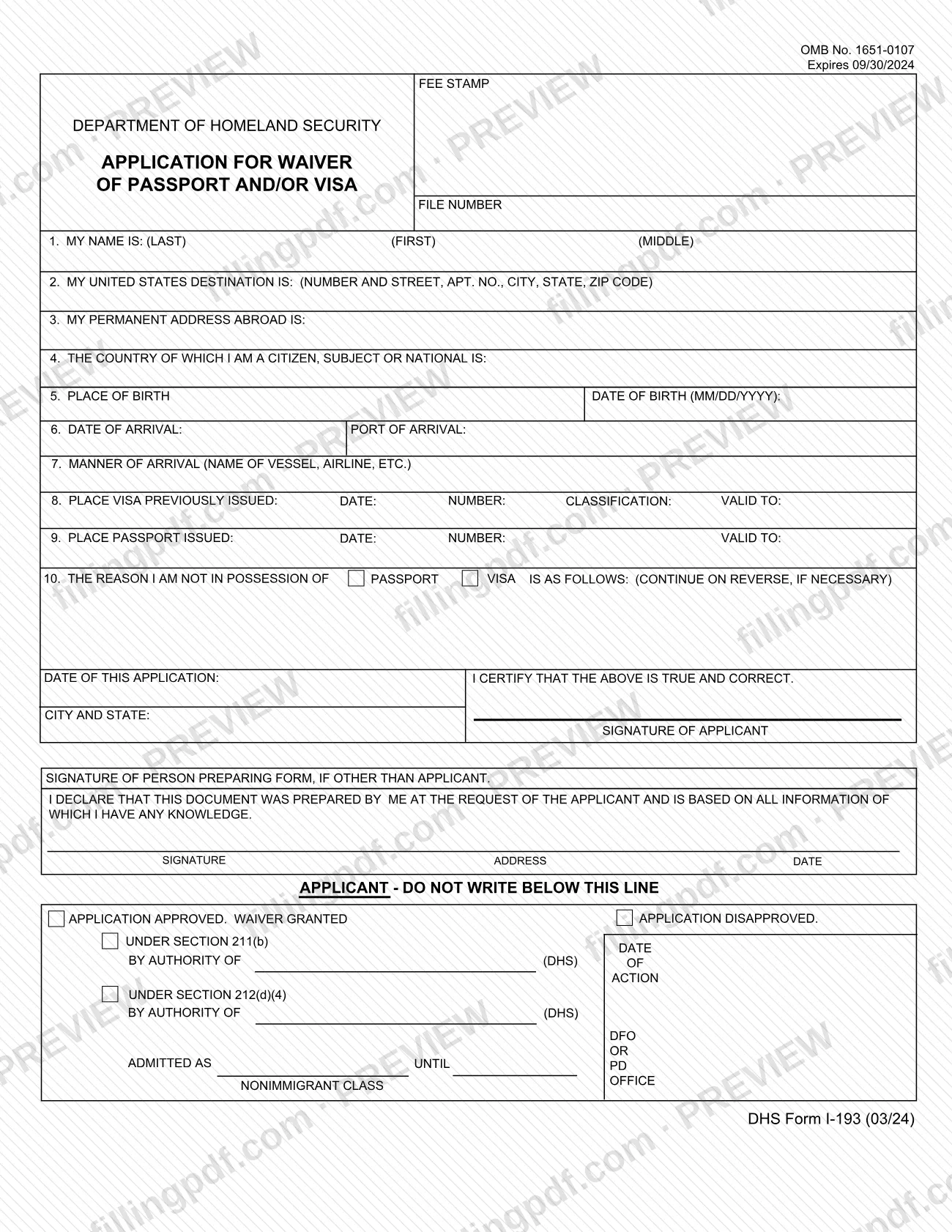
USCIS describes the form as the application for an alien who is a legal resident of the United States to reenter the country without the alien's passport and/or visa. The form is a single application with ten numbered items: the applicant's name, U.S. destination, permanent address abroad, country of citizenship, place and date of birth, date and port of arrival, manner of arrival, details of any visa and passport previously issued, and the reason the passport or visa is missing.
The lower part of the form is for the agency. It carries the decision, either application approved and waiver granted or application disapproved, with the waiver authority shown as section 211(b) or section 212(d)(4), and, where applicable, the nonimmigrant class of admission. The applicant does not write below the line marked "Applicant - do not write below this line".
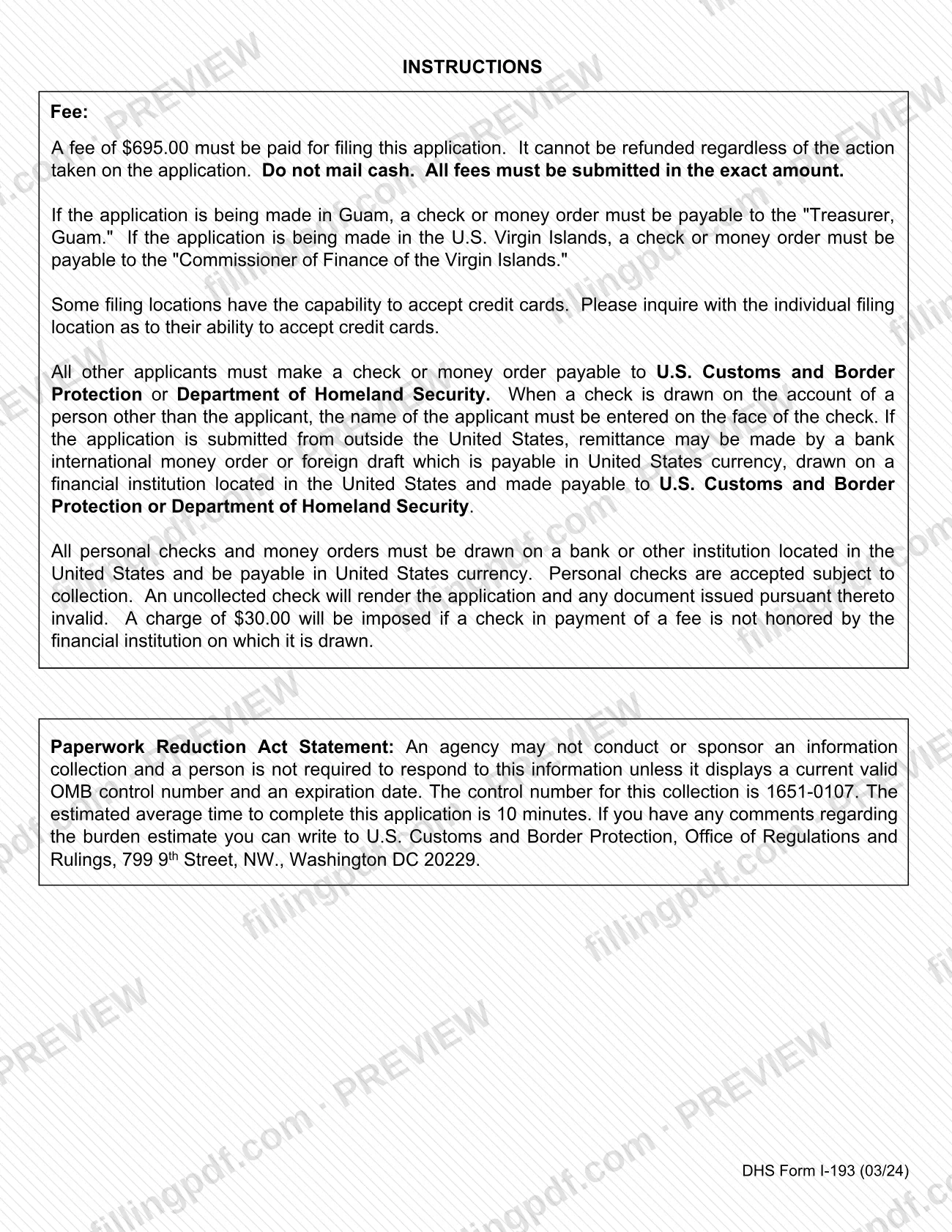
The form is printed under OMB No. 1651-0107, and the edition shown is DHS Form I-193 (03/24). The printed instructions give the estimated average time to complete it as 10 minutes and explain how the filing fee is paid. A filing fee applies; ask the filing location or check the USCIS Fee Schedule page for the current amount.
Who needs to file I-193?
The main group is an alien who is a legal resident of the United States and is entering, or reentering, the country without a passport and/or visa. The applicant completes the form and certifies that the information is true and correct.
- The applicant signs in the applicant signature block and enters the date of the application and the city and state.
- A person who prepares the form for the applicant must also sign, give an address and date it, declaring that the form was prepared at the applicant's request and is based on all the information the preparer knows. This block applies only when someone other than the applicant prepared the form.
The form asks for the applicant's U.S. destination and permanent address abroad, so it is built for a person arriving from outside the United States. The reason for the missing passport or visa goes in item 10, with a continuation on the reverse if more space is needed.
The printed instructions and the USCIS page do not list other eligibility groups or exclusions, so for questions about whether a waiver is available in your situation, ask the local office that covers your port of entry.
When to file I-193
The triggering event is arriving at, or entering through, a U.S. port of entry without a passport and/or visa. USCIS directs the form to the local office with jurisdiction over the port of entry where the alien is entering, so the application is filed at the port where you arrive.
Item 6 asks for the date and port of arrival, and item 10 asks why you do not have the passport or visa. The form and the USCIS page print no separate filing deadline and no processing time. The filing fee is paid when the application is filed, and it is not refunded whatever action is taken on the application.
Documents you need
- Filing fee payment: a check or money order in the exact amount, payable to U.S. Customs and Border Protection or Department of Homeland Security (to the Treasurer, Guam, or the Commissioner of Finance of the Virgin Islands if you apply there). Never cash.
- If the application is submitted from outside the United States: a bank international money order or foreign draft payable in U.S. currency, drawn on a U.S. financial institution, instead of a personal check.
How to fill out I-193
Enter your name
Item 1: write your last, first and middle name in the order the form prints them.
Give your U.S. destination
Item 2: enter the number and street, apartment number, city, state and ZIP code where you are going in the United States.
Enter your permanent address abroad
Item 3: write your permanent address outside the United States.
State your country of citizenship
Item 4: enter the country of which you are a citizen, subject or national.
Add place and date of birth
Item 5: enter your place of birth and your date of birth in MM/DD/YYYY format.
Enter arrival date and port
Item 6: write the date of arrival and the port of arrival.
Describe your manner of arrival
Item 7: enter the name of the vessel, airline or other means by which you arrive.
Complete visa and passport details
Item 8: give the place and date a visa was previously issued, its number, classification and valid-to date. Item 9: give the place and date your passport was issued, its number and valid-to date.
Explain why documents are missing
Item 10: state the reason you do not have your passport and/or visa. If you need more space, continue on the reverse.
Date, certify and sign
Enter the date of the application and the city and state, then sign as applicant under the certification that the information is true and correct.
Add preparer details if applicable
If someone other than you prepared the form, that person signs and enters an address and date in the preparer block. Leave this block empty if you prepared it yourself.
Leave the agency section blank and download
Do not write below the "Applicant - do not write below this line" mark. Review every item, then download or print the completed PDF from FillingPDF and file it as described under How to submit.
How to submit I-193
File Form I-193 with the local office that has jurisdiction over the port of entry where you are entering, and pay the filing fee when you file. The form prints no mailing address or online portal, so confirm the filing location's procedure with that office.
- Filing location: the local office with jurisdiction over your port of entry, as stated on the USCIS page for Form I-193.
- Fee: a filing fee applies and is not refundable; the amount is on the USCIS Fee Schedule page. Do not mail cash, and pay the exact amount.
- Check or money order: make it payable to U.S. Customs and Border Protection or Department of Homeland Security. In Guam, make it payable to the "Treasurer, Guam." In the U.S. Virgin Islands, make it payable to the "Commissioner of Finance of the Virgin Islands." If a check is drawn on someone else's account, write the applicant's name on its face.
- Payments from outside the United States: a bank international money order or foreign draft is accepted if payable in U.S. currency, drawn on a U.S. financial institution and made payable to U.S. Customs and Border Protection or Department of Homeland Security.
- Credit cards: some filing locations accept them; ask the location.
Sign the form: USCIS rejects and returns any unsigned form. If you print it to mail, keep the edition date and page numbers visible on every page, and use pages from the same edition. FillingPDF lets you fill out and download the PDF; submission follows the channels above.
Common mistakes to avoid
- Submitting the form unsigned. USCIS says it rejects and returns any unsigned form, so the applicant must sign and date it.
- Printing the form with missing pages, or with pages from different editions. USCIS may reject it unless the edition date and page numbers show on every page.
- Writing in the section below the line marked "Applicant - do not write below this line", which is reserved for the agency decision.
- Mailing cash or an amount other than the exact fee. The instructions say not to mail cash and that fees must be in the exact amount.
- Making the check or money order payable to the wrong party, for example not using the Guam or U.S. Virgin Islands payee when applying there.
- Paying with a check from someone else's account without writing the applicant's name on its face.
- Paying by a check or money order drawn on a non-U.S. bank or in a foreign currency; payments must be in U.S. currency and drawn on a U.S. institution.
- Leaving out the preparer's signature, address and date when someone other than the applicant filled in the form.
Frequently asked questions
What is Form I-193 used for?
Form I-193 is the DHS Application for Waiver of Passport and/or Visa. USCIS describes it as the form for an alien who is a legal resident of the United States to reenter the country without the passport and/or visa, and item 10 asks you to explain why the documents are missing.
Where do I file Form I-193?
File it with the local office that has jurisdiction over the port of entry where you are entering, as stated on the USCIS page for the form. The form prints no mailing address or online portal, so confirm the procedure with that office.
Is there a fee for Form I-193, and is it refundable?
Yes, a filing fee applies, and the instructions say it cannot be refunded regardless of the action taken on the application. The amount is on the USCIS Fee Schedule page. Pay the exact amount by check or money order; do not mail cash.
Who should the check or money order be payable to?
Generally to U.S. Customs and Border Protection or Department of Homeland Security. In Guam use "Treasurer, Guam," and in the U.S. Virgin Islands use "Commissioner of Finance of the Virgin Islands." Some locations accept credit cards, so ask the filing location.
Can I fill out Form I-193 online?
You can complete the PDF online on FillingPDF and download or print it. FillingPDF is an independent service and does not file the form with USCIS or DHS; you submit it through the channels the agency provides.
What happens if I forget to sign Form I-193?
USCIS states that it will reject and return any unsigned form. Sign and date the application in the applicant block, and if someone else prepared it, that person must sign the preparer block too.
Who signs if someone else filled out my I-193?
You still sign as the applicant, certifying the information is true and correct. The person who prepared the form also signs, gives an address and enters a date, declaring it was prepared at your request and based on all the information they know.
What do sections 211(b) and 212(d)(4) on the form mean?
They appear in the agency-use block at the bottom of the form, where the decision is recorded: waiver granted under section 211(b) or section 212(d)(4), or application disapproved. You do not complete that block as the applicant.
Ready to fill out I-193?
Fill out I-193 now