
Form I-212 is the application U.S. Citizenship and Immigration Services (USCIS) publishes for people who are inadmissible under INA section 212(a)(9)(A) or (C) and must obtain consent to reapply for admission before they can lawfully return to the United States. The I-212 asks for your removal history, the status you want to seek and the reasons for your request. On this page you can fill out the form online on FillingPDF and download or print the completed PDF; the form, its instructions and the filing addresses are published by USCIS.
Last updated
What is I-212?
Form I-212, Application for Permission to Reapply for Admission After Deportation or Removal, is the Department of Homeland Security (DHS) application used to ask for consent to reapply for admission to the United States when you are inadmissible under INA section 212(a)(9)(A) or (C). Consent to reapply is also called "permission to reapply."
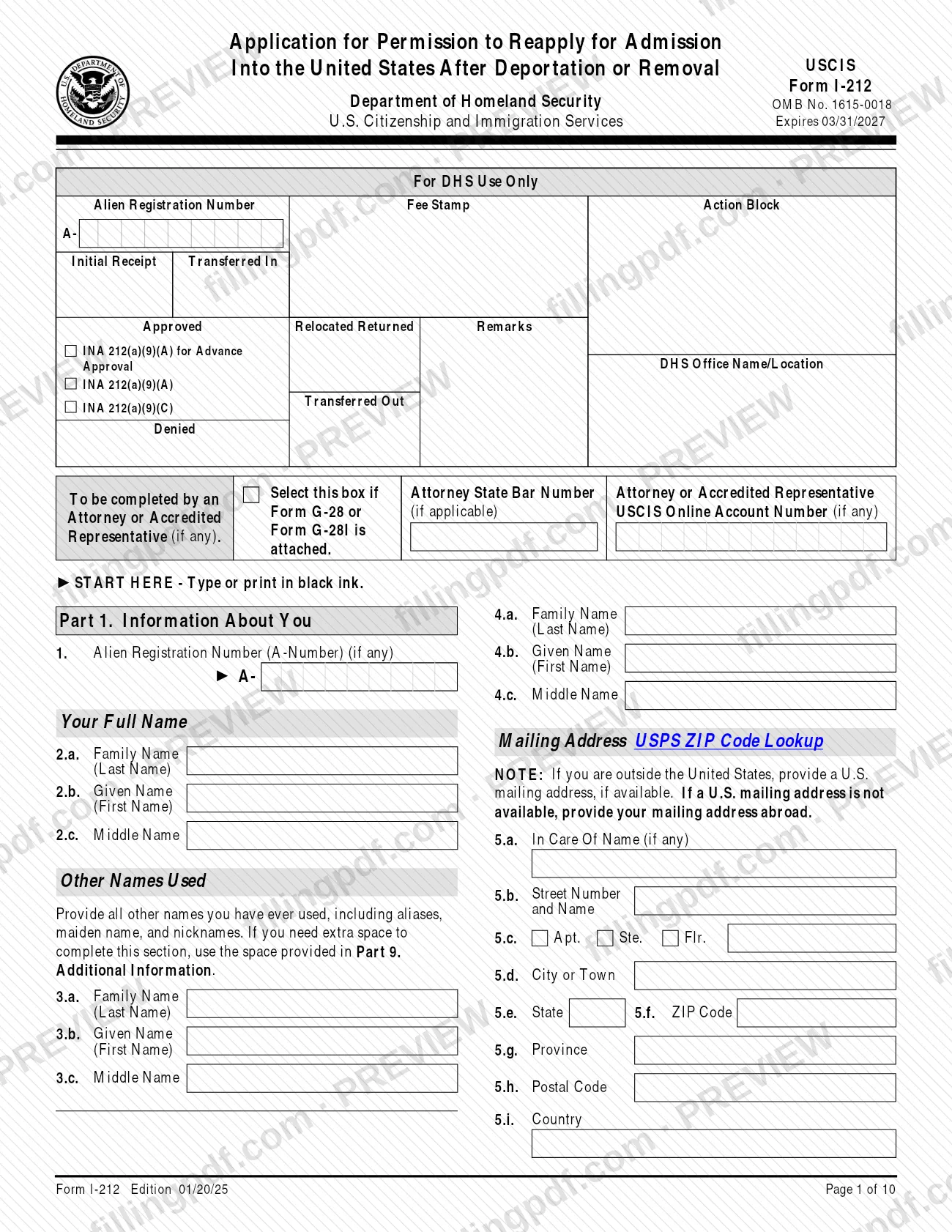
The form is issued by USCIS under OMB No. 1615-0018, and the edition on the PDF is 01/20/25. Its parts cover your personal information (Part 1), the reasons you are filing (Part 2), the status you would seek and why you want to return (Part 3), biographic information (Part 4), additional information required only when filing with U.S. Customs and Border Protection (CBP) (Part 5), signatures of the applicant, any interpreter and any preparer (Parts 6 to 8), and extra space (Part 9).
Approval is discretionary: the adjudicator weighs favorable and unfavorable factors. If approved, the permission is valid indefinitely unless the agency that granted it revokes it. The agency with jurisdiction depends on your case: USCIS decides only applications correctly filed with it, not those that must be filed with CBP or the Executive Office for Immigration Review (EOIR).
Some applicants use a waiver instead of Form I-212, such as Form I-601, Form I-690 or Form I-192, depending on the benefit sought. Form G-325A is no longer required with this application, because Form I-212 now collects those data.
Who needs to file I-212?
You should file Form I-212 if you are inadmissible under INA section 212(a)(9)(A) or (C) and need consent to reapply before returning to the United States. The USCIS instructions describe these groups:
- Inadmissible under 212(a)(9)(A) only: you were removed, or left on your own while a removal order was outstanding, and you are an immigrant visa applicant, an adjustment of status applicant under INA section 245, a person seeking nonimmigrant admission at a port of entry without needing a visa, or a nonimmigrant visa applicant at a U.S. Consulate.
- Inadmissible under 212(a)(9)(C): you are an immigrant visa applicant, a person seeking nonimmigrant admission at a port of entry without needing a visa, or a nonimmigrant visa applicant at a U.S. Consulate.
You may not file if you are inadmissible under 212(a)(9)(C) and you are in the United States, or you have not been outside the United States for more than 10 years since your last departure.
You may not need to file if, for example, your inadmissibility period has expired, you were refused entry but not formally removed, you left within the time set in a voluntary departure order, or you are applying for Registry or Temporary Protected Status. Some applicants, such as NACARA or HRIFA adjustment applicants, use a waiver form instead. If you are inadmissible under both (A) and (C), file Form I-212 and Form I-601.
A parent or legal guardian may sign for an applicant under 14, and a legal guardian may sign for a mentally incompetent person.
When to file I-212
File before you return to the United States. If you have already been excluded, deported or removed and are outside the country, you must seek consent to reapply before returning. If you are inadmissible under 212(a)(9)(C), you cannot file until you have been outside the United States for at least 10 years since your last departure.
If you have been ordered removed but have not yet left and will apply for an immigrant visa abroad, you may file before you depart; any approval is conditional until you actually leave, and it covers only inadmissibility under 212(a)(9)(A). If you are ordered removed again after approval, you need a new application.
The instructions set no other deadline and give no processing time. If you submit Form I-212 with a Form I-601, an adjustment of status application or an immigrant or nonimmigrant visa application, items 16 to 20 of Part 1 ask you to link them.
Documents you need
- Copies of all correspondence and documents about your deportation or removal proceedings and removal, including final orders, if applicable. Keep the originals.
- Evidence of your relationship to any relative listed in Part 3, Items 3.a.-3.c.; for a U.S. citizen relative, also proof of U.S. citizenship.
- For a relative who is not a U.S. citizen: full name, date of birth, place of birth, place and status at admission or entry, current immigration status and A-Number if known.
- If inadmissible under 212(a)(9)(C): evidence of your removal, the date you entered or tried to reenter without admission or parole, and your last departure date.
- If inadmissible under 212(a)(9)(C): evidence of 10 years outside the United States since your last departure, such as passport entry/exit stamps, airline tickets, foreign residence registration, utility bills or foreign employment records.
- If convicted of an aggravated felony (Part 2, Items 1.d. or 5.d.): court documents, police records or criminal records showing the disposition; originals or properly authenticated certified copies should be submitted.
- If filing with CBP at a port of entry: proof of citizenship; a driver's license alone is not proof of citizenship but may help establish identity with another document.
- If filing with CBP and you used other names: evidence of legal name changes such as marriage certificates, divorce decrees, adoption decrees or naturalization certificates; copies are acceptable.
- If filing with CBP: official police records, or proof none exist, from every country of prior residence and of citizenship; valid for 15 months from issuance.
- Evidence supporting a discretionary approval, such as family ties, hardship, rehabilitation and employment records. Affidavits must be backed by evidence or an explanation of why it cannot be obtained.
- Full English translation of any foreign-language document, with the translator's signed certification of accuracy and competence, printed name, date and contact information.
How to fill out I-212
Enter your A-Number and names
In Part 1, Item 1 enter your A-Number if you have one. Give your full legal name in Items 2.a.-2.c. and every other name you have used, including aliases, maiden name and nicknames, in Items 3.a.-4.c. If an attorney or accredited representative helps, complete the box at the top and attach Form G-28 or G-28I.
Provide mailing and physical addresses
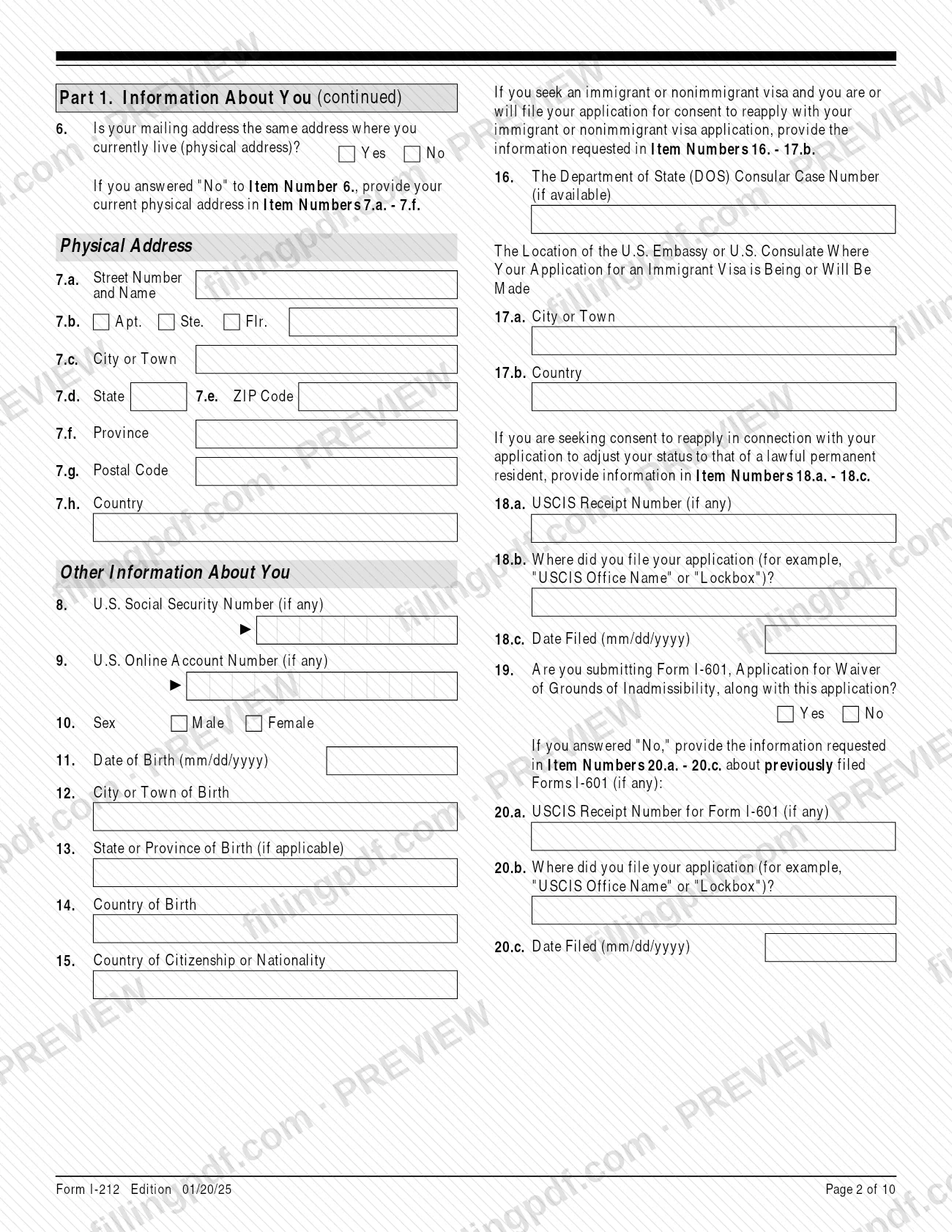
Items 5.a.-5.i. are the address where you want to receive correspondence; if you are outside the United States, give a U.S. mailing address if available. Answer Item 6, and if your mailing address is not where you live, give your physical address in Items 7.a.-7.h.
Complete other personal information
Enter your Social Security number (Item 8) and USCIS Online Account Number (Item 9) if any, sex (Item 10), date of birth as mm/dd/yyyy (Item 11), place of birth (Items 12-14) and country of citizenship or nationality (Item 15). Type "stateless" in Item 15 if you have no citizenship, and explain in Part 9.
Link related applications
Items 16-17.b.: DOS case number and the consulate city and country if you file with a visa application. Items 18.a.-18.c.: receipt number, filing location and date for an adjustment of status application. Items 19-20.c.: whether you file Form I-601 with this form, or details of a previously filed I-601.
Describe removal as an arriving or deportable alien
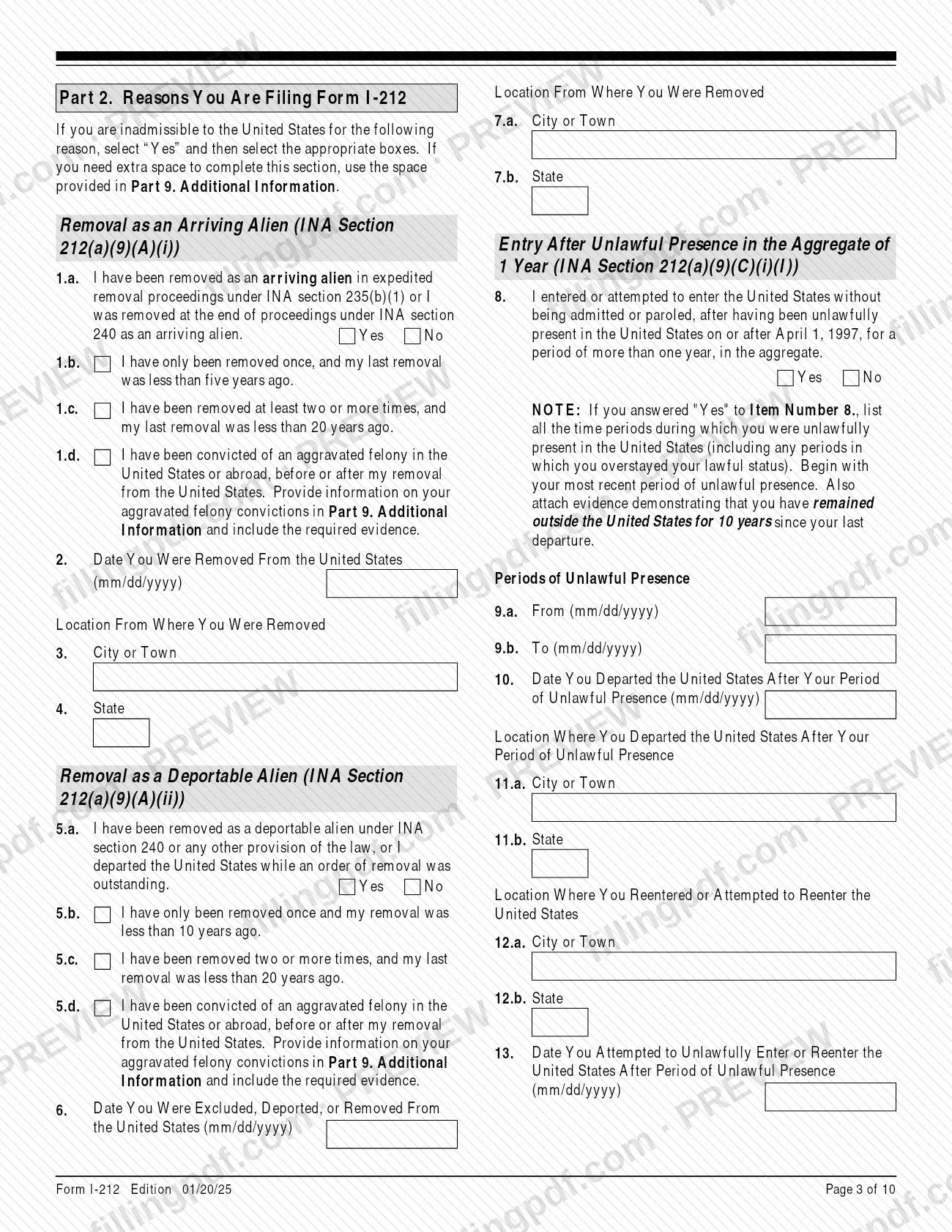
In Part 2, answer Items 1.a.-1.d. if you were removed as an arriving alien, and Items 5.a.-5.d. if removed as a deportable alien. Give the removal date and the city or town and state of removal in Items 2-4 or 6-7.b. For an aggravated felony conviction, explain in Part 9.
List unlawful presence and reentry history
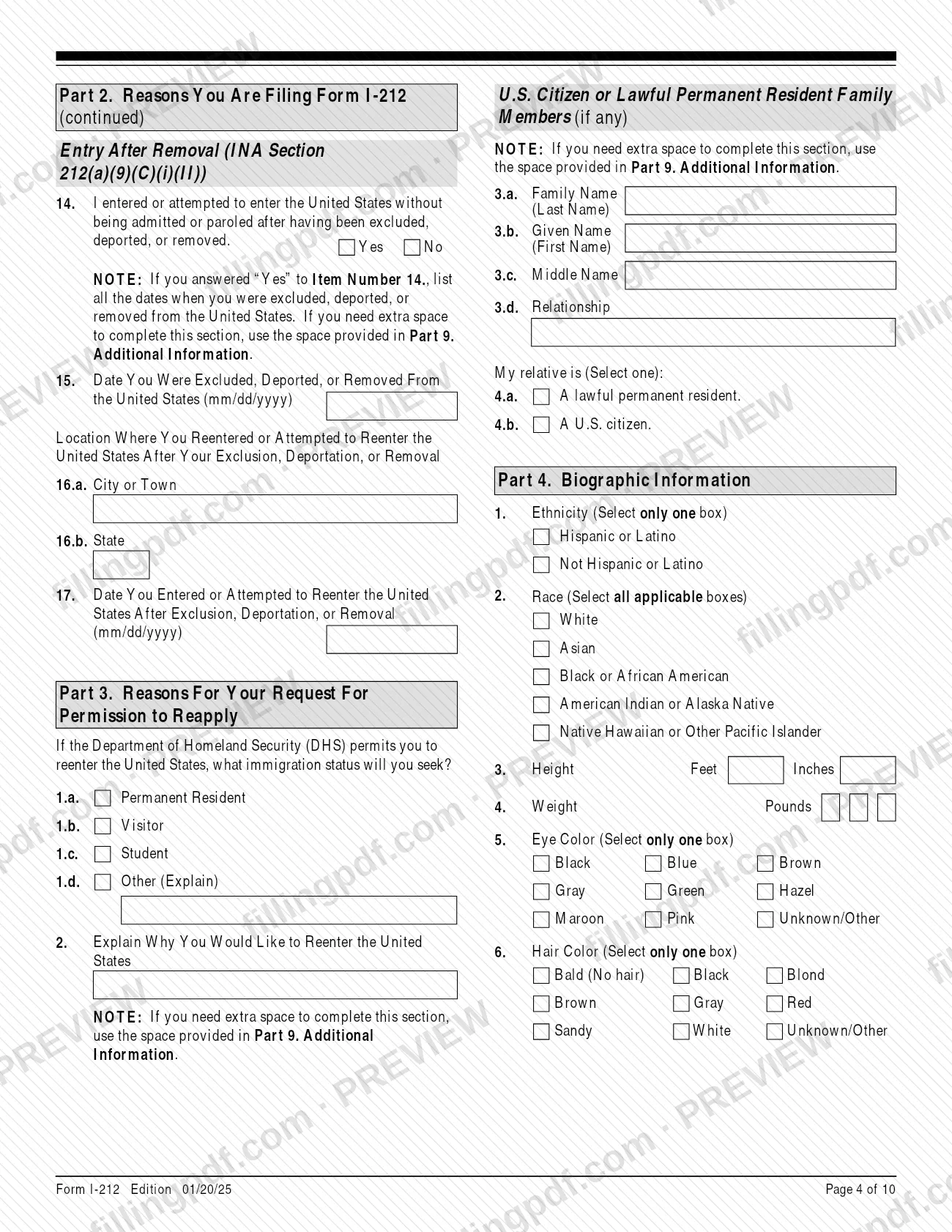
If Yes to Item 8, list each period of unlawful presence (Items 9.a.-9.b.) beginning with the most recent, plus departure and reentry dates and locations in Items 10-13. If Yes to Item 14, list all exclusion, deportation or removal dates and reentries in Items 15-17.
Explain your request to reapply
In Part 3, select the status you would seek in Items 1.a.-1.d. and explain why you want to return in Item 2. In Items 3.a.-4.b. list U.S. citizen or lawful permanent resident relatives with close ties, their relationship and whether each is a citizen or permanent resident.
Enter biographic information
Part 4 asks for ethnicity (one box), race (all that apply), height, weight in pounds, eye color and hair color. Enter "000" for weight if you do not know it or it is under 30 or over 699 pounds.
Complete Part 5 only if filing with CBP
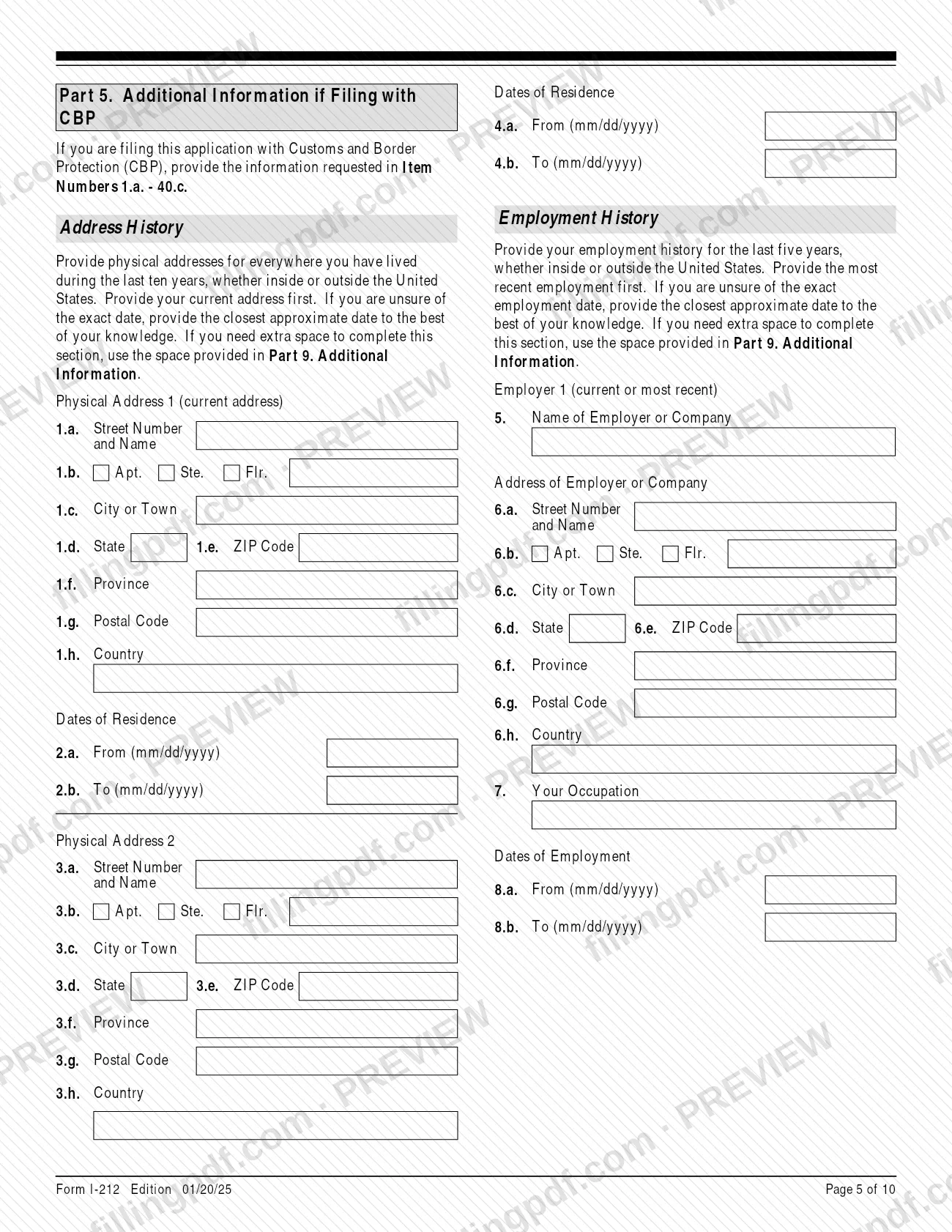
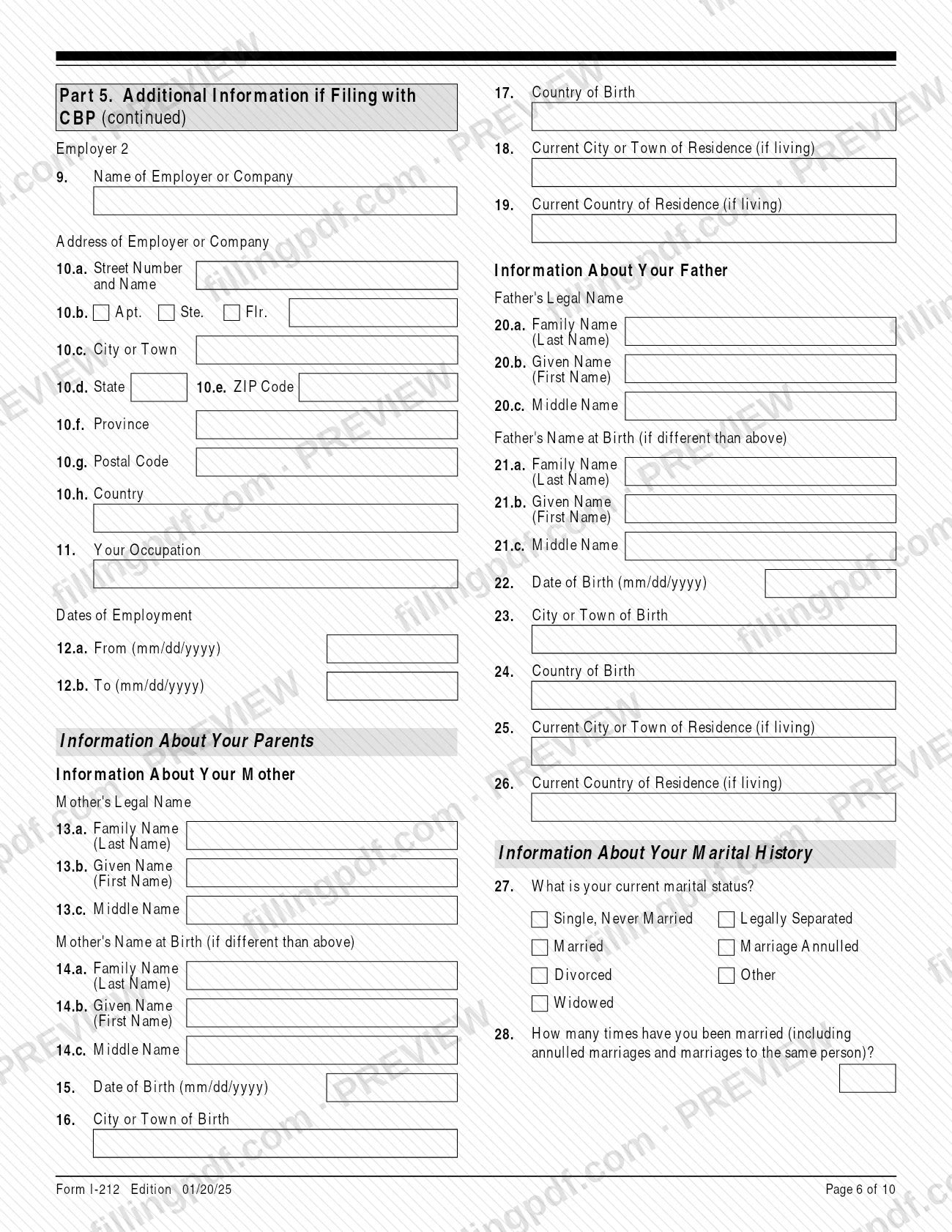
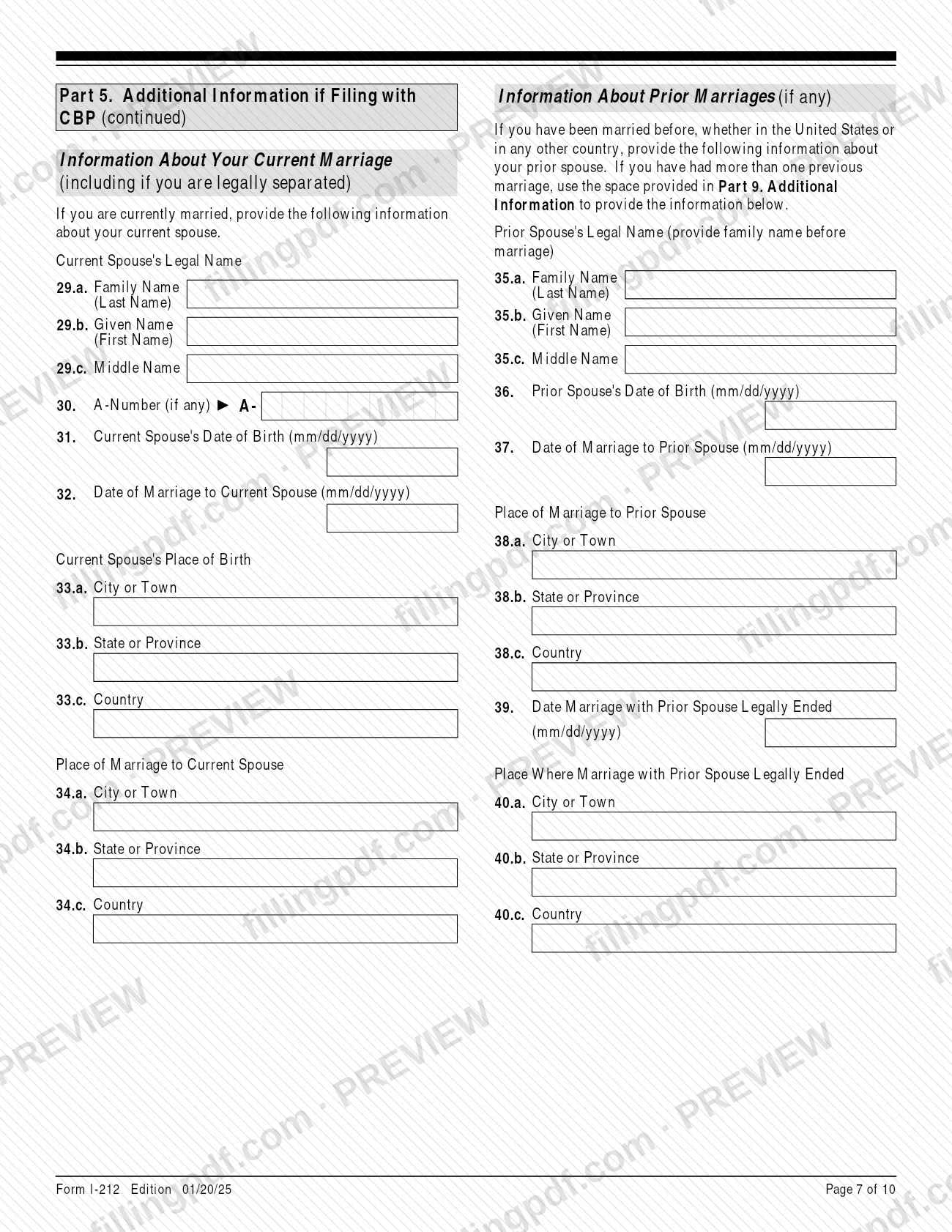
If you file with CBP, answer Items 1.a.-40.c.: address history, employment history for the last five years, parents, current marriage and prior marriages. The form text says ten years of addresses while the instructions say five; check the current instructions.
Sign and complete interpreter and preparer parts
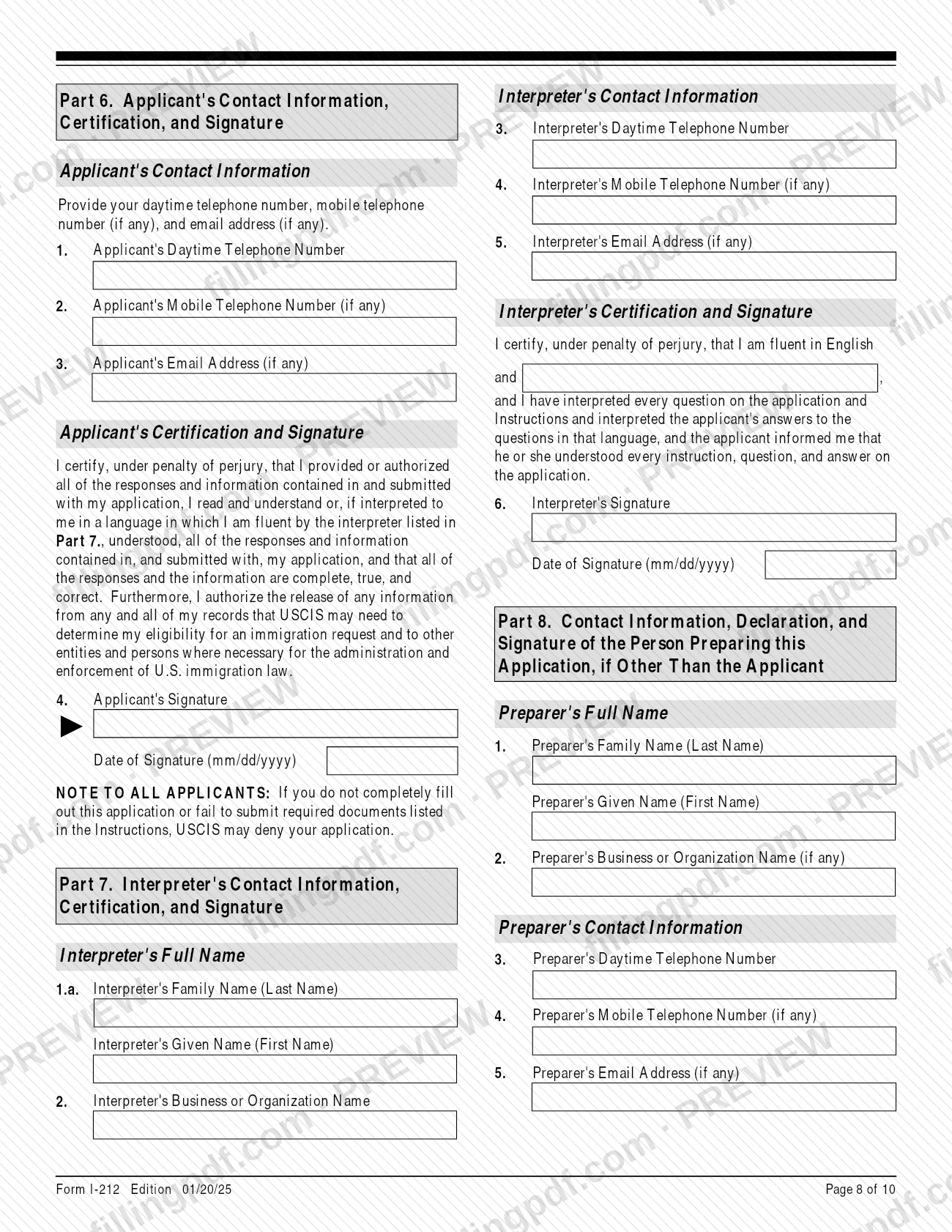
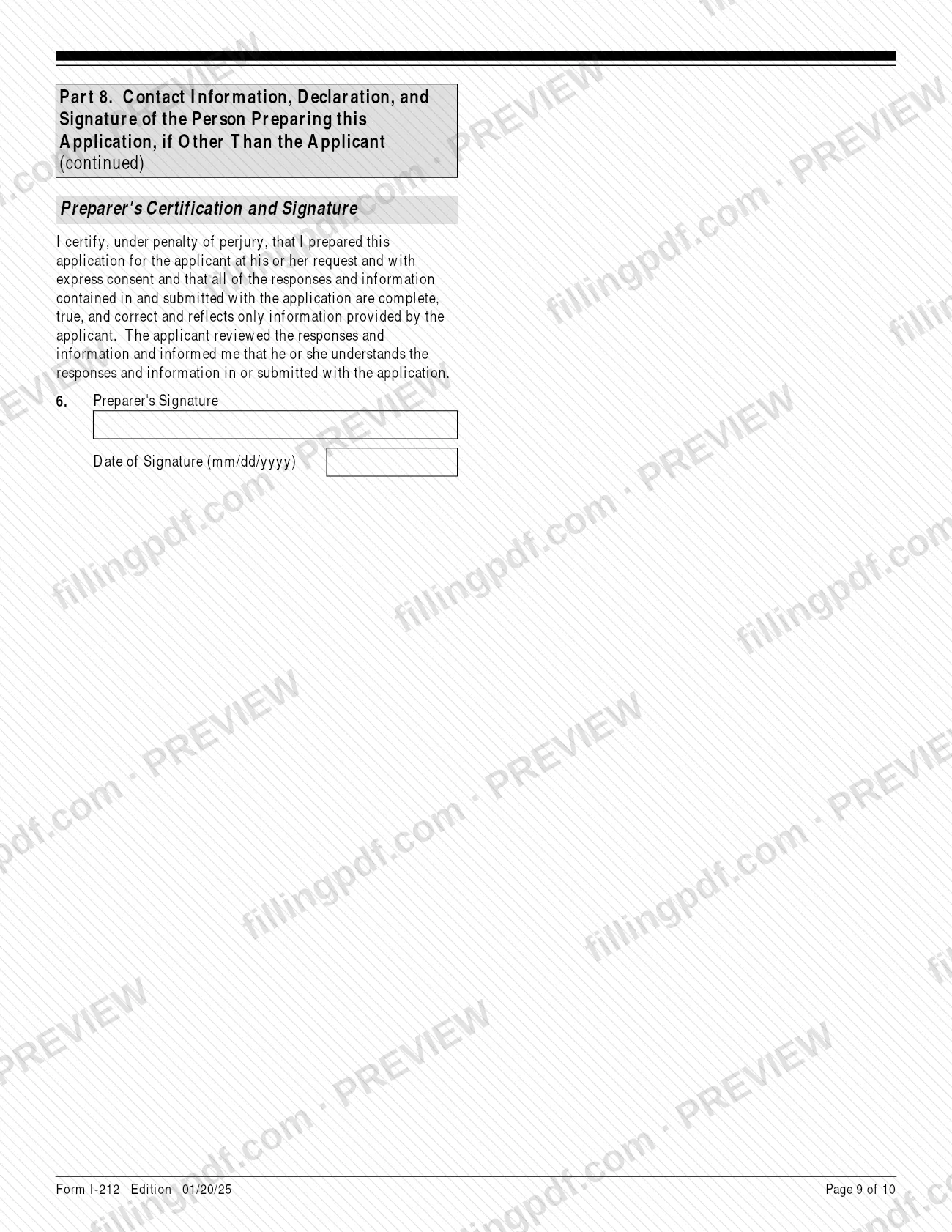
Sign and date Part 6 yourself. If an interpreter read the form to you, the interpreter completes and signs Part 7; if someone else prepared it, that person completes and signs Part 8. Add your contact details in Part 6.
Use Part 9 for extra space
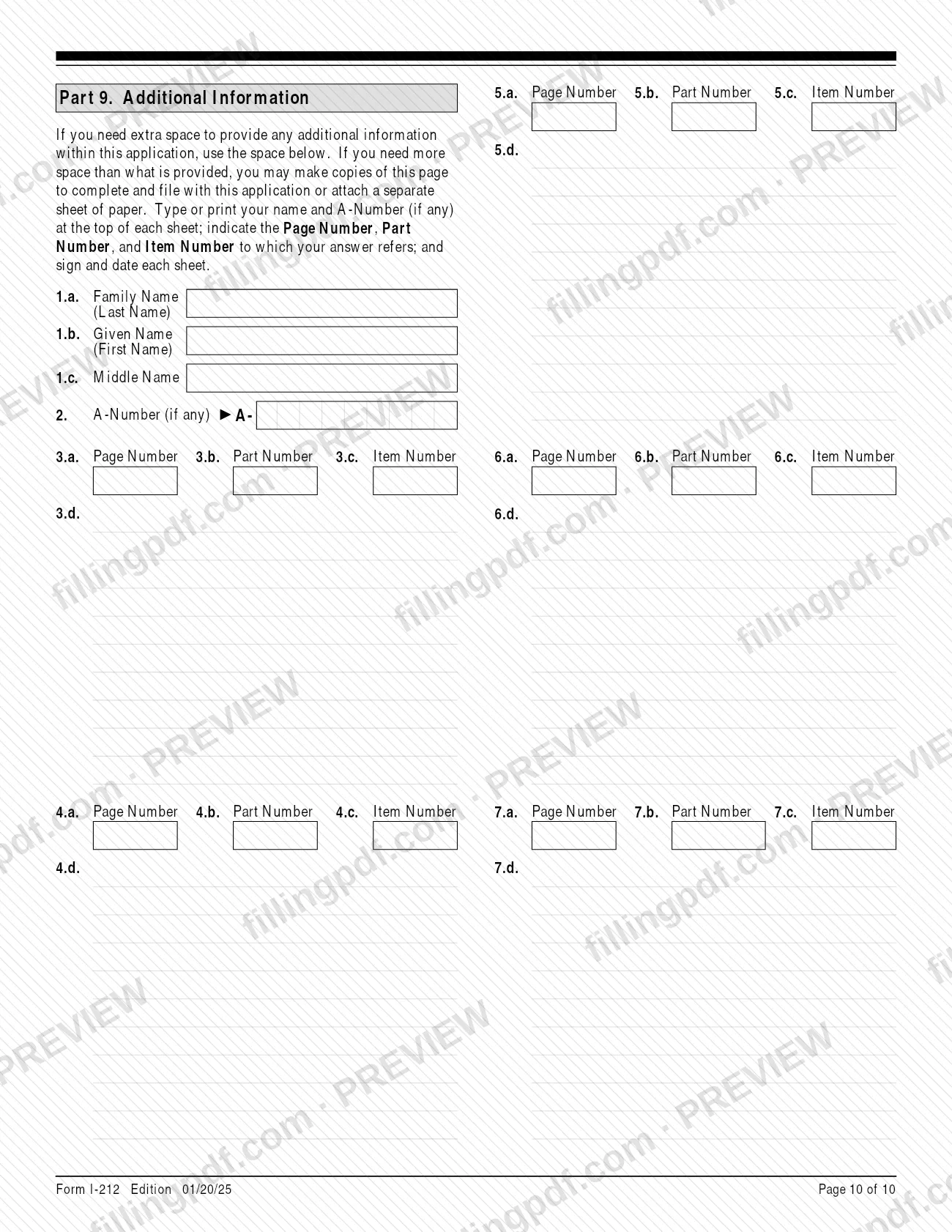
Use Part 9 or a separate sheet if you need more room. Put your name and A-Number at the top, state the page, part and item number each answer refers to, and sign and date each sheet.
Review, download and assemble
Check that every item is answered, with "N/A" or "None" where needed, then download or print the completed PDF from FillingPDF. Add the evidence listed above and submit through the channel described under How to submit.
How to submit I-212
Where you file Form I-212 depends on your situation: with USCIS, with CBP, with a U.S. Consulate, or with the immigration court.
- USCIS: use the addresses on the Direct Filing Addresses for Form I-212 page, reached from https://www.uscis.gov/i-212. If you mail a printed form, the edition date and page numbers must be visible at the bottom of every page, and all pages must be from the same edition, or USCIS may reject it.
- CBP: if you seek nonimmigrant admission at a port of entry without a visa, or are a nonimmigrant visa applicant (other than K, T, U or V), you can file electronically through CBP's e-SAFE system, or manually in person at designated ports of entry. Complete Part 5 for CBP filings.
- U.S. Consulate: the consulate handling a nonimmigrant visa application will tell you whether and how to file.
- Removal proceedings: follow the special filing instructions the immigration court gave you.
A filing fee applies; see Form G-1055 or the USCIS Fee Schedule page for the amount. A photocopy, fax or scan of a form with an original handwritten signature is valid for filing. To get an email or text when a USCIS lockbox accepts the form, clip Form G-1145 to the first page. Do not mail the form to the Paperwork Reduction Act address in the instructions. FillingPDF lets you fill out and download the PDF; submission follows the channels above.
Common mistakes to avoid
- Returning to the United States before filing and getting approval, when consent to reapply is required; the instructions warn of reinstated removal orders, criminal prosecution and a permanent bar.
- Submitting the form unsigned or with a stamped or typewritten name; USCIS rejects unsigned applications and does not accept stamped or typed signatures.
- Filing while in the United States when inadmissible under 212(a)(9)(C), or before 10 years outside the country since your last departure.
- Omitting the Family Name or Mailing Address in Part 1; USCIS states it will reject the form if these are missing.
- Mailing a printed form with missing pages or pages from different editions, or with the edition date and page numbers cut off.
- Leaving a question blank instead of writing "N/A", or "None" for a zero or none numeric answer.
- Failing to attach evidence of 10 years abroad when answering Yes to Part 2, Items 8 or 14.
- Sending original documents that were not requested; USCIS may destroy originals submitted when they are not required.
- Submitting foreign-language documents without a full English translation and the translator's certification.
- Submitting the optional USCIS checklist with the form; USCIS says not to send it.
Frequently asked questions
What is Form I-212 used for?
Form I-212 is the application for consent, or permission, to reapply for admission to the United States. You file it if you are inadmissible under INA section 212(a)(9)(A) or (C) after deportation, removal or certain unlawful presence and need approval before you can lawfully return.
Who needs to file Form I-212?
People inadmissible under INA section 212(a)(9)(A) or (C) who are immigrant visa applicants, adjustment applicants (for 9(A)), nonimmigrant applicants at a port of entry without a visa, or nonimmigrant visa applicants at a consulate. Some consulate applicants may not need it; the consulate advises.
Can I file Form I-212 while I am in the United States?
Not if you are inadmissible under 212(a)(9)(C): you must be outside the country for at least 10 years since your last departure. If you are inadmissible only under 212(a)(9)(A) and were ordered removed, you may file before leaving if you will apply for an immigrant visa abroad.
Where do I file Form I-212?
It depends on your case. USCIS publishes Direct Filing Addresses for Form I-212 at uscis.gov/i-212. Nonimmigrant applicants at ports of entry file with CBP, including electronically through e-SAFE. If you are in removal proceedings, follow the court's special filing instructions.
What evidence do I need to send with Form I-212?
Copies of your removal proceeding documents, proof of your relationship to relatives listed in Part 3, and, if inadmissible under 212(a)(9)(C), evidence of removal, reentry dates and 10 years abroad. CBP filers add proof of citizenship, name-change evidence and police records. Evidence of favorable factors is encouraged.
How long is an approved Form I-212 valid?
Approved permission to reapply is valid indefinitely unless revoked by the agency that granted it. If it was obtained for nonimmigrant purposes, it is also valid for future immigrant or nonimmigrant purposes. A new inadmissibility under 212(a)(9)(A) or (C) requires a new application.
Is there a fee to file Form I-212?
Yes, a filing fee applies. The USCIS instructions point to Form G-1055 and the USCIS Fee Schedule page for the current amount, so check them before you file. Filing with CBP or a consulate follows that agency's own rules.
Do I also need Form I-601 with Form I-212?
If you are inadmissible under both 212(a)(9)(A) and (C), the instructions say to file Form I-212 and Form I-601. Part 1, Items 19-20.c. of Form I-212 asks whether you are submitting an I-601 with it or have filed one before.
Can I fill out Form I-212 online on FillingPDF?
Yes. You can fill out the fillable PDF online on FillingPDF and download or print it. FillingPDF is independent of USCIS and does not file the form; you submit it through USCIS, CBP or the other channels described by the agency.
Ready to fill out I-212?
Fill out I-212 now