
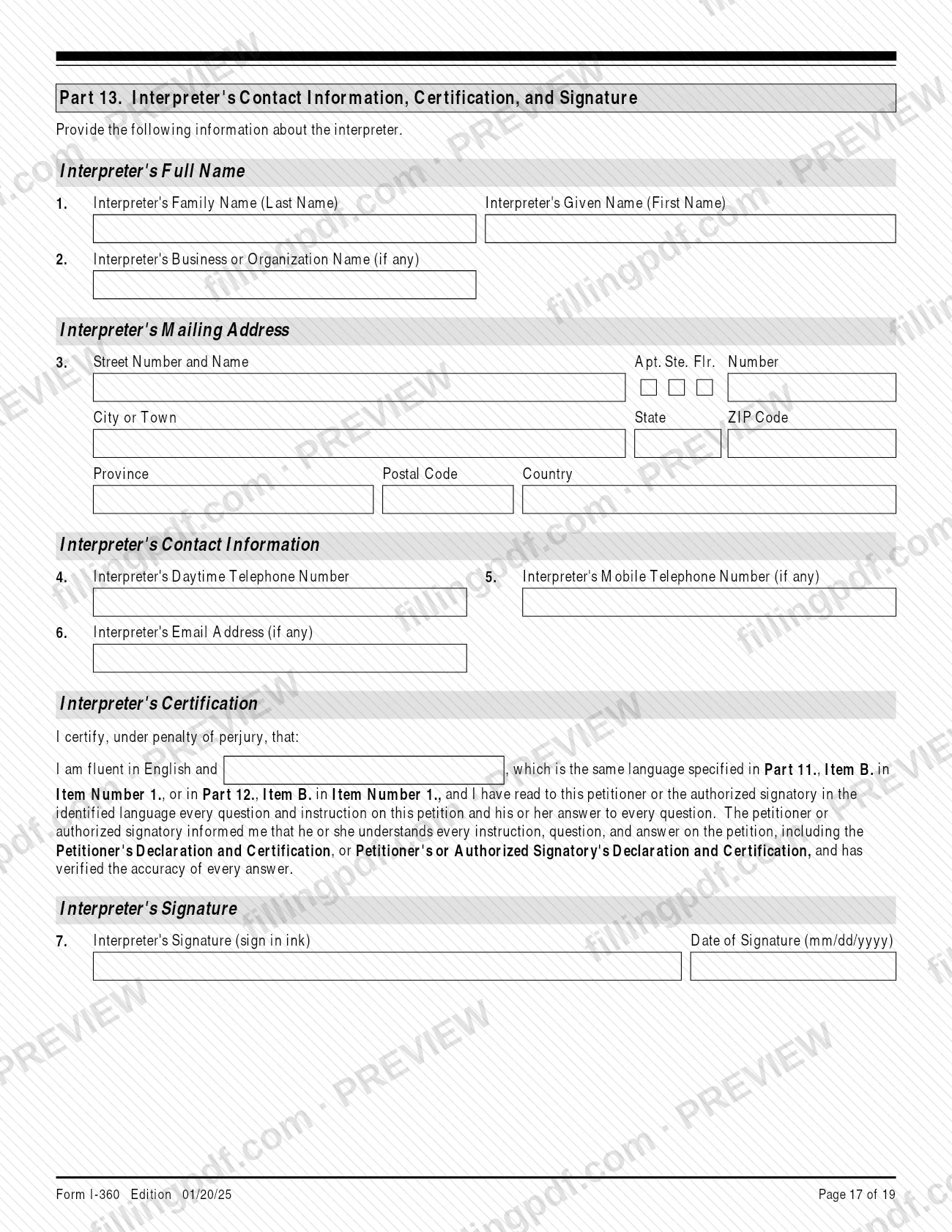
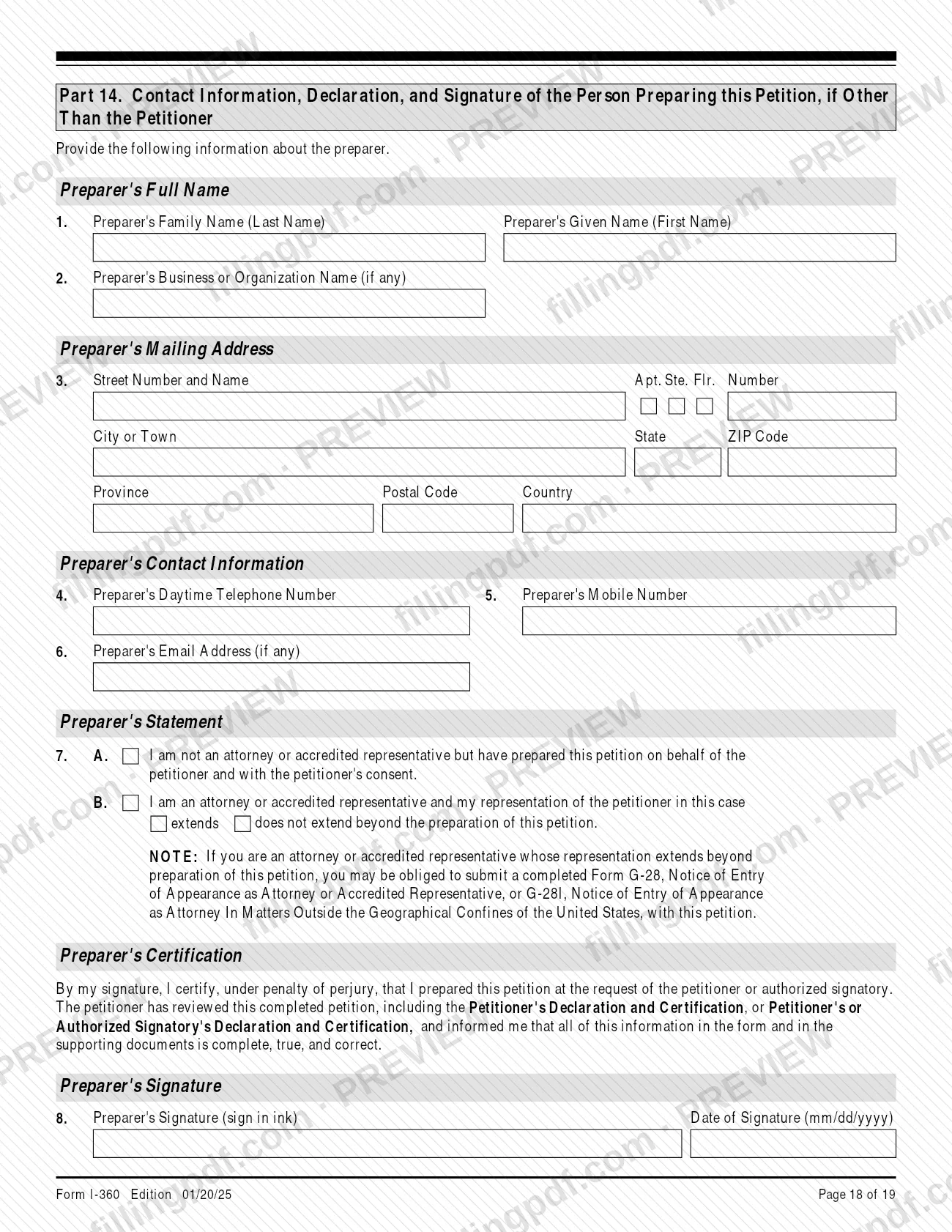
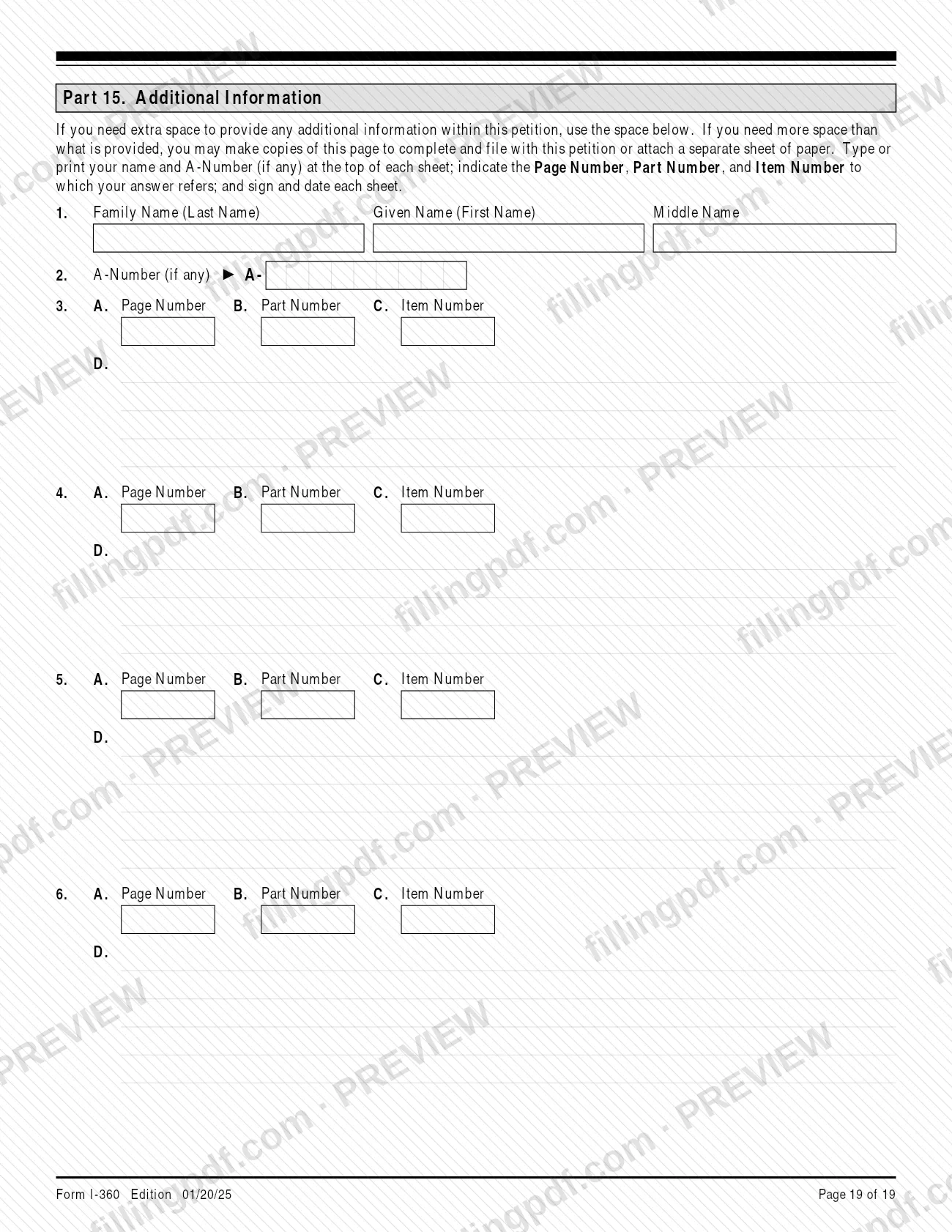
Form I-360, Petition for Amerasian, Widow(er), or Special Immigrant, is the U.S. Citizenship and Immigration Services (USCIS) petition used to classify a person as an Amerasian, the widow(er) of a U.S. citizen, a VAWA self-petitioner or one of several special immigrants. Depending on the category, the petitioner is the beneficiary, an employer or organization, or another person filing on the beneficiary's behalf. On this page you can fill out the form online on FillingPDF and download or print the completed PDF; the official PDF and instructions are published by USCIS.
Last updated
What is I-360?
Form I-360, Petition for Amerasian, Widow(er), or Special Immigrant, is the USCIS petition used to classify a person as an Amerasian, the widow(er) of a U.S. citizen, a VAWA self-petitioner, or a special immigrant such as a religious worker or a special immigrant juvenile.
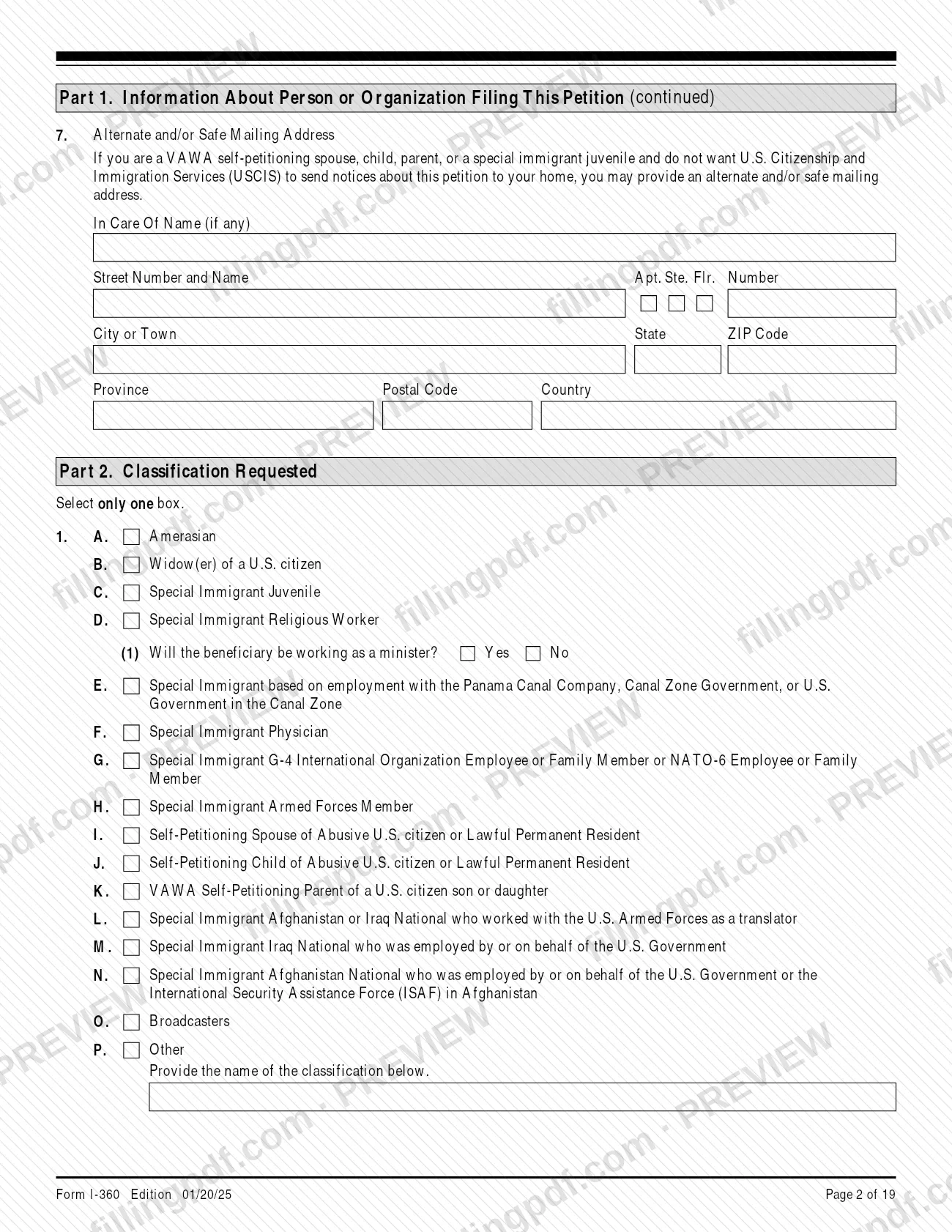
The U.S. Citizenship and Immigration Services (USCIS), part of the Department of Homeland Security, issues the form under OMB No. 1615-0020. The printed edition is 01/20/25 and runs 19 pages. In Part 2 you select only one classification, A through P:
- Amerasian, or widow(er) of a U.S. citizen.
- Special immigrant categories: juvenile, religious worker (with a question on whether the beneficiary will work as a minister), Panama Canal or Canal Zone employment, physician, G-4 or NATO-6 employee or family member, armed forces member, Afghanistan or Iraq translator, Iraq or Afghanistan government employee, and broadcasters.
- VAWA self-petitioning spouse, child or parent.
- Other, with the classification named on the form.
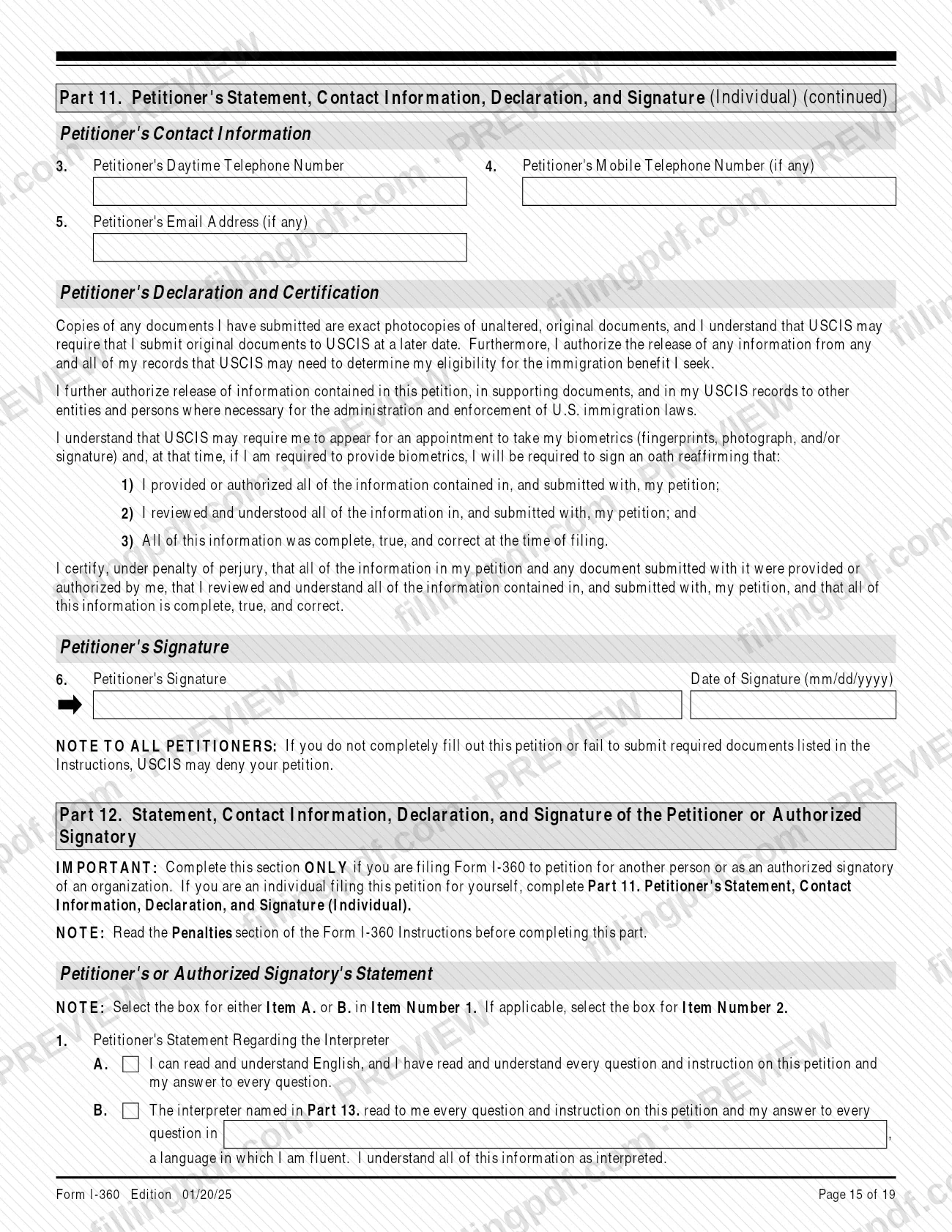
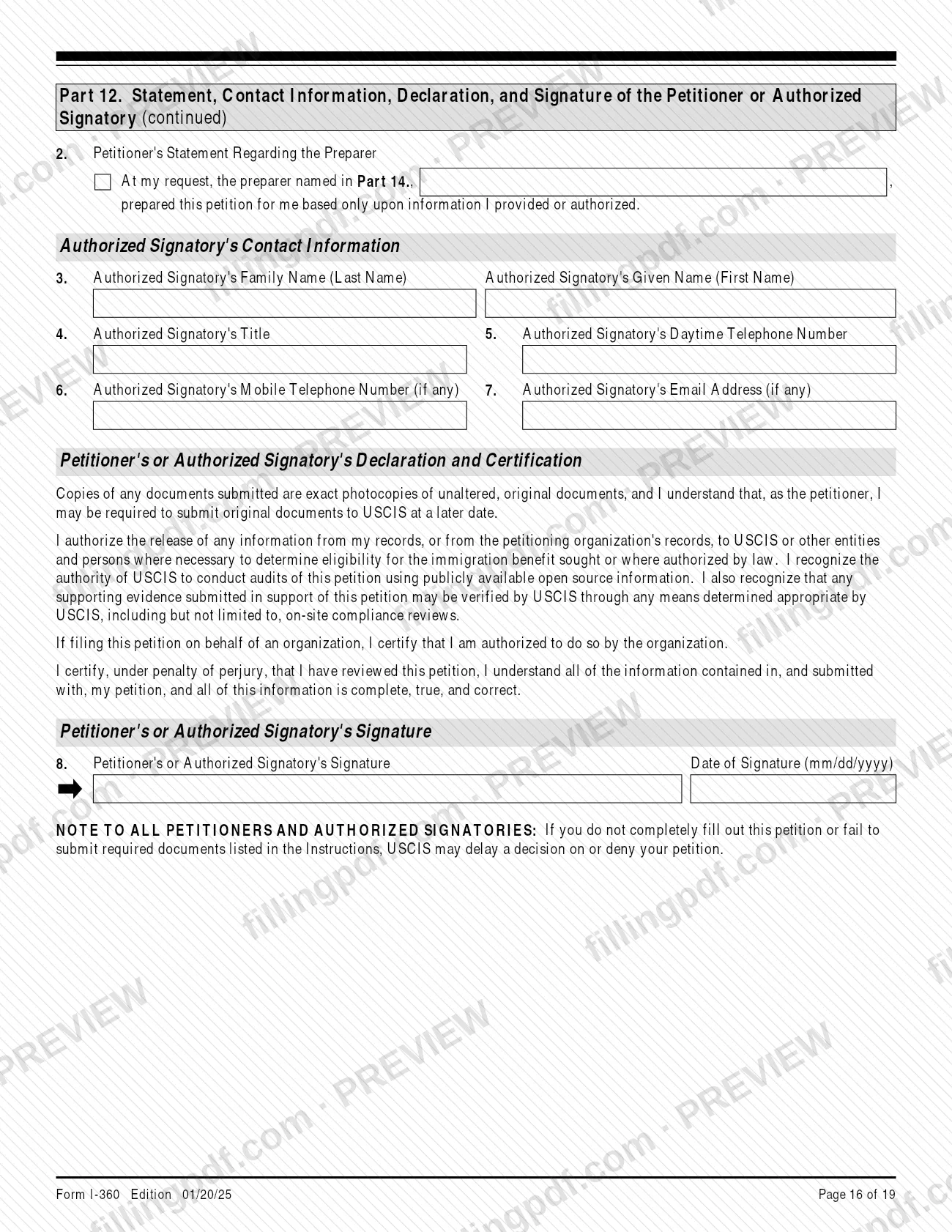
The instructions say special immigrants may also use this form for EB-4 Fourth Preference. Parts 6 to 10 apply only to specific categories: Amerasian, widow(er), special immigrant juvenile, religious worker and VAWA. The signature parts differ: Part 11 is for an individual filing for themselves, Part 12 for a petitioner filing for another person or an authorized signatory of an organization.
Form I-360 is a petition for classification. It is not an application to adjust status; that is Form I-485, which may be filed at the same time in some cases. Afghan special immigrant petitions started on or after July 20, 2022 use Form DS-157 with the Department of State instead.
Who needs to file I-360?
Who files depends on the classification you choose in Part 2.
- Amerasian: a person 18 or older may file for a beneficiary, including themselves, born in Korea, Vietnam, Laos, Kampuchea or Thailand after December 31, 1950 and before October 22, 1982, and fathered by a U.S. citizen. A U.S. corporation may also file.
- Widow(er) of a U.S. citizen: you file for yourself if your citizen spouse died, you were not legally separated at the time, and you have not remarried. Do not file if your spouse's Form I-130 was approved or still pending when they died; the instructions say it converted to a widow(er)'s I-360.
- Special immigrant juvenile: the beneficiary, or someone filing for them, if the juvenile is in the United States, unmarried and under 21, with the required juvenile court findings.
- Religious worker: a U.S. employer files for the beneficiary, or the beneficiary may file on their own behalf.
- Broadcasters: the International Broadcasting Bureau of the BBG or a BBG grantee.
- VAWA self-petitioners: an abused spouse or child of a U.S. citizen or lawful permanent resident, or an abused parent of a U.S. citizen son or daughter at least 21.
- Other special immigrants: the categories in the instructions, such as armed forces members and Afghan or Iraqi nationals who meet the stated conditions.
Afghan nationals who began the special immigrant process on or after July 20, 2022 should not file Form I-360. A parent or legal guardian may sign for a person under 14. An attorney or accredited representative may be required to submit Form G-28.
When to file I-360
File Form I-360 when you meet the eligibility conditions of your classification; the form itself prints no general due date, but several categories have time limits.
- Widow(er): file no later than 2 years after your spouse's death.
- Special immigrant juvenile: file before your 21st birthday. USCIS allows in-person filing at a field office within 2 weeks before you turn 21 through an appointment requested at 800-375-5283.
- VAWA self-petitioner: the instructions allow filing within two years of the abuser's death, of the abuser's loss of status because of domestic violence, or of the end of the marriage when it is connected to the abuse.
- Religious worker: the beneficiary must have had two years of membership and continuous work immediately before filing.
- Afghan nationals: if you started the process on or after July 20, 2022, do not file this form with USCIS.
If a document is missing or the form is unsigned, USCIS may reject it. The instructions set no processing time.
Documents you need
- Amerasian: copies of evidence that the beneficiary was born in Korea, Vietnam, Laos, Kampuchea or Thailand between the stated dates. For a Vietnam birth, add a copy of the Vietnamese identification card or an affidavit explaining why it is not available.
- Amerasian: copies of evidence of parentage and that the biological father was a U.S. citizen, plus a photograph of the beneficiary and, if the beneficiary is married, the marriage certificate and proof that prior marriages ended.
- Amerasian: Form I-361 and evidence the sponsor is at least 21 and a U.S. citizen or lawful permanent resident. You may send them with the petition or later when USCIS asks, but later filing adds to processing time.
- Widow(er): copy of your marriage certificate, proof that any prior marriages of either spouse ended, and the death certificate of your U.S. citizen spouse.
- Widow(er): evidence your spouse was a U.S. citizen, such as a U.S. birth certificate, Naturalization Certificate, Certificate of Citizenship, Form FS-240, or a U.S. passport valid at the time of death.
- Special immigrant juvenile: the juvenile's birth certificate or other proof of age, plus the court or administrative documents establishing eligibility with the specific findings of fact.
- Special immigrant juvenile: written consent from the Department of Health and Human Services (HHS) if the juvenile is in HHS custody and the juvenile court order altered custody status or placement.
- Religious worker: IRS tax-exempt determination letter, the employer attestation, evidence of how the beneficiary will be compensated, and evidence of the beneficiary's two years of denomination membership, continuous work and qualifications.
- Religious worker, for an organization affiliated with the denomination: organizing instrument, organizational literature and the signed and dated Religious Denomination Certification, in addition to the IRS determination letter.
- Panama Canal categories: a letter from the employing Canal Company, Canal Zone Government or U.S. Government agency on length and circumstances of employment, plus evidence of any claimed danger to personal safety.
- Physician: letters from the beneficiary's employers detailing employment since January 8, 1978, and copies of documents showing the beneficiary meets all criteria.
- G-4 or NATO-6: a letter from the international organization showing it qualifies and explaining the employment and status. For family members, add evidence of the family relationship.
- Armed Forces member: certified proof from the authorizing official of the executive department of the required honorable service or commitment, and your birth certificate.
- VAWA self-petitioner: any credible relevant evidence, such as proof of the abuser's status, relationship, shared residence, the abuse, good moral character (if 14 or older) and, for spouses, good-faith marriage.
- Afghanistan or Iraq translators and Iraq or Afghan government employees who file this form: the passport, birth certificate or ID, recommendation, Chief of Mission evidence and Form I-94 if in the United States, as listed for your category. Broadcasters: a signed and dated supplemental attestation.
How to fill out I-360
Add attorney or representative details
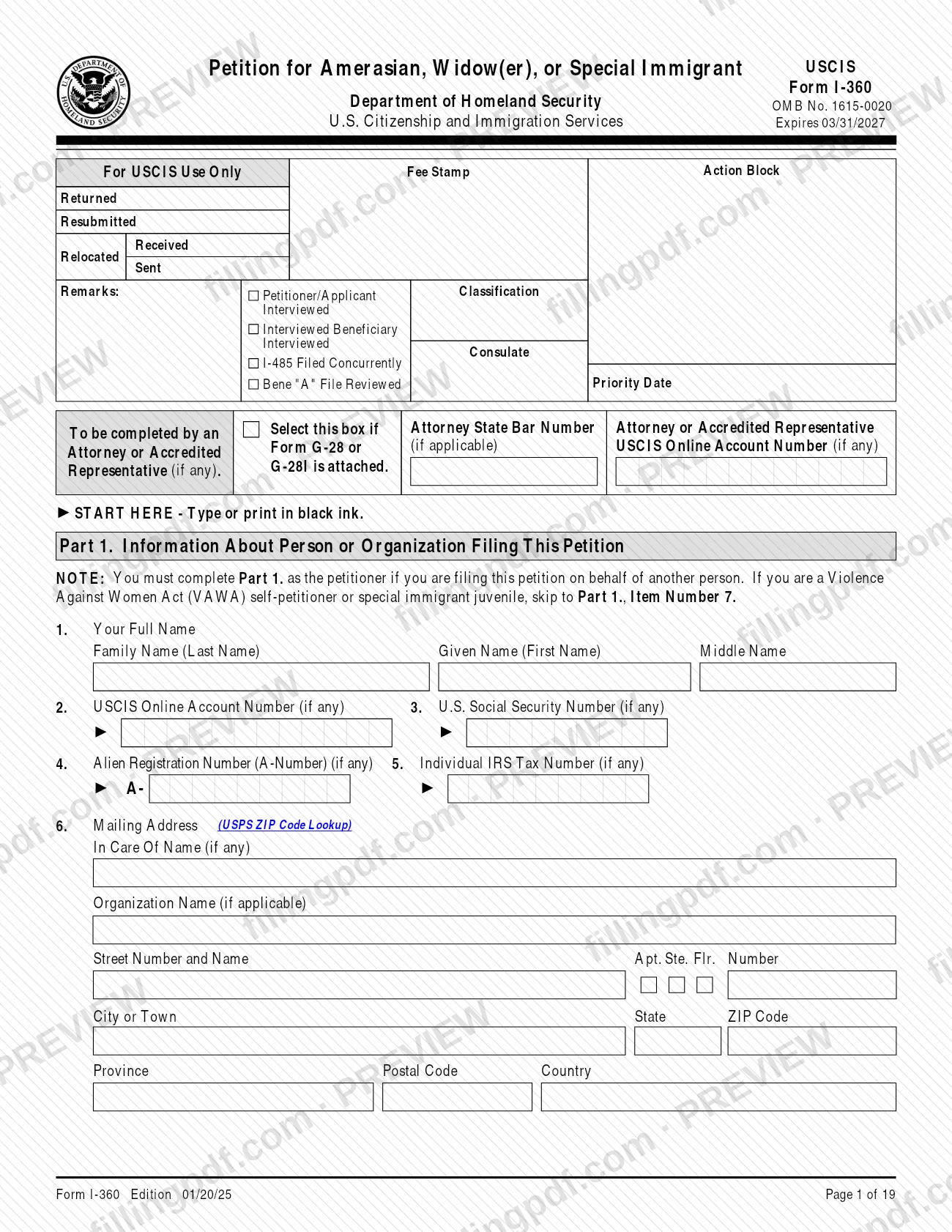
At the top of page 1, select the box if Form G-28 or G-28I is attached, and enter the attorney's State Bar Number and USCIS Online Account Number if applicable. Use black ink if you print the form.
Complete Part 1 as the petitioner
If you are filing for another person, enter your full name (Item 1), account, Social Security and A-Numbers if any (Items 2 to 5) and mailing address (Item 6). VAWA self-petitioners and special immigrant juveniles skip to Item 7 for an alternate or safe mailing address.
Select one classification in Part 2
Check only one box, A through P, such as Amerasian, Widow(er) of a U.S. citizen, Special Immigrant Juvenile or VAWA self-petitioning spouse. If you choose P (Other), name the classification, and answer the minister question if you select D.
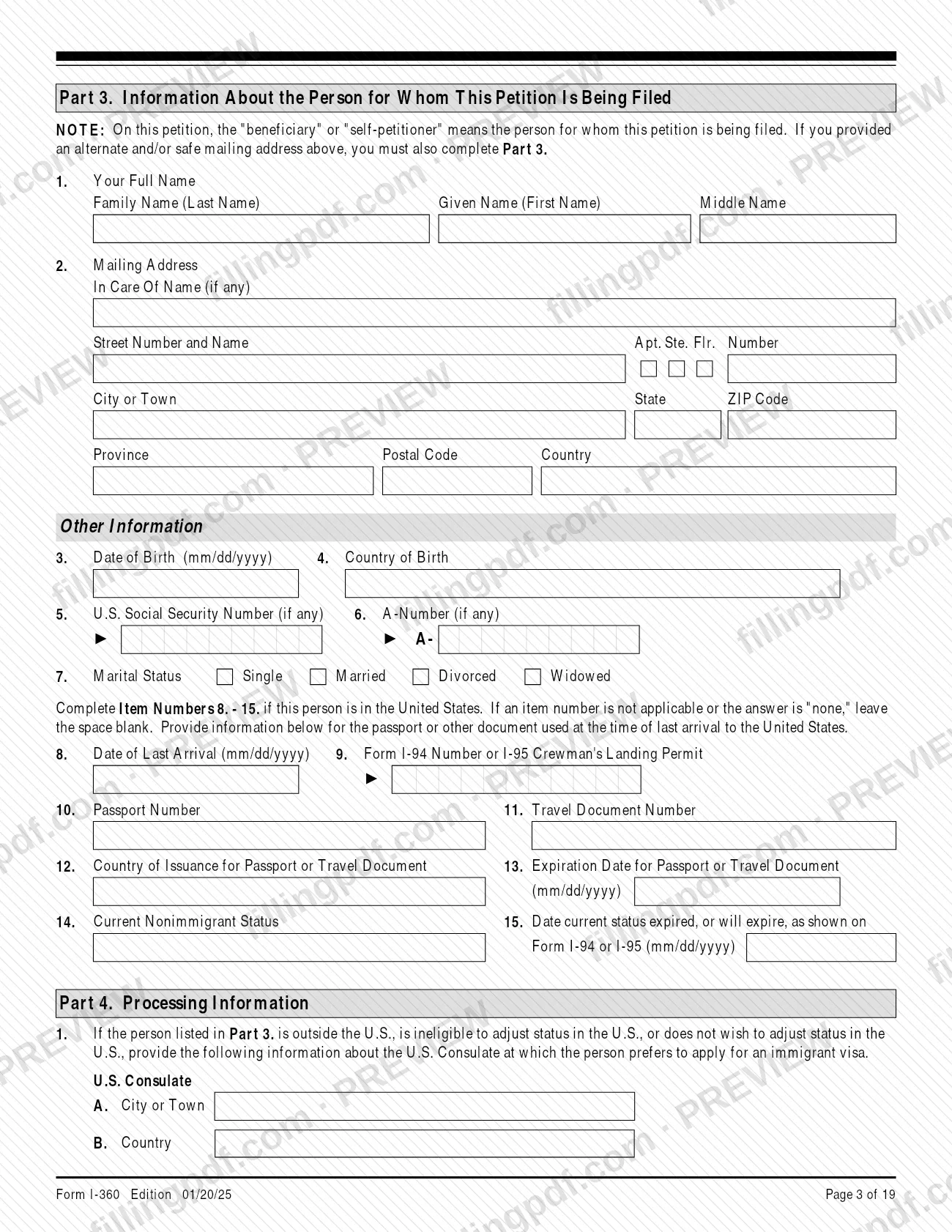
Enter the beneficiary in Part 3
Give the full name, mailing address, date of birth as mm/dd/yyyy, country of birth, Social Security and A-Numbers if any, and marital status. Complete Items 8 to 15 on the last arrival, I-94, passport and status only if the person is in the United States.
Answer Part 4 processing questions
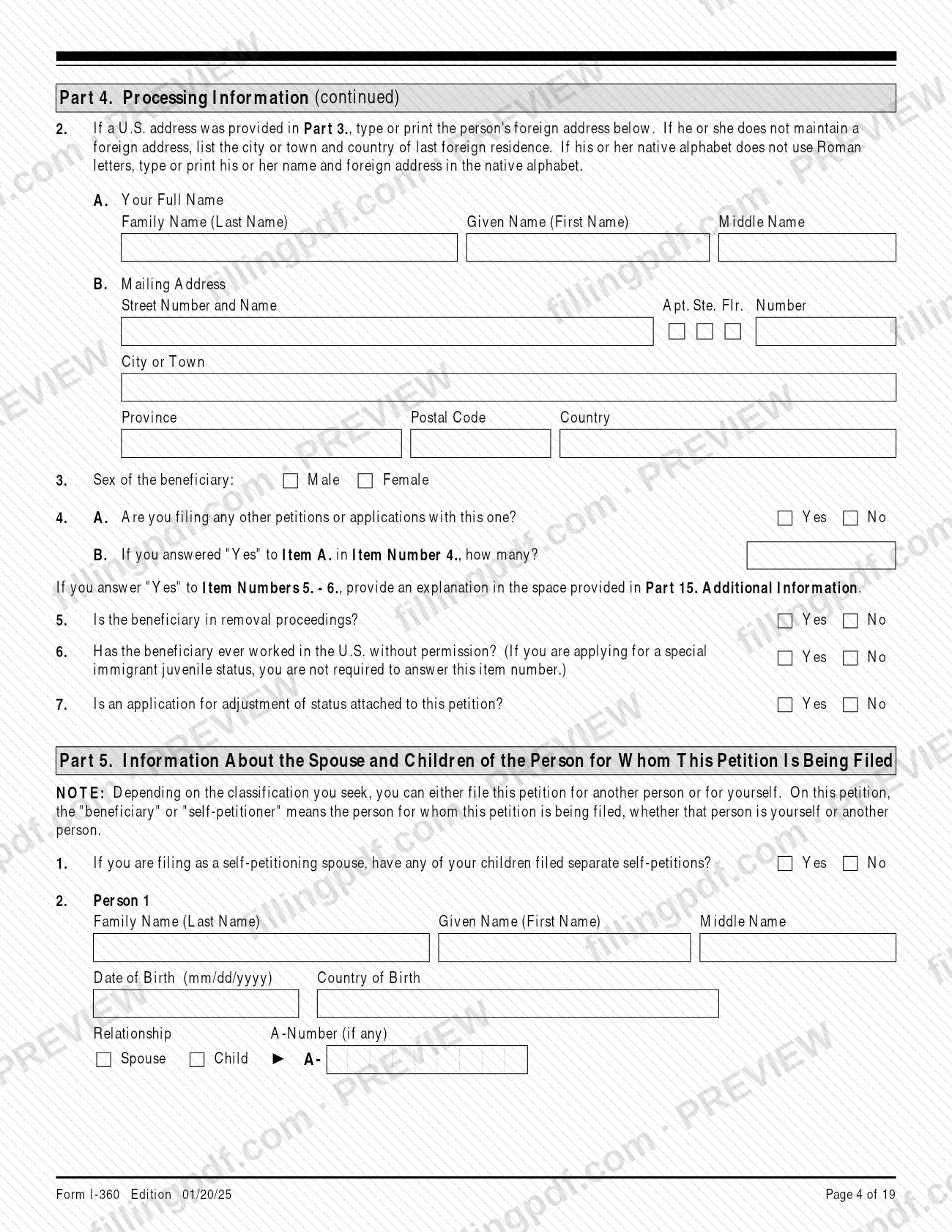
Name the preferred U.S. Consulate if the person is outside the U.S. or will not adjust status, and give the foreign address in Item 2. Enter the beneficiary's sex as on the birth certificate, then answer Items 4 to 7; explain any "Yes" to Items 5 or 6 in Part 15.
List spouse and children in Part 5
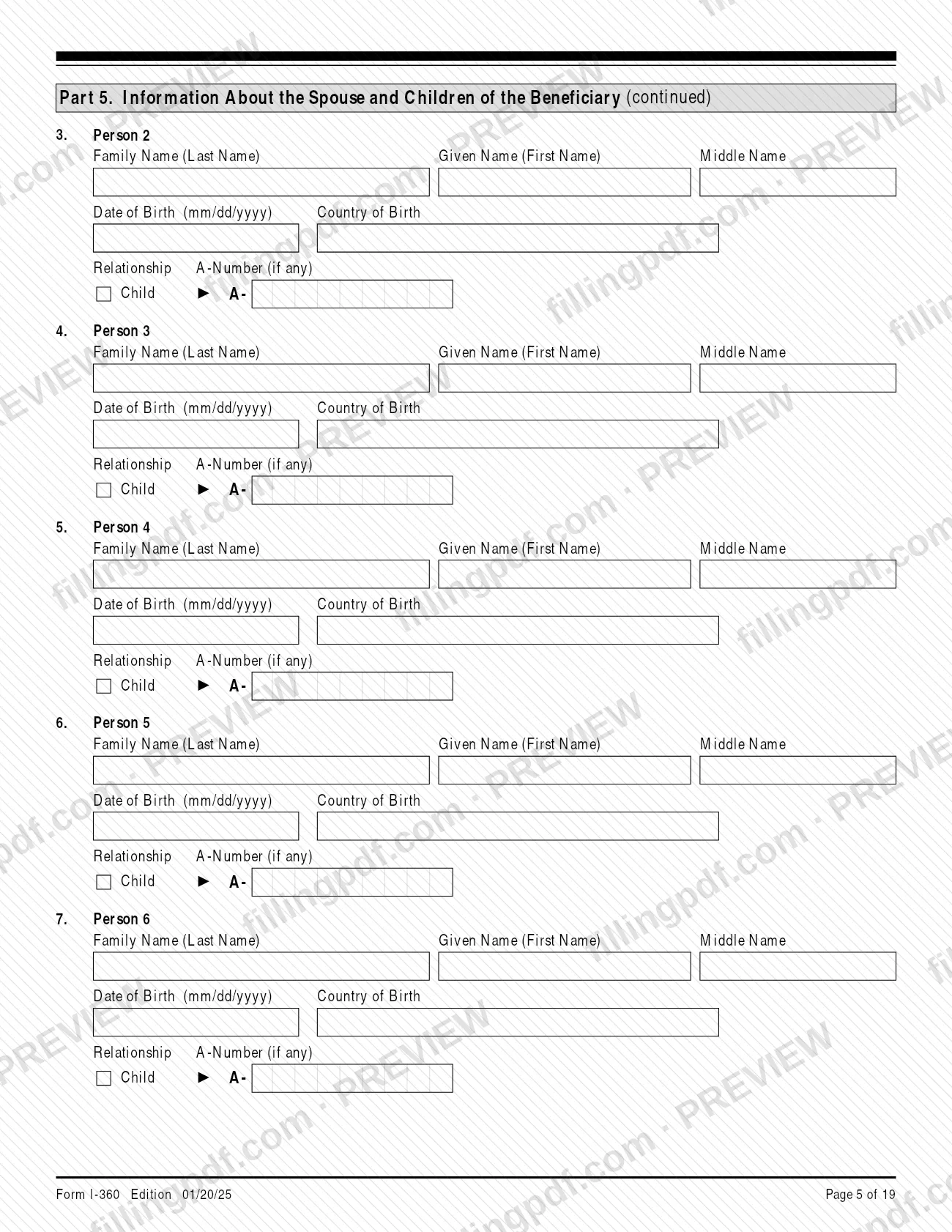
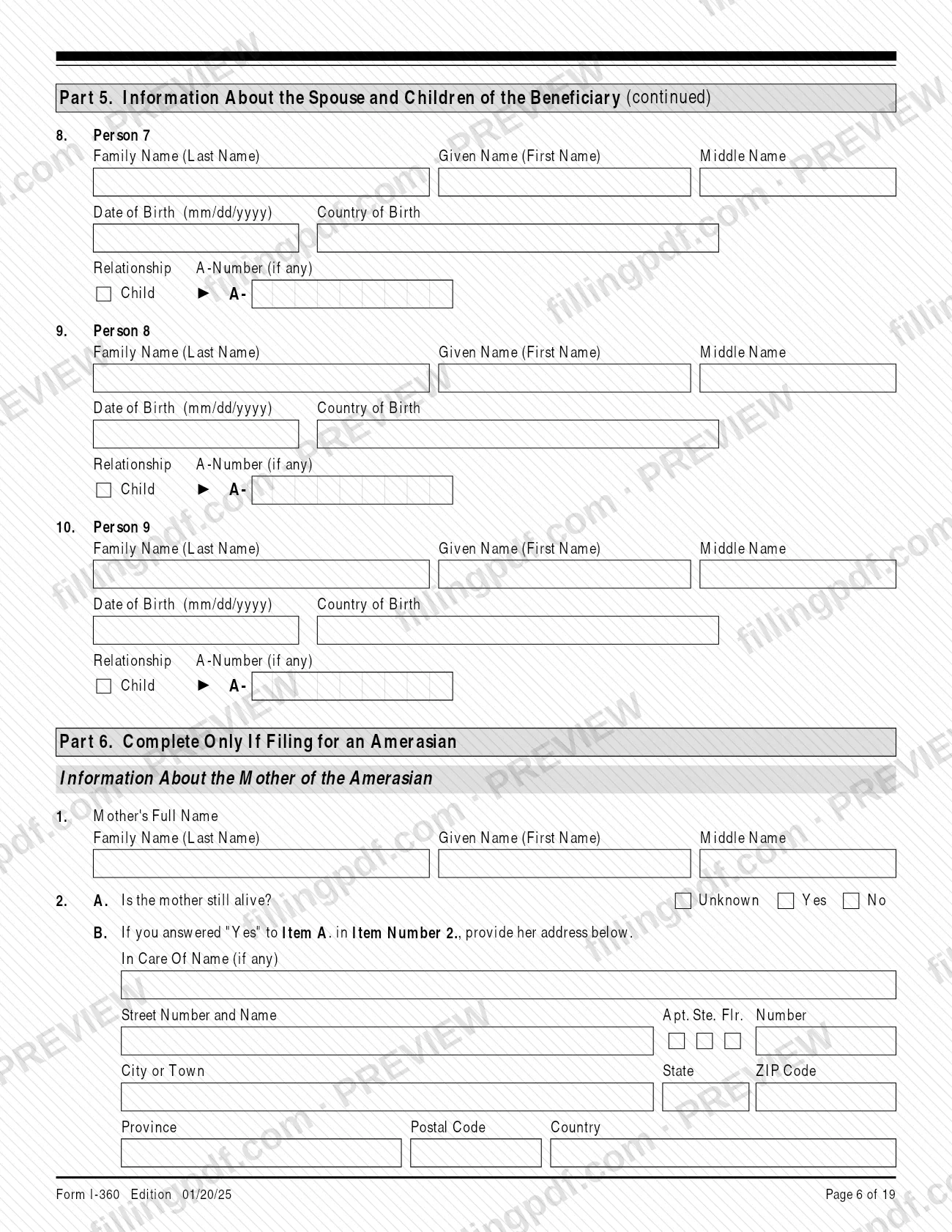
Enter the beneficiary's spouse and children, with name, date and country of birth, relationship and A-Number if any, up to nine people. Self-petitioning spouses first answer Item 1 about their children's separate self-petitions.
Complete Parts 6 to 8 if they apply
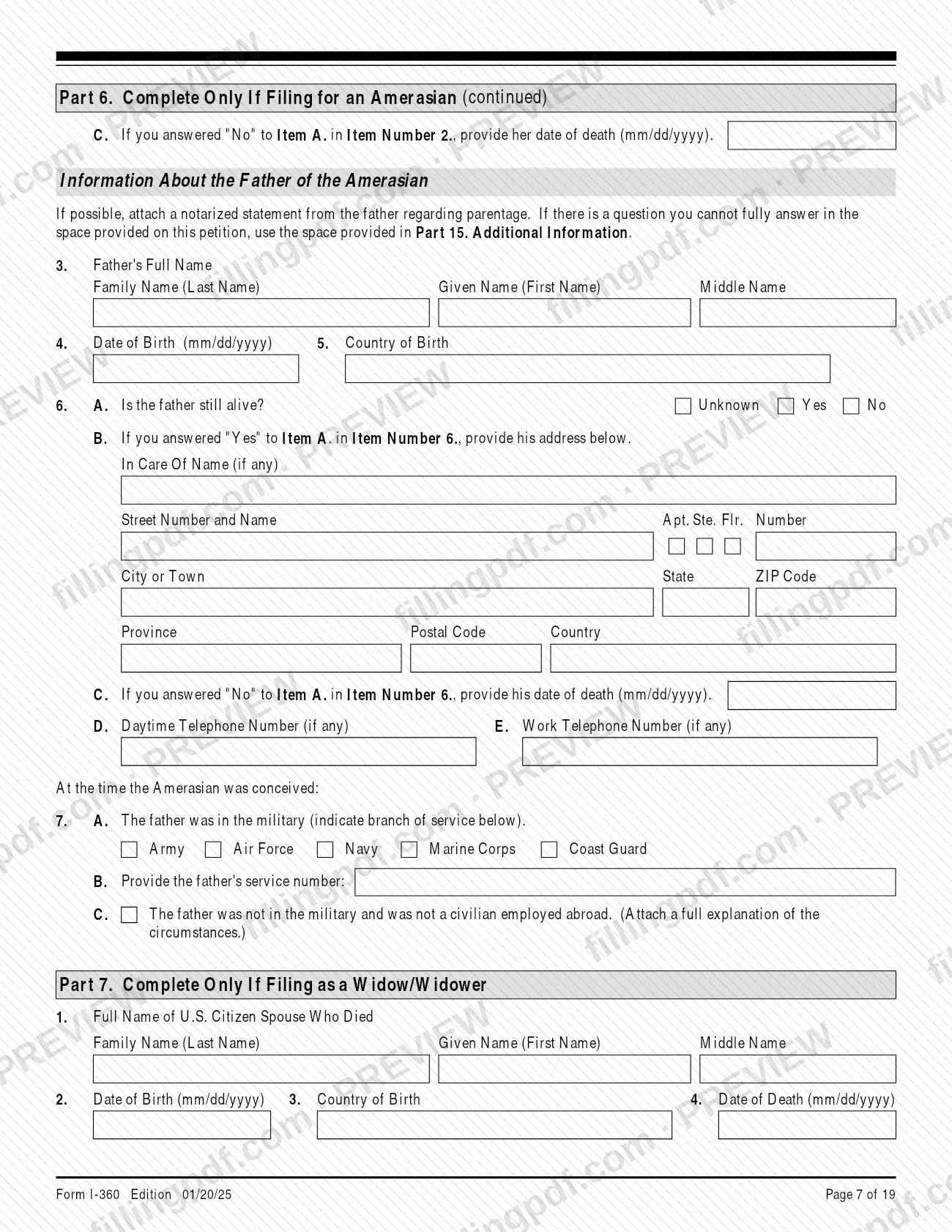
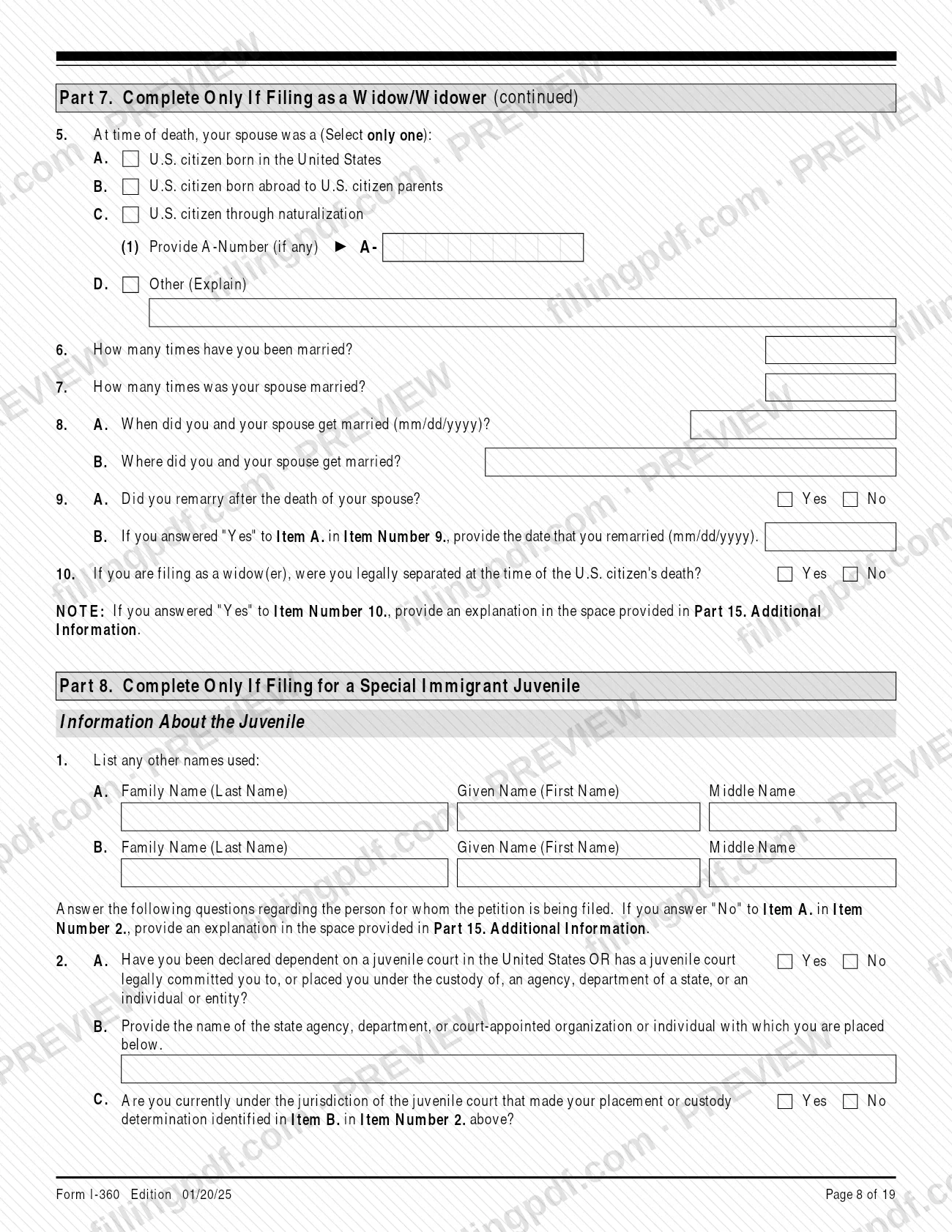
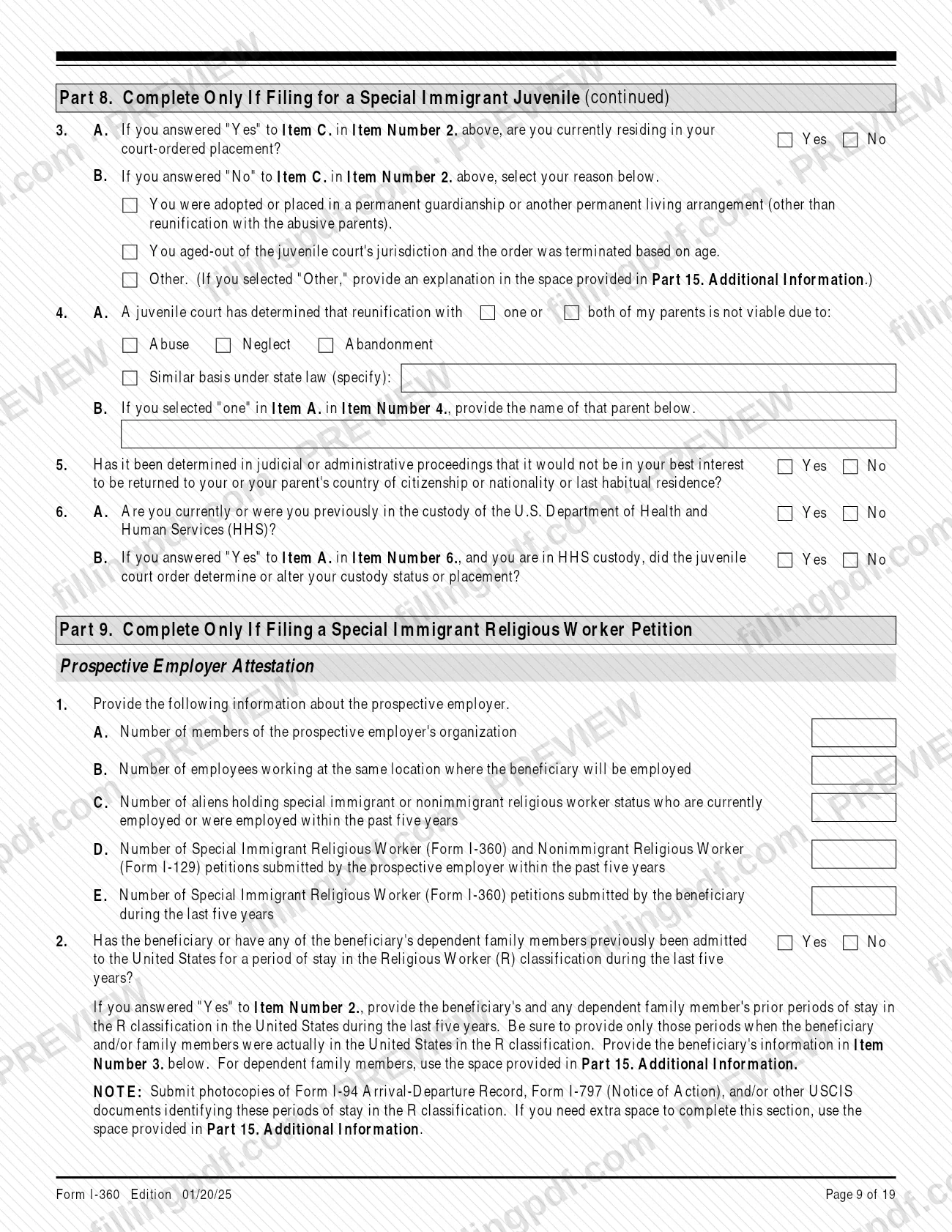
Part 6 is for Amerasians, with the mother's and father's details. Part 7 is for widow(er)s, with the deceased spouse and marriage history. Part 8 is for special immigrant juveniles, with the juvenile court findings.
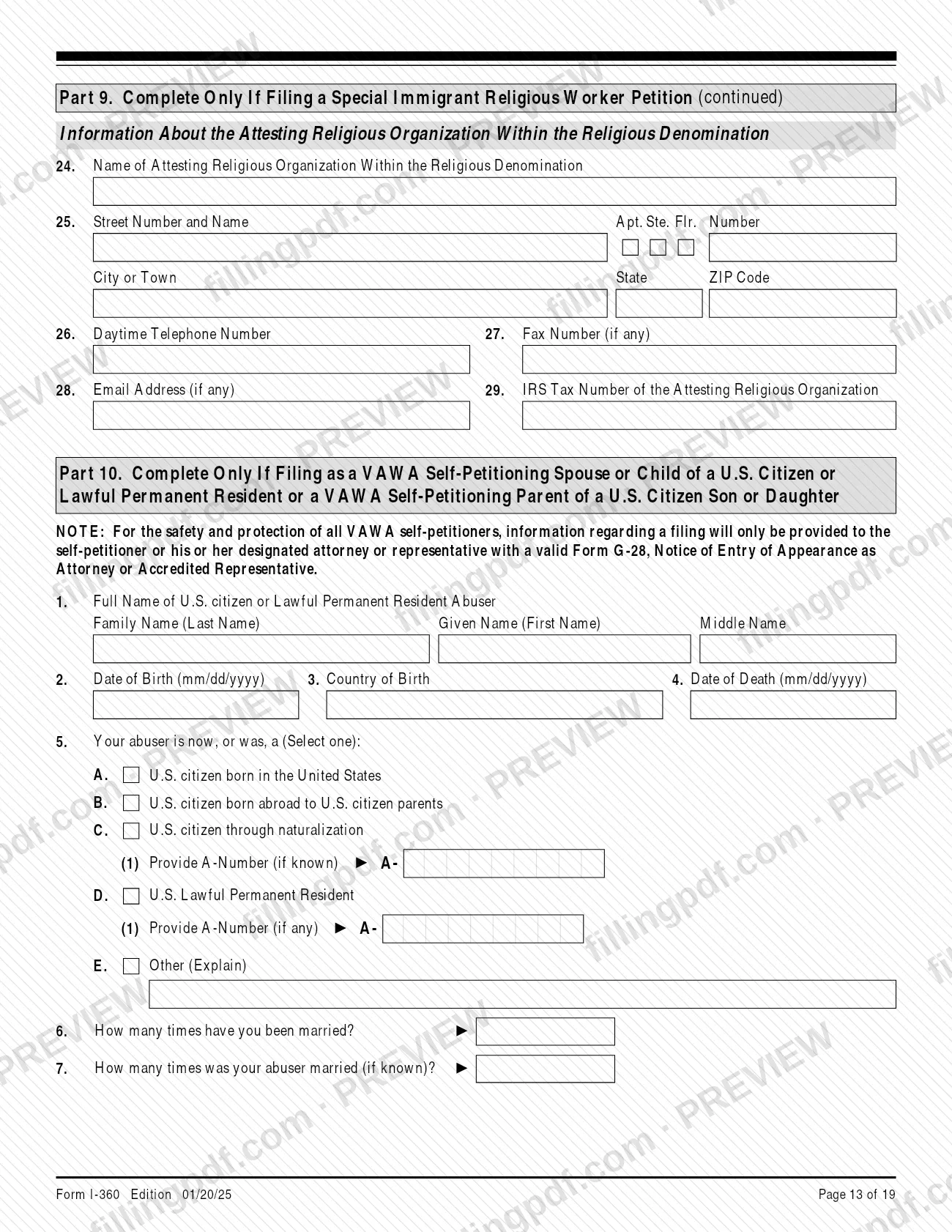
Complete Part 9 for religious workers
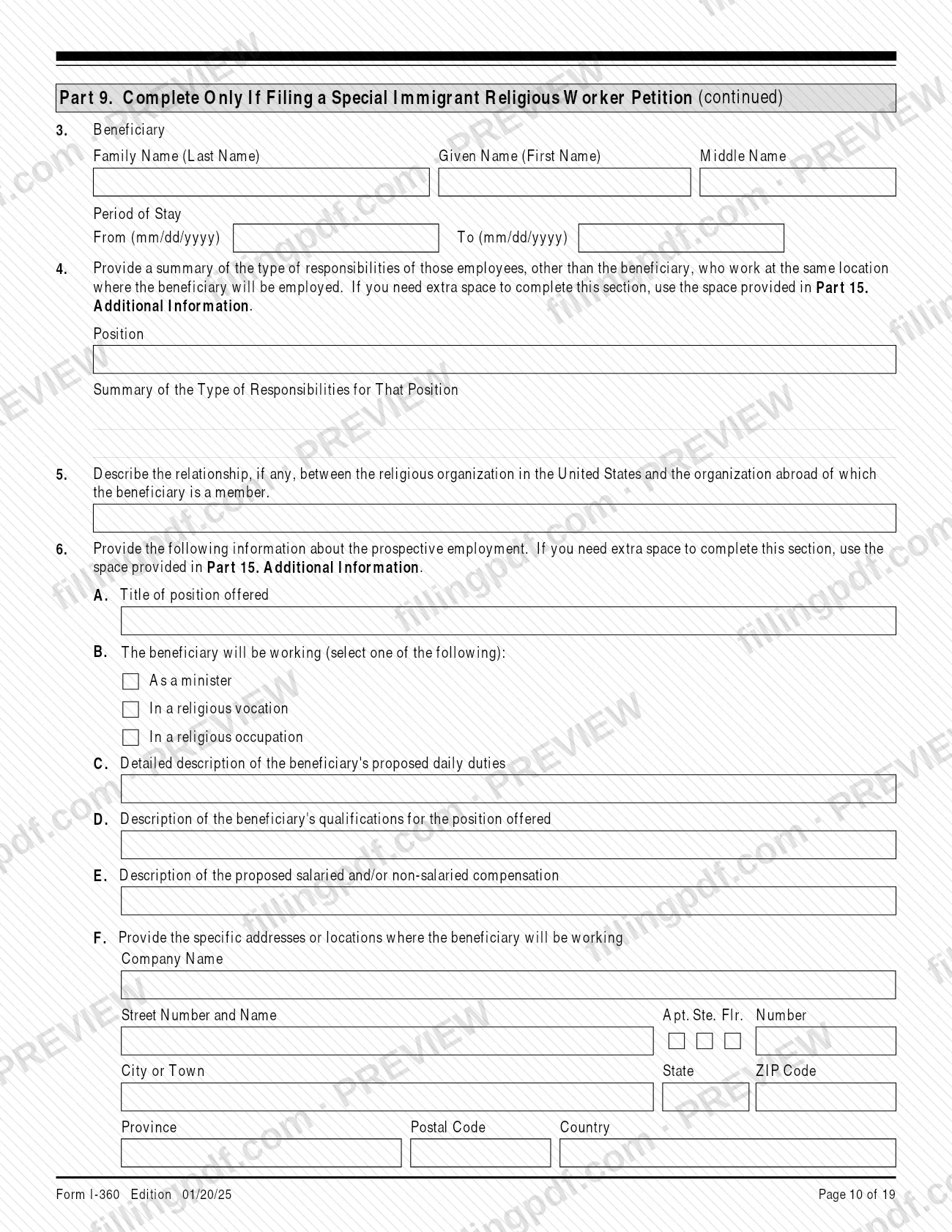
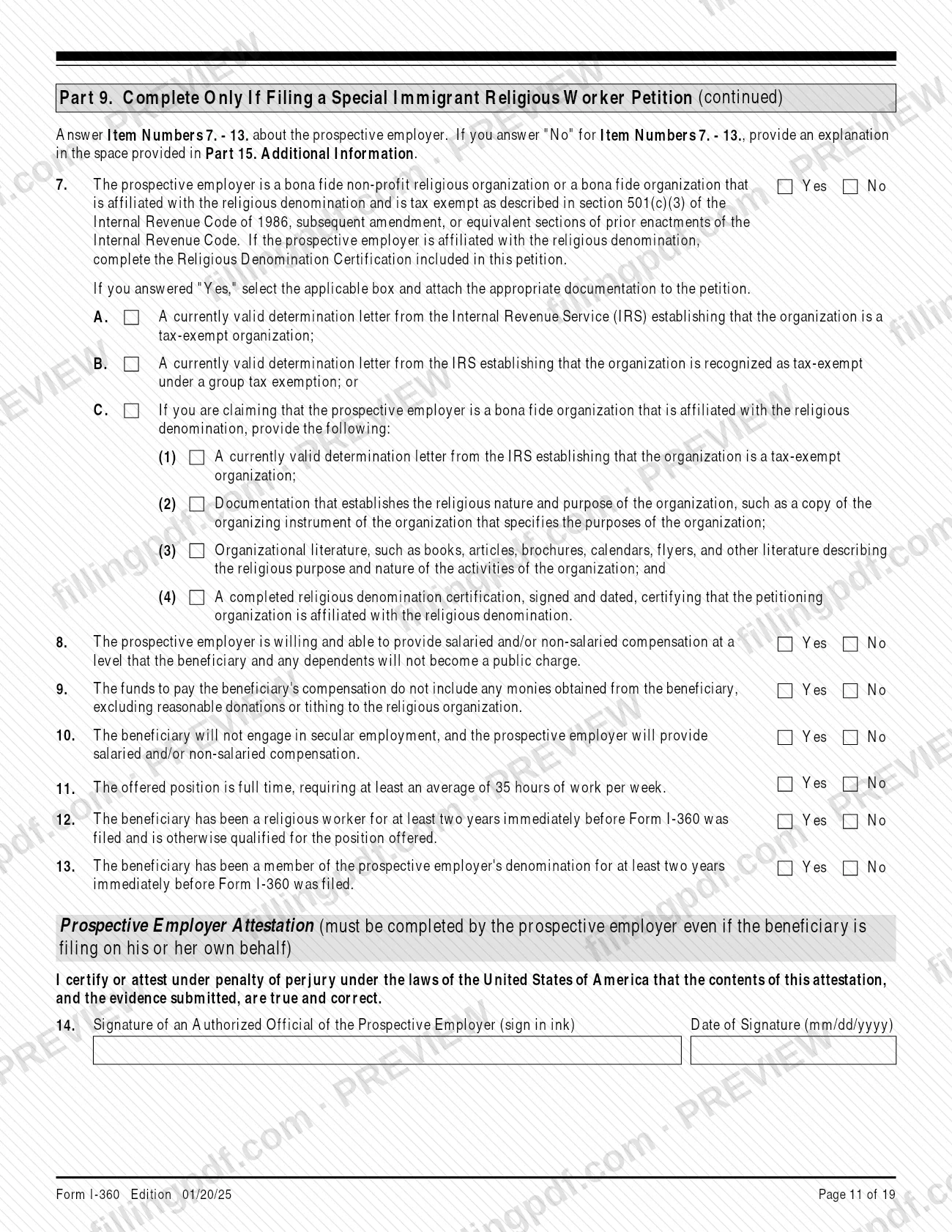
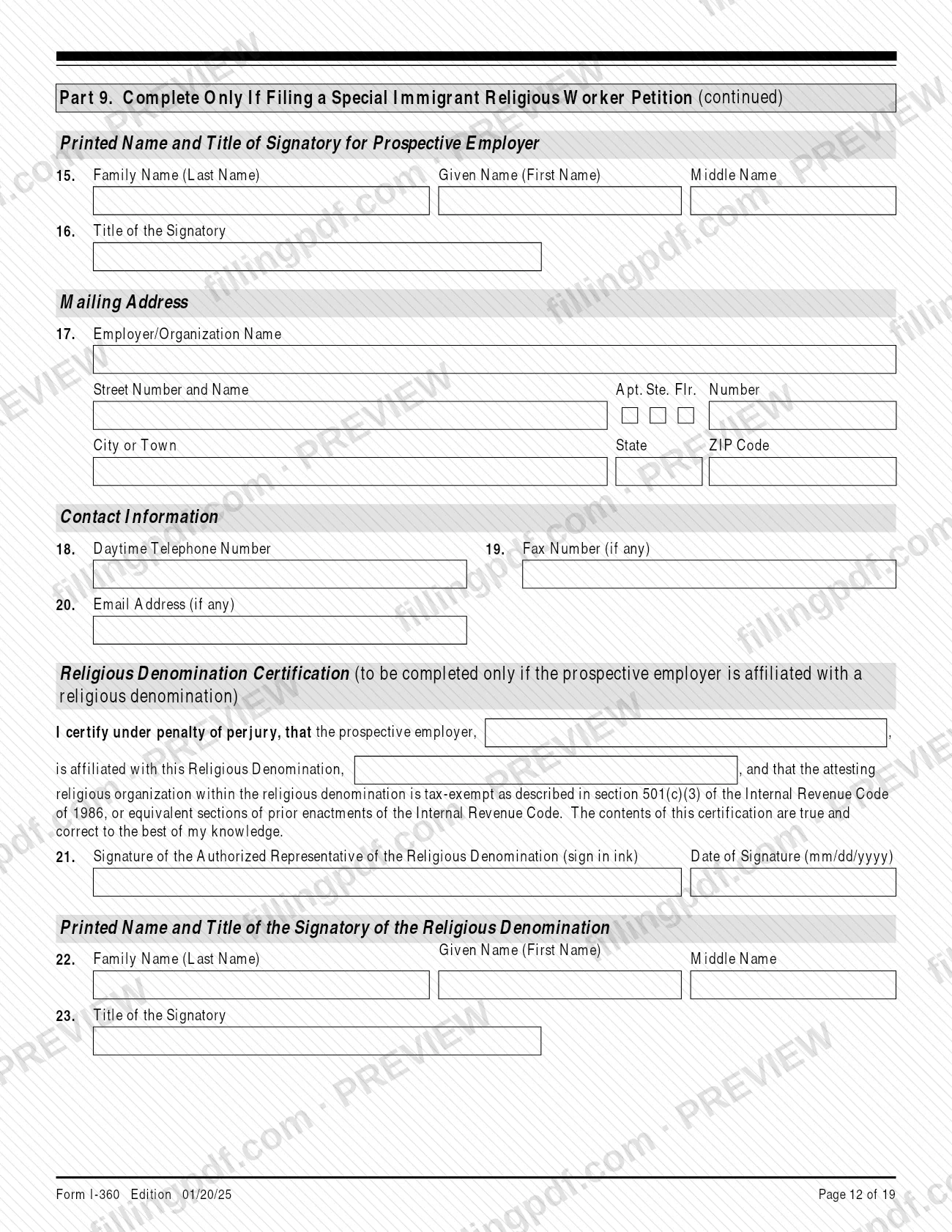
Provide the employer's attestation numbers, prior R classification stays, position and compensation details, and answer Items 7 to 13. An authorized employer official signs the attestation, and the Religious Denomination Certification applies only if the employer is affiliated with a denomination.
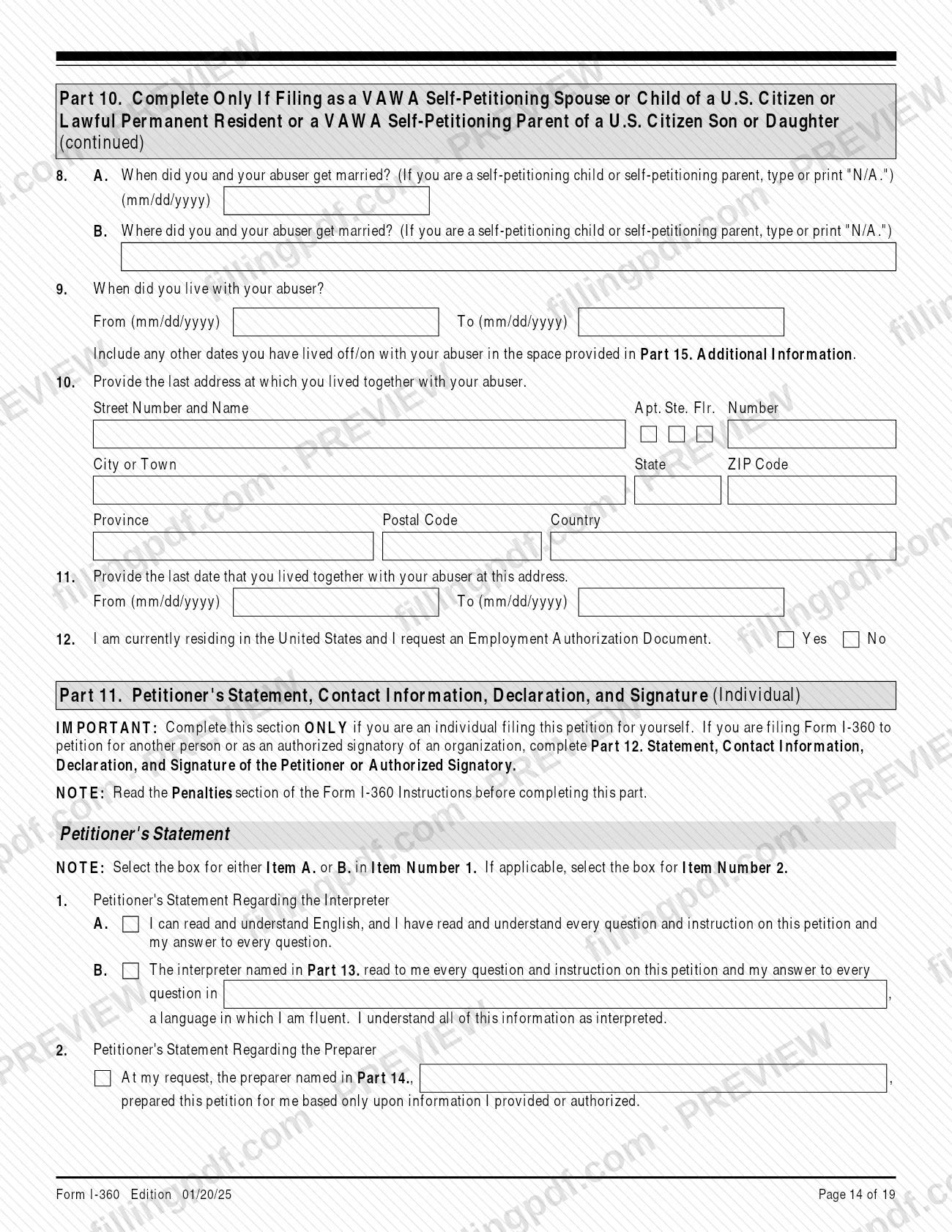
Complete Part 10 for VAWA
Enter the abuser's name, birth and death details, status, marriage history, dates and last shared address. Type or print "N/A" in Item 8 if you are a self-petitioning child or parent, and answer Item 12 on requesting an Employment Authorization Document.
Sign Part 11 or Part 12
Use Part 11 only if you are an individual filing for yourself; use Part 12 if you file for another person or sign for an organization. Select the interpreter and preparer boxes if they apply, enter your contact details, and sign and date in ink.
Add interpreter and preparer details
If an interpreter read the petition to you, they complete Part 13. Anyone who prepared it for you, other than you, completes and signs Part 14, including the statement on whether representation extends beyond preparation.
Use Part 15, then review and download
For extra space, write your name, A-Number, page, part and item number, then sign and date each sheet. Check every part, then download or print the completed PDF from FillingPDF and assemble the package described under How to submit.
How to submit I-360
Form I-360 can be filed by mail, online for certain petitions, or in person in one limited situation.
- By mail: where to send it depends on your eligibility category, where you live and whether you are filing Form I-485 at the same time. Check the Direct Filing Addresses for Form I-360 at https://www.uscis.gov/i-360 for current addresses. If you print the form, the edition date and page numbers must be visible on every page, and all pages must be from the same edition, or USCIS may reject it.
- Online: certain I-360 petitions can be filed by uploading a PDF through a USCIS online account. Check the Forms Available to File Online page to see whether you or your accredited representative can file it online.
- In person (special immigrant juvenile): within 2 weeks before your 21st birthday, request an appointment at a USCIS field office through the USCIS Contact Center, 800-375-5283. The field office date-stamps the first page and forwards the petition to the lockbox.
Sign the petition; USCIS rejects unsigned forms and does not accept a stamped or typewritten name. A photocopy, fax or scan of the handwritten original signature is valid. A filing fee applies for this form: see Form G-1055 or the USCIS Fee Schedule page for the current amount. To get an acceptance notice by email or text, clip Form G-1145 to the first page. Do not send a change of address to the lockbox, and do not mail the petition to the Camp Springs, MD address in the Paperwork Reduction Act notice. FillingPDF lets you fill out and download the PDF; submission follows the channels above.
Common mistakes to avoid
- Submitting the petition unsigned or with a stamped or typewritten name; USCIS rejects it as deficient and the instructions say a signature is required.
- Filing without the correct filing fee; the instructions say USCIS rejects any Form I-360 not accompanied by the correct fee. Check Form G-1055 or the Fee Schedule.
- Filing as a widow(er) when your U.S. citizen spouse already filed Form I-130 that was approved or pending; it was converted to an I-360 when your spouse died.
- Filing Form I-360 for an Afghan special immigrant case that started on or after July 20, 2022; that process uses Form DS-157 with the Department of State.
- Completing Part 11 when you are filing for another person or for an organization (or Part 12 when filing for yourself); each part is limited to its own filer.
- Describing yourself in Part 3 when you are only a preparer or attorney for the petitioner; the preparer's details belong in Part 14.
- Leaving a non-applicable answer blank instead of typing or printing "N/A", or "None" for a numeric answer of zero.
- Submitting a foreign-language document without a full English translation and the translator's signed certification.
- Sending original documents when the instructions do not ask for them; USCIS may destroy originals submitted when not required.
- Mailing a printed form with pages from different editions or without the edition date and page numbers visible, which can lead USCIS to reject it.
Frequently asked questions
What is Form I-360 used for?
Form I-360 is the USCIS petition used to classify a person as an Amerasian, the widow(er) of a U.S. citizen, a VAWA self-petitioner, or a special immigrant, such as a religious worker, special immigrant juvenile or armed forces member. You choose one classification in Part 2.
Can I fill out Form I-360 online?
You can fill out the PDF online on FillingPDF and download or print it. FillingPDF does not file anything with USCIS. Certain I-360 petitions can also be filed online through a USCIS online account by uploading a PDF; otherwise you mail the completed petition.
Who can file Form I-360?
It depends on the classification. A widow(er) or VAWA self-petitioner files for themselves, a U.S. employer or the beneficiary files for a religious worker, and an Amerasian petition may be filed by a person 18 or older or by a U.S. corporation. Check the category rules in the instructions.
What is the deadline for Form I-360 as a widow(er)?
You must file no later than 2 years after your U.S. citizen spouse's death. You also must not have remarried or been legally separated at the time of death. If your spouse filed Form I-130 for you that was approved or pending, you do not need to file this petition.
When must a special immigrant juvenile file Form I-360?
Before your 21st birthday. If delays make that difficult, USCIS allows in-person filing at a field office within 2 weeks before you turn 21. Request the appointment through the USCIS Contact Center at 800-375-5283.
Where do I mail Form I-360?
The address depends on your category, where you live and whether you are filing Form I-485 at the same time. See the Direct Filing Addresses for Form I-360 linked from www.uscis.gov/i-360. The instructions also tell you not to mail the form to the Camp Springs, MD address in the Paperwork Reduction Act notice.
Do I still file Form I-360 as an Afghan special immigrant?
Not if you started the special immigrant process on or after July 20, 2022; you file Form DS-157 with the Department of State instead. Only the limited groups listed in the instructions, such as people with Chief of Mission approval who did not file a signed DS-157, should file the I-360 with USCIS.
Can someone else sign Form I-360 for me?
Generally no: the petitioner or authorized signatory must sign, and USCIS does not accept a stamped or typewritten name. If you are under 14, your parent or legal guardian may sign, and a legal guardian may sign for a mentally incompetent person.
Is there a fee for Form I-360?
Yes, a filing fee applies, and USCIS rejects a petition that comes without the correct fee. The amount is not given here; see Form G-1055 or the USCIS Fee Schedule page for the current fee for this form.
Ready to fill out I-360?
Fill out I-360 now