
Form I-407, Record of Abandonment of Lawful Permanent Resident Status, is the form U.S. Citizenship and Immigration Services (USCIS) provides so that a lawful permanent resident (LPR) can record the voluntary abandonment of that status. It is used by LPRs who are outside the United States or at a port of entry, and by people who abandoned LPR status earlier and later returned as nonimmigrants or parolees. On this page you can fill out the form online on FillingPDF and download or print the completed PDF; the form, its instructions and the filing details are published by USCIS.
Last updated
What is I-407?
Form I-407, Record of Abandonment of Lawful Permanent Resident Status, is the U.S. Citizenship and Immigration Services (USCIS) form that records an individual's abandonment of lawful permanent resident (LPR) status and the waiver of the right to a hearing before an immigration judge.
USCIS describes the form as a simple procedure for recording abandonment. When USCIS receives it, the agency says it will update your records to show you are no longer an LPR. The form also ensures that the person abandoning status has been told about the right to a hearing and has knowingly, willingly and affirmatively waived it. If you choose a hearing instead, the instructions say you would have the right to an attorney or accredited representative at no expense to the U.S. Government, to challenge DHS evidence, to present your own evidence, to require DHS to prove abandonment by clear, unequivocal, and convincing evidence, and to appeal an adverse decision.
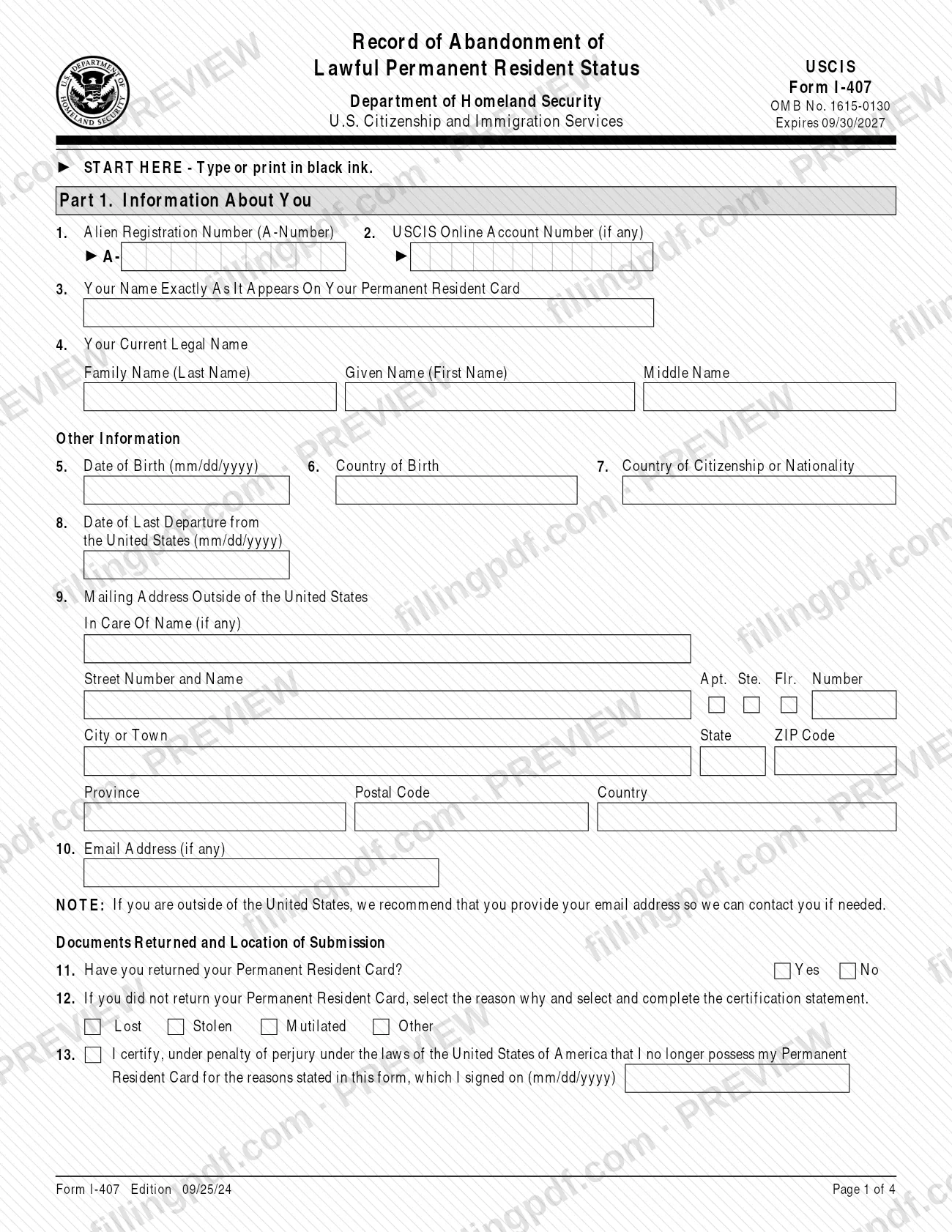
The form has four parts: Part 1, Information About You (with the certification and signature); Part 2, the interpreter's section; Part 3, the preparer's section; and Part 4, For Government Use Only. U.S. Department of Homeland Security (DHS) officials and U.S. Department of State (DOS) consular officers also use Form I-407 to record abandonment during an in-person interview or by correspondence.
Submitting the form is voluntary: the form states that U.S. law does not require you to complete, sign or submit it.
Who needs to file I-407?
Form I-407 is for lawful permanent residents who are outside the United States or at a port of entry and want to abandon their LPR status. It may also be used by people who were admitted as nonimmigrants or paroled into the United States after abandoning a prior LPR status and who now want to record that earlier abandonment (Item Number 18 on the form).
Minors and incapacitated adults. Generally, if a parent abandons LPR status, any minor children in that parent's custody also abandon theirs. If a parent, custodial parent or legal guardian files a separate form for a minor child, that person must submit evidence of the parental relationship, custody or guardianship. If the LPR is 14 years of age or younger, the parent, custodial parent or duly appointed legal guardian must sign and consent. For an incapacitated adult, the duly appointed legal guardian signs and consents.
Not required. Nobody is required to file it. The form notes that you may request a hearing before an immigration judge if you disagree with a DHS claim that you have abandoned your LPR status.
Interpreters and preparers. An interpreter who read the instructions and questions to you completes Part 2. A person who prepared the form for you completes Part 3.
When to file I-407
The form sets no deadline. You submit Form I-407 when you decide to record the abandonment of your LPR status: while you are outside the United States, at a U.S. port of entry, or, to document a past abandonment, after you have returned as a nonimmigrant or parolee.
The USCIS page says that in very rare circumstances a USCIS international field office, or a U.S. embassy or consulate without one, may accept the form in person when you need immediate proof that you abandoned LPR status. The most common reason is applying for an A or G visa. The instructions also warn that if you provide no email address and USCIS needs to contact you, processing may be delayed.
Documents you need
- Your Permanent Resident Card, and any reentry permit or refugee travel document in your possession: the instructions say to submit all of them. Surrender only documents issued by USCIS.
- If you did not return your Permanent Resident Card: select the reason in Item Number 12 (Lost, Stolen, Mutilated or Other) and complete the certification statement in Item Number 13.
- Evidence of the parental relationship, such as a birth certificate or a custodial parental agreement, when a parent or custodial parent signs for an LPR who is 14 years of age or younger.
- Letters of guardianship or other orders from a government agency or court authorized to appoint guardians where the LPR resides, when a legal guardian signs for a minor or an incapacitated adult.
How to fill out I-407
Enter your A-Number and account number
Item 1: your Alien Registration Number from your Permanent Resident Card, with leading zeros to make nine digits. Item 2: your USCIS Online Account Number only if you have one (a receipt number starting with IOE).
Enter your names
Item 3: your name exactly as it appears on your Permanent Resident Card, even if misspelled or since changed; enter "N/A" if you have no card. Item 4: your current legal name as family, given and middle name.
Provide birth and departure details
Item 5: date of birth as mm/dd/yyyy. Items 6 and 7: country of birth and country of citizenship or nationality, using the current official name. Item 8: date of last departure from the United States, if known.
Enter your address and email
Item 9: your mailing address outside the United States. Item 10: an email address if you have one; if you are abroad, USCIS recommends giving it, and omitting it may delay processing.
Report the card and other documents
Item 11: answer Yes or No for returning your Permanent Resident Card. If No, select the reason in Item 12 and complete Item 13 with the date you signed. Item 14: list other documents you returned, such as a reentry permit or refugee travel document.
Select where you are submitting
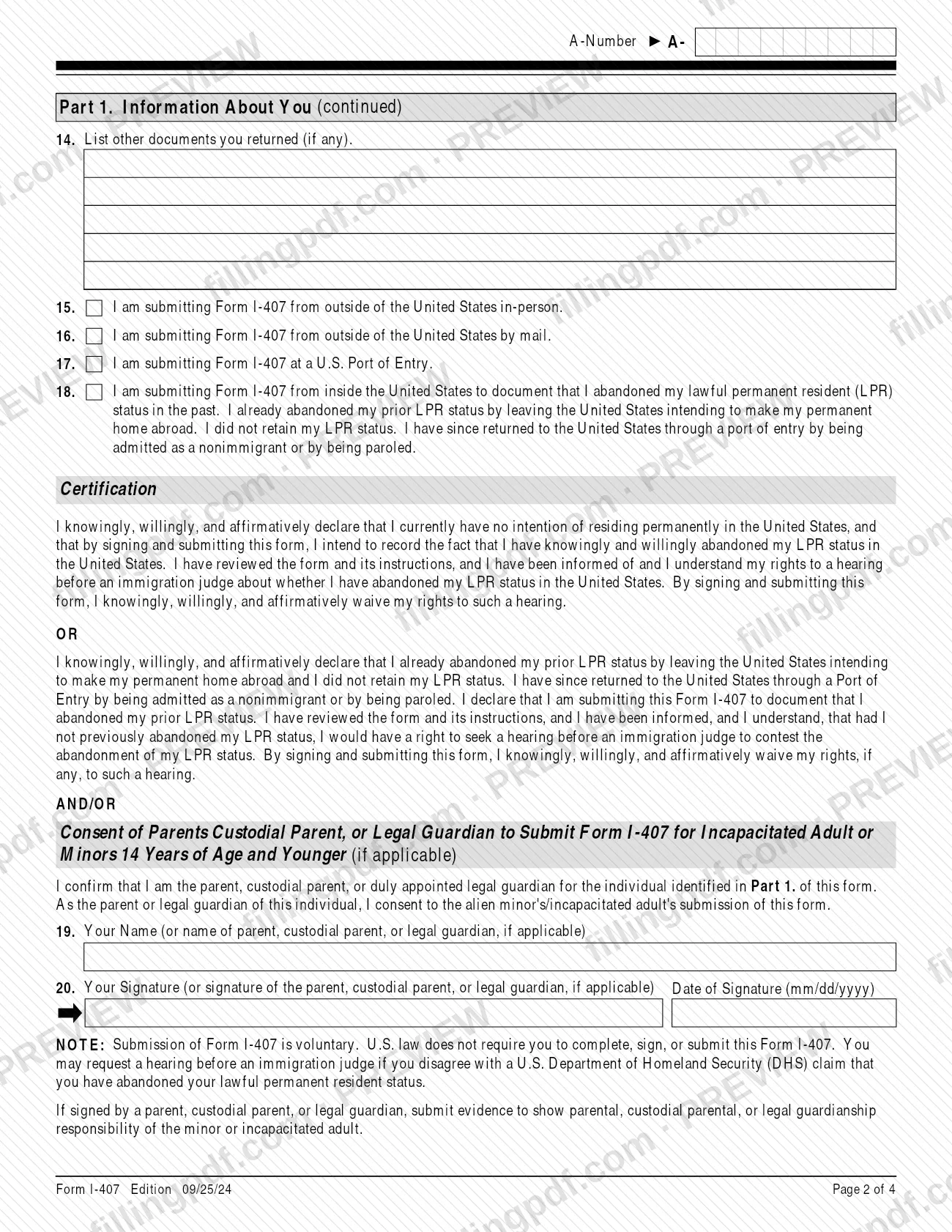
Select the box in Item 15 (outside the United States in person), 16 (outside the United States by mail), 17 (at a U.S. port of entry) or 18 (from inside the United States to document an earlier abandonment).
Read the certification and sign
Read the certification, including the waiver of the hearing before an immigration judge. Item 19: your name. Item 20: your signature and the date as mm/dd/yyyy.
Complete the parent or guardian consent
If the LPR is 14 or younger, or an incapacitated adult, the parent, custodial parent or legal guardian enters their name in Item 19 and signs in Item 20, and attaches evidence of the relationship or guardianship.
Complete Part 2 if an interpreter helped
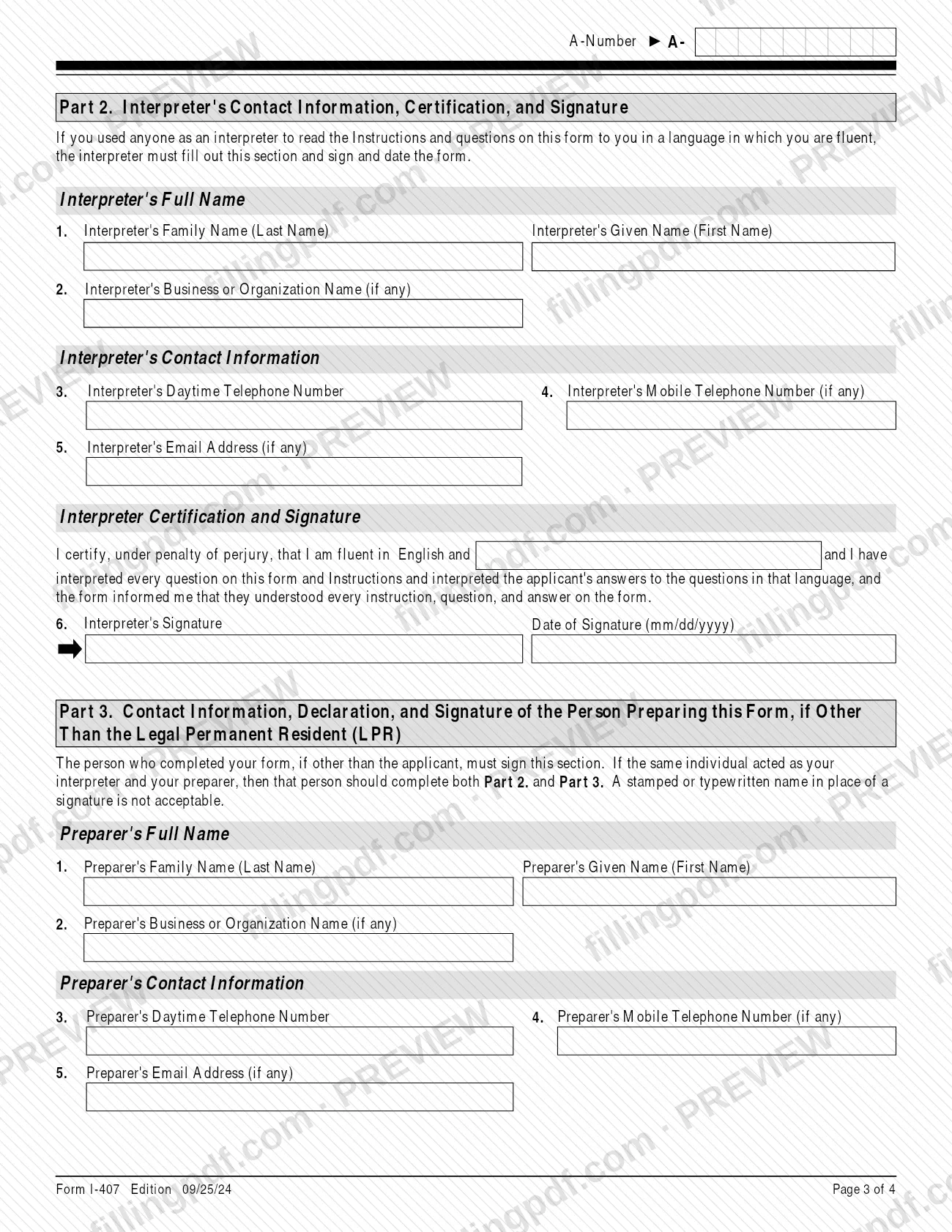
The interpreter enters their name, business or organization, telephone numbers and email in Items 1 to 5, then signs and dates Item 6. Skip this part if no interpreter was used.
Complete Part 3 if someone prepared the form
A preparer other than the LPR enters their name, organization, telephone numbers and email in Items 1 to 5 and personally signs and dates Item 6. If one person was both interpreter and preparer, they complete Parts 2 and 3.
Leave Part 4 blank
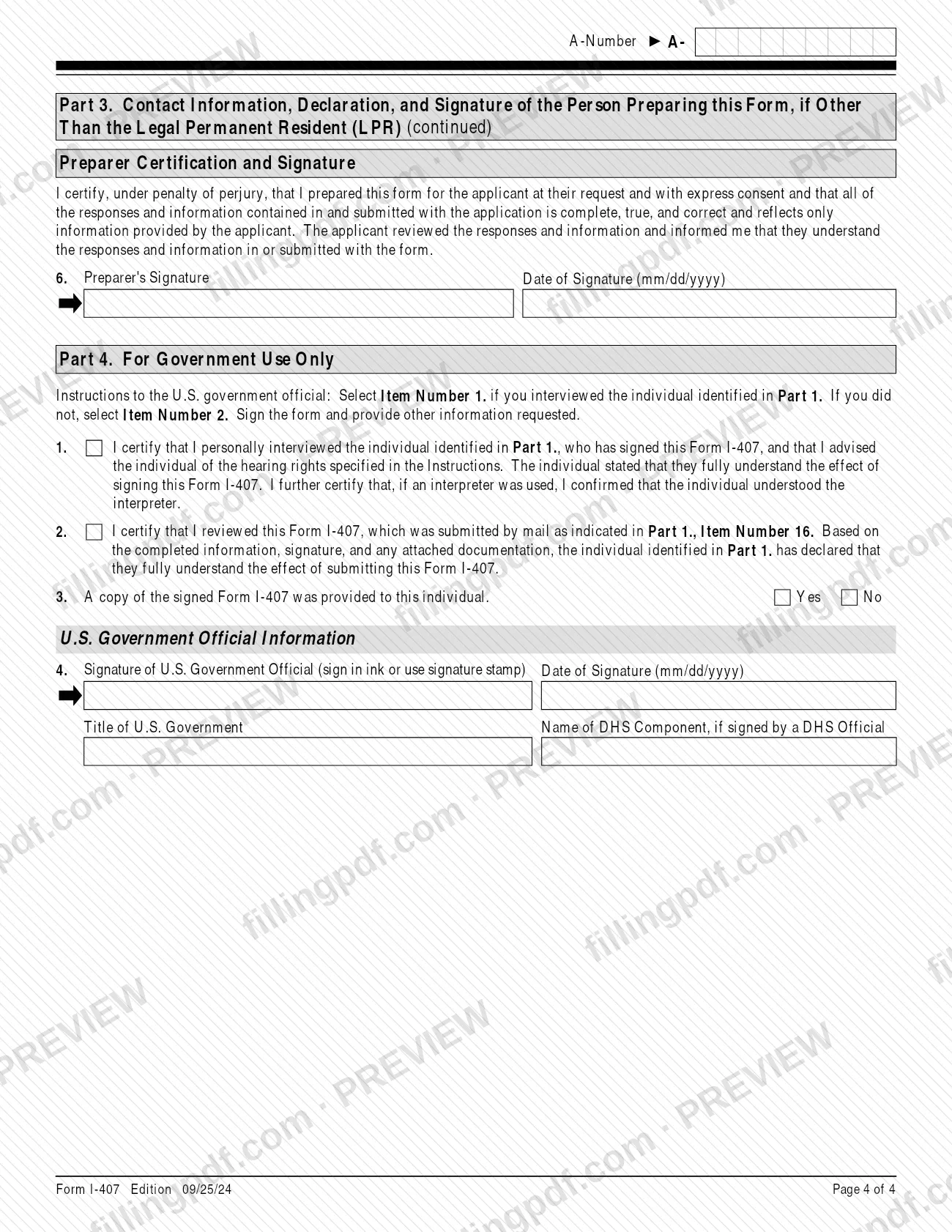
Part 4, For Government Use Only, is completed by the U.S. government official who receives or reviews the form. Do not fill in this part.
Review, download and assemble
Check that your A-Number is on every page and every applicable item is answered or marked "N/A". Download or print the completed PDF from FillingPDF, add the documents described under Required documents and submit it as described under How to submit.
How to submit I-407
You can submit Form I-407 by mail to USCIS, in person in limited cases abroad, or to a U.S. Customs and Border Protection officer at a port of entry. Mark the matching box in Items 15 to 18 on the form.
- By mail: send it to USCIS, Attn: I-407, 7 Product Way, Lee's Summit, MO 64002. The same address is given for U.S. Postal Service, FedEx, UPS and DHL deliveries. Do not mail the form to the Camp Springs, MD address printed in the instructions' Paperwork Reduction Act notice.
- In person outside the United States: in very rare circumstances a USCIS international field office, or a U.S. embassy or consulate without one, may allow it, for example when you need immediate proof for an A or G visa application.
- At a U.S. port of entry: you may give the form to a U.S. Customs and Border Protection officer.
Include all pages, sign the form, and surrender your Permanent Resident Card and any reentry permit or refugee travel document you hold. If you print and mail it, the edition date and page numbers must be visible at the bottom of every page and all pages must come from the same edition, or USCIS may reject it. USCIS rejects unsigned forms. A filing fee applies; see Form G-1055 and the USCIS Fee Schedule page for the amount. Check www.uscis.gov/I-407 for the latest filing information. FillingPDF lets you fill out and download the PDF; submission follows the channels above.
Common mistakes to avoid
- Submitting the form unsigned. USCIS says it will reject any unsigned Form I-407, and the form must be signed before DHS or DOS accepts it.
- Leaving out pages or mixing pages from different editions when you print and mail the form; USCIS may reject it. Keep the edition date and page numbers visible on every page.
- Surrendering other documents, such as a state-issued driver's license or a Social Security card; only documents issued by USCIS are surrendered.
- Not returning the Permanent Resident Card without selecting a reason in Item Number 12 and completing the certification in Item Number 13.
- Leaving the A-Number off any page, or entering fewer than nine digits; add leading zeros, for example A1234567 becomes A001234567.
- Leaving a non-applicable question blank instead of typing or printing "N/A", or "None" for a numeric answer of zero.
- Having a minor aged 14 or younger, or an incapacitated adult, sign without the parent or guardian's signature and evidence of the relationship or guardianship.
- Mailing the form to the Camp Springs, MD address in the Paperwork Reduction Act notice instead of the Lee's Summit, MO filing address.
- Using a stamped or typewritten name in place of the preparer's signature in Part 3; the form says that is not acceptable.
Frequently asked questions
What is Form I-407 used for?
Form I-407 records that a lawful permanent resident is abandoning LPR status. USCIS says it will update your records to show you are no longer an LPR, and the form also documents that you were told of your right to a hearing before an immigration judge and waived it.
Is it mandatory to file Form I-407?
No. The form states that submitting it is voluntary and that U.S. law does not require you to complete, sign or submit it. If DHS claims you abandoned your status and you disagree, you may request a hearing before an immigration judge.
Where do I mail Form I-407?
Mail it to USCIS, Attn: I-407, 7 Product Way, Lee's Summit, MO 64002. This address is given for USPS, FedEx, UPS and DHL deliveries. Do not use the Camp Springs, MD address in the instructions; it is only for comments on the paperwork burden.
Can I submit Form I-407 at an airport or embassy?
You may give it to a U.S. Customs and Border Protection officer at a U.S. port of entry. A USCIS international field office or a U.S. embassy or consulate may accept it in person only in very rare circumstances, such as when you need immediate proof for an A or G visa.
What rights do I give up by signing Form I-407?
You waive the right to a hearing before an immigration judge on whether you abandoned LPR status. In a hearing you could have an attorney at no U.S. Government expense, challenge and present evidence, require DHS to prove abandonment by clear, unequivocal, and convincing evidence, and appeal.
What if I lost my Permanent Resident Card?
Select Lost in Item Number 12 and complete the certification statement in Item Number 13, which says under penalty of perjury that you no longer possess the card. Also surrender any reentry permit or refugee travel document you still hold.
Who signs Form I-407 for a child?
If the LPR is 14 years of age or younger, a parent, custodial parent or duly appointed legal guardian signs and consents, with evidence of the relationship or guardianship. For an incapacitated adult, the duly appointed legal guardian signs with official guardianship papers.
Is there a fee, and does the IRS find out?
A filing fee applies; see Form G-1055 and the USCIS Fee Schedule page for the amount. USCIS says that if you file with it, it will give your name and filing date to the Internal Revenue Service, and ending LPR status may have tax consequences, such as an expatriation tax.
Can I fill out Form I-407 online?
You can fill out the PDF online on FillingPDF and download or print it. FillingPDF is an independent service and does not file the form or deliver it to USCIS; you submit it through the USCIS channels described on this page.
Ready to fill out I-407?
Fill out I-407 now