
Form I-539 is the application U.S. Citizenship and Immigration Services (USCIS) uses to extend the stay of a nonimmigrant in the United States or to change from one nonimmigrant status to another. It also covers F-1 and M-1 student reinstatement, V status, and an initial grant of status for certain residents of the Commonwealth of the Northern Mariana Islands (CNMI). On this page you can fill out the form online on FillingPDF and download or print the completed PDF; the official form, the instructions and the filing addresses are published by USCIS.
Last updated
What is I-539?
Form I-539, Application to Extend/Change Nonimmigrant Status, is the U.S. Citizenship and Immigration Services (USCIS) application that nonimmigrants in the United States use to request an extension of stay or a change to another nonimmigrant status.
In certain situations the form is also used to apply for an initial nonimmigrant status, and F-1 or M-1 students use it to apply for reinstatement. USCIS lists four groups that use it: certain nonimmigrants extending or changing status, CNMI residents applying for an initial grant of status, F and M nonimmigrants seeking reinstatement, and people seeking V status or an extension as a V nonimmigrant.
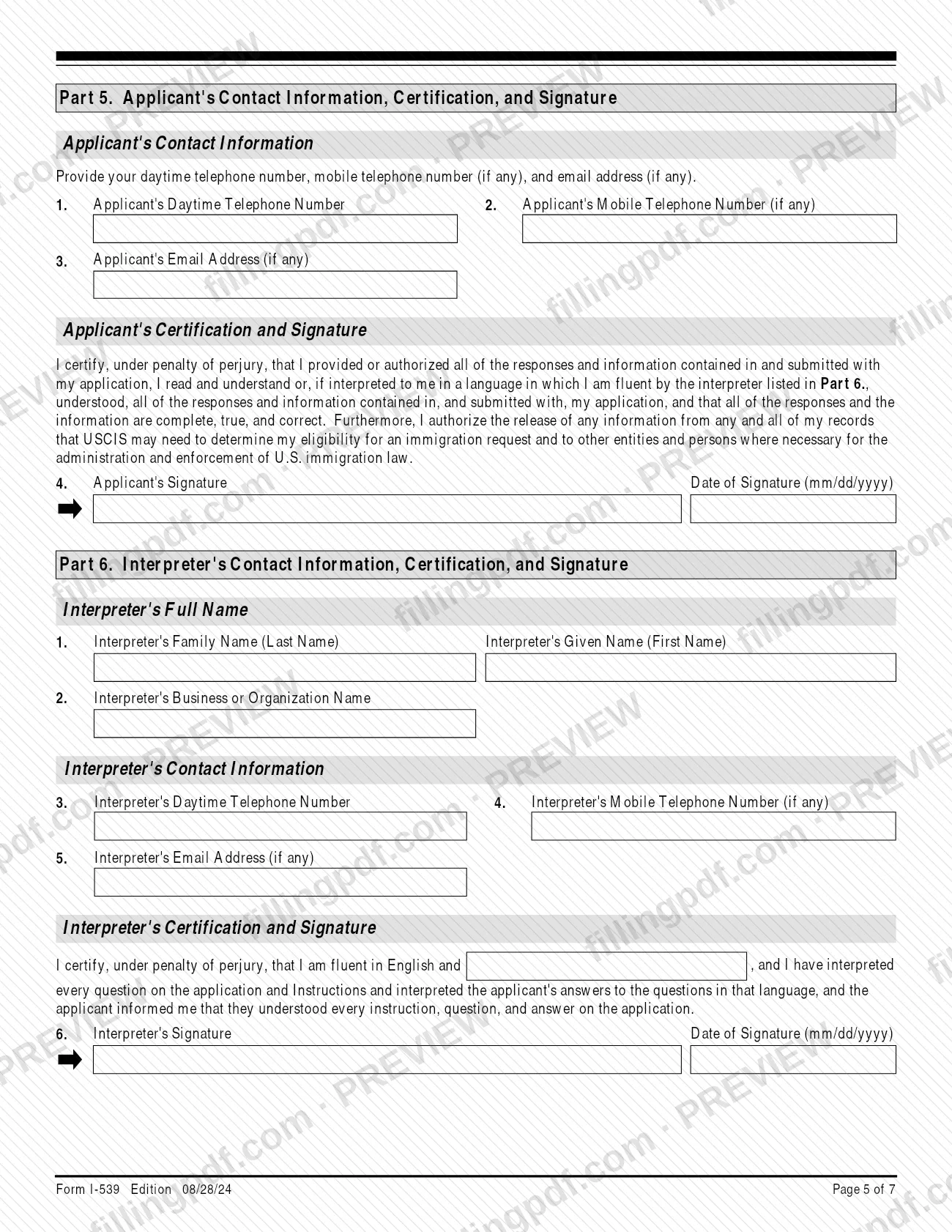
The form has eight parts: information about you, application type, processing information, additional information about the principal applicant, the applicant's signature, and sections for an interpreter, a preparer and additional information. Family members included in the same application each need a separate Form I-539A, the supplemental form for co-applicants.
Form I-539 is not the right form for every status. Requests to extend or change into certain employment-based classifications, such as H-1B, L-1, O-1 and P-1, are filed by an employer on Form I-129, Petition for a Nonimmigrant Worker. USCIS warns that filing on the wrong form may lead to rejection or denial, and that filing fees are not refunded if the case is denied. The edition printed on this form is 08/28/24, under OMB No. 1615-0003.
Who needs to file I-539?
Nonimmigrants in the United States who want to extend their stay or change to another nonimmigrant status use Form I-539, unless an exclusion applies. To qualify, you must have been lawfully admitted as a nonimmigrant and have committed no act that makes you ineligible for an immigration benefit.
Other groups named by USCIS:
- Dependents of principal E, H, L, O, P, R and TN workers (for example H-4, L-2, O-3, P-4, R-2 and TD), who file this form to extend or change status.
- F-1 and M-1 students seeking reinstatement. F-1 students use it for an extension only if admitted for a limited duration to study at a public secondary school.
- V applicants and CNMI residents seeking an initial grant of status.
- A spouse and unmarried children under 21 may be included as co-applicants, but only if all are in the same status or are in derivative status. Each co-applicant needs a Form I-539A.
You may not use it if you were admitted under the Visa Waiver Program, or if your status is C (in transit), TWOV, D (crewman), K-1 or K-2. Principal H-1B, H-2A, H-2B, H-3, L-1, O-1, O-2, P-1 to P-3, Q-1, R-1, TN-1 and TN-2 workers, and E-1, E-2 and E-3 principals, may not use it either. J-1 exchange visitors must contact their program's responsible officer for extensions.
A parent or guardian may sign for a child under 14, and a legal guardian may sign for a mentally incompetent person.
When to file I-539
File before your current authorized stay expires. USCIS suggests filing at least 45 days, but generally not more than 6 months, before the stay ends. Even if a later status is approved, you generally must file Form I-539 to bridge any gap between your current status and the start of the new one.
A late filing may be excused only if you show, when you file, that the delay was due to extraordinary circumstances beyond your control, the delay was reasonable, you have not otherwise violated your status, you are still a bona fide nonimmigrant, and you are not in removal proceedings.
V nonimmigrants seeking an extension may file no earlier than 120 days before their current expiration date. Your passport must be valid for the whole period of stay you request. If you are out of status, USCIS says it cannot change your status except in limited circumstances beyond your control. The instructions set no processing time for the form; USCIS notifies you of its decision in writing.
Documents you need
- Form I-539A for each co-applicant, signed by that co-applicant (a parent or guardian may sign for a child under 14), when you include your spouse or unmarried children under 21.
- Form I-94 Arrival/Departure Record: a copy, front and back, for each person included, in most categories. B-1 and B-2 filers include the original Form I-94 for each person.
- For B-1 or B-2 extension or change: a typed or written statement of your reasons, why the stay would be temporary, any effect on foreign employment or residency, and how you will support yourself.
- Evidence of family relationship for co-applicants and dependents: marriage certificate and proof any prior marriage ended for a spouse, or birth certificate or adoption decree for a child, plus a copy of the visa showing dependent classification.
- For H-4, L-2, O-3, P-4, R-2, TD and E dependents: a copy of the principal's Form I-129, I-797 Receipt Notice, most recent Form I-94 or I-797 Approval Notice, as the instructions list.
- For F-1 or M-1: a copy of Form I-20 from your school and documents showing you can pay for your studies and support yourself and accompanying family.
- For F-1 or M-1 reinstatement: evidence the violation resulted from circumstances beyond your control (or a course-load reduction a DSO could have authorized) and that denial would cause extreme hardship; if out of status more than five months, evidence of exceptional circumstances.
- For a change to J-1: Form DS-2019 and your Form I-94. Current or former J-1 or J-2: proof of that status, such as Form DS-2019 or a passport with the J visa stamp.
- For A, G and similar categories: Form I-566 certified by the Department of State. A-3 and G-5 filers also provide the employer documents listed in the instructions.
- For V status: proof you are the beneficiary of a qualifying immigrant petition, such as Form I-797 for Form I-130; proof of a pending Form I-485 if a visa number is immediately available; and Form I-693 for initial filings only.
- For TPS applicants: evidence of an approved Form I-821, government identification or an Employment Authorization Document, TPS re-registration evidence and evidence of eligibility for the requested status.
- For T or U extensions: your Form I-94 or approval notice and evidence of law enforcement need or exceptional circumstances, as the instructions describe.
- A full English translation of any foreign-language document, with the translator's signed certification of completeness and accuracy, printed name, date and contact information.
How to fill out I-539
Enter your identity and addresses
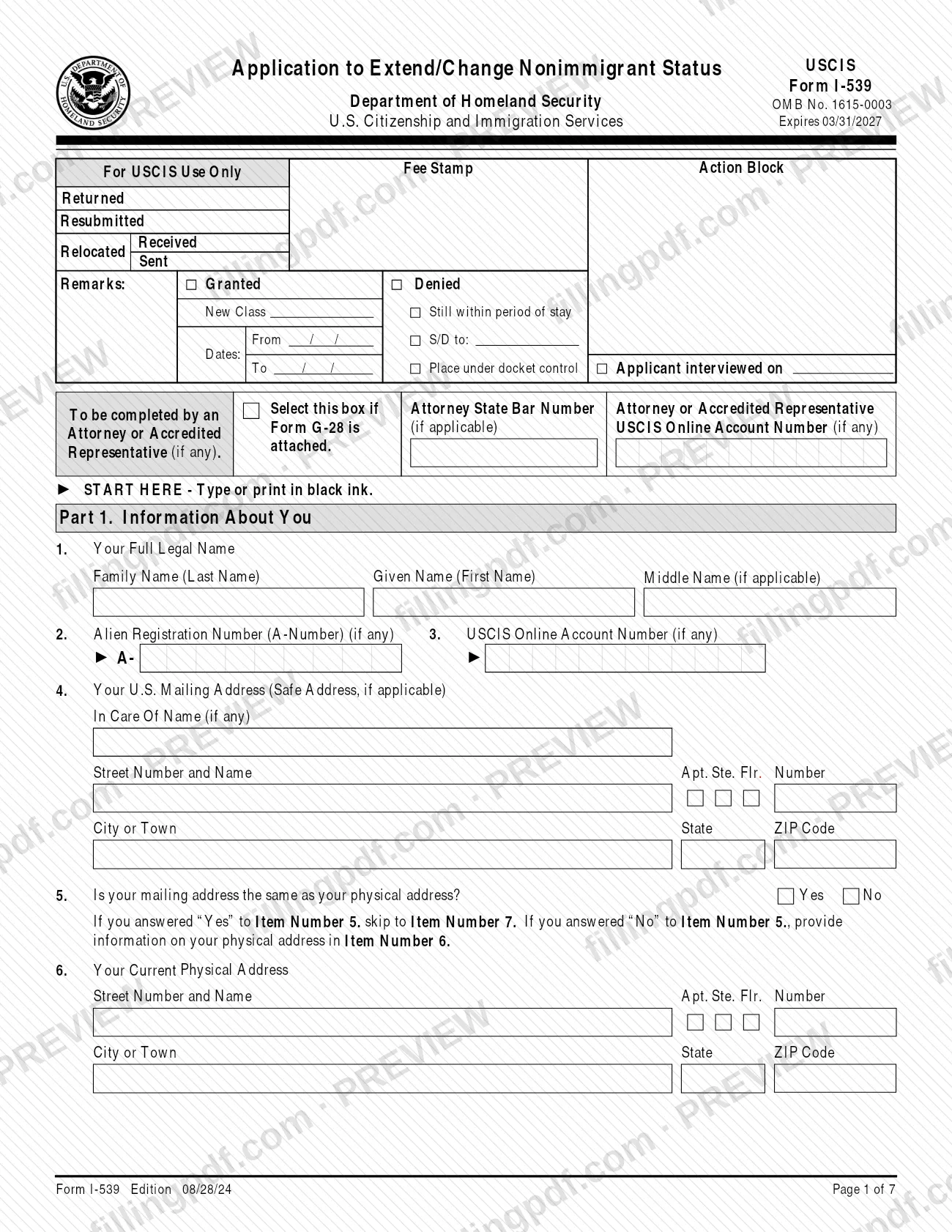
In Part 1, Item 1 enter your full legal name; Items 2 and 3 take your A-Number and USCIS Online Account Number, if any. In Item 4 give a valid U.S. mailing address (a safe address if applicable), and if Item 5 is No, enter your physical address in Item 6.
Add attorney details if applicable
If an attorney or accredited representative helps you, the top-of-form block takes their State Bar Number and USCIS Online Account Number, and the box to select if Form G-28 is attached.
Complete your personal and entry information
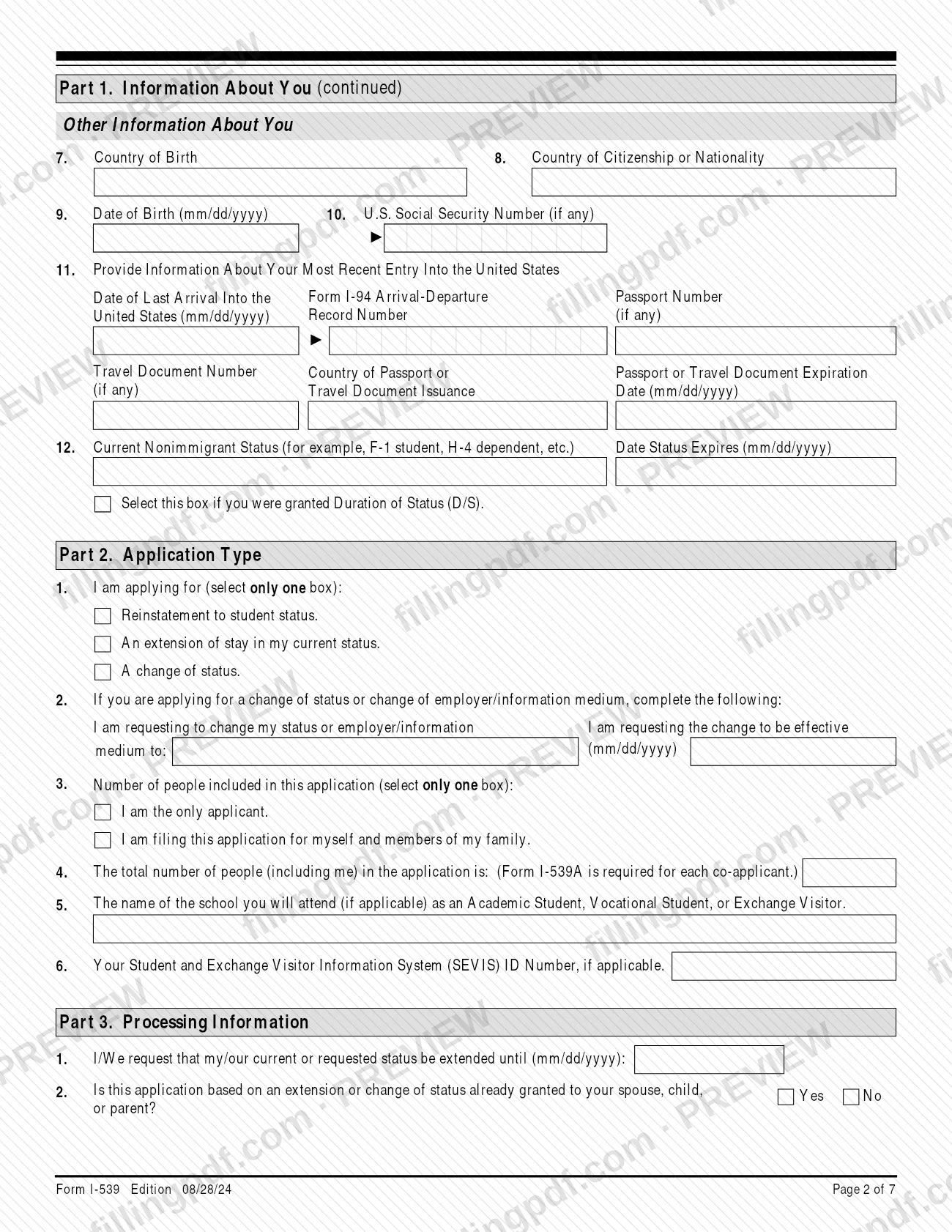
Enter country of birth (Item 7), country of citizenship or nationality (Item 8), date of birth in mm/dd/yyyy (Item 9) and Social Security Number, if any (Item 10). Item 11 asks for your last arrival date, Form I-94 number and passport or travel document details; Item 12 asks for your current status and its expiration date.
Select your application type
In Part 2, Item 1 select only one box: reinstatement to student status, extension of stay, or change of status. Item 2 asks for the requested status and effective date if you are changing status or employer.
List co-applicants, school and SEVIS ID
In Part 2, Item 3 mark whether you are the only applicant, and in Item 4 enter the total number of people including you. Items 5 and 6 take the school name and SEVIS ID number, if applicable.
Complete the processing information
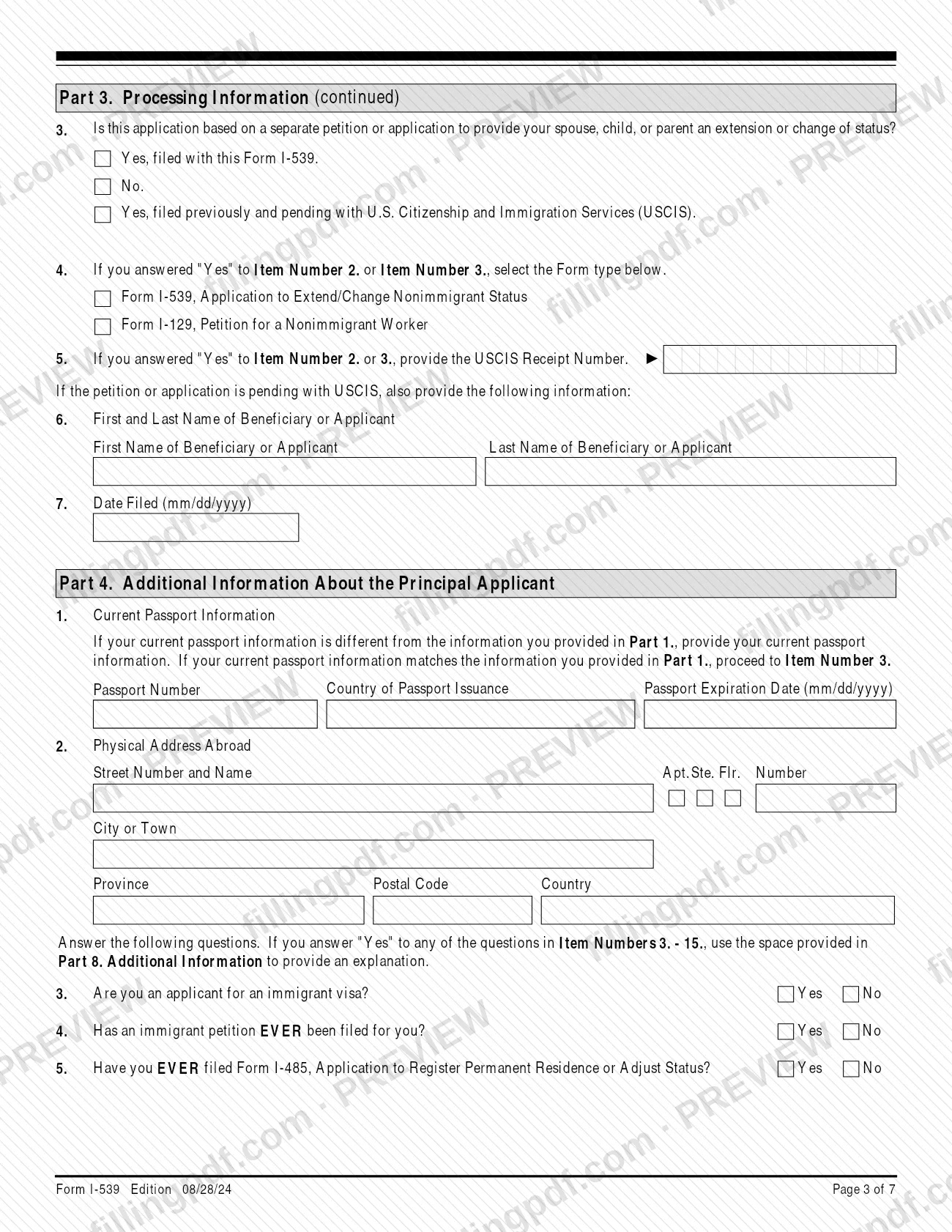
In Part 3, Item 1 enter the date until which you want your status extended (mm/dd/yyyy). Items 2 to 7 ask whether the request is based on a spouse, child or parent's extension or change, the related form type, receipt number, beneficiary name and date filed.
Enter passport and foreign address
In Part 4, Item 1 give your current passport information only if it differs from Part 1. Item 2 asks for your physical address abroad.
Answer the eligibility questions
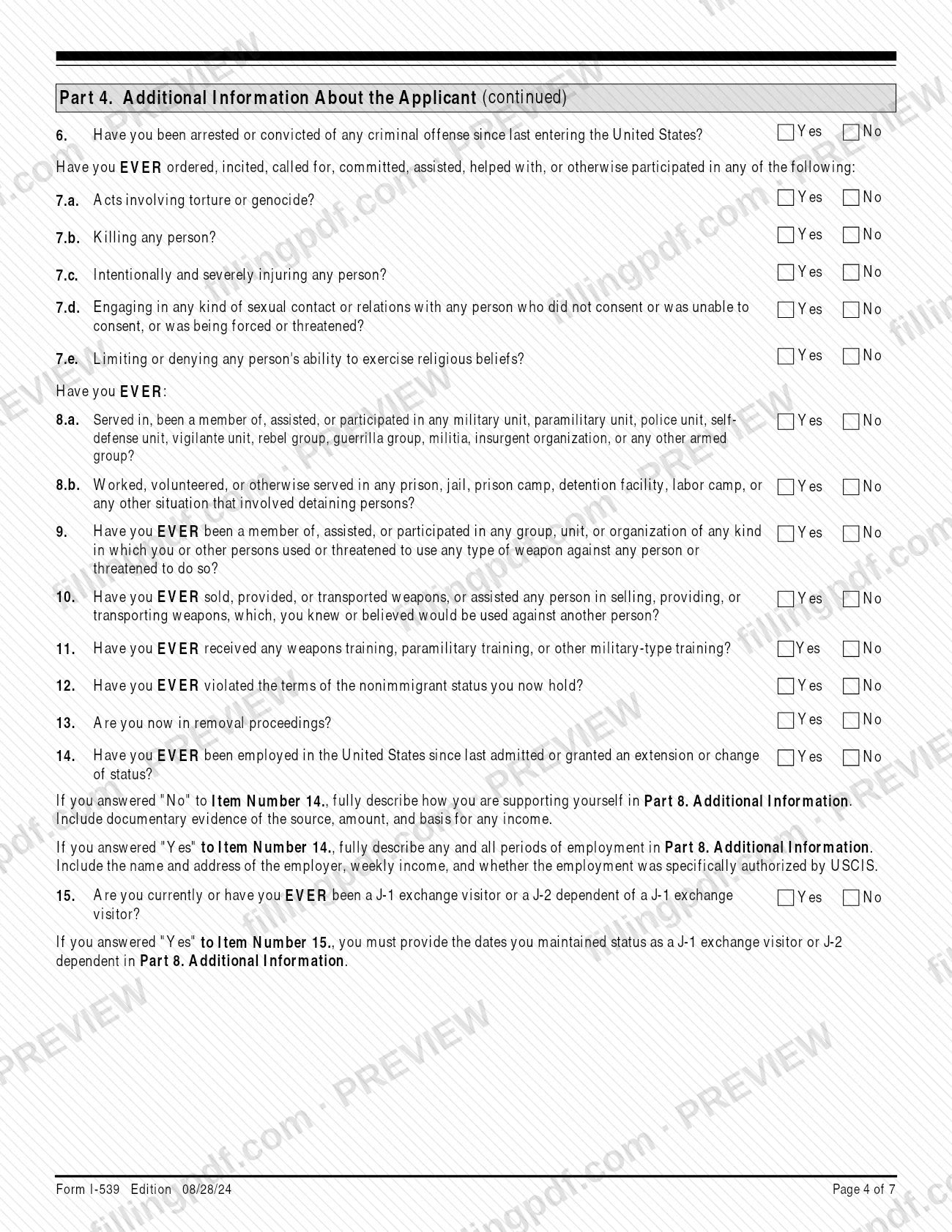
Answer Yes or No to each question in Part 4, Items 3 to 15, including immigrant petitions, Form I-485, arrests, status violations, removal proceedings, employment and J-1 or J-2 history. Explain every Yes answer in Part 8; Item 14 also requires a description of employment or of how you support yourself.
Add contact details and sign
In Part 5, enter your daytime telephone, mobile telephone and email, then sign and date in Item 4 with a handwritten signature. A parent or legal guardian may sign where applicable.
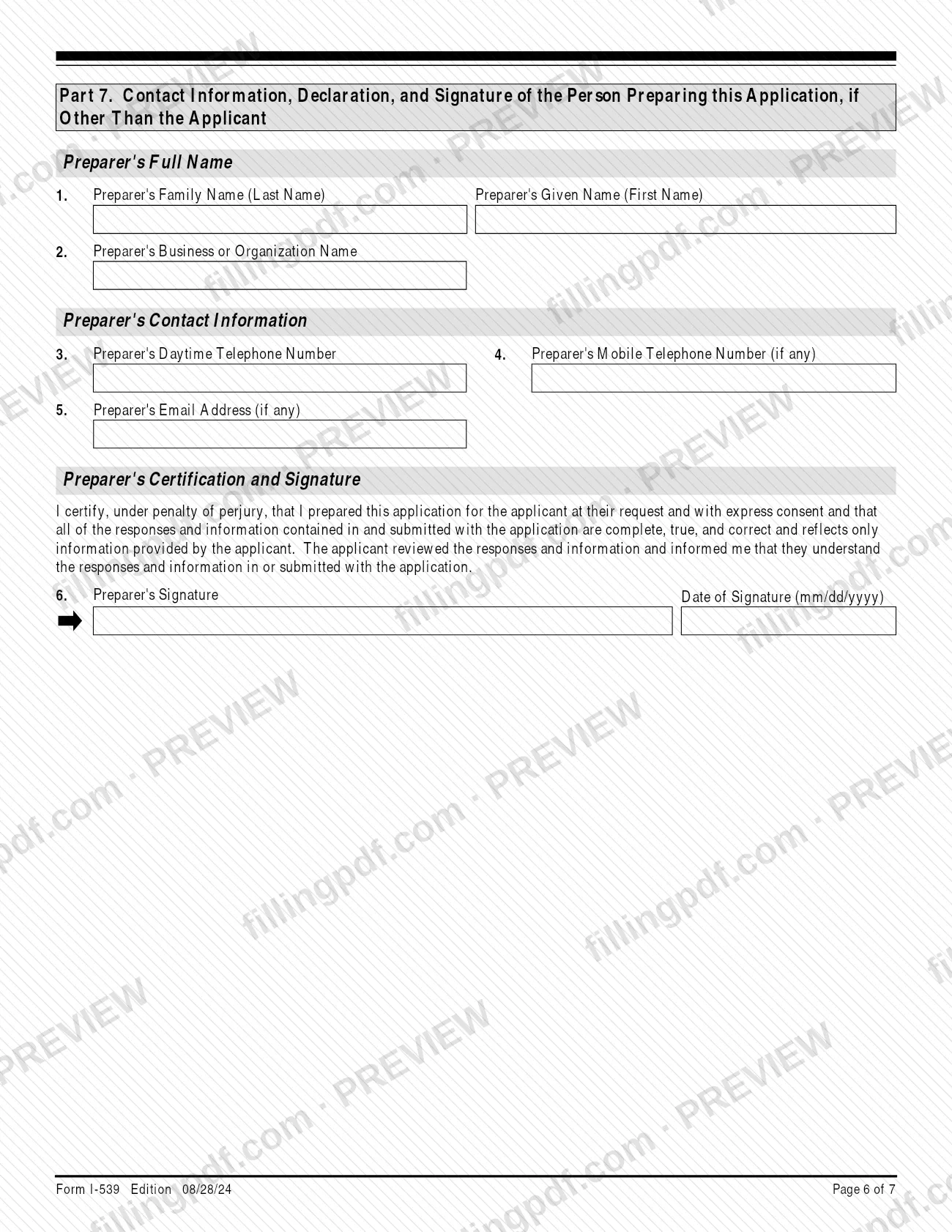
Complete interpreter and preparer sections
If someone interpreted the form for you, they complete Part 6. If someone other than you prepared it, that person completes and signs Part 7. One person acting in both roles completes both parts.
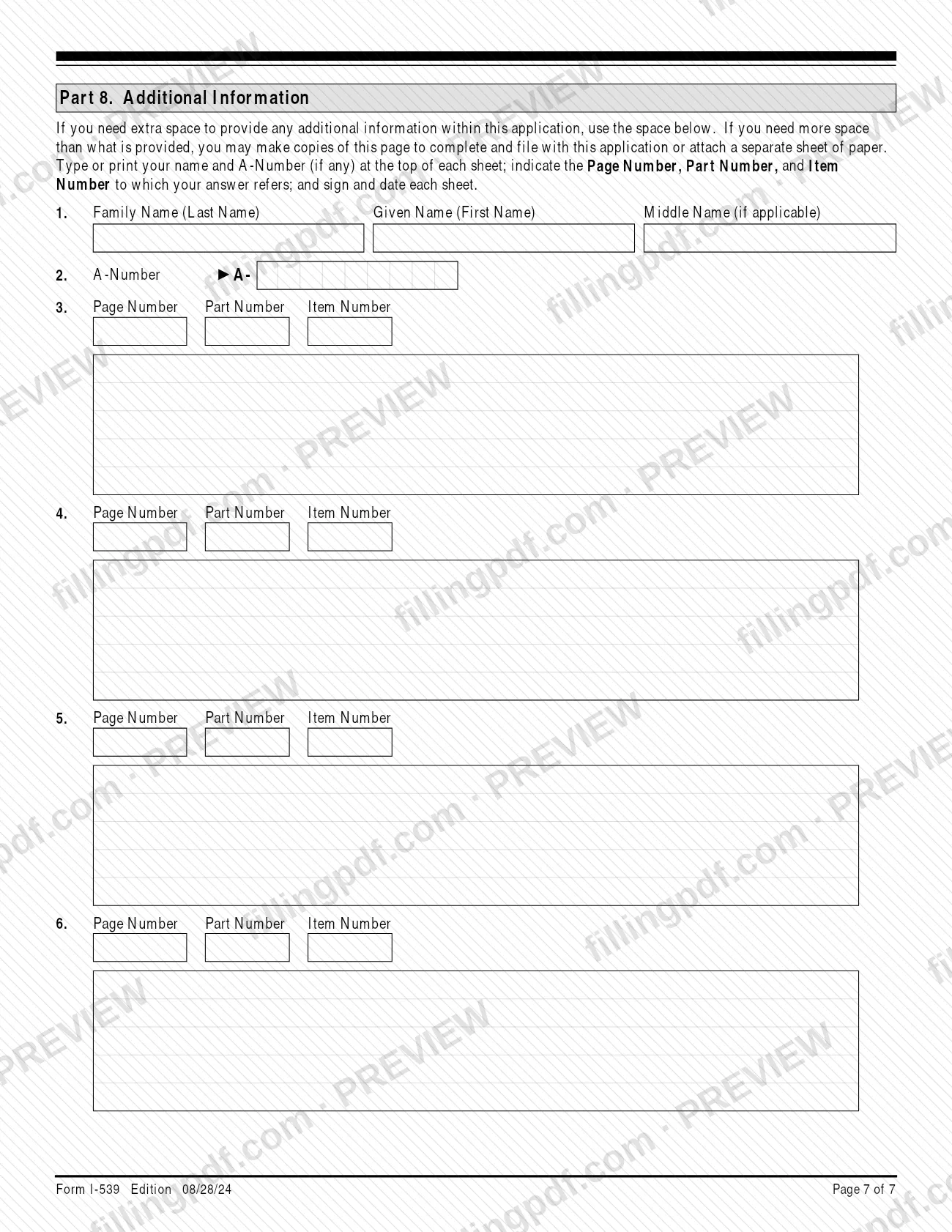
Use Part 8 for extra information
Write your name and A-Number, then the page, part and item number each answer refers to. Sign and date each extra sheet.
Review, sign and download the PDF
Check every part, confirm the signature and date, then download or print the completed PDF from FillingPDF. Add any Forms I-539A and evidence, and submit through the channels described under How to submit.
How to submit I-539
You can file Form I-539 by mail or online. USCIS directs applicants to www.uscis.gov/i-539 for the most current information on where to file.
- By mail: send the signed form, any Forms I-539A, the fee and your evidence to the address listed on the USCIS Form I-539 Direct Filing Addresses page. Make sure the edition date and page numbers are visible on every page and that all pages come from the same edition; USCIS may reject incomplete or mixed-edition forms. CNMI residents use their CNMI P.O. Box as their address and file at the California Service Center.
- Online: online filers follow the instructions on myUSCIS (my.uscis.gov) to create an account and complete the form.
- Through a mission office: A-3 and G-5 applicants file with their mission office, together with the documents listed in the instructions.
A filing fee applies; see Form G-1055, Fee Schedule, at www.uscis.gov/g-1055 for the current amount. If you request Premium Processing where available, also file Form I-907 with its fee. Submit legible photocopies unless the instructions ask for an original. Do not mail the form to the Paperwork Reduction Act address in the instructions, and do not send change-of-address requests to a Lockbox. For questions, call the USCIS Contact Center at 800-375-5283 (TTY 800-767-1833). FillingPDF lets you fill out and download the PDF; submission follows the USCIS channels above.
Common mistakes to avoid
- Filing Form I-539 to extend or change into a status that requires an employer petition, such as H-1B, L-1, O-1 or TN principal status; USCIS may reject or deny it without refund.
- Leaving out Part 1 name, mailing address, date of birth or current status, or the Part 2 application type, requested status or number of people; USCIS rejects forms missing these.
- Submitting an unsigned form, or a stamped or typewritten name instead of a signature; USCIS rejects the application.
- Including a spouse or child without a separate Form I-539A, or including family members who are not all in the same status or in derivative status.
- Answering Yes to any question in Part 4, Items 3 to 15, without an explanation in Part 8; the form requires one.
- Not giving the dates you held J-1 or J-2 status; the instructions warn that willful failure to disclose it can lead to denial.
- Sending original documents when the instructions ask only for copies; USCIS may destroy originals it did not request.
- Mailing the form to the Paperwork Reduction Act address printed in the instructions instead of the filing address listed on the USCIS direct filing page.
- Filing after your authorized stay has expired without showing extraordinary circumstances beyond your control.
- Submitting a foreign-language document without a full English translation and the translator's signed certification.
Frequently asked questions
What is Form I-539 used for?
Form I-539 is the USCIS application to extend your stay in the United States or change to another nonimmigrant status. It is also used for F-1 and M-1 reinstatement, V status, and an initial grant of status for certain CNMI residents.
Who cannot use Form I-539?
People admitted under the Visa Waiver Program and those in C, TWOV, D, K-1 or K-2 status cannot be granted an extension or change. Principal H-1B, L-1, O-1, P-1, TN and similar workers also cannot use it, because their requests go through an employer's Form I-129.
When should I file Form I-539?
File before your authorized stay expires. USCIS suggests at least 45 days before, but generally not more than 6 months before. A late filing is excused only if you show extraordinary circumstances, a reasonable delay, no other status violation, bona fide nonimmigrant intent and no removal proceedings.
Can I include my spouse and children on my Form I-539?
Yes, you may include your spouse and unmarried children under 21 if you are all in the same status or they are all in derivative status. Each co-applicant must complete and sign a separate Form I-539A, and you must provide evidence of the relationship.
Where do I file Form I-539?
By mail at the address on the USCIS Form I-539 Direct Filing Addresses page, or online through myUSCIS. A-3 and G-5 applicants file with their mission office. USCIS points to www.uscis.gov/i-539 for the most current filing information.
Is there a fee to file Form I-539?
Yes, a filing fee applies. The instructions refer to Form G-1055, Fee Schedule, at www.uscis.gov/g-1055 for fee details. If you request Premium Processing where available, you must also file Form I-907 with its filing fee.
Can someone else sign my Form I-539?
Generally you must sign it yourself, with a handwritten signature; a stamped or typewritten name is not accepted and unsigned forms are rejected. A parent or legal guardian may sign for a child under 14, and a legal guardian may sign for a mentally incompetent person.
Can I send a photocopy or scan of my signed I-539?
USCIS treats a photocopied, faxed or scanned copy as valid for filing if it is a copy of the original form carrying your handwritten ink signature. Submit legible photocopies of supporting documents unless the instructions ask for an original.
Can I fill out Form I-539 online on FillingPDF?
Yes. You can fill out the PDF online on FillingPDF and download or print it. FillingPDF is an independent service and does not file the form with USCIS; you submit it through the USCIS channels.
Ready to fill out I-539?
Fill out I-539 now