
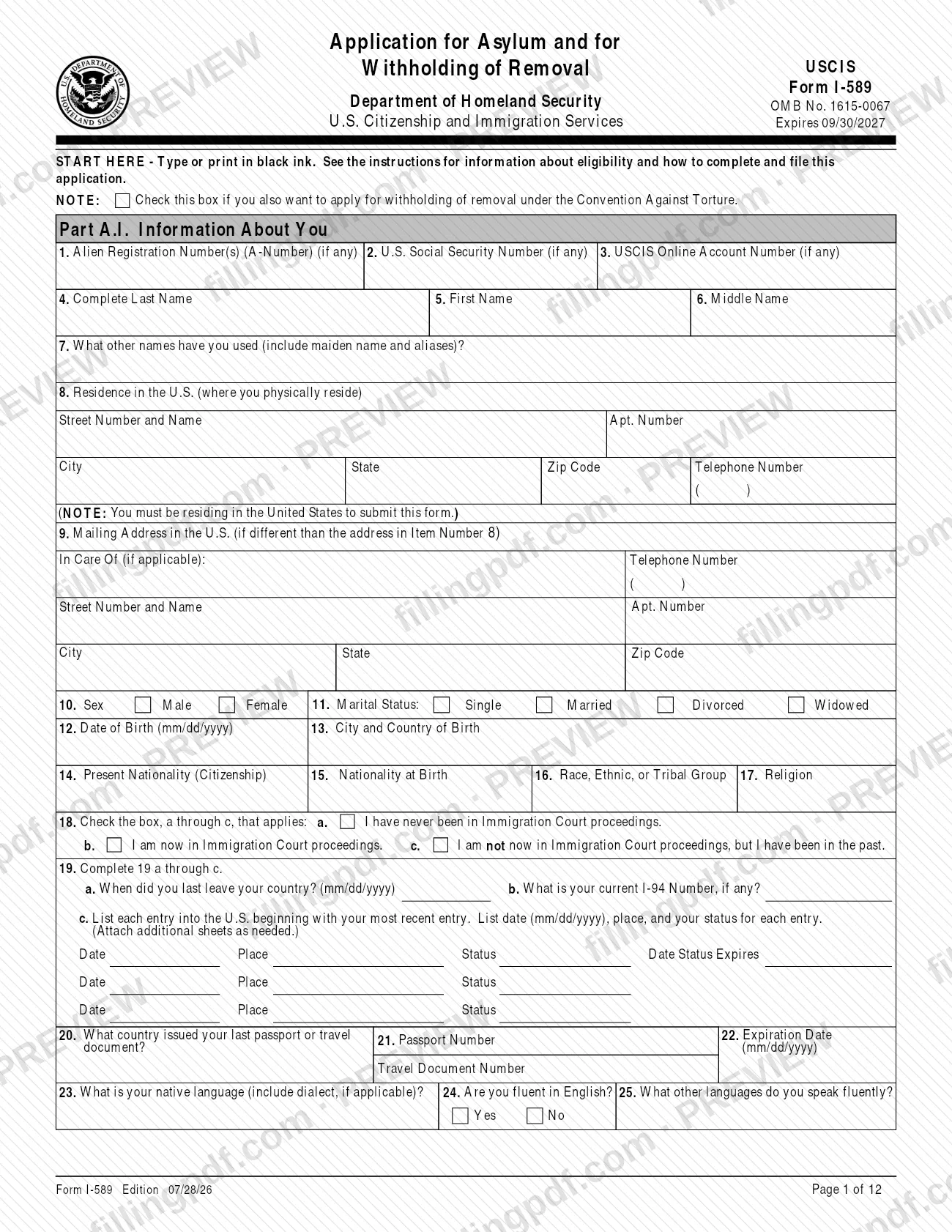
Form I-589 is the application that U.S. Citizenship and Immigration Services (USCIS) publishes for people who are physically present in the United States and want to apply for asylum and for withholding of removal. It can also be used to ask for protection under the Convention Against Torture. The form must be completed in English, and where you file it depends on whether you are in proceedings before the Executive Office for Immigration Review (EOIR). On this page you can fill out Form I-589 online on FillingPDF and download or print the completed PDF; the form, instructions and filing rules are published by USCIS.
Last updated
What is I-589?
Form I-589, Application for Asylum and for Withholding of Removal, is the U.S. Citizenship and Immigration Services (USCIS) form used to apply for asylum in the United States and for withholding of removal, and it can also be used to seek protection under the Convention Against Torture.
The USCIS instructions explain that your asylum application is also considered an application for withholding of removal under section 241(b)(3) of the INA. It may be considered an application for withholding under the Convention Against Torture if you check the box at the top of page 1 or if the evidence shows you may be tortured in the country of removal. Only immigration judges and the Board of Immigration Appeals may grant withholding of removal or deferral of removal under the Convention Against Torture.
The form has these parts:
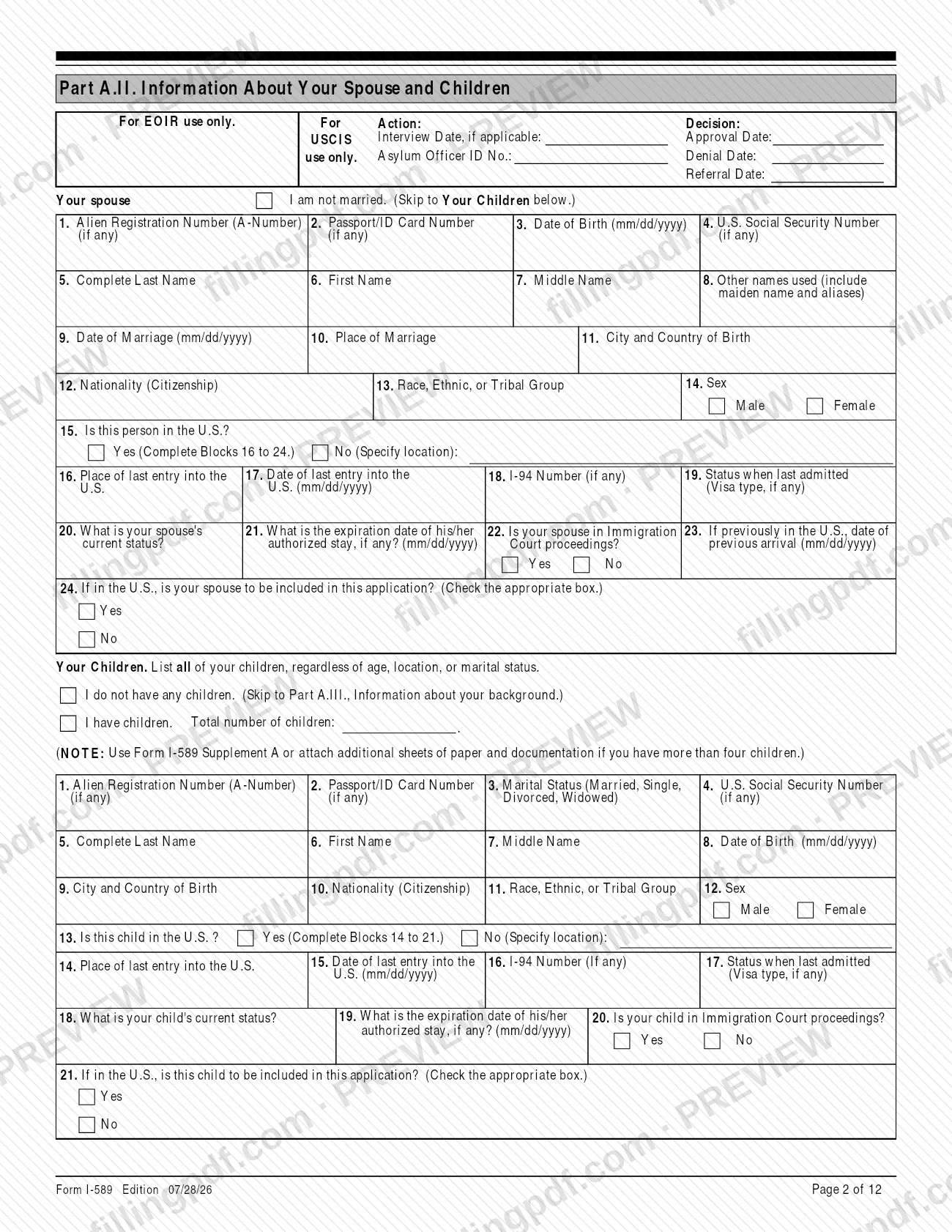
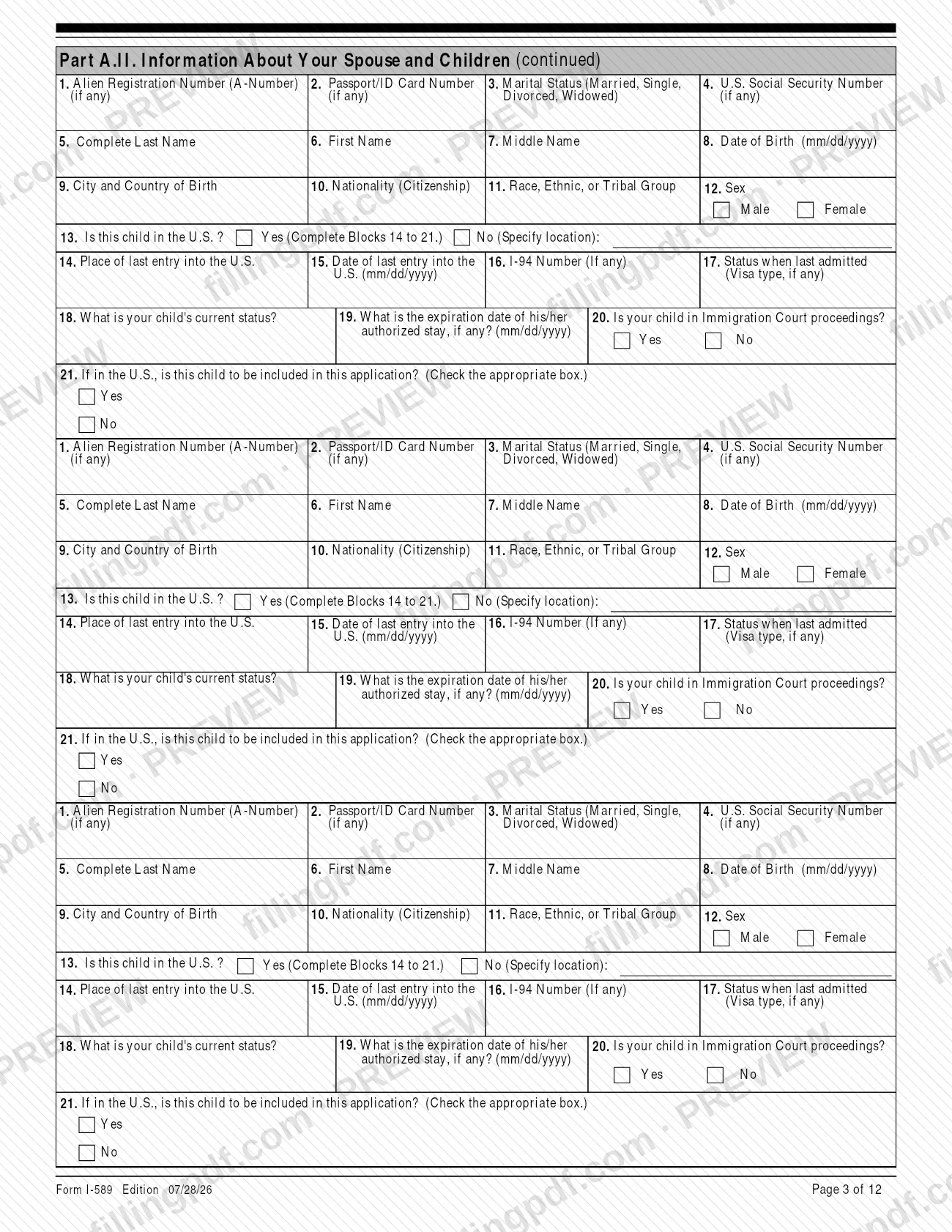
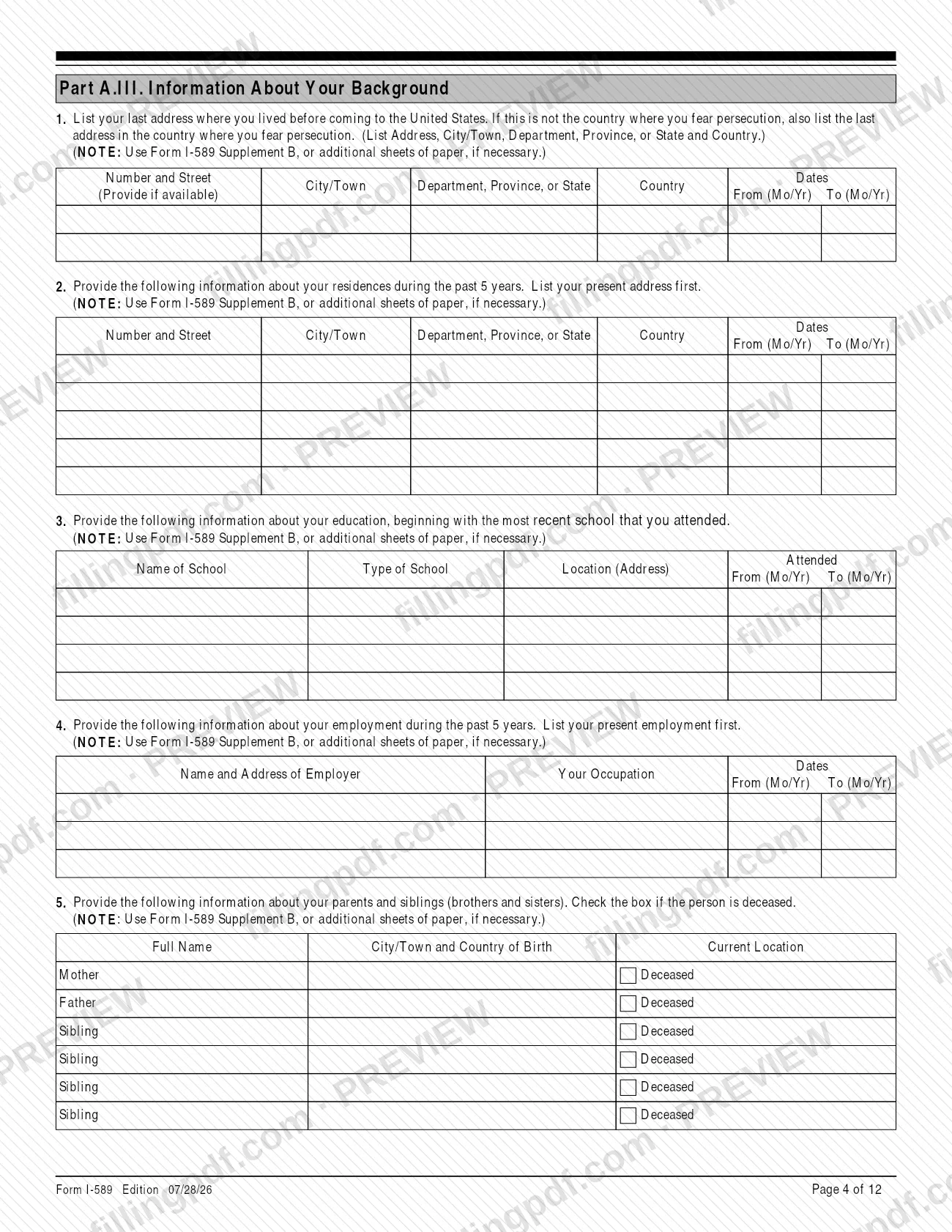
- Part A.I, information about you; Part A.II, your spouse and children; Part A.III, your background.
- Part B and Part C, the questions about your claim and additional information.
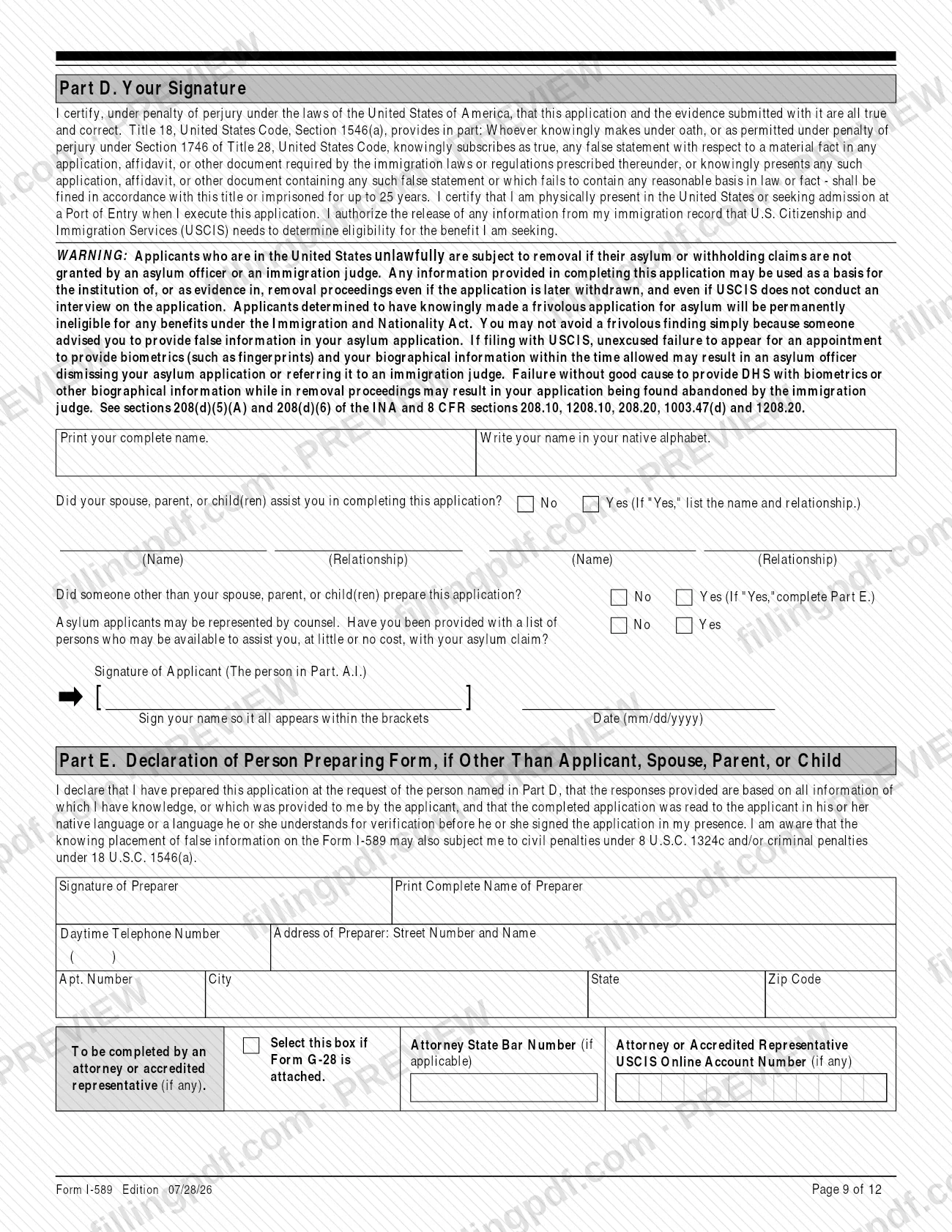
- Part D, your signature; Part E, the declaration of a person who prepared the form for you.
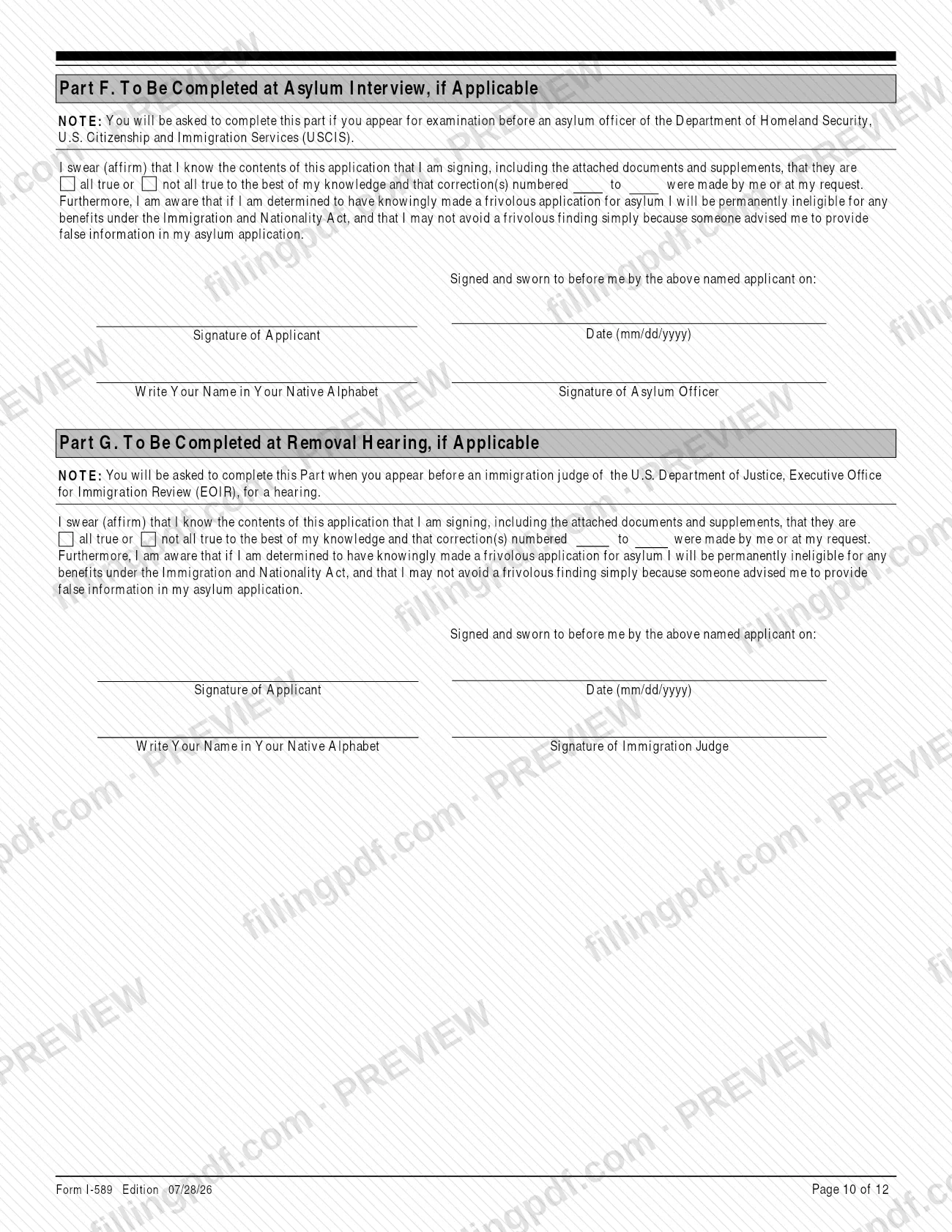
- Part F (asylum interview) and Part G (removal hearing), which you do not sign before filing.
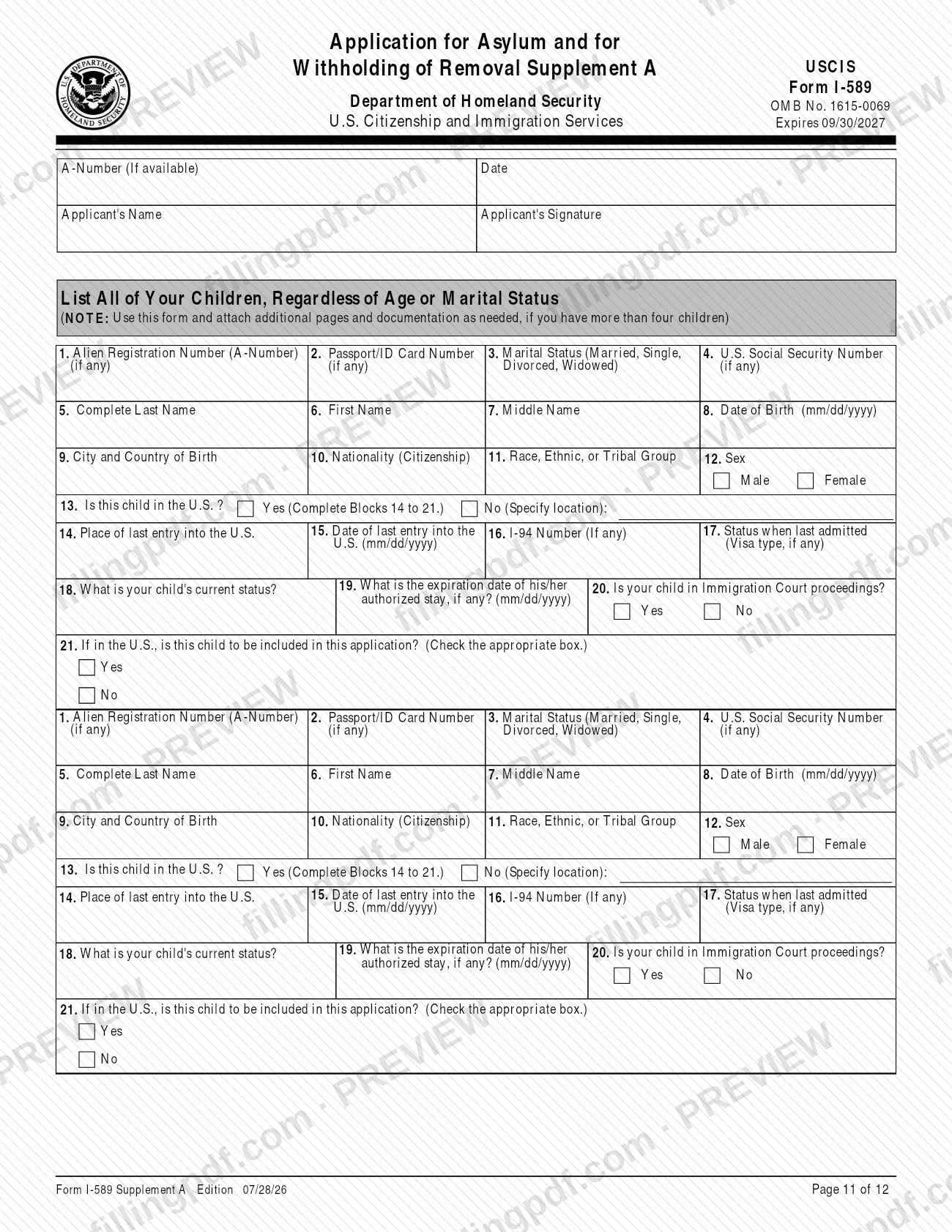
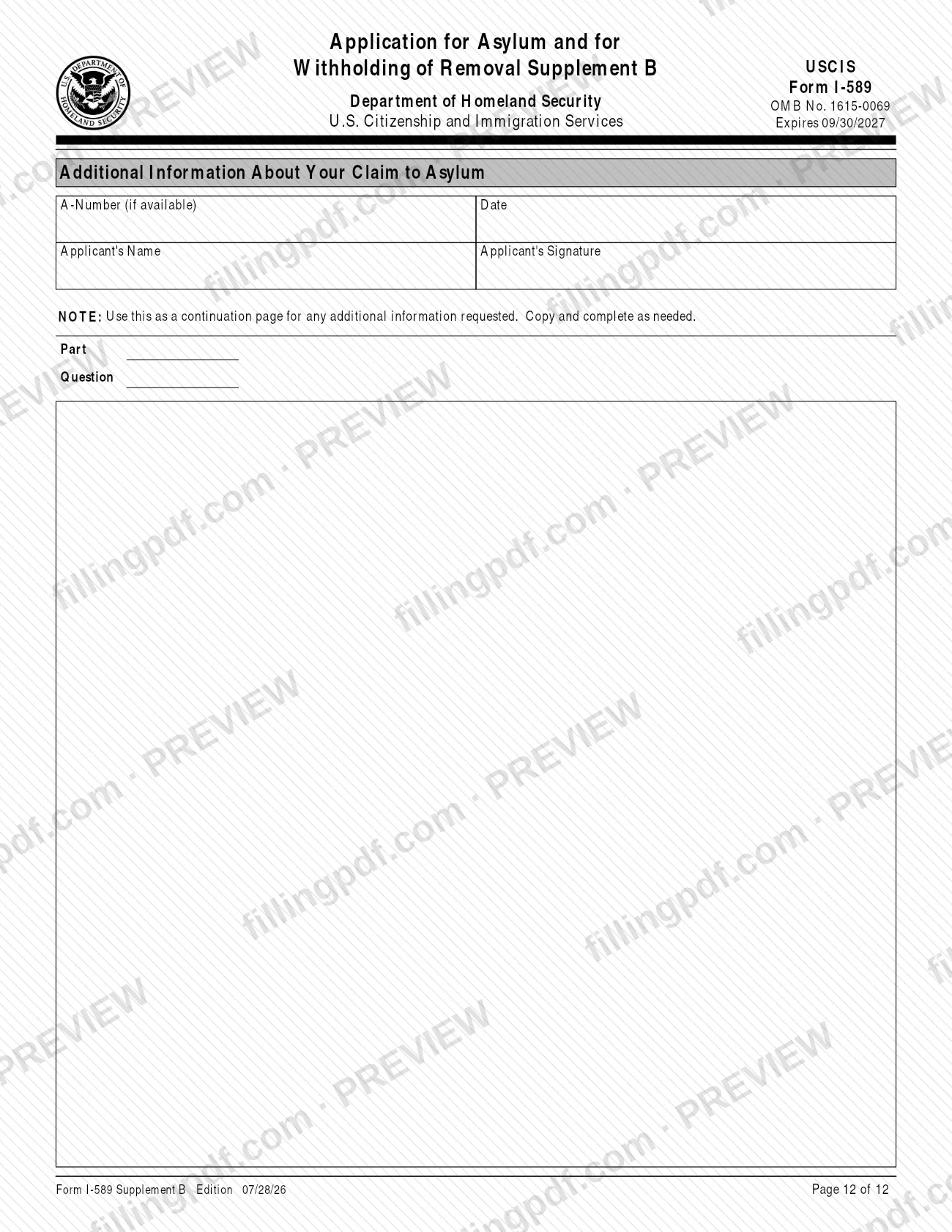
- Supplement A (more children) and Supplement B (continuation pages for Parts B and C and any other part).
USCIS may adjudicate your application without an interview and without a request for evidence, so the form says your application and evidence may be your only opportunity to meet your burden of proof before USCIS. USCIS accepts only the English version of the form, even though translations are available for information.
Who needs to file I-589?
You may file Form I-589 if you are physically present in the United States and are not a U.S. citizen. The USCIS instructions say you may apply regardless of immigration status, even if you are in the United States unlawfully, unless a statute or regulation provides otherwise.
Where you file depends on your situation:
- You file with USCIS if you have never been issued an A-Number, or you have one but are not in EOIR proceedings, or you are in removal proceedings and are, or were determined to be, an unaccompanied alien child (UAC).
- You must file with the immigration court (or the Board of Immigration Appeals) if you are in EOIR proceedings and are not, and never were determined to be, a UAC.
You may include your spouse and unmarried children under 21 who are in the United States. Children who are married or 21 or older must file their own Form I-589. A spouse or child outside the United States is not included; if you are granted asylum you may file Form I-730 for them.
USCIS does not adjudicate applications from certain crewmembers and stowaways, Visa Waiver Program applicants, certain people ordered removed on security grounds, and S nonimmigrants. People physically present in the Commonwealth of the Northern Mariana Islands cannot apply for asylum until January 1, 2030, but may use this form for withholding of removal and Convention Against Torture protection in Immigration Court.
When to file I-589
You must file Form I-589 within 1 year after you arrived in the United States, unless you show changed circumstances that affect your eligibility for asylum or extraordinary circumstances that prevented you from filing within the year. Part C, Question 5 asks you to explain a late filing. If your explanation is not accepted, you may not be eligible for asylum but could still be eligible for withholding of removal or Convention Against Torture protection.
If you were denied asylum by an immigration judge or the Board of Immigration Appeals, you must show changed circumstances that affect your eligibility.
Other timing rules in the instructions: an incomplete application is returned within 30 days of receipt; the 150-day wait before you may request employment authorization starts only when a complete application is filed; and you must tell USCIS in writing within 10 days if you change your address. You may amend or supplement your application until a decision is issued.
Documents you need
- The completed, signed original of Form I-589, plus the originals of any supplementary sheets and statements (Supplement A or B or additional pages). Keep an extra copy of the application for your records.
- For each spouse included: one copy of the marriage certificate and proof of termination of any prior marriages.
- For each unmarried child under 21 included: one copy of the child's birth certificate.
- If primary evidence of relationship is unavailable: secondary evidence such as medical, religious or school records, or affidavits, with an explanation of why primary evidence is unavailable. Affidavits must be originals.
- One copy, cover to cover, of all passports or other travel documents you hold, and of any U.S. immigration documents such as Form I-94, for you and each included family member. Do not send original passports unless asked.
- Reasonably available corroborative evidence of the general conditions in your country and the specific facts of your claim; if it is unavailable or not provided, an explanation of why on Supplement B or additional sheets.
- A full English translation of any foreign-language document, with the translator's signed certification of competence and accuracy, printed name, date and contact information.
- Form G-28, Notice of Entry of Appearance as Attorney or Accredited Representative, signed by you and your representative, if you have one.
- If someone other than your spouse, parent or child prepared the form: that person's completed and signed Part E.
- If you previously applied and were denied, or were a dependent on a spouse's or parent's application: a letter saying so and referencing the earlier application.
- If filing as a UAC and you have them: the instruction sheet from DHS counsel or ORR documents, such as the UAC Initial Placement Referral Form or Verification of Release Form.
- If applicable: proof of class membership in the Ms. L. Settlement Agreement.
How to fill out I-589
Check the Convention Against Torture box
At the top of page 1, check the box if you also want to apply for withholding of removal under the Convention Against Torture. The instructions say you must then fully complete the form and explain your fear of torture in Part B, Question 4.
Enter your identity and addresses
In Part A.I, give your A-Number, Social Security number and USCIS Online Account Number if you have them (Items 1-3), your name (Items 4-7), and your U.S. residence in Item 8. Add a mailing address in Item 9 only if it differs; use the "In Care Of" field if someone collects your mail.
Complete personal and entry details
Items 10-17 cover sex, marital status, date of birth (mm/dd/yyyy), birthplace, nationalities, race and religion. In Item 13 use the current country name. Item 18 asks about Immigration Court proceedings; Item 19 asks for your last departure, I-94 number and each entry, writing "None" or "No Inspection" where the instructions say.
List passport and language details
Items 20-22 ask which country issued your last passport or travel document, its number and expiration date. Items 23-25 ask for your native language, whether you are fluent in English and other languages you speak.
Complete your spouse and children sections
In Part A.II, list your spouse and all children, including stepchildren, adopted and deceased children, regardless of age or location, and say whether each in the U.S. is included. Use Supplement A for more than four children.
Fill in your background history
In Part A.III, answer Questions 1-5 in reverse chronological order: last address abroad, residences and employment for the past 5 years, education, and parents and siblings. Use Supplement B if you need more room.
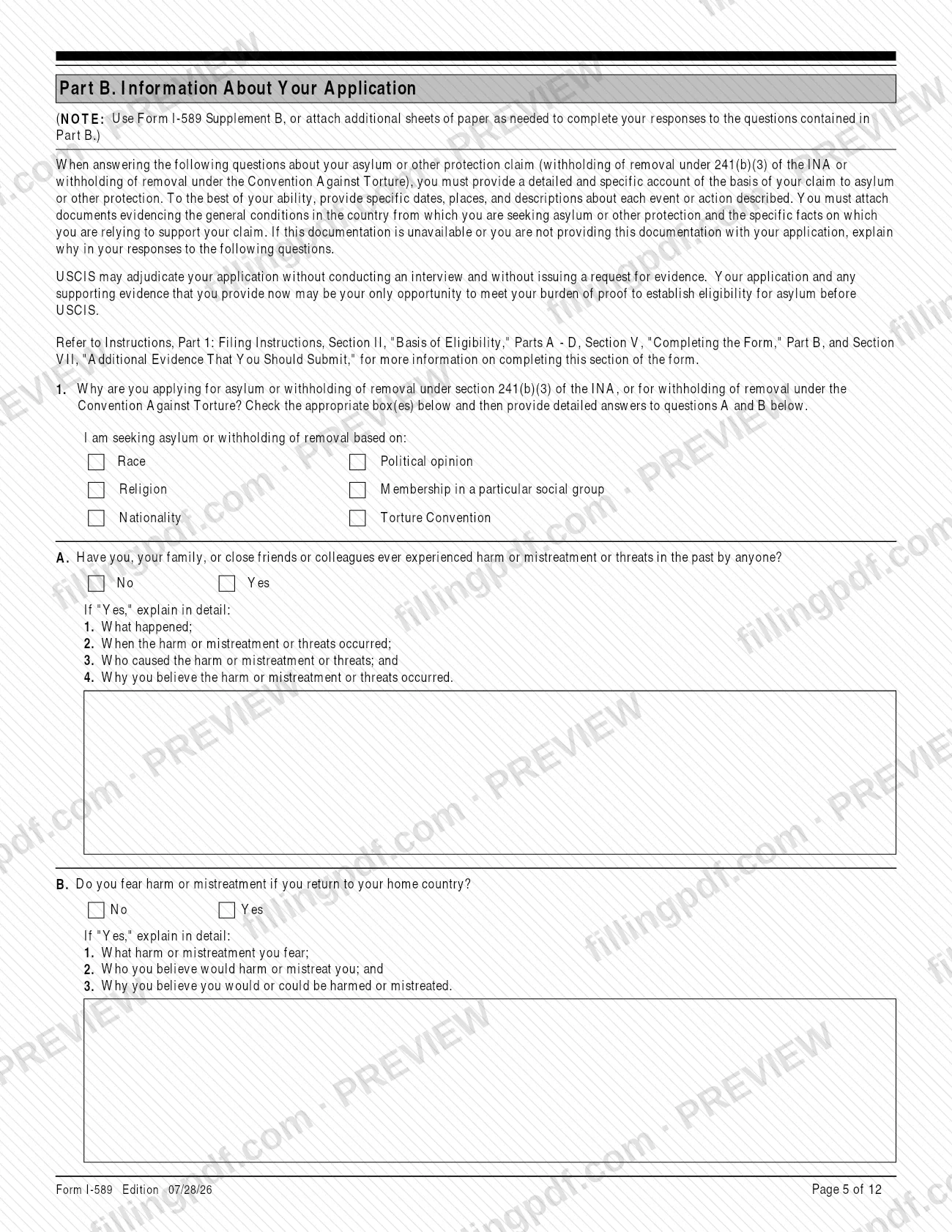
Explain your claim in Part B
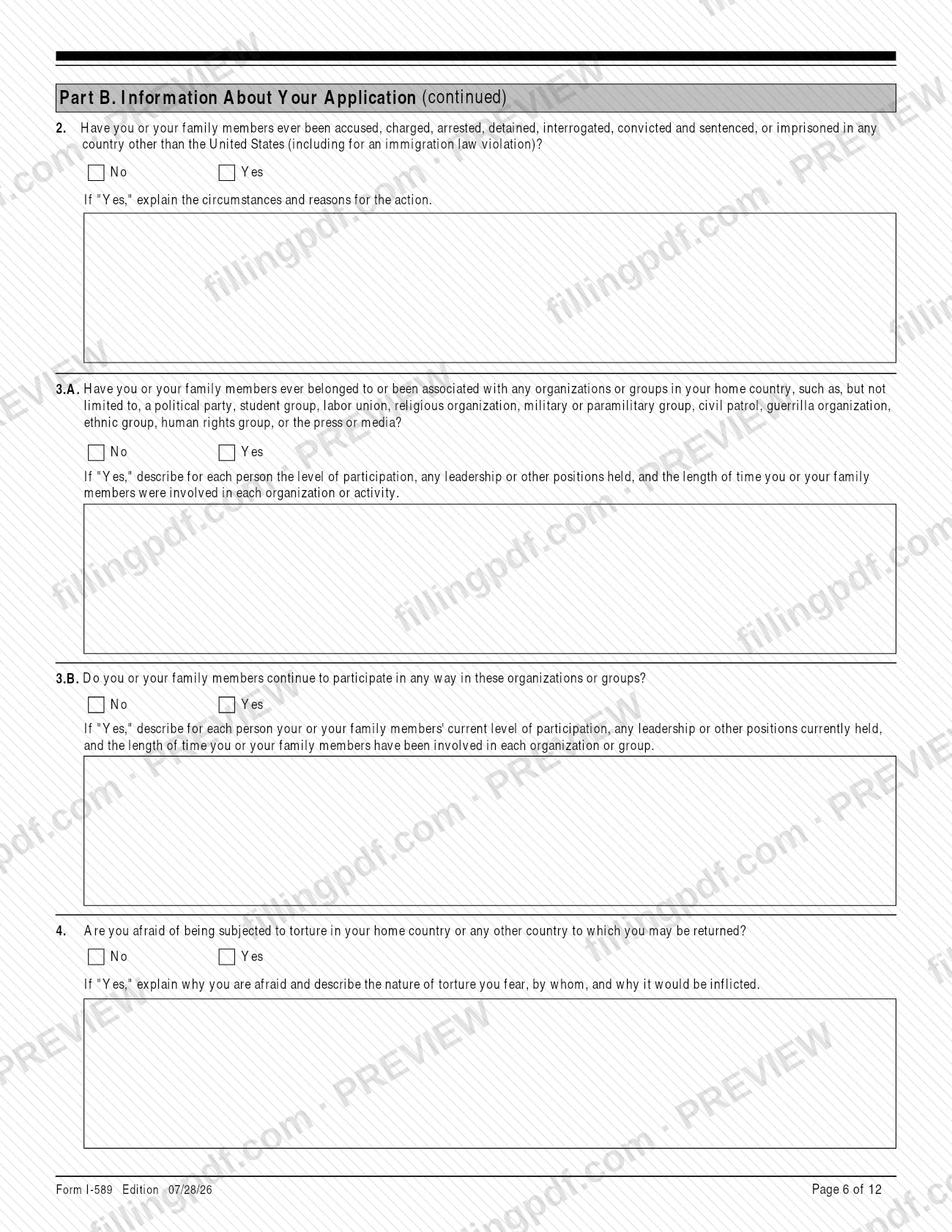
In Question 1 check each basis for your claim, then answer A and B in detail with specific dates, places and events. Answer Questions 2, 3.A, 3.B and 4 with No or Yes, explaining every Yes.
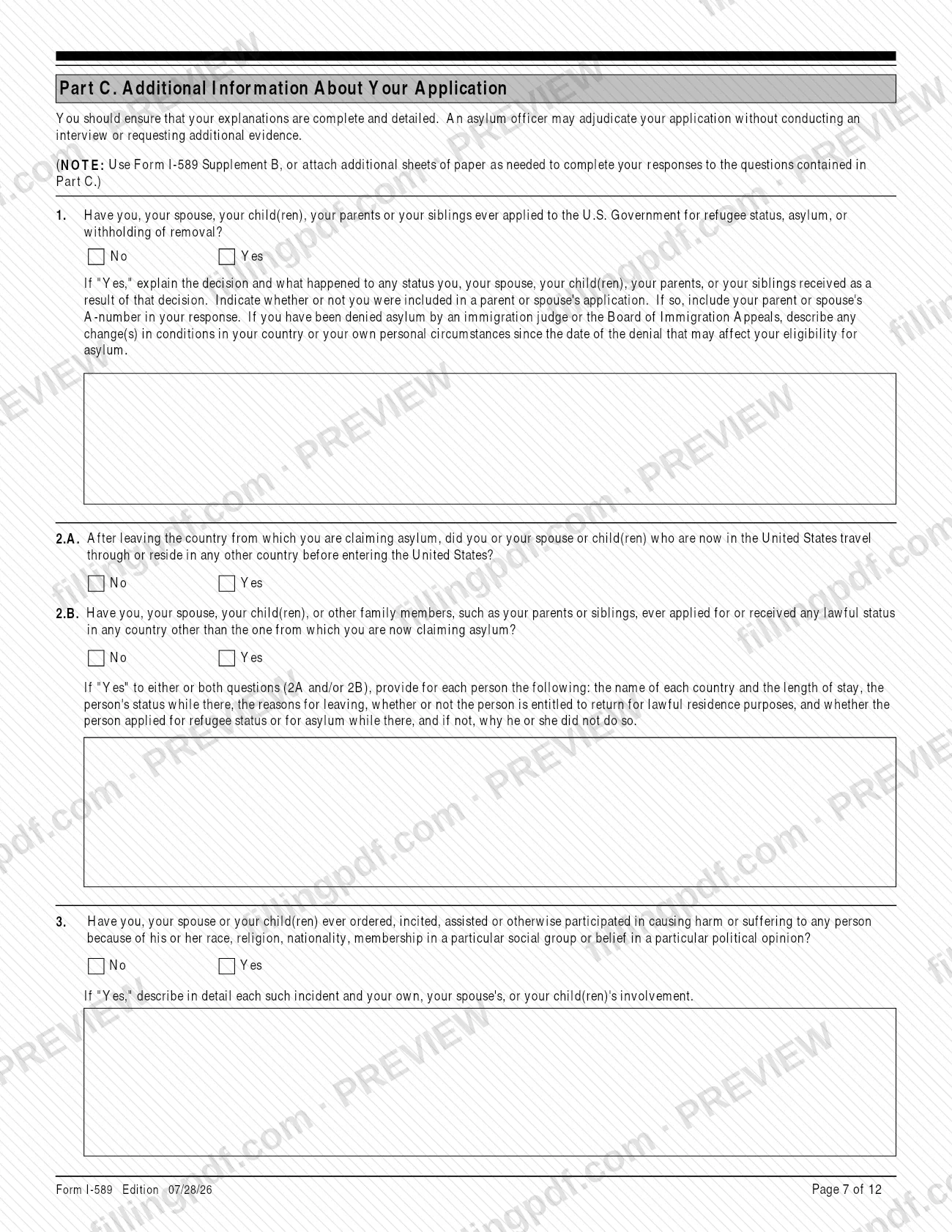
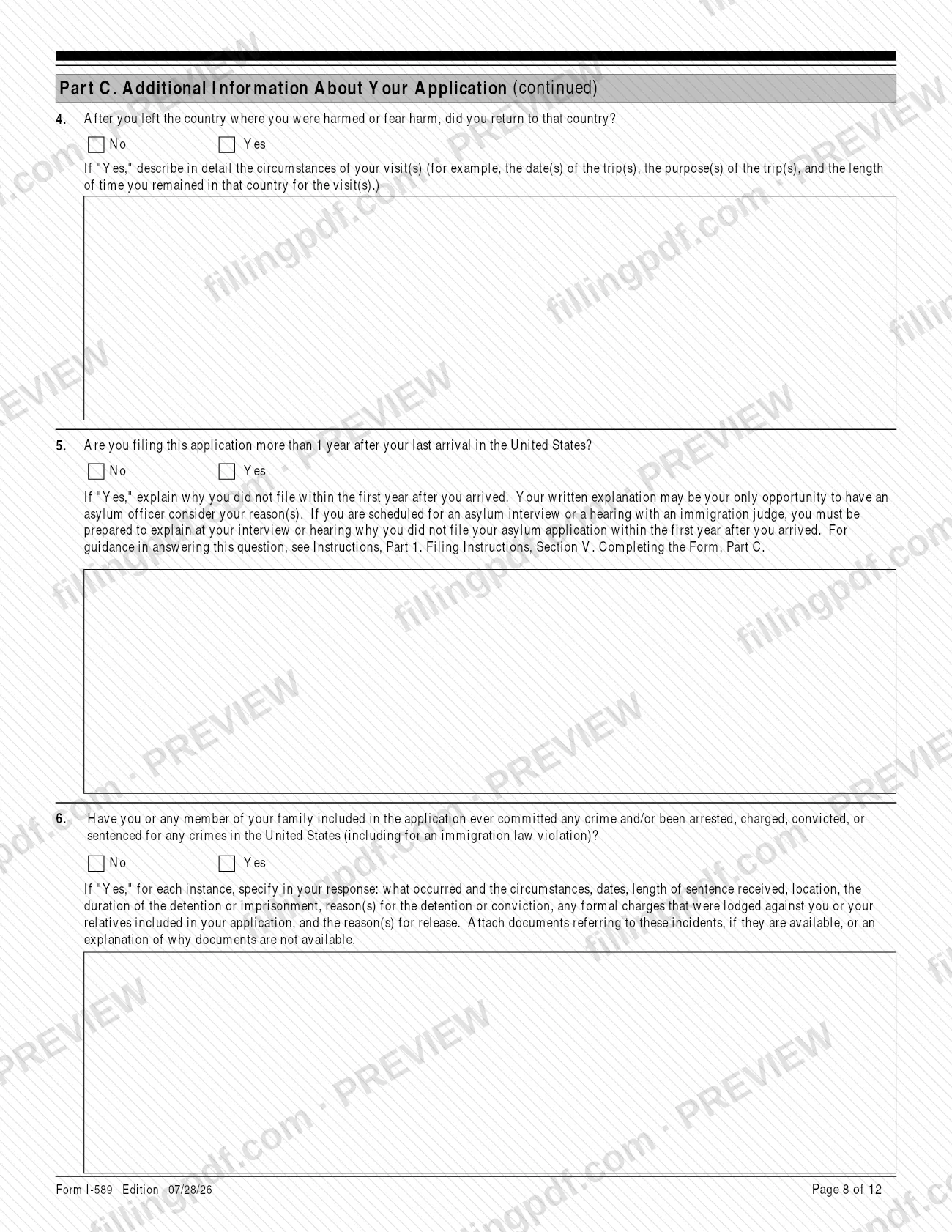
Answer the questions in Part C
Check No or Yes for Questions 1 through 6 and explain each Yes, including prior applications, travel through other countries, returns to your home country and criminal history. If you answer Yes to Question 5, explain why you did not file within 1 year of arrival.
Sign Part D and report help received
Print your name, write it in your native alphabet, and answer the questions about who assisted you and whether you received a list of free or low-cost counsel. Sign inside the brackets and date it (mm/dd/yyyy). Leave Parts F and G unsigned.
Complete Part E if someone prepared it
If someone other than your spouse, parent or child prepared the application, that person completes and signs Part E with name, address and telephone number. An attorney or accredited representative also enters a bar number and checks the Form G-28 box if applicable.
Add supplements and mark every page
Use Supplement B continuation pages, entering the Part and Question number, and put your A-Number, name exactly as in Part A.I, signature and date on each sheet and on supporting document covers.
Review, download and assemble
Check that every question is answered, answers are in English and the form is signed. Download or print the completed PDF from FillingPDF, then assemble the package in the order the instructions give and submit it through the channels under How to submit.
How to submit I-589
Where you send Form I-589 depends on your situation: USCIS online, a USCIS Lockbox by mail, the USCIS Asylum Intake Unit, or the Immigration Court.
- Online with USCIS: some applicants may file online. USCIS's Filing Instructions Tool shows whether you may file online or must mail. UACs, people whose removal proceedings were dismissed or terminated, and people whose Notice to Appear was never filed with EOIR must file by mail.
- USCIS Dallas Lockbox (residents of Florida, Georgia, Maryland, New Jersey, Pennsylvania, Texas): USPS to USCIS Attn: I-589 (Box 653080), P.O. Box 653080, Dallas, TX 75265-3080; FedEx, UPS, DHL to USCIS Attn: I-589 (Box 653080), 2501 S. State Highway 121 Business Suite 400, Lewisville, TX 75067-8003.
- USCIS Chicago Lockbox (any other state or territory): USPS to USCIS Attn: I-589, P.O. Box 6893, Chicago, IL 60680; FedEx, UPS, DHL to USCIS Attn: I-589 (Box 6893), 131 S. Dearborn St., 3rd Floor, Chicago, IL 60603-5517.
- USCIS Asylum Intake Unit: only for the Nunc Pro Tunc category, with a letter naming the category: USCIS Attn: I-589, 3 Intake Way, Minneapolis, MN 55438-1455.
- Immigration Court: if you are in EOIR proceedings (non-UAC), file with the court that has jurisdiction over your case; the EOIR hotline or online system identifies it.
Do not send a second Form I-589 to add a dependent to a pending case; mail the request to your asylum office. A fee may apply (see Form G-1055 and the USCIS Fee Schedule), and principal applicants with a pending case may owe an Annual Asylum Fee, paid online at my.uscis.gov/accounts/annual-asylum-fee/start/overview. FillingPDF lets you fill out and download the PDF; submission follows the channels above.
Common mistakes to avoid
- Mailing Form I-589 unsigned, or leaving Part D blank; USCIS rejects any unsigned form.
- Leaving out Part E when someone other than your spouse, parent or child prepared the application; it is returned as incomplete.
- Signing Part F or Part G before filing; you sign those only at the asylum interview or the removal hearing.
- Completing the form or its explanation fields in a language other than English; such forms are returned.
- Leaving required fields blank, such as Question 4 (last name), Question 8 (residence), Question 12 (date of birth) or Question 13 (country of birth), or skipping Part B and C questions.
- Filing with USCIS while you are in EOIR proceedings and were never a UAC; EOIR-case filings belong with the immigration court identified by the EOIR hotline or online system.
- Submitting a second Form I-589 to add a spouse or child to a pending case, or to speed up processing; it can be rejected and may cause delays.
- Referencing an addendum or Supplement B in an answer but not attaching it, or omitting the explanation of why you are applying.
- Printing the form with pages from different editions or with the edition date and page numbers cut off; USCIS may reject it.
- Sending additional evidence to the Lockbox or Asylum Intake Unit after your application is accepted instead of to your local asylum office.
Frequently asked questions
What is Form I-589 used for?
Form I-589 is used to apply for asylum in the United States and for withholding of removal, and it may also be used to apply for protection under the Convention Against Torture. You may file it if you are physically present in the United States and are not a U.S. citizen.
Where do I file Form I-589?
It depends on your case. If you are not in EOIR proceedings, file with USCIS online or by mail to the Dallas or Chicago Lockbox depending on your state. If you are in immigration court proceedings (and not a UAC), file with that court. A Minneapolis Asylum Intake Unit address applies only to the nunc pro tunc category.
What is the deadline to file Form I-589?
File within 1 year after you arrived in the United States. A later filing is accepted only if you show changed circumstances affecting your eligibility or extraordinary circumstances that prevented timely filing. Part C, Question 5 asks you to explain a late filing.
Can I include my spouse and children on my I-589?
Yes, if they are in the United States and are your spouse or unmarried children under 21. Submit proof of the relationship for each. Married children and children 21 or older must file their own Form I-589, and withholding of removal does not extend to included family members.
Is there a fee to file Form I-589?
Form G-1055 and the USCIS Fee Schedule give the fees that apply to this form. The principal applicant with a pending application may also owe an Annual Asylum Fee, which cannot be waived and is paid online after USCIS sends a notice. Check USCIS for current amounts.
Can I fill out Form I-589 online on FillingPDF?
Yes. You can fill out the PDF online on FillingPDF and download or print it. FillingPDF is an independent service and does not file the application with USCIS or EOIR; you submit it through the agency's channels.
Can I work while my asylum application is pending?
Filing alone does not give work permission. You may request employment authorization on Form I-765 after 150 days have passed since USCIS or the court accepted your application, and USCIS may grant it if the application has not been denied within 180 days. Delays you cause do not count.
What happens if I leave the United States while my I-589 is pending?
If you leave without first obtaining advance parole using Form I-131, USCIS presumes you abandoned your application. If you get advance parole and return to the country of claimed persecution, USCIS presumes abandonment unless you show compelling reasons for the return.
Do I need a lawyer to file Form I-589?
No. You have a right to your own legal representation at no cost to the U.S. Government, but it is not required. If someone other than your spouse, parent or child helps prepare the form, that person must sign Part E, or the application is returned as incomplete.
Ready to fill out I-589?
Fill out I-589 now