
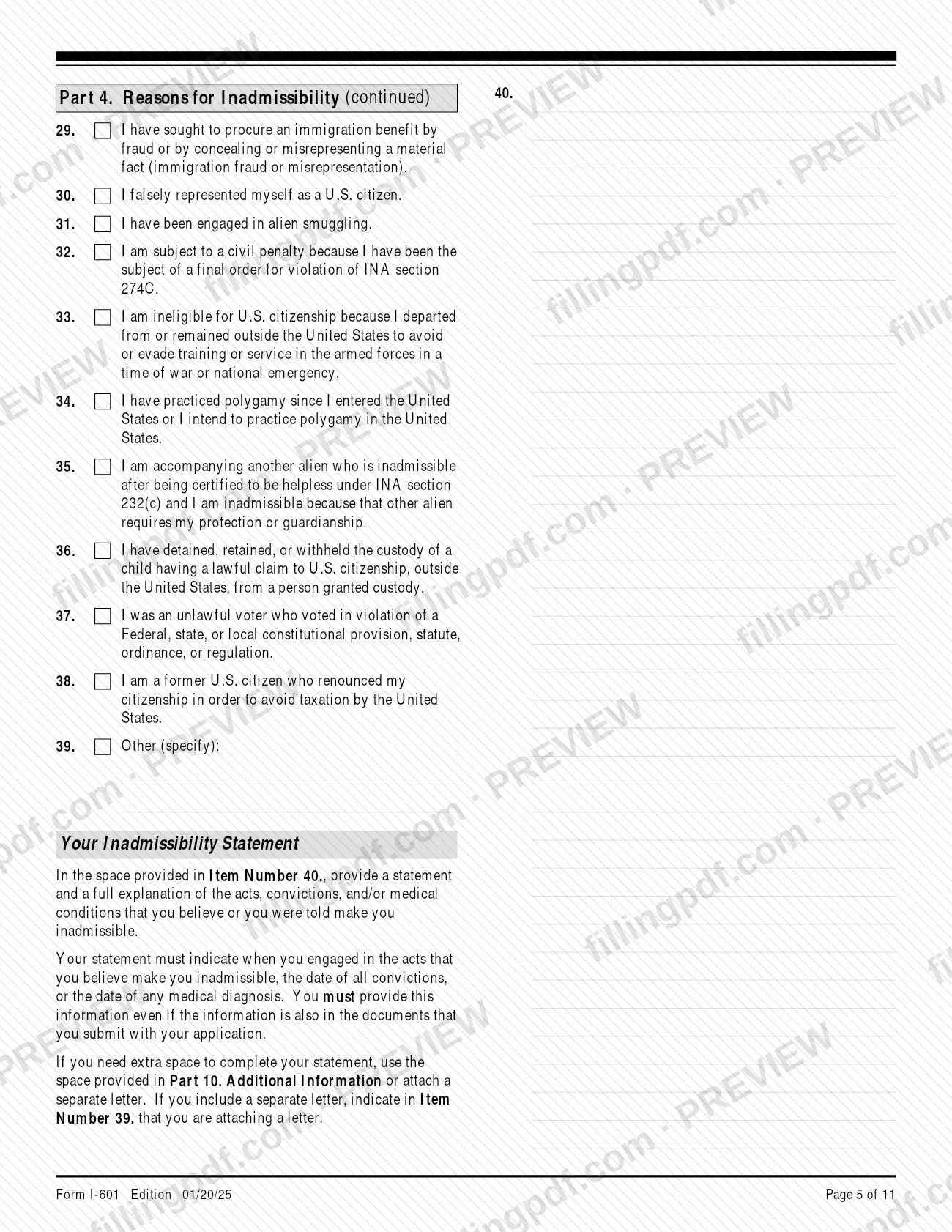
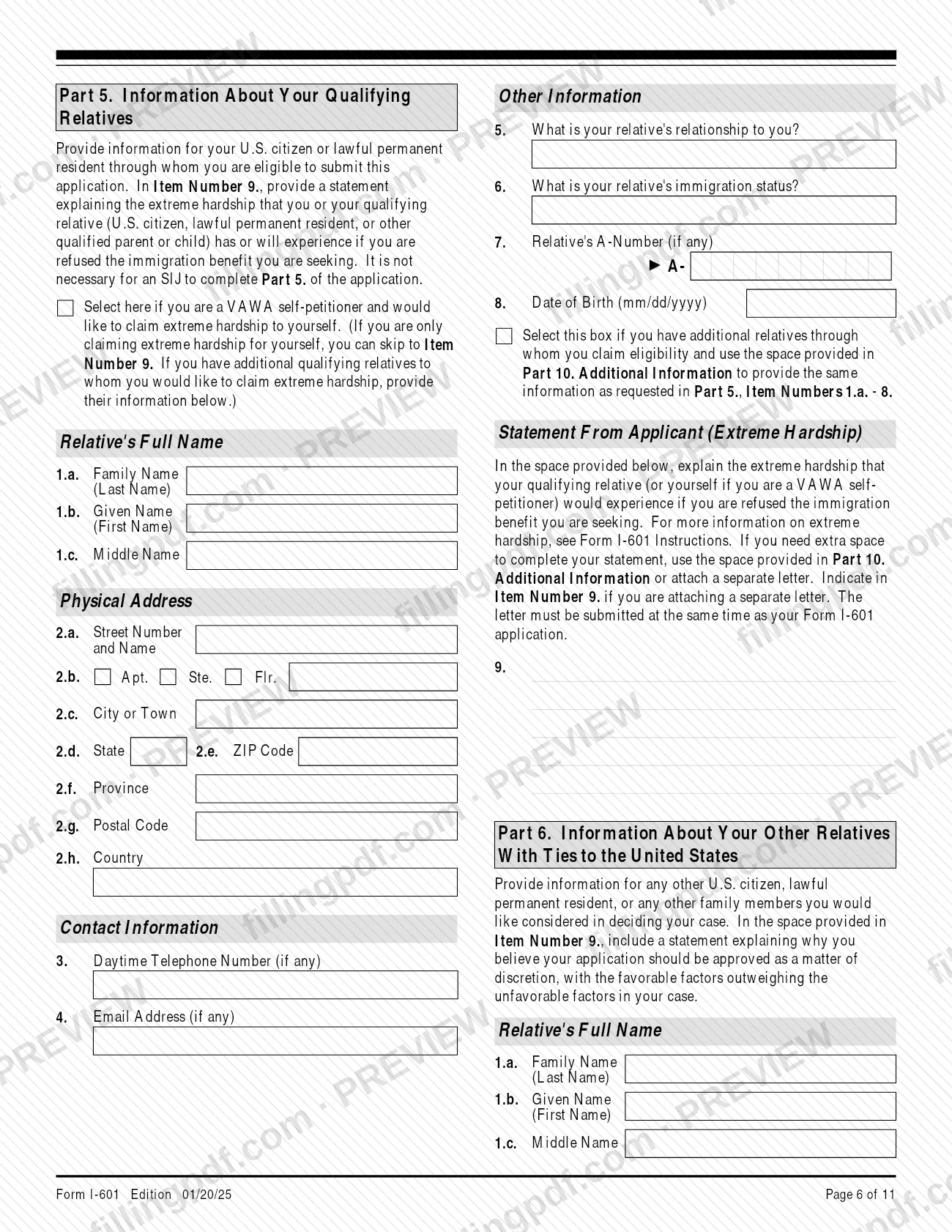
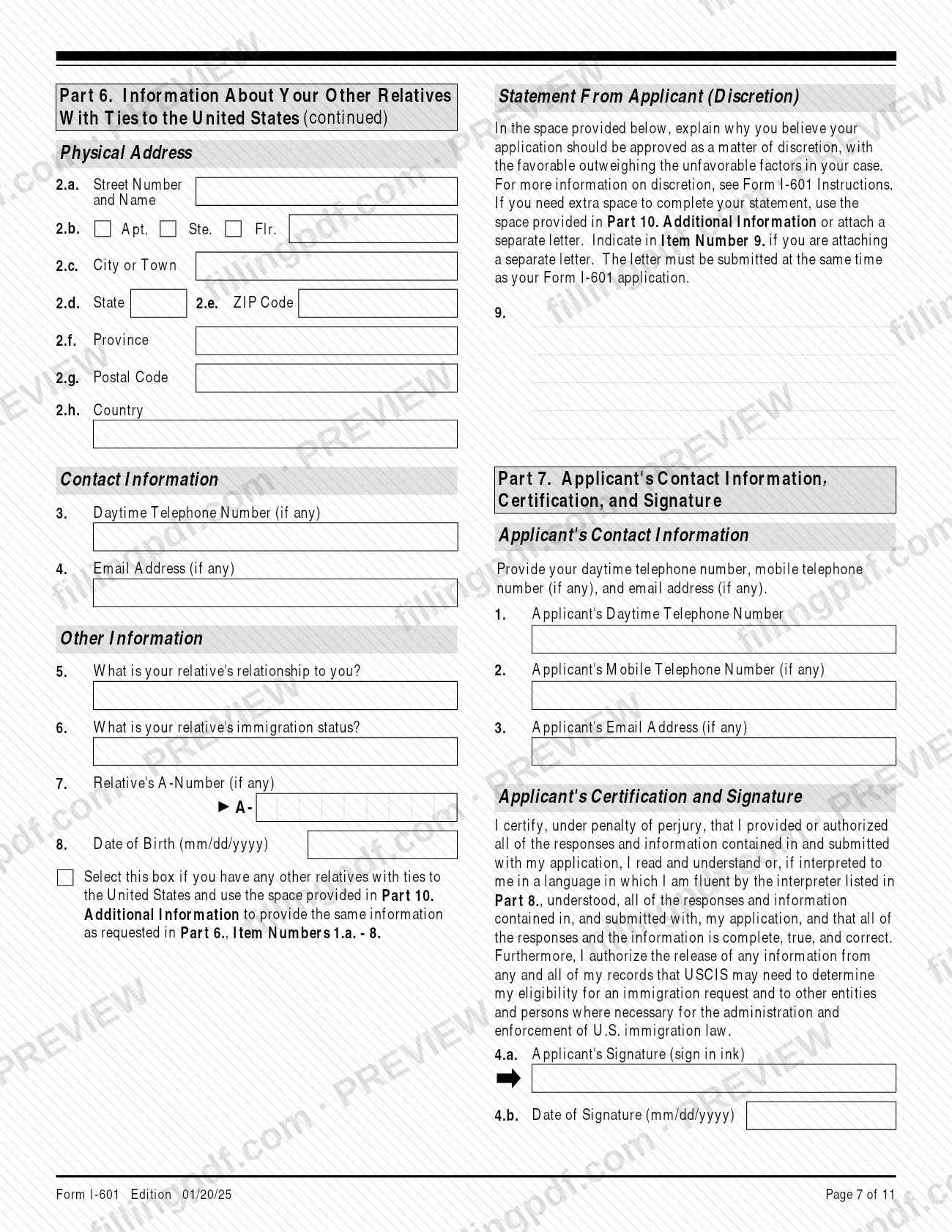
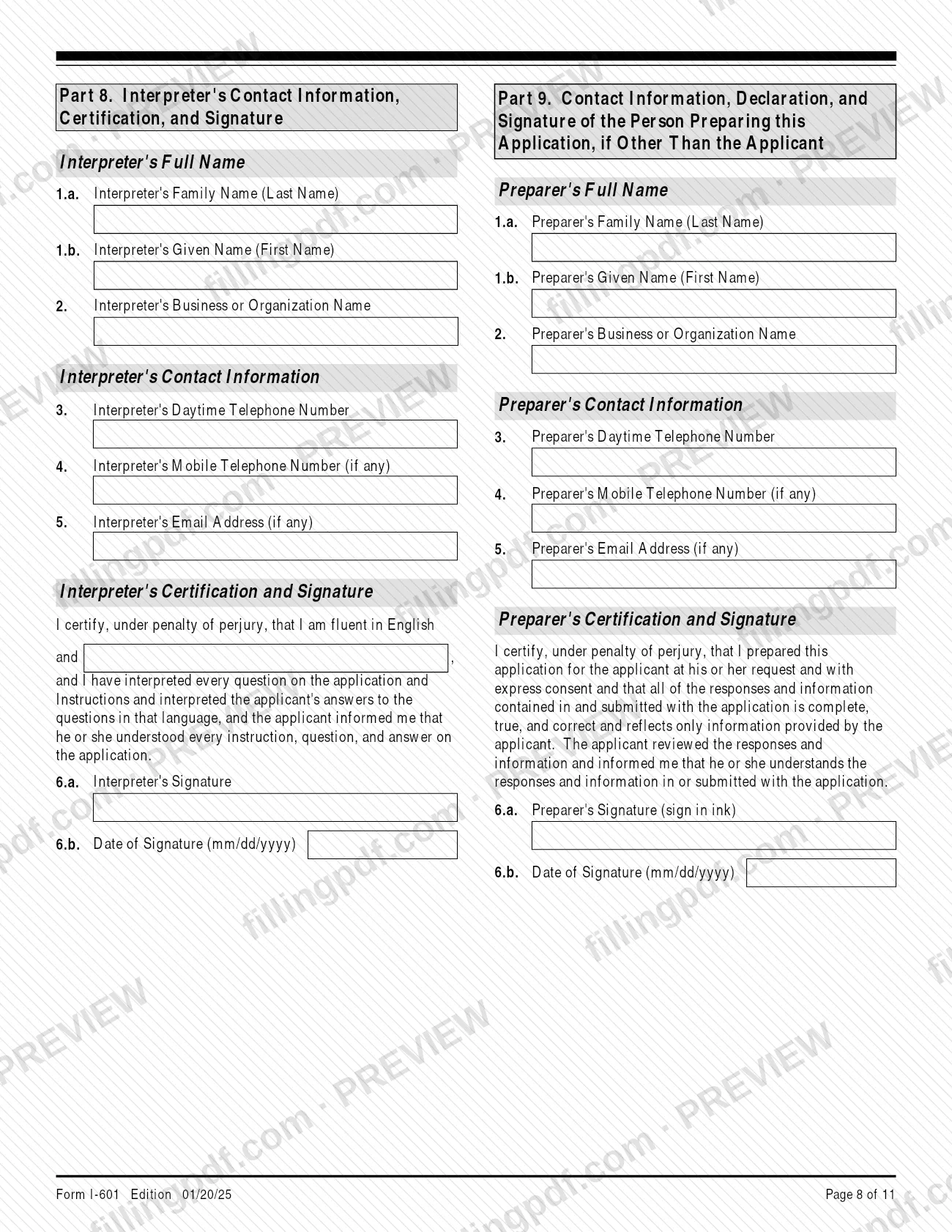
Form I-601 is the application that U.S. Citizenship and Immigration Services (USCIS) uses to decide whether certain grounds of inadmissibility can be waived for people seeking an immigrant visa, adjustment of status, Temporary Protected Status (TPS) or certain other benefits. Which waiver you can request depends on the benefit you seek and the reason you are inadmissible. On this page you can fill out the form online on FillingPDF and download or print the completed PDF; the form, its instructions and the filing addresses are published by USCIS.
Last updated
What is I-601?
Form I-601, Application for Waiver of Grounds of Inadmissibility, is the USCIS form on which a person who cannot be admitted to the United States as an immigrant, or cannot adjust status, asks for a waiver of certain grounds of inadmissibility, and on which certain nonimmigrant applicants do the same.
The form is an 11-page application issued under OMB No. 1615-0029. You select the grounds you believe apply to you (Part 4), explain the acts, convictions or medical conditions behind them, name the qualifying relative through whom you claim eligibility and describe extreme hardship (Part 5), and explain why the application should be approved as a matter of discretion (Part 6). Applicants with a Class A Tuberculosis condition also complete Part 11.
A waiver granted in connection with an immigrant visa or adjustment of status is valid indefinitely, except for the conditional or limited cases the instructions list (Convention adoptee, K nonimmigrant, conditional resident and TPS). It covers only the grounds, crimes, incidents, events or conditions you included in the application.
Form I-601 is not Form I-601A, Application for Provisional Unlawful Presence Waiver, which is used only for the unlawful presence ground under INA section 212(a)(9)(B). It is also separate from Form I-212, Application for Permission to Reapply for Admission into the United States After Deportation or Removal, which the form asks about at Items 18 and 19.
Who needs to file I-601?
You may file Form I-601 if you are inadmissible and apply for one of these benefits:
- An immigrant visa, a K or V nonimmigrant visa, or adjustment of status to lawful permanent residence, for grounds such as health-related grounds, certain criminal grounds, immigration fraud or misrepresentation, membership in a totalitarian party, alien smuggling, a civil penalty, or the 3-year or 10-year unlawful presence bar.
- Temporary Protected Status (TPS), for most grounds in INA section 212(a).
- Adjustment under NACARA section 202 or HRIFA section 902.
- Adjustment as a VAWA self-petitioner or the child of one.
- Adjustment based on T nonimmigrant status.
- Adjustment as a Special Immigrant Juvenile (SIJ) based on an approved Form I-360.
Many waivers require a qualifying relative, such as a U.S. citizen or lawful permanent resident spouse or parent. SIJs do not need one and skip Part 5.
Do not use Form I-601 for a provisional unlawful presence waiver; use Form I-601A. The instructions also say not to file it for a false claim to U.S. citizenship made on or after September 30, 1996, and list further cases where no waiver is needed or available, such as certain VAWA, T and SIJ situations and many TPS grounds.
You must have a United States address to file. If you are under 14, your parent or legal guardian may sign for you; a legal guardian may sign for a mentally incompetent person.
When to file I-601
File Form I-601 when you are found inadmissible, or believe you are, for the benefit you are seeking, and a waiver is available for that ground. For an immigrant visa or K or V visa, that means after the consular interview in which you were found inadmissible. For adjustment of status or TPS, the form asks for the receipt number of the Form I-485 or Form I-821 you have already filed, so you may also file the waiver after those applications.
The form and the instructions set no deadline of their own. Submit all evidence at the time of filing, including the statements in Part 5, Item 9 and Part 6, Item 9; a separate letter must be submitted at the same time as the form.
USCIS may later ask you to attend a biometric services appointment or an interview, and will notify you of the decision in writing or, for electronic filings, by electronic notice. If you are not a U.S. citizen, report a new address to USCIS within 10 days of moving.
Documents you need
- Evidence showing why you qualify for the waiver of the ground(s) of inadmissibility that apply to you, and why USCIS should grant it as a matter of discretion.
- Certified court records or dispositions for every arrest or conviction; an uncertified copy is not sufficient for records of convictions.
- Evidence of the family relationship, such as a birth or marriage certificate, when the waiver requires extreme hardship to a qualifying relative or, for a VAWA self-petitioner, to yourself.
- Evidence of extreme hardship, such as affidavits, expert opinions, medical documentation, financial and employment records or country-condition reports, when the waiver requires it.
- For physical or mental disorder with harmful behavior: a complete medical history and a report covering the disorder, current condition, prognosis and recommended treatment.
- For a vaccination exemption: evidence that your objection is to all vaccinations, rests on religious beliefs or moral convictions, and is sincere.
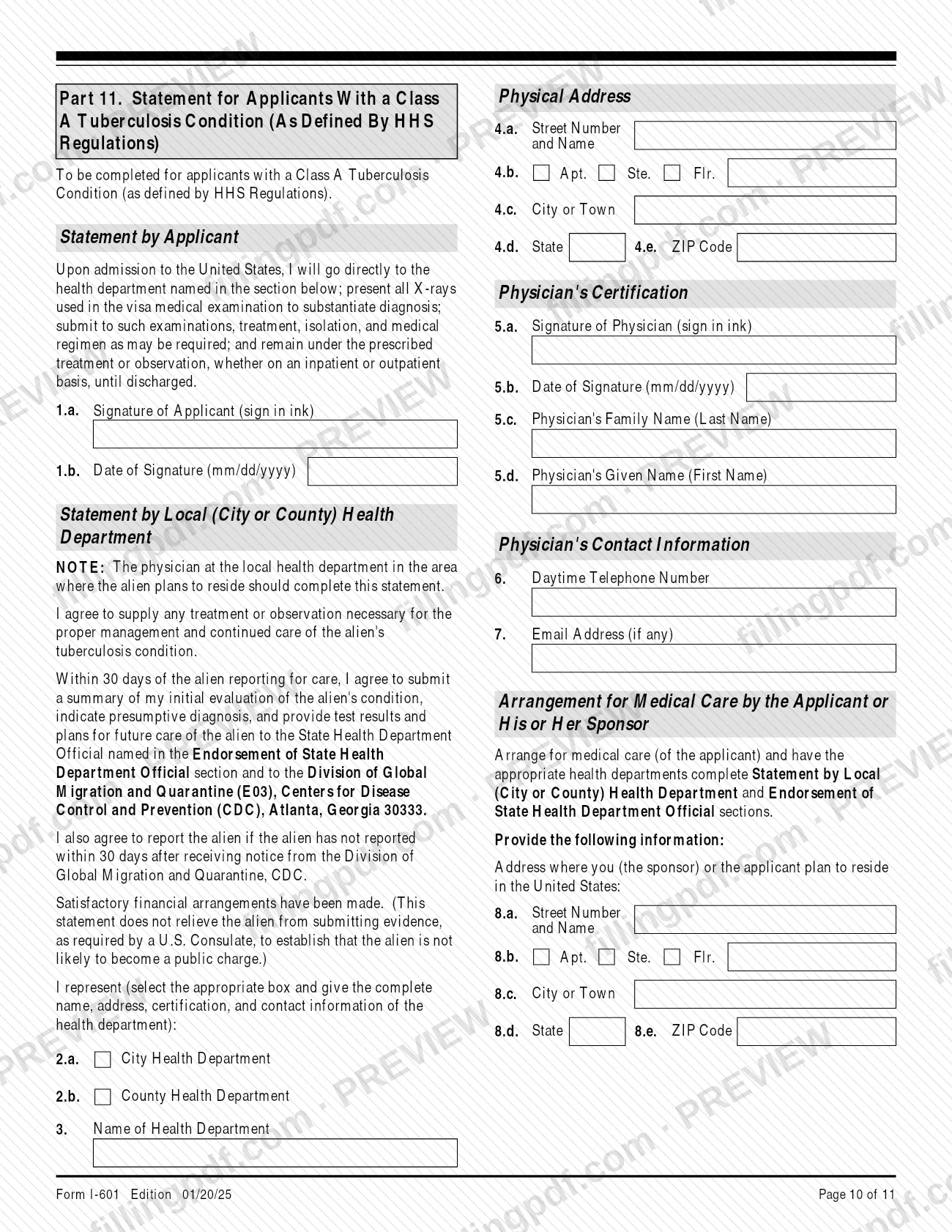
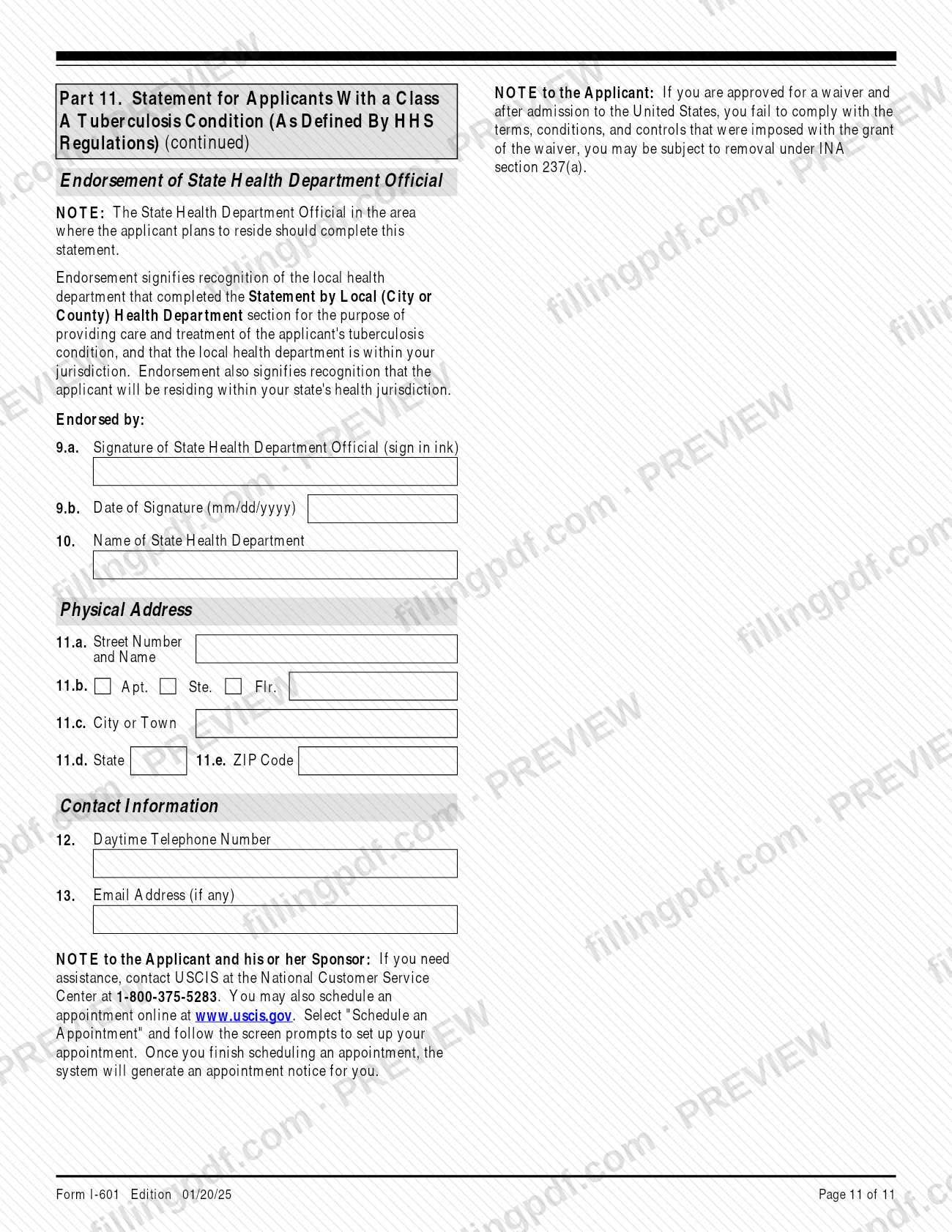
- For a Class A Tuberculosis condition: completed Part 11, with statements from the local health department physician and the State Health Department official.
- For approved VAWA self-petitioners seeking an INA 212(a)(9)(C)(iii) waiver: evidence of the connection between the battery or extreme cruelty and your removal, departure or reentry.
- For T nonimmigrant adjustment applicants: evidence that the waiver is in the national interest and, for non-health grounds, that your victimization caused the activities making you inadmissible.
- For TPS applicants: evidence that the waiver serves humanitarian purposes, family unity or the public interest.
- A full English translation of any foreign-language document, with the translator's signed certification of completeness, accuracy and competence.
- Form G-28 if an attorney or accredited representative represents you, and Form G-1145 if you want e-mail or text notice of acceptance.
How to fill out I-601
Complete the attorney block if represented
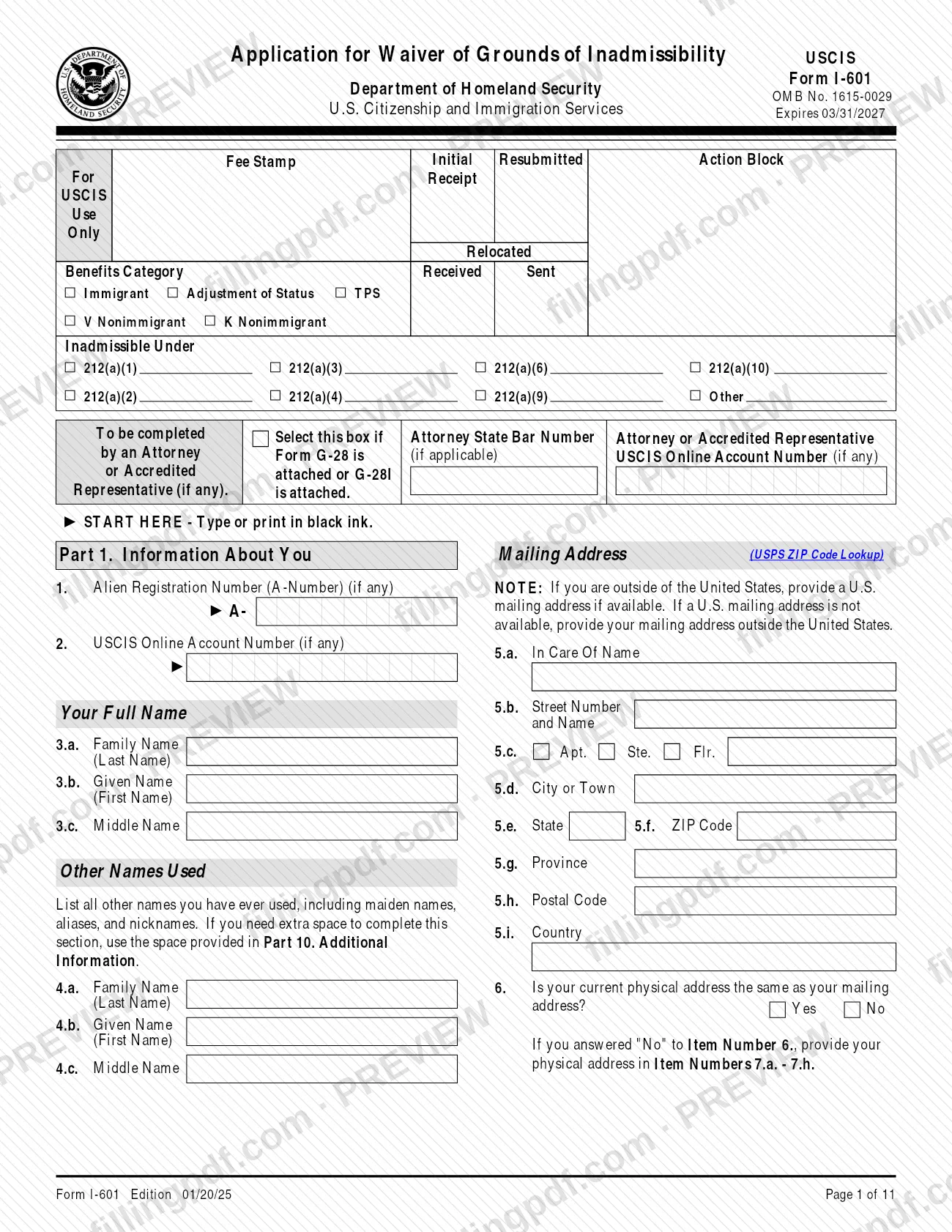
If an attorney or accredited representative acts for you, they complete the top block and you select the box showing that Form G-28 or G-28I is attached. Type or print in black ink.
Enter your identity in Part 1
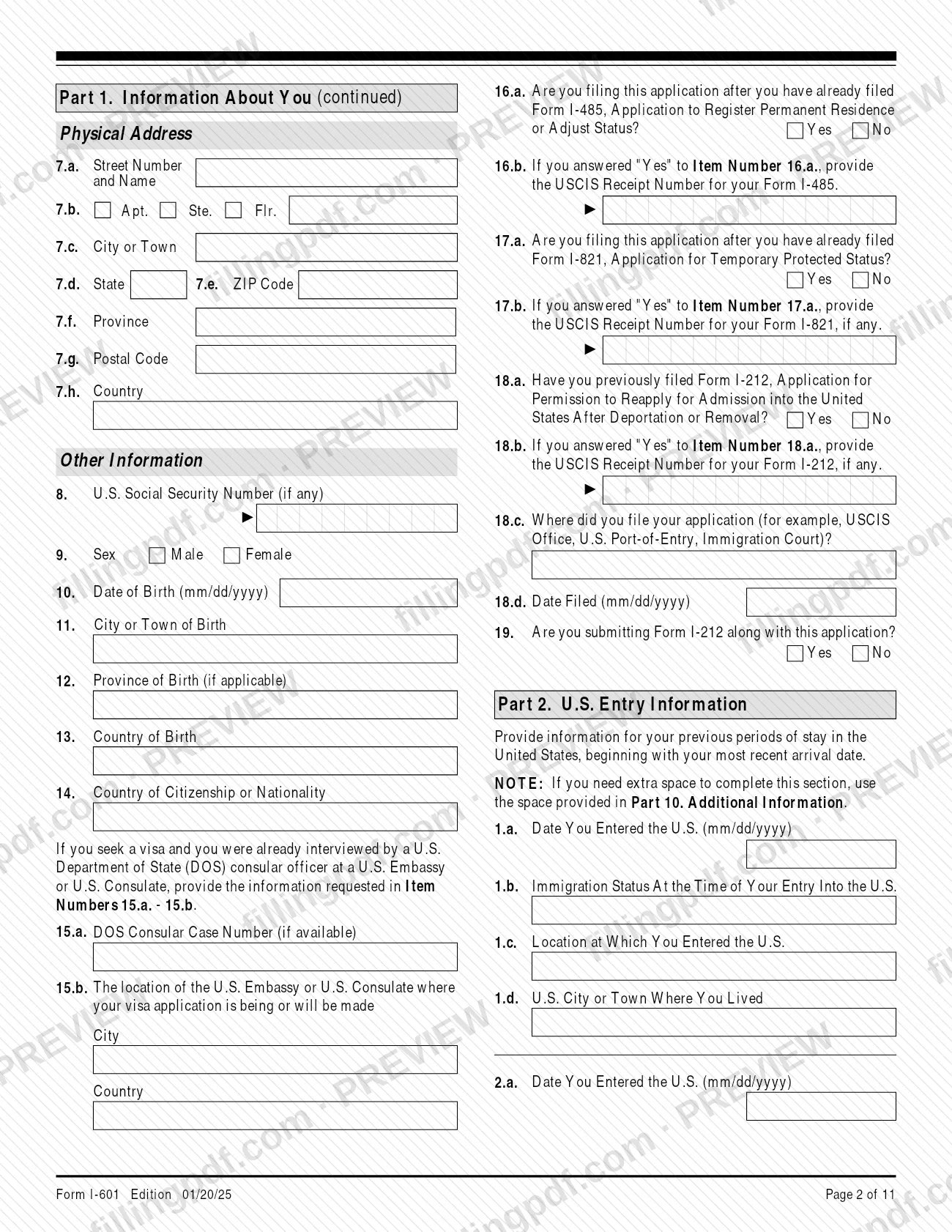
Give your A-Number and USCIS Online Account Number if any (Items 1 and 2), your full legal name (3.a.-3.c.) and other names used (4.a.-4.c.). Add Social Security number, sex, date of birth as mm/dd/yyyy, and birth and citizenship details (Items 8-14).
Provide mailing and physical addresses
Items 5.a.-5.i. take a mailing address; use a U.S. address if you have one. If your physical address differs, answer No to Item 6 and complete Items 7.a.-7.h.
Answer the related-filing questions
Items 15.a.-15.b. cover a consular interview, 16.a.-16.b. a Form I-485, 17.a.-17.b. a Form I-821 and 18.a.-19. a Form I-212, with receipt numbers where asked. Answer Yes or No to each.
List your U.S. entries in Part 2
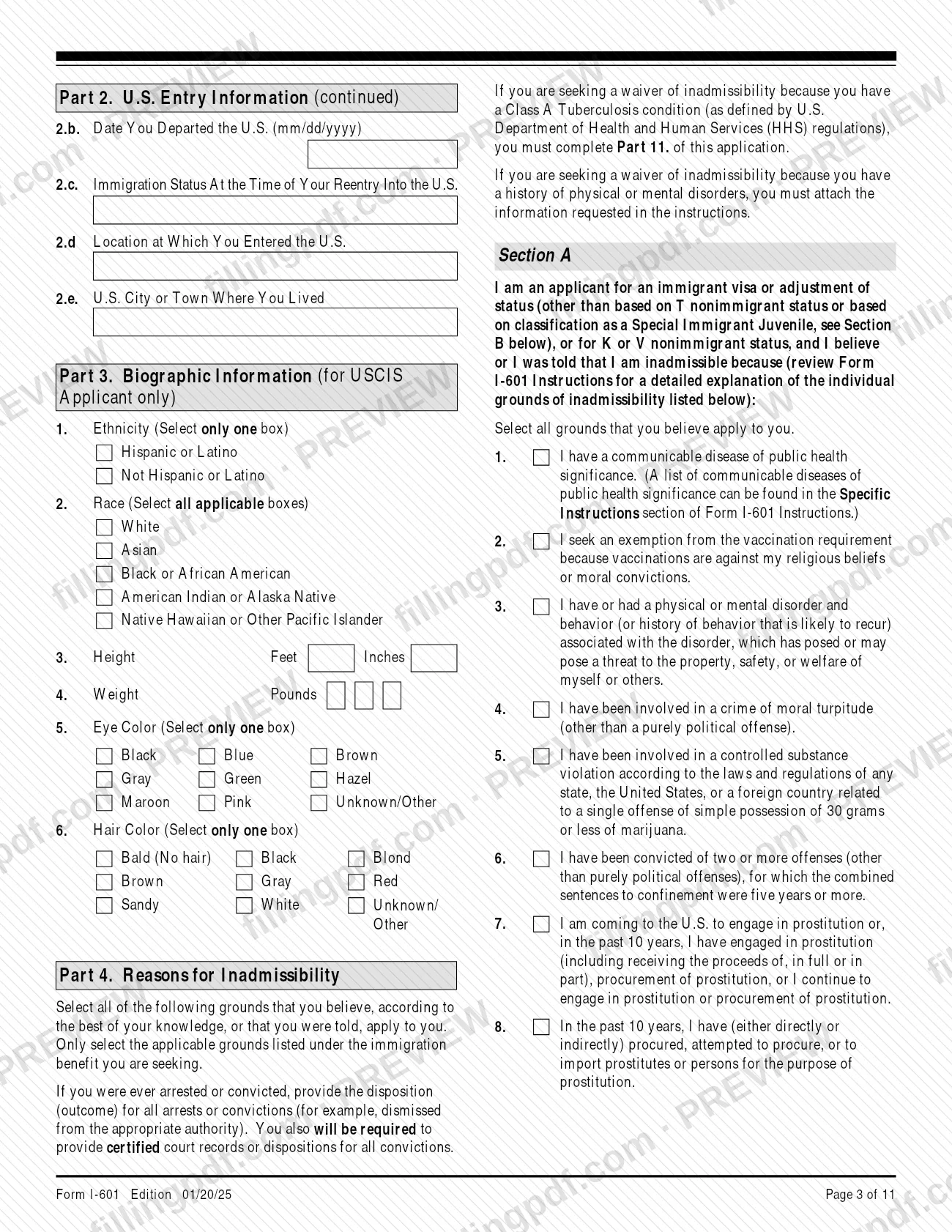
Starting with your most recent arrival, enter the date entered (mm/dd/yyyy), status, entry location and U.S. city or town. Continue periods of stay at Items 2.a.-2.e., and use Part 10 if you need more space.
Complete biographic information in Part 3
Select ethnicity and race, then height in feet and inches, weight in pounds, eye color and hair color. Enter 000 for weight if you do not know it or it is under 30 or over 699 pounds.
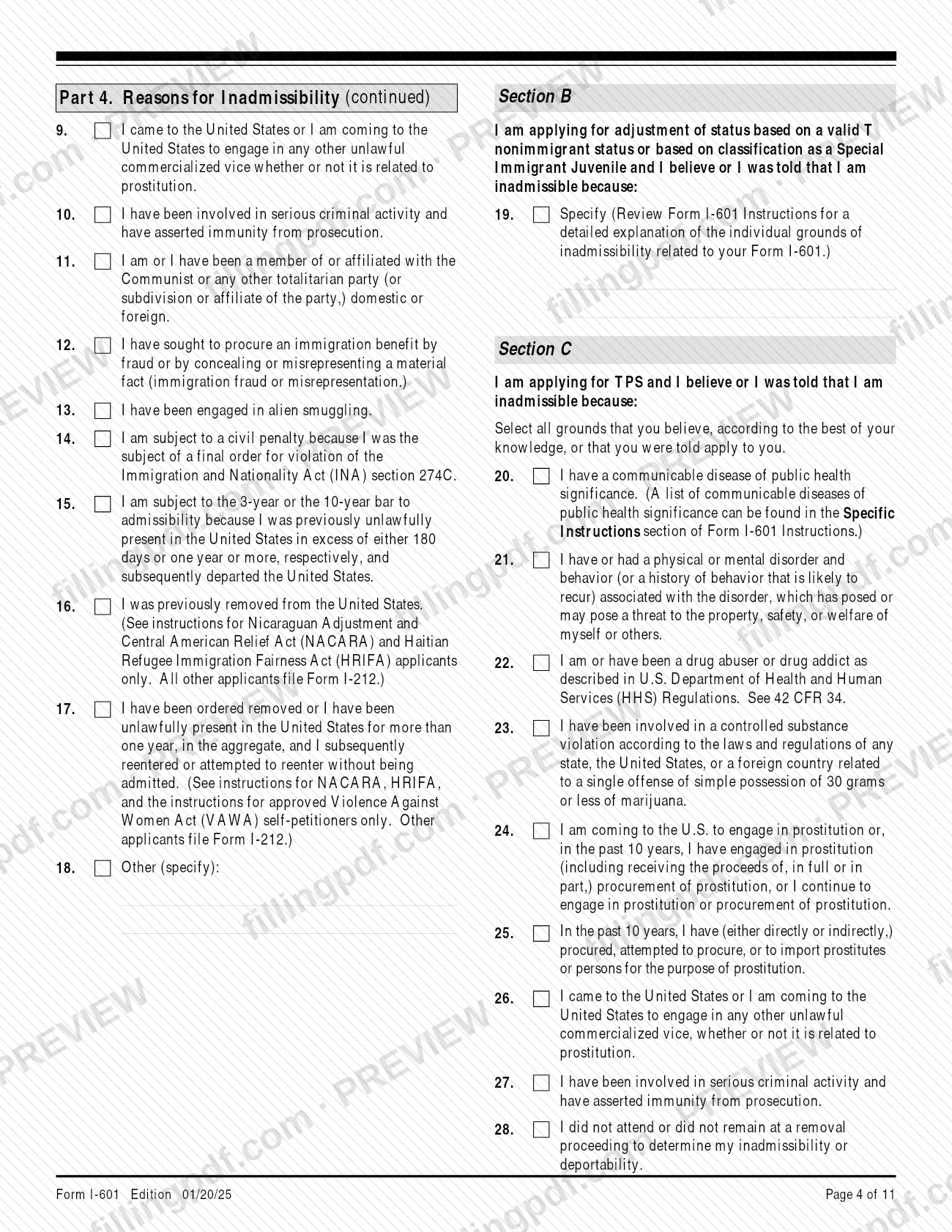
Select your grounds in Part 4
Use Section A for immigrant visa, adjustment (other than T or SIJ) and K or V applicants, Section B (Item 19) for T and SIJ adjustment applicants, and Section C for TPS applicants. Then write your inadmissibility statement in Item 40 with dates of acts, convictions or diagnoses.
Identify qualifying relatives in Part 5
Enter the relative's name, address, contact details, relationship, immigration status, A-Number and date of birth. In Item 9 explain the extreme hardship; SIJs need not complete Part 5, and K applicants follow the instructions' special entries.
Add other relatives and your discretion statement
In Part 6, list other relatives with ties to the United States, then use Item 9 to explain why the favorable factors outweigh the unfavorable ones. Select the box if you need Part 10 for more relatives.
Sign Part 7 and add interpreter or preparer
Enter your phone numbers and email, then sign in ink (4.a.) and date (4.b.). An interpreter completes Part 8 and a preparer other than you completes Part 9, each signing.
Use Parts 10 and 11 when needed
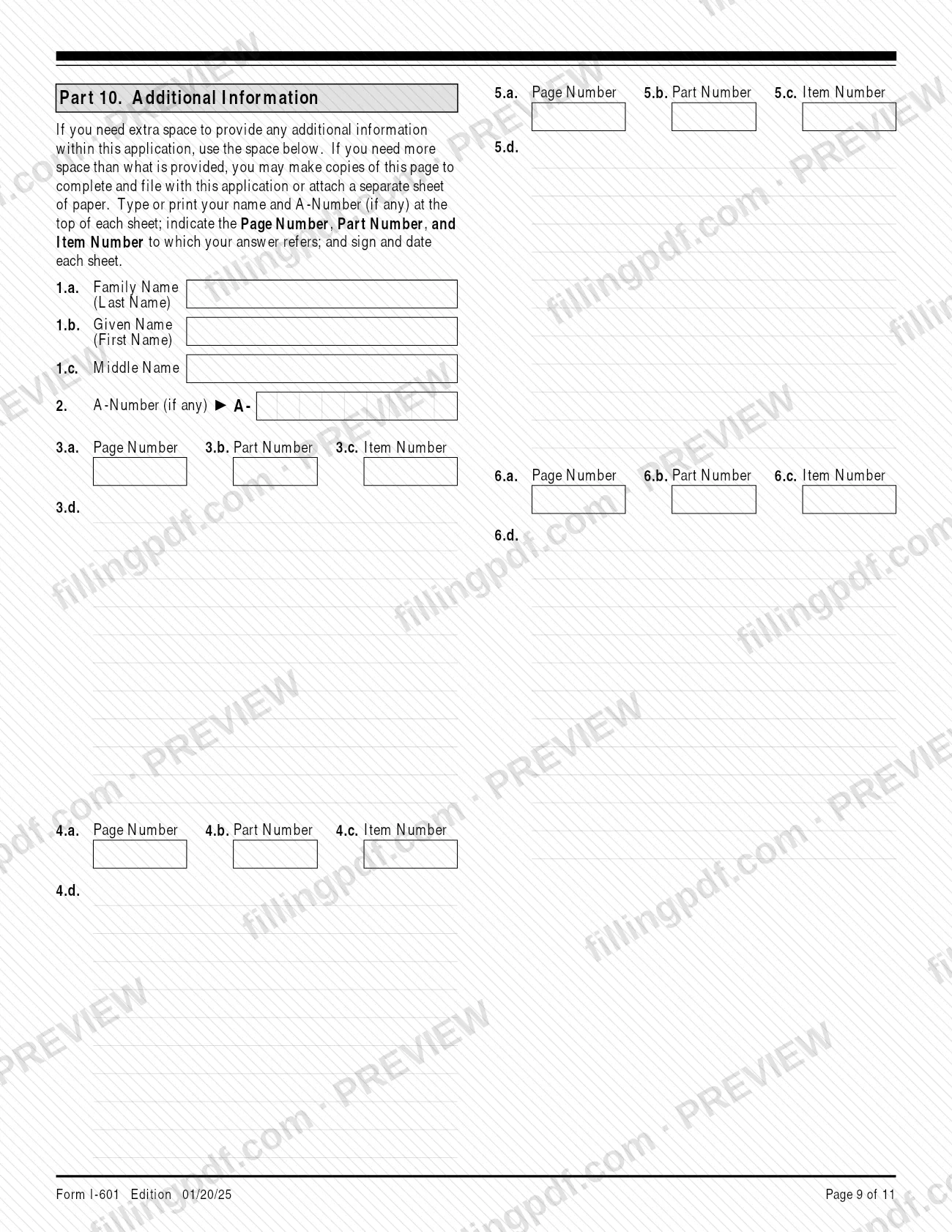
Part 10 is for extra space: give your name, A-Number, and the page, part and item number each answer refers to. Part 11 is only for applicants with a Class A Tuberculosis condition.
Review, sign and download the PDF
Check that every item is answered, "N/A" or "None" is entered where required, and all 11 pages are included. Download or print the completed PDF from FillingPDF, sign it in ink and assemble the package described under How to submit.
How to submit I-601
Form I-601 is filed with USCIS on paper by mail, or electronically where USCIS allows it, and the correct filing location depends on the benefit you are seeking.
- By mail: USCIS lists the addresses on its Direct Filing Addresses page. Check www.uscis.gov/I-601 or call the USCIS Contact Center at 1-800-375-5283 (TTY 1-800-767-1833) for the current filing location.
- Electronically: follow the instructions on the USCIS website at www.uscis.gov/file-online.
Submit all 11 pages, with the edition date and page numbers visible and all pages from the same edition; missing or mixed-edition pages may lead to rejection. Send photocopies, not originals, unless the instructions or USCIS request originals. Sign in ink: photocopied, faxed or scanned copies of an original handwritten signature are accepted for filing.
A filing fee applies; see Form G-1055 and the USCIS Fee Schedule page for the amount. If you file with USCIS, you do not pay the biometric services fee at filing. USCIS accepts fee waiver requests from certain categories, such as VAWA self-petitioners and TPS applicants. To receive e-mail or text notice of acceptance, clip Form G-1145 to the first page. Do not mail the form to the Paperwork Reduction Act address in the instructions. FillingPDF lets you fill out and download the PDF; submission follows the channels above.
Common mistakes to avoid
- Submitting the form unsigned or with a stamped or typewritten name; USCIS rejects an application without a valid signature.
- Leaving out Family Name, Mailing Address or Date of Birth in Part 1; USCIS says it will reject the form if these are missing.
- Sending fewer than all 11 pages, or pages from different form editions.
- Listing only some grounds or conduct: an approved waiver covers only the grounds and events you included in the application.
- Using Form I-601 to request a provisional unlawful presence waiver, which requires Form I-601A.
- Submitting an uncertified copy of conviction records instead of certified court documents.
- Sending foreign-language documents without a full English translation and the translator's signed certification.
- Attaching a separate hardship or discretion letter without typing or printing in Item 9 that a letter is attached, or sending it after the form.
- Skipping Part 11 when the waiver is based on a Class A Tuberculosis condition.
- Mailing the completed form to the Paperwork Reduction Act address printed in the instructions, or sending original documents when none are requested.
Frequently asked questions
What is Form I-601 used for?
Form I-601 is the USCIS application for a waiver of certain grounds of inadmissibility. People seeking an immigrant visa, adjustment of status, TPS or certain other benefits use it when a ground such as a health-related, criminal, fraud or unlawful presence ground applies and a waiver is available.
What is the difference between Form I-601 and Form I-601A?
Form I-601A is only for a provisional waiver of the unlawful presence ground under INA section 212(a)(9)(B). The I-601 instructions say not to use Form I-601 for a provisional unlawful presence waiver. Form I-601 covers the other waivers listed in its instructions.
Can I fill out Form I-601 online?
You can complete the I-601 PDF online on FillingPDF and download or print it. FillingPDF is an independent service and does not file the form with USCIS; you submit it through USCIS channels, mail or the electronic filing instructions at www.uscis.gov/file-online.
Do I need a qualifying relative to file Form I-601?
Often yes, but it depends on the waiver. Many require extreme hardship to a U.S. citizen or lawful permanent resident spouse or parent, or a K visa petitioner. Special Immigrant Juveniles do not need a qualifying relative and skip Part 5, and TPS and T waivers use different standards.
Where do I mail Form I-601?
The filing location depends on the benefit you seek. USCIS directs you to www.uscis.gov/I-601, its Direct Filing Addresses page, or the Contact Center at 1-800-375-5283 for the current address. Do not use the Paperwork Reduction Act address in the instructions.
Is there a filing fee for Form I-601?
Yes, a fee applies; see Form G-1055 or the USCIS Fee Schedule page for the amount. USCIS accepts fee waiver requests from groups such as VAWA self-petitioners, T visa applicants, TPS applicants and Special Immigrant Juveniles. No biometric fee is due at filing.
How long is an approved I-601 waiver valid?
Generally indefinitely when granted with an immigrant visa or adjustment application, even if you do not obtain the visa or lose LPR status. Exceptions: K-1 and K-2 waivers depend on the marriage, conditional resident waivers end with that status, and TPS waivers cover only TPS and re-registration.
What must I attach to Form I-601?
Evidence showing why you qualify for a waiver and deserve it as a matter of discretion. Depending on the ground this includes certified court records, proof of family relationship, hardship evidence or medical reports. Foreign-language documents need a certified English translation.
Who can sign Form I-601 for me?
You sign it yourself, in ink. A parent or legal guardian may sign if you are under 14, and a legal guardian may sign for a mentally incompetent person. USCIS will not accept a stamped or typewritten name, and an unsigned form is rejected.
Ready to fill out I-601?
Fill out I-601 now