
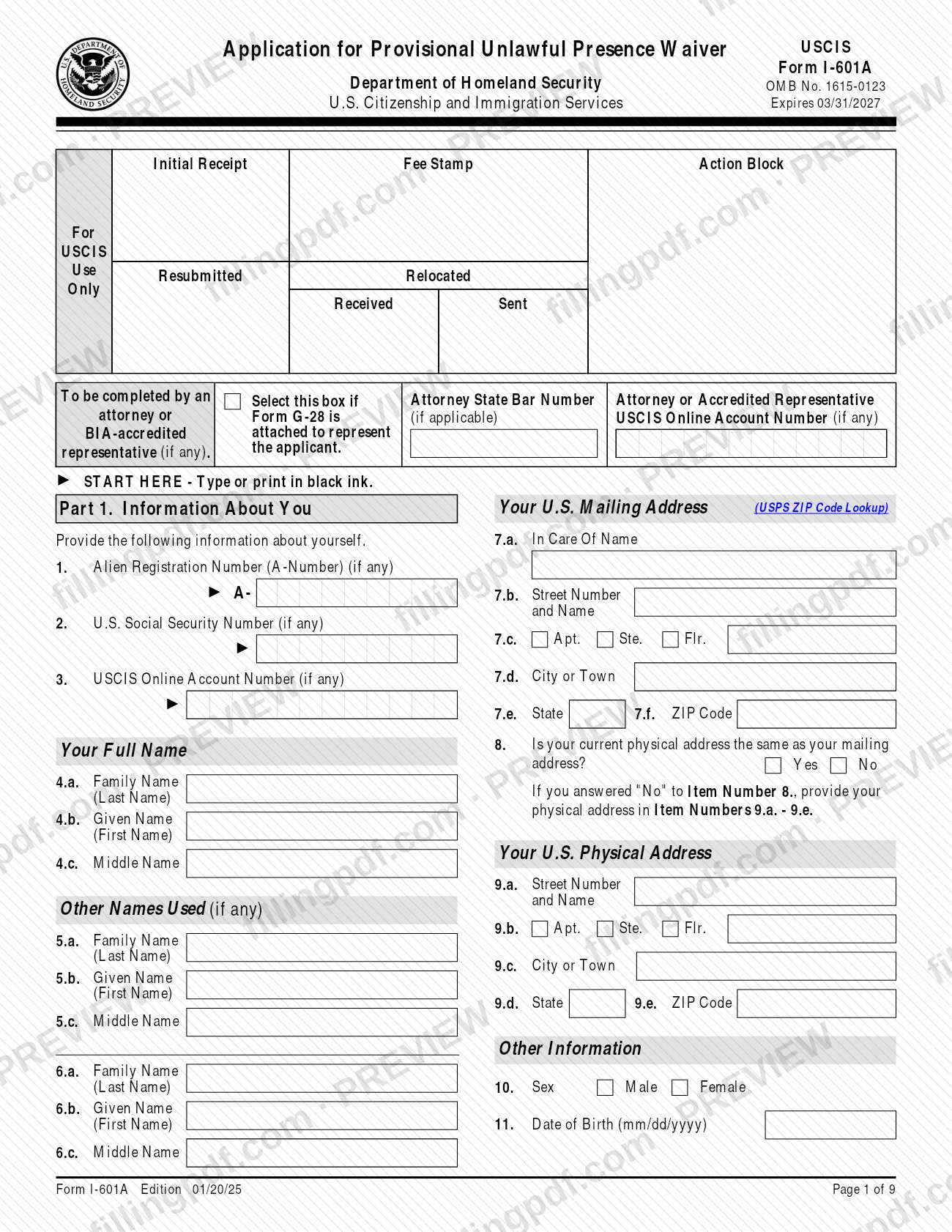
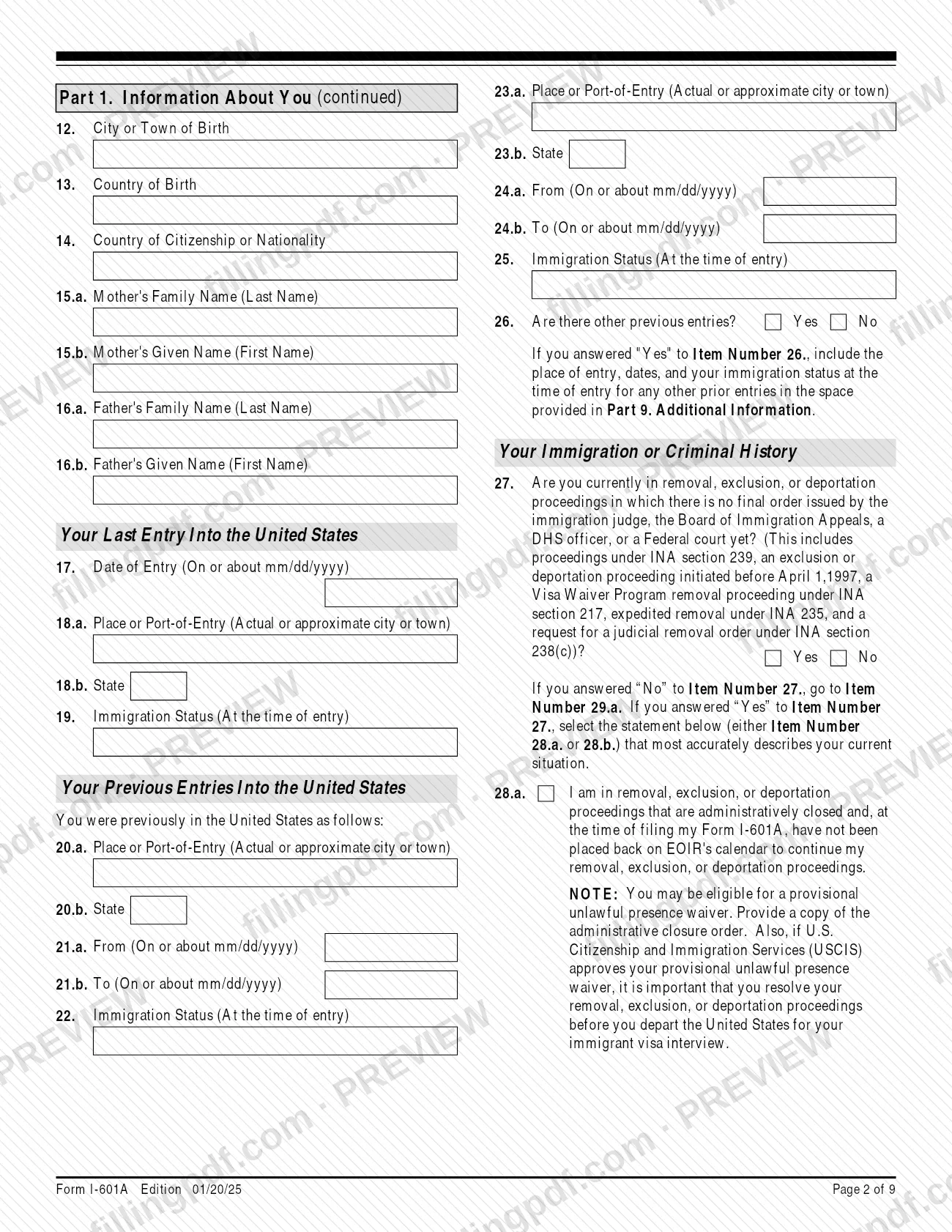
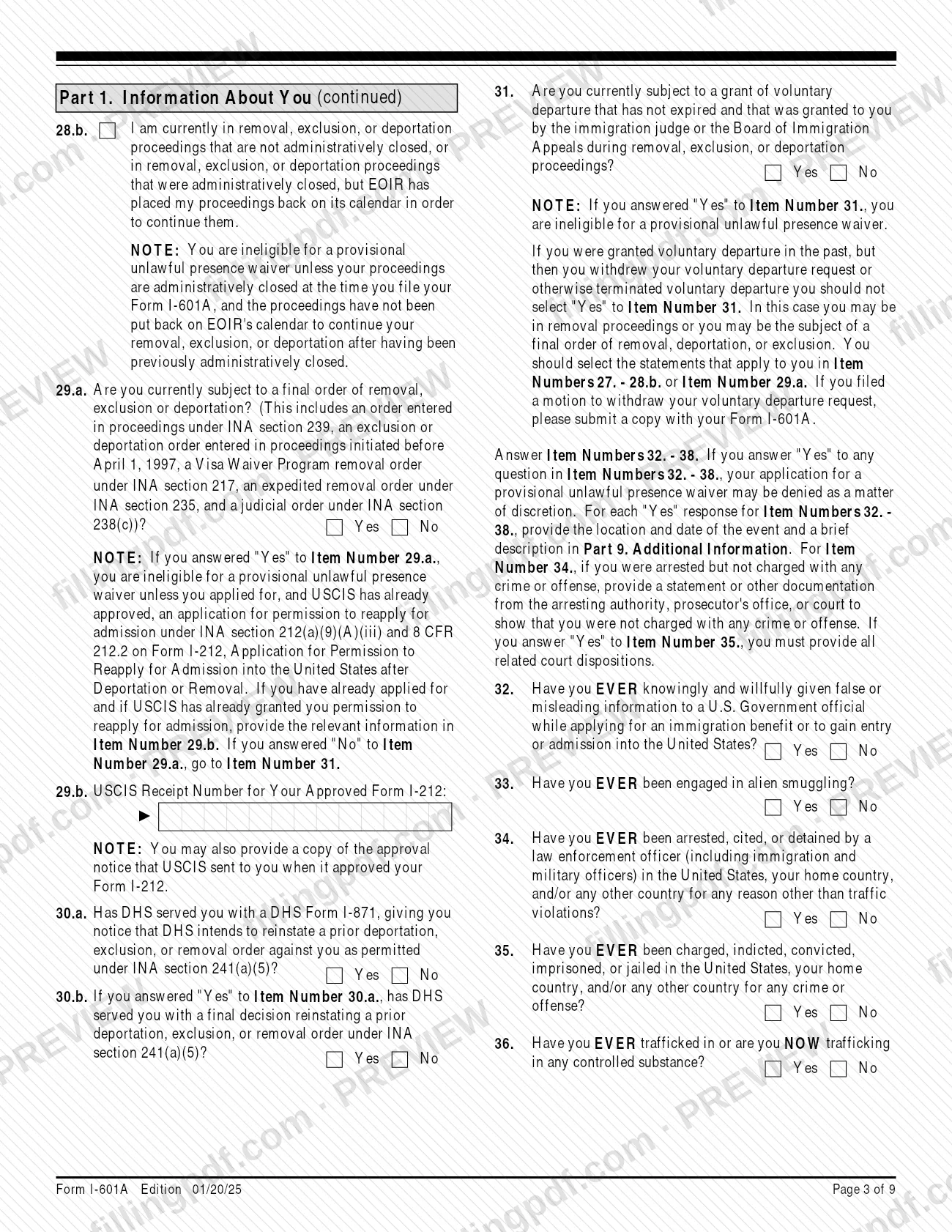
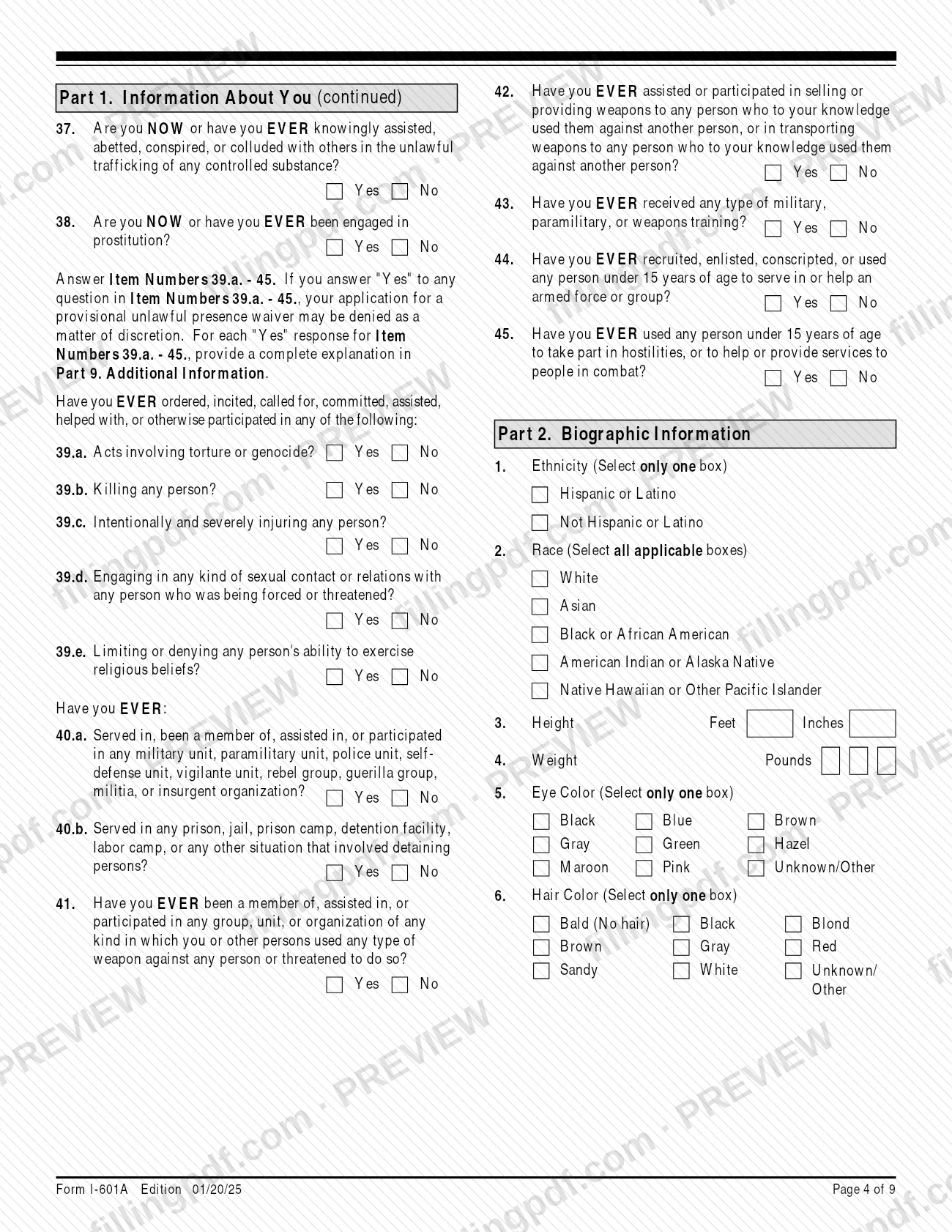
Form I-601A, Application for Provisional Unlawful Presence Waiver, is the U.S. Citizenship and Immigration Services (USCIS) application that certain immigrant visa applicants use to ask for a provisional waiver of the unlawful presence grounds of inadmissibility before they leave the United States for a visa interview. It is for relatives of U.S. citizens or lawful permanent residents (LPRs) who are physically in the United States when they file. On FillingPDF you can fill out the form online and download or print the completed PDF; the form, edition 01/20/25, and its instructions are published by USCIS, and you file it by mail.
Last updated
What is I-601A?
Form I-601A, Application for Provisional Unlawful Presence Waiver, is the USCIS application that lets certain immigrant visa applicants who are relatives of U.S. citizens or lawful permanent residents (LPRs) request a provisional waiver of the unlawful presence grounds of inadmissibility.
The waiver addresses only the grounds in Immigration and Nationality Act (INA) section 212(a)(9)(B): unlawful presence of more than 180 days but less than 1 year, or of 1 year or more, during a single stay. You ask for it before you depart the United States to attend your immigrant visa interview at a U.S. Embassy or Consulate.
Approval is discretionary. You must show that your U.S. citizen or LPR spouse or parent (the qualifying relative) would experience extreme hardship if you were refused admission, and that your case deserves a favorable exercise of discretion.
An approved waiver takes effect only after you depart, appear at the interview, and the Department of State (DOS) consular officer finds you otherwise admissible and eligible for the visa. It then stays valid indefinitely for the period of unlawful presence that was waived. It does not give interim benefits such as work authorization, does not give lawful status, does not stop unlawful presence from accruing, does not protect against removal and does not guarantee a visa.
Form I-601A is a standalone application and cannot be filed with other benefit requests. If a consular officer later finds you inadmissible, the instructions point to Form I-601, Application for Waiver of Grounds of Inadmissibility, filed from abroad when a waiver is available.
Who needs to file I-601A?
You may file Form I-601A if all of the following apply:
- You are physically present in the United States and at least 17 years old when you file.
- You have an immigrant visa case pending with DOS as the principal beneficiary of an approved Form I-130, I-140 or I-360 (with the DOS immigrant visa processing fee paid), as a Diversity Visa (DV) Program selectee, or as the spouse or child of either.
- You believe you are or will be inadmissible only because of the unlawful presence periods above.
- You have a U.S. citizen or LPR spouse or parent who would suffer extreme hardship if you were refused admission.
You are not eligible, and USCIS will deny the application, if for example:
- You have Form I-485 pending.
- You are in removal proceedings, unless they are administratively closed and have not been put back on the EOIR calendar when you file.
- You are subject to a final removal order, unless USCIS has already approved Form I-212.
- DHS has entered a final decision reinstating a prior order.
- You hold an unexpired grant of voluntary departure.
A U.S. citizen or LPR child is not a qualifying relative. Your hardship counts only through its effect on a qualifying spouse or parent. A parent or legal guardian may sign for an applicant under 14. An interpreter or preparer who helped you must complete Parts 7 and 8.
When to file I-601A
File Form I-601A once you have an immigrant visa case pending with DOS and before you depart the United States for the immigrant visa interview. You must be in the United States at the time of filing. Petition-based applicants must already have paid the DOS immigrant visa processing fee. DV Program selectees and derivatives can file as soon as they are selected.
The form and instructions set no calendar due date. Keep in mind that after you file, you should send all required immigrant visa paperwork to the DOS National Visa Center (NVC), which cannot schedule your interview until it has everything.
If you are in administratively closed removal proceedings and USCIS approves the waiver, the instructions say to resolve those proceedings before you leave the United States. Leaving first may delay your visa and may automatically revoke the approved waiver. The instructions give no processing time for this form.
Documents you need
- DOS immigrant visa processing fee receipt, showing payment status PAID, for petition-based applicants (I-130, I-140 or I-360). Place it on top of the form. DV selectees and derivatives do not need it.
- Copy of the Form I-797 approval notice for the I-130, I-140 or I-360 petition, if available; omitting it can cause delays or rejection.
- For DV selectees or derivatives: printout from the DOS Electronic Diversity Visa Entrant Status Check page confirming selection, plus proof of relationship to the selectee for derivatives.
- Copy of the EOIR administrative closure order, if you are in administratively closed removal, exclusion or deportation proceedings.
- Copy of the Form I-797 approval notice for Form I-212, if you have a final removal order and USCIS granted permission to reapply; you may also enter the receipt number in Item 29.b.
- Evidence of your relationship to the qualifying relative, only for employment-based or DV cases, or when the relative is not the family petitioner. Examples: marriage certificate or birth certificate.
- Evidence of the qualifying relative's U.S. citizenship or LPR status, in the same cases. Examples: birth certificate, naturalization certificate, unexpired U.S. passport, Form FS-240, or both sides of the permanent resident card.
- Evidence of admission or parole if you were inspected at a port of entry: Form I-94, passport with admission or parole stamp, or other DHS evidence.
- Evidence of extreme hardship to the qualifying relative, such as medical, financial, employment, education or country-condition records, expert opinions and signed statements.
- Evidence supporting a favorable exercise of discretion, as described in Part 5.
- Certified court dispositions, arrest reports and charging documents for any charge, even if records were expunged or sealed; for arrests without charges, the arrest report and any documentation showing no charge.
- Copy of the death certificate of a deceased U.S. citizen or LPR spouse or parent who filed your petition, for surviving relatives.
- Full English translation with the translator's signed certification for every foreign-language document.
- Form G-28, when an attorney or accredited representative represents you.
How to fill out I-601A
Identify yourself in Part 1
Enter your A-Number (if any), U.S. Social Security Number (or N/A) and USCIS Online Account Number (if any) in Items 1-3. Give your full legal name in Items 4.a.-4.c. and every other name used, including maiden and married names, in Items 5.a.-6.c.
Enter your U.S. addresses
Items 7.a.-7.f. take the mailing address where you want USCIS correspondence. Answer Item 8; if your physical address differs, complete Items 9.a.-9.e. A U.S. address is required.
Give birth and family details
Complete Items 10-16: sex, date of birth (mm/dd/yyyy), city and country of birth, country of citizenship or nationality (enter "stateless" if none), and your parents' full names.
List your last and previous entries
Items 17-19 cover your last entry: date, place and status. If you entered without inspection, enter "PWI" as status. Items 20-26 cover earlier entries; use Part 9 if there are more.
Answer immigration and criminal history
Answer Items 27-45 truthfully. For Yes answers to Items 32-38, give location, date and a brief description in Part 9. For Items 39.a.-45, give a complete explanation there.
Complete Part 2 biographic information
Select ethnicity (Item 1), race (Item 2), height in feet and inches (Item 3), weight in pounds (Item 4), and eye and hair color (Items 5-6).
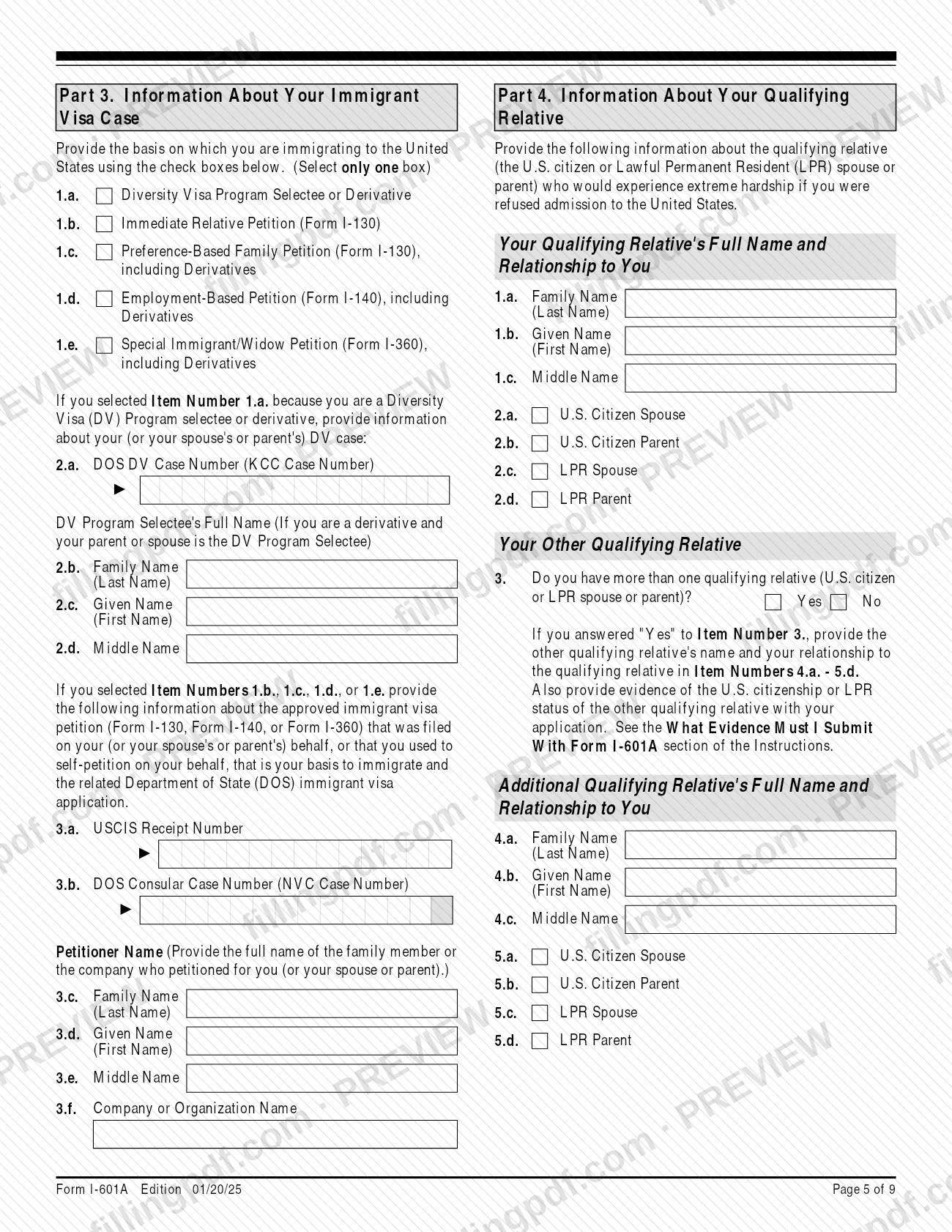
Describe your immigrant visa case
In Part 3, select one basis in Items 1.a.-1.e. DV cases give the DOS DV case number and selectee in Items 2.a.-2.d. Petition cases give the USCIS receipt number, NVC case number and petitioner in Items 3.a.-3.f., entering "Self" for a self-petition.
Identify your qualifying relative
In Part 4, give the U.S. citizen or LPR spouse or parent who would suffer extreme hardship (Items 1.a.-2.d.). If you have another qualifying relative, answer Item 3 and complete Items 4.a.-5.d.
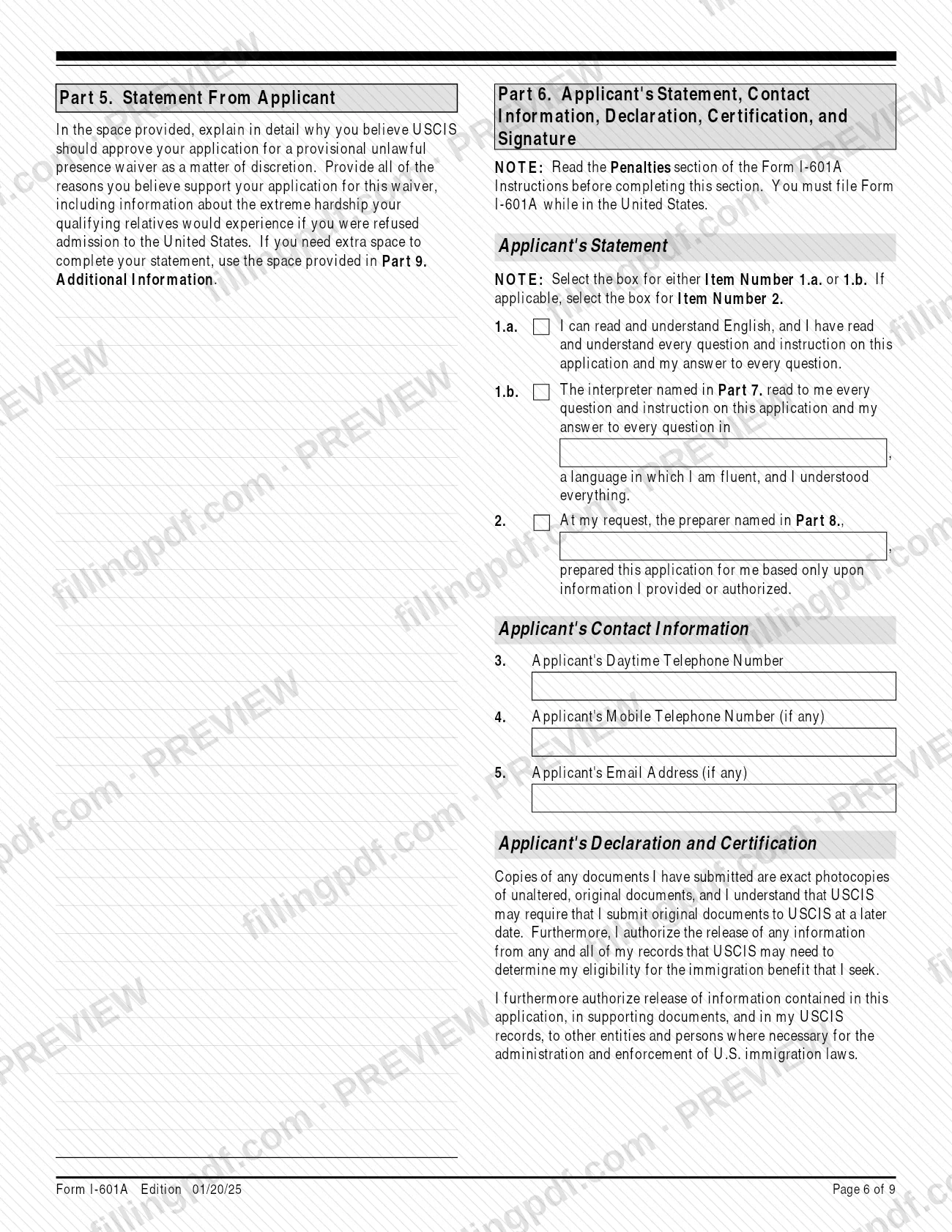
Write your statement in Part 5
Explain the extreme hardship your qualifying relative would experience if you were refused admission, and why USCIS should approve the waiver as a matter of discretion, weighing favorable against unfavorable factors. Continue in Part 9 if needed.
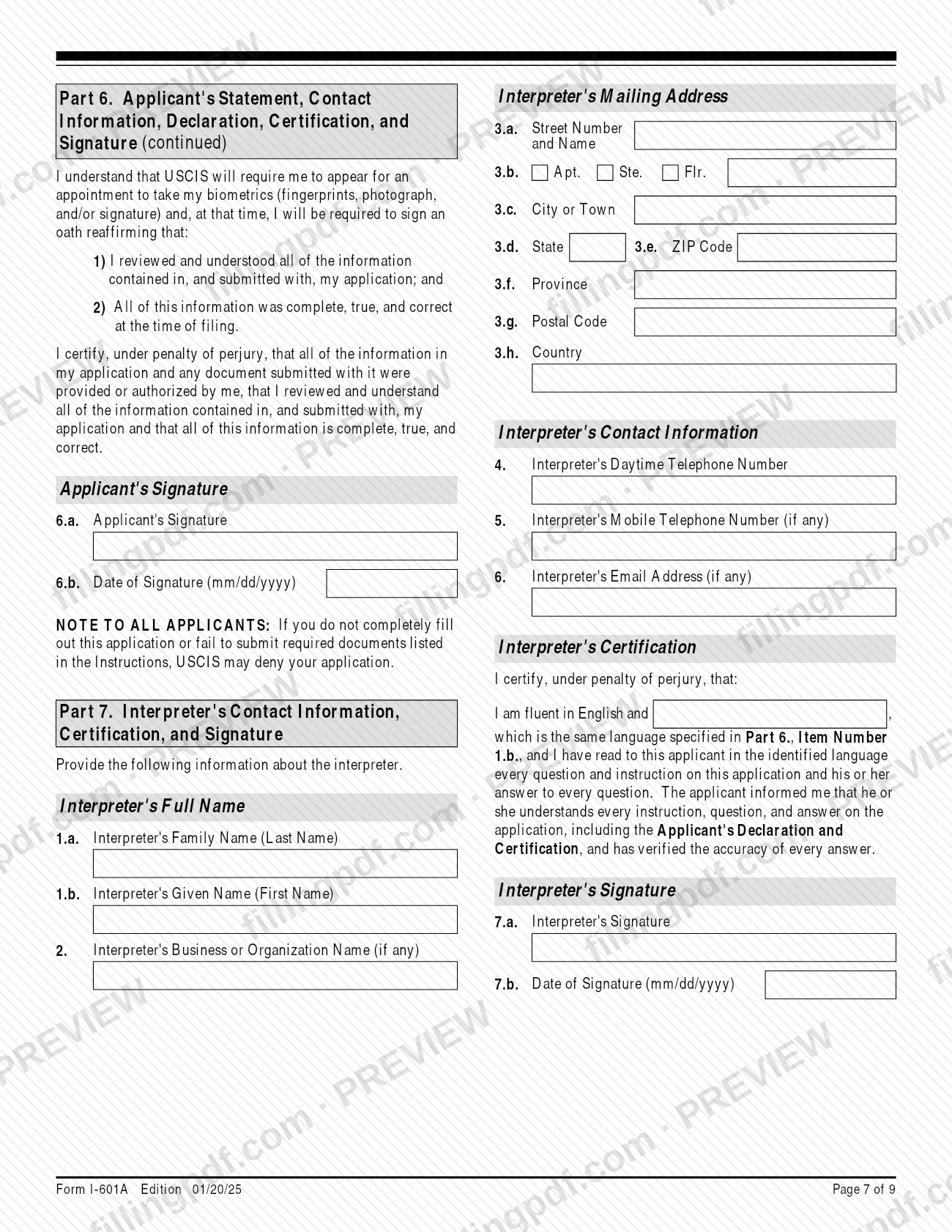
Complete Part 6 and sign
Select Item 1.a. or 1.b., and Item 2 if a preparer helped. Enter your daytime phone, mobile phone and email in Items 3-5, then sign and date in Items 6.a.-6.b. in ink or by hand after printing.
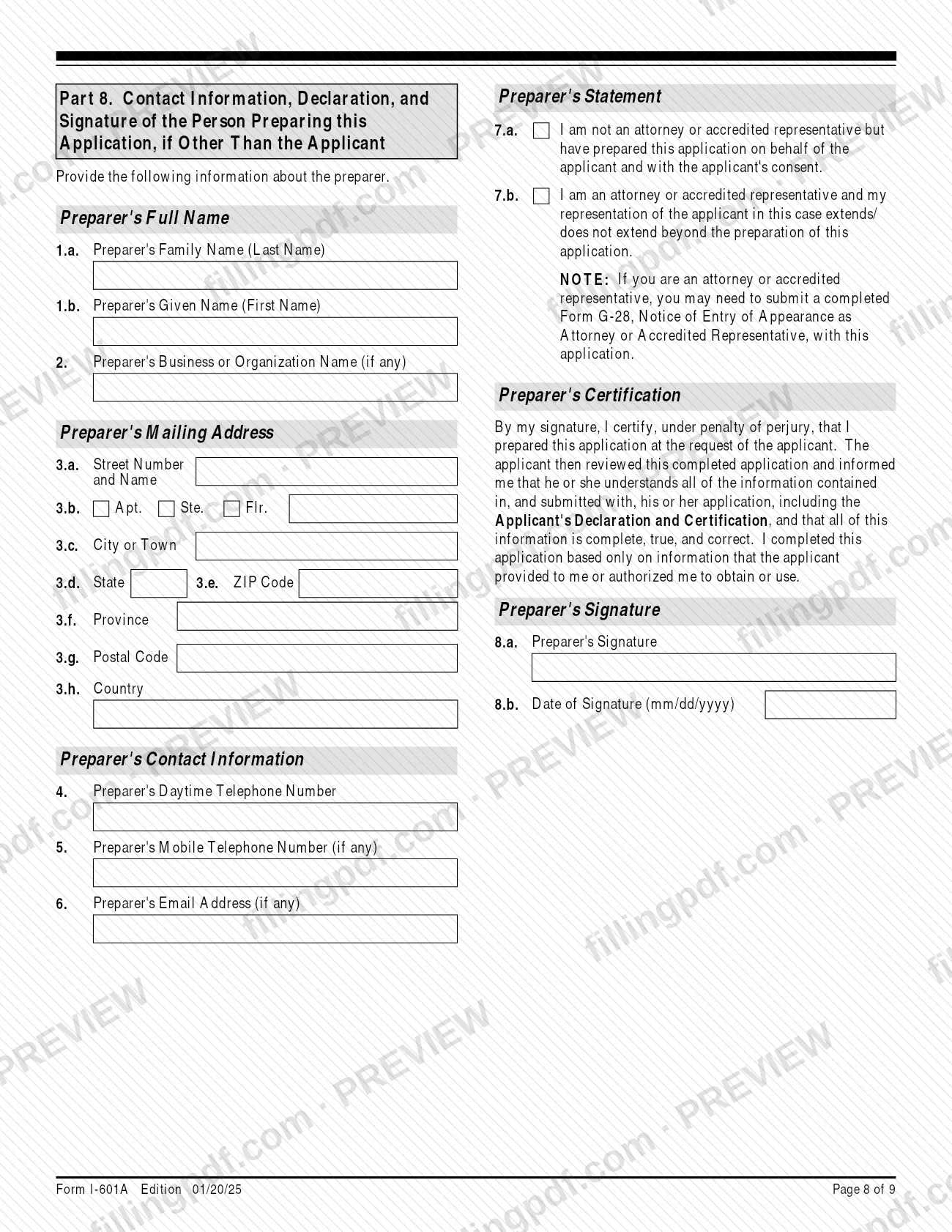
Add interpreter and preparer details
If an interpreter read the form to you, that person completes and signs Part 7. Anyone who prepared it for you completes and signs Part 8; attorneys and accredited representatives may also need Form G-28.
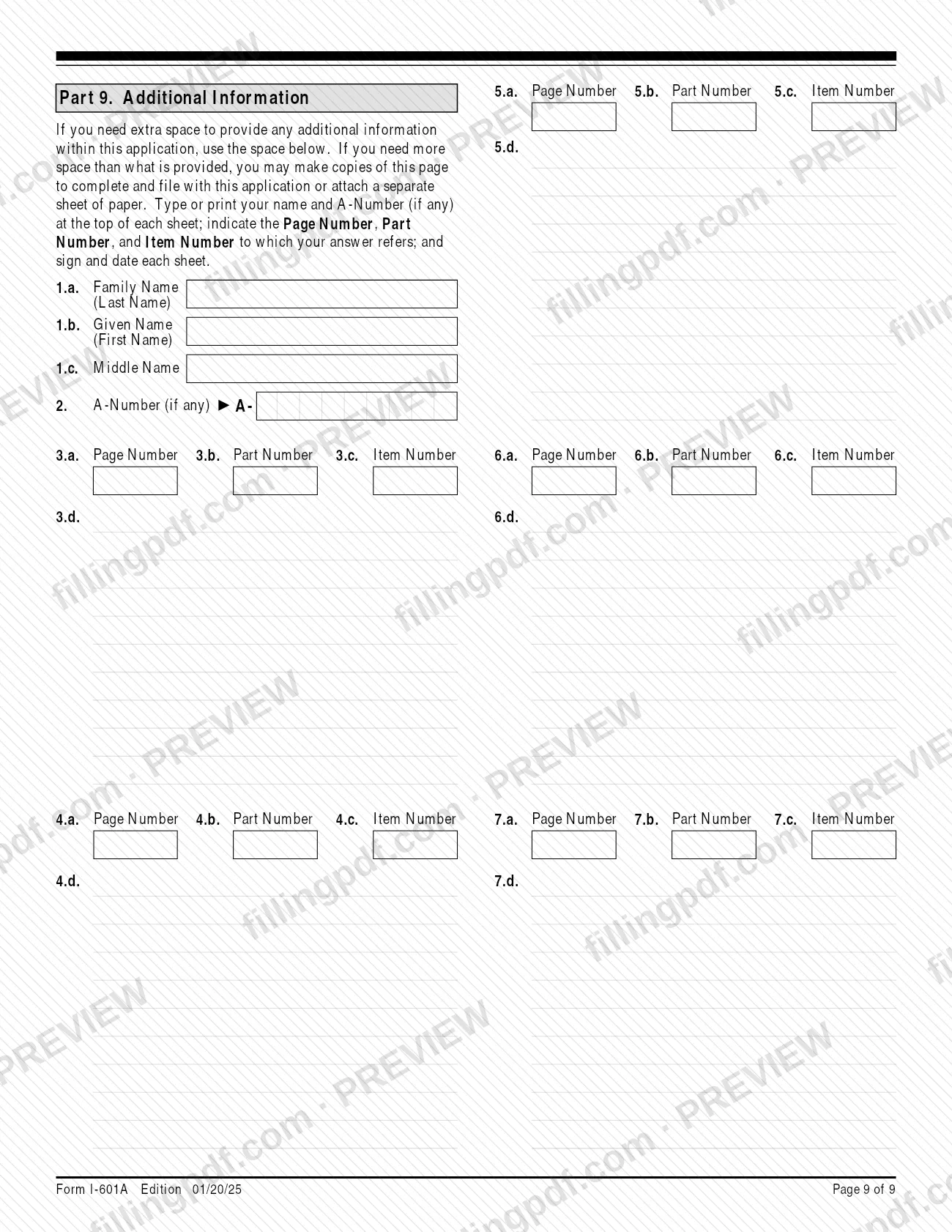
Use Part 9 for extra information
Add your name and A-Number, then the page, part and item number for each answer that continues there. Sign and date any added sheet.
Review, sign and download the PDF
Check every item, that each Yes answer is explained, and that you have the evidence listed in the instructions. Download or print the completed PDF from FillingPDF, sign it by hand and assemble the package described under How to submit.
How to submit I-601A
Form I-601A is filed by mail with the USCIS Chicago lockbox. The USCIS Form I-601A page says to mail it there, and the instructions send you to www.uscis.gov/I-601A for the most current filing information.
- U.S. Postal Service: USCIS, Attn: I-601A, P.O. Box 4599, Chicago, IL 60680-4599.
- FedEx, UPS and DHL: USCIS, Attn: I-601A (Box 4599), 131 S. Dearborn, 3rd Floor, Chicago, IL 60603-5517.
A filing fee applies. The instructions refer you to Form G-1055 and the USCIS Fee Schedule page for the amount. USCIS rejects the form if it is unsigned or lacks the correct fees, and returns it with any fees paid. Place your DOS immigrant visa processing fee receipt, or your DV selection proof, on top of the form. Do not send original documents unless requested. Do not file other forms with it. Form G-1145 clipped to the first page requests an e-mail or text acceptance notice. If you print the form, all pages must show the same edition date and page numbers. USCIS will later send a biometrics appointment notice. FillingPDF lets you fill out and download the PDF; submission follows the channels above.
Common mistakes to avoid
- Filing Form I-601A together with Form I-485, I-130, I-212, I-131 or I-765. USCIS rejects the package and returns it with any fees paid.
- Mailing the form unsigned or with a typed or stamped name. USCIS rejects any unsigned form and does not accept a stamped or typewritten signature.
- Omitting the DOS immigrant visa processing fee receipt, or sending an invoice or an "In Process" receipt instead of one showing "PAID".
- Leaving out the full name, U.S. physical address or date of birth in Part 1, which leads to rejection.
- Answering "Yes" to Item 31 after withdrawing or not using voluntary departure; the instructions say to answer Items 27-28.b or 29.a instead.
- Leaving out court dispositions because records were expunged, sealed or diverted; the instructions require them anyway.
- Describing hardship to yourself or your U.S. citizen or LPR children without tying it to a qualifying spouse or parent.
- Printing a mailing copy with missing pages or pages from different form editions, which USCIS may reject.
- Adding attachments without your name and your A-Number or petition receipt number on every page.
- Sending the form to the address in the Paperwork Reduction Act notice; the lockbox address is the one for filing.
Frequently asked questions
What is Form I-601A used for?
Form I-601A asks USCIS for a provisional waiver of the unlawful presence grounds of inadmissibility under INA section 212(a)(9)(B). Certain immigrant visa applicants who are relatives of U.S. citizens or LPRs file it before leaving the United States for their immigrant visa interview abroad.
Who is eligible to file the I-601A form?
You must be in the United States, at least 17, with an immigrant visa case pending with DOS, and inadmissible only for unlawful presence. You also need a U.S. citizen or LPR spouse or parent who would suffer extreme hardship. Pending Form I-485 or a final removal order, among other things, makes you ineligible.
Can I file Form I-601A with Form I-485 or Form I-130?
No. Form I-601A is a standalone application. If you submit it with Form I-485, I-130, I-212, I-131 or I-765, USCIS rejects it and returns it with any fees paid. You may add Form G-1145 to request an electronic acceptance notice.
Where do I mail Form I-601A?
Mail it to the USCIS Chicago lockbox. USPS: USCIS, Attn: I-601A, P.O. Box 4599, Chicago, IL 60680-4599. FedEx, UPS or DHL: USCIS, Attn: I-601A (Box 4599), 131 S. Dearborn, 3rd Floor, Chicago, IL 60603-5517. Check www.uscis.gov/I-601A for current filing information.
Is there a fee to file Form I-601A?
Yes. The instructions refer you to Form G-1055 and the USCIS Fee Schedule page for the current amount. USCIS rejects the form if it lacks the correct fees and returns what you paid; if USCIS denies a fully adjudicated application, the fees are not refunded.
What documents do I attach to Form I-601A?
It depends on your case. Petition-based applicants attach the DOS immigrant visa fee receipt marked "PAID" and the approval notice if available; DV selectees attach the Entrant Status Check printout. You also need evidence of hardship, discretion and admission, plus court records for any charges.
Does an approved I-601A give me legal status or work authorization?
No. A pending or approved waiver gives no interim benefits, no lawful status and no protection from removal, and it does not stop unlawful presence from accruing. It takes effect only after you depart, attend your immigrant visa interview and the consular officer finds you eligible.
What happens if my I-601A is denied?
You may still leave to attend your immigrant visa interview and, if DOS finds you inadmissible, file Form I-601 from abroad if a waiver is available. You may also file a new Form I-601A with the fee if you still meet every requirement. A denial does not automatically start removal proceedings.
Can I fill out Form I-601A online?
You can fill out the PDF online on FillingPDF and download or print it. FillingPDF is an independent service and does not file the form with USCIS; you sign it and mail it to the USCIS lockbox.
Who signs Form I-601A?
The applicant signs Part 6 by hand; USCIS does not accept a stamped or typed name. A parent or legal guardian may sign for an applicant under 14, or a legal guardian for a mentally incompetent person. Interpreters and preparers sign their own parts.
Ready to fill out I-601A?
Fill out I-601A now