
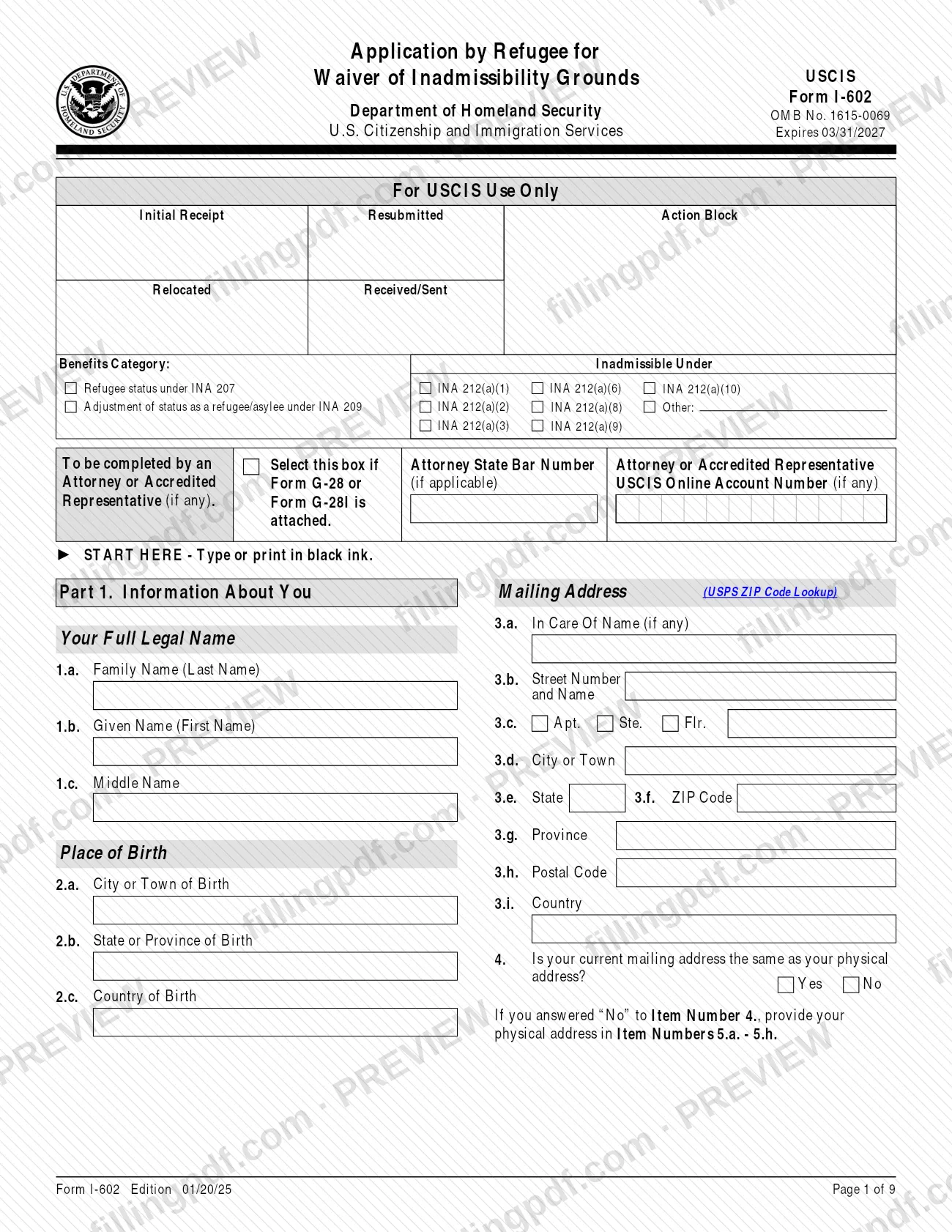
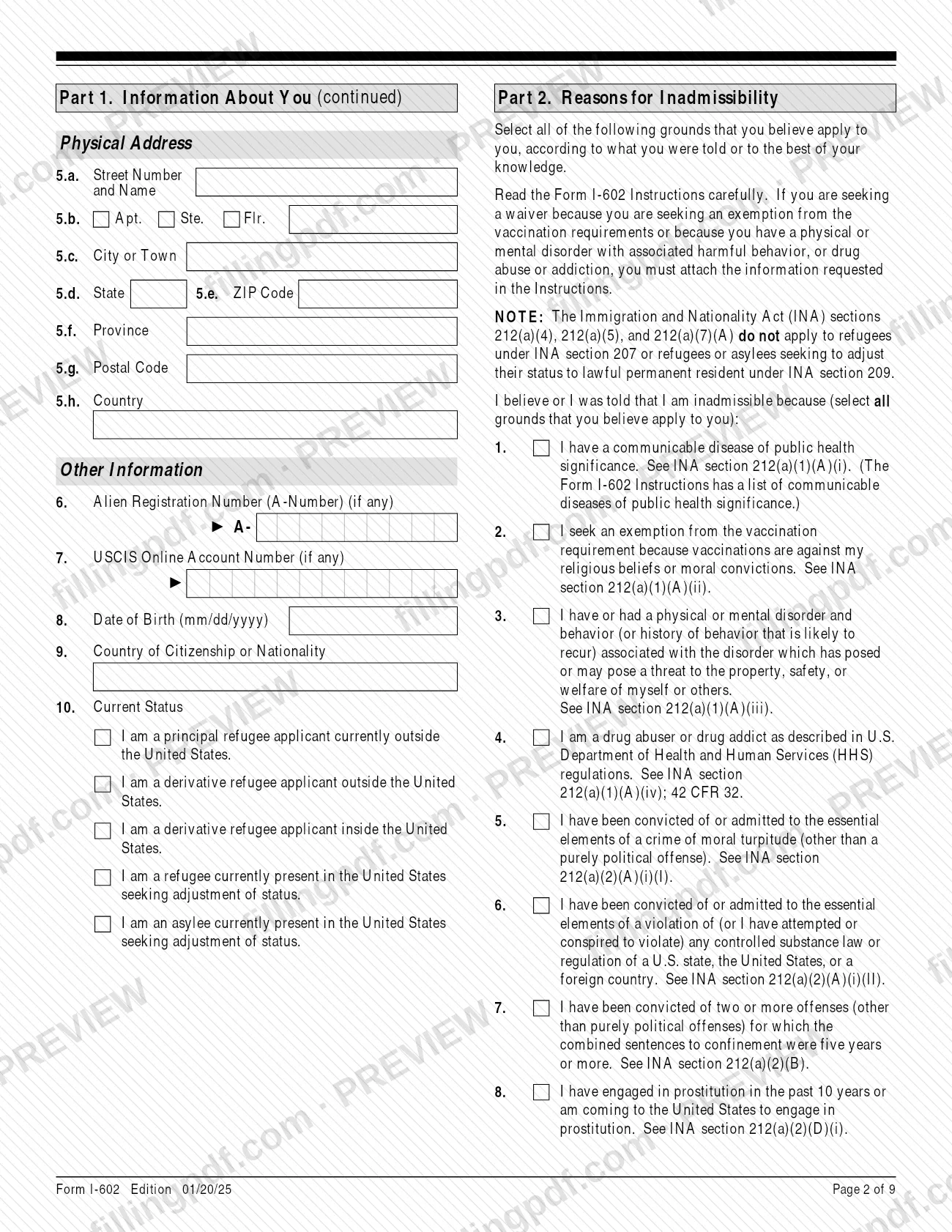
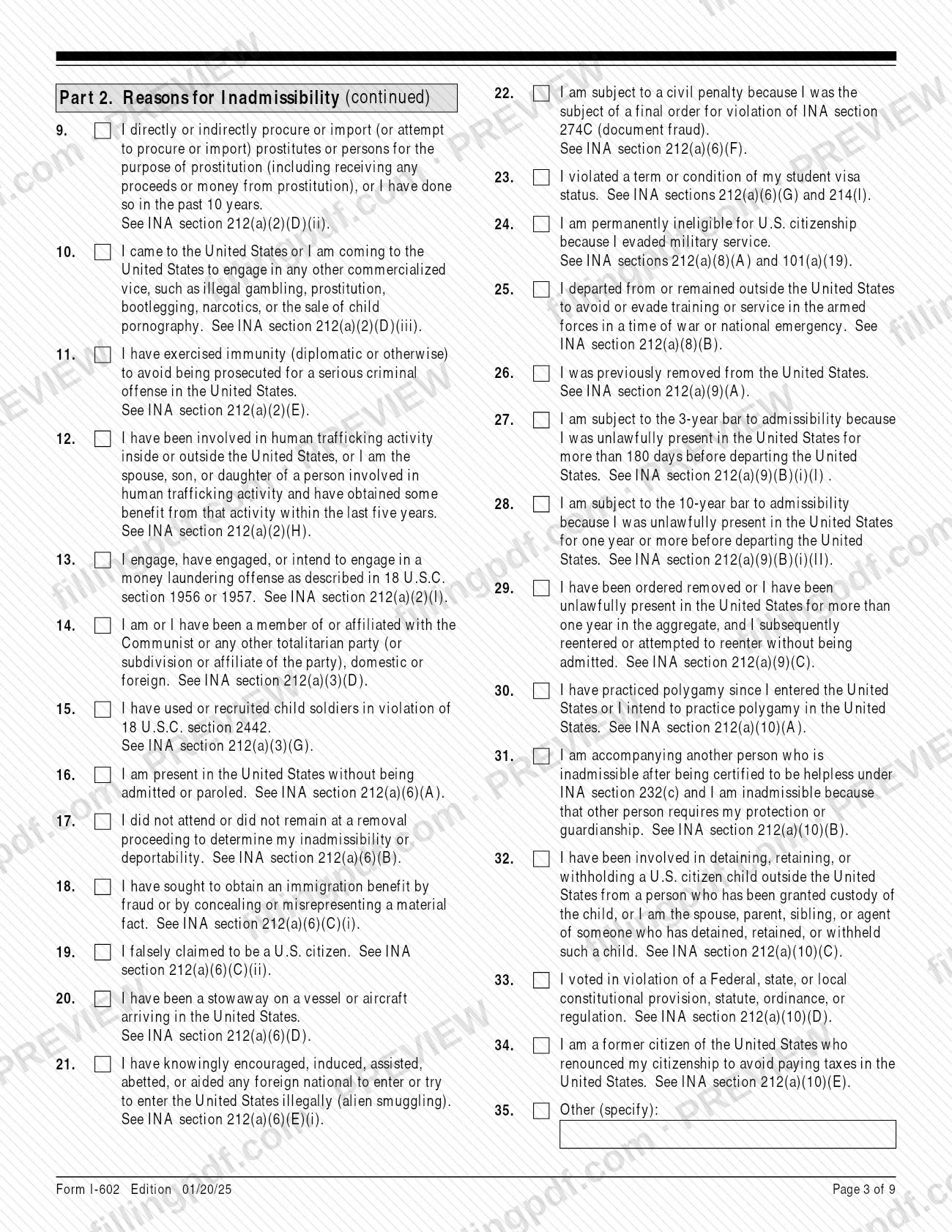
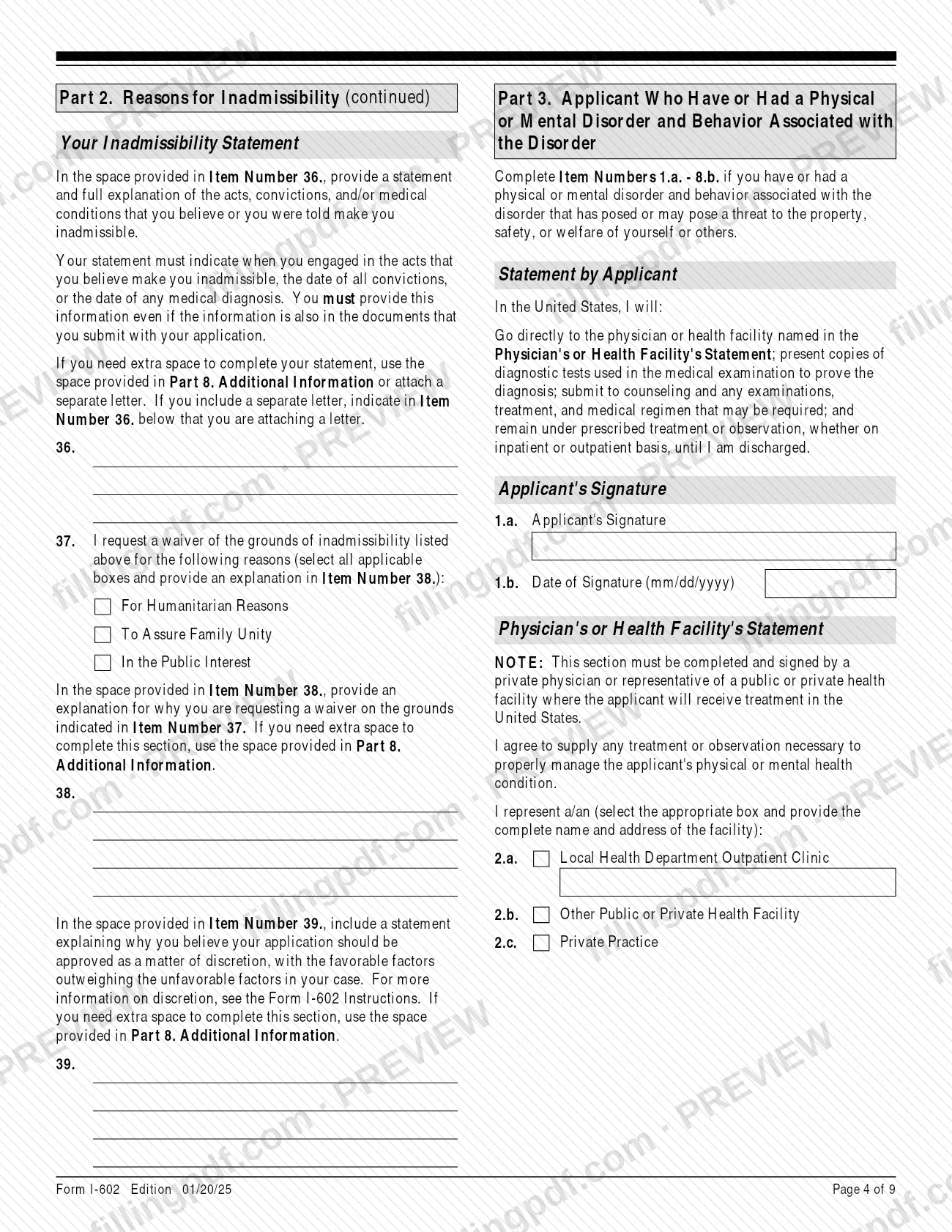
Form I-602 is the application U.S. Citizenship and Immigration Services (USCIS) uses to decide whether to waive certain grounds of inadmissibility for a refugee applicant or for a refugee or asylee applying for a green card. USCIS may grant the waiver for humanitarian purposes, to preserve family unity, or in the public interest. On this page you can fill out the form online on FillingPDF and download or print the completed PDF. The official form, its instructions and the current filing information are published by USCIS at uscis.gov/i-602.
Last updated
What is I-602?
Form I-602, Application by Refugee for Waiver of Inadmissibility Grounds, is the USCIS form a foreign national files to ask for a waiver of certain grounds of inadmissibility when seeking admission as a refugee, or when a refugee or asylee applies to become a lawful permanent resident (LPR).
USCIS may grant the waiver if you can establish that it would serve humanitarian purposes, preserve family unity, or otherwise be in the public interest. The form is issued by the Department of Homeland Security (DHS) under OMB No. 1615-0069 and is collected under sections 207 and 209 of the Immigration and Nationality Act (INA).
The form is built around the grounds you believe apply to you:
- Part 2 lists 35 grounds, from health-related grounds under INA 212(a)(1) to criminal, immigration-violation and other grounds, and asks for your inadmissibility, waiver-reason and discretion statements (Items 36 to 39).
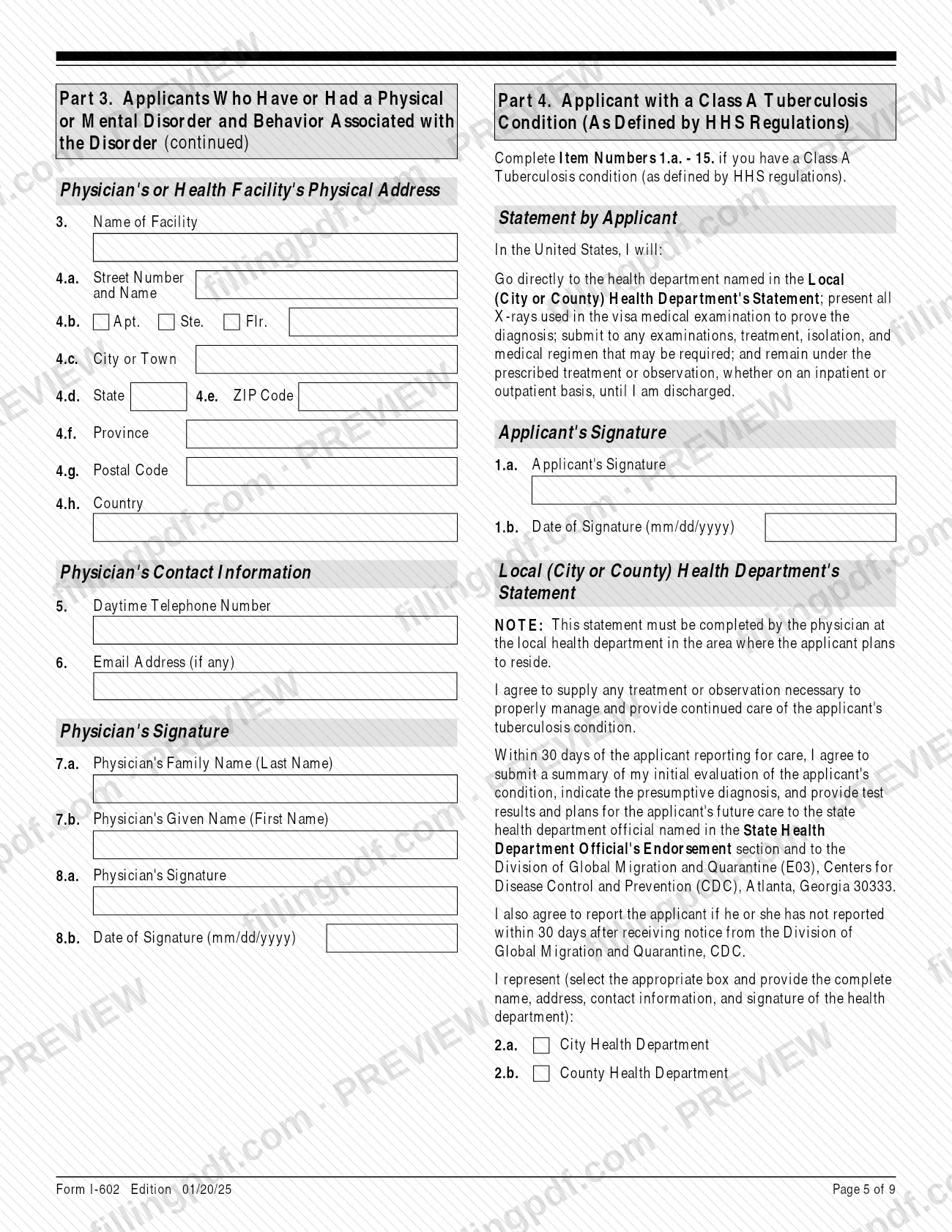
- Part 3 is for a physical or mental disorder with associated harmful behavior and carries a physician's or health facility's statement.
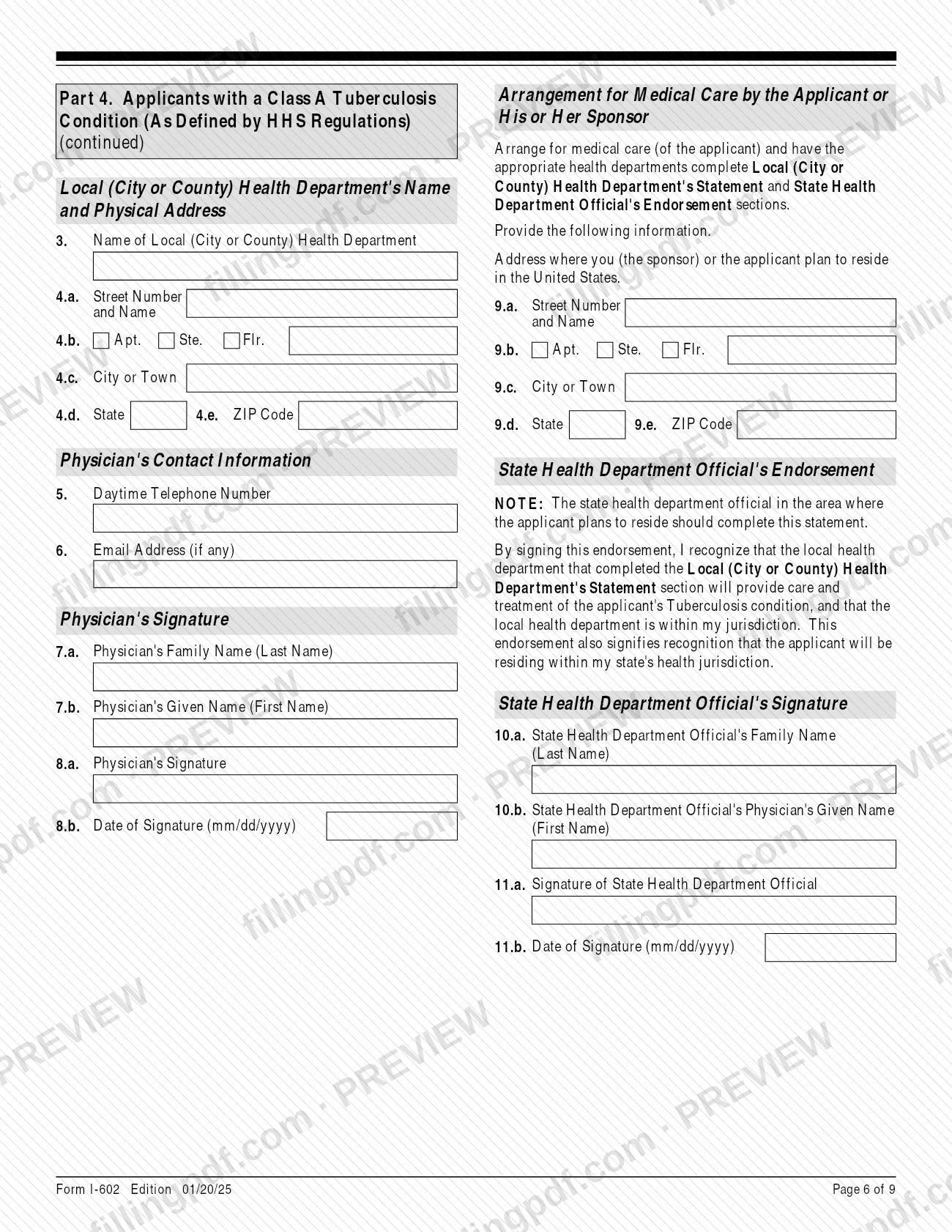
- Part 4 is for a Class A tuberculosis condition and carries health department statements.
The waiver covers only the grounds, crimes, incidents, events or conditions you list in the application. Applicants who are not refugees or asylees seeking admission or adjustment should use the Form I-601 Instructions instead; Form I-602 is not for them.
Who needs to file I-602?
You may file Form I-602 if you are or were found inadmissible to the United States and you are one of these:
- a foreign national seeking to come to the United States as a refugee, or as a derivative refugee because you are the spouse or child of a refugee;
- a foreign national in the United States seeking derivative refugee status as the spouse or child of a refugee;
- a refugee in the United States applying to become an LPR (green card holder);
- an asylee in the United States applying to become an LPR.
Do not file this form if you are not seeking admission as a refugee and are not a refugee or asylee applying for LPR status; other applicants should consult the Form I-601 Instructions.
No waiver is available, and you should not file, if you are inadmissible as a controlled substance trafficker (INA 212(a)(2)(C)), under the general security grounds (INA 212(a)(3)(A)), for terrorist activities (INA 212(a)(3)(B)), for adverse foreign policy consequences (INA 212(a)(3)(C)), or as a participant in Nazi persecution, genocide, torture or extrajudicial killing (INA 212(a)(3)(E)).
You do not need a waiver, and should not file, for public charge (INA 212(a)(4)), labor certification (INA 212(a)(5)) or documentation requirements (INA 212(a)(7)(A)). Refugees coming under INA 207 also do not need to file for the vaccination ground.
If you are under 14, a parent or legal guardian may sign for you; a legal guardian may sign for a mentally incompetent person.
When to file I-602
File Form I-602 when you have been found inadmissible on a ground for which a waiver is available and you are pursuing refugee admission, derivative refugee status or adjustment to LPR status. The form prints no filing deadline of its own; timing follows the process it supports.
The USCIS page ties it to other filings. If your petitioner files Form I-730 at the same time, send the I-602 to the office handling that petition. If you file it with Form I-485, mail both together. If you file it after Form I-485, send it to the office adjudicating your I-485.
A refugee who was not granted a waiver on entry can still apply for it when applying for LPR status. Asylees applying for LPR status must file Form I-602 for all grounds that apply. USCIS may ask you for an interview or a biometric services appointment at any time. The instructions give no processing time.
Documents you need
- Certified court records or dispositions for every conviction (judgments showing the outcome of arrests and convictions); an uncertified copy is not sufficient.
- Copies of any documents that support your inadmissibility statement in Part 2, Item 36.
- Form G-28 or Form G-28I, if an attorney or accredited representative represents you.
- Health-related grounds: a completed medical history and report addressing any possible treatment, for a communicable disease of public health significance.
- Physical or mental disorder with harmful behavior: a complete medical history and report covering the disorder, current physical findings, prognosis and treatment recommendation, plus Part 3 signed by a physician or health facility representative.
- Drug abuse or addiction ground: a copy of the immigration medical examination report (Form I-693 or Form DS-2054 and related worksheets); additional medical documentation is also advised.
- Vaccination exemption: evidence that you oppose vaccinations in any form, that the objection rests on religious beliefs or moral convictions, and that it is sincere.
- Class A tuberculosis condition: Part 4 completed, with signatures from the local health department physician and state health department official.
- A full English translation of any foreign-language document, with the translator's signed certification, printed name, date and contact information.
- Legible photocopies of requested documents; send originals only if the instructions require them.
How to fill out I-602
Confirm eligibility and use current edition
Check that you are a refugee applicant, derivative refugee or refugee or asylee applying for LPR status, and that a waiver is available for your ground. Use the form edition printed at the bottom of each page and type or print in black ink.
Add attorney details if represented
At the top of page 1, select the box if Form G-28 or G-28I is attached and enter the attorney's State Bar Number and USCIS Online Account Number, if any.
Enter your name, birth and addresses
In Part 1, Items 1.a.-1.c., enter your full legal name as on your identity documents. Items 2.a.-2.c.: city, state or province and country of birth, with the country named as when you were born. Items 3.a.-3.i. give your mailing address; answer Item 4 and, if No, give your physical address in Items 5.a.-5.h.
Complete identification and status items
Item 6: A-Number, or "N/A". Item 7: USCIS Online Account Number if you have one. Item 8: date of birth in mm/dd/yyyy. Item 9: country of citizenship, or "stateless" with an explanation in Part 8. Item 10: select your current status.
Select your grounds of inadmissibility
In Part 2, Items 1 to 35, select every ground you believe or were told applies to you, or enter an Other ground in Item 35. Attach the extra medical information the instructions require for vaccination, disorder or drug-abuse grounds.
Write your statements
Item 36: explain the acts, convictions and medical conditions with dates. Item 37: select the waiver reasons (humanitarian reasons, family unity, public interest). Item 38: explain them. Item 39: explain why the favorable factors outweigh the unfavorable ones.
Complete Part 3 if it applies
If you have or had a physical or mental disorder with associated harmful behavior, sign and date Items 1.a.-1.b. The physician or health facility representative completes Items 2.a.-8.b., including facility address and signature.
Complete Part 4 for Class A tuberculosis
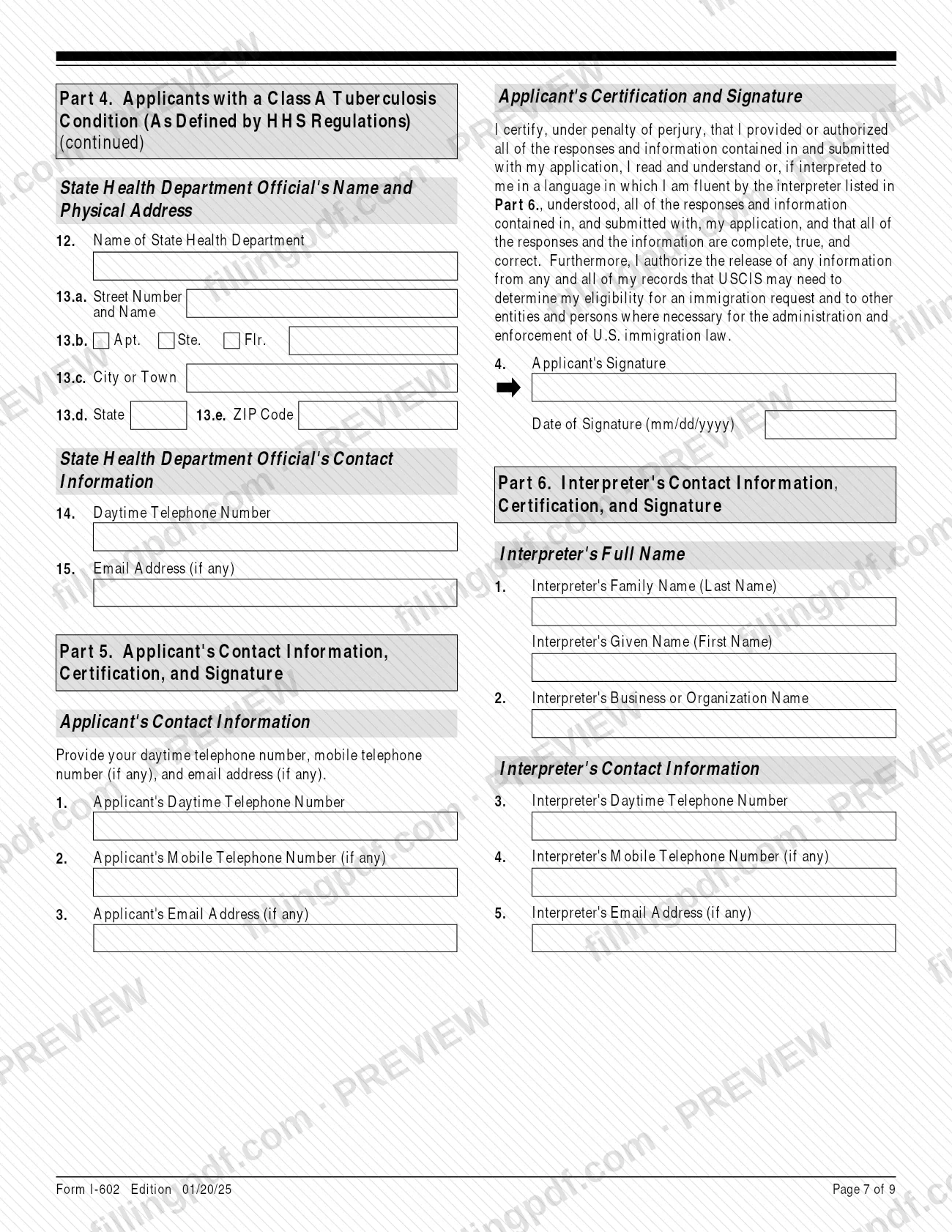
Sign and date Items 1.a.-1.b. The local health department physician completes Items 2 to 8.b., and the state health department official completes Items 10.a.-15. Items 9.a.-9.e. give the address where you or your sponsor plan to reside.
Add contact details and sign Part 5
Items 1 to 3: daytime telephone, mobile telephone and email, if any. Read the certification and sign and date in Item 4 by hand; a parent or legal guardian may sign where applicable.
Complete interpreter and preparer sections
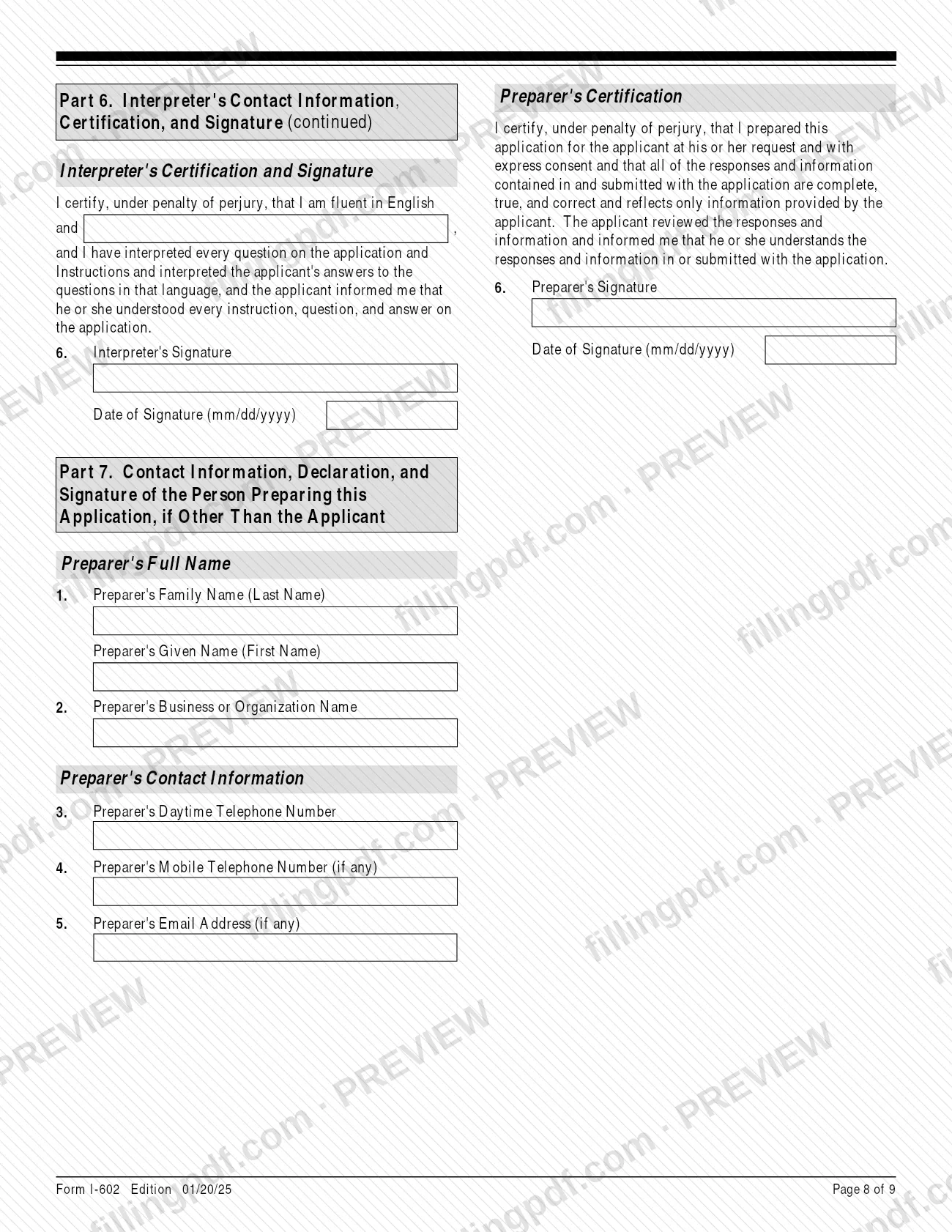
Part 6 is for an interpreter who read the questions to you: name, contact details, language, signature and date. Part 7 is for a preparer other than you; one person acting as both completes both parts.
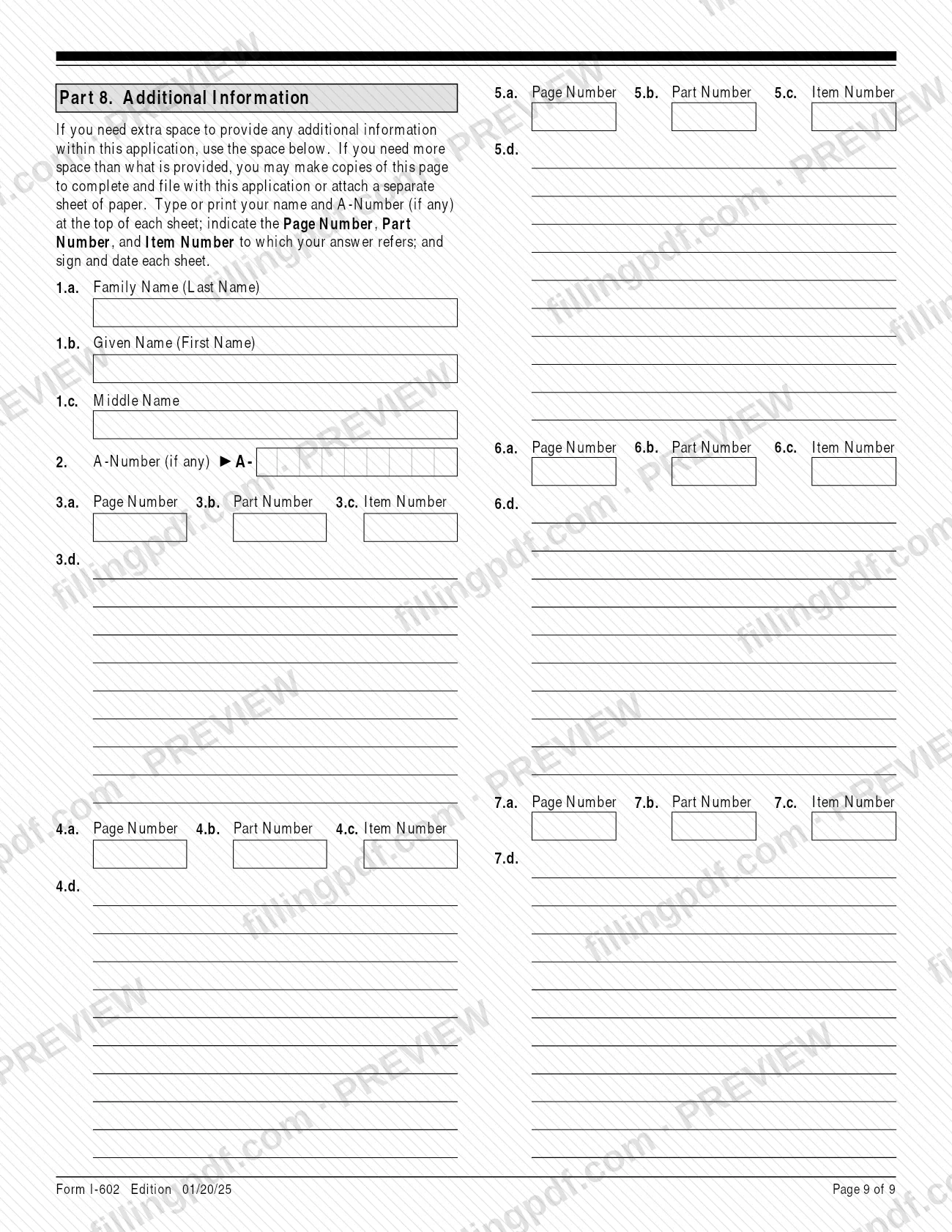
Use Part 8 for extra space
Enter your name and A-Number, then the page, part and item number each answer refers to. Sign and date each extra sheet.
Review, print and sign the PDF
Check every item, enter "N/A" or "None" where required, then download or print the completed PDF from FillingPDF. Sign it in ink and assemble the evidence described under How to submit.
How to submit I-602
The Form I-602 instructions give no single address: where you file depends on your situation, and USCIS directs you to www.uscis.gov/i-602 for the most current information.
- With Form I-485: mail both forms according to the Direct Filing Addresses for Form I-485 page. If you file the I-602 after the I-485, send it to the USCIS office adjudicating your I-485.
- With Form I-730: send it to the same USCIS office that processes your petitioner's Form I-730. If a petitioner already filed an I-730 for you, send it to the office processing it, or, if you live outside the United States, to the USCIS office with jurisdiction over your residence.
- After Form I-590: if you were interviewed on Form I-590 and told you are inadmissible and a waiver is available, contact the Resettlement Support Center (RSC) that helped you prepare it for filing instructions.
- In Immigration Court proceedings: if you were served with Form I-221, I-122, I-862 or I-863, file with the appropriate Immigration Court; the DHS attorney provides filing instructions.
Do not mail the completed form to the Camp Springs, MD address in the Paperwork Reduction Act notice. A filing fee information source is Form G-1055 and the USCIS Fee Schedule page. If you print the form, make sure the edition date and page numbers show on all pages and all pages are from the same edition. Sign the form; USCIS rejects unsigned forms. FillingPDF lets you fill out and download the PDF; submission follows the channels above.
Common mistakes to avoid
- Leaving out a ground or incident: an approved waiver applies only to the grounds, crimes, events or conditions you list in the application.
- Submitting uncertified copies of conviction records; the instructions require certified court documents.
- Filing the form without a handwritten signature or with a stamped or typewritten name; USCIS rejects an unsigned application.
- Filing Form I-602 for a ground with no waiver available, such as terrorist activities or controlled substance trafficking.
- Filing Form I-602 for public charge, labor certification or documentation requirements, which need no waiver.
- Printing the form with pages from different editions or with the edition date and page numbers cut off; USCIS may reject it.
- Sending foreign-language documents without a full English translation and the translator's certification.
- Mailing the completed form to the Camp Springs, MD address in the Paperwork Reduction Act notice.
- Leaving a physician or health department section unsigned in Part 3 or Part 4 when your ground requires it.
- Writing a blank instead of "N/A" or "None" where a question does not apply.
Frequently asked questions
What is Form I-602 used for?
Form I-602 is the USCIS application for a waiver of certain grounds of inadmissibility. Refugee applicants, derivative refugees, and refugees or asylees applying for a green card use it when they were found inadmissible, for example for health reasons or a criminal conviction.
Who should not file Form I-602?
Do not file if you are not seeking admission as a refugee and are not a refugee or asylee applying for LPR status; use the Form I-601 Instructions instead. Also do not file if no waiver exists for your ground (such as terrorist activities) or if it is public charge, labor certification or documentation requirements.
Where do I file Form I-602?
It depends on your case. File with Form I-485 per its direct filing addresses, with the office handling your Form I-730, or with the Immigration Court if you are in proceedings. After a Form I-590 interview, contact your Resettlement Support Center. See uscis.gov/i-602 for current details.
Is there a fee for Form I-602?
The instructions refer you to Form G-1055 for the fees that apply to this form, and the USCIS page points to its Fee Schedule page. Check those for the current amount before you file.
What happens if I leave out a ground of inadmissibility?
An approved waiver applies only to the grounds, crimes, events and conditions you included in the application. That is why the instructions tell you to disclose all conduct or conditions that may make you inadmissible and list every ground you want waived.
How long is an approved I-602 waiver valid?
For a refugee admitted after a granted waiver, the ground is waived on entry and you need not reapply when adjusting under INA 209. If you become an LPR on refugee or asylee status, the grounds are permanently waived. Adjusting on another category requires a new waiver for all grounds.
Can someone sign Form I-602 for me?
A parent or legal guardian may sign if you are under 14, and a legal guardian may sign for a mentally incompetent person. A stamped or typewritten name is not accepted, and USCIS rejects an unsigned application. A photocopy, fax or scan of the original handwritten signature is valid for filing.
Can I fill out Form I-602 online?
You can fill out the Form I-602 PDF online on FillingPDF and download or print it. FillingPDF is an independent service and does not file the form with USCIS; you submit it through the channels USCIS gives for your situation.
Ready to fill out I-602?
Fill out I-602 now