
I-612 is the Application for Waiver of the Foreign Residence Requirement that U.S. Citizenship and Immigration Services (USCIS) accepts from J-1 exchange visitors who are subject to the two-year foreign residence requirement of section 212(e) of the Immigration and Nationality Act (INA). It is filed on one of two grounds: exceptional hardship to a U.S. citizen or lawful permanent resident spouse or child, or a fear of persecution in the home country. On this page you can fill out Form I-612 online on FillingPDF and download or print the completed PDF; USCIS publishes the form, the instructions and the filing locations at uscis.gov/I-612.
Last updated
What is I-612?
Form I-612, Application for Waiver of the Foreign Residence Requirement (212(e)) is the U.S. Citizenship and Immigration Services (USCIS) form that eligible J-1 exchange visitors use to ask for a waiver of the two-year foreign residence requirement of INA section 212(e).
INA section 212(e) requires certain J-1 and J-2 exchange visitors to return to their home country, or country of last foreign residence, for at least two years after completing their U.S. training and leaving the United States. Until then they may not apply for an immigrant visa, an adjustment of status or a change of status, such as to the H or L nonimmigrant category. Form I-612 gives eligible exchange visitors a way to apply for a waiver of that requirement.
The form asks why you are subject to the requirement (Part 2), why you want the waiver (Part 3), your exchange program, last entry and family details (Part 4), and carries the applicant, interpreter and preparer sections and an Additional Information page (Parts 5 to 8).
The waiver cannot be granted unless the Department of State's Waiver Review Division makes a favorable recommendation to the Secretary of the Department of Homeland Security (DHS). Form I-612 is not the form for waivers based on a request from an Interested U.S. Government Agency, a "No Objection" statement from your home country, or the Conrad Waiver Program; those follow the Department of State process.
Who needs to file I-612?
Exchange visitors (J-1) who are subject to the two-year foreign residence requirement may file Form I-612 if the waiver is based on one of two grounds:
- exceptional hardship to the exchange visitor's U.S. citizen or lawful permanent resident spouse or children; or
- the exchange visitor's belief that returning to the country of citizenship or nationality or last foreign residence would mean persecution on account of race, religion or political opinion.
According to the USCIS instructions, you are subject to the requirement if your exchange program was financed in whole or in part by a U.S. Government agency or your home government, if your country was designated by the Secretary of State as requiring your specialized knowledge or skill, or if you came on or after January 10, 1977 for graduate medical education or training.
J-2 spouses and unmarried minor children can be included in the J-1 applicant's application; those who are not included do not receive waivers with the applicant. A spouse or child who is subject to the requirement as a J-1 files a separate application.
The following may not file: J-2 spouses and children of a deceased J-1; J-2 spouses whose marriage to the J-1 has ended; married J-2 children; and J-2 children aged 21 or older. A J-2 spouse still married to the J-1, and unmarried children under 21, may not file on their own behalf either. Do not file with USCIS if your waiver rests on an Interested U.S. Government Agency request, a "No Objection" statement or the Conrad Waiver Program.
When to file I-612
Form I-612 has no deadline printed on it. You file it when you are subject to the two-year foreign residence requirement and want a waiver, because the requirement bars an immigrant visa, adjustment of status or change of status until it is completed or waived.
File the complete package at one time: the form, the signed statement, the evidence and the filing fee. USCIS rejects an application that is unsigned or lacks the correct fee, and an application is not properly filed until USCIS accepts it. You can correct a rejected application and resubmit it.
After acceptance, USCIS checks the application for completeness and may ask for more evidence, for original documents or for an interview. It may also require biometrics, and if you are overseas the appointment notice tells you to contact a U.S. Embassy, U.S. Consulate or USCIS office outside the United States. USCIS notifies you of its decision in writing. The instructions give no processing time.
Documents you need
- A statement signed and dated by you, if you select Part 3, Item Number 1: a detailed explanation of why complying with the two-year requirement would cause exceptional hardship to your U.S. citizen or lawful permanent resident spouse or children, with financial information on your and your spouse's income and savings.
- A statement signed and dated by you, if you select Part 3, Item Number 2: the reasons you cannot return because you would face persecution on account of race, religion or political opinion, with any available supporting evidence.
- Copies of all Forms DS-2019/IAP-66, Certificate of Eligibility for Exchange Visitor Status, for all exchange programs in which you or your spouse participated (if applicable).
- A copy of your Form I-94, Arrival/Departure Record, if you are in the United States, and of your spouse's if he or she is in the United States and is not a U.S. citizen or lawful permanent resident. Do not send an original passport.
- A complete copy of all passport pages, if the entry permit is attached to or stamped in your passport.
- If you select Part 3, Item Number 1 and the spouse or child is a U.S. citizen by birth: a birth certificate, or, if unavailable, a letter from the state agency explaining why, plus a baptismal certificate or affidavits of two U.S. citizens who know of the birth.
- If you select Part 3, Item Number 1 and the spouse or child became a citizen through a parent without a certificate of citizenship: evidence of the parent's citizenship and marriage, termination of prior marriages, the child's birth certificate and a statement of all U.S. arrivals and departures.
- A copy of the naturalization certificate, if the spouse's or child's naturalization occurred within 90 days before you filed.
- A copy of a valid Form I-551, Permanent Resident Card, of the spouse or child, if he or she is a lawful permanent resident.
- If you select Part 3, Item Number 1: evidence of your relationship to the spouse or child, including a marriage certificate and proof of legal termination of all prior marriages for you and your spouse, and the child's birth certificate if the hardship is to a child.
- A full English translation with the translator's signed certification of accuracy and competence, for any document in a foreign language.
- Form G-28 or Form G-28I, if an attorney or accredited representative prepared the application and may be obliged to submit one.
- The filing fee; see Form G-1055 or the USCIS Fee Schedule page for the current amount.
How to fill out I-612
Enter your identifying information
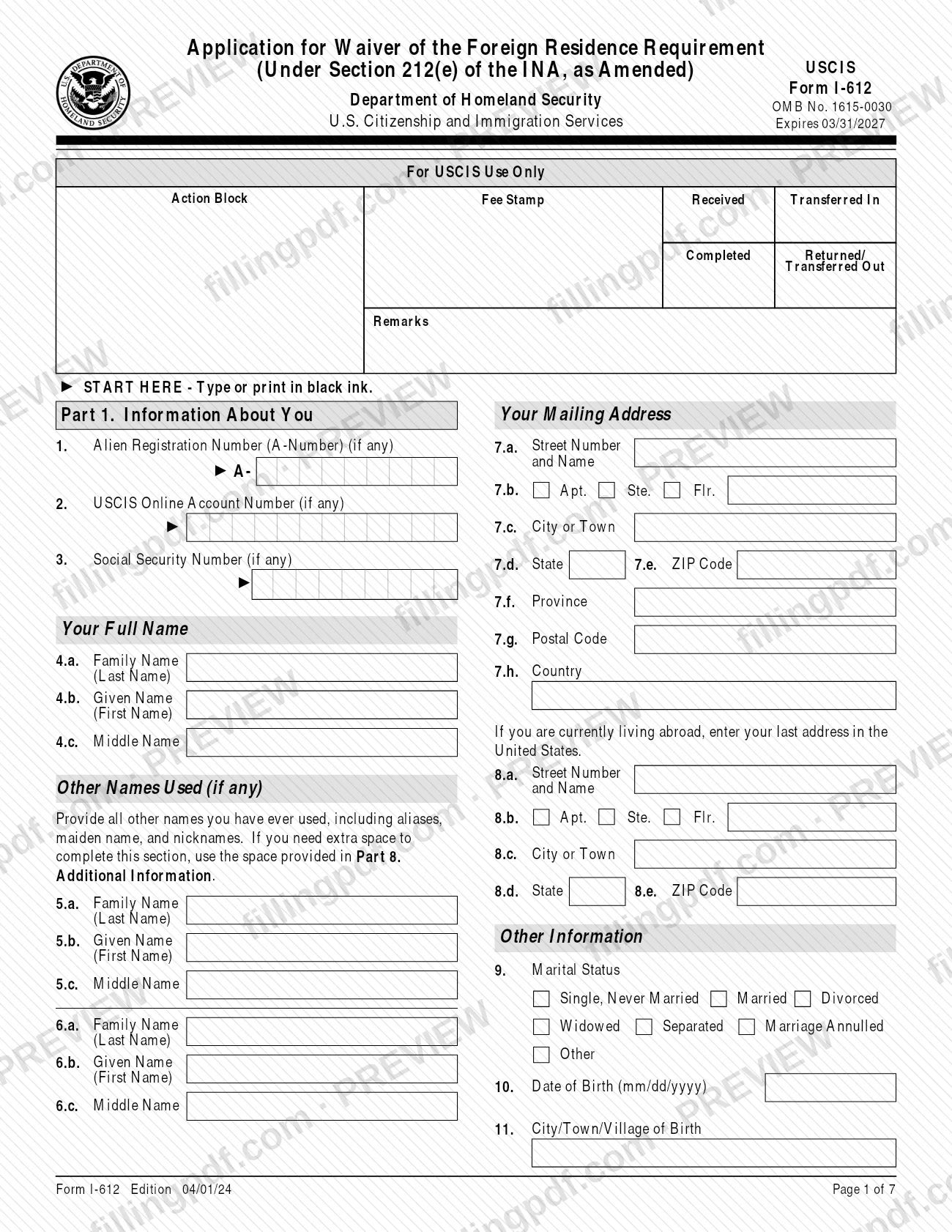
In Part 1, Items 1 to 3, enter your A-Number, USCIS Online Account Number and Social Security Number, each only if you have one. An Online Account Number exists only if you filed a form with a receipt number beginning with IOE.
Enter names and mailing address
Give your full name in Items 4.a to 4.c and all other names you have used, including aliases and maiden name, in Items 5 and 6. Enter your mailing address in Item 7; if you live abroad, enter your last U.S. address in Item 8.
Complete personal and birth details
Select your marital status in Item 9, then enter date of birth (mm/dd/yyyy), city, country of birth, country of citizenship or nationality and country of last foreign residence in Items 10 to 14. If you are stateless, enter "stateless" and explain in Part 8.
Select why you are subject to the requirement
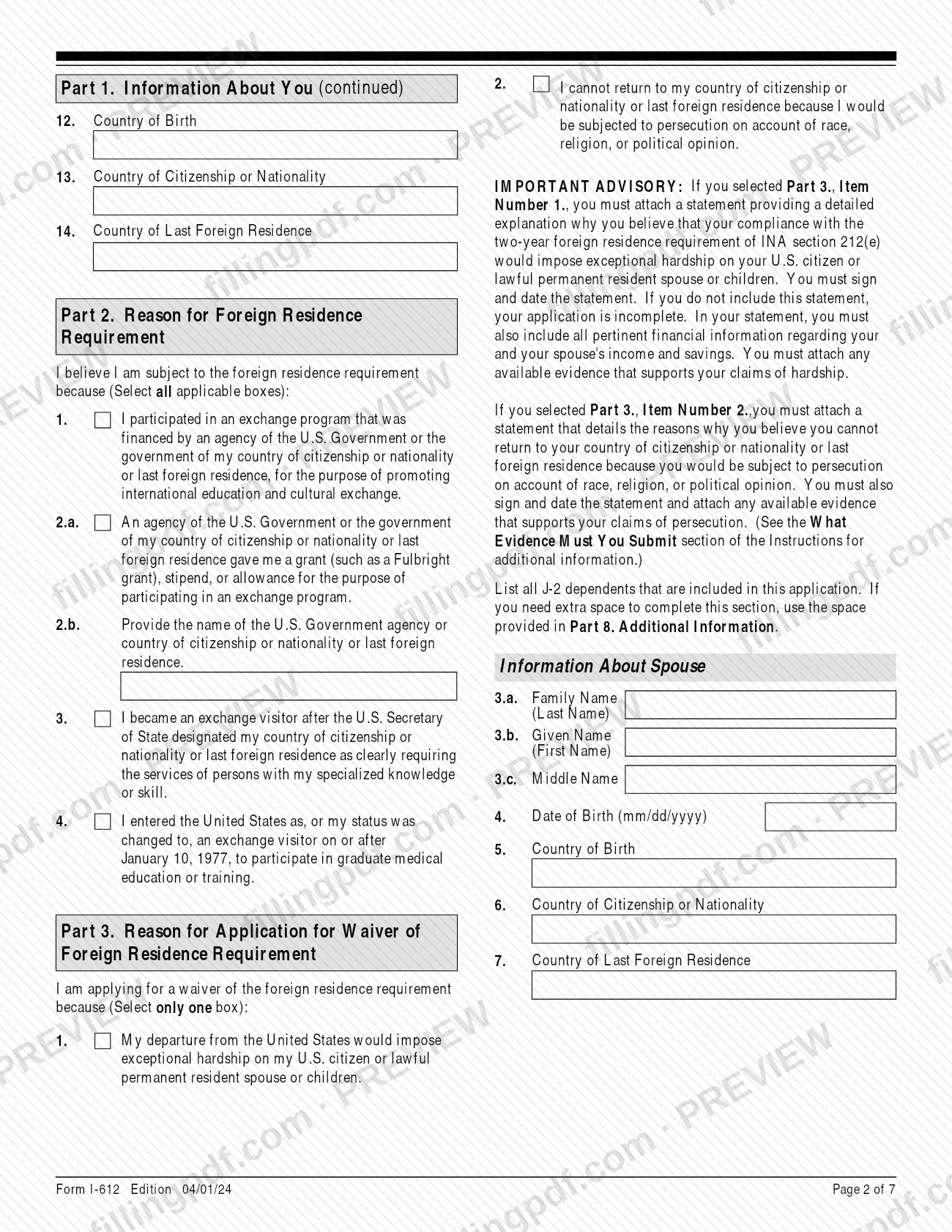
In Part 2, select all applicable boxes: exchange program financing (Items 1 and 2.a, with the agency or country in 2.b), designation of your country by the Secretary of State (Item 3), or graduate medical education or training on or after January 10, 1977 (Item 4).
Select one reason for the waiver
In Part 3, select only one box: Item 1 for exceptional hardship to a U.S. citizen or lawful permanent resident spouse or children, or Item 2 for persecution. Prepare the signed and dated statement the form's advisory requires for the box you choose.
List J-2 spouse and children
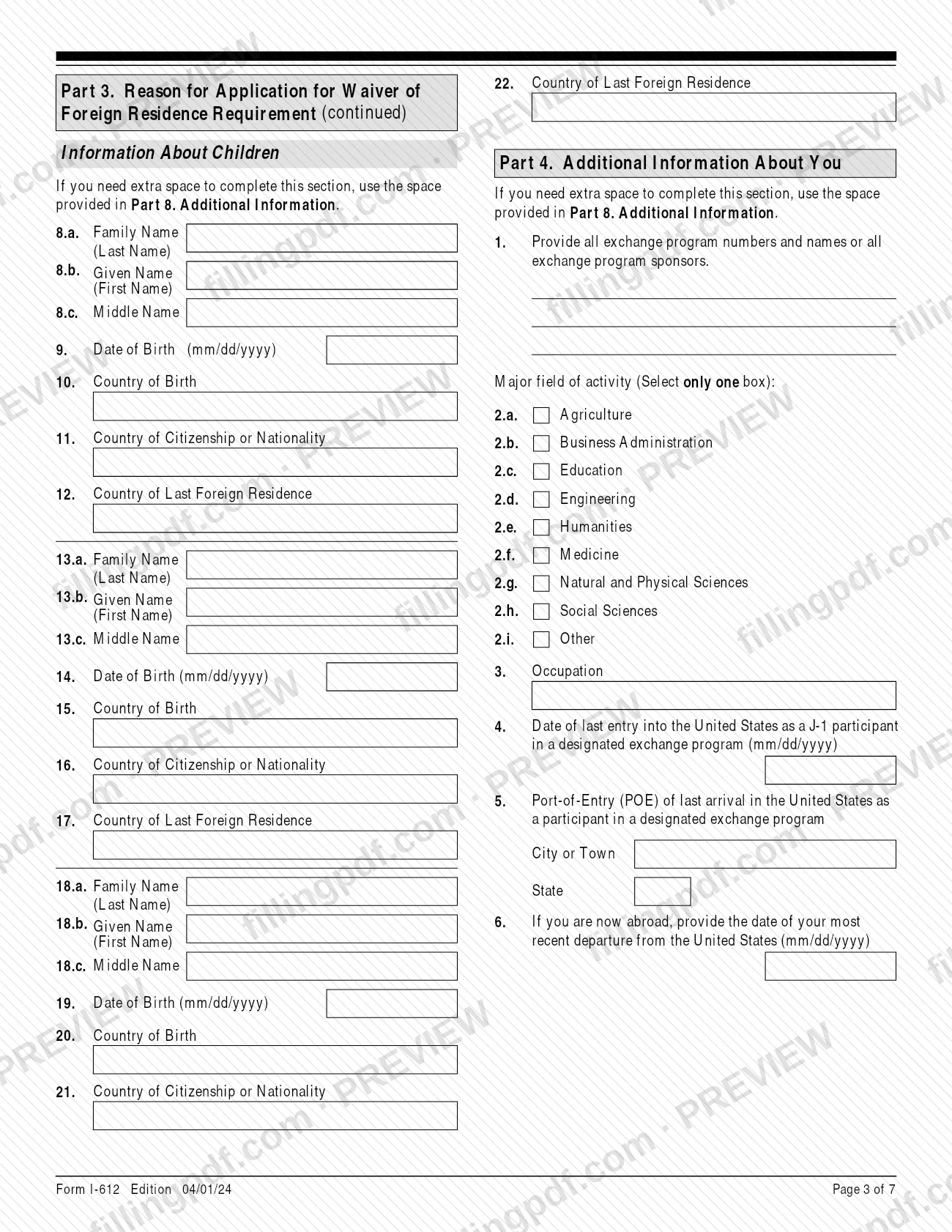
List the J-2 dependents included in the application under Information About Spouse and Information About Children, with names, dates of birth and countries of birth, citizenship and last foreign residence. Use Part 8 if you need more space.
Describe your exchange program and entry
In Part 4, give exchange program numbers and names or sponsors (Item 1), select one major field of activity (Item 2), and enter your occupation, date and port of entry of your last J-1 entry, and your latest departure date if you are abroad (Items 3 to 6).
Complete spouse and family hardship details
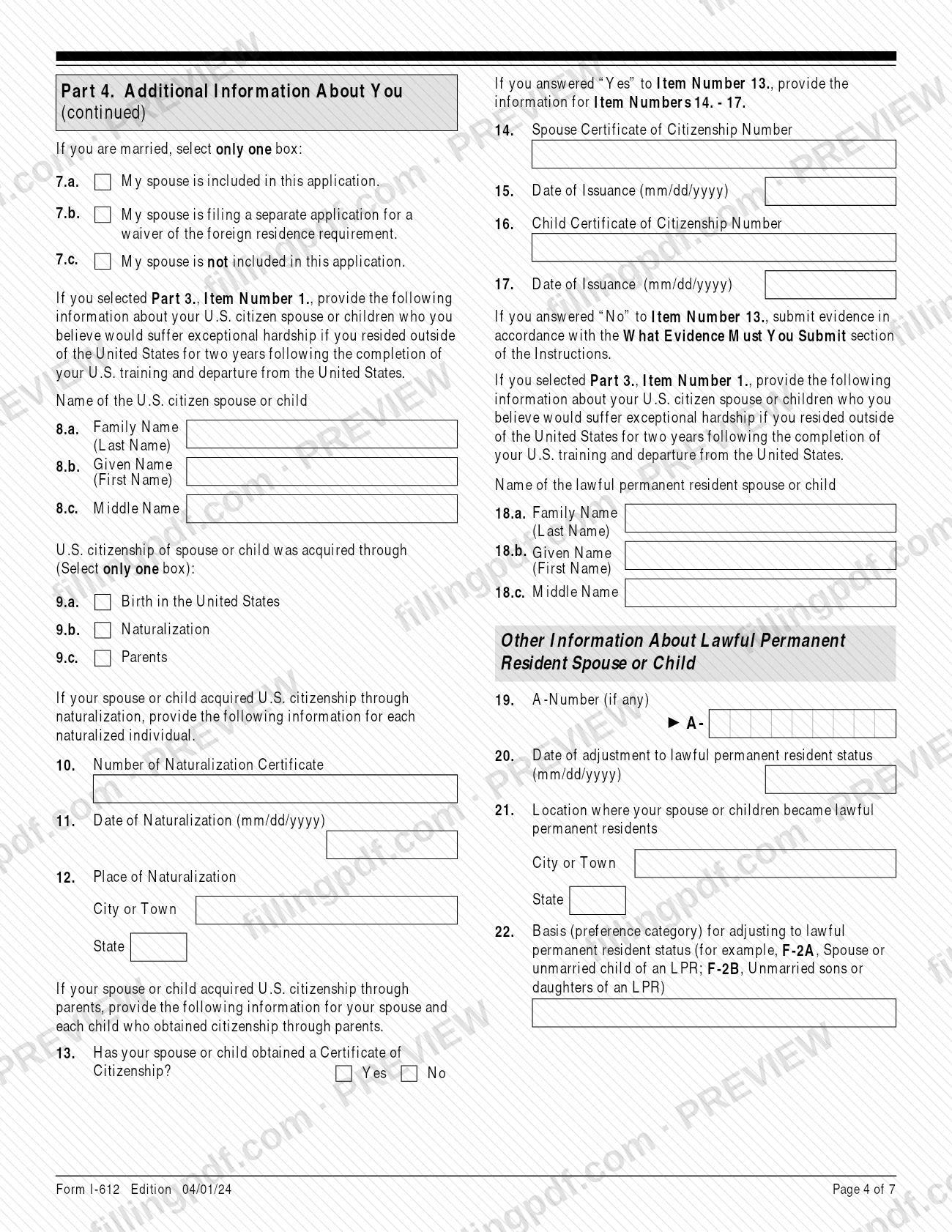
Select one box in Item 7 on whether your spouse is included, filing separately or not included. If you selected Part 3, Item 1, give the U.S. citizen spouse or child details in Items 8 to 17, or the lawful permanent resident details in Items 18 to 22.
Complete the applicant's statement and sign
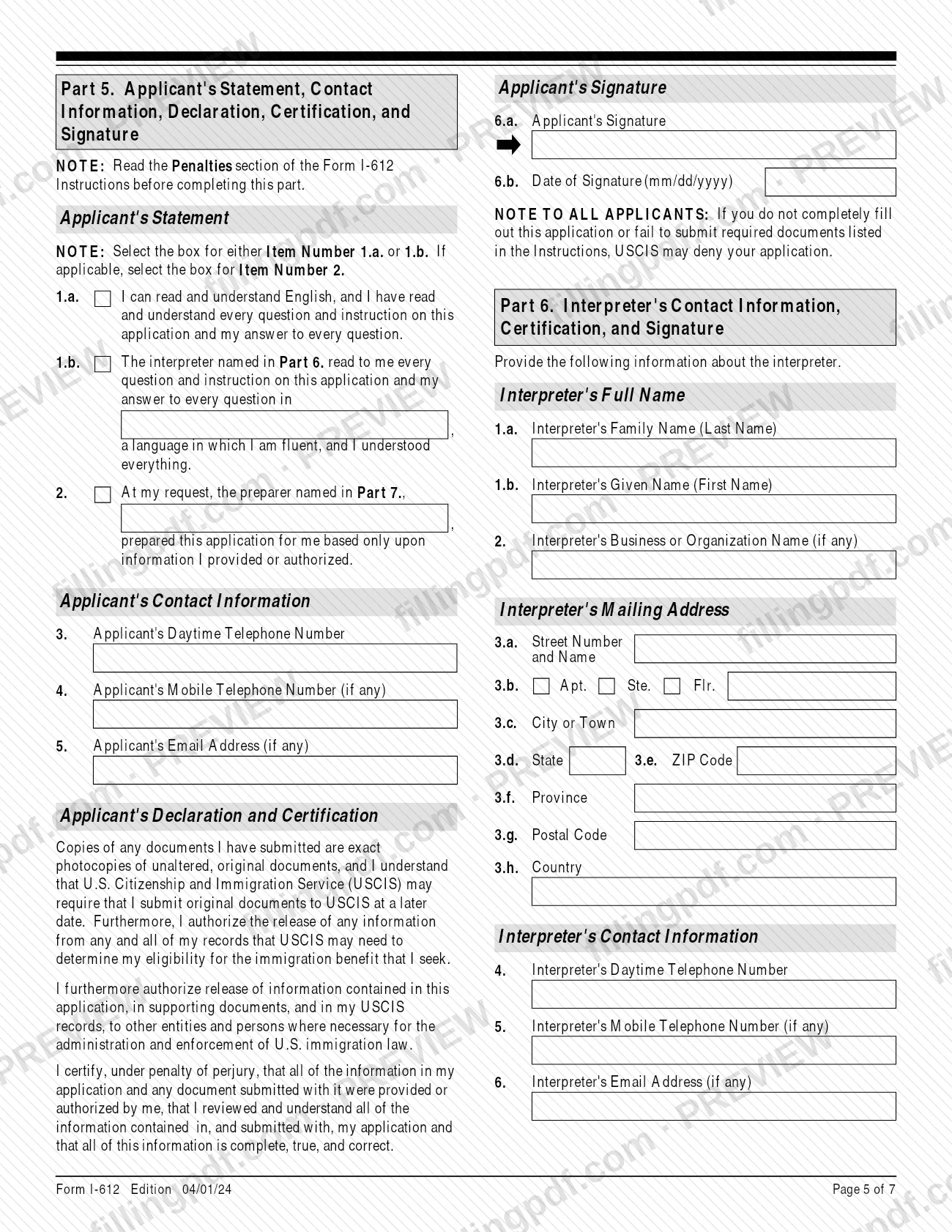
In Part 5, select Item 1.a or 1.b (and Item 2 if a preparer helped), enter daytime and mobile telephone numbers and email, then sign and date in Items 6.a and 6.b. The form requires your own signature, not a stamped or typewritten name.
Complete interpreter and preparer sections
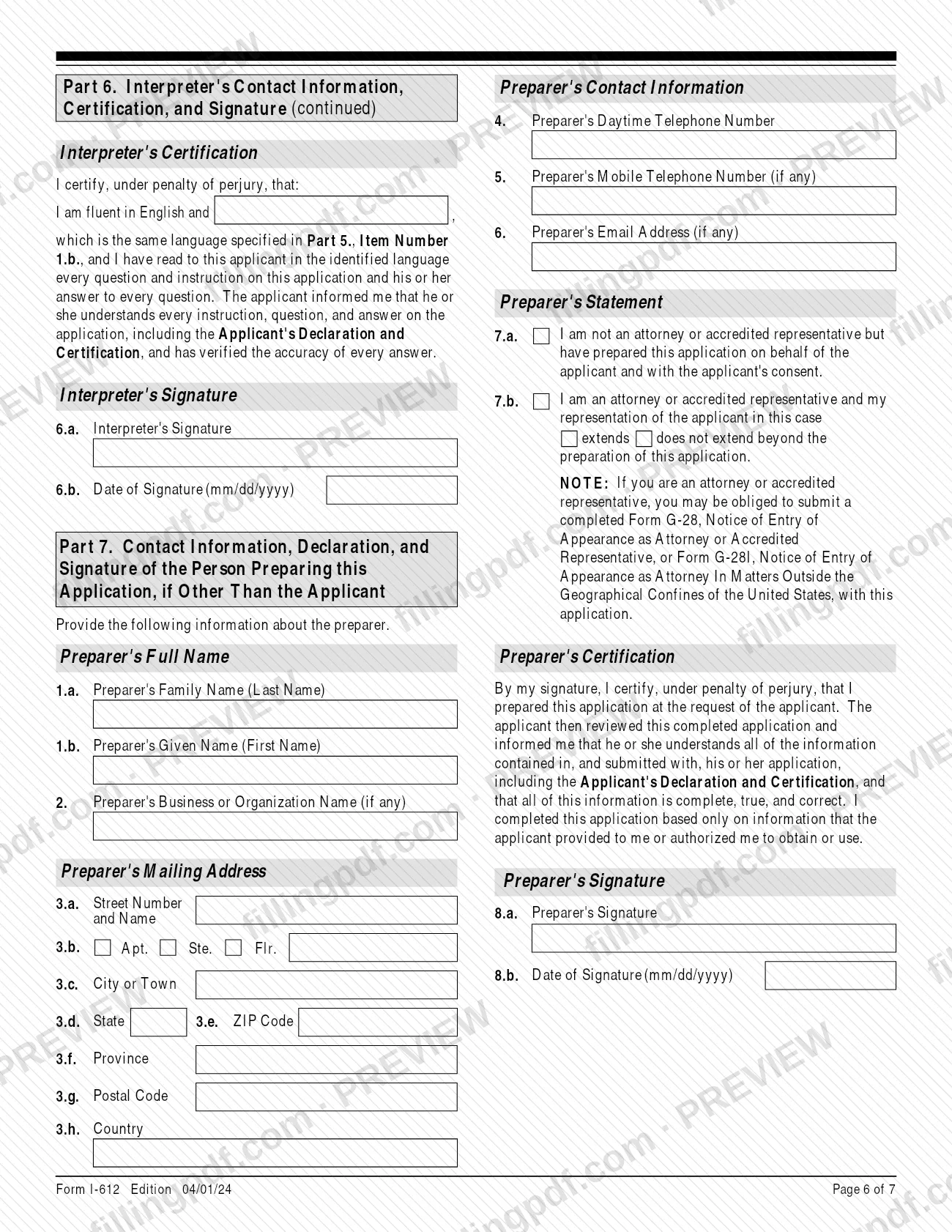
If an interpreter read the form to you, they complete and sign Part 6. If someone other than you prepared the application, that person completes and signs Part 7; an attorney or accredited representative may also need to file Form G-28 or G-28I.
Use Part 8, review and download
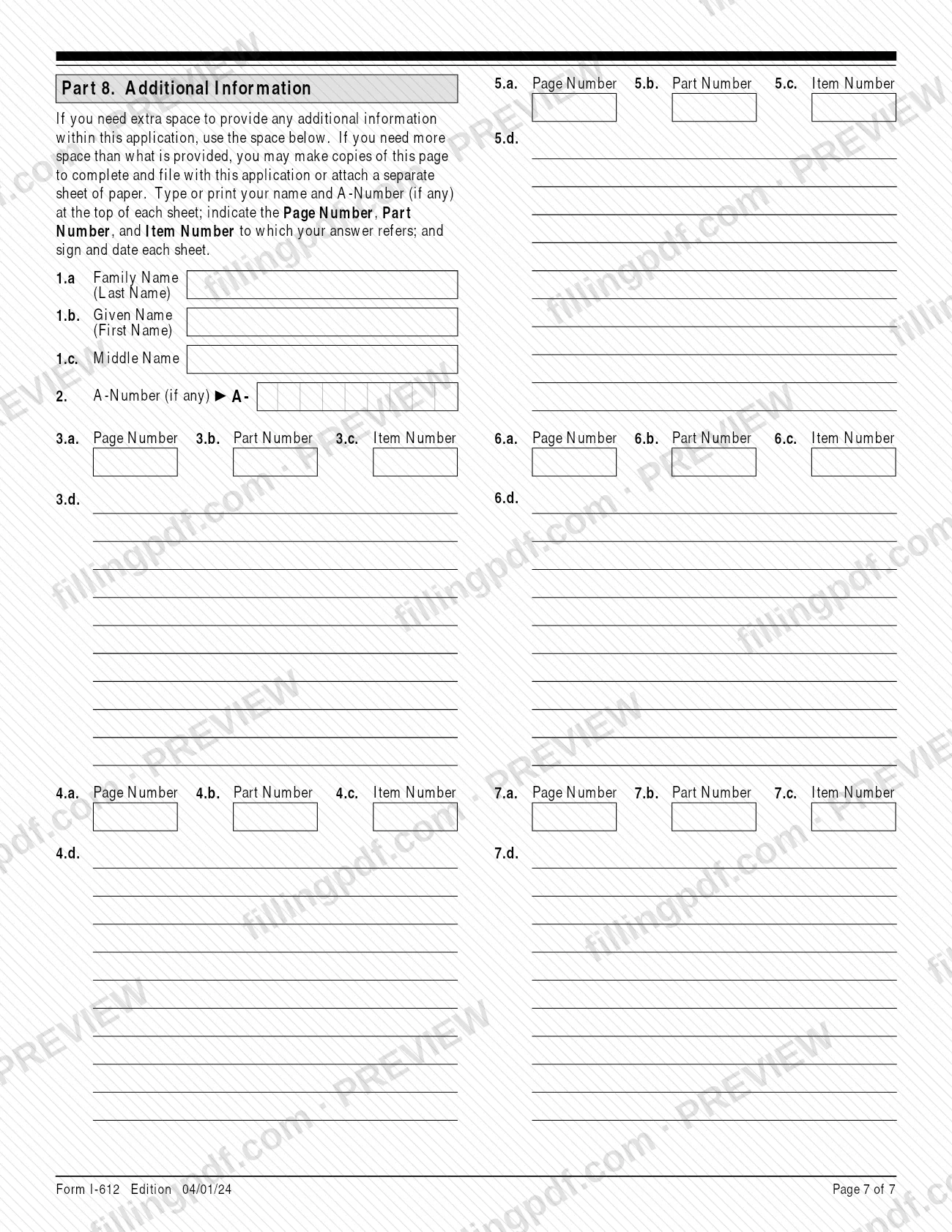
Use Part 8 for extra space, giving the page, part and item number and signing each sheet. Review every item, download or print the completed PDF from FillingPDF, then assemble the package described under How to submit.
How to submit I-612
You submit Form I-612 by mail to a USCIS lockbox, chosen by the state or territory where you live. The USCIS page for Form I-612 (uscis.gov/I-612) has the current filing information.
- USCIS Elgin Lockbox (Alaska, Armed Forces – America, Europe and Pacific, Connecticut, Delaware, District of Columbia, Idaho, Illinois, Indiana, Iowa, Kansas, Maine, Massachusetts, Michigan, Minnesota, Missouri, Montana, Nebraska, New Hampshire, New Jersey, New York, North Dakota, Ohio, Oregon, Pennsylvania, Rhode Island, South Dakota, Tennessee, Utah, Vermont, Washington, Wisconsin, Wyoming). U.S. Postal Service: USCIS Attn: I-612, P.O. Box 4224, Carol Stream, IL 60197-4224. FedEx, UPS and DHL: USCIS Attn: I-612 (Box 4224), 2500 Westfield Drive, Elgin, IL 60124-7836.
- USCIS Phoenix Lockbox (Alabama, American Samoa, Arkansas, Arizona, California, Colorado, Florida, Georgia, Guam, Hawaii, Kentucky, Louisiana, Maryland, Micronesia, Mississippi, Nevada, New Mexico, North Carolina, Northern Mariana Islands, Oklahoma, Palau, Puerto Rico, South Carolina, Texas, U.S. Virgin Islands, Virginia, West Virginia). U.S. Postal Service: USCIS Attn: I-612, P.O. Box 20128, Phoenix, AZ 85036-0128. FedEx, UPS and DHL: USCIS Attn: I-612 (Box 20128), 2108 E. Elliot Rd., Tempe, AZ 85284-1806.
A filing fee applies; see Form G-1055 or the USCIS Fee Schedule page for the amount. Print all pages from the same form edition with the edition date and page numbers visible, or USCIS may reject the form. Do not send original documents unless asked. Questions go to the USCIS Contact Center at 800-375-5283 (TTY 800-767-1833). FillingPDF lets you fill out and download the PDF; submission follows the channels above.
Common mistakes to avoid
- Submitting Form I-612 unsigned, or with a stamped or typewritten name; USCIS rejects an unsigned application.
- Sending the form without the correct filing fee, which also leads to rejection.
- Selecting Part 3, Item Number 1 or 2 without attaching the signed and dated statement; the form says the application is then incomplete (hardship statement) or must include one (persecution).
- Selecting more than one box in Part 3, which allows only one reason.
- Filing Form I-612 for an Interested U.S. Government Agency, "No Objection" or Conrad Waiver Program waiver; those follow the Department of State process.
- Leaving out J-2 dependents who should be covered; a J-2 spouse or child not listed does not receive a waiver with you.
- Sending an original passport or original documents when not requested; USCIS may destroy originals.
- Printing the form with pages from different editions or with the edition date and page numbers cut off, which can lead to rejection.
- Leaving non-applicable items blank instead of typing or printing "N/A", or "None" for numeric answers of zero.
- Submitting foreign-language documents without a full English translation and the translator's certification.
Frequently asked questions
What is Form I-612 used for?
Form I-612 is the USCIS application for a waiver of the two-year foreign residence requirement of INA section 212(e). J-1 exchange visitors file it based on exceptional hardship to a U.S. citizen or lawful permanent resident spouse or child, or on a fear of persecution in the home country.
Who can file Form I-612?
Exchange visitors (J-1) who are subject to the two-year requirement may file. J-2 spouses still married to the J-1 and unmarried children under 21 cannot file on their own; they are included in the J-1's application. Other J-2 categories, such as spouses whose marriage ended, may not file at all.
Can I fill out Form I-612 online?
Yes. You can fill out the PDF online on FillingPDF and download or print it. FillingPDF is an independent service and does not file the form with USCIS; you mail the printed package to the correct USCIS lockbox.
Where do I mail Form I-612?
Mail it to the USCIS Elgin Lockbox (P.O. Box 4224, Carol Stream, IL 60197-4224) or the USCIS Phoenix Lockbox (P.O. Box 20128, Phoenix, AZ 85036-0128), depending on where you live. The state list and courier street addresses are on the USCIS page for Form I-612.
What do I attach to Form I-612?
Attach a signed and dated statement of hardship or persecution, copies of all Forms DS-2019/IAP-66, and a copy of your Form I-94. For a hardship claim, add evidence of your spouse's or child's citizenship or permanent resident status and of your relationship to them.
Is there a fee to file Form I-612?
Yes, a filing fee applies, and USCIS rejects an application without the correct fee. The amount is not printed on the form; check Form G-1055 or the USCIS Fee Schedule page for the current figure.
Should I use Form I-612 for a Conrad Waiver or a No Objection waiver?
No. Do not file Form I-612 with USCIS for a waiver based on an Interested U.S. Government Agency request, a "No Objection" statement or the Conrad Waiver Program. Those follow the process on the Department of State website.
Can my spouse and children be included in my I-612 application?
Yes, J-2 spouse and unmarried minor children can be listed on your application. If you leave them out, they will not receive waivers with you. A spouse or child who is subject to the requirement as a J-1 must file a separate application.
What happens after I send Form I-612?
USCIS checks the application for completeness and may ask for more evidence, originals, an interview or biometrics. The waiver also needs a favorable recommendation from the Department of State's Waiver Review Division. USCIS notifies you of its decision in writing.
Ready to fill out I-612?
Fill out I-612 now