
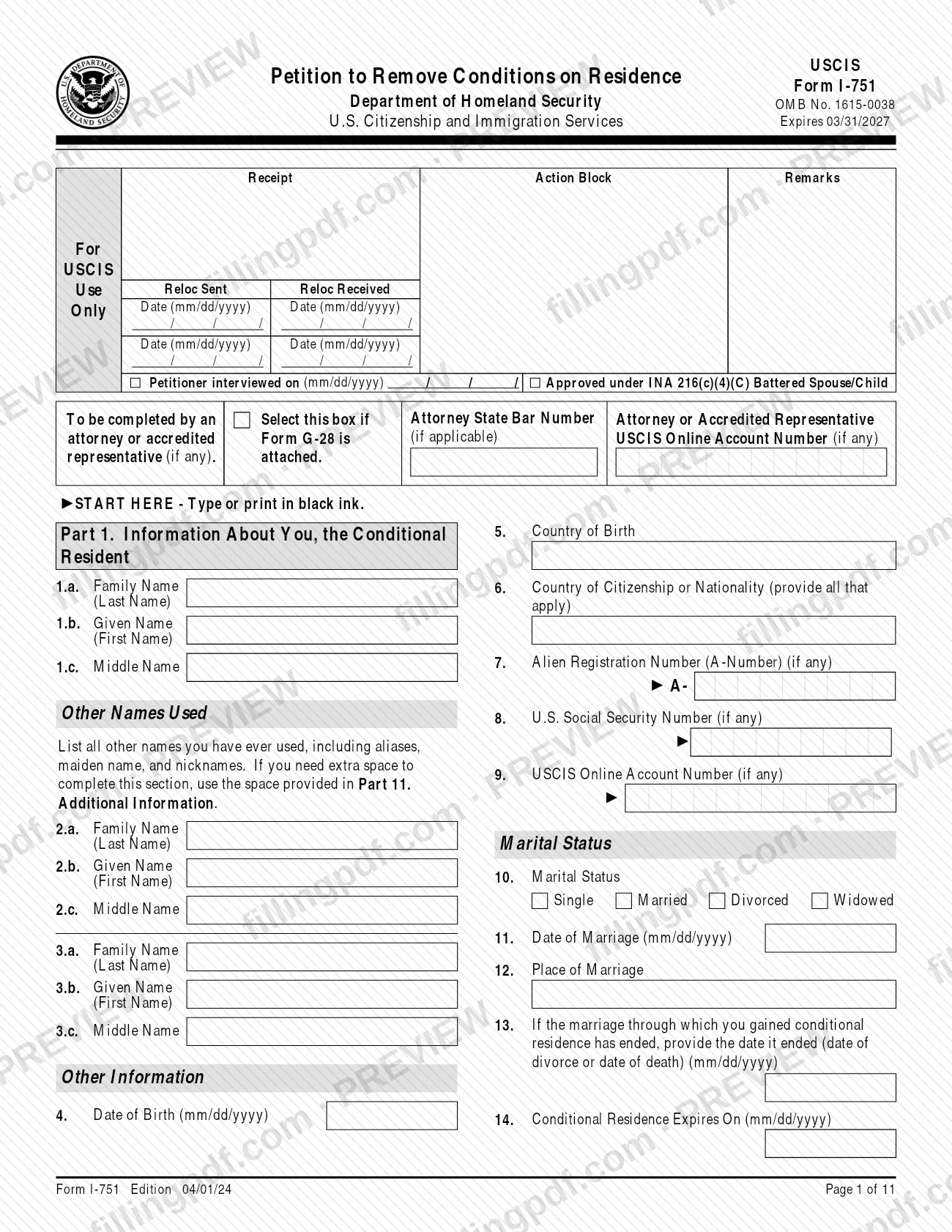
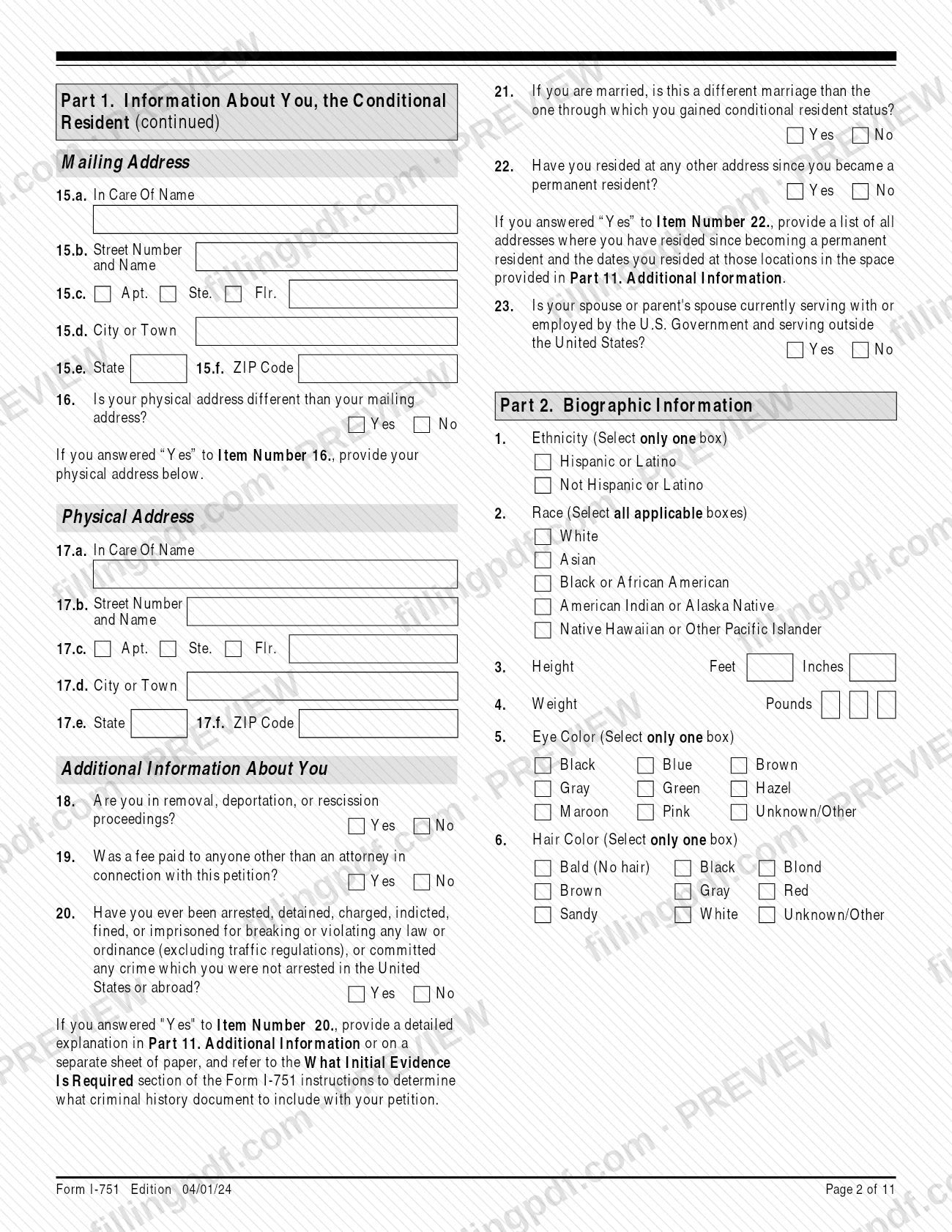
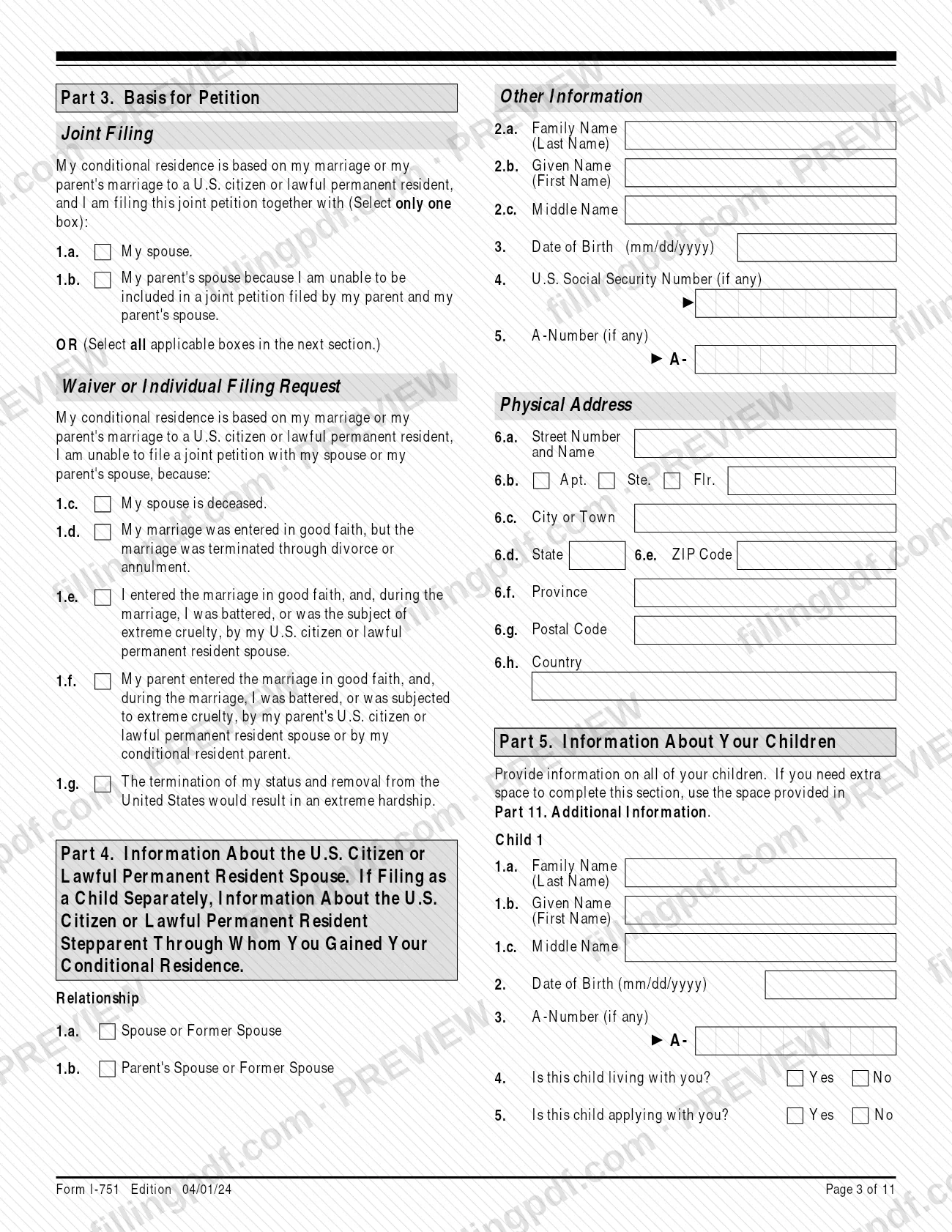
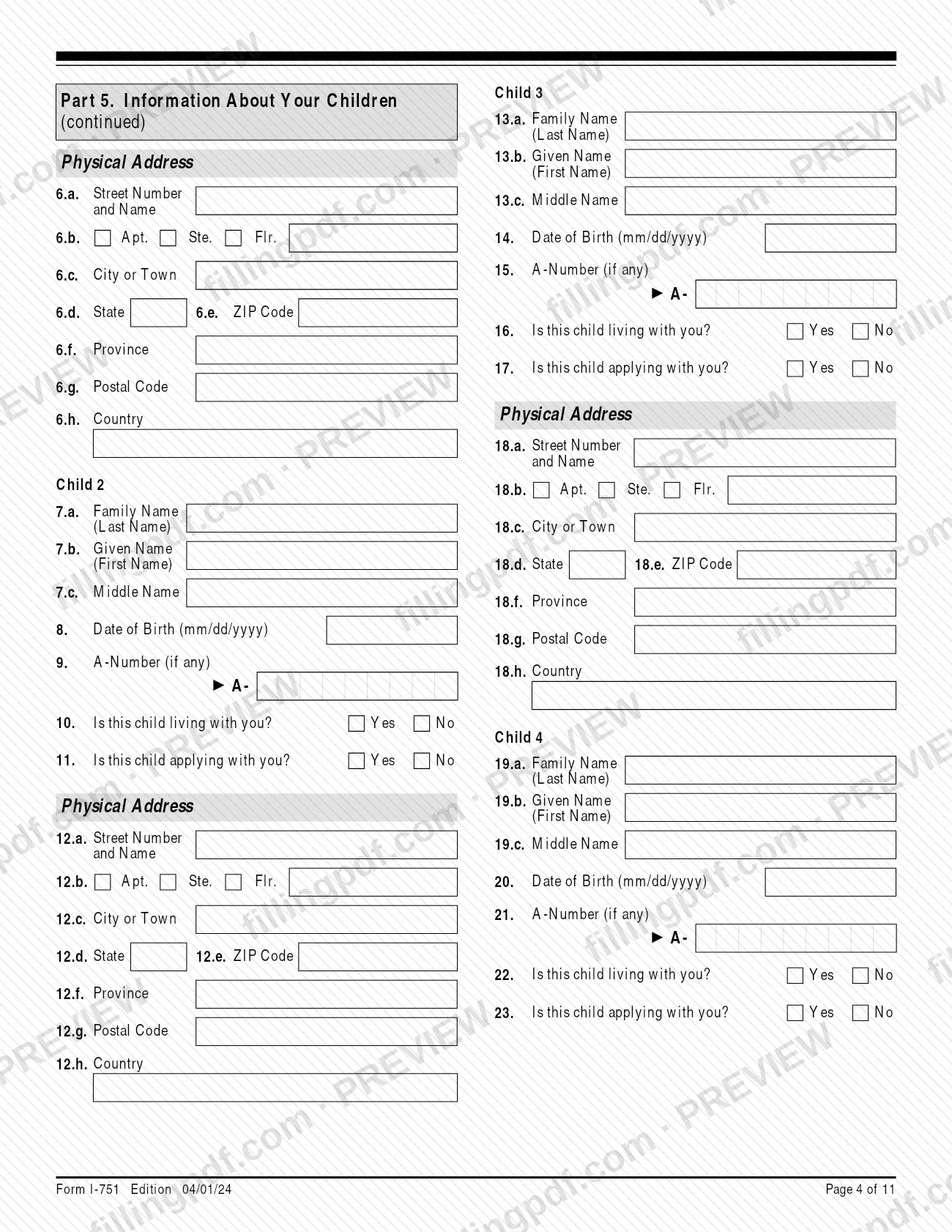
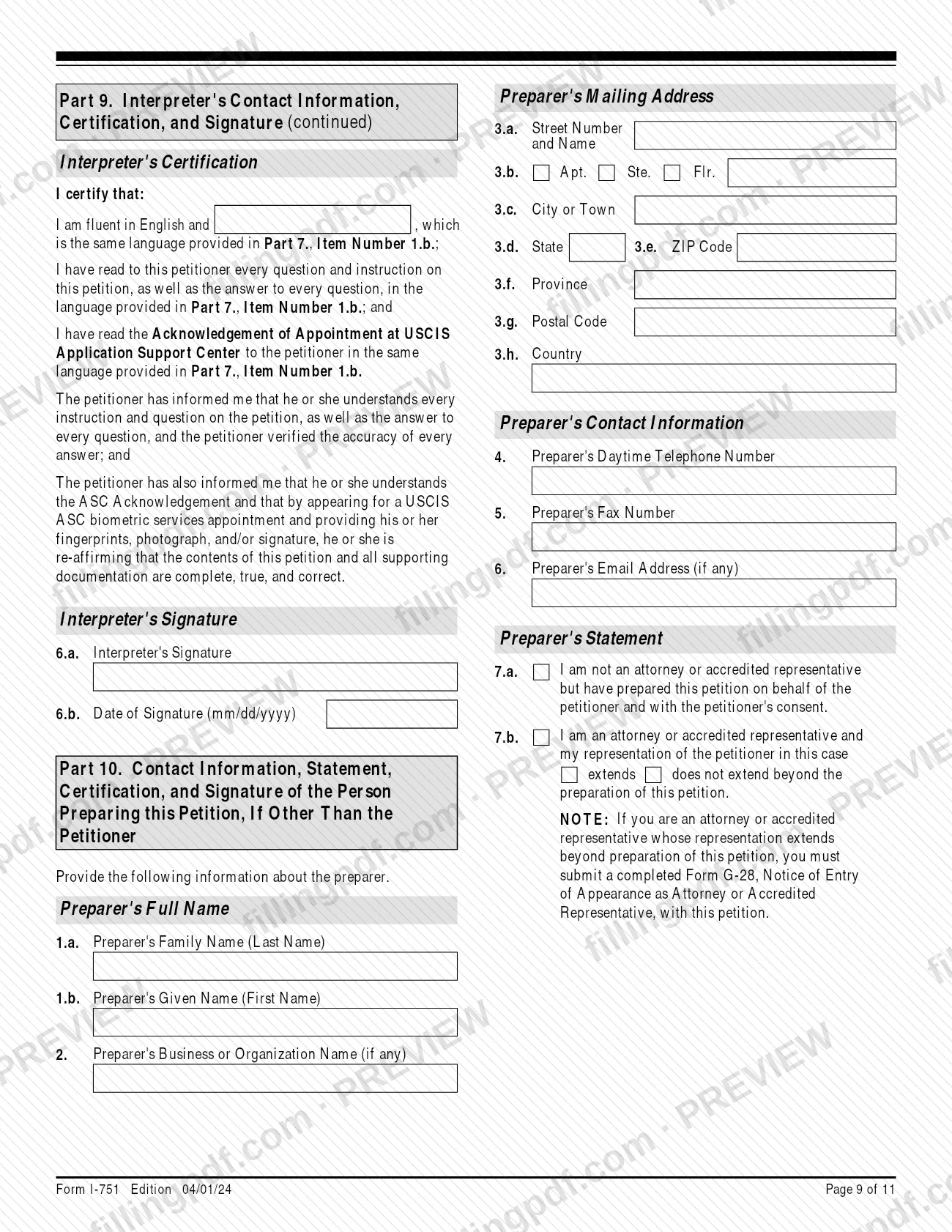
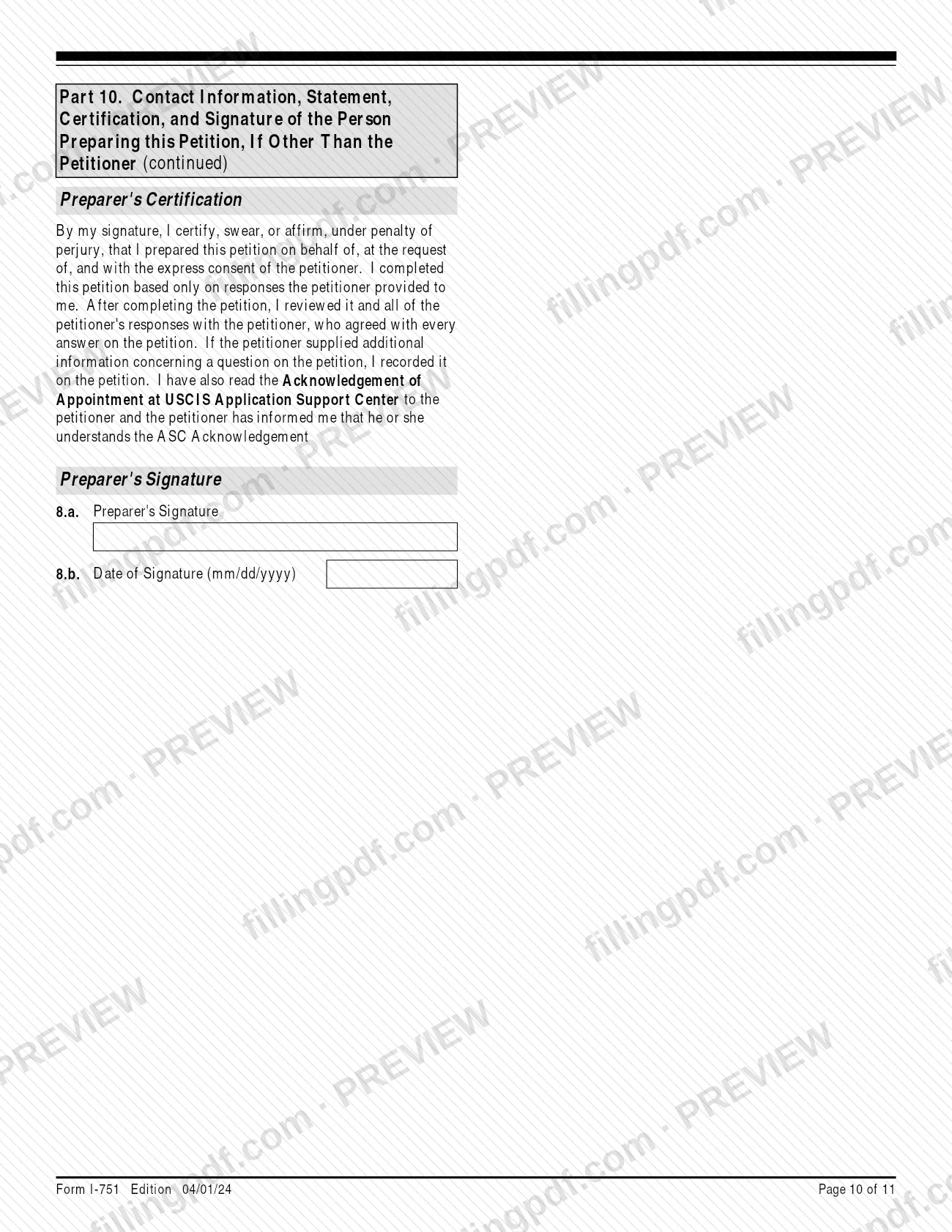
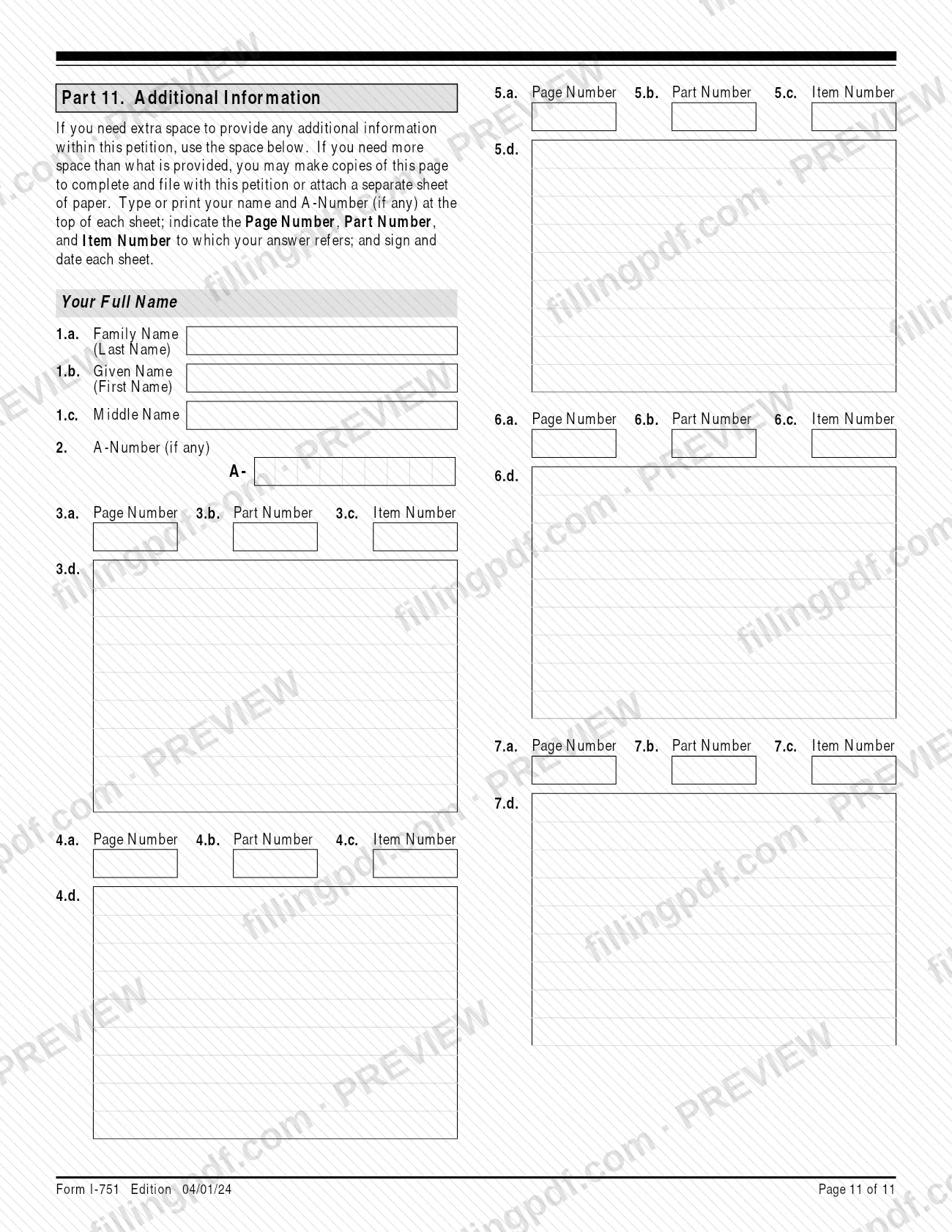
Form I-751 is the petition that U.S. Citizenship and Immigration Services (USCIS) uses to remove the conditions on the residence of a conditional resident who obtained status through marriage. Most petitioners file it jointly with the spouse through whom they gained status, during the 90-day period before conditional residence expires; some may file without the spouse and request a waiver. On FillingPDF you can fill out Form I-751 online and download or print the completed PDF. The form and instructions are published by USCIS, and filing follows the USCIS channels described below.
Last updated
What is I-751?
Form I-751, Petition to Remove Conditions on Residence, is the USCIS form a conditional resident who obtained status through marriage files to ask USCIS to remove the conditions on his or her residence. It is issued by the Department of Homeland Security (DHS) under OMB No. 1615-0038.
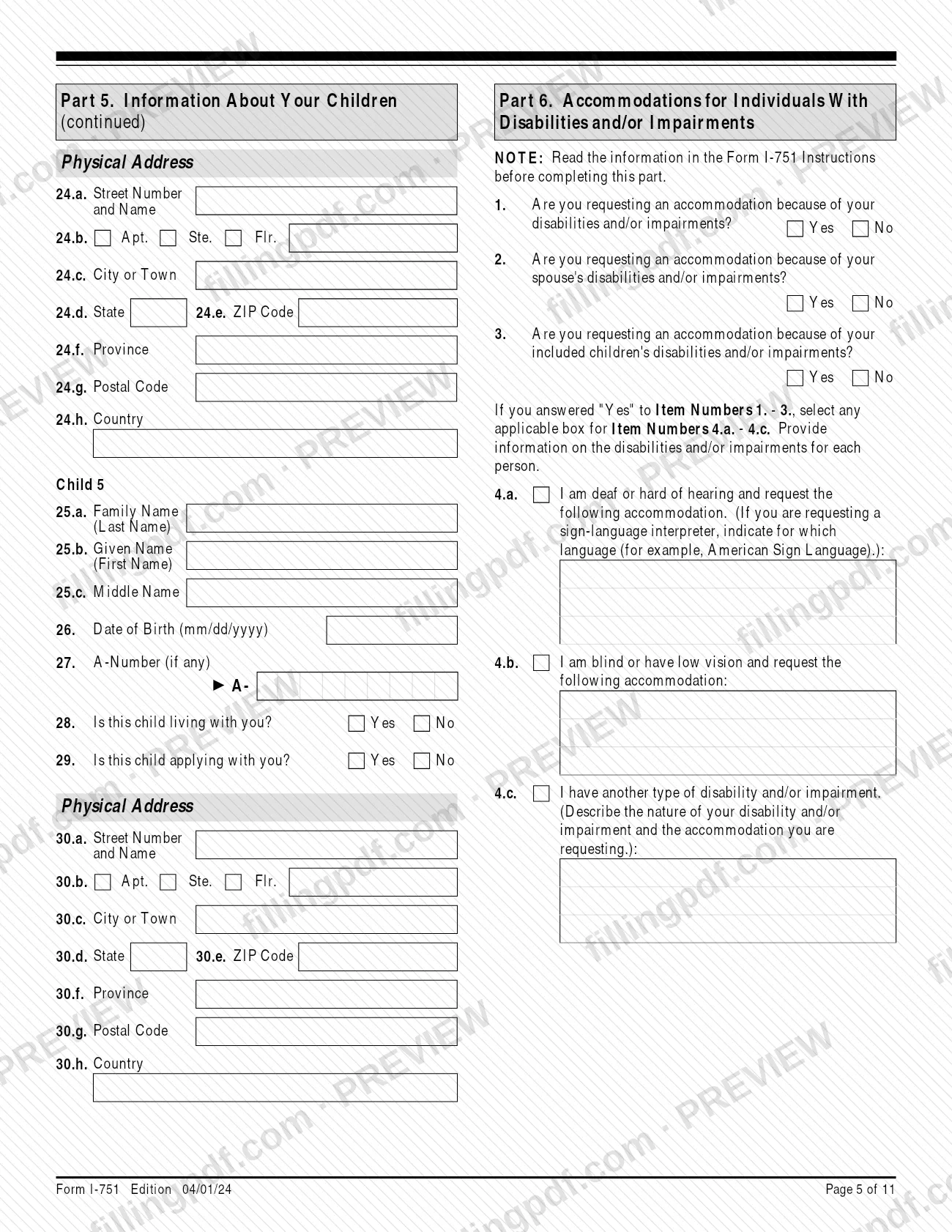
The petition has eleven parts. They collect information about you, biographic details, the basis for the petition (a joint filing, or a waiver or individual filing request), information about the U.S. citizen or lawful permanent resident spouse, your children, requests for disability accommodations, and the statements and signatures of the petitioner, the spouse (when applicable), any interpreter and any preparer. Part 11 is extra space for additional answers.
Conditional resident children can be included in the same petition in Part 5 when they acquired conditional status on the same day as you or within 90 days afterward. Other dependent children file their own Form I-751.
Related forms named in the USCIS materials: Form G-28, Notice of Entry of Appearance as Attorney or Accredited Representative, for attorneys whose representation goes beyond preparing the petition; Form G-1055 for fee information; Form G-1145, E-Notification of Application/Petition Acceptance; and Form FD-258 fingerprint cards for petitioners overseas on military or government orders.
Who needs to file I-751?
You use Form I-751 if USCIS granted you conditional resident status through marriage to a U.S. citizen or lawful permanent resident and you want the conditions removed.
- Still married: file jointly with the spouse through whom you obtained conditional status.
- Waiver or individual filing: you may file without your spouse if you entered the marriage in good faith and your spouse later died; the marriage ended by divorce or annulment; you were battered or subjected to extreme cruelty by your petitioning spouse; or the termination of your status and removal would cause extreme hardship. A child may also file this way if the conditional resident parent entered the marriage in good faith and the child was battered or subjected to extreme cruelty by the parent's spouse or by the parent.
- Children: dependent children who got conditional status the same day as you, or within 90 days after, are listed in Part 5. Children who did not, or whose conditional resident parent is deceased, must each file a separate Form I-751.
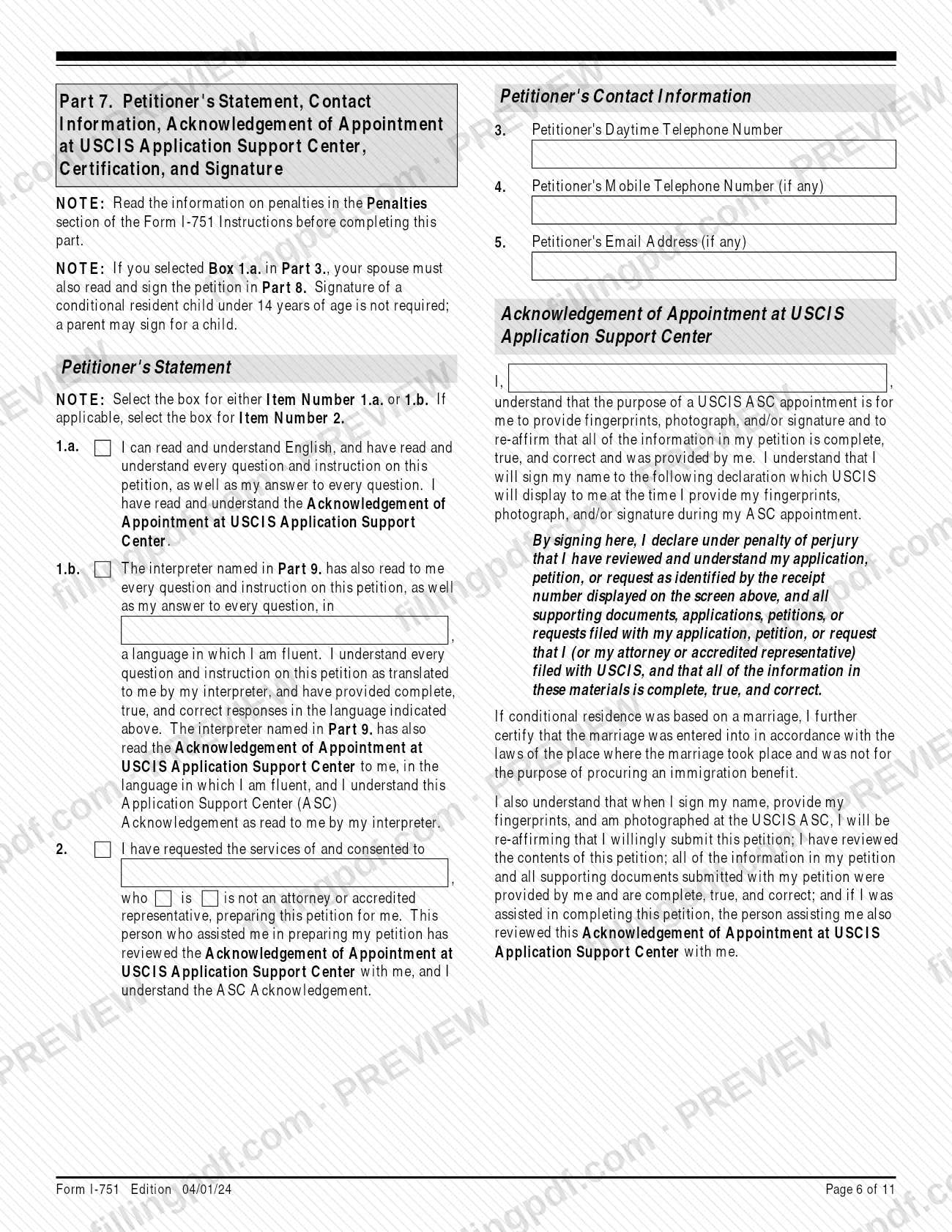
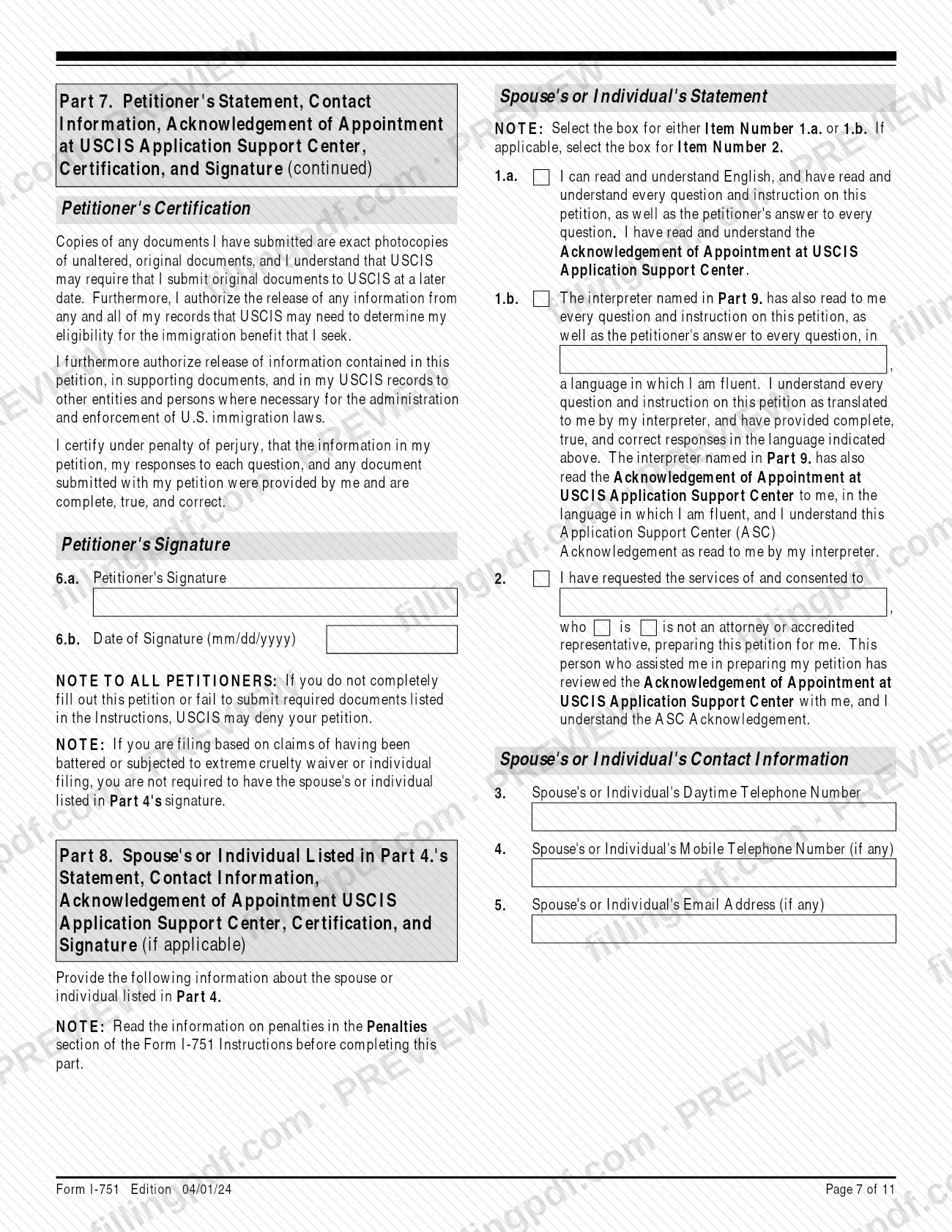
Signatures: if you check Part 3, Item 1.a., your spouse must also read and sign in Part 8. Spouse signature is not required for battered-or-extreme-cruelty waivers. A parent or legal guardian may sign for a petitioner under 14, and a legal guardian may sign for a mentally incompetent person. You must have a U.S. address to file.
When to file I-751
If you file jointly with your spouse, file during the 90-day period immediately before your conditional residence expires. USCIS says a petition filed before the first day of that window may be rejected; its When to File Your Petition to Remove Conditions page shows how to find that day. A child filing a separate joint petition with a stepparent may file at any time before conditional status expires.
Waiver or individual filings have no 90-day window. The form instructions say you may file any time after being granted conditional status and before you are removed from the United States; the USCIS Form I-751 page says any time before conditional status expires.
If no petition is filed, you automatically lose permanent resident status two years from the date conditional status was granted and become removable. A late petition may be excused if you file a written explanation showing the delay was due to extraordinary circumstances beyond your control and was reasonable in length. USCIS notifies you of its decision in writing.
Documents you need
- Copy of your permanent resident or alien registration card, front and back, with every petition.
- Copies of the front and back of the permanent resident cards of conditional resident children included in Part 5.
- Evidence the marriage was entered in good faith, such as birth certificates of children, lease or mortgage showing joint residence, joint financial records, or insurance policies.
- Affidavits sworn or affirmed by at least two people who have known you both since conditional residence was granted; originals, with the details the instructions list, supported by other evidence.
- Death certificate and evidence of the qualifying relationship, if you file as an individual because your spouse died.
- Final divorce decree or other document ending or annulling the marriage, plus evidence of the relationship, if you file because the marriage was terminated.
- Evidence of abuse (police, court, medical, school, clergy or social service records, protection orders, shelter evidence, photographs), if you file on a battered or extreme cruelty claim; add the divorce decree if divorce was on those grounds.
- Evidence of hardship significantly greater than that of other foreign nationals removed after extended stays, if you request a waiver for extreme hardship; it must relate to the two-year conditional period.
- Full explanation and supporting documents for why you file separately, if you are a child filing apart from your parent.
- Criminal history records as the instructions require: official no-charge statement, or original or court-certified arrest records, dispositions, sentencing and completion records, or a no-record court statement, as applicable.
- Two color passport-style photos and two Form FD-258 fingerprint cards (ages 14 to 79) per petitioner and dependent, plus a copy of current military or government orders, if you reside overseas on such orders.
- Full English translation with the translator's signed certification for any foreign-language document.
- Form G-28, if an attorney or accredited representative's representation extends beyond preparing the petition.
How to fill out I-751
Enter your identity details in Part 1
Items 1.a.–1.c.: your legal name, then any other names used in Items 2 and 3. Add date of birth, country of birth, citizenship, A-Number, Social Security number and USCIS Online Account Number where they apply; type "N/A" for questions that do not apply.
Give marital status and residence dates
Items 10–14: marital status, date and place of marriage, the date the marriage ended if it did, and the date your conditional residence expires, in mm/dd/yyyy format.
Add addresses and background answers
Items 15–17: mailing address and, if different, physical address. Answer Items 18–23 (proceedings, fee paid to a non-attorney, arrests, different marriage, other addresses, spouse serving abroad); explain "Yes" answers in Part 11.
Complete biographic information in Part 2
Select ethnicity and race, enter height in feet and inches and weight in pounds ("000" if unknown or outside the range), and select eye and hair color.
Select the basis for the petition
Part 3: check 1.a. or 1.b. for a joint filing, or the waiver or individual filing reasons 1.c.–1.g. that apply. Do not mix a joint filing box with the waiver boxes.
Provide spouse or stepparent information
Part 4: check whether the person is a spouse or former spouse (1.a.) or a parent's spouse or former spouse (1.b.), then enter their name, date of birth, Social Security number, A-Number and physical address.
List your children
Part 5: for each child enter the name, date of birth, A-Number if any, whether the child lives with you and whether the child applies with you, plus address. Use Part 11 for more than five.
Request accommodations if needed
Part 6: answer Items 1–3 and, for any "Yes," select the boxes in Item 4 and describe the accommodation.
Complete Parts 7 and 8 statements
Part 7: choose Item 1.a. or 1.b., Item 2 if someone prepared the petition, add contact details, then sign and date in 6.a.–6.b. in ink. Your spouse or individual from Part 4 completes and signs Part 8 when required.
Add interpreter and preparer details
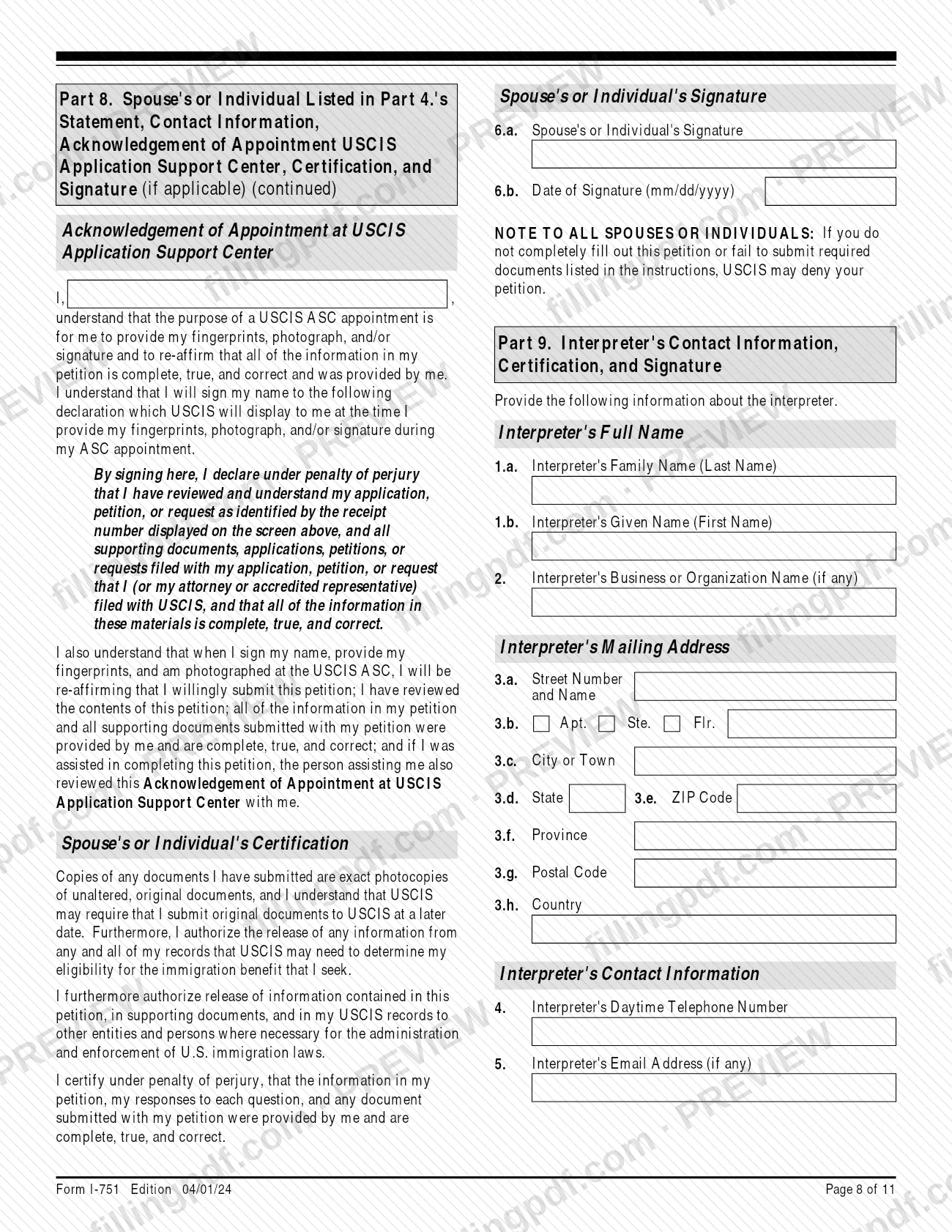
Part 9 is completed and signed by any interpreter; Part 10 by anyone other than you who prepared the petition. Attorneys whose representation goes beyond preparation must also attach Form G-28.
Use Part 11 for extra information
Enter your name and A-Number, then the page, part and item number for each added answer, such as other addresses or a criminal-history explanation.
Review, sign and download the PDF
Check every part, make sure signatures are in place and download or print the completed PDF from FillingPDF. Assemble the petition with the evidence and submit it through one of the channels described under How to submit.
How to submit I-751
You can file Form I-751 online with USCIS or by mail on paper.
- Online: create a USCIS online account and file the petition there; USCIS then sends a receipt notice.
- By mail: the instructions send you to www.uscis.gov/I-751 for the most current filing location, and the USCIS page points to its Direct Filing Addresses for Form I-751 page. Do not mail the petition to the Camp Springs, MD address in the Paperwork Reduction Act notice.
A filing fee applies; see Form G-1055 or the USCIS Fee Schedule page for the amount. If you mail a printed form, every page must show the edition date and page numbers and all pages must be from the same edition, or USCIS may reject it. Sign in ink: a photocopy, fax or scan of an original handwritten signature is valid for filing. To get an email or text when USCIS accepts the form at a lockbox, clip Form G-1145 to the first page. For questions, call the USCIS Contact Center at 800-375-5283 (TTY 800-767-1833). FillingPDF lets you fill out and download the PDF; submission follows the USCIS channels above.
Common mistakes to avoid
- Filing a joint petition before the 90-day window opens; USCIS says an early petition may be rejected.
- Submitting the petition unsigned, or with a stamped or typewritten name instead of a signature; USCIS rejects it.
- Leaving out your spouse's Part 8 signature when you check Part 3, Item 1.a. (the exception is the battered or extreme cruelty waiver).
- Mailing a printed form with missing pages or pages from different editions, or without the edition date and page numbers visible.
- Sending original documents when the instructions do not ask for them; submit legible photocopies unless told otherwise.
- Submitting foreign-language documents without a full English translation and the translator's signed certification.
- Omitting criminal history documents after answering "Yes" to Part 1, Item 20., or leaving the explanation out of Part 11.
- Overseas military or government-orders petitioners forgetting to write "ACTIVE MILITARY" or "GOVERNMENT ORDERS" at the top of the form and attach the orders.
- Sending a change of address to the USCIS Lockbox, or using the website or Contact Center when you checked Part 3, Item 1.e. or 1.f.
Frequently asked questions
What is Form I-751 used for?
Form I-751 is the USCIS petition a conditional resident who obtained status through marriage files to request removal of the conditions on residence. Children who acquired conditional status with you may be included in Part 5.
When should I file Form I-751?
If you file jointly with your spouse, file during the 90-day period immediately before your conditional residence expires; an earlier filing may be rejected. Waiver and individual filings have no 90-day window, and USCIS can excuse a late petition only for extraordinary circumstances beyond your control.
Can I file Form I-751 without my spouse?
Yes, with a waiver or individual filing request, if your spouse died, the marriage ended by divorce or annulment in good faith, you or your child were battered or subjected to extreme cruelty, or removal would cause extreme hardship. Check the matching box in Part 3 and attach the evidence the instructions list.
What documents do I need to submit with Form I-751?
Copies of both sides of your permanent resident card, plus evidence the marriage was entered in good faith. Add the documents for your situation, such as a death certificate, divorce decree, evidence of abuse or hardship, and criminal history records if applicable.
Can I file Form I-751 online?
Yes. USCIS accepts the petition online through a USCIS online account or by mail on paper. You can fill out the PDF online on FillingPDF and download it, but FillingPDF does not file anything with USCIS.
Is there a fee to file Form I-751?
Yes, a filing fee applies. The form instructions refer you to Form G-1055 and the USCIS page to its Fee Schedule page for the current amount, so check one of them before you file.
What happens if I do not file Form I-751?
You automatically lose permanent resident status two years from the date conditional status was granted and become removable from the United States. If the failure was beyond your control, you may file late with a written explanation asking USCIS to excuse it.
Who signs Form I-751 for a child under 14?
A parent or legal guardian may sign for a petitioner under 14. A conditional resident child under 14 does not have to sign, because a parent may sign for the child. USCIS rejects a petition with no valid handwritten signature.
Ready to fill out I-751?
Fill out I-751 now