
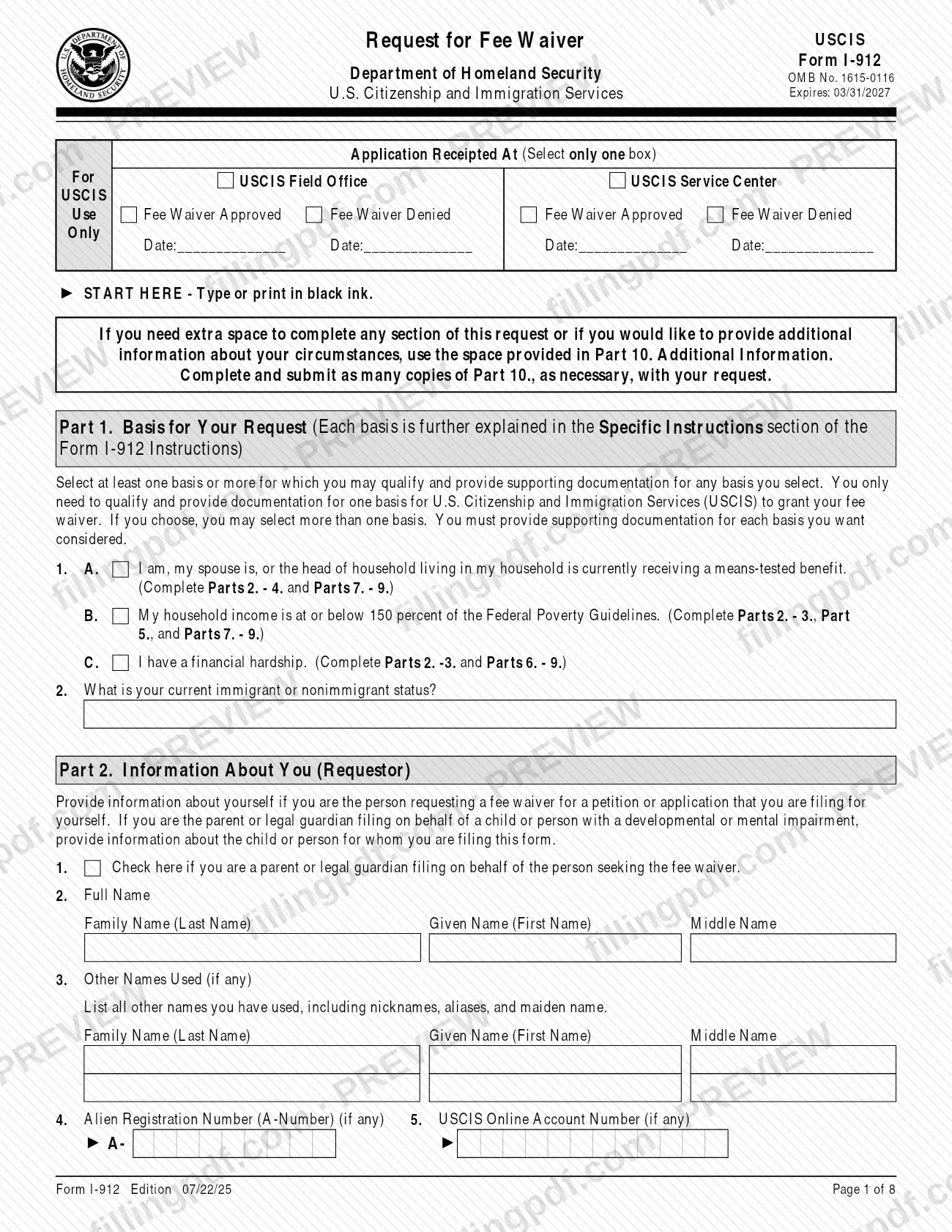
Form I-912 is the U.S. Citizenship and Immigration Services (USCIS) request for a fee waiver, used when you cannot pay the filing fee or biometric services fee for an eligible application or petition. You qualify on one of three bases: you receive a means-tested benefit, your household income is at or below 150 percent of the Federal Poverty Guidelines, or you have a financial hardship. On this page you can fill out the form online on FillingPDF and download or print the completed PDF; the form, its instructions and the list of eligible forms are published by USCIS.
Last updated
What is I-912?
Form I-912, Request for Fee Waiver is the U.S. Citizenship and Immigration Services (USCIS) form you submit to ask that the filing fee or biometric services fee for an eligible application or petition be waived because you are unable to pay it.
You must clearly demonstrate that inability to pay, and you need to qualify and document only one of three bases in Part 1: receipt of a means-tested benefit (Part 4), household income at or below 150 percent of the Federal Poverty Guidelines (Part 5), or a financial hardship (Part 6). USCIS publishes the current guidelines in Form I-912P, Poverty Guidelines for Fee Waiver Request.
The form does not stand alone. It travels with the application or petition it supports, and USCIS can approve a waiver only for the forms and filings its regulations allow (8 CFR 106.3). Examples listed in the instructions include Form I-90, Form I-485 (for applicants exempt from the public charge ground of inadmissibility), Form I-751, Form I-765 and Form N-400.
Some fees cannot be waived: USCIS states that it cannot waive fees required by Pub. L. 119-21, 139 Stat. 72 (H.R.-1). For forms covered by that law, a waiver of the separate DHS fee may still be available, but the non-waivable fee must be paid separately. Form I-912 is not used for DACA, which has no fee waivers, or for applications that require no fee. Form G-1055 explains fee exemptions and the fee schedule.
Who needs to file I-912?
You use Form I-912 if you are the primary applicant or petitioner, and you cannot pay the filing fee or biometric services fee for an application or petition that is eligible for a fee waiver. The requestor may also be the parent or legal guardian of a child, or of a person with a physical, developmental or mental disability, who is the primary applicant. The form must be submitted in the name of the primary applicant.
Eligible filings include certain forms in full (for example I-90, I-751, N-400, N-600) and others only under conditions (for example Form I-485 when the applicant is exempt from the public charge ground of inadmissibility, or Form I-765 unless filed under category (c)(33)). Applicants related to certain statuses, such as T or U nonimmigrants, VAWA self-petitioners, asylees and refugees, may request a waiver for any related application if not otherwise fee exempt.
Do not use Form I-912 in these cases:
- You are requesting consideration for DACA.
- The application or petition requires no filing fee, or you qualify for a fee exemption based on your immigration status.
- The form you are filing is not on the eligible list; check its own instructions.
One Form I-912 can cover family members who file related forms together, and joint forms such as Form I-485 and Form I-765 need only one.
When to file I-912
File Form I-912 at the same time as the application or petition for which you want the fee waived. USCIS states that you cannot submit Form I-912 after it has received that application or petition, and that you should not submit it without a completed application or petition. If you are filing family-related forms at the same time, one Form I-912 covers all of them, and you send all forms together.
The form sets no deadline of its own. After review, USCIS notifies you of its decision in writing. If it denies the request, the notice explains how to resubmit your application or petition, and for some benefits the time to resubmit with the proper fee is limited, so check the instructions for the underlying form.
Documents you need
- For Part 1, Item 1.A (means-tested benefit): a letter, notice or agency document showing your name (or the recipient's), the granting agency, the type of benefit and that it is currently received.
- If the benefit document is more than 12 months old and the benefit is still received: additional evidence that the benefit is currently being received.
- For Part 1, Item 1.B (income): your most recent Federal tax return, if available, and the same for each household member whose income you count.
- If there is no tax return or it does not reflect current income: consecutive pay stubs for at least the past month, a recent Form W-2, Form SSA-1099, or employer statements on business stationery showing pay.
- If you have no income or cannot show income: a description of your situation in Part 5, Item 9; affidavits from religious institutions, non-profits or community organizations may be added if available.
- If you are a full-time student over 21 and under 24, unmarried, living with your parents or claimed as their dependent: both parents' Federal tax returns and your own return or proof of income.
- Documentation of additional financial assistance counted as income, such as child support, alimony, pensions or stipends: a court order, bank statements, or agency documents showing the actual amount.
- For Part 1, Item 1.C (financial hardship): documents matching your circumstance, such as medical bills, termination letter, eviction letter, military deployment orders, FEMA documents, utility and mortgage bills, or a divorce decree or death certificate.
- For hardship: documentation of your income and a complete list, description and estimated value of assets easily converted to cash, plus evidence of monthly expenses where possible.
- For any foreign-language document: a full English translation with the translator's signed certification of completeness, accuracy and competence.
- Form G-28 or G-28I if the preparer is an attorney or accredited representative who may be obliged to submit it with the request.
How to fill out I-912
Select your basis in Part 1
In Item 1 check 1.A (means-tested benefit), 1.B (income at or below 150 percent of the Federal Poverty Guidelines) or 1.C (financial hardship); you may check more than one but must document each. In Item 2 enter your current immigrant or nonimmigrant status.
Enter your information in Part 2
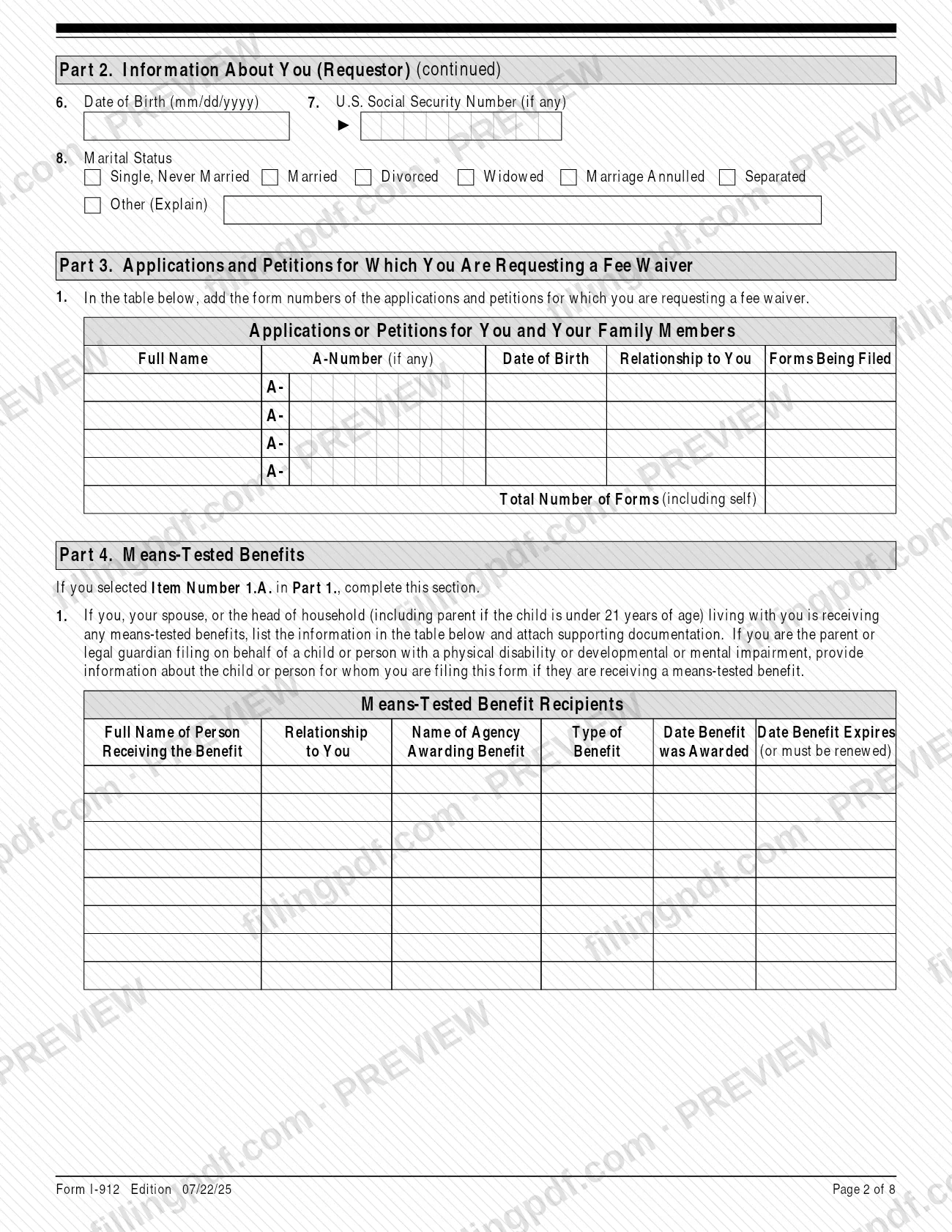
Check Item 1 only if you are a parent or legal guardian filing for someone else, then give the full name (Item 2), other names used (Item 3), A-Number (Item 4), USCIS Online Account Number (Item 5), date of birth as mm/dd/yyyy (Item 6), Social Security number (Item 7) and marital status (Item 8). Enter "N/A" where an item does not apply.
List the forms in Part 3
In the table, add yourself and each family member requesting a waiver with you, with name, A-Number, date of birth, relationship and the forms being filed. Enter the total number of forms, including your own.
Complete Part 4 for benefits
Only if you checked 1.A, list each recipient of a means-tested benefit with relationship, agency, type of benefit, award date and expiration or renewal date, and attach the supporting documents.
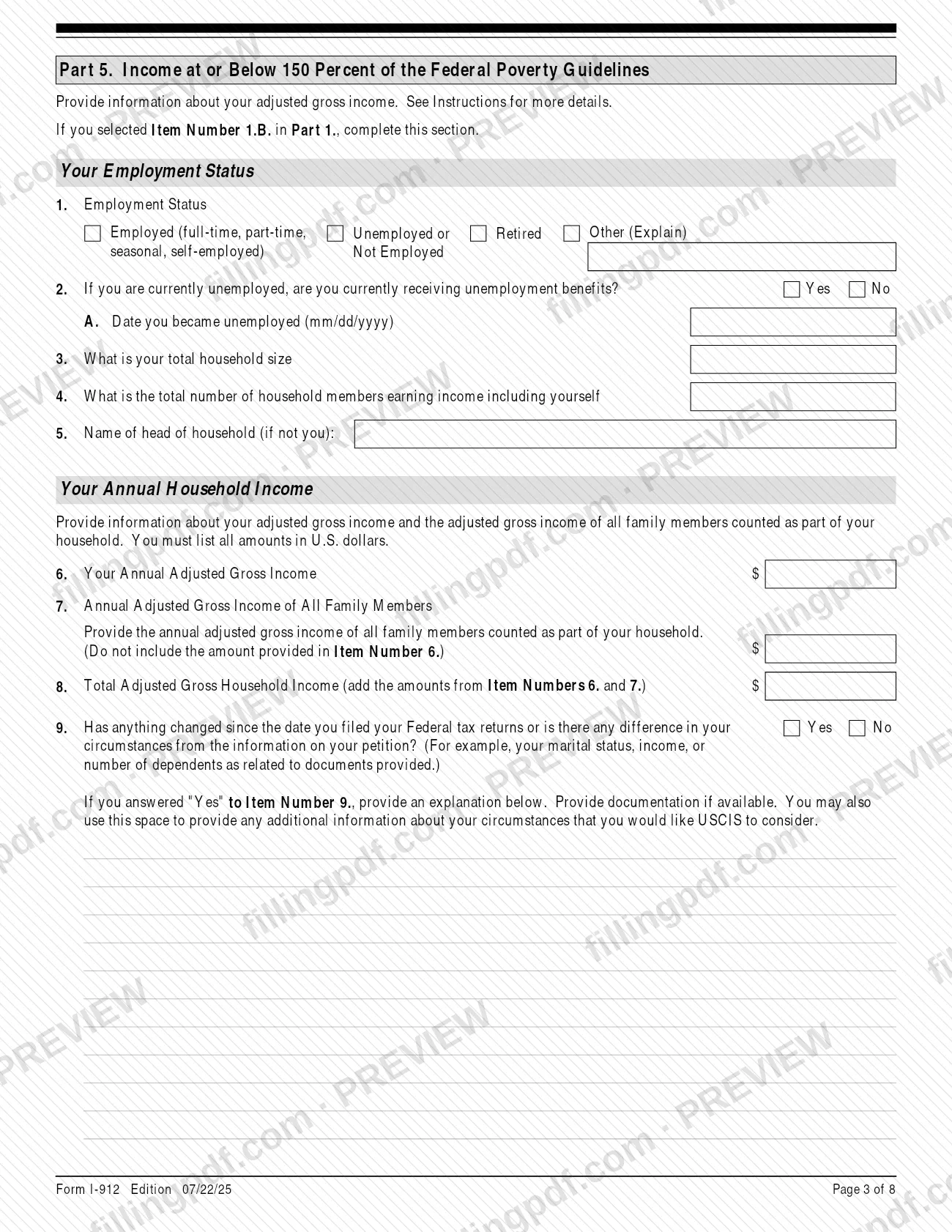
Complete Part 5 for income
Only if you checked 1.B, give your employment status (Items 1-2), household size (Item 3), earners (Item 4) and head of household (Item 5). Enter your annual adjusted gross income in Item 6, other household members' income in Item 7 and the sum of Items 6 and 7 in Item 8; answer Item 9 and explain any change.
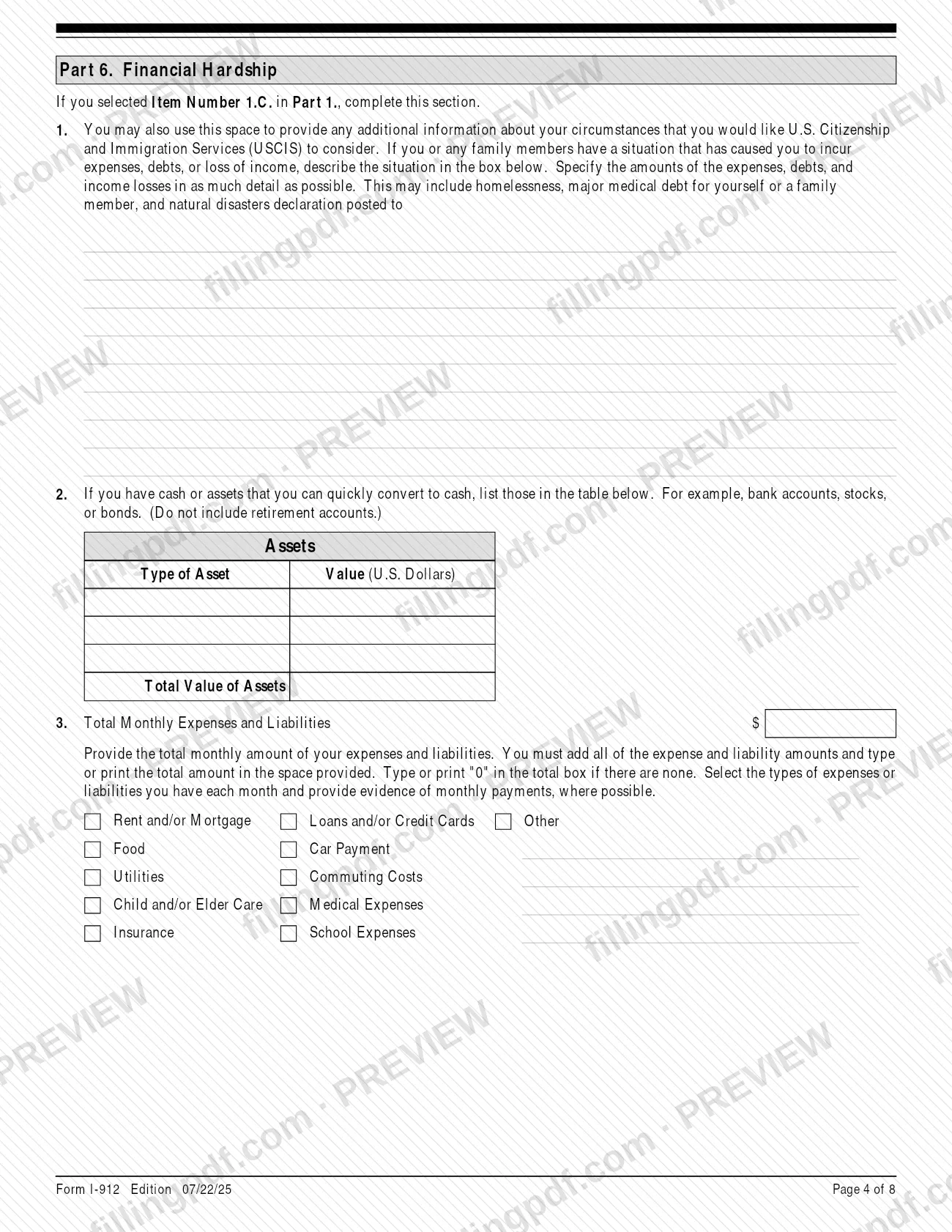
Complete Part 6 for hardship
Only if you checked 1.C, describe the situation and amounts of expenses, debts or lost income in Item 1, list cash and easily convertible assets with their total in Item 2, and enter total monthly expenses and liabilities in Item 3 (type "0" if none).
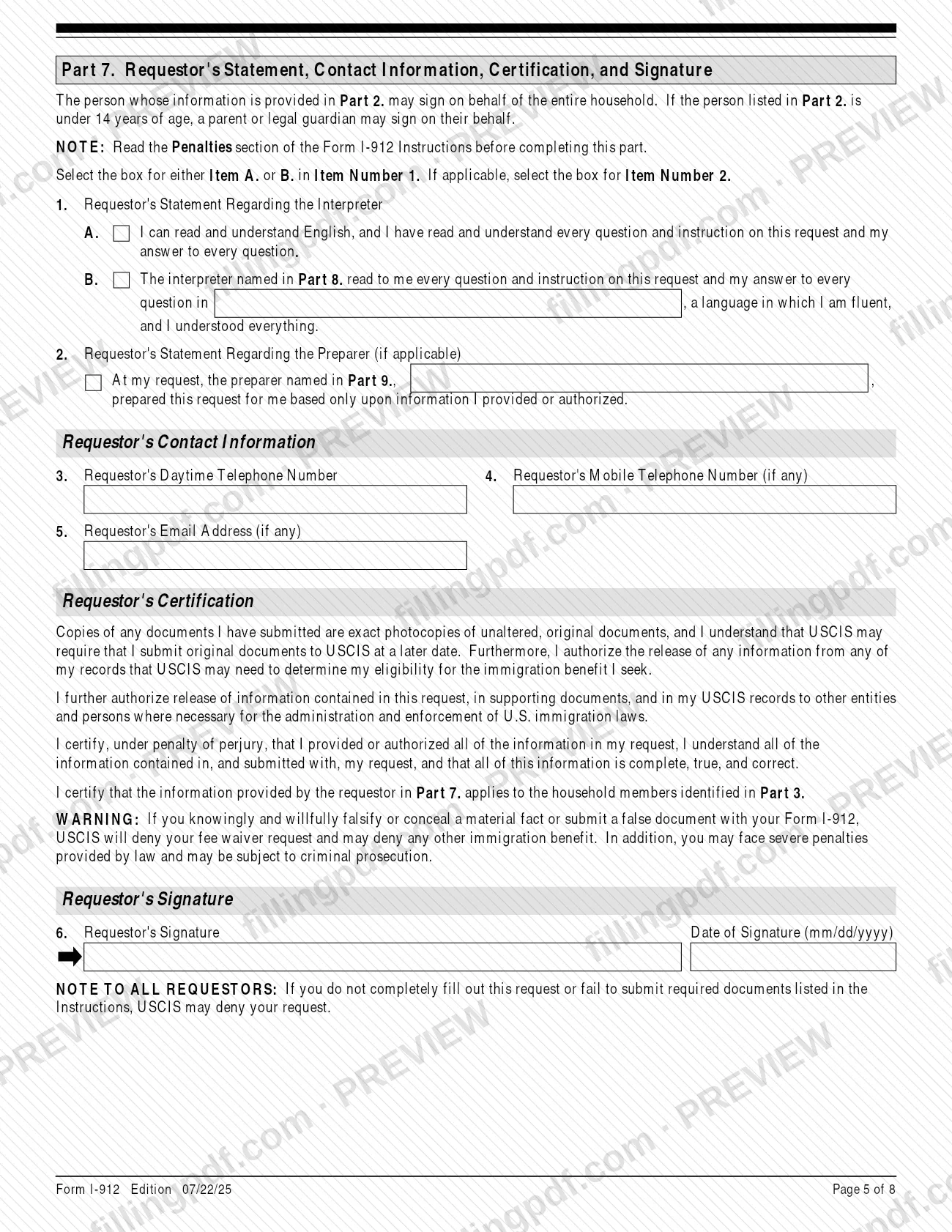
Complete the statement in Part 7
Check Item 1.A if you read English or 1.B if an interpreter read the form to you, and Item 2 if a preparer helped. Enter your phone numbers and email (Items 3-5), then sign and date in Item 6; a parent or guardian signs if you are under 14.
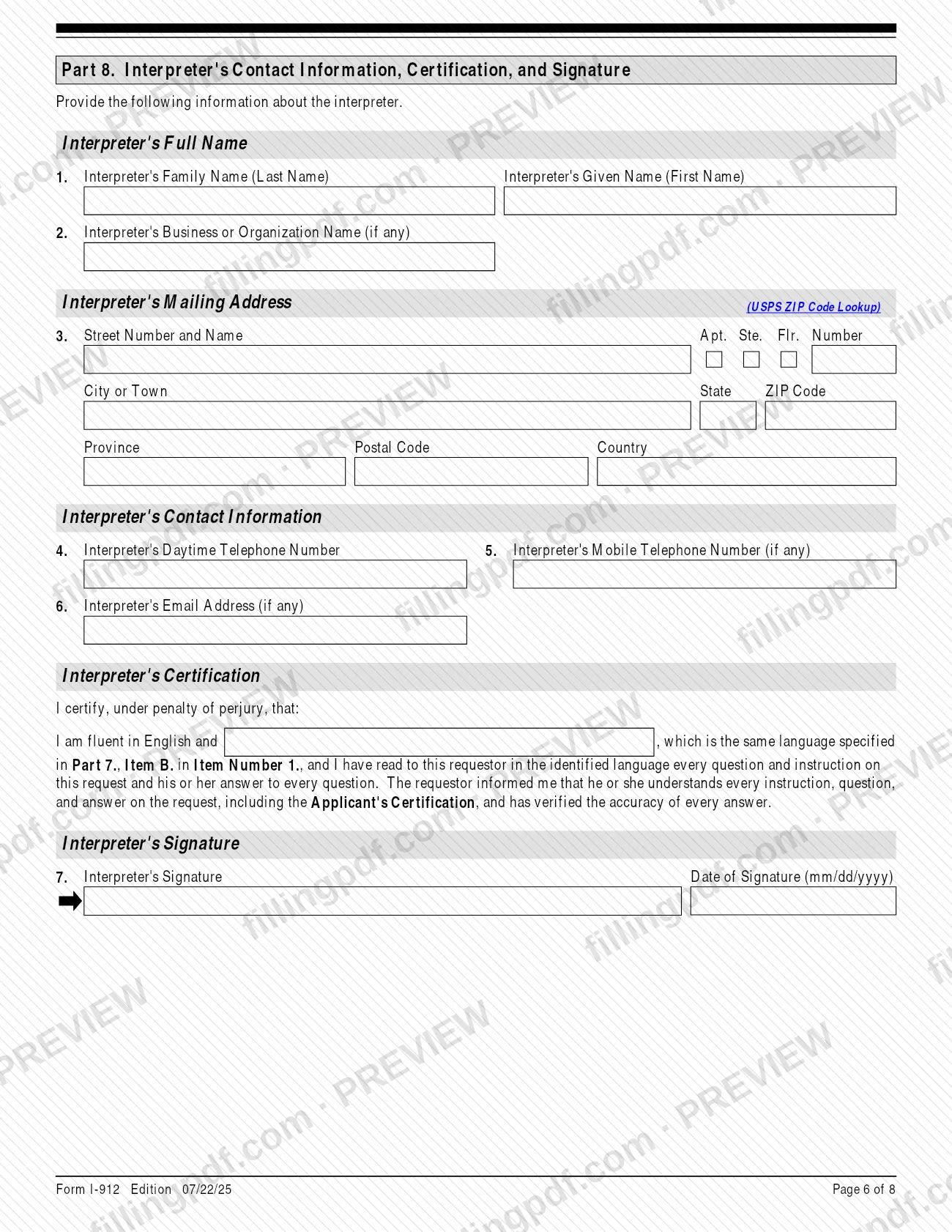
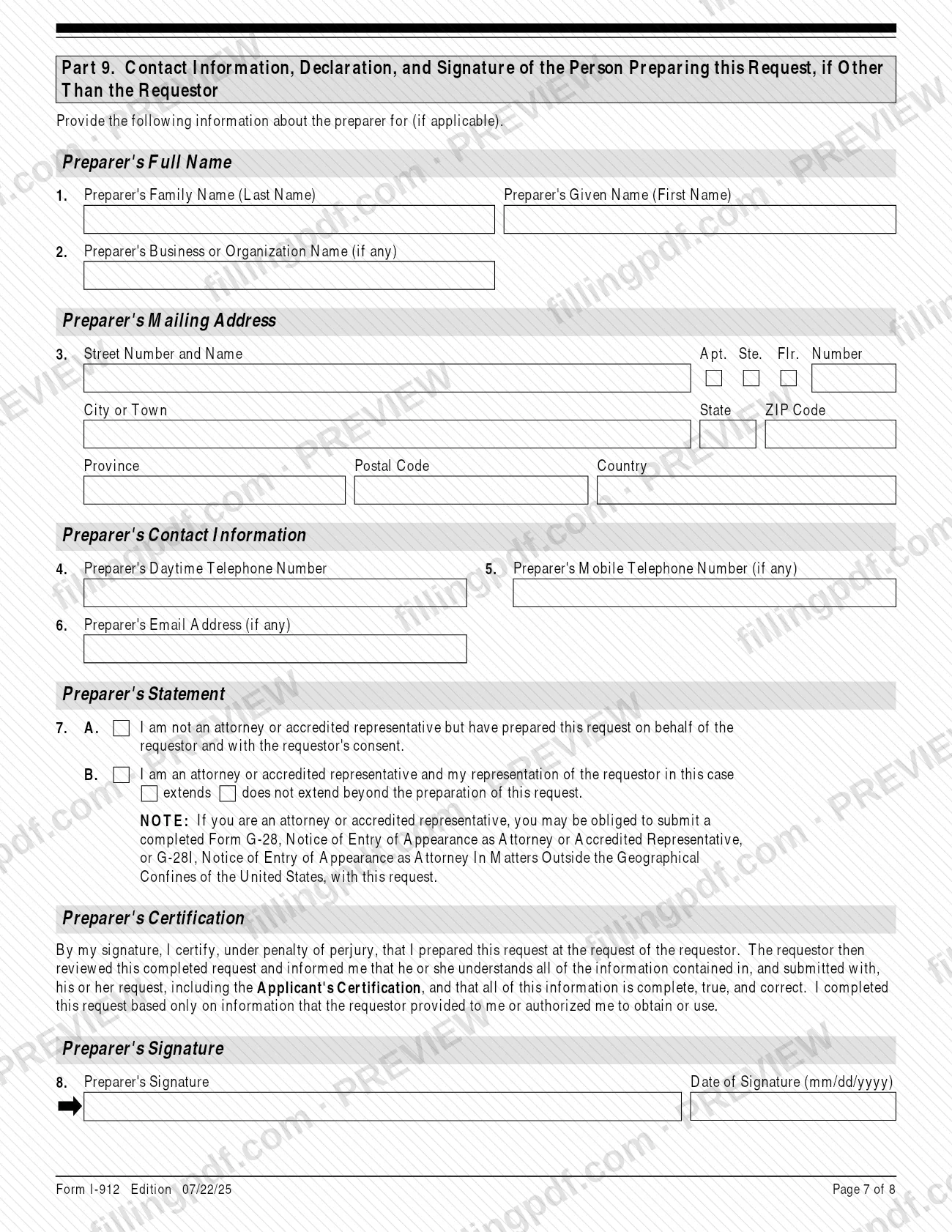
Add interpreter and preparer details
If you used an interpreter, Part 8 asks for their name, address, contact details, signature and date. If someone other than you prepared the form, Part 9 asks for the same, plus whether the preparer is an attorney or accredited representative.
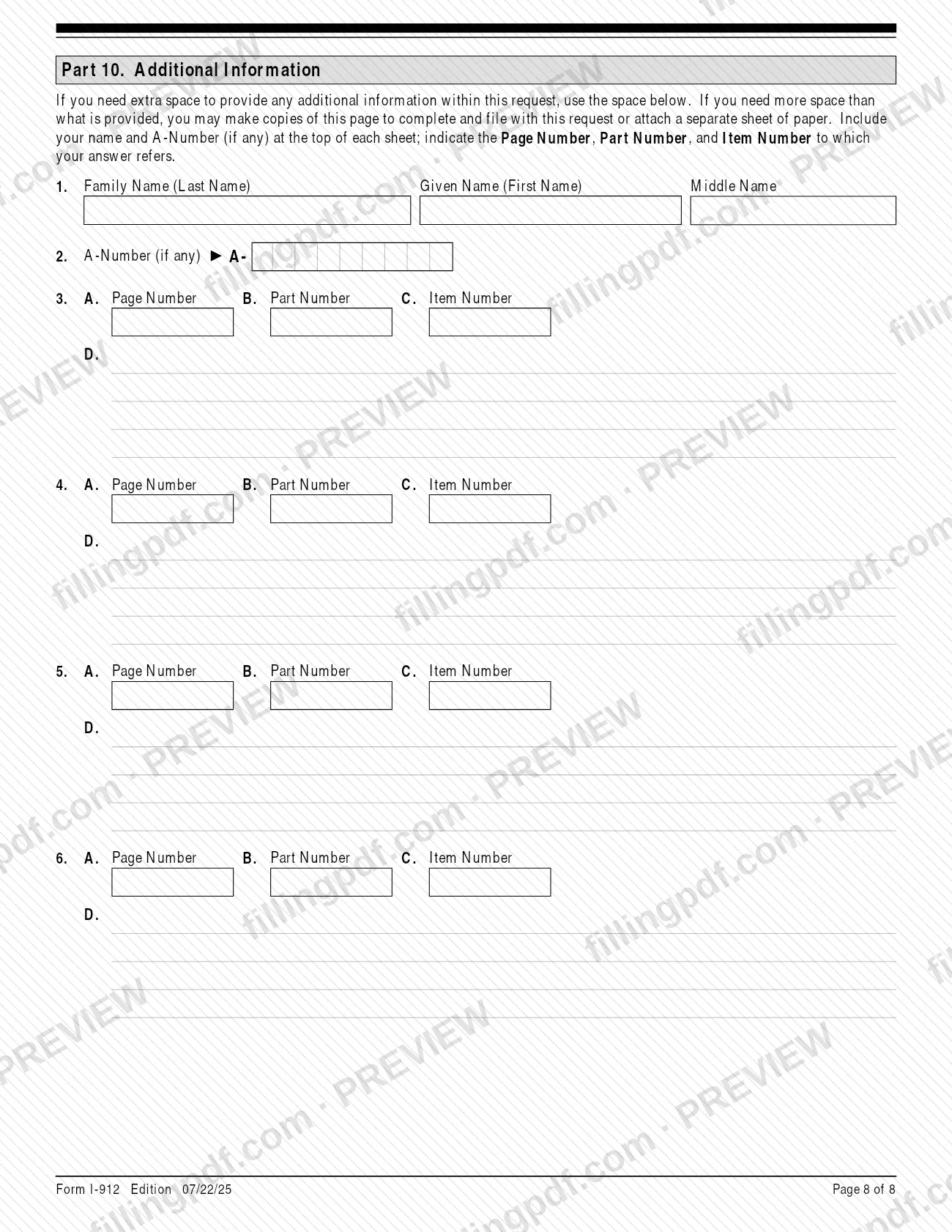
Use Part 10 for extra space
Enter your name and A-Number, then the page, part and item number for each added answer. If you need more room, attach a sheet with your name, A-Number and the same references, signed and dated.
Review, sign and download the PDF
Check that every item that applies is answered, that documents match the basis you selected and that all signatures are handwritten. Download or print the completed PDF from FillingPDF, sign it in ink, and attach it to your application as described under How to submit.
How to submit I-912
You submit Form I-912 together with the application or petition it supports, by mail or, for certain eligible forms, through your USCIS online account.
- By mail: attach Form I-912 and all supporting documents to the application or petition and mail the package to the address in the Where to File section of that form's instructions. For example, a Form N-400 fee waiver goes with Form N-400 to the address in the Form N-400 instructions. Do not mail Form I-912 to the Paperwork Reduction Act address in its instructions.
- Online: for certain eligible forms, you can upload a completed PDF of Form I-912 with the completed form, using your USCIS online account.
Do not send Form I-912 alone or after USCIS has received your application. If you print the completed form, make sure the edition date and page numbers show at the bottom of every page and that all pages come from the same edition; otherwise USCIS may reject it. For forms covered by H.R.-1, send separate payment of the non-waivable fee. For fee amounts, see Form G-1055; for questions, call the USCIS Contact Center at 800-375-5283 (TTY 800-767-1833). FillingPDF lets you fill out and download the PDF; submission follows the USCIS channels above.
Common mistakes to avoid
- Filing Form I-912 after USCIS has already received the application or petition it is meant to support; the waiver request cannot be added later.
- Submitting the form without a signature, or with a stamped or typewritten name; USCIS rejects unsigned requests.
- Requesting a waiver for a form that is not on the eligible list, or for DACA, which has no fee waivers.
- Selecting a basis in Part 1 without attaching documentation for that basis; each basis you want considered needs its own proof.
- Using a Medicare, unemployment, Social Security retirement, SSDI, RSDI or student aid benefit as a means-tested benefit; the instructions say these do not count.
- Using a parent's means-tested benefit at age 21 or older when you are not disabled with that parent as legal guardian.
- Counting an abuser or trafficker as a household member or including their income, when you are applying based on VAWA, T or U status.
- Assuming a fee waiver covers fees required by Pub. L. 119-21; those cannot be waived and must be paid separately.
- Mailing Form I-912 to the Paperwork Reduction Act address instead of the address in the underlying form's instructions.
- Leaving items blank instead of entering "N/A" or "None" where they do not apply.
Frequently asked questions
What is Form I-912 used for?
Form I-912 is the USCIS request for a fee waiver. You use it to ask USCIS to waive the filing fee or biometric services fee for an eligible application or petition when you cannot pay, by showing a means-tested benefit, low income or a financial hardship.
Who qualifies for a fee waiver with Form I-912?
You qualify on one basis: you, your spouse or head of household receive a means-tested benefit; household income is at or below 150 percent of the Federal Poverty Guidelines; or you have a financial hardship. The form you are filing must also be eligible for a waiver.
Can I fill out Form I-912 online?
You can fill out the PDF online on FillingPDF and download or print it. FillingPDF is independent, is not affiliated with USCIS and does not file the request; you submit it with your application by mail or, for certain forms, through your USCIS online account.
Where do I send Form I-912?
Send it with the application or petition it supports, to the address in the Where to File section of that form's instructions. For a Form N-400 waiver, that is the address in the Form N-400 instructions. Certain eligible forms can instead be uploaded through your USCIS online account.
Can I submit Form I-912 after I file my application?
No. USCIS says you cannot submit Form I-912 after it has received the application or petition you want waived, and you should not submit it without a completed application or petition. File both together.
What counts as a means-tested benefit on Form I-912?
A public benefit whose eligibility or amount depends on income and resources, such as Medicaid, SNAP, TANF or SSI. Medicare, unemployment benefits, Social Security retirement, SSDI, RSDI and student financial aid do not count.
Can I get a fee waiver for DACA?
No. You may not file Form I-912 when requesting consideration for DACA, because there are no fee waivers for DACA. USCIS offers fee exemptions only in limited circumstances, described on its DACA fee exemption page.
Does Form I-912 waive every fee?
No. USCIS cannot waive fees required by Pub. L. 119-21, 139 Stat. 72 (H.R.-1). For forms covered by that law you may still request a waiver of the separate DHS fee, but you must pay the non-waivable fee separately.
Who signs Form I-912 for a child?
If the person in Part 2 is under 14, a parent or legal guardian may sign for them; a legal guardian may also sign for a mentally incompetent person. A stamped or typewritten name is not accepted, and USCIS rejects unsigned requests.
Ready to fill out I-912?
Fill out I-912 now